
1. INTRODUCTION
The creation of sustainable urban settlements is an attempt to operationalize the theory of sustainable development in architecture. The first attempts dated back to the 1960s and were initiated by eco-enthusiasts who were ready to turn back from consumerism and accept some inconveniences to save the planet. Gradually, with the rise of social awareness about the ecological problems the international and national policies were introduced. To verify the effectiveness of sustainable development various standards for certification were proposed. The most famous is Leadership in Energy and Environment Design (LEED), Building Research Establishment Assessment Method (BREEAM), Haute Qualité Environnementale (HQE®) and Deutsche Gesellschaft für Nachhaltiges Bauen (DGNB) systems, which have separate modules for the assessment of neighborhoods, i.e. LEED FOR NEIGHBOURHOOD DEVELOPMENT, BREEAM (for) COMMUNITIES, HQE AménagementTM, or DGBN Urban Districts (DGNB NSQ). There are also certification systems developed by private foundations, such as One Planet Living®, or national systems, such as the French Government’s ÉcoQuartier® program [1]. Those rating standards define a set of criteria and a rating system to score them. There are researchers who are enthusiast of those standards and believe that applying certification systems to control the performed activities would guarantee sustainable development achievements [2]. On the other hand there are researchers who think that it is not possible to develop one standard that would promote a truly sustainable neighbourhood. Each of them has some deficiences in assessment of social, economical and political aspects [3, 4, 5].
The development of sustainable urban settlements – eco-neighborhoods requires the introduction of specific means concerning ecological, economical, and societal aspects of design and functioning. The recognized gap in knowledge concerns the development of health-promoting places within eco-neighborhoods [6]. The concept of therapeutic landscapes was coined by Wilbert Gesler who defined them as places where “physical and built environments, social conditions and human perceptions combine to produce an atmosphere which is conducive to healing” [7, 8]. The therapeutic landscapes are well-known for their salutogenic effects and miraculous healings, like Lourdes in France or Epidaurus in Greece. The health-promoting places are “everyday places which unite the qualities of therapeutic landscapes to influence people physical, mental, and spiritual healing” [9]. The research question was is it possible to unite the qualities of therapeutic landscapes in everyday public open space of modern eco-neighborhoods? In this study ZAC Boucicaut and ZAC Frequel-Fontarabe, two small certified eco-neighborhoods in Paris are presented and assessed with the universal standard for health-promoting places. These operations received the French national ÉcoQuartier certificate. Eco-neighborhood design is the application in the process of integrated design of the synergic triad: economy, ecology, and society which could serve as a matrix to describe the qualities of that neighborhoods [10].
2. ZAC BOUCIACUT
The operation has an area of approximately 3 hectares in the 15th arrondissement of Paris. It was limited to former 19th-century Boucicaut hospital, which originally contained small pavilions surrounded by gardens. There were numerous additions and renovations during the century which partially destroyed the original tissue, therefore only three pavilions and the chapel of the former hospital, as well as trees planted at the end of the 19th century, were chosen to be preserved (Fig. 1, 3, 5, 7, 9).
2.1. Ecology
Operation Boucicaut was designated by the City of Paris to promote and educate about biodiversity. Thus, a careful study was made to define the priority species. Nesting boxes for insects, birds, and bats, passages for microfauna, and beehives have been proposed. The project restores high-quality green spaces to join the network of the green infrastructure of surrounding green spaces (Park André Citroën, Square Duranton) through a network of green, tree-lined avenues. Historical trees – chestnut trees, plane trees, and cedar – have been preserved. [11, 12]
The limit of maximum daily consumption of drinking water was set at 80 l /inhabitant/ day. To achieve this goal some hydro-saving devices were installed. In addition, some buildings are equipped with rainwater storage tanks in the ground or the basement, which are used to irrigate outdoor spaces and to supply sanitary facilities in a dual water circuit.
A comprehensive rainwater management system has been introduced in the district, both in public spaces and on individual plots. The central square has a permeable surface that allows the natural infiltration of rainwater. Infiltration basins and rain gardens were also constructed at the edges of streets and on some individual plots. Green roofs have been installed on some buildings.
2.2. Economy
The revenues from the sale of public land finance the project and enable investment in innovative solutions (e.g. micro-retention, recycling), which would reduce future operating costs. The project was designed to limit its environmental impact not only in the context of demolition and construction works but also in the costs of use and maintenance. A global cost processual approach was used, with an extensive introductory phase and an iterative approach to solving design problems. From the very beginning, the cooperation of all stakeholders and the extensive project team, as well as public participation, were important. The environmental quality of the project is continuously monitored and assessed in “annual reviews” which is part of the EcoQuartier certification process. The actual energy consumption of new buildings in ZAC Boucicaut is expected to be less than 50 kWhEP/m²/year and less than 80 kWhEP/m²/year for renovated buildings. This is an even more ambitious goal than required by the Paris City’s Climate and Energy Territorial Plan (Plan Climat), the aim of which is to reduce operating costs for tenants, but also to minimize the impact in terms of gas emissions [11–17].
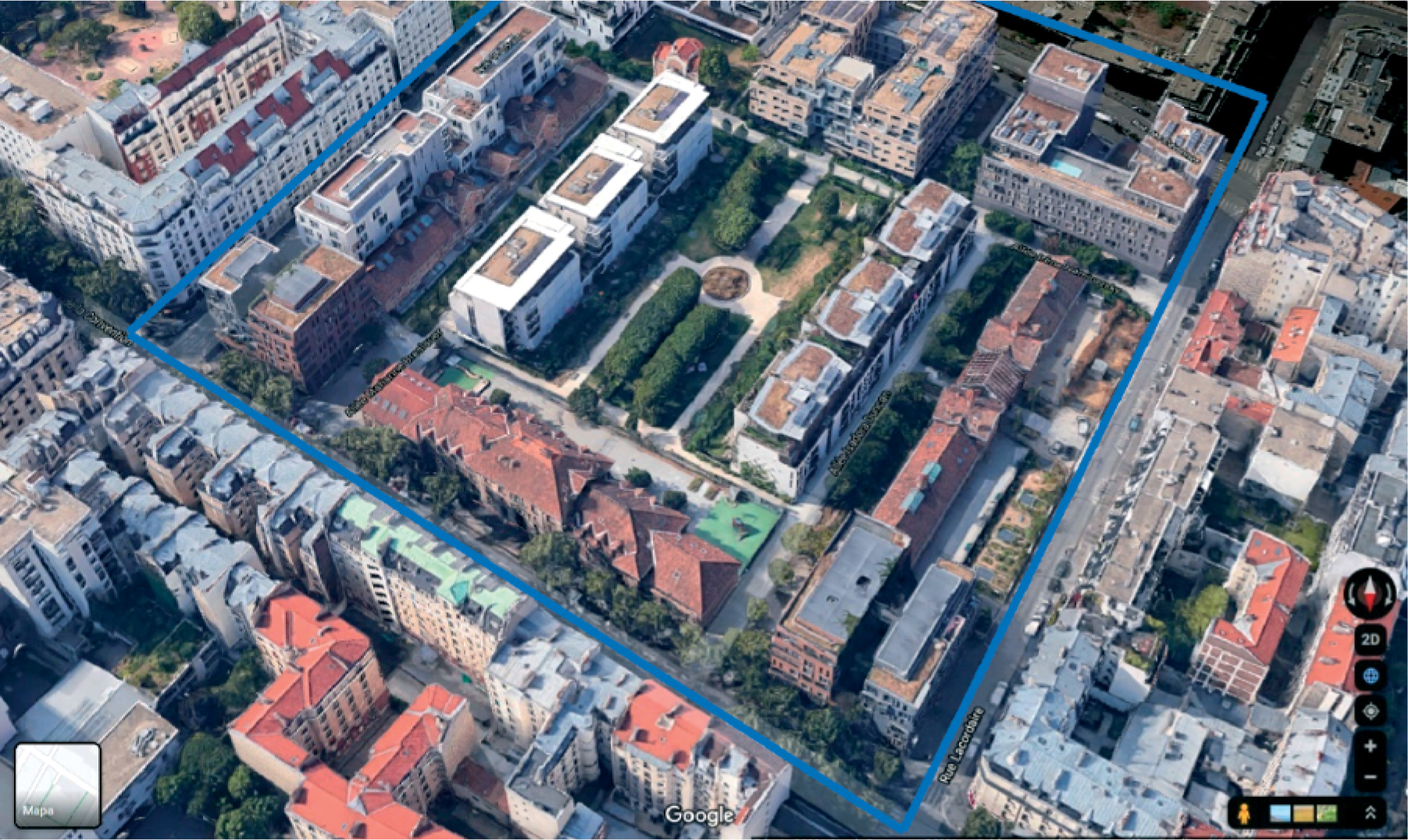
Figure 1.
A bird’s eye view of ZAC Boucicaut, source: author using Google Maps [18]
2.3. Society
In ZAC Boucicaut, an interesting method for social integration through economic activity was proposed. The contractors were asked to include a social inclusion clause in construction contracts: 6% of hours were to be offered to employ staff returning to work after a long break (long-term unemployed). In this way, project ZAC Boucicaut made it possible for several people, initially employed based on an ’integration’ contract, to return to the workforce and sign permanent employment contracts. The city authorities also assumed that opening new companies, and especially setting up innovative companies, would contribute to the improvement of the district. Therefore, the rental prices in ZAC Boucicaut were set lower than in the Paris market, some premises are shared (especially conference rooms). Additional services offered by the coordinator (legal assistance, etc.) are also offered.
The district is completely pedestrianized and benefits from a highly developed public transport network (bus, metro, tram). Bicycle (Vélib) and car-sharing (Autolib) stations are also in the immediate vicinity. Stops and stations are located less than 300 m away. Additionally, the pedestrian connections have been designed in such a way as to ensure safe access to public transport stops. Therefore, it is common to use public transport. There is no parking on the ground, but each building has an underground garage with charging stations for electric vehicles. Moreover, bicycle rooms are provided in all buildings. All buildings and public spaces are accessible to people with reduced mobility.
2.4. Quality of life and health of the inhabitants
It was important for the designers to create a friendly place to live. Efforts were made to implement high architectural and urban quality and to reconcile high building density with the quality of life. New green areas were created and public spaces were interconnected to promote active recreation. Plant species, selected for their low allergenic potential, are planted in public spaces. Noise exposure has been optimized by placing shops and social infrastructure points on the noisiest facades to favor the location of flats on quieter facades.
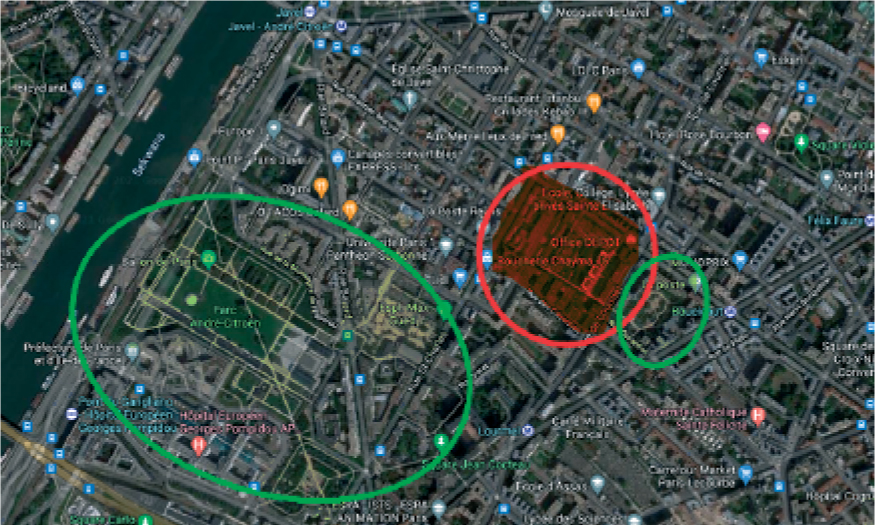
Figure 2.
Map of ZAC Boucicaut shows close walking distance to public parks: Square Duranton – approx. 4 min, and Park André Citroën – approx. 12 min, source: author using Google Maps[18]
3. ZAC FREQUEL FONTARABE
This project for approx. 1 hectare is located in the 20th arrondissement of Paris, which although picturesque required deep revitalization. This urban renewal project concentrated on the eviction of structures constructed with unhealthy building materials and the promotion of the well-being of inhabitants. The other challenge was to resolve the circulation problems and create a continuous network of walkable and enjoyable public spaces. New buildings were constructed to fill the gaps between the historic ones. The new urban form was developed to blend with surrounding urban tissue, which required numerous studies concentrating on volume and proportions [19].
In terms of ecology, economy, society, and health promotion, ZAC Frequel-Fontarabe and ZAC Boucicat offered similar approaches, also because of the label EcoQuartier which favors sustainable solutions and processual integrated design (Fig. 2, 4, 6, 8, 10).
3.1. Ecology
Jardin de Vitaly was created in the center of a new eco-neighborhood to sew the new construction with preserved, historic buildings. The deciduous trees were chosen to allow the sunshine to penetrate in the winter and protect from overheating in the summer. Non-allergenic, sturdy, minimal maintenance plants were chosen. The porous pavement was chosen to permit the infiltration of rainwater.
3.2. Economy
Similar to ZAC Boucicaut, the processual approach was used, with an extensive introductory phase and an iterative approach to solving design problems. The cooperation of all stakeholders and public participation was important. The actual energy consumption of new buildings is expected to be less than 50 kWhEP/m²/year and less than 80 kWhEP/m²/ year for renovated buildings. Both new and renovated buildings should meet the requirements of passive buildings [20, 21].
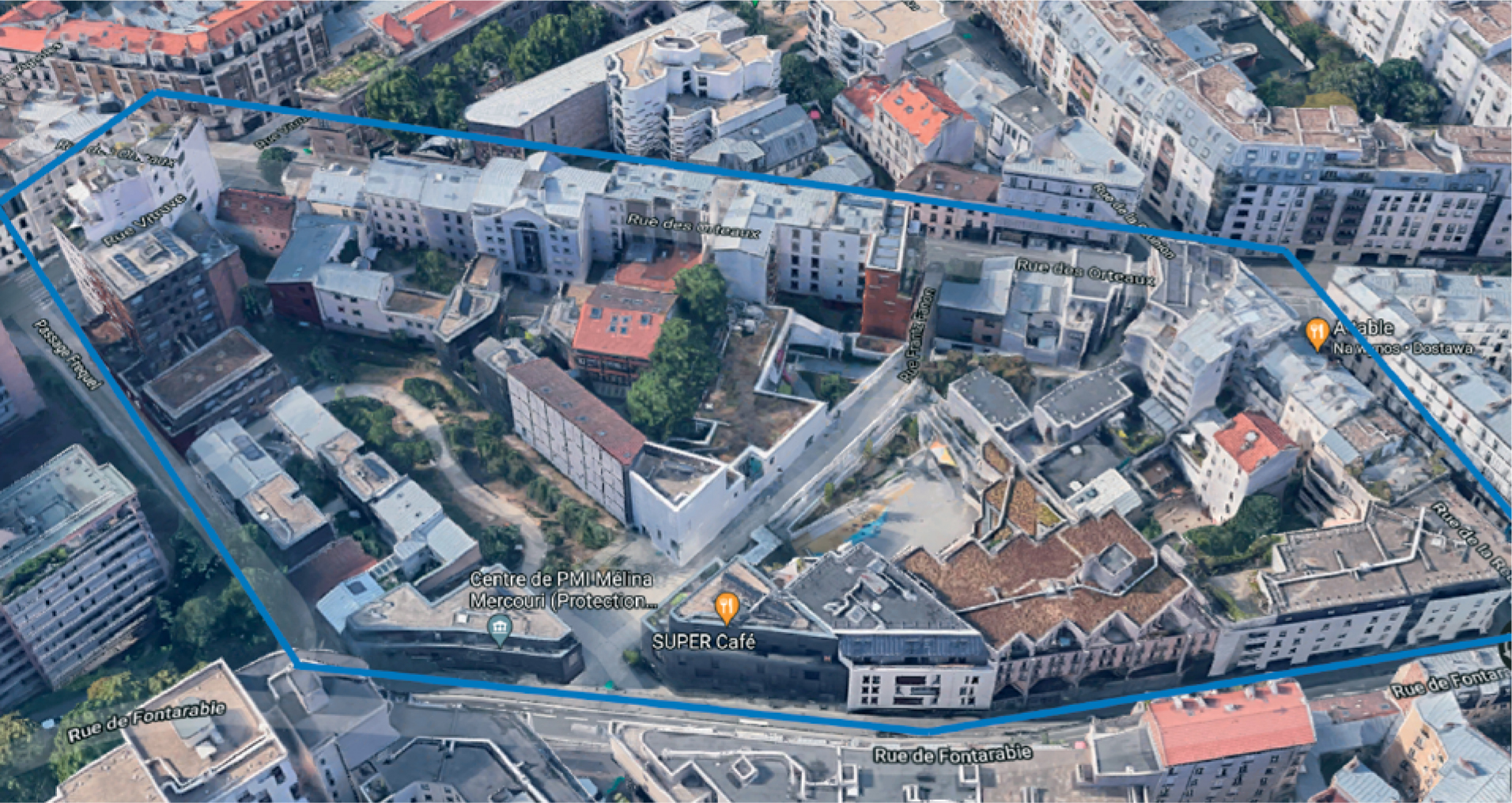
Figure 3.
A bird’s eye view of ZAC Frequel-Fontarabe, source: author using Google Maps [22]
3.3. Society
One of the challenges was to improve the image of the district. The beautification and creation of friendly public spaces proved to be helpful. The much-needed amenities like a local medical center and kindergarten were built. Many existing buildings, as well as local schools, were renewed. One of the major obstacles was to create a continuous grid of walkable streets and passages. Today, the neighborhood, as much as ZAC Boucicaut, is completely pedestrianized and has a highly developed public transport network (bus, metro, tram), as well – bicycle (Vélib) and car-sharing (Autolib) stations. All stops are located within 300 m distance. All buildings and public spaces are accessible. Similarly to ZAC Boucicaut, the pedestrian connections have been designed in such a way as to ensure safe access to public transport stops
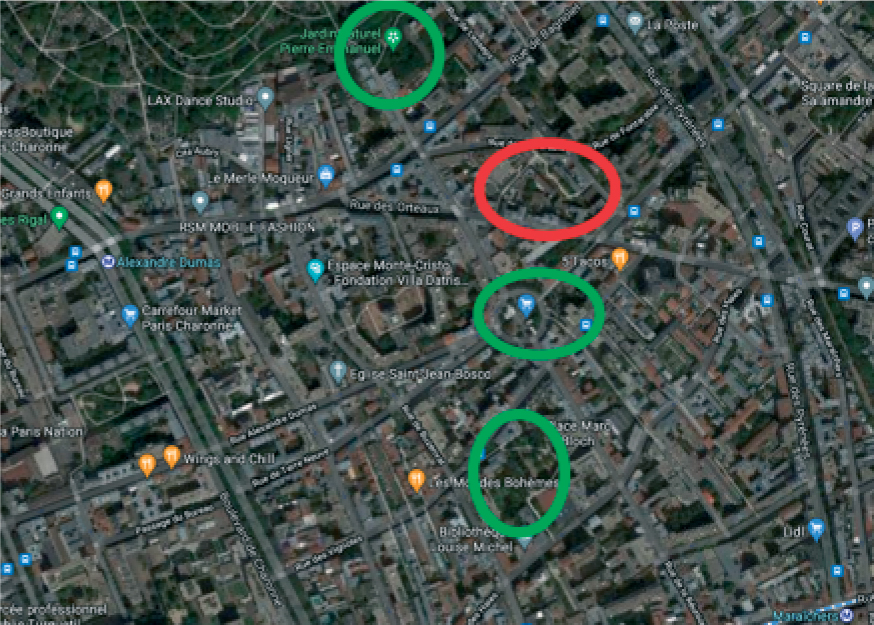
Figure 4.
Map of ZAC Frequel-Fontarabe. Walking distance to pocket parks: both Rue Vitruve and Jardin naturel Pierre-Emanuel is approx. 4 min, and to Jardin Casque d’Or les Haies is approx. 6 min, source: author using Google Maps [22]
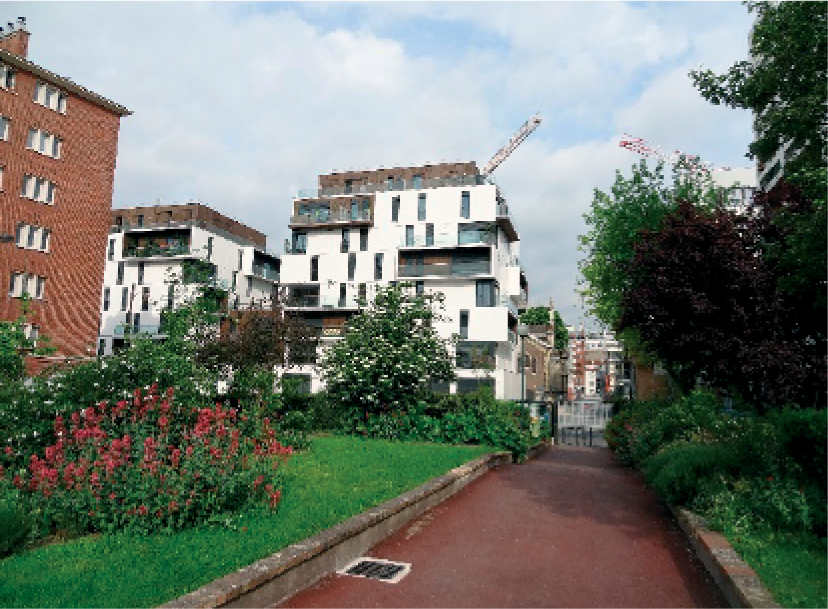
Figure 5.
ZAC Boucicaut, Paris. Open green space. Source: author
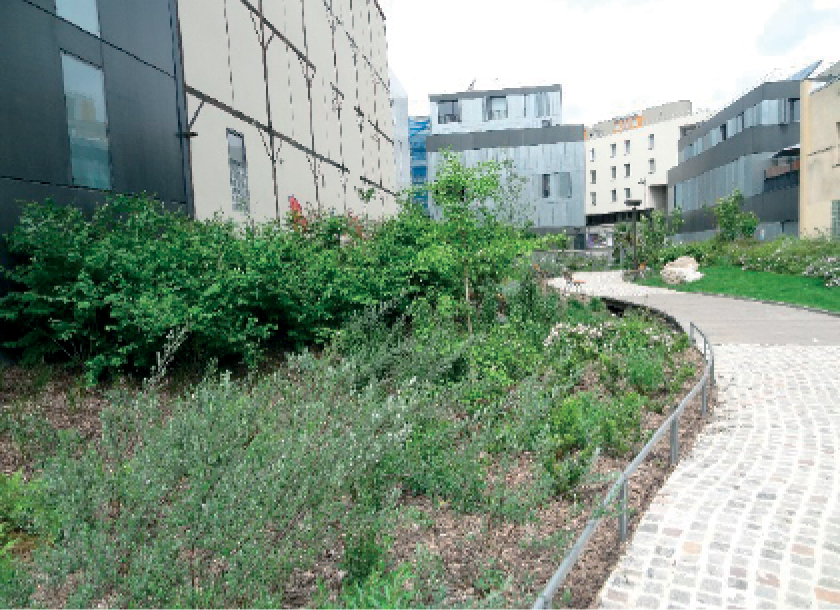
Figure 6.
ZAC Frequel Fontarabe, Jardin de Vitaly, Source: author
3.4. Quality of life and health of the inhabitants
Building materials were carefully chosen, not to allow and noive products. Whenever possible renewable materials were specified, especially wood. The kindergarten was located away from the road to eliminate the noise nuisance. Centrally located Jardin de Vitaly was created as a green oasis between the older buildings and new constructions. The eco-neighborhood was designed to become a friendly place for living.
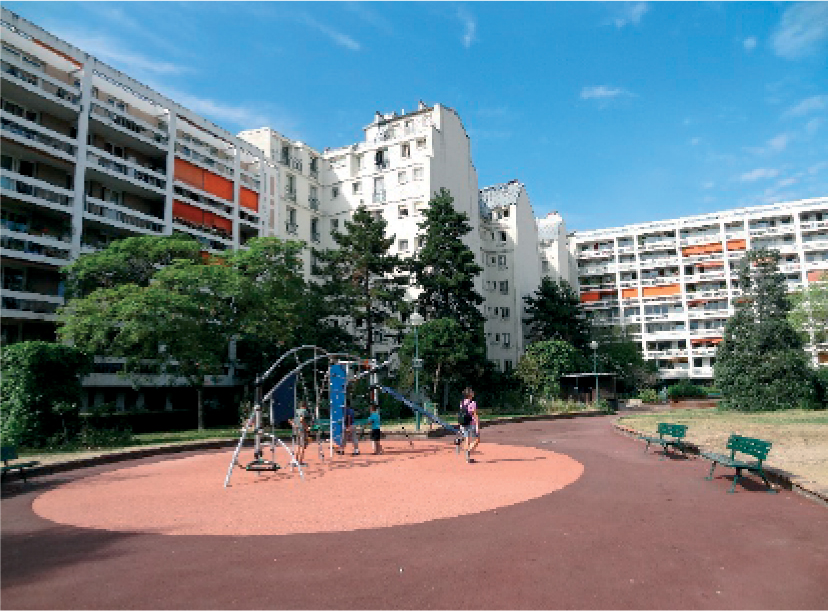
Figure. 7.
Square Duranton, adjacent to ZAC Boucicaut, Paris. Source: author
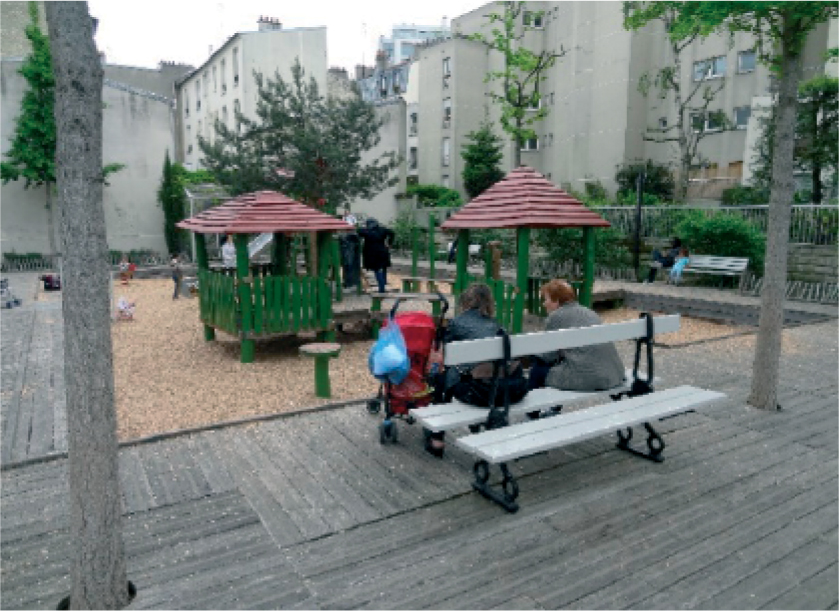
Figure. 8.
ZAC Frequel Fontarabe vicinities, Rue Vitruve, Source: author
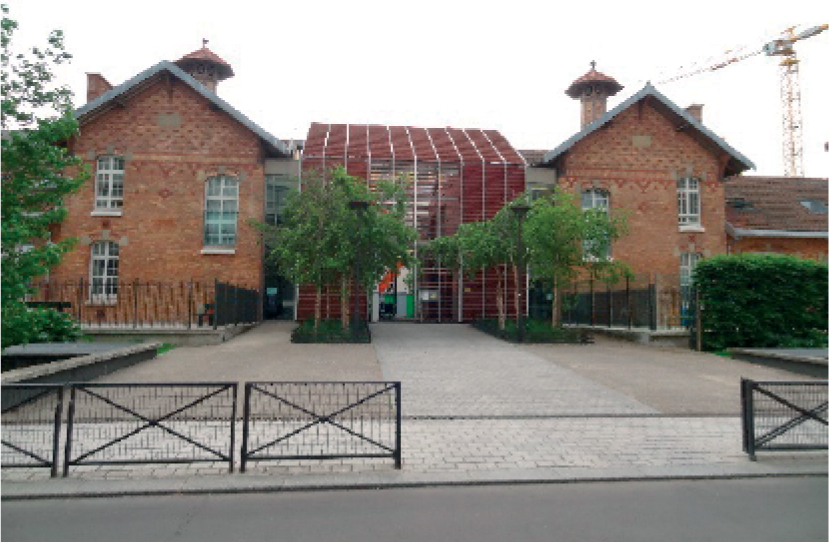
Figure. 9.
ZAC Boucicaut, Paris. Regeneration of former hospital buildings. Source: author
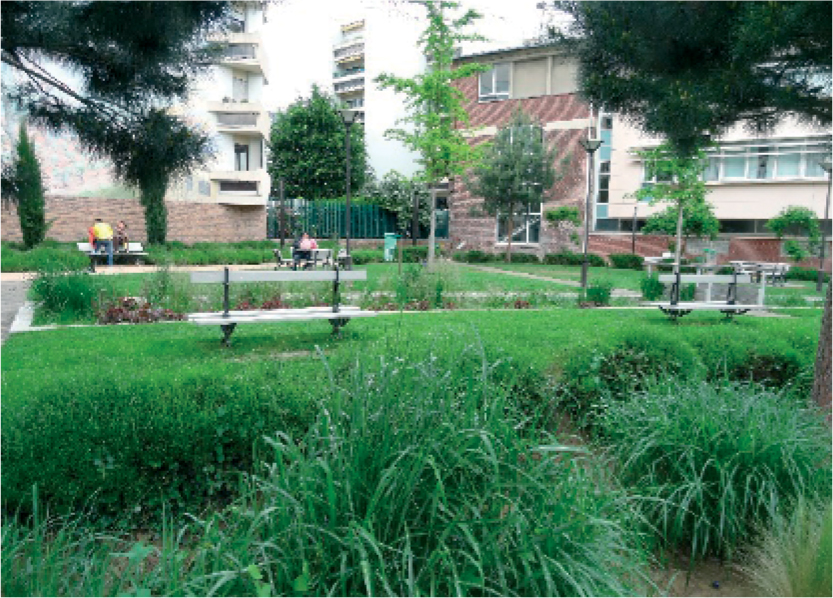
Figure. 10.
ZAC Frequel Fontarabe vicinities, Square de la Reunion, Source: author
4. MATERIALS AND METHODS
Both of the studied eco-neighborhood complied with standards of EcoQuartier certification. When visited they seemed a very friendly place to live. That observation led to the research question: is it possible to unite the qualities of therapeutic landscapes in everyday public open spaces of modern eco-neighborhoods? To provide answers the neighborhood public spaces were assessed with the universal standard for health-promoting places.
The first draft of the conceptual framework for therapeutic parks and gardens was proposed by the author in 2016 and continually developed to serve as a tool to evaluate health-promoting qualities of urban places (Table 1) [23, 24 with further additions]. This tool can be used both for rough binary evaluation and detailed studies.
Table 1.
A universal standard for health-promoting urban places. Source: author [23, 24 with further additions]
| 1. SUSTAINABILITY | 2. ACCESSIBILITY | 3. AMENITIES | 4. DESIGN | 5. PLACEMAKING |
|---|---|---|---|---|
| 1.1 Place Area Location Surrounding urban pattern 1. 2 Environmental characteristics Soil quality Water quality Air quality Noise level Forms of natural protection Green Infrastructure 1.3 Biodiversity protection Parts of open green space not available to visitors Native plants Native animals Natural maintenance methods 1.4 Sustainable water management Rainwater infiltration Irrigation with non-potable water 1.5 Parks of Second (New) Generation 1.6 Urban metabolism 1.7 Ecological energy sources | 2.1 Distance to park 2.2 Sidewalk Infrastructure-Width of sidewalk Evenness of surface Lack of obstructions Slope Sufficient drainage 2.3 General conditions of walkways Maintenance Overall aesthetics Street art Sufficient seating Perceived safety Buffering from traffic Street activities Vacant lots 2.4 Traffic Speed Volume Number and safety of crossings Stop signs On-street parking 2.5 User Experience Air quality Noise level Sufficient lighting Sunshine and shade Visibility of nearby building 2.6 Public transport stops 2.7 Sufficient Parking | 3.1. Psychological and physical regeneration Natural Landscapes Green open space Presence of water Places to rest in the sun shade Places to rest in quiet and solitude 3.2. Promotion of Physical Activities Sports and recreational infrastructure Community gardens Addressing the needs of people with disabilities 3.3. Catering for basic needs Safety and security (presence of guards, cleanliness, maintenance, etc.) Places to sit and rest Shelter Restrooms Drinking water Food (possibility to buy food in the park or in the closest vicinities) | 4.1. Architectural design Human scale Focal points and landmarks Structure of interior connections Framed views Long vistas (Extent) Pathways with views Invisible parts of the scenery (Vistas which engage the imagination) Possibility to watch other people Possibility to see wildlife 4.2. Salutogenic design Optimal levels of complexity Architectural Variety Engaging features Risk Mystery/Fascination Movement 4.3. Sensory stimuli design Sensory stimuli: Sight Sensory stimuli: Hearing Sensory stimuli: Smell Sensory stimuli: Touch Sensory stimuli: Taste Sensory path | 5.1 Enhancement of Social Contacts Organization of events Meeting places for groups 5.2 Human perception - spiritual & symbolic Sacred places Works of Art Monuments Culture and connections to the past Thematic gardens Personalization 5.3 Community Engagement Personalising the architectural process Participation of all stakeholders, including inhabitants and users Determining the rules of conduct and self-man-agement Space for social contact
|
In this study both eco-neighbourhoods were treated as potential large health-promoting places with universally accessible public open green spaces, public parks, and gardens within walking distance.
That space was assessed using the universal standard (Table 1). Both a binary and a detailed assessment were performed.
The binary assessment has 3 categories (0; 1; and 0.5): No, not observed - 0; Yes, satisfactory - 1 Yes, but only partially - 0.5
The addition of category 0.5 to binary assessment was proposed by Izabela Krzeptowska-Moszkowicz, Łukasz Moszkowicz and Karolina Porada [25].
The detailed assessment required a written explanation of why the researcher thought that the attribute was present. The more information is provided during the detailed assessment phase, the better. It is advisable to avoid only yes or no answers in a detailed assessment. For better clarity, the results of the assessment were grouped into five tables representing five sections of the universal standard (Tables 2–6).
Table 2.
Assessment of ZAC Boucicaut and ZAC Frequel-Fontarabe – part 1, source: author
| Table 2. ZAC BOUCICAUT, 2010-2016 | ZAC FREQUEL FONTARABE | POINTS | POINTS | |
|---|---|---|---|---|
| 1. SUSTAINABILITY | 14/14 | 14/14 | ||
| 1.1 Place | -/- | |||
| Area | 3ha | 1ha | ||
| Location | XV Arronds. Paris | XVIII Arronds. Paris | ||
| Surrounding urban pattern | High density urban tissue, large scale residential districts | High density urban tissue | ||
| 1. 2 Environmental characteristics | ||||
| Soil quality | Sufficient for recreational use. No visible traces of pollution | Sufficient for recreational use. No visible traces of pollution | 1 | 1 |
| Water quality | N/A | N/A | - | - |
| Air quality | Good [26], presence of mature deciduous trees is important for purifying air pollution | Good [27], presence of mature deciduous trees is important for purifying air pollution | 1 | 1 |
| Noise level | Low to moderate noise level in areas close to traffic routes | Low to moderate noise level in areas close to traffic routes | 1 | 1 |
| Forms of natural protection | No specific legal protection of nature | No specific legal protection of nature | 1 | 1 |
| Green Infrastructure | Important part of the green infrastructure. | Important part of the green infrastructure | 1 | 1 |
| 1.3 Biodiversity protection | ||||
| Parts of open green space not available to visitors | Small secluded areas fenced for bio-diversity protection. | Small secluded areas fenced for biodiversity protection. | 1 | 1 |
| Native plants | Planting is a combination of native and non-native species | Planting is a combination of native and non-native species | 1 | 1 |
| Native animals | Both native and foreign species were observed | Both native and foreign species were observed | 1 | 1 |
| Natural maintenance methods | Only natural maintenace methods are permited in Paris public parks | Only natural maintenace methods are permited in Paris public parks | 1 | 1 |
| 1.4 Sustainable water management | ||||
| Rainwater infiltration | Porous, permeable surfaces, rain gardens, infiltration basins | Porous, permeable surfaces, rain gardens, infiltration basins | 1 | 1 |
| Irrigation with non-potable water | Both non-potable and potable water is used for irrigation | Both non-potable and potable water is used for irrigation | 1 | 1 |
| 1.5 Parks of Second (New) Generation | ||||
| Yes, many parts can be regarded as park of new generation | Yes, many parts can be regarded as park of new generation. | 1 | 1 | |
| 1.6 Urban metabolism | ||||
| Waste segregation and collection | Waste segregation and collection | 1 | 1 | |
| 1.7 Ecological energy sources | ||||
| Yes, in ZAC Bouciacut ecological energy sources are used | Yes, in ZAC Frequel Fontarabe ecological energy sources are used | 1 | 1 | |
Table 3.
Assessment of ZAC Boucicaut and ZAC Frequel-Fontarabe, Paris – part 2, source: author
| Table 3. ZAC Boucicaut, Paris – part 2 | POINTS | POINTS | ||
|---|---|---|---|---|
| 2. ACCESSIBILITY | 26/26 | 26/26 | ||
| 2.1 Distance to park | ||||
| There is a centrally located small park – reminescece of Hospital Boucicaut gardens. Larger urban parks – Square Duranton and Park André Citroën are within walking distance (15 minutes) | There is a centrally located small pocket park Jardin de Vitaly. Small pocket parks, one localted at the Place de la Reunion (rue Vitruve) and Jardin naturel Pierre-Emanuel and Jardin Casque d’Or les Haies are located within walking distance (15 minutes) | 1 | 1 | |
| 2.2 Sidewalk Infrastructure- | ||||
| Width of sidewalk | Sufficient for walking, pathways are wide and even | Sufficient for walking, some paths are narrow | 1 | 1 |
| Evenness of surface | Comfortable for walking, no obstacles | Comfortable for walking, some streets are cobbled | 1 | 1 |
| Lack of obstructions | Majority of terrain is universally accessible | Majority of terrain is universally accessible. There are some impasses. | 1 | 1 |
| Slope | gentle slope comfortable for walking | gentle to moderate slope | 1 | 1 |
| Sufficient drainage | Sufficient | Sufficient | 1 | 1 |
| 2.3 General conditions of walkways | ||||
| Maintenance | Regularly cleaned | Regularly cleaned | 1 | 1 |
| Overall aesthetics | Comfortable for walking, aestethicaly pleasing | Comfortable for walking, aestethicaly pleasing | 1 | 1 |
| Street art | Yes | Yes, interesting street art | 1 | 1 |
| Sufficient seating | May be perceived as sufficient | May be perceived as sufficient | 1 | 1 |
| Perceived safety | Safe neighbourhood, presence of guards, policeman, etc. | Safe neighbourhood, presence of guards, policeman, etc. | 1 | 1 |
| Buffering from traffic | Sufficient buffering by street greenery, street furniture, etc. | Sufficient buffering by street greenery, street furniture, etc. | 1 | 1 |
| Street activities | Occasionaly organised street activities | Occasionaly organised street activities | 1 | 1 |
| Vacant lots | No vacant lots | No vacant lots | 1 | 1 |
| 2.4 Traffic | ||||
| Speed | Slow traffic, comfortable for pedestrians | Slow traffic, comfortable for pedestrians | 1 | 1 |
| Volume | Comfortable for pedestrians | Comfortable for pedestrians | 1 | 1 |
| Number and safety of crossings | Numerous possibilities for safe crossing of the street | Numerous possibilities for safe crossing of the street | 1 | 1 |
| Stop signs | Yes | Yes | 1 | 1 |
| On-street parking | Yes, on-street parking is permited | Yes, on-street parking is permited | 1 | 1 |
| 2.5 User Experience | ||||
| Air quality | Comfortable, no perceptable nuisance | Comfortable, no perceptable nuisance | 1 | 1 |
| Noise level | Comfortable, moderate urban noise | Comfortable, moderate urban noise | 1 | 1 |
| Sufficient lighting | Yes, the streets are well-lit, public parks are closed after dusk | Yes, the streets are well-lit, public parks are closed after dusk | 1 | 1 |
| Sunshine and shade | User can find places to rest in the sunshine and in the shade | User can find places to rest in the sunshine and in the shade | 1 | 1 |
| Visibility of nearby buildings | Good visibility of nearby buildings | Good visibility of nearby buildings | 1 | 1 |
| 2.6 Public transports stops | ||||
| Within walking distance, comfortable waiting places | Within walking distance, comfortable waiting places | 1 | 1 | |
| 2.7 Sufficient Parking | ||||
| On-street parking for visitors, underground parking for the inhabitants | On-street parking for visitors, underground parking for the inhabitants | 1 | 1 | |
Table 4.
Assessment of ZAC Boucicaut and ZAC Frequel-Fontarabe, Paris – part 3, source: author
| Table 4. ZAC Boucicaut, Paris – part 3 | POINTS | POINTS | ||
|---|---|---|---|---|
| 3. AMENITIES | 14.5/15 | 14.5/15 | ||
| 3.1. Psychological and physical rejuvenation | ||||
| Natural Landscapes | There are small garden rooms which offer a subjective feeling of natural landscape | Jardin naturel -Pierre Emmanuel offers a subjective feeling of natural landscape | 0,5 | 0,5 |
| Green open space | Yes, there are numerous green open spaces in the neighbourhood and its vicinites | Yes, there are numerous green open spaces in the neighbourhood and its vicinites | 1 | 1 |
| Presence of water | Yes, in Park André Citroën there are numerous water works | Yes, in Jardin naturel Pierre Emmanuel | 1 | 1 |
| Places to rest in the sun and shade | Yes, there are numerous benches in the sun and in the shade, movable chairs | Yes, there are numerous benches in the sun and in the shade, movable chairs | 1 | 1 |
| Places to rest in quiet and solitude | Yes, there are numerous benches in popular, as well as more secluded places, movable chairs | Yes, there are numerous benches in popular, as well as more secluded places, movable chairs | 1 | 1 |
| 3.2. Physical Activity Promotion | ||||
| Sports infrastructure | bicycle paths, playgrounds | bicycle paths, playgrounds | 1 | 1 |
| Recreational infrastructure | Recreational infrastructure for all age groups within walking distance | Recreational infrastructure for all age groups within walking distance | 1 | 1 |
| Community gardens | Yes, There is limited space for gardeners within community gardens | Yes, jardin casque d’or les haies received an award for community gardens [28] | 1 | 1 |
| Addressing the needs of people with disabilities | Public space and majority of buildings are accessible | Public space and majority of buildings are accessible | 1 | 1 |
| 3.3. Catering for basic needs | ||||
| Safety and security (presence of guards, cleanliness, maintenance, etc.) | Presence of guards, regularly cleaned | Presence of guards, regularly cleaned | 1 | 1 |
| Places to sit and rest | Comfortable benches, movable chairs | Comfortable benches, movable chairs | 1 | 1 |
| Shelter | garden pavilions in Park André Citroën, restaurants and cafes in the streets connecting the open public green spaces | restaurants and cafes in the streets connecting the open public green spaces | 1 | 1 |
| Restrooms | Yes, there are public toilets | Yes, there are public toilets | 1 | 1 |
| Drinking water | Yes, there are drinking fountains, snack bars, food stands & restaurants | Yes, there are drinking fountains, snack bars, food stands & restaurants | 1 | 1 |
| Food (possibility to buy food in the park or close vicinity) | It is possible to buy food on the way to public parks. There are snack bars, food stands & restaurants | It is possible to buy food on the way to public parks. There are snack bars, food stands & restaurants | 1 | 1 |
Table 5.
Assessment of ZAC Boucicaut and ZAC Frequel-Fontarabe, Paris – part 4, source: author
| Table 5. ZAC Boucicaut, Paris – part 4 | POINTS | |||
|---|---|---|---|---|
| 4. DESIGN | 21/21 | 20/21 | ||
| 4.1. Architectural design | ||||
| Human scale | That is a strong point of ZAC Boucicaut, which was desiged in human scale | desiged in human scale | 1 | 1 |
| Focal points and landmarks | Recognizable landmarks, monuments, sculptures and buildings | Recognizable landmarks, monuments, sculptures and buildings. | 1 | 1 |
| Structure of interior connections | A clear structure of interior connections | A clear structure of interior connections | 1 | 1 |
| Framed views | Natural frames are created by mature trees | Urban design create framed views | 1 | 1 |
| Long vistas (Extent) | Urban composition offers numerous extensive vistas | Urban composition offers numerous extensive vistas | 1 | 1 |
| Pathways with views | There are many paths which offer interesting views | There are many paths which offer interesting views | 1 | 1 |
| Invisible parts of the scenery (Vistas which engage the imagination) | Numerous designed vistas which engage the imagination | Numerous designed vistas which engage the imagination | 1 | 1 |
| Possibility to observe other people | Plenty of places to watch the activities of other people from a distance. | Plenty of places to watch the activities of other people from a distance. | 1 | 1 |
| Possibility to observe animals | Limited possibility to observe animals living in urban environment | Limited possibility to observe animals living in urban environment | 1 | 1 |
| 4.2. Salutogenic design | ||||
| Optimal levels of complexity | Yes, ZAC Boucicaut and its vicinity offer optimal levels of complexity | Yes, ZAC Frequel-Fontarabe and its vicinity offer optimal levels of complexity | 1 | 1 |
| Architectural Variety | Each new building was designed by a different architect | Each new building was designed by a different architect | 1 | 1 |
| Engaging features | There are multiple elements which attract attention | There are multiple elements which attract attention | 1 | 1 |
| Controlled Risk | Sensory paths in Park André Citroën | Wooden paths in Jardin de Vitaly and other parks | 1 | 1 |
| Mystery/Fascination | Presence of historic monuments can be fascinating | Presence of street art, historic street names, etc. can be fascinating | 1 | 1 |
| Movement | Foliage of plants in the wind, waterworks in Park André Citroën | Foliage of plants in the wind, water in Jardin Naturel | 1 | 1 |
| 4.3. Sensory stimuli design | ||||
| Sensory stimuli: Sight | compositions of colourful plants which are offering seasonal interests, colourful street furniture | compositions of colourful plants which are offering seasonal interests, colourful street furniture | 1 | 1 |
| Sensory stimuli: Hearing | sounds of waterworks in Park André Citroën, sounds of birds and animals living in the urban environment, sounds of plants shimmering in the wind | sounds of birds and animals living in the urban environment, sounds of plants shimmering in the wind | 1 | 1 |
| Sensory stimuli: Smell | Scent of plants: flowers, leaves, etc. | Scent of plants: flowers, leaves, etc. | 1 | 1 |
| Sensory stimuli: Touch | Various textures of plants, water-works in Park André Citroën | Various textures of plants | 1 | 1 |
| Sensory stimuli: Taste | Food and drinks, which can be bought in restaurants, cafes, food stands, etc. | Food and drinks, which can be bought in restaurants, cafes, food stands, etc. | 1 | 1 |
| Sensory path | Yes – in Park André Citroën | No | 1 | 0 |
Table 6.
Assessment of ZAC Boucicaut and ZAC Frequel-Fontarabe, Paris – part 5, source: author
| Table 6. ZAC Boucicaut, Paris – part 5 | POINTS | |||
|---|---|---|---|---|
| 5. PLACEMAKING | 13/13 | 13/13 | ||
| 5.1 Social Contact Enhancement | ||||
| Organization of events | Multiple events, sport challenges, etc. are organised. Public parks offer possibilities to organise events. | Multiple events are organised. | 1 | 1 |
| Meeting places for groups | Yes, especialy in Park André Citroën, but also within ZAC Boucicaut there are numerous places where groups can meet. | Limited places for group meetings in open public space, public infrastructure offers indoor meeting places | 1 | 1 |
| 5.2 Human perception - spiritual & symbolic | ||||
| Sacred places | Nearby churches and religious centers | Nearby churches and religious centers | 1 | 1 |
| Works of Art | Yes, there are some sculptures and works of art located in public open space | Yes, there are some sculptures and works of art located in public open space | 1 | 1 |
| Monuments | Yes, the remaining historic buildings of Hospital Boucicaut which were preserved in unchanged form | the remaining historic buildings were preserved | 1 | 1 |
| Culture and connections to the past | Yes, historic buildings, preserved old trees, historic street names | Yes, historic buildings, historic street names | 1 | 1 |
| Thematic gardens | Yes, there are numerous thematic gardens in Park André Citroën | Yes, Jardin naturel | 1 | 1 |
| Personalization | Limited possibility of personalisation, only within the community gardens | Limited possibility of personalisation, only within the community gardens | 1 | 1 |
| 5.3 Community Engagement | ||||
| Personalising the architectural process | Yes, there were meetings and workshops organised for all stakeholders | Yes, there were meetings and workshops organised for all stakeholders | 1 | 1 |
| Participation of all stakeholders, including inhabitants and users | Yes, ZAC Boucicaut was designed using the Integrated Design Process, all stakeholders participated | Yes, ZAC was designed using the Integrated Design Process, all stakeholders participated | 1 | 1 |
| Determining the rules of conduct and self-management | Yes, the rules of conduct were determined during meetings of all stakeholders | Yes, the rules of conduct were determined during meetings of all stakeholders | 1 | 1 |
| Space for social contact | Yes, there are numerous places in the neighbourhood which can serve as meeting places for various social groups | Yes, there are numerous places in the neighbourhood which can serve as meeting places for various social groups | ||
| – third places | Yes, there are numerous possibilities for group meetings, participation in events, etc. on regular basis | Yes, there are numerous possibilities for group meetings, participation in events, etc. on regular basis | 1 | 1 |
| – fourth places | Yes, the entrire neighbourhood can be regarded as attractive fourth place where people can spend some quality time ocasionally | Yes, the entrire neighbourhood can be regarded as attractive fourth place where people can spend some quality time ocasionally | 1 | 1 |
5. RESULTS
The assessment of sustainability demonstrated that both ZAC Boucicaut and ZAC Frequel Fontarabe together with surrounding urban tissue within walking distance can be regarded as a human-friendly place – comparable to a sustainable park of a new generation. The open public green spaces are interconnected by walkable streets with mature trees canopy. The maintenance methods in Paris are chosen to guarantee biodiversity protection. Both ZAC Boucicaut and ZAC Frequel Fontarabe scored 14 out of possible 14 points in this category (Table 2).
In categories related to accessibility, both ZAC Boucicaut and ZAC Frequel-Fontarabe obtained a maximum number of points 26/26 – confirming that they are universally accessible and human-friendly places (Table 3).
In categories related to amenities, both ZAC Boucicaut and ZAC Frequel-Fontarabe scored 14.5 out of 15 possible points (Table 4). The presence of natural landscapes is difficult if not impossible in dense urban tissue, however, ½ points were given to ZAC Boucicaut, as there are small secluded parts in Park André Citroën where park users can be surrounded by greenery and develop a subjective feeling of natural landscapes. Jardin naturel Pierre Emmanuel is within walking distance from ZAC Frequel-Fontarabe therefore ½ point was given.
In the category related to Design ZAC Boucicaut obtained 21 out of 21 possible points and ZAC Frequel-Fontarabe 20 out of 21 possible points (Table 5). That result can be improved with the installation of sensory paths and installations which provoke the feeling of overcoming a controllable danger. In category Placemaking, both ZAC Boucicaut and ZAC Frequel-Fontarabe were granted 13 out of 13 points, because of numerous efforts undertaken to preserve the memory, cultural heritage, and place identity (Table 6).
The binary assessment demonstrated that the ZAC Boucicaut scored 88.5 of 89 points (99%) and ZAC Frequel-Fontarabe 87.5 of 89 points (98%) (Tables 2–6). Those scores indicate high quantity and quality of health-promoting attributes in studied eco-neighborhoods. Therefore, they have potential to become health-promoting places defined as “everyday places which unite the qualities of therapeutic landscapes to influence people physical, mental, and spiritual healing” [4]. The discrepancy in scores between two studied neighbourhoods resulted from the size of adjacent public parks. While ZAC Boucicaut is located close to Park André Citroën with numerous attractions, ZAC Frequel-Fontarabe has walkable access only to small pocket parks where the number of attractions is limited by park size.
6. DISCUSSION
The high overall scores of ZAC Boucicaut and ZAC Frequel-Fontarabe confirmed that eco-neighborhoods that are interlocked into the grid of walkable green streets and public parks can be regarded as a health-promoting place. The grid of open public green spaces – centrally located pocket park with walkable green streets leading to adjacent larger parks, not only form part of green infrastructure of entire city, but also should be universally accessible to people of every age and special needs. The dense grid of public parks of various sizes within walking distance makes a human-friendly health-promoting place. The general opinion that Paris is one of the best places to live is a result of numerous factors, but also urban renewal projects resulting in the creation of eco-neighborhoods are important to guarantee high quality of living.
In case of small scale urban renewal operations, it depends on qualities of surrounding urban tissue. If there are health-promoting urban places and therapeutic parks available within walking distance, and the walking paths are safe and enjoyable, the urban renewal projects take advantage of their location. It is noteworthy that large scale urban parks could not be replaced by a grid of small pocket parks, as there are some therapeutic attributes which could not be provided on a tiny urban lot (e.g. natural landscape).
The use of health-promoting qualities of a given place depends on the attitude of the end user and willingness to visit open public green spaces, spend time in green environment and participate in proposed activities. However, it is the duty of designers to propose health-promoting places and facilitate their use.
7. CONCLUSIONS
Designing eco-neighborhood which meets high standards of energy efficiency is not enough to create health-promoting place. Taking care of the inhabitants’ health promotion is equally important. In case of ZAC Boucicaut and ZAC Frequel-Fontarabe both eco-neighborhoods and health-promotion places were created. Both studied eco-neighborhoods prove that health-promoting places can be combined with urban and architectural design respecting high standards of sustainability. The results suggest that within eco-neighborhoods it is possible to address ecological challenges as well as health-promotion. The creation of urban tissue which is sustainable and sound in aspects of ecology, economy, and society can go in pair with the development of health-promoting places.