
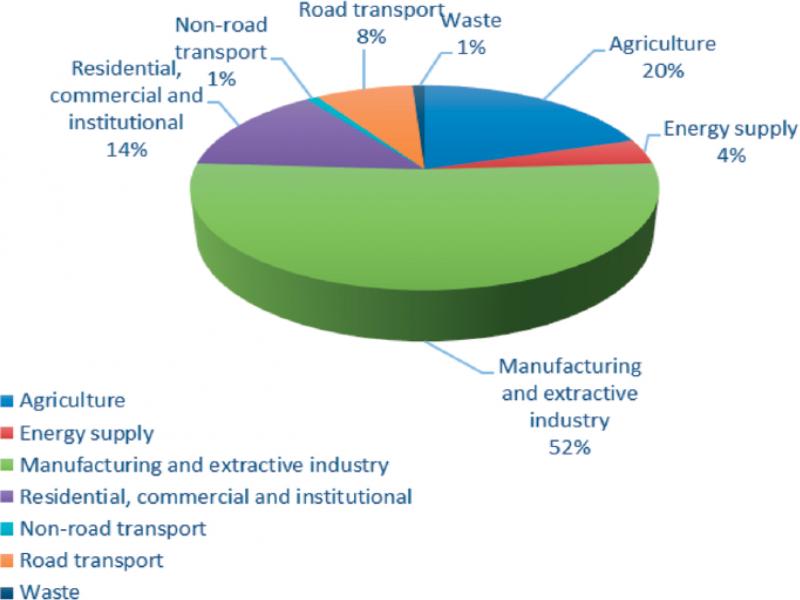
Figure 1.
Contribution to EU-28 area emissions from the main source sectors in 2018 of non-methane volatile organic compounds (NMVOCs) (Source: Air quality in Europe - 2020 report; EEA Report, No 09/2020 [4])
Table 1.
| Biotrickling filters | |
|---|---|
| Advantages | Disadvantages |
| Effective removal of pollutants | Risk of bed blockage by excessively growing biomass increase in a pressure drop in gas phase due to clogging of the bed and the need to remove inhibitors formed as secondary process products |
| Process conditions: 25-30°C, atmospheric pressure | Low efficiency in removing compounds insoluble in water |
| Low operating costs - no need for bed replacement and disposal, low energy consumption | Inability to use this technology for non-biodegradable compounds |
| Very good process control ability | |
| Ecological purity - no secondary pollutants | |
| No risk of explosion | |
Table 2.
A review of recent work on the effectiveness of biodegradation in relation to packing material [29, 30, 31, 32, 33, 34, 35, 36, 37]
| References | Pollution | Packing material | Degradation Effectiveness/Conclusions |
|---|---|---|---|
| Hernandez et al. 2013 [30] | Ethylmercaptan, NH3 and H2S | Poplar wood chips and polyurethane foam | Both biotrickling filters achieved complete NH3 removal, and more than 90% degradation of H2S, ethylmercaptan reported lower performance in biotrickling filters packed with polyurethane foam. Polyurethane foam requires a longer time for the immobilization of microorganisms, poplar wood shows greater resistance in terms of NH3 elimination, the durability of poplar wood is 2 years and much more profitable compared to polyurethane foam. |
| Sun et al. 2019 [31] | H2S from municipal wastewater treatment plant | Polypropylene rings | The average H2S removal efficiency was 91.8% |
| Chen et al. 2019 [32] | H2S from sewage lift station | Bamboo charcoal | The average H2S removal efficiency was 99% |
| Huan et al. 2020 [33] | NH3 and H2S | Polyhedral spheres | The average H2S removal efficiency was 98.25% and NH3 was 88.55% |
| Liu et al. 2020 [34] | removal of odors (mainly H2S and NH3), from the sludge dewatering room in wastewater treatment plant. | Polyurethane, Volcanic rock, modified activated carbon fiber | Odor (mainly H2S and NH3) removal efficiency was 98,5% |
| Ying et al. 2020 [35] | H2S and NH3 | Porcelain Raschig rings and ceramsite | The average H2S and NH3 removal efficiency was over 99% |
| Chen et al. 2016 [36] | H2S | Activated carbonloaded polyurethane (upper layer) and with modified organism-suspended fillers (lower layer) | The average H2S removal efficiency was greater than 96% In addition, the biotrickling filter was able to withstand periods of contaminated starvation (1.5 days and 7 days) with several hours of recovery time |
| Lebrero et al. 2021 [29] | H2S, methylmercaptan and toluene | Conventional plastic packing material and new clay-based materials (Saint Gobain) | The use of new fillings in the biotrickling filter has increased the efficiency and buffer capacity compared to plastic rings. Similar conclusions apply to biofilters, almost complete reduction of H2S and toluene and 80% methylmercaptan removals were investigated. Clay-based packing materials (Saint Gobain) were found to have high buffer capacity, high water retention and good gas-liquid mass transfer |
| Tu et al. 2019 [37] | Mixed sulfur compounds | Plastic balls in the upper layer and with lava rocks in the bottom layer | Improvement in sulfur removal efficiency and a higher bed pH using the new packing combination compared to a lava rocks only packing. |
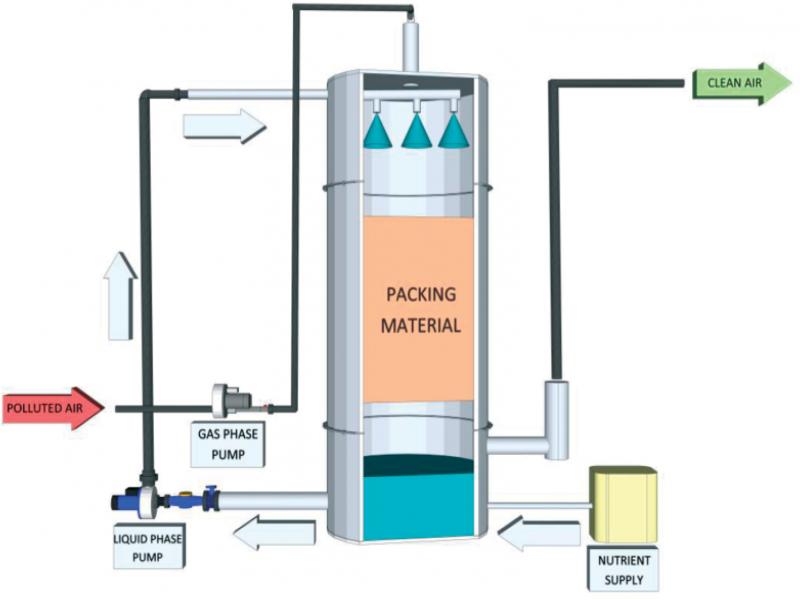
Figure 2.
Model of Compact Trickle Bed Bioreactor (own study based on Kasperczyk et al. 2019 [39])
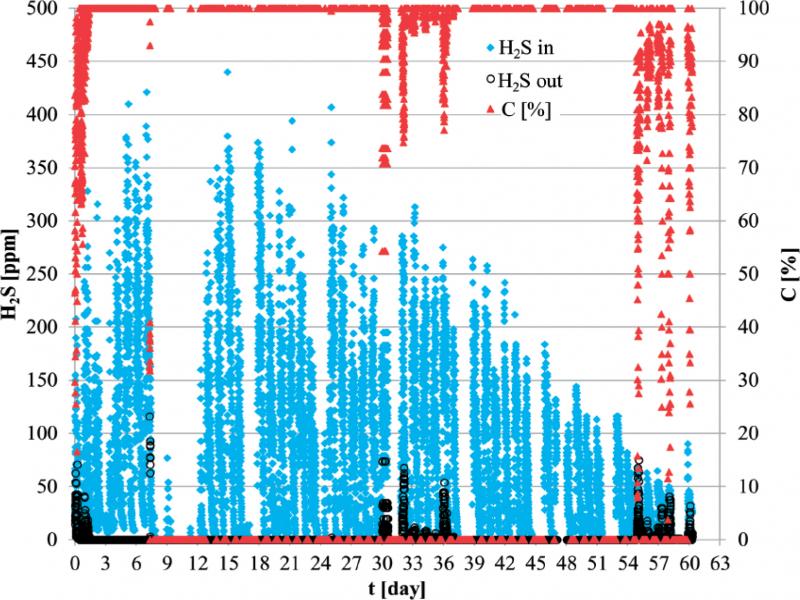
Figure 3.
Efficiency of biopurification of air from H2S (Figure source: Kasperczyk et al. 2019 [39])
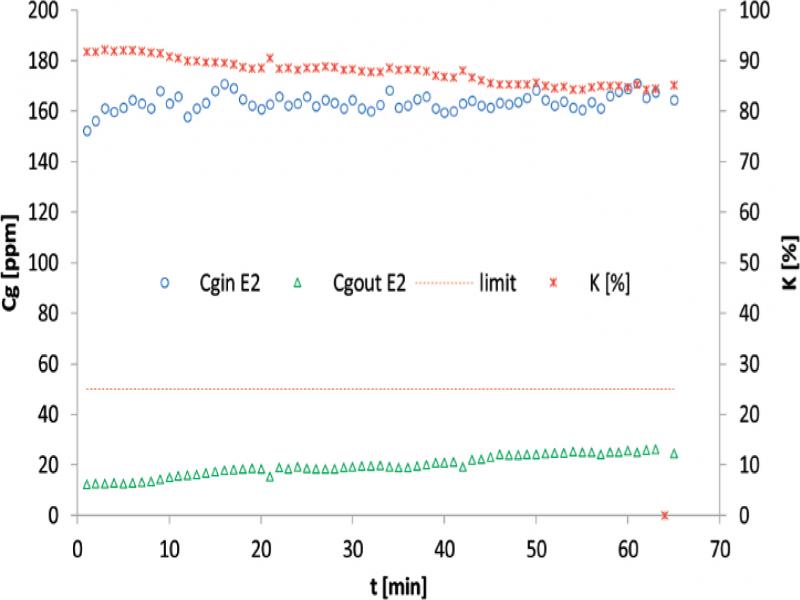
Figure 4.
Efficiency of biopurification of air from VOC in pilot scale CTBB. (Figure source: Kasperczyk et al. 2019 [42])
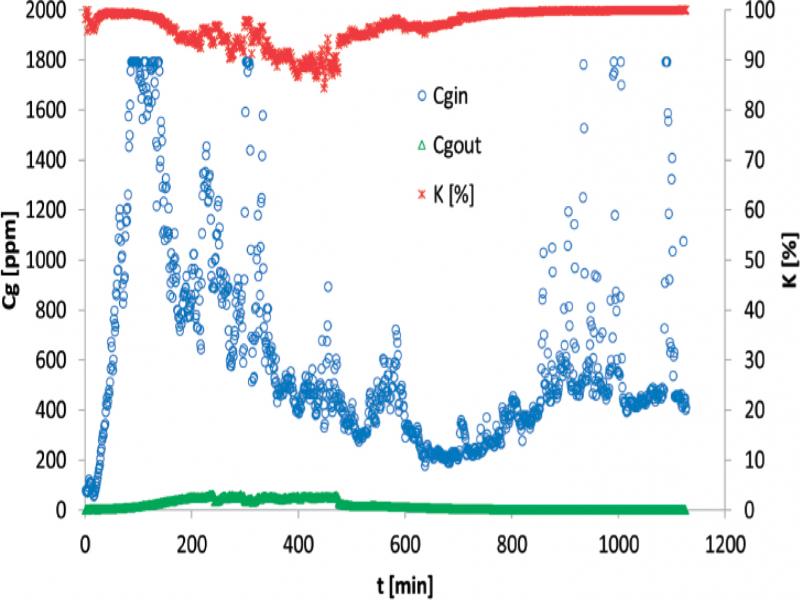
Figure 5.
Efficiency of biopurification of air from VOC in full scale CTBB. (Figure source: Kasperczyk et al. 2021 [42])
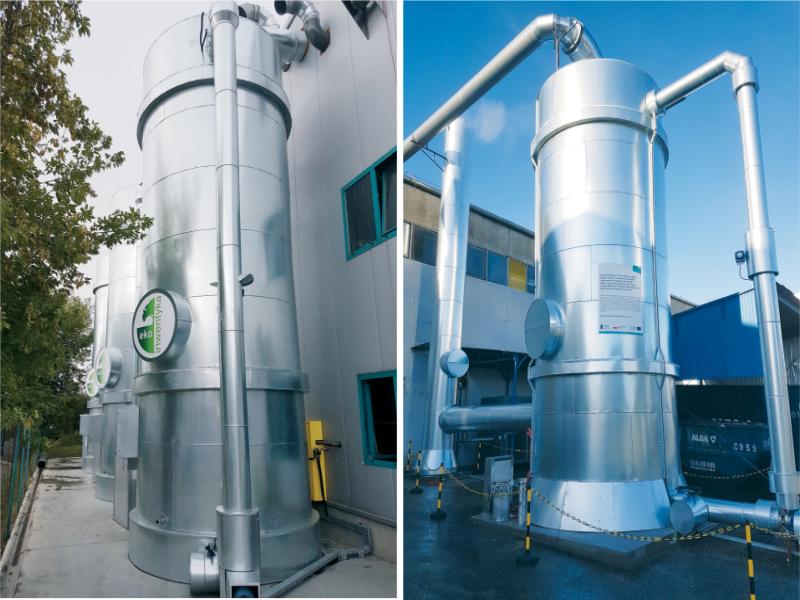
Figure 6.
Compact Trickle Bed Bioreactor implemented on a full scale to remove VOC emitted from paint industry (Ekoinwentyka Ltd)