
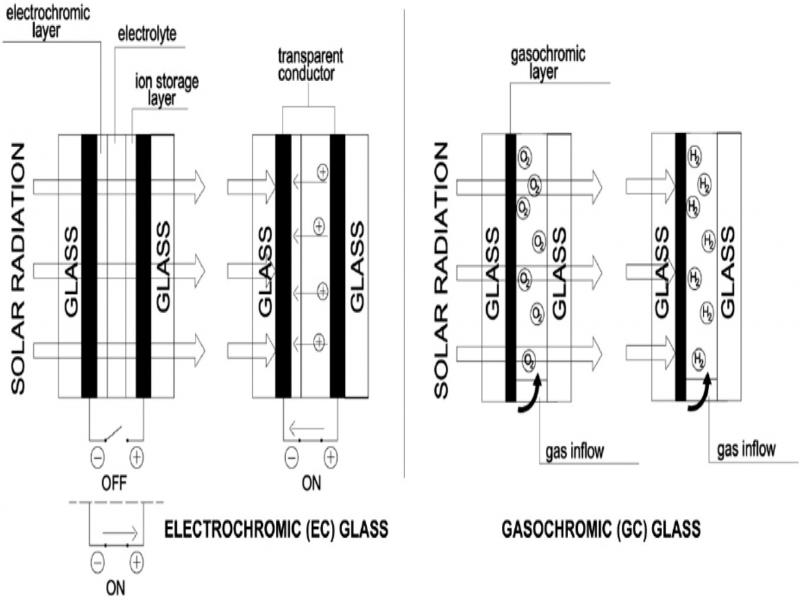
Figure 1.
General structure and principle of operation of electrochromic (EC) and gasochromic glass (GC) [5]
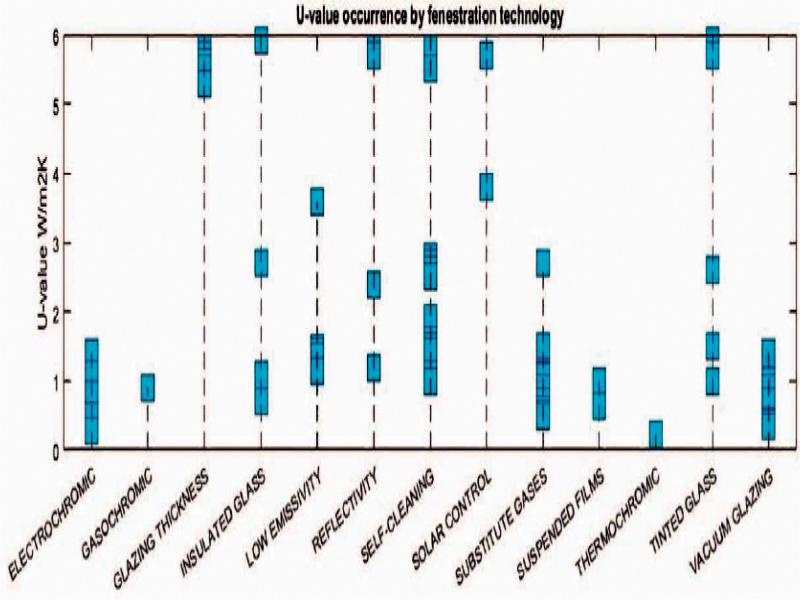
Figure 2.
Average U-value comparison of commercial glass including EC and GC technology [6]
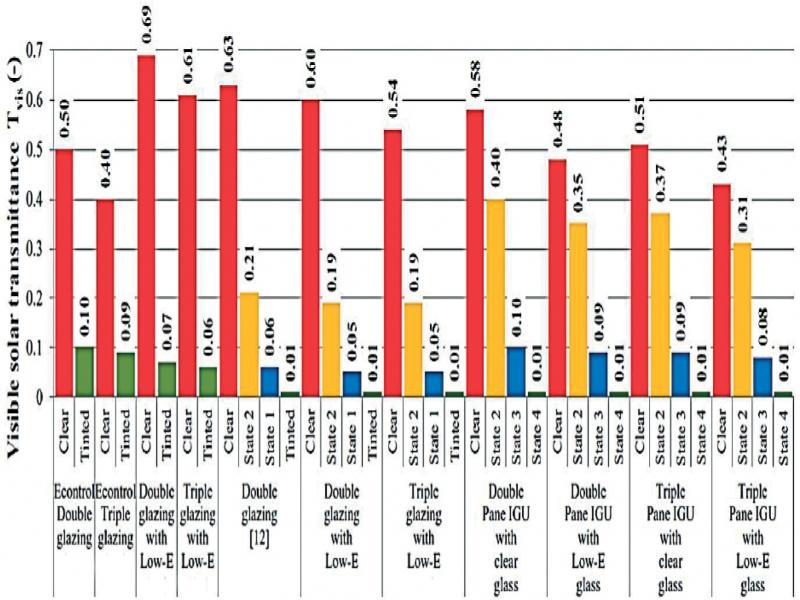
Figure 3.
Values of visible solar transmittance for EC products at different modes they are in [13]
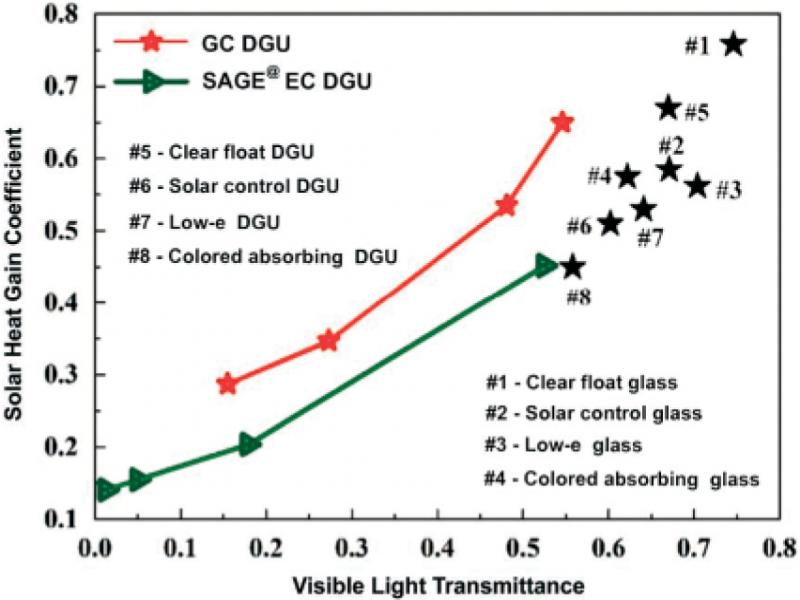
Figure 4.
Tv to g-value (SHGC) relationship of selected glazing technologies including EC and GC [14]
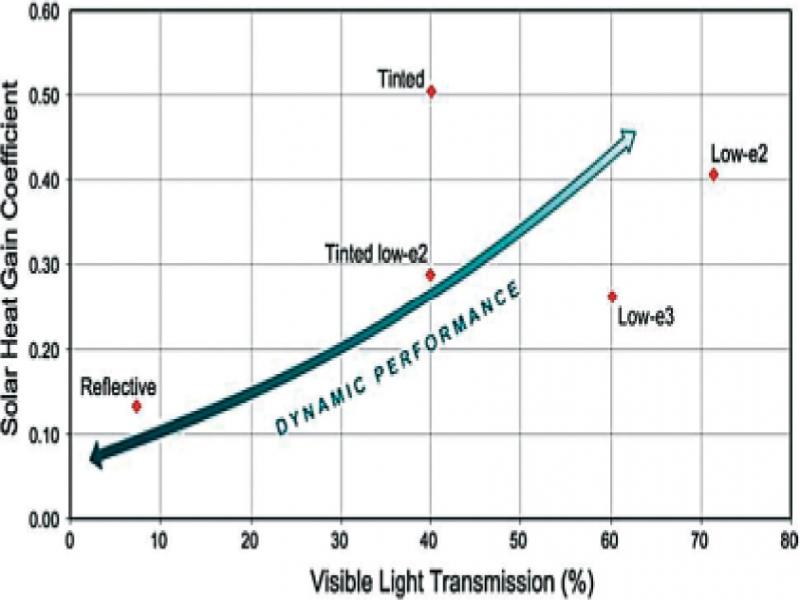
Figure 5.
Tv to g-value (SHGC) relationship of EC and selected solar/thermal protective static glazing technologies [15]
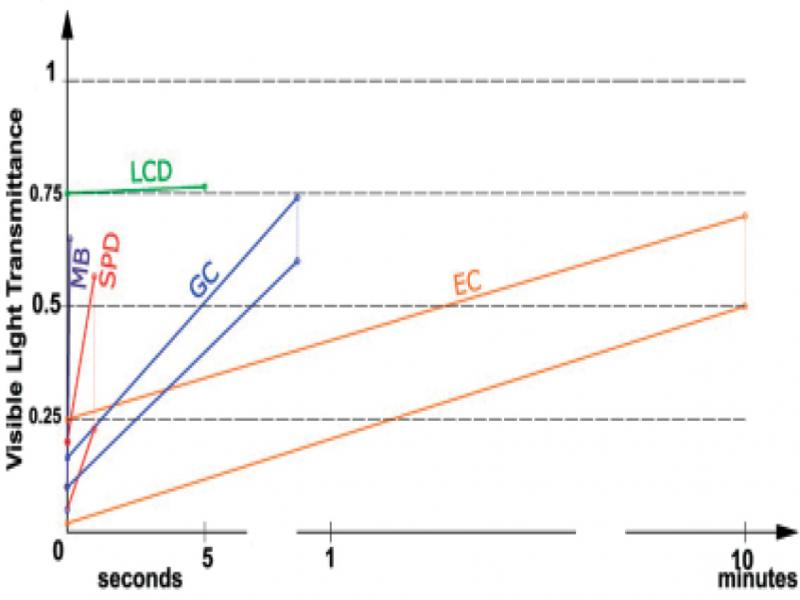
Figure 6.
Transition period for various switchable glazing technologies, including EC and GC glazing - visible transmittance as a time variable [5]
Table 1.
Energy demand for heating and cooling in three different climatic conditions in Europe using four different types of glazing, including EC and GC [20]
| Heating Energy (kWh/m2a) | ||||
|---|---|---|---|---|
| Low-e DGU U=1.3W/(m2K) g=0.60 | Solar-control DGU U=1.1W/(m2K) g=0.33 | EC TGU U=1.1W/(m2K) g=0.15-0.40 | GC TGU U=0.9W/(m2K) g=0.18-0.48 | |
| Rome | 3.7 | 5.5 | 5.8 | 4.9 |
| Brussels | 16.6 | 20.3 | 19.9 | 17.2 |
| Stockholm | 33.8 | 39.4 | 37.9 | 33.1 |
| Cooling Energy (kWh/m2a) | ||||
| Rome | 45.5 | 24.2 | 14.1 | 15.2 |
| Brussels | 16.3 | 6.8 | 3.0 | 3.4 |
| Stockholm | 18.8 | 7.3 | 2.6 | 3.1 |
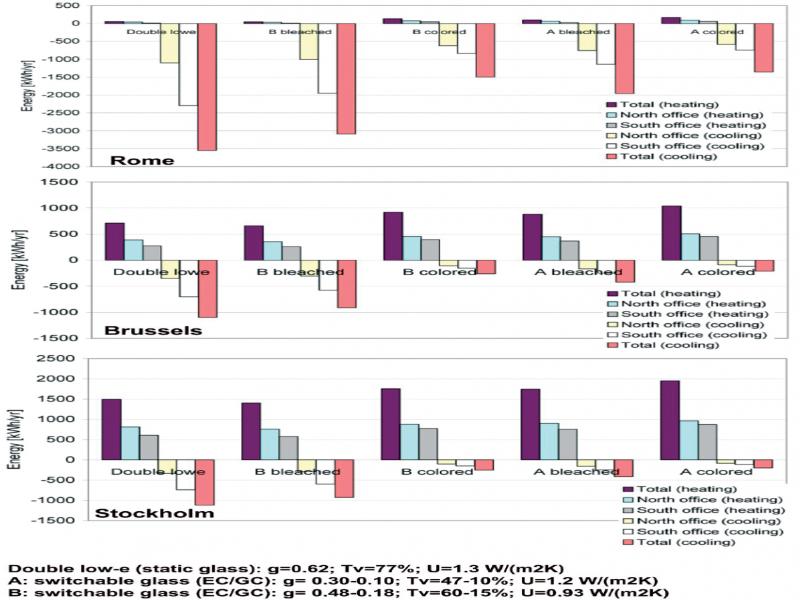
Figure 7.
Energy demand for heating and cooling of office spaces in three different locations across Europe, depending on the technology and parameters of window glazing, including switchable glazing (EC/GC) [21]
Table 2.
Climatic characteristics (annual values of outside air temperature and irradiation) for Chinese cities covered by simulation studies [23]
| Average lowest temperature values (°C) | Average highest temperatura values (°C) | Irradiation (kWh/m2) | |
|---|---|---|---|
| Beijing | -4 | +26 | |
| Chonguing | -15 | +23 | |
| Guangzhou | + 14 | +29 | 1300 |
| Harbin | -18 | +23 | |
| Shanghai | +5 | +28 |
Table 3.
EC and GC glazing as well as various types of static glazing studied with reference to the impact on energy efficiency of a virtual office building for 5 different climatic conditions in China [14]
| Glazing system types | ID | g (SHGC) | Tv |
|---|---|---|---|
| #1: Clear Float glass | 8205 | 0.758 | 0.746 |
| #2: Solar Control glass | 8253 | 0.585 | 0.671 |
| #3: Low-E glass | 8307 | 0.562 | 0.704 |
| #4: Colored absorbing glass (Green) | 8209 | 0.575 | 0.622 |
| #5: Clear Float+Clear float DGU | 8205+8205 | 0.670 | 0.670 |
| #6: Solar Control+Clear float glass DGU | 8253+8205 | 0.510 | 0.602 |
| #7: Low-E+Clear float glass DGU | 8307+8205 | 0.530 | 0.641 |
| #8: Colored absorbing +Clear float glass DGU | 8209+8205 | 0.450 | 0.558 |
| #9: SAGE@EC+ Clear float glass DGU | Bleached state Colored state | 0.452 0.141 | 0.525 0.013 |
| #10: GC+Clear float glass DGU | Bleached state Colored state | 0.650 0.287 | 0.546 0.155 |
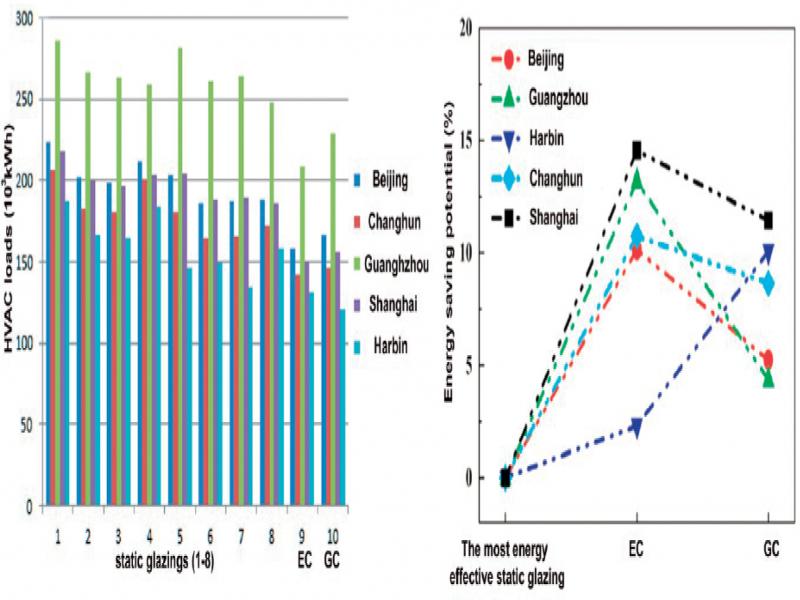
Figure 8.
HVAC loads of different glazing systems, including EC and GC, in 5 different regions across China (left) (by the author, on the basis of [14]). Energy saving potential of EC and GC glazing for the studied locations
Table 4.
Percentage of reduced cooling and lighting energy of EC, GC glazing and solar protective static glazing for different ratios of window to floor (WFR) area in offices in hot climate (southern Egypt) [24]
| North | East | South | West | |||||
|---|---|---|---|---|---|---|---|---|
| Cooling Energy | Light Energy | Cooling Energy | Light Energy | Cooling Energy | Light Energy | Cooling Energy | Light Energy | |
| 8% WFR | ||||||||
| EC | 38 | 20 | 30 | 35 | 40 | 42 | 32 | 30 |
| GC | 22 | 20 | 25 | 34 | 32 | 41 | 27 | 30 |
| TC | 15 | 19 | 21 | 30 | 26 | 37 | 24 | 26 |
| Blue | 11 | 30 | 18 | 31 | 19 | 38 | 21 | 26 |
| Green | 11 | 16 | 17 | 41 | 18 | 48 | 21 | 35 |
| Brown | 9 | 25 | 16 | 36 | 16 | 43 | 19 | 31 |
| 16% WFR | ||||||||
| EC | 28 | 41 | 32 | 52 | 36 | 56 | 35 | 47 |
| GC | 26 | 41 | 28 | 52 | 31 | 55 | 30 | 45 |
| TC | 22 | 33 | 22 | 47 | 25 | 53 | 24 | 40 |
| Blue | 19 | 33 | 18 | 47 | 15 | 52 | 20 | 40 |
| Green | 19 | 48 | 18 | 56 | 15 | 57 | 19 | 49 |
| Brown | 17 | 41 | 16 | 52 | 12 | 55 | 16 | 45 |
| 24% WFR | ||||||||
| EC | 31 | 54 | 40 | 52 | 40 | 59 | 43 | 51 |
| GC | 25 | 54 | 34 | 52 | 34 | 58 | 36 | 57 |
| TC | 20 | 48 | 26 | 47 | 27 | 57 | 29 | 54 |
| Blue | 16 | 50 | 22 | 47 | 19 | 58 | 25 | 54 |
| Green | 16 | 57 | 21 | 56 | 18 | 59 | 25 | 53 |
| Brown | 13 | 55 | 19 | 52 | 15 | 59 | 23 | 50 |
| 32 WFR | ||||||||
| EC | 35 | 57 | 43 | 60 | 46 | 61 | 45 | 57 |
| GC | 30 | 57 | 38 | 60 | 40 | 60 | 41 | 57 |
| TC | 25 | 54 | 30 | 58 | 32 | 59 | 33 | 54 |
| Blue | 19 | 55 | 23 | 59 | 21 | 59 | 25 | 54 |
| Green | 19 | 59 | 23 | 60 | 20 | 60 | 25 | 59 |
| Brown | 16 | 58 | 21 | 60 | 16 | 59 | 23 | 57 |
Table 5.
Evaluation of EC and GC glazing in terms of their impact on the energy efficiency of the building [by the author]
| Climate | ||||||
|---|---|---|---|---|---|---|
| Cold | Moderate | Hot | ||||
| EC | GC | EC | GC | EC | GC | |
| HVAC | + | + + | + + | + | + + | + |
| – cooling, - air conditioning | + | + | + + | + | + + | + |
| – heating | +/- | + | +/- | + | - | +/- |
| HVAC + lighting | + | + + | + | + | + + | + |
| evaluation predicted: further research required | ||||||