
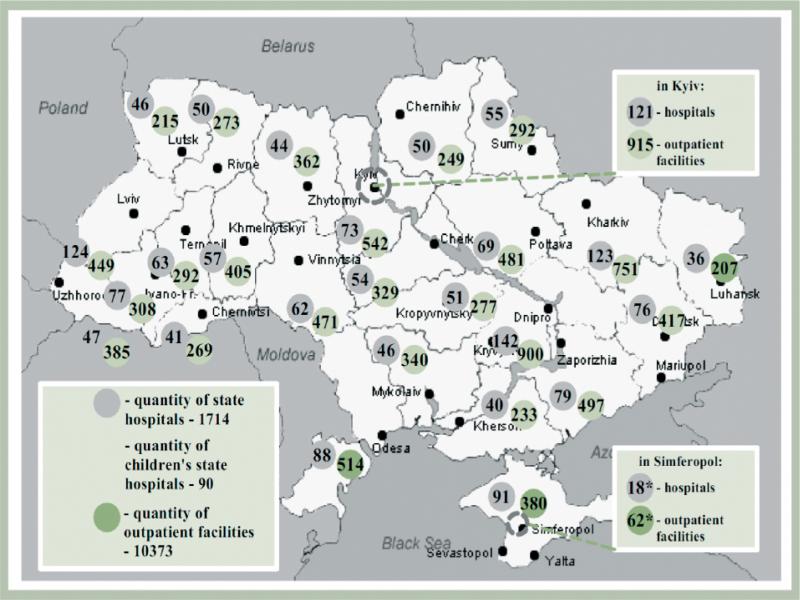
Figure 1.
Urban planning network of hospitals and outpatient facilities in Ukraine (Figure by the author of the paper)
Table 1.
Proposals of dynamic scenarios of the territorial and spatial development of pediatric treatment facilities at the national level of organization of the urban network of primary healthcare facilities
| Name | 2030 | 2040 | 2050 | 2060 | 2100 |
|---|---|---|---|---|---|
| Population / optimistic (max) case | 42.0 million | 40.0 million | 38.3 million | 36.0 million | 37.5 million |
| Number of primary care physicians | 33 600 | 32 000 | 30 640 | 28 800 | 30 000 |
| Population / optimal (opt) case | 39.8 million | 39.8 million | 33.6 million | 30.8 million | 24.0 million |
| Number of primary care physicians | 31 840 | 29 600 | 26 880 | 24 640 | 19 200 |
| Population / pessimistic (min) case | 39.0 million | 36.0 million | 32.2 million | 27.0 million | 15.0 million |
| Number of primary care physicians | 31 200 | 28 800 | 25 760 | 21 600 | 12 000 |
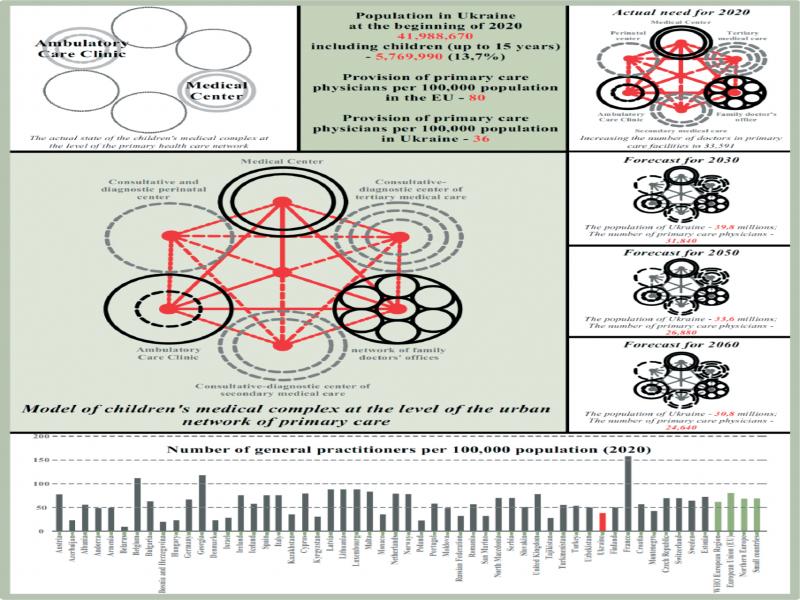
Figure 2.
The model of children’s therapeutic complex, indicators of the number of doctors in the world, summarized actual and forecast data for forecasting the territorial and spatial development of the urban system of pediatric treatment facilities at the level of an urban network of primary care facilities (Figure by the author of the article)
Table 2.
Proposals for dynamic scenarios of the territorial and spatial development of pediatric treatment facilities at the national level of hospital urban networks organization of secondary and tertiary healthcare
| Name | 2030 | 2040 | 2050 | 2060 | 2100 |
|---|---|---|---|---|---|
| Population / optimistic (max) case | 42.0 million | 40.0 million | 38.3 million | 36.0 million | 37.5 million |
| Total number of beds in hospitals | 221 340 | 210 800 | 201 841 | 189 720 | 197 625 |
| Population / optimal (opt) case | 39.8 million | 37.0 million | 33.6 million | 30.8 million | 24.0 million |
| Total number of beds in hospitals | 209 746 | 194 990 | 177 072 | 162 316 | 126 480 |
| Population / pessimistic (min) case | 39.0 million | 36.0 million | 32.2 million | 27.0 million | 15.0 million |
| Total number of beds in hospitals | 205 530 | 189 720 | 169 694 | 142 290 | 79 050 |
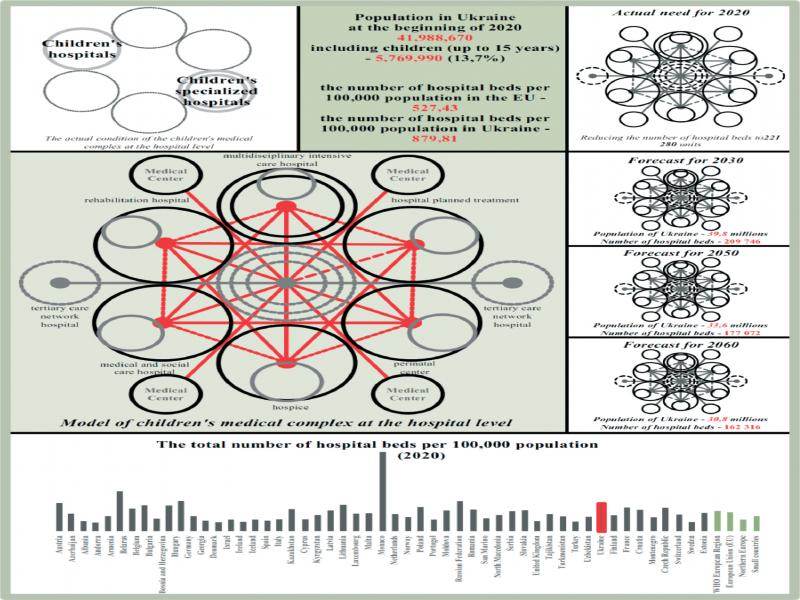
Figure 3.
The model of children’s therapeutic complex, indicators of the total number of hospital beds per 100,000 population in the world, summarized actual and forecast data for forecasting the territorial and spatial development of the urban system of pediatric treatment facilities at the level of an urban hospital network (Figure by the author of the paper)