
Table 1.
Overview of definitions and main assumptions of the compact city concept (based on selected studies from 1996–2018)
| Author (year) | Title/the main subject of research | The definition of the compact city concept | The main attributes of the compact city (based on the definition) |
|---|---|---|---|
| P. Nijkamp, S.A. Rienstra (1996) | Sustainable transport in a compact city. | “This concept is embodied in the «compact city», where housing is provided in a relatively high-density form, and where jobs are concentrated in the central city and in a limited number of sub-centers” [14]. |
|
| R. Burgess (2000) | The global perspective of the compact city concept. | “It is possible to offer a tentative and composite definition of contemporary compact city approaches as: «to increase built area and residential population densities, to intensify urban economic, social and cultural activities and to manipulate urban size, form, structure and settlement systems to pursuit of the environmental, social and global sustainability benefits, derived from the concentration of urban functions»” [15]. |
|
| E. Burton (2002) | Measuring urban compactness (on the example of UK cities). | “(…) the compact city is usually described as one or other or all of three types of city, two that are related to «product»:
|
|
| J. Arbury (2005) | Analysis of urban growth management on the example of the selected city. | “This model differs greatly from conventional urban development (or sprawl) by focusing on urban intensification, creating limits to urban growth, encouraging mixed-use development and placing a greater focus on the role of public transportation and quality urban design” [17]. |
|
| A. Polit (2010) | Advantages and disadvantages of the compact city concept. | “For many years, the remedy for all diseases of contemporary urban planning caused by the phenomenon of sprawl was seen in the concept of a compact city. The idea was to design buildings with relatively high intensity, to mix the functions of urban areas and to base their functioning on efficient public transport. Clear urban boundaries, revitalizing city centers, encouraging cycling or walking, and improving the quality of public spaces are important guidelines of the Compact City concept” [18]. |
|
| K. Solarek (2011) | The review of contemporary concepts of city development. | “The concept (…) is connected (…) with the structuring of space and with the main assumptions heading towards the shaping of Compact Cities, developing inwards, intensively - but according to their scale and character – built-up, with a mixed function of the area, pedestrian-friendly, and accessible by communication” [19]. |
|
| OECD (2012) | A comparative assessment of the compact city policies in OECD countries. | “Spatial urban form characterized by «compactness». By understanding various definitions of a compact city, this report defines its key characteristics as i) dense and proximate development patterns; ii) urban areas linked by public transport systems; and iii) accessibility to local services and jobs” [12]. |
|
| E. Węcławowicz -Bilska (2012) | The review of the selected urban development concepts | “The compact city of short distance is an urban concept that promotes a relatively high density of builtup areas with a diverse, mixed-use of land. An efficient public transport system will encourage the abandonment of car transport and a compact urban layout will encourage walking and cycling” [20]. |
|
| P. Chhetri et al. (2013) | The analysis of the realization compact city model in Melbourne. | “The land-use policy changes built around the concept of the compact city include the following: Intensification, consolidation or densification, particularly around inner suburbs. In-fill development and redevelopment of brownfield land. More intensive use of urban land. Sub-divisions and conversions of existing development. Re-zoning and greater mixing of land use. Greater dwelling density and re-urbanization. Higher degrees of accessibility” [21]. |
|
| M. Stangel (2013) | Contemporary urban design in the context of sustainable development. | “The paradigm of a city of compact or sustainable urban planning in a broader sense calls for a dense, multifunctional building structure that is comfortable to walk and transport, with access to local services, jobs and green spaces” [22]. |
|
| R. Kotharkar, P. Bahadure, N. Serda (2014) | Measuring urban compactness (on the example of Indian city). | “Essentially the compact city model defined as «…a high density, mixed-use development, within a restrictive geographical area with enhanced public transport and infrastructure facilities»” [23]. |
|
| B. Komar (2014) | The analysis of space quality of the selected housing estates in the context of sustainable development. | “A compact city is a city that has the following characteristics: a revitalized center, a high density of buildings, mixed functions of urban areas and numerous services. The Compact city also supports walking and cycling, reducing distances between work and housing, as well as building multifunctional facilities” [24]. |
|
| Z. Paszkowski (Report of Living Space of Poles) (2014) | The selected trends of development of cities in Poland. | “A city model with an intensive, multifunctional and well-structured urban form, which also includes well-equipped recreational greenery and good accessibility to all necessary public services” [25]. |
|
| National Urban Policy 2023 (2015) | Definition activities of government administration in terms of urban policy in Poland. | “In planning development, local governments should act in accordance with the idea of a compact city, which - implementing the principles of sustainable development - promotes a polycentric structure, taking the form of dense and multifunctional buildings, served by pedestrian, bicycle and public transport, while reducing the need to use individual car transport” [9]. |
|
| S. Gzell (2015) | The selected problems of contemporary urban planning. | “(…) the idea of a compact city may be served by increasing the intensity of housing development, the development of urban set-aside, poorly used traffic areas or post-production areas” [26]. |
|
| K. Gasidło (2017) | Analysis of the methods to achieve compactness in existing dispersed urban form. | “Compact city is generally defined as a compactly developed city, as the term compactness evokes closeness, focus, continuity, concentration. Buildings and components of technical and social infrastructure should be close to each other, concentrate around public space, which reduces the distance and facilitates access to all functions of the city” [27]. |
|
| S. Tapper, T. Klöti, M. Drilling (2018) | Urban green spaces in the compact city (on the example of Swiss cities). | “The compact city approach is marked by high density, mixed land use, pedestrian-oriented habitation, the utilization of development reserves for construction projects and the structural transformation of former industrial areas or fallow land into service or residential areas of high quality (…)” [28]. |
|
Table 2.
Indicators of city compactness
| No. | Indicator | Unit | Formula | Justification | The basic source of data |
|---|---|---|---|---|---|
| I1 | The population density within the administrative boundary | The number of inhabitants per 1 km2 | The basic indicator of the city, commonly included in public statistics. | National Statistical Office | |
| I2 | Change of the population density within the administrative boundary | % | The indicator presents urbanization trends. | National Statistical Office | |
| I3 | Share of developed areas in a total area | % | The indicator presents the level of development areas in a city. | Regional Surveying and Cartographic Documentation Centre | |
| I4 | The population density in developed areas | The number of inhabitants per 1 km2 urban land | The indicator presents the population density only in built-up areas in a city. | National Statistical Office; Regional Surveying and Cartographic Documentation Centre |
Table 3.
Indicators of accessibility
| No. | Indicator | Unit | Formula | Justification | The basic source of data |
|---|---|---|---|---|---|
| I5 | Accessibility to service facilities | % | The indicator presents the share of residential areas within the access zone (e.g. 500 m) to service facilities (facilities where commercial and service activities are carried out, e.g. shopping centers) in the city. | Regional Surveying and Cartographic Documentation Centre | |
| I6 | Accessibility to education facilities | % | The indicator presents the share of residential areas within the access zone (e.g. 500 m) to education facilities in the city. | Regional Surveying and Cartographic Documentation Centre | |
| I7 | Accessibility to health facilities | % | The indicator presents the share of residential areas within the access zone (e.g. 500 m) to health facilities in the city. | Regional Surveying and Cartographic Documentation Centre | |
| I8 | Accessibility to green areas | % | The indicator presents the share of residential areas within the access zone (e.g. 500 m) to green areas in the city. | Regional Surveying and Cartographic Documentation Centre | |
| I9 | Accessibility to public transport | % | The indicator presents the share of residential areas within the access zone (e.g. 500 m) to public transport in the city. | Regional Surveying and Cartographic Documentation Centre |
Table 4.
Indicators of the transport system
| No. | Indicator | Unit | Formula | Justification | The basic source of data |
|---|---|---|---|---|---|
| I10 | Number of passenger cars per 1000 population | pieces | The indicator shows the popularity of using individual car transport | National Statistical Office | |
| I11 | Cost of a combined monthly ticket (all modes of public transport) for 5–10 km in the central zone | euro | – | The indicators show accessibility to public system in the economic aspect | Urban Audit |
| I12 | Length of bicycle lanes per 1000 population | km | The indicator shows the state of investment in cycle infrastructure | National Statistical Offices | |
| I13 | Length of bus lanes per 1000 population | km | The indicator shows the state of investment in bus infrastructure | National Statistical Offices |
Table 5.
Indicators of urban regeneration with development brownfield lands
| No. | Indicator | Unit | Formula | Justification | The basic source of data |
|---|---|---|---|---|---|
| I14 | The share of areas to be included in the urban regeneration in a total area | % | The indicator shows areas which need corrective actions | Local Action Plan for Urban Regeneration | |
| I15 | The share of the investment areas offered by the city in a total area | % | The indicator shows investment areas, especially brownfield lands | Data provided by city offices |
Table 6.
Indicators of public spaces
| No. | Indicator | Unit | Formula | Justification | The basic source of data |
|---|---|---|---|---|---|
| I16 | The share of public open areas in a total area | % | The indicator shows public open areas, e.g. forests and copses. | Regional Surveying and Cartographic Documentation Centre | |
| I17 | The share of public recreational and sports complexes in a total area | % | The indicator shows localization of recreational and sports complexes, e.g. parks, sports centers. | Regional Surveying and Cartographic Documentation Centre |
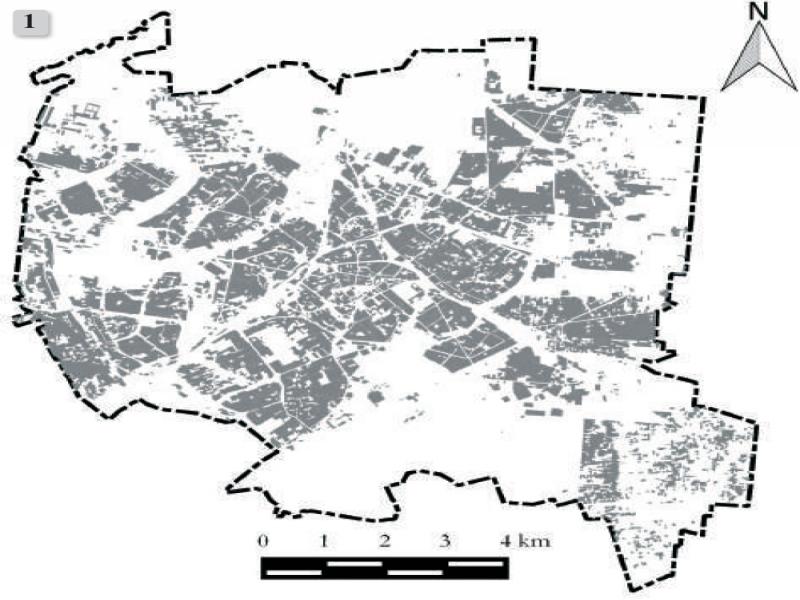
Figure 1.
Built-up areas in Bialystok
Source: author’s own work based on Database of Topographical Objects from Regional Surveying and Cartographic Documentation Centre in Bialystok [32]
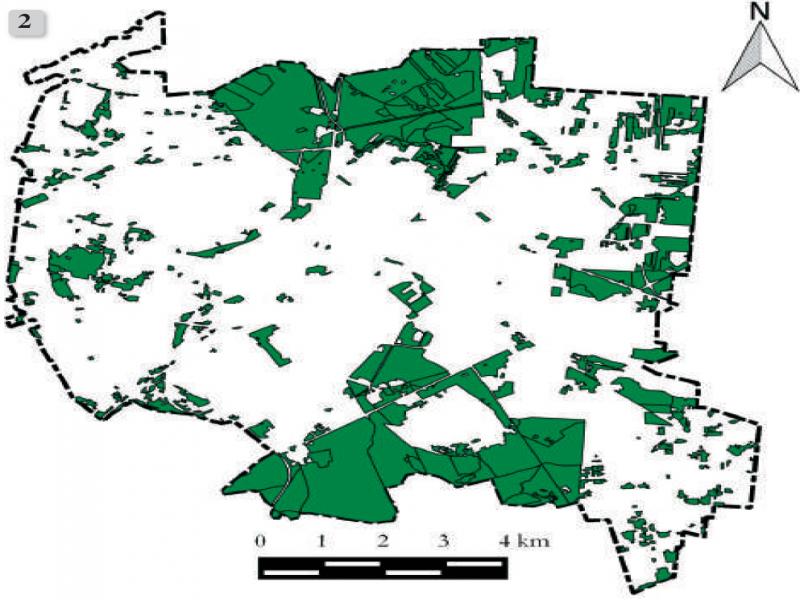
Figure 2.
Green spaces in Bialystok
Source: author’s own work based on Database of Topographical Objects from Regional Surveying and Cartographic Documentation Centre in Bialystok [32]
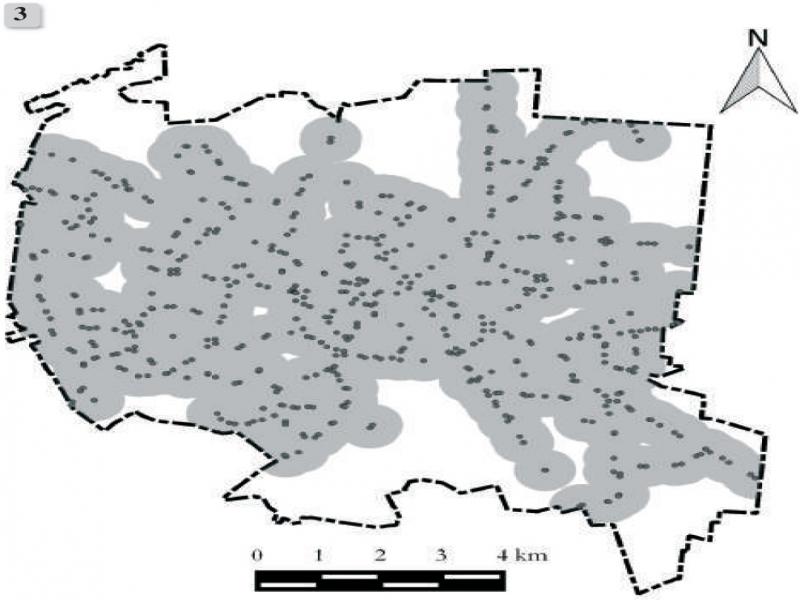
Figure 3.
Public transport stops with access zone (500 m) in Bialystok
Source: author’s own work based on Database of Topographical Objects from Regional Surveying and Cartographic Documentation Centre in Bialystok [32]
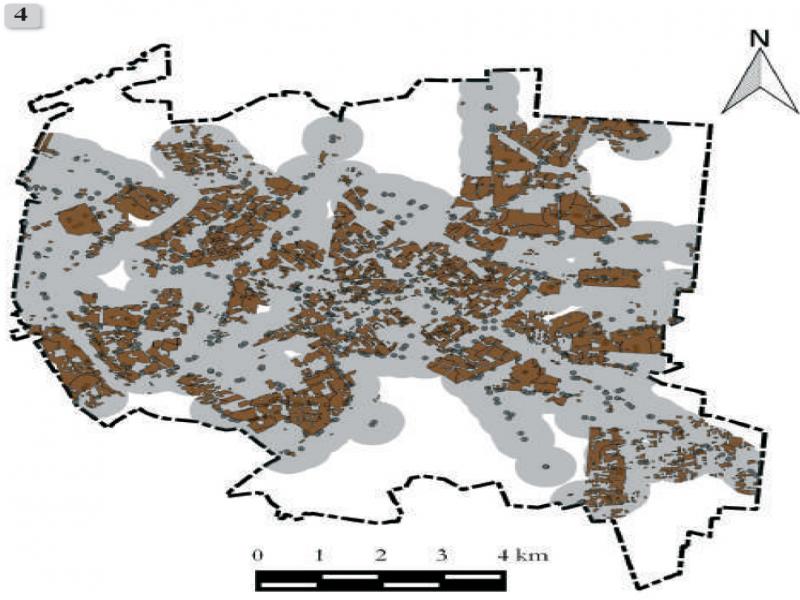
Figure 4.
Residential area in access zone of public transport stop in Bialystok
Source: author’s own work based on Database of Topographical Objects from Regional Surveying and Cartographic Documentation Centre in Bialystok [32]
Table 7.
The weights of compact city indicators – option I
| Indicator groups | Global weights | Indicators | Global weights | Local weights |
|---|---|---|---|---|
| City compactness | 0.200 | The population density within the administrative boundary | 0.250 | 0.050 |
| Change of the population density within the administrative boundary | 0.250 | 0.050 | ||
| Share of developed areas in a total area | 0.250 | 0.050 | ||
| The population density in developed areas | 0.250 | 0.050 | ||
| Accessibility | 0.200 | Accessibility to service facilities | 0.200 | 0.040 |
| Accessibility to education facilities | 0.200 | 0.040 | ||
| Accessibility to health facilities | 0.200 | 0.040 | ||
| Accessibility to green areas | 0.200 | 0.040 | ||
| Accessibility to public transport | 0.200 | 0.040 | ||
| Transport system | 0.200 | Number of passenger cars per 1000 population | 0.250 | 0.050 |
| Cost of a combined monthly ticket (all modes of public transport) for 5-10 km in the central zone | 0.250 | 0.050 | ||
| Length of bicycle lane per 1000 population | 0.250 | 0.050 | ||
| Length of bus lanes per 1000 population | 0.250 | 0.050 | ||
| Urban regeneration with development brownfield lands | 0.200 | The share of areas to be included in the urban regeneration in a total area | 0.500 | 0.100 |
| The share of the investment areas offered by the city in a total area | 0.500 | 0.100 | ||
| Public spaces | 0.200 | The share of public open areas in a total area | 0.500 | 0.100 |
| The share of public recreational and sports complexes in a total area | 0.500 | 0.100 |
Table 8.
The weights of compact city indicators – option II
| Indicator groups | Global weights | Indicators | Global weights | Local weights |
|---|---|---|---|---|
| City compactness | 0.333 | The population density within the administrative boundary | 0.250 | 0.083 |
| Change of the population density within the administrative boundary | 0.250 | 0.083 | ||
| Share of developed areas in a total area | 0.250 | 0.083 | ||
| The population density in developed areas | 0.250 | 0.083 | ||
| Accessibility | 0.333 | Accessibility to service facilities | 0.200 | 0.067 |
| Accessibility to education facilities | 0.200 | 0.067 | ||
| Accessibility to health facilities | 0.200 | 0.067 | ||
| Accessibility to green areas | 0.200 | 0.067 | ||
| Accessibility to public transport | 0.200 | 0.067 | ||
| Transport system | 0.111 | Number of passenger cars per 1000 population | 0.250 | 0.028 |
| Cost of a combined monthly ticket (all modes of public transport) for 5-10 km in the central zone | 0.250 | 0.028 | ||
| Length of bicycle lane per 1000 population | 0.250 | 0.028 | ||
| Length of bus lanes per 1000 population | 0.250 | 0.028 | ||
| Urban regeneration with development brownfield lands | 0.111 | The share of areas to be included in the urban regeneration in a total area | 0.500 | 0.056 |
| The share of the investment areas offered by the city in a total area | 0.500 | 0.056 | ||
| Public spaces | 0.111 | The share of public open areas in a total area | 0.500 | 0.056 |
| The share of public recreational and sports complexes in a total area | 0.500 | 0.056 |
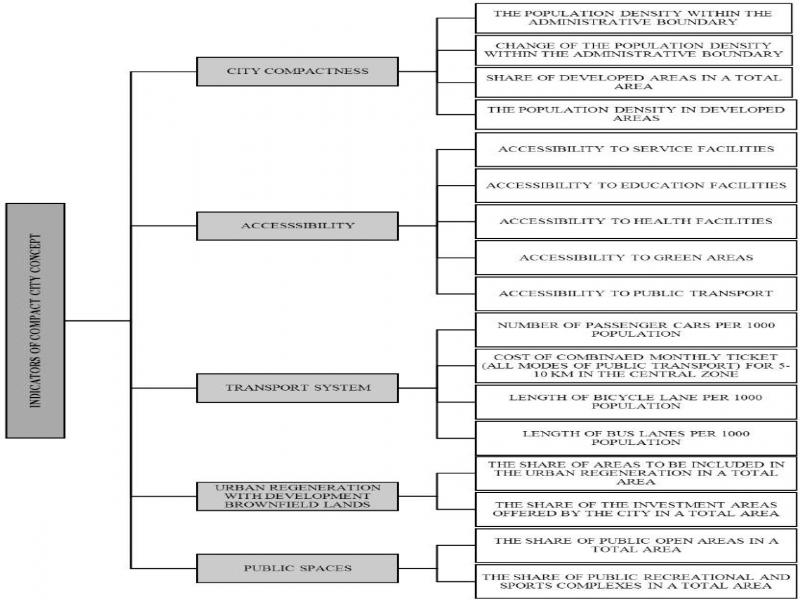
Figure 5.
Hierarchical structure of indicators of the compact city concept. Source: author’s own work