
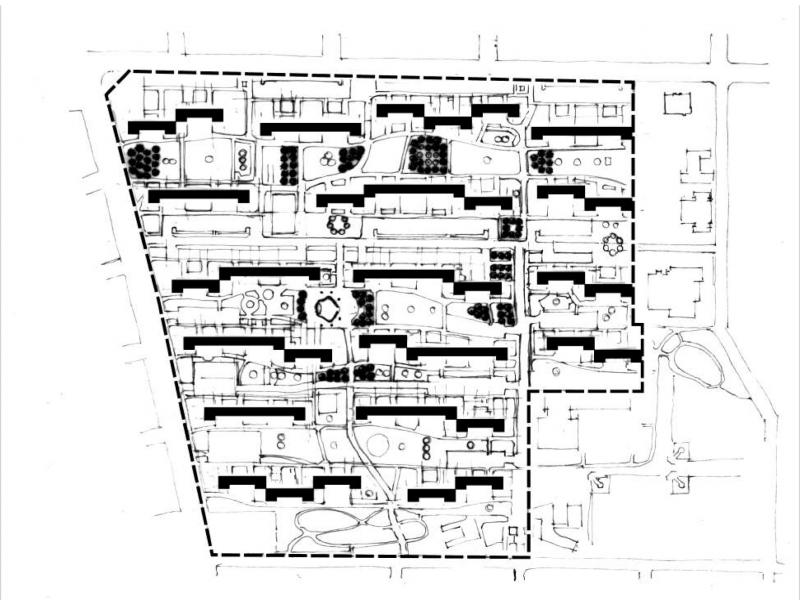
Figure 1.
Development of the Pruitt-Igoe housing estate, author’s own drawing [13]
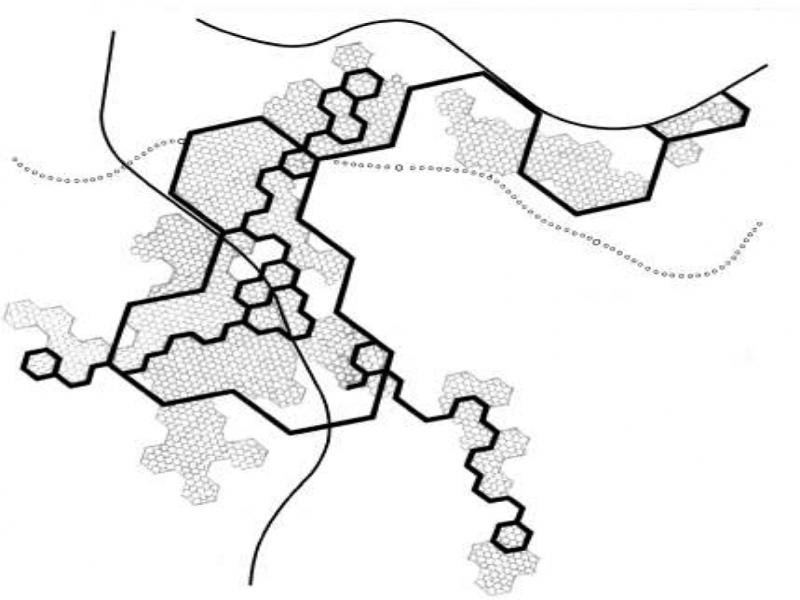
Figure 2.
Layout of PlantIT, author’s own drawing [18]
Table 1.
Assessment criteria
| Assessment criteri | Pruitt-Igoe | PlantIT | |
|---|---|---|---|
| First group | → | + | + |
| Second group | → | + | - |
| Third group | → | - | + |
| Fourth group | → | - | - |
Table 2.
First group
| Accessibility by foot | Facilities located 10 minutes of walking distance from home and work |
| Buildings located close to a thoroughfare with windows facing the street | |
| Parking places on the street or in underground car parks | |
| Narrow streets designed for vehicular traffic with a low speed | |
| Areas for pedestrian and motor traffic | |
| Network of links through communication paths | Network of interlinked streets providing redistribution of traffic and promoting walking routes |
| Hierarchical streets: narrow streets, boulevards, avenues | |
| network of pedestrian connections and public spaces ensuring the attractiveness of walking through them | |
| Increased density | Buildings, shops and service facilities located in the close vicinity |
| More efficient use of resources and services | |
| Green transport | High-quality transport network used to connect cities, towns and settlements |
| Pedestrian-friendly design of cities, providing extensive use of bicycles, rollers, scooters and walking tours promoting everyday traffic | |
| Quality of life | Access to running water, sewage, light, recreation and green areas inside and around the housing estate |
Table 3.
Second group
| Uniformity of urban development | Uniform shape of buildings, standardization of housing areas |
Table 4.
Third group
| Mixed functionality and diversity | Mixing the functions of stores, offices, individual apartments in one place |
| Mixed functionalities using the neighborhood within the block and inside the building | |
| Mixing people at different ages, income levels, cultures and races | |
| Diversity of apartments | Various size of apartments |
| High quality architecture | Emphasis on beauty, aesthetics, comfort of the urban environment, creating a “sense of place” |
| Rooting of the sense of public spaces in the community | |
| Urban design | The human scale of architecture and a beautiful environment that supports the humanist spirit |
| Traditional neighborhood structure | Clear distinction between the center and the peripheries with a clear indication of this |
| Creation of public spaces in the center | |
| High quality public spaces | |
| Main destinations used on a daily basis within a ten-minute walk | |
| The largest density of development in the city center gradually becoming less dense on the outskirts | |
| Sustainable development | Minimal impact of buildings on the environment and its maximum use |
| Eco-friendly technologies, respect for the environment and awareness of the value of natural systems | |
| Energy efficiency | |
| Limiting the use of non-renewable energy sources | |
| Increase of local production | |
| More emphasis on walking, limitation of driving | |
| Digitization of the connection network | Flow of information on energy consumption, access control, movement, work, leisure and entertainment |
Table 5.
Fourth group
| Social segregation | Racial segregation, material segregation |
| High-scale of objects | Buildings with several floors |
| Accumulation of population | Common spaces inside buildings |
| Deficiency in availability of sufficient communication | Insufficient number of parking spaces |
| Dry ambient environment | Lack of diversity in local environment |