
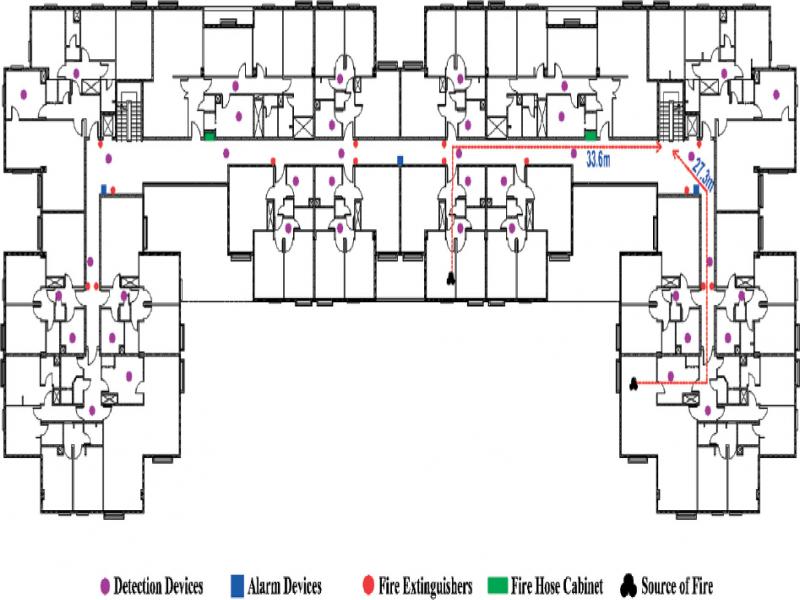
Figure 1.
Floor plan of the case study building
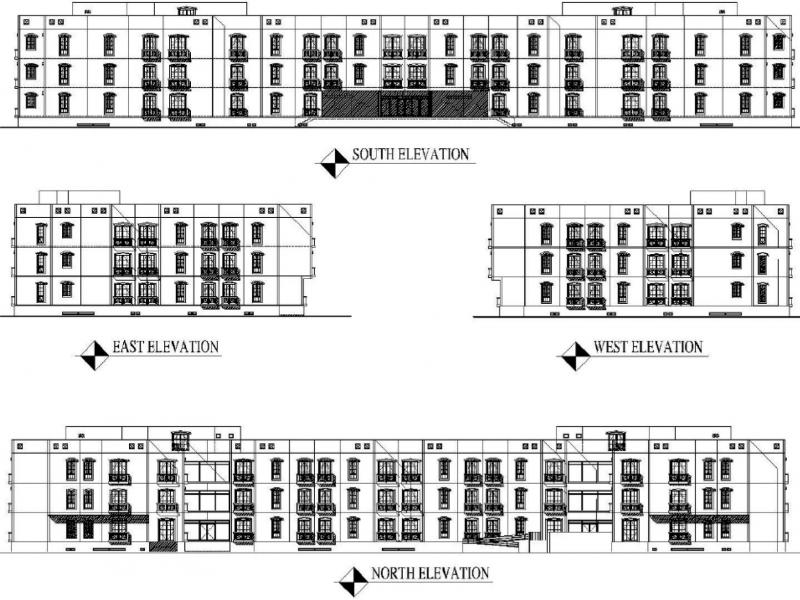
Figure 2.
Elevation views of the case study building
Table 1.
Code-compliance checklist for fire safety requirements in residential facilities
| A. Means of egress | Yes | No | |
|---|---|---|---|
| 1. | Exits are not to be less than the required number and capacity as per the code. | ✓ | |
| 2. | Exit doors are swinging in the direction of egress. | ✓ | |
| 3. | The travel distance does not exceed 15 meters. | ✓ | |
| 4. | Exterior doors are leading to discharge outside the building, or a public path. | ✓ | |
| 5. | Corridors are always lighted when the building is occupied. | ✓ | |
| 6. | Exit signs are available, and lighted throughout the building. | ✓ | |
| 7. | There are no barriers that would reduce the width of any exit. | ✓ | |
| 8. | The phrase “PUSH TO EXIT” is available on all fire doors. | ✓ | |
| 9. | Exit lighting could be operated using a standby power supply in case of an absence of municipal power supply. | ✓ | |
| B. Fire protection systems | |||
| 10. | An automatic sprinkler system is installed throughout all floors. | ✓ | |
| 11. | Fire extinguishers are placed every 22 meters, in visible locations. | ✓ | |
| 12. | Fire extinguishers are mounted on walls. | ✓ | |
| 13. | Fire extinguishers are inspected annually. | ✓ | |
| 14. | There is no paint over sprinkler heads, except that of the factory. | ✓ | |
| 15. | Records of fire protection systems’ inspections are kept for the past 3 years. | ✓ | |
| 16. | A 1 meter net space is provided around every fire hydrant. | ✓ | |
| 17. | Fire alarms are provided throughout the building. | ✓ | |
| C. Electrical installation and distribution systems | |||
| 18. | Power taps are directly plugged into permeant sockets. | ✓ | |
| 19. | Relocatable cords are not passing through interior walls, finished floors, ceilings, doors or floor finishes, and are not subjected to harm. | ✓ | |
| 20. | Extension cords are not an alternative to permanent wiring. | ✓ | |
| 21. | Extension cords are not damaged. | ✓ | |
| 22. | There are no open junction boxes, as well as open wiring connections. | ✓ | |
| 23. | Electrical motors do not have any accumulations of oil or dirt. | ✓ | |
| 24. | The phrase “ELECTRICAL ROOM” is available on all doors of electrical rooms. | ✓ | |
| D. Fire doors | |||
| 25. | Fire doors are not blocked in any way. | ✓ | |
| 26. | The assemblies of fire doors are not modified in any way. | ✓ | |
| 27. | Fire doors’ closers have enough force to close and latch the door. | ✓ | |
| 28. | Fire doors remain in closed positions at all times. | ✓ | |
| E. Housekeeping practices | |||
| 29. | Storage containing combustibles are kept in an organized manner. | ✓ | |
| 30. | The storage space is isolated from heat sources. | ✓ | |
| 31. | There are no combustibles stored in exits, exit enclosures, boiler, mechanical, and electrical rooms. | ✓ | |
| 32. | Dumpsters and containers are adequately provides throughout the building. | ✓ | |
| F. Miscellaneous fire safety requirements | |||
| 33. | The building has a clear, readable address number. | ✓ | |
| 34. | Accessibility to the fire hydrant are not obstructed in any way. | ✓ | |
| 35. | Evacuation plans are clearly posted throughout the building. | ✓ | |
| G. Hazardous materials | |||
| 36. | Flammable liquids are not available in the basement. | ✓ | |
| 37. | There are no more than 10 gallons of flammable and combustible liquids used for operation and maintenance of equipment. | ✓ | |
| 38. | There is no excessive storage of gas containers throughout the building. | ✓ | |