
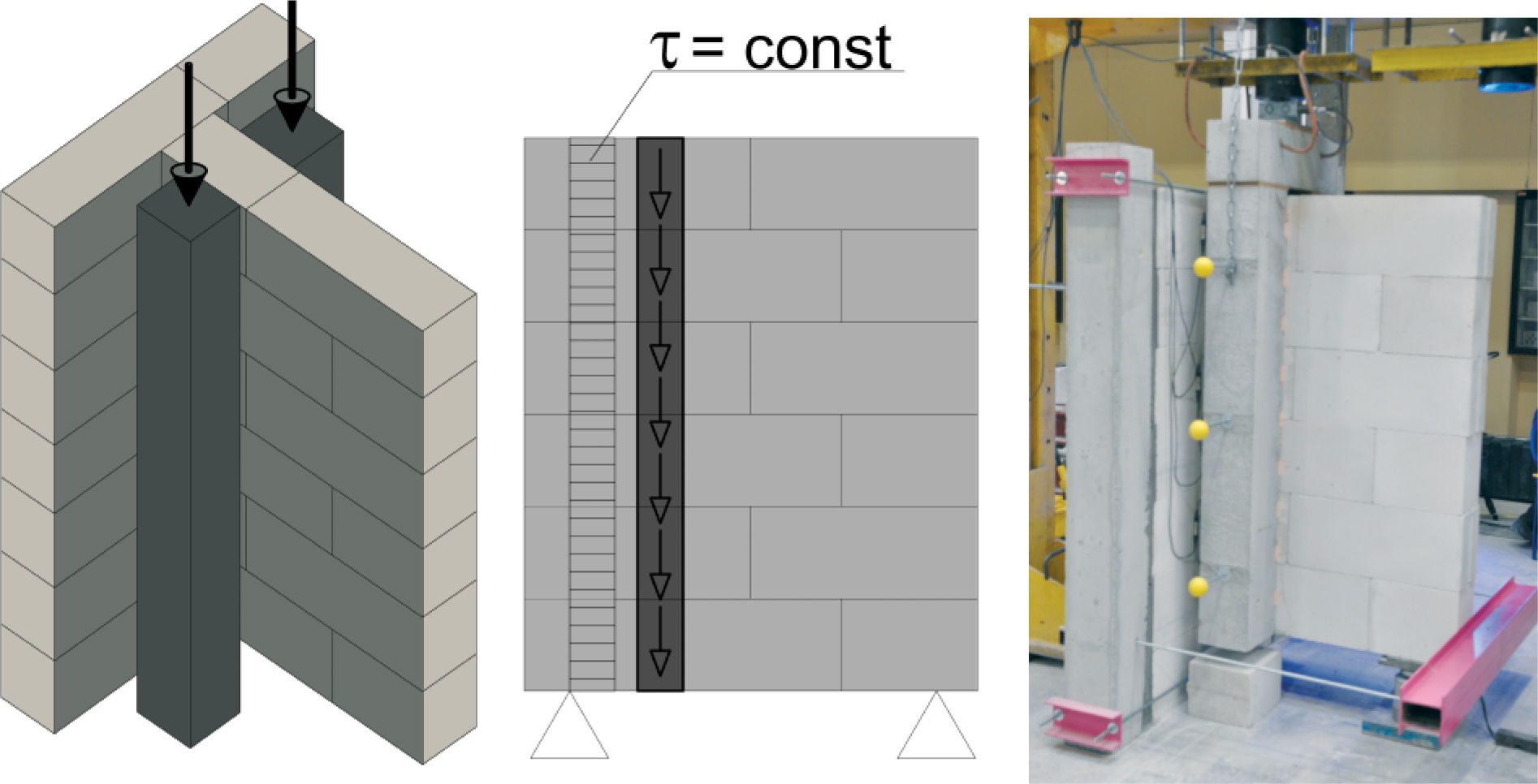
Figure 1.
Scheme and view of the modified testing set-up
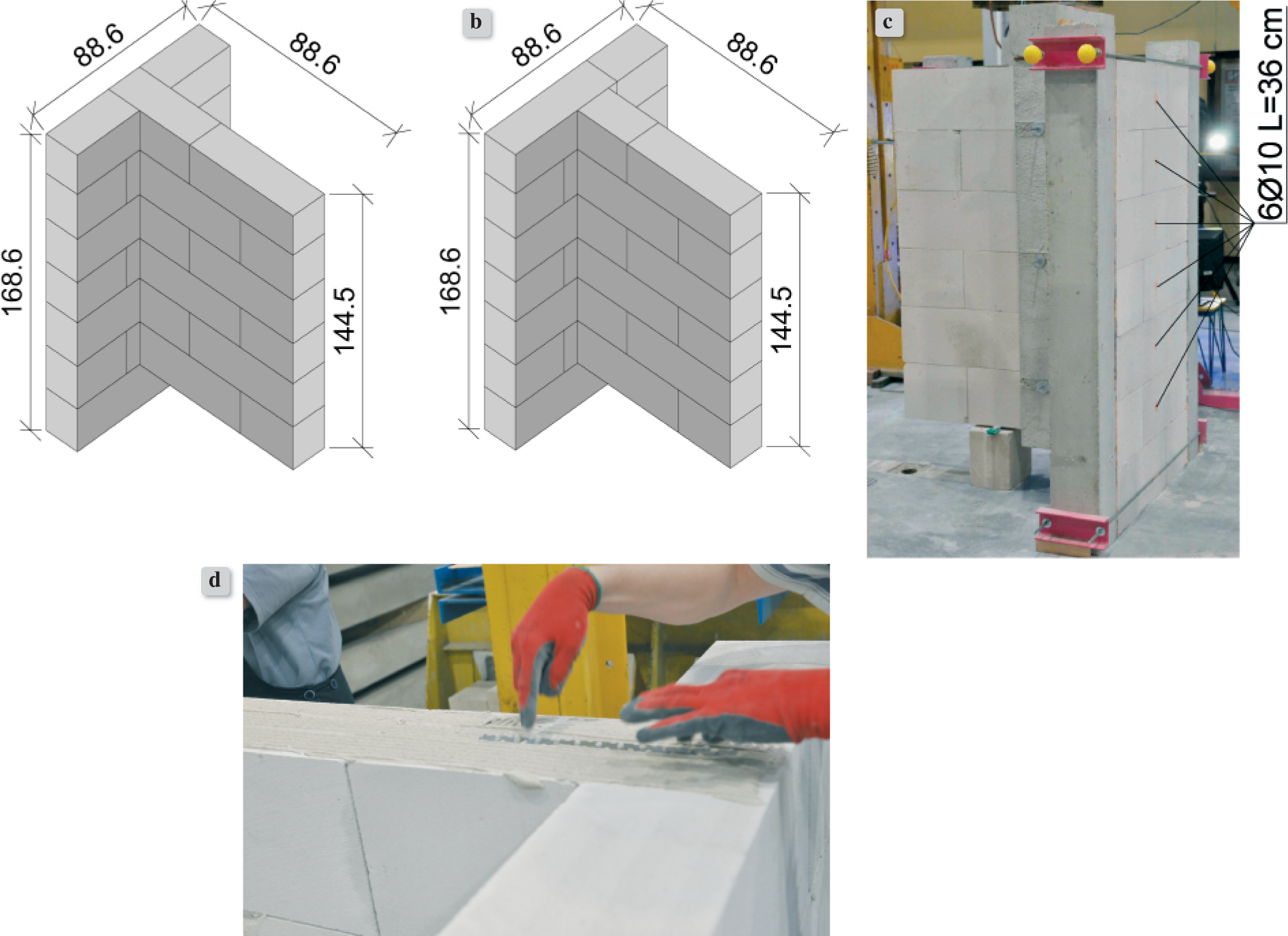
Figure 2.
Geometry: a) of P type reference masonry wall, b) masonry walls with steel connectors (wall B and F), c) method of the anchorage with steel punched flat profile, d) method of connection with a wall junction strip
Table 1.
Testing program
| Series name | Type of joint | l mm | A mm2 | I mm4 | fy N/mm2 | Es N/mm2 | No. of walls in series |
|---|---|---|---|---|---|---|---|
| P | Traditional masonry bond | -- | -- | -- | -- | -- | 3 |
| B | Perforated wall junction strip b×t= 22×1 mm
| 300 (300 t) | 22 | 1.83 | 144 | 66225 | 3 |
| F | Steel bar ϕ10
| 300 (30 ϕ) | 79 | 491 | 536 | 190500 | 3 |
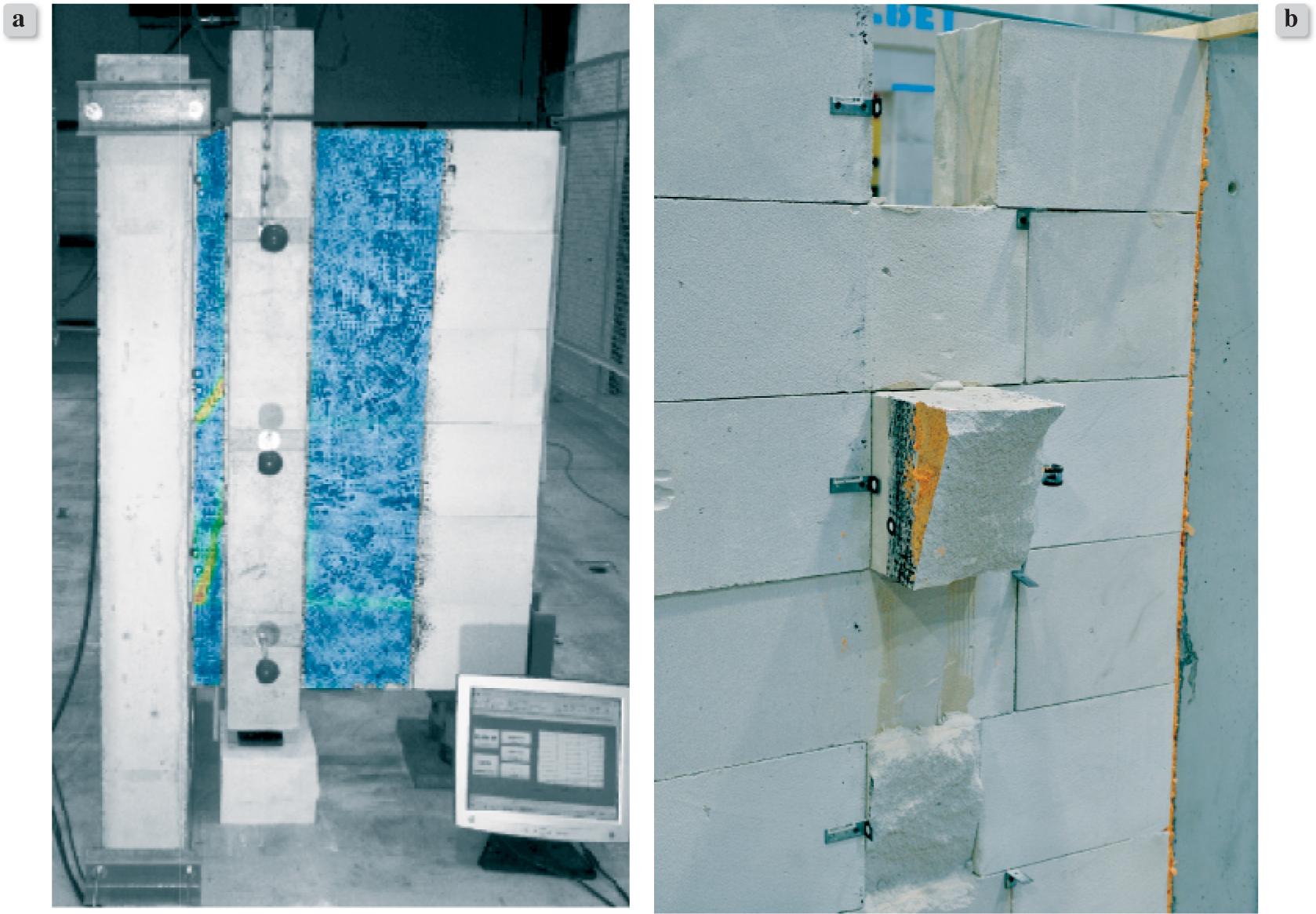
Figure 3.
Failure of a P series model a) first cracks in the reference model P_2 b) view of the joint at the moment of failure P_3
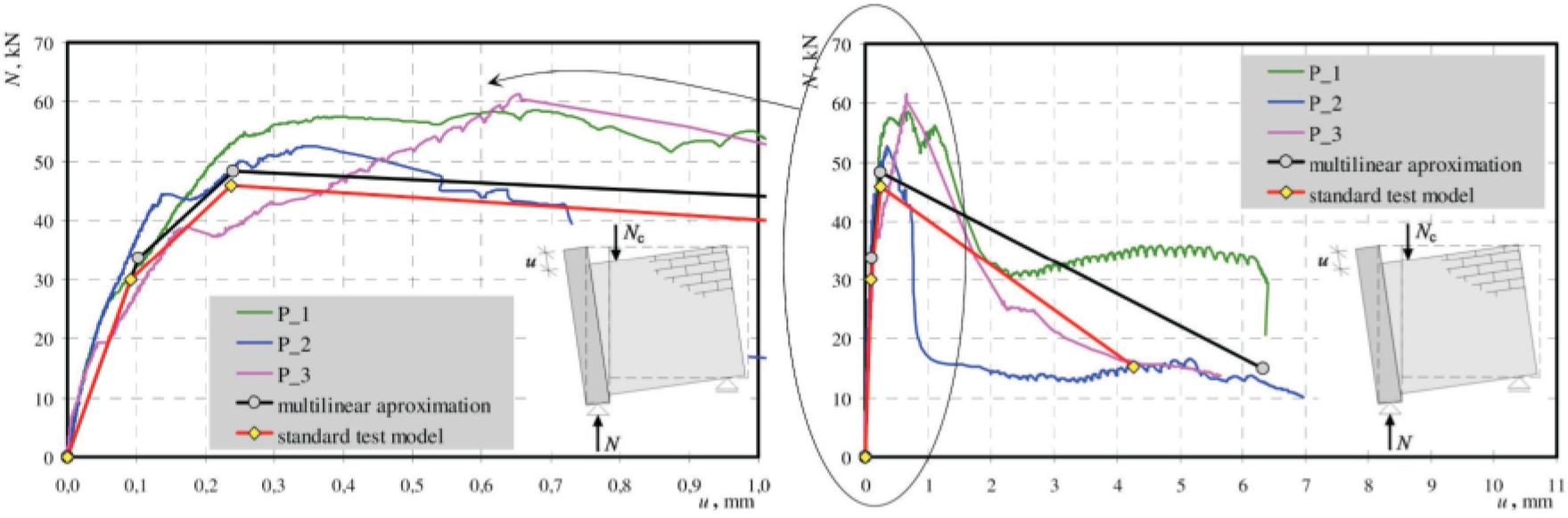
Figure 4.
Relationship between the total force and mean relative displacement of the joint – test and calculation results
Table 2.
Test results
| Model | Cracking force | Force at failure | Residual force | Displacement at the moment of cracking | Displacement right before failure | Residual dis-placement | ||||||
|---|---|---|---|---|---|---|---|---|---|---|---|---|
| Ncr kN | N cr,mv kN | Nu kN | Nu,mv kN | Nr kN | Nr,mv kN | ucr mm | ucr,mv mm | uu mm | uu,mv mm | ur mm | ur,mv mm | |
| P_1 | 27.3 | 33.7 | 56.3 | 48.3 | 20.7 | 14.9 | 0.07 | 0.10 | 0.31 | 0.24 | 6.36 | 6.32 |
| P_2 | 42.6 | 50.0 | 10.2 | 0.12 | 0.25 | 6.97 | ||||||
| P_3 | 31.2 | 38.6 | 13.8 | 0.12 | 0.16 | 5.64 | ||||||
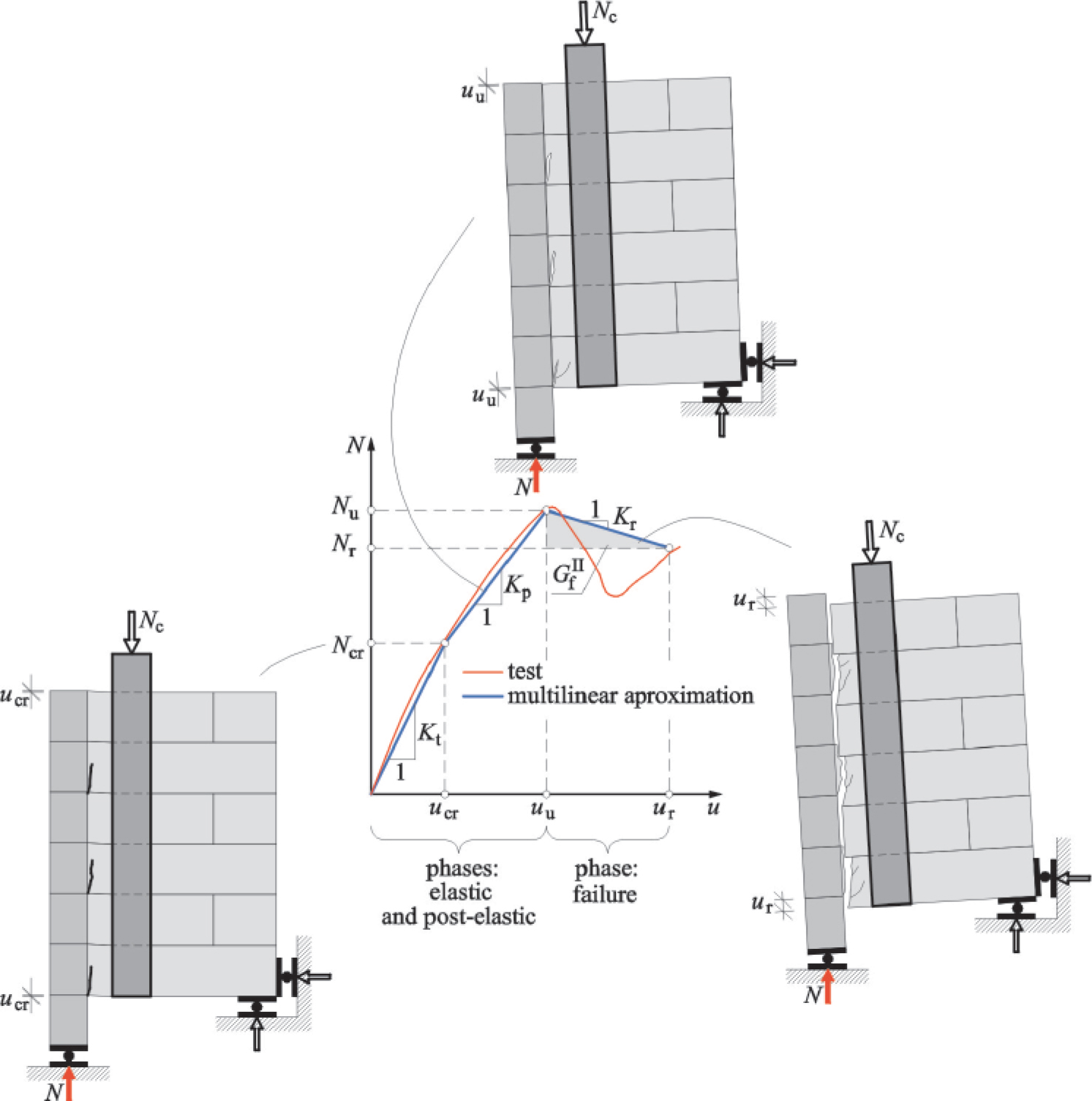
Figure 5.
Linear approximation of joint’s behaviour
Table 3.
Joint stiffness
| Model | Elastic joint stiffness | Residual joint stiffness | Residual force | |||
|---|---|---|---|---|---|---|
| Kt
MN/m | Kt,mv
MN/m | Kp
MN/m | Kp,mv
MN/m | Kr
MN/m | Kr,mv
MN/m | |
| P_1 | 413 | 341 | 119 | 114 | 6 | 5 |
| P_2 | 341 | 60 | 6 | |||
| P_3 | 268 | 163 | 5 | |||
Table 4.
Comparison of test and calculation results
| Joint model test | Calculation results | ||||
| Cracking force | Failure force | Residual force | Cracking force (7) | Failure force (9) | Residual force (11) |
| Ncr,mv
kN | Nu,mv
kN | Nr,mv
kN | Ncr
kN | Nu
kN | Nr
kN |
| 33.7 | 48.3 | 14.9 | 30.0 | 45.9 | 15.3 |
| Cracking dis-placement | Failure dis-placement | Residual dis-placement | Cracking displacement (6) | Failure dis-placement (8) | Residual force (10) |
| ucr,mv
mm | uu,mv
mm | ur,mv
mm | ucr
mm | uu
mm | ur
mm |
| 0.10 | 0.24 | 6.32 | 0.09 | 0.24 | 4.27 |
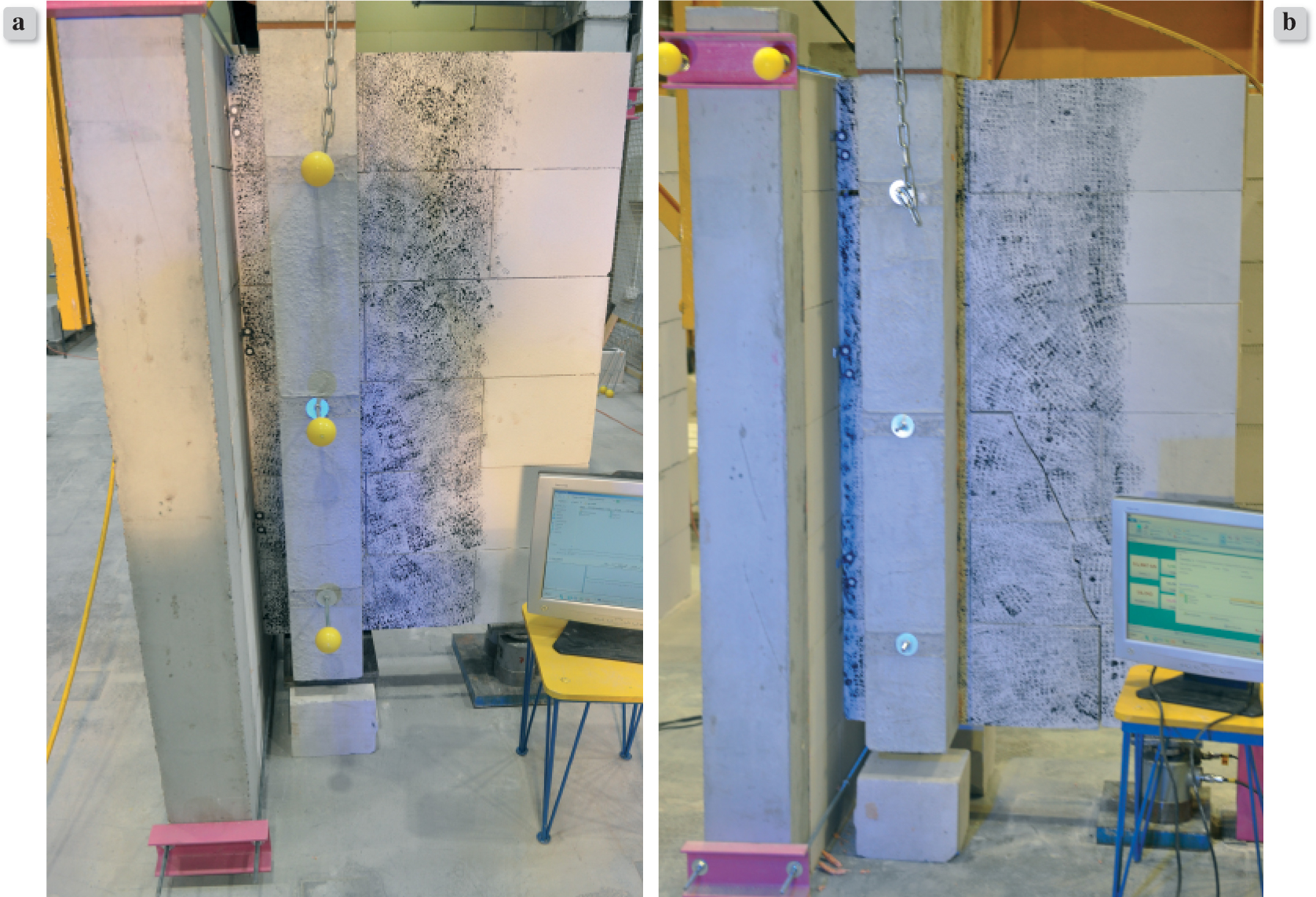
Figure 6.
View of the models at the moment of failure: a) model B_2 with wall junction strips, b) model F_3 with bars
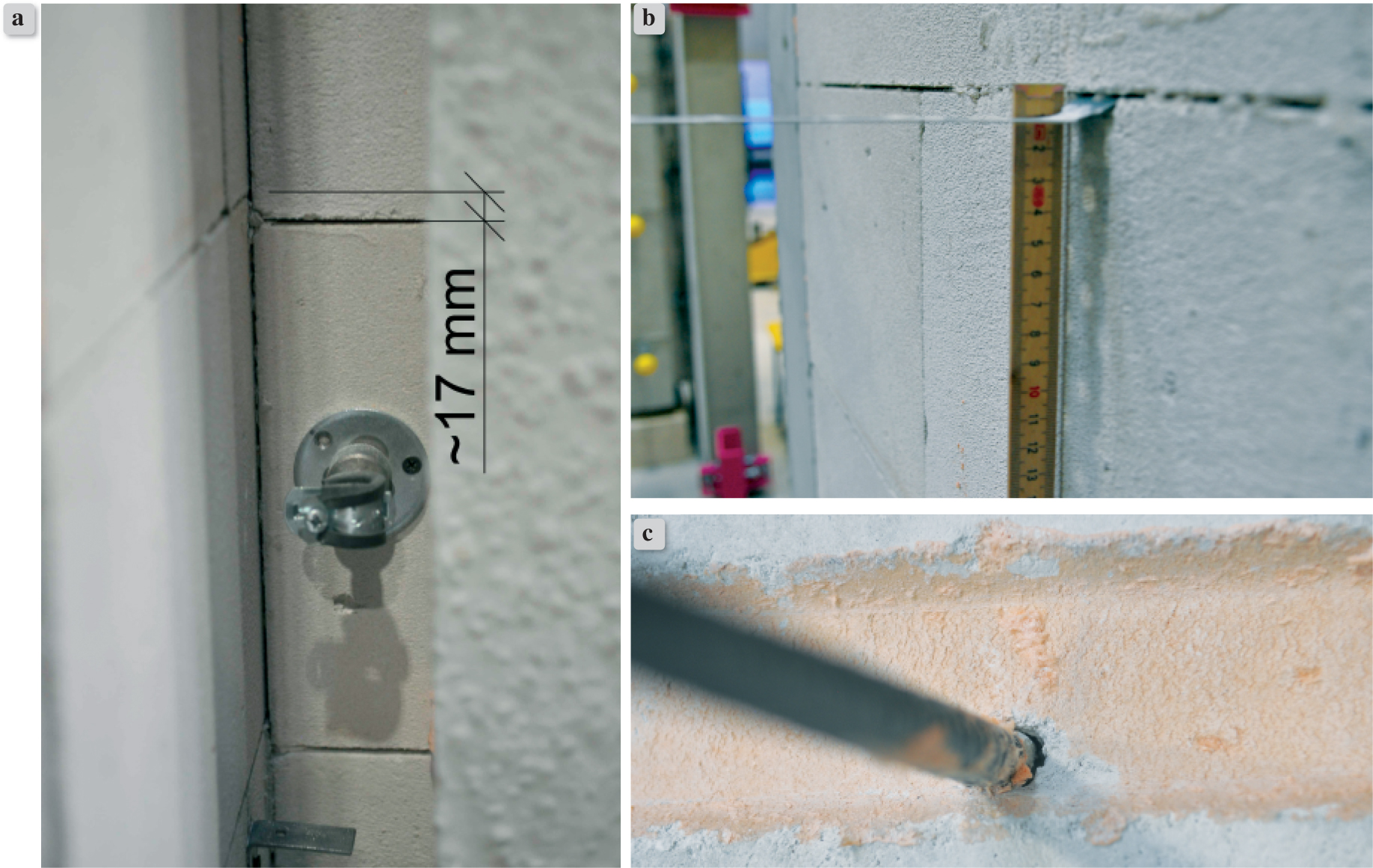
Figure 7.
Failure of B and F series models a) view of a damaged model with dimensioned displacements between the bed joints in perpendicular walls (B_1) b) typical cambers in the wall junction strip flat profile within the joint (B_3) c) view of a bar joining the walls, pulled out after the test (F_2)
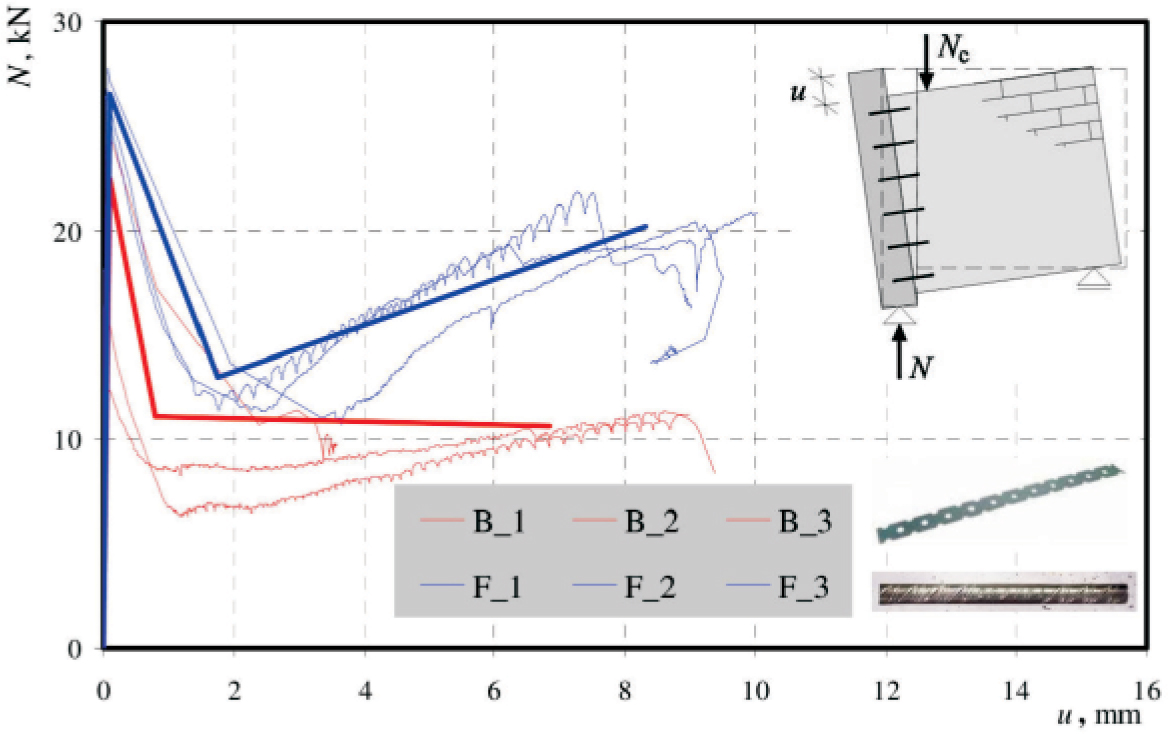
Figure 8.
Relationship between the total force and mean relative displacement of the joint
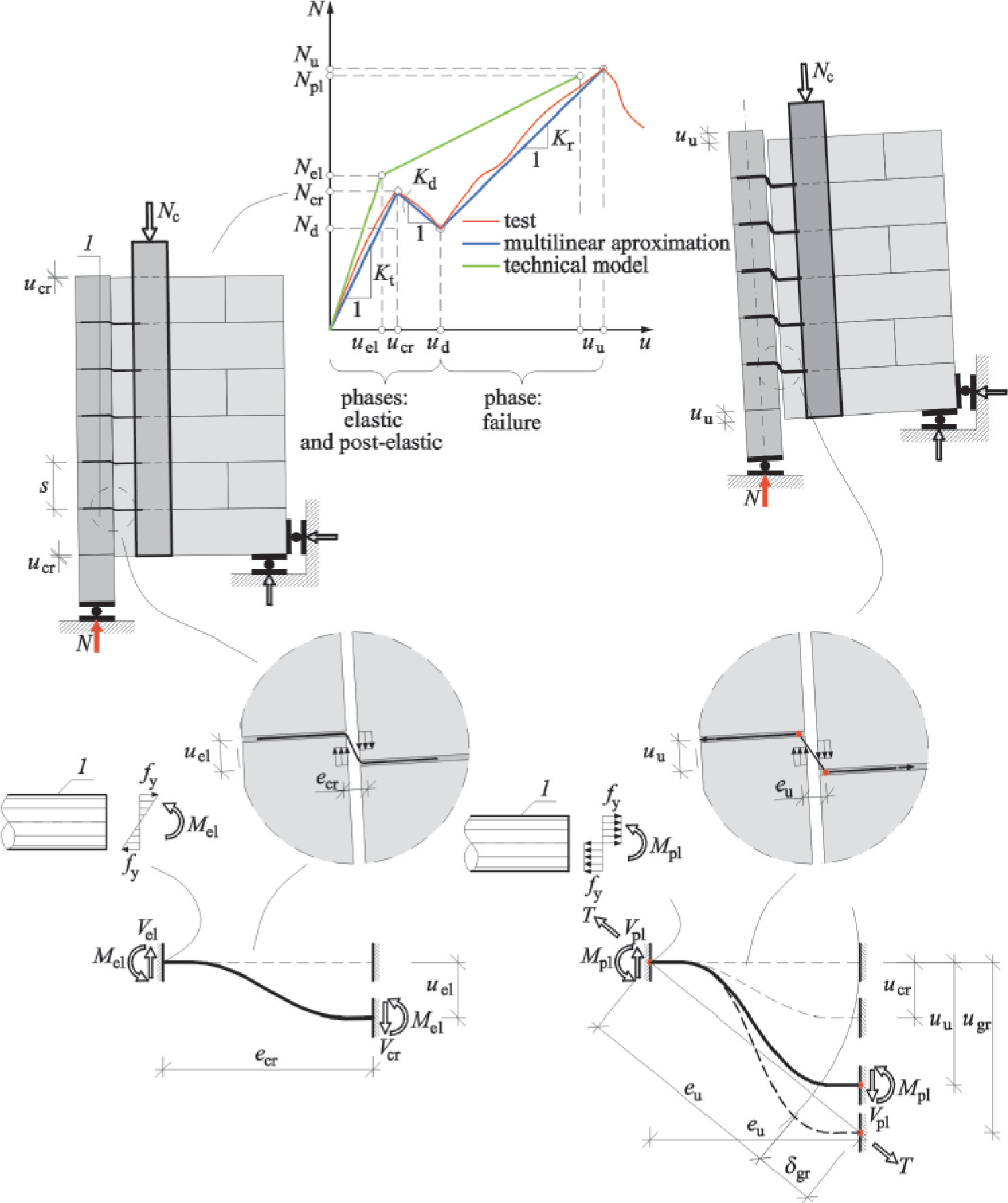
Figure 9.
Linear approximation of work of reinforced joint (1 – connector)
Table 5.
Test results
| Model | Cracking force | Dowel force | Force at failure | Displacement at the moment of cracking | Dowel displacement | Displacement right before failure | ||||||
| Ncr
kN | Ncr,mv
kN | Nd
kN | Nd,mv
kN | Nu
kN | Nu,mv
kN | ucr
mm | ucr,mv
mm | ud
mm | ud,mv
mm | uu
mm | uu,mv
mm | |
| B_1 | 24 | 17.6 | 17 | 11.1 | 10 | 10.6 | 0.12 | 0.09 (0.09t) | 0.82 | 0.80 | 3.36 | 6.86 (6.86t) |
| B_2 | 16 | 7 | 11 | 0.05 | 1.06 | 8.60 | ||||||
| B_3 | 12 | 9 | 11 | 0.09 | 0.52 | 8.61 | ||||||
| F_1 | 25 | 26.5 | 13 | 13.0 | 21 | 20.2 | 0.12 | 0.09 (0.9ϕ) | 1.29 | 1.75 | 6.96 | 8.31 (0.83ϕ) |
| F_2 | 28 | 14 | 20 | 0.07 | 1.94 | 9.17 | ||||||
| F_3 | 27 | 12 | 19 | 0.08 | 2.01 | 8.81 | ||||||
Table 6.
Joint stiffness
| Model | Elastic joint stiffness | Residual joint stiffness | Residual force | |||
|---|---|---|---|---|---|---|
| Kt
MN/m | Kt,mv
MN/m | Kd
MN/m | Kd,mv
MN/m | Kr
MN/m | Kr,mv
MN/m | |
| B_1 | 202 | 221 | 10 | 9 | 3 | 1 |
| B_2 | 330 | 9 | 1 | |||
| B_3 | 132 | 7 | 0 | |||
| F_1 | 215 | 320 | 10 | 8 | 1 | 1 |
| F_2 | 400 | 8 | 1 | |||
| F_3 | 344 | 8 | 1 | |||
Table 7.
Lengths of connectors determined based on the condition of forces acting in the joint
| Type of connector | Elastic phase | Post-elastic phase | Failure phase | Mean value |
|---|---|---|---|---|
| ecr,mv
mm | ed,mv
mm | eu,mv
mm | e
mm | |
| B | 0.35 (0.35t) | 0.56 (0.56t) | 0.87 (0.87t) | 0.59 (0.59t) |
| F | 23.8 (2.4ϕ) | 48.6 (4.9ϕ) | 53.0 (5.3ϕ) | 41.8 (4.18ϕ) |
Table 8.
Calculated lengths of connectors
| Type of connector | Displacements | Forces | Ultimate displacements | |||||
|---|---|---|---|---|---|---|---|---|
| Elastic phase | Failure phase | Elastic phase | Failure phase | Assumptions of the method | Condition of the connector’s rapture (21) | |||
| uel
mm | upl
mm | Nel
kN | Npl
kN | uel,gr
mm | ugr,y
mm | |||
| B | 2.48·10-4 | 3.72·10-4 | 10.4 | 15.6 | 1.69 | 0.68 | 0.02 mm (0.02t) | 0.04 (0.04t) |
| F | 1.64·10-1 | 2.78·10-1 | 15.1 | 25.6 | 1.76 | 0.79 | 1.19 mm (0.12ϕ) | 3.14 (0.31ϕ) |
Table 9.
Lengths of connectors determined from the conditions of displacements
| Type of connector | Elastic phase | Failure phase | Limit length of the connector |
|---|---|---|---|
| eel,u
mm | epl,u
mm | egr
mm | |
| B | 11.2 (11t) | 80.5 (80t) | 300 t |
| F | 30.7 (3.1 ϕ) | 228.5 (22.9 ϕ) | 30 ϕ |
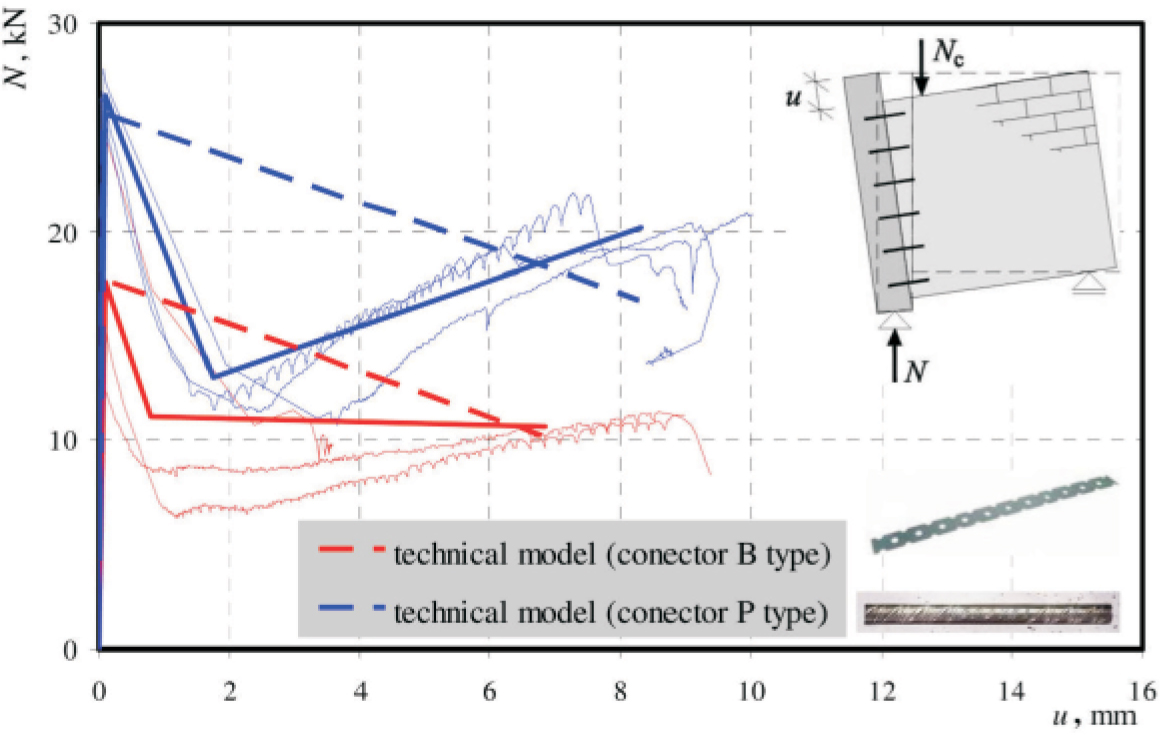
Figure 10.
Comparison of test results with the calculation results according to the engineering model