
Even before becoming a librarian, or having an idea that I would choose librarianship for a profession, I enjoyed visiting libraries. As a child growing up in Greenville, South Carolina, I have a vague memory of the old public library, which was a Carnegie building, and fondly remember the “new” library with its sleek late 1960’s modern style—a look, that has since been replaced. My first experience with a large research library while I was in graduate school at the University of Wisconsin-Madison was initially as a student, then as a student worker for the European history bibliographer. In that role, I worked across several library departments, and this increased my understanding of how multi-faceted a library, particularly a research library, can be. I was in awe of the vastness of Memorial Library and the services that were cutting edge. It seemed foretold in some way that I would make a career in a library. This stimulated an interest in visiting other noteworthy libraries. My first visit to the Library of Congress took place on a whim while visiting the nation’s capital on a trip in the 1980’s, although that was just to the library’s museum to view some of the rare items. I revisited during my first ALA conference in Washington DC in 2007, when a reference librarian showed me the main reading room. Since I was working in circulation at my own library at the time, I was taken down below to see how the retrieval process worked. It had not changed much since the late 19th century, with a combination of vacuum tubes and a belt system.
I like visiting libraries wherever I travel, whether I am on vacation or traveling on library business. Earlier this year, I traveled to Berlin, Germany, for a 10-day vacation. In my sightseeing, I planned to visit the Berlin State Library located on the Unter den Linden. It was convenient, because it was near my hotel, and so many historic and cultural sites are located on that avenue, such as the Bebel Platz, where the first Nazi book burning took place in 1933. Nearby are the museums of Museum Island, where I had already spent the morning seeing the famed bust of Queen Nefertiti and the collection of German Romantic painting at the Old National Gallery with the Brandenburg Gate—my ultimate destination—at the far end. In any case, I had hoped to find some kind of exhibit hall or museum or find someone to talk to, but I was not successful in that venture. A security desk at the top of a grand flight of stairs was all I found. No doubt I should have made an appointment in advance to see some of the library’s great collections, but having read about the popularity of the library and its branches with the public, I expected it to be relatively easy. Being already tired at that point probably was not conducive to asking questions, either.
One part of my job at the H. C. Hofheimer II Library at Virginia Wesleyan University where I am also the Head Librarian is managing interlibrary loan (ILL). Over the years, I have developed a special interest in interlibrary loan, and so I seek opportunities to visit other libraries and meet with their ILL departments. This time, I made an advance appointment to visit the Jakob- und Wilhelm Grimm Library of the Humboldt University of Berlin in advance of my trip. ILL land is pretty informal, and I was put in touch with one of the members of the interlibrary loan department, Natalie Schlottke. I was asked to communicate in advance what I specifically wanted to talk about, and a one-hour meeting time was agreed upon.
When I arrived at the library (Figure 1), Natalie met me at the information desk, and from there we first went to the office which she shares with another colleague to work on managing borrowing requests. In the course of the hour, which turned into two, I learned about the system for processing requests (they use Alma), the workflow management, and staff training. I was surprised that there was less automation in their software and workflow, which is in any case more complex in a library with millions of holdings. On the subject of staff training, particularly student workers, we had similar experiences with learning time on our respective platforms, but I seem to continue to be in a minority that believes student workers can be trained on borrowing, which is more complex than lending and requires some research skill. I also learned about the peculiarities of German copyright law and interlibrary loan, for example, that PDFs cannot be shared, and that book chapters and articles must be printed and delivered. Students and faculty are also charged €1.50 (about $1.65) per submission, although users in this country typically are not charged for the service. If they fail to provide sufficient information in the request work form, or the request gets cancelled because the library already owns it, there is no refund. In turn, we discussed my ILL operation and I was able to demonstrate how it works (more smoothly in my opinion!). The time spent at the library also included a tour through their award-winning building (Figures 2 and 3), a visit to the special collections department to see the Grimm’s book collection, and witnessing the installation of a new system for sorting book returns and sending them to the correct floor for reshelving.
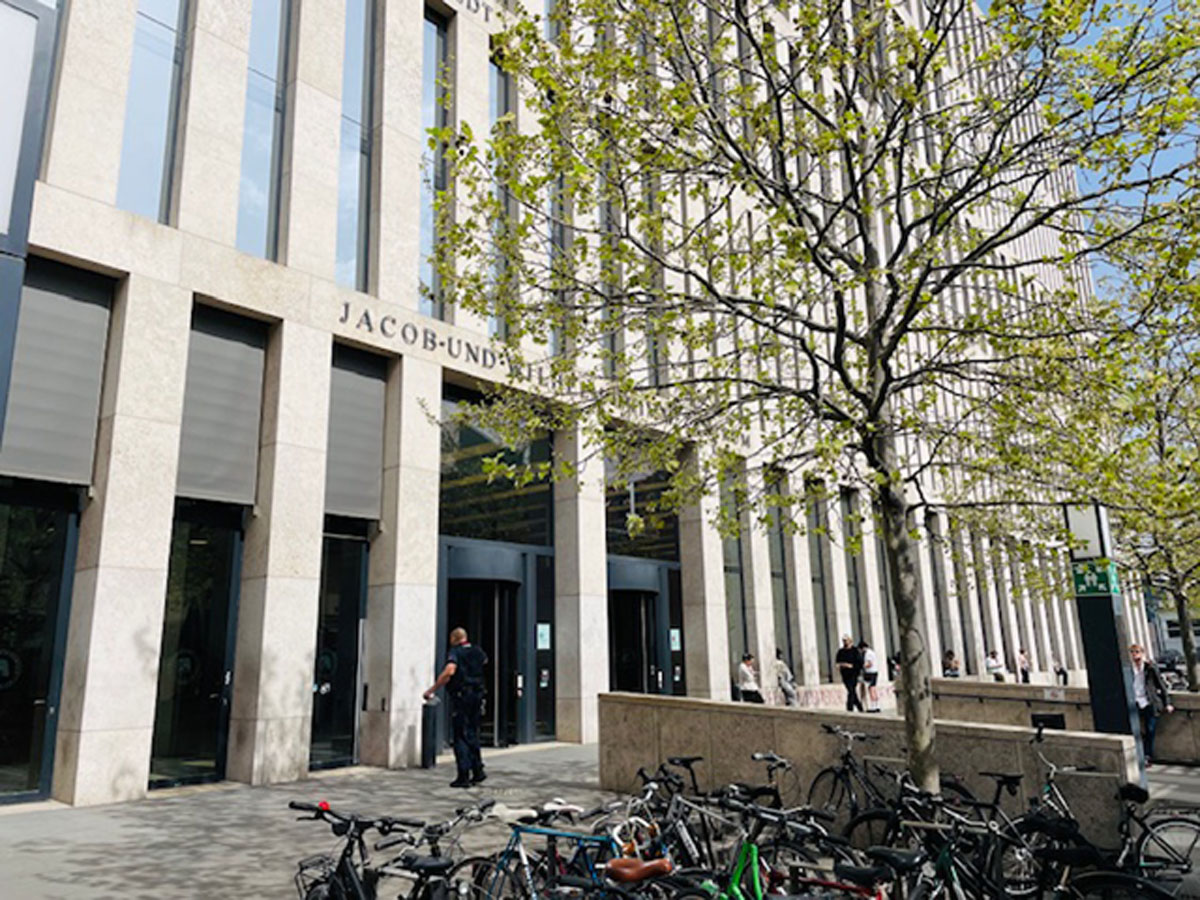
Figure 1
Jakob- und Wilhelm Grimm Library entrance.
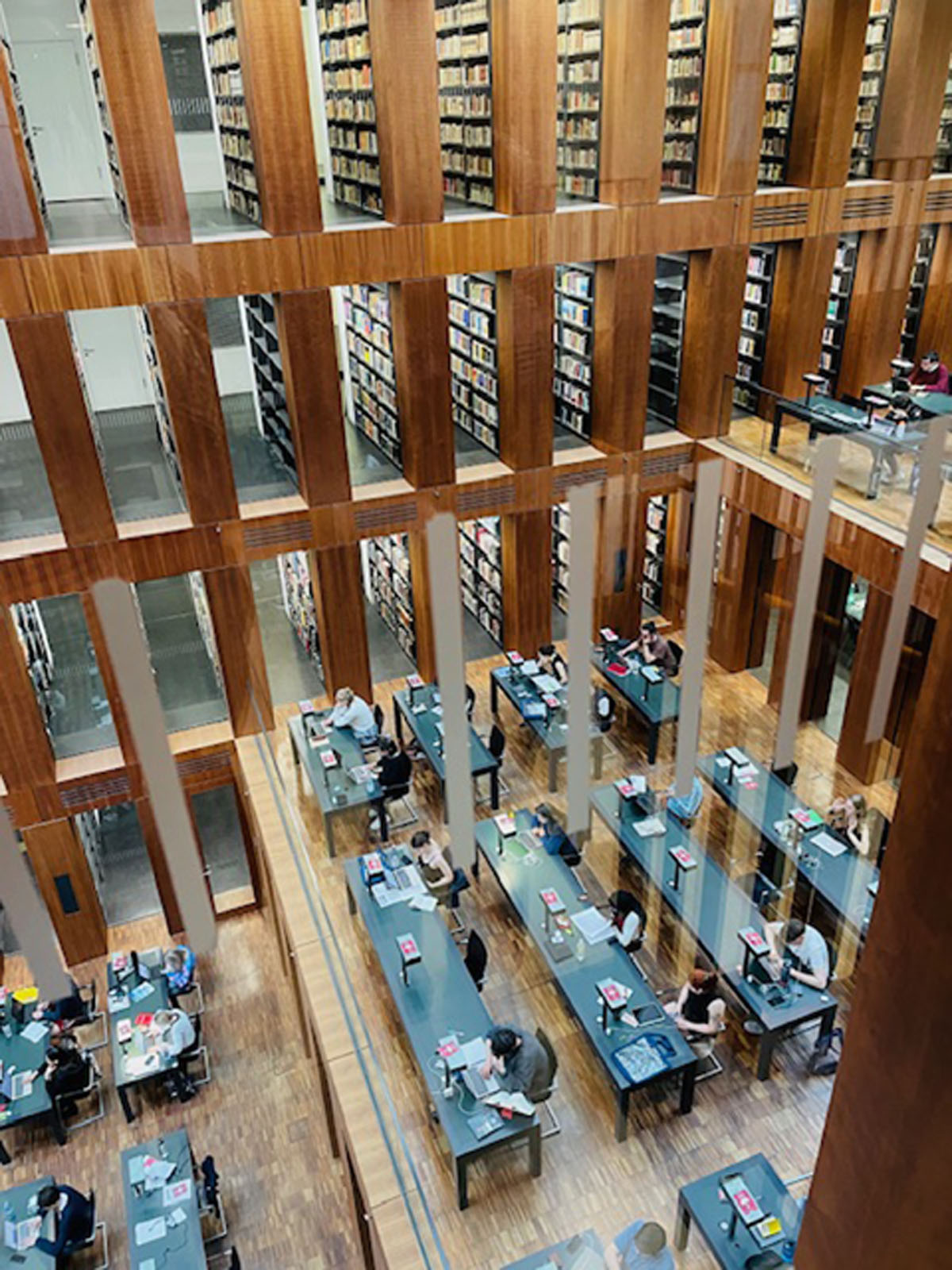
Figure 2
Grimm Library Reading Room.
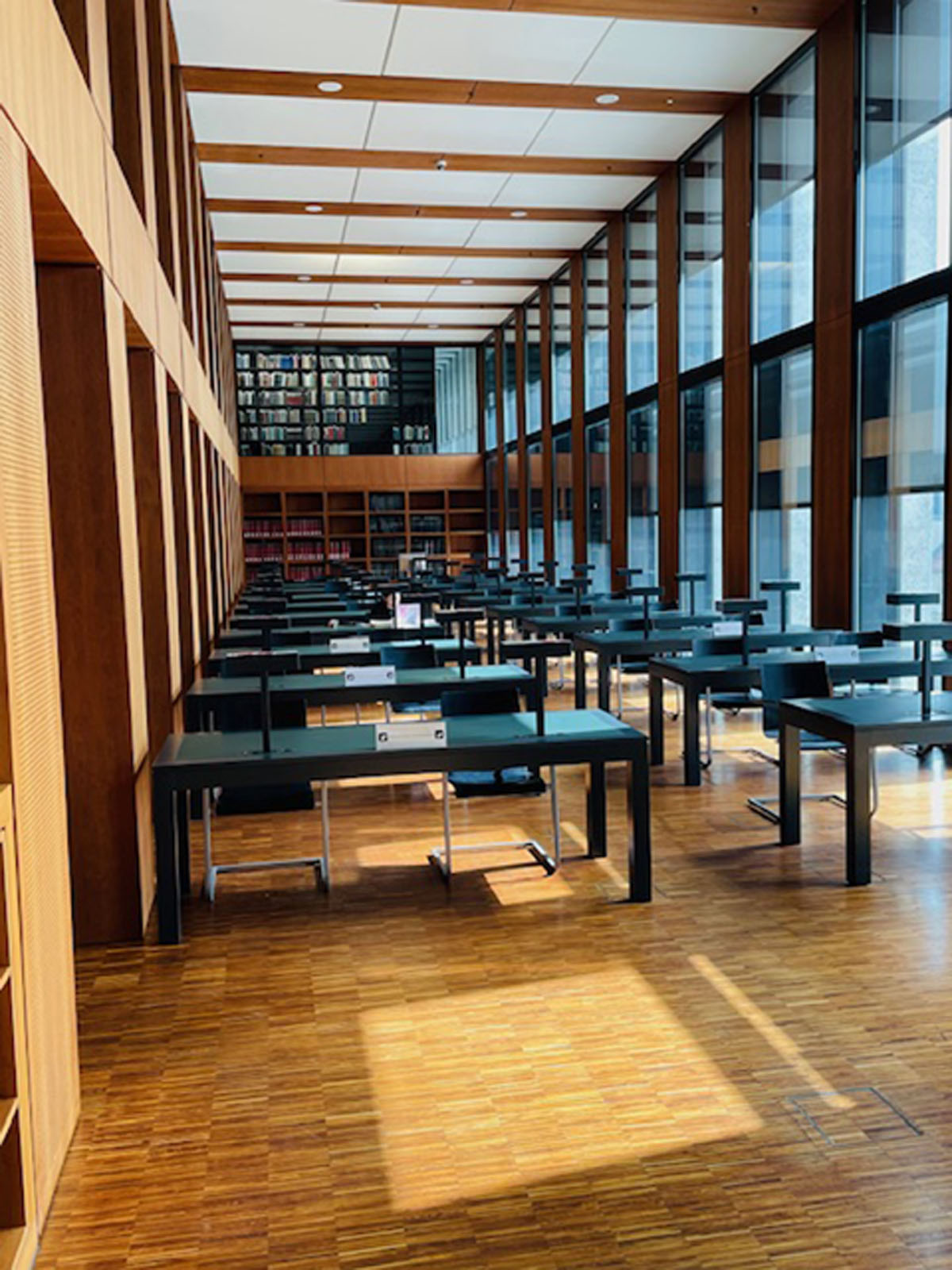
Figure 3
Grimm Library Special Collections.
Beyond the many things I learned during my visit, an equally important benefit was making a new personal contact. Time will tell if we can become ILL suppliers to one another, as we do supply some European libraries. Within a couple weeks of my return, Natalie contacted me to ask about other Alma libraries, as someone in her department was looking for an internship in an Alma library in the United States. I sent her a list of the Alma libraries that I knew of in Virginia, hopeful that a Tidewater-area library could come through with a suitable opportunity.
So, I encourage librarians to visit other libraries, whether locally or in other travels. We can learn so much from one another in the exchange. One of the things I miss since COVID is that area meetings seem to remain stuck on Zoom, rather than going back to in-person. During my earlier years here in Tidewater Virginia, getting out and visiting the other libraries was so important to my work. One of the connections I made later became instrumental in my promotion in rank, by providing a required external professional reference. While Zoom was very helpful during the pandemic to keep services going to assist library users and stay in touch with one another, it has proved to be perhaps too much of a good thing. Maybe we save money and time not having to drive somewhere, but we are losing the value of in-person connection, and the ability to learn first-hand what is happening in other libraries of all kinds is severely limited. I have always gained something, whether it is collections, operations or improving my library instruction, and I hope that what I have shared has helped others. This just cannot be done via Zoom or similar video conferencing platform. Other learning experiences I look back on include: happening to be in Minneapolis when the new public library had its grand opening. This was the first time I encountered self-checkout, a brand new and expensive technology at the time. While vacationing in Belize and stopping in to the Belize City library, I experienced how a library with few resources, many of which were outdated, can still transform lives. Their lack of resources challenged me to learn to be creative with what I have.
Ours is a profession committed to life-long learning. As we encourage our library users to embrace this ideal, one way we practice it ourselves is by engaging one another and visiting each other’s libraries. It is easy to think that our own situation may not be so interesting, but the contrary is often the case. Go visit, and invite others in!