
Libraries serve their communities in ways that other institutions cannot. As many as 76% of all Americans report that libraries provide important, long-standing resources for their families.1 In rural locales, the public library is valued as a highly trusted anchor institute for its ability to share information and support within the community.2 Equitable access to technology, the internet, and information may seem out of reach for some rural families; yet, rural libraries are uniquely positioned to provide vital services—free access to public computers, internet, health and general information, children’s programming, community meeting spaces, etc.—and, of course, books.3
Library access to children’s books plays an important role in supporting public education and literacy initiatives in rural communities. Children’s books provide opportunities for inclusive and equitable learning experiences by providing opportunities to explore various portrayals of reality including the human condition.4 Through books, a child’s understanding of their own world is enhanced while also learning about the world of others, ultimately contributing to their understanding of place and sense of identity.5 When children see themselves reflected back in books, they recognize similarities and differences that enable moving beyond a one-dimensional view of themselves and the world.
Children’s books depicting authentic representations of rurality affirm student identities and connections to their rural culture in positive ways.6 Rita Sims Bishop summarizes the mechanism behind such connections through an eloquent metaphor comparing texts to mirrors, windows, and sliding glass doors:
Books are sometimes windows, offering views of worlds that may be real or imagined, familiar or strange. These windows are also sliding glass doors, and readers have only to walk through in imagination to become part of whatever world has been created or recreated by the author. When lighting conditions are just right, however, a window can also be a mirror. Literature transforms human experience and reflects it back to us, and in that reflection we can see our own lives and experiences as part of the larger human experience. Reading, then, becomes a means of self-affirmation, and readers often seek their mirrors in books.7
Unfortunately, when it comes to children’s books, rural readers are unlikely to find the self-affirming mirrors they seek.
Given the great care librarians take in selecting books for library holdings, it is perhaps surprising that rural contexts are all too often absent in children’s library book collections. The American Library Association recommends building library holdings through a process grounded in established practices and policies.8 Librarians are charged with developing and adhering to policy that establishes book selection and acquisition protocols. Such policies and procedures are often operationalized with flexibility at the local level in order to meet community-based needs; however, threads of commonality across policies exist.9 For example, representation of diversity and inclusion within library holdings is a widely accepted hallmark principle undergirding collection development.10
Despite holding to an ideal of diverse representation in library holdings, rural books in particular remain absent in many children’s book collections.11 Research points to three hypotheses for this seemingly perplexing disconnect. First, there are very few books that accurately portray rural people and culture.12 A review of available children’s literature reveals a paucity of authentic rural texts.13 For example, Eppley found in her analysis of picture books that only a fraction of texts portray rural life, sending a message that the culture of rurality is irrelevant in modern times.14 Parton reported similar findings in her review of young adult literature, pointing to an alarming incongruence between (1) the portrayals of rural students and representation of place in children’s literature, and (2) the rural readers they presume to represent.15 Such findings highlight a wide gap in authentic-based rural literature across a range of library holdings from picture books to young adult books.
Second, researchers hypothesize that many tasked with collection development simply fail to recognize rural as an element of diversity.16 The lived experiences of students situated within rural contexts shape student identities in unique ways that matter for learning; yet, mirrors that reflect a mismatch with students’ rural identities often lead to alienation of rural students in the classroom.17 To draw attention to this phenomenon, several organizations, such as the Center for Rural Literature (CRL) and Dr. Parton’s Literacy in Place (LIP), have taken steps in recent years to curate lists of recommended children’s books vetted for authentic portrayals of rural contexts, making it easier for librarians to quickly identify appropriate rural books across a range of library categories (picture books, middle grades, and young adult). Very little is known, however, about how librarians in rural communities use such resources to inform their children’s library collection development.
Third, rural areas often house small public libraries with limited funding, which in turn may impact purchasing power for children’s books.18 However, a library consortium—whether local, regional, or national—offers a collaborative solution while reducing costs for its members.19 Regional library consortiums (RLC) are a promising way to expand access while increasing the total number of available resources.20 Furthermore, the use of a delivery service by an RLC may further broaden access at no cost to the patrons.21
Regional comprehensive university (RCU) libraries, particularly those with educator preparation programs, stand to contribute to RLC partnerships in many ways. RCU libraries often house extensive children’s and young adult library collections in an effort to support pre-service teachers, graduate students, researchers, and other community library patrons.22 RCU collections are typically developed in collaboration with educational faculty members who teach, conduct research, and engage long-term with rural schools within their region. Faculty conduct school-embedded student-teacher observations across their regions and frequently provide professional development opportunities for local school divisions. In these ways, RCU libraries are rooted in place within their regions—with access to rural schools in ways not afforded to other community libraries—leaving RCUs especially well-poised to support authentic portrayals of rural life.23 Nevertheless, while RCU libraries are intuitively thought to increase access to children’s books depicting authentic portrayals of rural life, whether this is the case remains largely unexplored by the research.
Even if the participation of a regional university in an RLC expands the volume of books available for circulation within the local community, very little is known about whether increased book volume actually expands the diversity of books available for circulation. For example, the major award-winning books such as the Caldecott or Newbery Award winners are likely to be found in every library’s children’s book collection across an RLC.24 Replication of award-winner book holdings within a consortium is understandable, however, one might wonder whether additional consortium collection overlap exists and at what consequence to overall access and diversity. Such concerns beg the question: Out of the thousands of children’s books published each year, what factors influence a consortium’s overall library collection development, and do these factors result in an increase in both volume and diversity of available books for circulation within rural communities? More specifically, how well do library consortiums situated within geographically rural areas answer the call to provide books that are reflective of the communities in which they serve?
In Summary
The ability to tap into a regional consortium of libraries may provide greater access to a broader collection of diverse books, particularly in instances where small individual rural communities lack extensive funding for library collection development. However, how consortiums develop collections in tandem and/or share resources is not well understood in the field. Therefore, the aims of the current exploratory study are to examine the RCU children’s library holdings for inclusion of texts depicting rural life and to investigate whether membership in a regional library consortium broadens access to rural-based children’s literature. The specific research questions included:
How many books in the rural consortium’s children’s collection represent life in rural places?
Within rural book holdings, what variation exists in terms of the number of books available for circulation across the target audiences (e.g., picture books, middle grades, and young adults)?
What is the change in availability of rural-based texts when joining a consortium?
Methods
Participants
Children’s book holdings within a regional library consortium were examined for inclusion of portrayals of authentic rural contexts. At the time of this study, the regional library consortium was newly formed and in existence for approximately one month. The RLC consisted of four libraries—one small public regional comprehensive university (RCU), one small private college, and two public libraries. The RLC libraries are located within a mid-Atlantic geographical region that includes two counties. According to the US Department of Agriculture, a rural area is defined as one that is not urbanized and has a population of fifty thousand or less.25 The area served by the RLC is designated as highly rural because its population falls between 97-100% rural.26
The RCU has a strong 175-year long history of preparing teacher educators. Approximately ten percent of the 4,300 undergraduate students are education majors, completing multiple student-teaching placements within regional schools prior to matriculation. Additionally, the RCU offers eight graduate degrees, seven of which are education-based programs. The RCU’s library, located on campus, is staffed by six librarians, of which two are specifically assigned to support and liaise directly with education faculty for collections development purposes.
The small private college with an enrollment of approximately 850, while participating in the RLC, does not offer education-related degree programs. Three librarians support collection development, collaborating with faculty for the selection of books.
Two public libraries’ children’s book collections were available for analysis. For the purposes of this study, the collections were combined, resulting in one collective public library database of children’s books for review.
At the time of the study, the overall number of library holdings and the children’s collection within, respectively, were as follows for each member of the RLC: RCU (346,860; 23,888), small private college (307,541; 6,159), and two public libraries (74,953; 26,762).
Rural Book Identification Tool
The Center for Rural Education (CRE) at Virginia Tech maintains a list of current children’s books depicting authentic representations of rural places and people. The list of anchor book titles (n = 388) is publicly available on the CRE website (https://rural.vt.edu/rural-literature-library/), and is organized by the following target audiences: picture (n = 71); middle grade (n = 208); and young adult (n = 109). The CRE children’s booklist served as the foundation for the current study’s collection analyses.
Procedures
Data for inclusion in the study were collected by comparing RLC library holdings to the CRE booklist titles. Using the title search feature, each book on the CRE booklist was entered to probe the consortium database of book holdings to determine (1) whether the title was present, and (2) which library held the title. As CRE booklist titles were found present within the consortium’s book holdings, data from the title search were collected in an Excel spreadsheet and tallied according to the following elements: book call number, owning library, format type (electronic, hard copy, DVD, etc.), award winner status, and price. If multiple versions of a title were found in the initial title search, both title and author were added to the search process to clarify and distinguish those with an exact match to the CRE booklist. The identified titles were sorted into target audiences in line with the CRE booklist framework: picture, middle grades, and young adult.
A review of the data took place across three phases. First, frequencies and percentages of rural identified books across target audiences were tabulated for each individual library and the combined consortium collection. Second, frequencies were reexamined with an eye for duplicity in book holdings. Book titles were tallied according to whether multiple copies of the book were housed in two or more library locations within the region. And third, to explore the frequency for which award books were selected in children’s book collections, award-winning books were coded according to (1) award won, (2) target audiences, and (3) the number of libraries holding the book in circulation. Frequencies and percentages were calculated by number of libraries holding duplicated titles as well as by award-winning status.
Data Analysis
Research Question 1: How many books in the rural consortium’s children’s collection represent life in rural places?
Frequencies of CRE titles were examined across libraries by target audiences (i.e., picture, middle grades, and young adult). Altogether, the consortium libraries owned a collective 209 books designated by the CRE as depicting authentic rural life.
The total number of identified books varied by library. Frequency counts of library holdings across two public libraries in the regional consortium resulted in a total of eighty-four total rural children’s books. Over half of the titles were found at the middle grade level (n = 48; 57%), followed by young adult (n = 25; 28%) and picture books (n = 11; 13%).
The small private college (n = 14) and regional comprehensive university libraries (n = 110) raised title frequencies within the rural region to 209 total children’s books with authentic rural representation based on the CRE list.
Research Question 2: Within rural book library holdings, what variation exists in the number of books available for circulation across children’s target audiences (picture books, middle grades, and young adults)?
The total frequency of the consortium holdings were broken down by target audiences: picture, middle grades, and young adult. Libraries within the consortium tended to have more middle grade books (n = 143; 68%) available for circulation than young adult (n = 46; 22%) or picture books (n = 31; 15%). See Table 1 for book title frequency counts and percentages by consortium library.
Table 1
Frequency and percentages of rural children’s book holdings by consortium library.
| LIBRARY | PICTURE BOOKS N (%) | MIDDLE GRADES N (%) | YOUNG ADULT N (%) | TOTAL N |
|---|---|---|---|---|
| Public Libraries | 11 (13%) | 48 (57%) | 25 (28%) | 84 |
| Private College | 2 (13%) | 11 (73%) | 2 (13%) | 15 |
| Regional University | 18 (15%) | 84 (70%) | 19 (16%) | 110 |
| Total | 31 (15%) | 143 (68%) | 46 (22%) | 209 |
Research Question 3: What is the change in availability of rural-based texts when joining a consortium?
Data were examined to determine whether book title frequency counts represented unique library holdings versus instances of multiple copies of the same book within the regional consortium. In total, over a quarter (n = 59; 28%) of the consortium’s rural book titles were found in at least two of the consortium libraries; fourteen (7%) of these titles were found in all three libraries. Of the duplicate titles, middle grade book holdings recorded the largest amount of redundancy (n = 41; 69%), while picture books recorded the least (n = 7; 12%). For more details on the overlap of book holdings across libraries and book categories, see Table 2.
Table 2
Frequency and percentages of redundant book holdings across libraries.
| DUPLICATE HOLDINGS | PICTURE BOOKS N (%) | MIDDLE GRADES N (%) | YOUNG ADULT N (%) | TOTAL N (%) |
|---|---|---|---|---|
| 2 Libraries | 5 (16%) | 30 (73%) | 10 (90%) | 45 (22%) |
| All 3 Libraries | 2 (06%) | 11 (27%) | 1 (1%) | 14 (07%) |
| Total Duplicates | 7 (12%) | 41 (69%) | 11 (19%) | 59 (28%) |
| (Percentage of total) |
To explore the potential influence of book award recognition on collection development, we examined the consortium’s duplicate title holdings according to award status. Overall, twenty-five books (42%) from the duplicated list were recognized with a prestigious book award and/or honor. Nine different types of awards were identified among the titles, with one picture book receiving more than one award. The Newbery Medal (n = 9; 35%) and Newbery Honor (n = 8; 31%) awards garnered the highest frequency counts among duplicate title awards, accounting for 65% of the total awards given and including recipients from across all three book categories.
Within the picture book category (n = 31), there were seven duplicated picture book titles, five (71%) of which were award winners. Within the middle grades book holdings (n = 143), forty-one titles were found within the children’s book collections at more than one library; of the duplicated titles, 46% were award winners. And finally, from the consortium’s total young adult books (n = 46), there were eleven duplicated titles, however, only one (.09%) was an award winner. For a listing of duplicate book awards received by book category, see Table 3.
Table 3
Frequency and percentages of duplicate books by award and category.
| AWARDING AGENCY | AWARD WINNERS BY BOOK CATEGORY | |||
|---|---|---|---|---|
| PICTURE BOOKS N | MIDDLE GRADES N | YOUNG ADULT N | TOTAL N | |
| American Indian Youth | 1 | 0 | 0 | 1 |
| Literature Honor Award | ||||
| Asian Pacific American | 0 | 0 | 0 | 0 |
| Awards for Literature | ||||
| Caldecott Honor | 2 | 0 | 0 | 2 |
| Caldecott Medal | 0 | 0 | 0 | 0 |
| Coretta Scott King Honor | 0 | 3 | 0 | 3 |
| Coretta Scott King Award | 0 | 1 | 0 | 1 |
| Newbery Honor | 1 | 6 | 1 | 8 |
| Newbery Medal | 0 | 9 | 0 | 9 |
| Robert F. Sibert Informational | 2 | 0 | 0 | 2 |
| Book Medal | ||||
| Total Awards | 6 | 19 | 1 | 26 |
| Percentage of Duplicate | (57%) | (46%) | (1%) | (44%) |
| Award Titles | ||||
[i] Note: The award frequency is higher than the total number of duplicate picture book titles (n = 5) because one picture book received more than 1 award.
Discussion
RLCs are uniquely situated to play a pivotal role in increasing access to children’s books for members of the rural communities they serve. In this study, the researchers examined the holdings of one RLC’s children’s collection to learn more about increased access to rural-based books with regard to both the volume and diversity of texts. In this case, membership in the RLC was found to expand access to available rural-based texts for the community. Total rural-based RLC holdings (n = 209) are more than double the number of texts held in the combined public and private college library inventories. The RCU was the largest single holder of texts containing authentic representations of rural people and places within the consortium. From the total rural-based consortium collection, the RCU owned over half of all book titles (n = 110; 53%) in the region. This data set suggests that the combined RLC holdings increased access to rural-based texts, with RCU emerging as a significant resource for community members. While it may be instinctive to conclude that joining a regional library consortium within a rural area would increase access to a greater number and variety of rural-based texts, this assumption was not fully supported when considering the variety of text titles as many of the holdings across the regional collections were found to be duplicate titles. Furthermore, while increased numbers of rural-based texts should improve access across the consortium, particularly given free courier service is available to shuttle requested books to a home library, one should consider the possibility that patrons may forgo the online library search for simply browsing the shelves.
While access to the number of rural-based texts increased through the RLC, an examination of the RLC’s children’s collection revealed an imbalance in the types of books included in the collection across targeted audiences. Texts in the middle grades category were the most numerous in the library holdings across all RLC members, representing 68% of the rural-based holdings across all book categories. It is unclear if this data profile is representative of the overall availability of texts in the middle-grade category or if there are other factors which could influence the distribution of the RLC’s holdings. Further investigation into potential underlying causes of inequities in representation across target audiences is recommended.
Although the purpose of this study was to highlight the availability of rural-based texts to patrons within a rural community, it is important to note the value that rural-based texts bring to library collections in non-rural and even urban communities. Returning to Bishop’s metaphor where texts are likened to windows, mirrors, and sliding glass doors, we know that balanced library collections with a variety of diverse texts can provide more than a reflection of the reader’s lived experiences. Equally important are the glimpses of the greater human experience one receives when looking through the text-based window into cultures and life experiences different than one’s own. Just as the reader from a rural community can learn about life in a large urban area through authentic texts, authentic rural-based texts in the urban library can dispel stereotypes of rural life for the urban reader. In this way, libraries in all communities can celebrate the benefits that balanced collections bring to their readers, allowing not only the reflective affirmations of their own life experiences, but also the greater understanding and acceptance of others.
Limitations and Recommendations
The findings in this study are limited by several factors. Research suggests that rural locations are diverse both within and across rural communities.27 As a result, the needs of rural communities within different regions may vary. For example, the needs present in a rural Native American community may differ greatly from the needs found in a midwestern rural farming community. Reflecting on the specific characteristics and needs of individual rural communities is a critical consideration and an important step when planning for and meeting needs in rural communities. The uniqueness of the rural community supported by the children’s collections under review in this study was not considered at the outset of the study.
Our analysis of children’s book holdings was conducted comparing current holdings in the consortium with an existing curated list of rural-based texts provided by the CRE. While this list provided a sound beginning for our exploratory analysis, this listing is not a complete inventory of all texts that could be considered rural-based. Consequently, some rural-based texts in our collection could have been overlooked. Additionally, the analysis did not include a physical examination of book holdings in the library. Moving beyond titles with a physical evaluation of the books on the shelves may have yielded texts in addition to the titles on the Center for Rural Education book list that are in fact rural-based. Furthermore, a physical evaluation would have provided an opportunity to uncover texts that contain bias and stereotypes in their depictions of rural people and places. Upcoming plans for this research team include a physical examination of the children’s collection using guidance for text review provided by the Center for Rural Education. In addition, future research should explore the circulation patterns within the RLC to determine whether consortium participation increases circulation of rural-based texts. Future researchers are cautioned to consider ways to expand collection analysis procedures in ways that will more accurately capture all the rural-based books in their children’s collection and identify texts in the collection that contain inappropriate bias and stereotypes.
Finally, membership in the consortium is currently limited to two college level libraries and two public libraries. We would expect access to rural-based texts for the region to grow as the consortium membership increases, and consortium members to consider the broader consortium collection when adding to their own collections. Recommendations from this research team include encouraging strategies for collaborative planning across the consortium with regard to children’s library collection expansions so that community access to texts in both volume and diversity is increased.
Recommendations for Diverse Collection Development
Collaborative diverse collection building across a consortium is not intuitive and does not occur naturally; rather, it is an ongoing cyclical process requiring an awareness of potentially changing diverse community needs through purposeful reflection. We propose a five-part collection development process that includes attention to coordination, policy, purchasing, processing, and reviewing (see Figure 1). First, coordinate a discussion with library partners to identify the unique characteristics and needs of the patrons in the region. Second, examine existing collection development policy for the elements of representation/diversity that align both with the needs of patrons within your region and the purpose of the children’s collections (educational or recreational). Third, define the combined purchasing power or limitations of the individual partners within the consortium with an eye towards maximizing spending power (format, multiple copies, or language). Guard against unknown selector bias or habit purchasing when making acquisitions. Fourth, follow the processing of a diverse book to determine if the final cataloged record includes terms that allow the material to be easily located within and across the collections. Fifth, review the current collections to identify inequities, inappropriate bias, and stereotypes. Although these recommendations are presented ordinally, the steps require intentional and regular review.
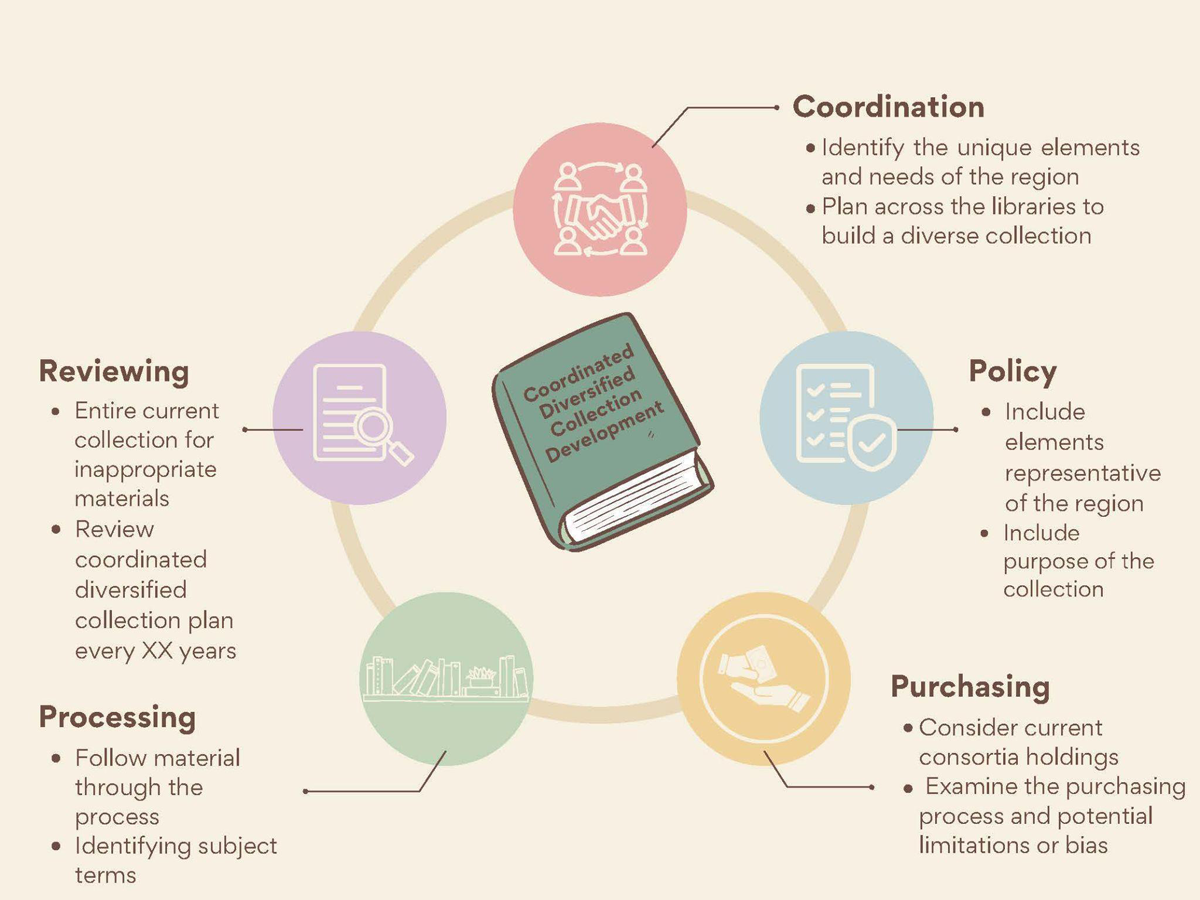
Figure 1
Coordinated diverse collection development process.
In conclusion, regional library consortiums stand to positively impact rural communities. Member libraries should strive for diverse text collections that both mirror the uniqueness of their region and provide windows of opportunity for readers to see other cultures and life experiences through books.
Notes
[2] Lee Rainie, “The Next Rural Library,” Pew Research Center: Internet & Technology, (presentation, Association for Rural & Small Libraries, Omaha, NE, September 26, 2013), https://www.pewresearch.org/internet/2013/09/26/the-next-rural-library/.
[3] Nicole D. Alemanne, Lauren H. Mandel, and Charles R. McClure, “The Rural Public Library as Leader in Community Broadband Services,” Library Technology Reports 47, no. 6 (August 30, 2011): 19–28.
[4] Brian Real and R. Norman Rose, “Rural Libraries in the United States: Recent Strides, Future Possibilities, and Meeting Community Needs Report,” (Washington, D.C., American Library Association, July 13, 2017), https://apo.org.au/node/102761.
[5] Frank Serafini, “Images of Reading and the Reader,” Reading Teacher 57, no. 7 (April 2004): 610–617.
[6] Karen Eppley, “Picturing Rural America: An Analysis of the Representation of Contemporary Rural America in Picture Books for Children,” The Rural Educator 32, no. 1 (November 2010): 1–10, https://doi.org/10.35608/ruraled.v32i1.433; Chea L. Parton, “Who’s ’Ere?: Identifying and Addressing Rural Erasure in ELA Classrooms,” Virginia English Journal 71, no. 2 (December 2021): 1–26, https://digitalcommons.bridgewater.edu/vej/vol71/iss2/2.
[7] Carroll S. Marshall, “Using Children’s Storybooks to Encourage Discussions Among Diverse Populations,” Childhood Education 74, no. 4 (July 12, 1998): 194–199, https://doi.org/10.1080/00094056.1998.10521934.
[8] Rita S. Bishop, “Mirrors, Windows, and Sliding Glass Doors,” Perspectives: Choosing and Using Books for the Classroom 6, no. 3 (Summer 1990): ix–xi.
[9] “Selection & Reconsideration Policy Toolkit for Public, School, & Academic Libraries,” American Library Association, December 8, 2016, http://www.ala.org/tools/challengesupport/selectionpolicytoolkit.
[10] Helen N. Levenson, “Nimble Collection Development Policies: An Achievable Goal,” Library Resources & Technical Services 63, no. 4 (October 2019): 206–219, https://doi.org/10.5860/lrts.63n4.206.
[11] Stephanie Hallam, B. Reel, and R. Heisserer-Miller, “Overdue: Collection Development and Deselection Projects for a Faculty-Selected Collection,” College & Undergraduate Libraries 28, no. 1 (January 1, 2021): 51–66, https://doi.org/10.1080/10691316.2021.1885548; “Selection & Reconsideration Policy Toolkit,” American Library Association.
[12] Virginia Kay Williams and Nancy Deyoe, “Diverse Population, Diverse Collection? Youth Collections in the United States,” Technical Services Quarterly 31, no. 2 (March 17, 2014): 97–121, https://doi.org/10.1080/07317131.2014.875373; Amy Price Azano, “RURAL The Other Neglected ‘R’: Making Space for Place in School Libraries,” Knowledge Quest 43, no. 1 (September 2014): 60–65.
[13] Eppley, “Picturing Rural America”; Azano, “RURAL The Other Neglected ‘R’”; Parton, “Who’s ‘Ere?”
[14] Amy Price Azano and Trevor Thomas Stewart, “Exploring Place and Practicing Justice: Preparing Pre-service Teachers for Success in Rural Schools,” Journal of Research in Rural Education 30, no. 9 (May 2015): 1–12; Eppley, “Picturing Rural America”; Dezarae Osborne, “Collecting Better: A Case Study of the Collection Development Policies and Collecting Habits of Rural Public Libraries in Western North Carolina,” (master’s thesis, UNC-Chapel Hill, 2018) https://doi.org/10.17615/jnx0-qa29; Parton, “Who’s ‘Ere?”
[17] Rachael Elrod and Brittany Kester, “Diverse BookFinder: BIPOC Collection Development for Children’s and Young Adult Collections,” College & Research Libraries News 81, no. 10 (November 2020): 481–85, https://doi.org/10.5860/crln.81.10.481; Anjali Adukia et al., “What We Teach About Race and Gender: Representation in Images and Text of Children’s Books,” The Quarterly Journal of Economics 138, no. 4 (November 2023): 2225–2285, https://doi.org/10.1093/qje/qjad028; Renae J. Watson and Randyn A. Heisserer-Miller, “Weighed and Measured: Making Way for a Diverse Children’s Collection in a Research University Library During a Reorganization,” Collection Management 49, no. 1/2 (October 18, 2023): 1–15, https://doi.org/10.1080/01462679.2023.2269892; Virginia Kay Williams and Nancy Deyoe, “Diverse Population, Diverse Collection? Youth Collections in the United States,” Technical Services Quarterly 31, no. 2 (March 17, 2014): 97–121, https://doi.org/10.1080/07317131.2014.875373.
[18] Sean Ruday, Amy Price Azano, and Rachelle Kuehl, “Books as Portals: Using Place to Understand Rural Students’ Individuated Reading Experiences,” English in Education 56, no. 2 (April 26, 2021): 122–38, https://doi.org/10.1080/04250494.2021.1919017; Azano, “Exploring Place and Practicing Justice.”
[20] Valerie Horton and Greg Pronevitz, eds., Library Consortia: Models for Collaboration and Sustainability, (Chicago: American Library Association, 2015); George Machovec, “Trends in Higher Education and Library Consortia,” Journal of Library Administration 57, no. 5 (July 14, 2017): 577–84, https://doi.org//10.1080/01930826.2017.1326266.
[21] Krista Riggs, “Reinforcing Purpose and Motivation to Sustain Regional Library Cooperatives,” Public Libraries 60, no. 3 (May 2021): 13–17.
[23] Elrod, “Diverse BookFinder”; Watson, “Weighed and Measured”; Virginia Kay Williams, “Building and Evaluating Juvenile Collections in Academic Libraries,” College & Undergraduate Libraries 18, no. 1 (March 10, 2011): 58–76.
[24] Cecilia M. Orphan and Kevin R. McClure, “An Anchor for the Region: Examining a Regional Comprehensive University’s Efforts to Serve Its Rural, Appalachian Community,” Journal of Research in Rural Education 35, no. 9 (October 2019): 1–19.
[26] “What is Rural?,” U.S. Department of Agriculture National Agricultural Library, 2020, https://www.nal.usda.gov/rural-development-communities/what-is-rural.
[28] Alyssa Ratledge, “Recognizing Diversity in Rural America: College Access Strategies in Rural Communities of Color,” MDRC, 2020, https://www.mdrc.org/sites/default/files/Rural_Matters_2.pdf.
Competing Interests
The authors have no competing interests to declare.