
Introduction: What is Modernity?
From the perspective of 18th century Enlightenment philosophers, the Middle Ages in the recent past functioned as a convenient foil, an antagonist. With the Renaissance, modernity arrives on the scene as the hero and protagonist, defeating the Middle Ages and ushering in the “first decisive stage” of salvific “progress.”5 At the same time, this characterization applied beyond the relatively recent medieval past; the medieval became synonymous with the “barbaric,” non-Western, non-Christian, unenlightened present.6 Edward Said, in his analysis of Western, colonial, literature, defined “Orientalism” as the invented portrayal of a non-Western, primitive Other.7 In Enlightenment thought, the Middle Ages is also the Other, a fictive and grotesquely “dark” age to which the contemporary non-Western and non-Christian world belonged.8 This notion of modernity is, thus, a conceit with which scholars of medievalism and decolonial thought are similarly concerned.
This essay brings medievalism and decolonial thought into conversation. On one hand, scholars of medievalism are concerned with the definitions and representations of the medieval produced by modernity. Modernity, in defining medievalism as the Other, defines itself. Yet, medievalism is heavily imbibed with a nostalgic fixation on the invented past and a desire for its restoration. In Svetlana Boym’s work, such nostalgia is the result of the modern notion of progress as a trajectory towards the future.9 Decolonial scholars, on the other hand, are concerned about how modernity as a scientific and philosophical project is inseparable from its manifestation as a totalizing colonial project directed towards the non-Christian and non-European Other.
Decolonial scholars construct modernity as an original break, one located in the Spanish encounter with the so-called New World. This encounter signaled the beginning of colonial modernity and the development of its hierarchies of knowledge, race, labor, and gender. In 2000, Aníbal Quijano published a paper titled, “Coloniality of Power, Eurocentrism, and Latin America”10 in which he articulated a framework for what became the “decolonial” school. Drawing from earlier “world-systems” analyses of the global capitalist political economy co-written with Immanuel Wallerstein,11 Quijano traced the processes through which the notion of “race” emerged alongside “colonial domination”12 and what would become global capitalism. He begins this theoretical narrative with the Spanish conquistadors. The “new model of power” that the conquistadors established “placed some in a natural situation of inferiority” and others in a position of superiority.13 Race would constitute an economic hierarchy of “domination” under which Indigenous peoples of the so-called New World were assigned “nonpaid” and “nonwaged” serfdom.14 Then, the Spaniards enslaved and trafficked African peoples, establishing a distinct racial class in the New World defined by permanent enslavement.15 According to Quijano, this racial-economic class system produced “whiteness” as an attribute assigned to colonial rulers and used to justify economic subordination on the basis of supposed biological superiority.16 Additionally, modernity’s claim to progress, knowledge, and science excluded “formal systems of science” developed by Aztec, Mayan, and Incan peoples,17 relegating the colonized Other to the unenlightened past.18
Quijano asserts that where scientific-economic race classes emerged, the “Christian” world came to see itself as European and white. Other scholars have identified medieval “Christendom”19 and the development of its religious identity amidst holy wars against enemy “Saracens,” as Muslims were pejoratively named,20 and non-Christian “pagans”21. Yet, Quijano’s account of Europe’s emerging self-definition necessarily differentiates its prior sense of superiority on the basis of Christianity from its sense of superiority as the “exclusive producer and protagonist of modernity”.22 Yet, modernity’s claim to exclusivity is simply a claim; if its claim to superior knowledge invites investigation and critique, then its claims in relation to the medieval past also invite investigation and critique. This essay thus explores whether European modernity’s matrices of power and “difference” were truly novel.
The New World Encounter
The Spanish conquistadors weaponized conversion in the New World conquest. Historian Margarita Zamora, examining Christopher Columbus’s journal, highlights how he described “first contact with the natives of Guanahani” in October 1492. Columbus wrote, “And I believe that they would easily become Christians, for it seemed they had no religion.”23 Then, in 1513, the Spanish monarchs issued the Requirement proclamation, prescribing violent reprisal if Indigenous people refused to convert and submit. According to Patricia Seed, the Requirement demanded that the “Indigenous peoples of the New World acknowledge the Church as superior and therefore consent to have priests preach to them.”24 Yet, in the context of medieval Spanish treatment of converts from Islam and Judaism, moriscos and conversos respectively, conversion did not prevent violence.25 Benzion Netanyahu suggests that Inquisition Courts were established in order to “terrorize,” “demoralize,” and “eradicate” the Jewish population in Spain.26 In the 1400s, the belief in Christian bloodline purity helped justify outbreaks of violence against Jewish conversos.27 The Inquisition later accompanied colonial projects abroad and generated continued suspicion against “new Christians”.28 According to Irene Silverblatt, Inquisitors in the so-called New World applied the notion of Christian blood purity to emerging “modern” conceptions of “calculable” race.29 They believed that “blood carried stains, and that stains could determine character traits, intelligence, political rights, and economic possibilities.”30
While Quijano considered the Spanish conquest as the birth of a “new model of power,” Zamora demonstrates how Columbus employed existing language to describe the Arawak people as inferiors and subjects. Describing the initial encounter, Columbus named them “mancebo.”31 In Spanish, this refers to a male “still under his father’s authority”32; Zamora argues that this signified his paternalist intentions. Columbus’s journals thus reflect a sense of “benevolent custodianship” over the Arawak; he referred to them as “beasts” and “monsters” lacking in “intellectual aptitude.”33 Zamora links Columbus’s language to Aristotelian natural philosophy, under which “natural” slaves are rendered subject by their ontological lack of intellectual and moral capacity. Gines de Sepúlveda later cited Aristotleian natural philosophy in his rationale for the enslavement of Indigenous peoples.34 Under the “natural slave” framework, the conquistadors could frame conquest as a philanthropic, benevolent, intervention, even as they carried out forced conversions, mutilation, enslavement, and genocide.35
Practically, the Spanish conquest involved sexual violence. Michael Hardin links this to the Spanish idealization of “machismo”, the lust for accumulation of power enacted through sexual conquest.36 Hardin notes that the Spanish conquest involved humiliating Indigenous peoples by means of “genital mutilation of the men and the rape of the women”. Hardin argues that the conquistadors performed penetrative masculinity through extreme acts of torture, emphasizing sexual domination over the emasculated and sexually violated Other.
In 1504, Hernán Cortés drew direct comparisons between the Indigenous peoples he encountered in the conquest of Mexico with the “Moorish Other”. This evoked longstanding enmity against the Moors beginning with the Moorish conquest of Spanish Iberia in the 700s. In 1095, Pope Urban II’s call for the First Crusade also included the domestic Spanish crusade to reclaim Iberia.37 The Catholic Monarchs of Spain, Isabella and Ferdinand, finally accomplished this in 1492. Cortés notably “remarked from the beginning that Indigenous clothing looked ‘Moorish,’ and he referred to Indigenous temples as ‘mosques.’”38 Columbus’s contemporary, de Las Casas, also employed similar characterizations.39
The designation of “Moor” bore connotations of moral inferiority, sodomy, and effeminacy. In 1519, Spanish authorities in the Veracruz settlement that Cortes founded wrote to the Emperor Charles V that, “We have learned and have been informed that they are doubtless all sodomites and engage in that abominable sin.”40 This corresponds with Spanish histories from the period, where authors exoticized and hypersexualized Indigenous sexual practices.41 In medieval Spain, such as in the city of Palma, accusations of sodomy or sexual deviance were “predominantly” weaponized against “outsiders” such as “Catalans, Moors, and Jews.”42 Thus, without conflating distinct peoples against whom Columbus and Cortés rationalized and committed violence, it is possible to theorize the ideological basis of Spanish conceptions of rule, including supposed intellectual inferiority and sexual deviance. These indicate that the conquistadors relied on existing frameworks of imperial masculinity demonstrated in the Iberian reconquest and employed existing performances of masculinity typified by forced sexual penetration and humiliation. They also subjected Indigenous peoples to erasure as they universalized cultural, gendered, and sexual narratives of difference prevalent in medieval Spain and constitutive of its social fabric. This erasure precipitated the emerging construction of “race.” I thus find Quijano’s term, “colonial difference,” to be conversant with the medieval Spanish social order and the subjugation of enslaved, Jewish, and Moorish subjects. Such an analysis should not conflate all groups who experienced colonial violence but consider the shared roots of the ideologies that motivated conquest.
This article thus considers how Quijano’s assertion that the colonial difference and “race” emerged during modernity may prevent a broader analysis of racialization and “race before race” throughout its development, evolution, and varied implementations. Ultimately, a close study of the Spanish conquest through its expressed philosophies, logics, theologies and science may help identify where medieval theologies of conquest, sexual norms, and narratives of difference contributed to the rise of racial capitalism.
The Non-Human, the Not-Man
Maria Lugones furthers decolonial scholarship in the direction of what she terms “decolonial feminism.”43 She argues that Spanish and later European colonizers imposed a gendered system on Indigenous populations as part of their strategy of colonial domination. They created this system from an existing understanding of males as the pinnacle of human strength and rationality and females as a lesser “inversion”.44 Then, in the colonial world, they created new gendered categories for colonized not-humans. Colonial modernity thus developed multiple categories of gender, not two: colonizing male, colonizing female, colonized males (“not-human-as-not-men”) and colonized females (“not-human-as-not-women”).45 Lugones argues that this gender system did not exist in “precolonial” Europe; as “constituted by and constitutive of the coloniality of power, knowledge, being, nature, and language”, this gender system is “crucially inseparable” from modernity.46 In other words, colonial modern gender systems cannot be extricated from colonial modern economic and racial systems. Yet, Lugones also notes that the gendered designation of enslaved and free people in Greek antiquity informed the colonial modern gender system. Galen, a second-century Roman physician, drew from existing Grecian thought to define femininity as an inversion of masculinity.47 Thomas Laqueur identifies the prevalence of this definition in Europe from antiquity until the 18th century.48 Therefore, in spite of her larger thesis, Lugones engages with concepts that indicate continuities between the gender systems in colonial modernity and precolonial Europe.
“Not-human” gender designations existed in medieval Spain. This is particularly evident in the definition of the pre-masculine or sub-masculine mancebo in contrast with true men, vir. In Lugones’s framework, colonial subjects assigned the male gender were subject to emasculating “humiliation” and the “threat of rape.”49 Similarly, medieval Spaniards drew from Latin to describe masculinity (vir) as freedom from emasculation, sexual impenetrability, rationality, virtue, and moral superiority.50 Slavery and penetration,51 on the other hand, that produced “gender slippage” from male to female.52 Men who were penetrated or in danger of penetration were not vir, but mancebo. They had not attained to masculine maturity and could be acceptably penetrated.53 Thus, colonization operated on the premise of gender slippage, simultaneously rendering the conquistadors masculine and colonized Indigenous peoples as not-men.
Female gender slippage was also present in the pre-colonial European world. For example, high-status women in ancient Rome were required to distinguish themselves from prostitutes and other un-virtuous, penetrable women by displaying sexual virtue, restraint, and moral superiority and wearing modest, upper-class clothing.54 Scholars tend to think of the “Cult of True Womanhood” in the context of Western settler-colonization,55 but medieval archetypes of “Madonna” and “Whore” enforced similar distinctions between noble and penetrable women56 In the early Christian and medieval era, virtuous religious women, vir-gins, could attain to spiritual masculinity and virtue.57 Thus, Lugones’s understanding of a distinction between European females and colonized females on the basis of virtue and penetrability has roots in the medieval world. Across these periods, true, virtuous womanhood was an exclusive status and not a universal designation.
The penetrable status of medieval Spanish slaves, in particular, may have also indicated a not-human status for both males and females. Debra Blumenthal asserts that “sexual exploitation often was a distinguishing feature of the enslaved woman’s experience” in 15th century and late medieval Spain.58 This was uniquely situated in a context where the pretense of “Christian” morality dictated public sensibility and offered legal rights to enslaved women who bore their masters’ children. Masters, attributing virtue to their ruling position, would assert that they were “Christian” and did not take advantage of their right to sexual access.59 Scholars similarly identify a relationship between the enslavement and penetrability of males in the medieval ages,60 such as among Scandinavians and Anglo-Saxons.61 The Spanish conquistadors reinscribed these frameworks of ontological difference, incomplete masculinity, and not-man-and-not-woman-hood, drawing from Greco-Roman62 and medieval thought.63 Thus, the gender designations assigned to the colonized “not-man” and “not-woman” do not necessarily indicate a modern break with all things medieval.
Indigenous decolonization and feminist scholarship consistently emphasize the prevalence and use of sexual violence in colonization, even in the present day. Cherokee Nation scholar Jeff Corntassel argues that the contemporary industrial invasion of Indigenous land corresponds to increased violence against Indigenous bodies.64 Lisa Dellinger of the Chickasaw nation similarly considers historic and continued colonial violences against Indigenous bodies as rooted in conceptions of their bodies as “peripheral, dark, sensory, anarchic, underdeveloped, and as female/penetrable”, thus “dirty,” “rapeable,” and “not entitled to bodily integrity.”65 She notes that Columbus described “New World” landforms as female breasts and nipples, a metaphor that she links to the colonial pursuit of “dominion.”66 Muscogee Nation researcher Sarah Deer thus calls for a “Native Feminist” decolonization of rape law, laws that are the product of a settler-colonial state under which Native women suffer disproportionate rates of sexual violence.67 “Rape”, she notes, “is more than a metaphor” but a “part and parcel” of colonization.68 Ultimately, according to Paula Gunn Allen of the Laguna Pueblo nation, sexual violence is “indistinguishable from fundamental Western concepts of social order” because these concepts emphasize how “the strong must prevail over the weak, the superior over the inferior, the violent over the peaceful.”69 This is the root belief that drives both rape and “ethnic cleansing”; she thus calls for “dismantling the entire philosophical and social order” of colonial heteropatriarchy.70 For Maile Arvin, Eve Tuck, and Angie Morrill, Native feminist projects invalidate the conventional feminist narrative of singular oppression of women by men. Instead, these projects uncover how these binary categories reflect heteropatriarchal ideology and facilitate violence.71 Historic settler-colonial sexual violences are thus incredibly relevant to present-day projects of epistemic resistance and activism; decolonization literature points to how the periodization of colonization as a past phenomenon and the concept of “post”-colonization in the present are unhelpful. Similarly, I argue that when we relegate the medieval period to categories such as “pre”-colonization and pre-modernity, we obscure an extensive history of sexual violence and conquest.
The Medieval-Modern Colonial Difference
Should we consider the medieval and the Christian as distinct from the modern, scientific and supposedly “secular?” When did the Spanish start thinking of themselves as superior on the basis of “race” as opposed to “religion?” Decolonial scholar Walter Mignolo responds to these themes, taking the Spanish invasion of the New World as the starting-point for this colonial-modern shift from religion to science, and from Christianity to Europeanness. He provides a bridge between Christendom and Europe by finding the “historical foundation of the colonial matrix” in “Christian theology that located the distinction between Christians, Moors, and Jews in the ‘blood’” as part of forced expulsions and conversions in the Iberian Peninsula.72 He then discusses the “racial configuration between Spanish, Indian, and African” in the New World”,73 writing,
The point is not “what is race?” Nor is it whether race exists, is a social construct, or is different from caste. The point is that Spanish men of letters and officers of the state established the historical foundation of a classification of human beings according to their religion or lack thereof.74
While Mignolo admits that there are express connections between racial and religious hierarchies in the Spanish Conquest and the treatment of Jewish and Moorish subjects of Spain, he does not explore the medieval world of the “Spanish men of letters”. Mignolo does not fully clarify if the colonial modern knowledge project is truly thrust into being with the dawn of modernity or if this is simply modernity’s claim, a claim that can be problematized and investigated. As Columbus, de las Casas, and Sepúlveda’s writings indicate that they were employing existing narratives of difference in the New World, perhaps engaging more broadly with histories of “classification” may uncover shared ideological foundations.75
Medieval scholars like Geraldine Heng and Roland Betancourt extend the frameworks established by scholars of European colonization in their analyses of difference, race, and otherness. However, Heng specifically challenges the premise that race and modernity are coterminous. Studying “cultural documents” from the 13th to 15th centuries, she discovered patterns of “racial thinking, racial law, racial formation, and racialized behaviors and phenomena” in medieval Europe.76 These emerged before the modern “vocabulary of race” and include the attribution of nobility and virtue to “white” skin and demonic evil to “black” skin.77 Heng thus removes the notion of “race” from the “substantive content” that forms its logic in modernity, whether blood or skin color. Instead, she argues scholars can approach race as a “structural relationship for the articulation and management of human differences.”78 Heng’s suggestion is that the scholarly analysis of racial difference should transcend the specifics of its iteration in modernity.
Mignolo’s definition of race identifies its underlying narrative of progress. He highlights shifts in this narrative, namely an evolution from a “Christian” religious identity among colonizers to a focus on Europeans as a racial class, from a religious gospel to a later, progressive and scientific one. These are, in his analysis, the same overall Eurocentric structure bolstered by different rationales. This is modernity’s exclusive “knowledge,” the knowledge that distinguishes modern Europe from the primitive Other and also from the medieval Other. Thus, we can propose that “Modernity is modernity because of its fiction of progress” and “Race in modernity is premised on the fiction of progress.” This becomes more complicated when we also accept that “Medievalism is based on the fiction of progress.” This means that we would have to examine the same conceits and presuppositions that create the medieval-modern break as we examine the very world in which these suppositions took on practical and identifiable forms such as in racial capitalism. A decolonial scholar critiques modernity as a fiction, yet often examines it only within the boundaries established by that fiction (See Image 1). This becomes a paradox that medieval and medievalist scholarship can help overcome.
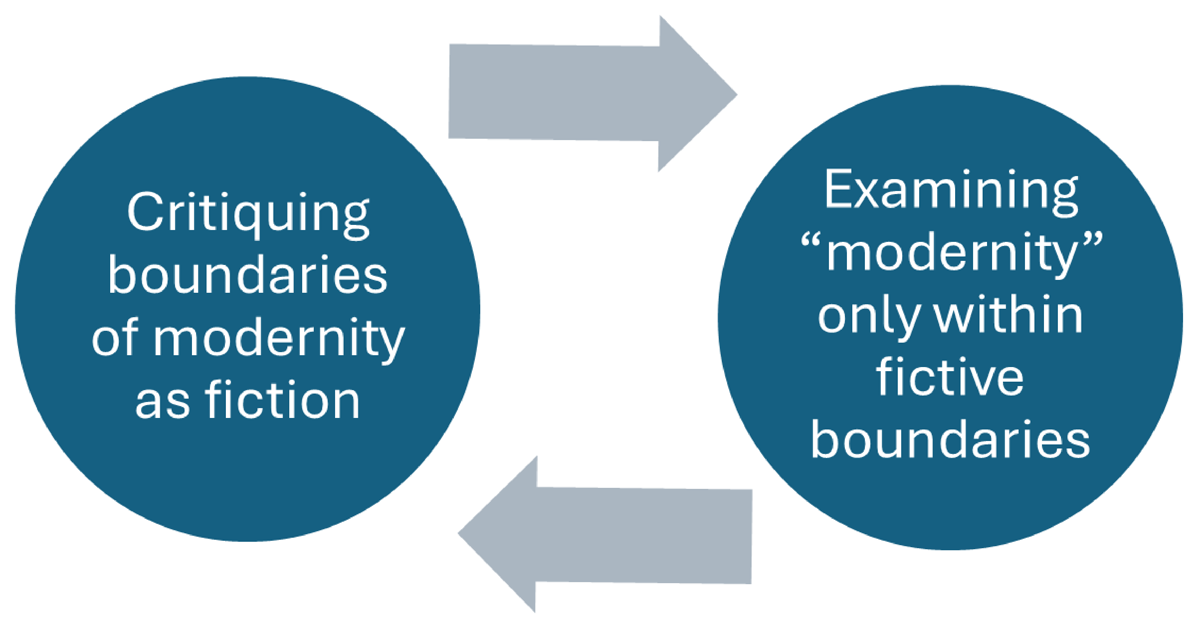
Image 1
The paradox of decolonial critique in relation to the Middle Ages and modernity.
In Mignolo’s language, reconsidering our perception of the Middle Ages may help us counter colonial modern conquest not only of primitive “space,” but also of primitive “time.” Is there an epistemological undressing we can accomplish in identifying how and where colonial-modern conquest employed “medieval” epistemologies such as that of just war theory, canon law, and natural slavery? Periodization, I suggest, should be employed consciously as method rather than presumed as doctrine. One reason why periodization is helpful is because “colonial modernity” is identifiably characterized by distinct stages in Mignolo’s narrative. Even then, I think Mignolo’s periodization of the Christian age superseded by the secular Enlightenment may be complicated by, for example, Fernando Segovia’s periodization of Western missionization. Segovia identifies the same rough periods as Mignolo does, post-1492 and post-1792, but he defines them according to modes of European economic imperialism and by Catholic and Protestant missionization. According to Segovia, Protestants began the “massive evangelization of Africa, Asia, and remaining areas of the Americas” in 1792.79 Thus, “post-1492,” a point at which Mignolo argues the colonial difference gradually became more scientific, secular, and “racial” in character, is also the point at which Segovia identifies new waves of militant religious conquest. In this case, Mignolo’s and Segovia’s periodizations converge and diverge; both can be critiqued as heavily Eurocentric.
Ultimately, it can be argued that any periodization of the “medieval” and “modern” should engage with more specifics: What did the “modernity fiction” help facilitate? What are the specific features in question, i.e. racial capitalism, that substantiate the distinction between periods? If modernity’s knowledges are essential to colonial projects, then it is worth examining how medievalism benefits colonial modernity, and how attempts to disavow and disguise medieval roots may perpetuate epistemic colonization.
Conclusion
Decolonial thought as a generative response to the problems of both colonization and modernity continues to be deeply valuable. Medieval scholar Roland Betancourt, for example, employs decolonial thought in his study of intersectional gendered, sexual, and racial hierarchies.80 Betancourt, however, also insists that future scholars “must acknowledge that marginalization, oppression, and intersectionality are not modern constructs.”81 These violences are systematic, as Heng also notes, and can be subverted by readings of the medieval that reveal our medievalism. The medievalist narratives we create, when studied closely, reveal coeval processes that reverberate between the colonial-modern conceptions of both “orient” and “medieval” as Other.
Time is not linear to racists – their fictitious and contradictory “past” is coeval with and permeates the present. They often invoke medieval tropes to bolster anachronistic notions of Christian supremacy on one hand and white racial supremacy and Eurocentrism on the other, notions that Mignolo and Quijano highlight.82 For example, Phillip S. Baun describes how Christchurch shooter Brenton Tarrant, unaware of the relative newness of the notion of “Europe,” projected a modern, racialized, “essentialist” definition “backward through time,”83 misappropriating both medieval and modern concepts. The same equivocations occur in anti-Muslim and war-mongering rhetoric in contemporary America.84 This points to a need for broader definitions of race-making, such as Heng’s framework of “race-as-difference” and the inclusion of medievalist studies, that is, studies into the appropriation and invocation of the Middle Ages.
The broader definition of race proposed by Geraldine Heng may also be of increasing relevance against claims that 19th century racism or early American slavery no longer exist in their well-recognized forms.85 To borrow from Heng’s framework, what should decolonial scholars do when individuals claim racism as a thing of the past because its pseudoscientific “content” is no longer the same, even if violent structural relationships and effects continue?86 Heng’s broader definition drawn from a robust study of medieval history is, thus, far more versatile in the midst of evolving intersectional realities.
The undressing of modernity as fictive narrative invites us to explore the processes through which fictive narratives are created. For example, Rajabzadeh takes one slur, “Saracen,” and examines a long history of characterizing Muslims as lascivious, deceitful in general, and dishonest in supposed claims to be descendants of “Sara-” in particular.87 Narrative, according to Michel-Rolph Trouillot, is the construction of inevitable silences and omissions88 even if such silences (like the Saracen lie?) become so taken for granted that they are no longer “deliberate” or “perceptible.”89 Scholarly claims to unambiguity and certitude often reveal what lies behind the mask, namely, a failure to identify how one’s positions are “solidly anchored in the present.”90 If anything, this calls for a theoretical consciousness about the ways in which we address, invoke, or even “colonize” time. Scholarly approaches to memory and narrative may sustain practices of power and domination, and these are practices employed by the protagonists of colonial modernity. If modernity’s accounts of history and constructions of race and difference are built on silences, if not outright deceptions, then perhaps decolonial projects inevitably encounter these silences. As it presses against assumptions and boundaries built into Enlightenment knowledge and Enlightenment violence, decolonial thought may be used to further unravel the Enlightenment construction of an irrelevant, Othered, medieval past.
Notes
[1] Anibal Quijano, “Coloniality of Power and Eurocentrism in Latin America,” International Sociology 15, no. 2 (2000): 215–232.
[2] María Lugones, “Heterosexualism and the Colonial/Modern Gender System,” Hypatia 22, no. 1 (2007): 186–219; María Lugones, “Toward a Decolonial Feminism,” Hypatia 25, no. 4 (2010): 742–759.
[3] Walter D. Mignolo, “Preamble: The Historical Foundation of Modernity/Coloniality and the Emergence of Decolonial Thinking,” in A Companion to Latin American Literature and Culture, ed. Sara Castro-Klaren (Blackwell, 2008), 12–52.
[4] Wallace K. Ferguson, The Renaissance in Historical Thought: Five Centuries of Interpretation (Toronto: University of Toronto Press, 1948); Joseph Richardson, “Enlightenment Historians and the Problem of the Medieval,” in The Medieval World and the Modern Mind, eds. Michael Brown and Stephen H. Harrison (Four Courts Press, 2000), 77–100.
[6] David Matthews, Medievalism: A Critical History (Woodbridge: Boydell & Brewer Ltd, 2015), 45–91.
[7] Edward W. Said, Orientalism (New York: Penguin Random, 1978).
[8] Matthew Gabriele and Jim Meskimen, The Bright Ages: A New History of Medieval Europe (New York: Harper, 2021); Walter Mignolo, The Darker Side of Western Modernity: Global Futures, Decolonial Options (Durham: Duke University Press, 2011).
[9] Svetlana Boym, The Future of Nostalgia (New York: Basic Books, 2008).
[11] Aníbal Quijano and Immanuel Wallerstein, “Americanity as a Concept; or,” The Americas in the Modern World-System”. International Social Science Journal 44, no. 4 (1992): 549–557.
[17] Jorge Cañizares-Esguerra, Nature, Empire, and Nation: Explorations of the History of Science in the Iberian World (Stanford, CA: Stanford University Press, 2006), 46.
[19] Brian A. Catlos, Kingdoms of Faith: A New History of Islamic Spain (New York: Oxford University Press, 2018).
[20] Shokoofeh Rajabzadeh, “The Depoliticized Saracen and Muslim Erasure,” Literature Compass 16, no. 9–10 (2019): e12548.
[21] Elizabeth Siberry, The New Crusaders: Images of the Crusades in the Nineteenth and Early Twentieth Centuries (Burlington, VT: Ashgate, 2000), 144.
[23] Margarita Zamora, “Abreast of Columbus: Gender and Discovery,” Cultural Critique 17 (1990): 132.
[24] Patricia Seed, Ceremonies of Possession in Europe’s Conquest of the New World, 1492–1640 (Cambridge: Cambridge University Press, 1995), 71.
[25] Erika Tritle, “Before ‘Purity of Blood’: Elements and Metaphors in the 1449–1450 Converso Debate,” Philologia Hispalensis 37, no. 2 (2023): 109–134.
[26] Benzion Netanyahu, “The Marranos According to the Hebrew Sources of the Fifteenth and Early Sixteenth Centuries,” Proceedings of the American Academy for Jewish Research 31 (January 1963): 84.
[27] Erika Tritle, “A Jewish Solution to the Problem of Excessive Christian Virility in the War Against Spanish Islam,” in Crusading and Masculinities, edited by Natasha R. Hodgson, Katherine J. Lewis, and Matthew M. Mesley (London: Taylor and Francis, 2019), 256–271.
[28] Silverblatt, Irene. “Colonial Peru and the Inquisition: Race-Thinking, Torture, and the Making of the Modern World.” Transforming Anthropology 19, no. 2 (2011): 136.
[32] Norman Roth, “‘Deal gently with the young man’: Love of Boys in Medieval Hebrew Poetry of Spain,” Speculum 57, no. 1 (1982): 20–51.
[34] Federico G. Carvajal, Butterflies Will Burn: Prosecuting Sodomites in Early Modern Spain and Mexico (Austin: University of Texas Press, 2003).
[36] Michael Hardin, “Altering Masculinities: The Spanish Conquest and the Evolution of the Latin American Machismo,” International Journal of Sexuality and Gender Studies 7 (2002): 1–22.
[42] Richard Trexler, Sex and Conquest: Gendered Violence, Political Order, and the European Conquest of the Americas (Ithaca, NY: Cornell University Press, 1995), 56.
[47] Colleen Conway, Behold the Man: Jesus and Greco-Roman Masculinity (New York: Oxford University Press, 2008),17.
[48] Thomas Laqueur, Making Sex: Body and Gender from the Greeks to Freud (Cambridge, MA: Harvard University Press, 1992).
[51] Inhee C. Berg, “Female Gender Marginality in the Imperial Roman World: Affinity Between Women and Slaves in their Shared Stereotypes and Penetrability,” Gender Studies 18, no. 1 (2020): 1–26.
[53] Warren Johansson and William Percy, “Homosexuality,” in Handbook of Medieval Sexuality, eds. Vern L. Bullough and James Brundage (New York: Routledge, 2013), 155–190.
[54] Kelly Olson, “Matrona and Whore: The Clothing of Women in Roman Antiquity,” Fashion Theory 6, no. 4 (2002): 387–420.
[55] Barbara Welter, “The Cult of True Womanhood: 1820–1860,” American Quarterly 18, no. 2 (1966): 151–174; Evelyn Nakano Glenn, “Settler Colonialism as Structure: A Framework for Comparative Studies of US Race and Gender Formation,” Sociology of Race and Ethnicity 1, no. 1 (2015): 52–72.
[56] Rosanna McNamara, “The Trouble with Whorephobia: A Contemporary Re-evaluation of the Myth of Mary Magdalene with Special Reference to Marlene Dumas’ Magdalena Series,” Journal of Religion and Culture 27, no. 1 (2017): 13–34.
[57] Jo Ann McNamara, “Sexual Equality and the Cult of Virginity in Early Christian Thought,” Feminist Studies 3, no. 3/4 (1976): 145–158.
[58] Debra Blumenthal, ““As If She Were His Wife”: Slavery and Sexual Ethics in Late Medieval Spain,” in Beyond Slavery: Overcoming Its Religious and Sexual Legacies, ed. Bernadette J. Brooten (New York: Palgrave Macmillan US, 2010), 180.
[61] David Clark, Between Medieval Men: Male Friendship and Desire in Early Medieval English Literature (New York: Oxford University Press, 2009).
[63] Vern L. Bullough, “Cross Dressing and Gender Role Change in the Middle Ages,” in Handbook of Medieval Sexuality, eds. Vern L. Bullough and James Brundage (New York: Routledge, 2013), 223–241.
[64] Jeff Corntassel, “Life Beyond the State: Regenerating Indigenous International Relations and Everyday Challenges to Settler Colonialism,” Anarchist Developments in Cultural Studies 2021, no. 1 (May 24, 2021): 71–97, accessed January 23, 2024, https://journals.uvic.ca/index.php/adcs/article/view/20172, 71.
[65] Lisa Dellinger, “The Doctrine of Discovery as Christianized Genocide in the Lives of Indigenous Women and Their Communities,” in Feminist Praxis against U.S. Militarism, ed. Wonhee Anne Joh and Nami Kim (New York: Palgrave Macmillan, 2019), 38.
[67] Sarah Deer, “Decolonizing Rape Law: A Native Feminist Synthesis of Safety and Sovereignty,” Wicazo Sa Review 24, no. 2 (Fall 2009): 149–167.
[69] Paula Gunn Allen, Off the Reservation: Reflections on Boundary-Busting, Border-Crossing, Loose Canons (Boston: Beacon Press, 1998), 66.
[71] Maile Arvin, Eve Tuck, and Angie Morrill, “Decolonizing Feminism: Challenging Connections between Settler Colonialism and Heteropatriarchy,” Feminist Formations 25, no. 1 (Spring 2013): 18.
[76] Geraldine Heng, “The Invention of Race in the European Middle Ages,” Literature Compass 8, no. 5 (2011): 315.
[80] Roland Betancourt, Byzantine Intersectionality: Sexuality, Gender, and Race in the Middle Ages (Princeton: Princeton University Press, 2020).
[82] Phillip S. Baun, “Memory and Far-Right Historiography: The Case of the Christchurch Shooter,” Memory Studies 15, no. 4 (2022): 650–665.
[84] Matthew Gabriele, “Debating the ‘Crusade’ in Contemporary America,” The Mediaeval Journal 6, no. 1 (2016): 73–92.
[85] Eduardo Bonilla-Silva, Racism without Racists: Color-Blind Racism and the Persistence of Racial Inequality in the United States (Lanham, MD: Rowman & Littlefield Publishers, 2006).
Competing Interests
The author has no competing interests to declare.