
Table 1
Rank and institution type of RREE participants.
| Rank at time of RREE | Institution Type | |
|---|---|---|
| Public | Private not-for-profit | |
| Assistant Professor | 41 | 5 |
| Associate Professor | 32 | 16 |
| Full Professor | 22 | 11 |
| Other | 18 | 4 |
| Total | 113 | 36 |
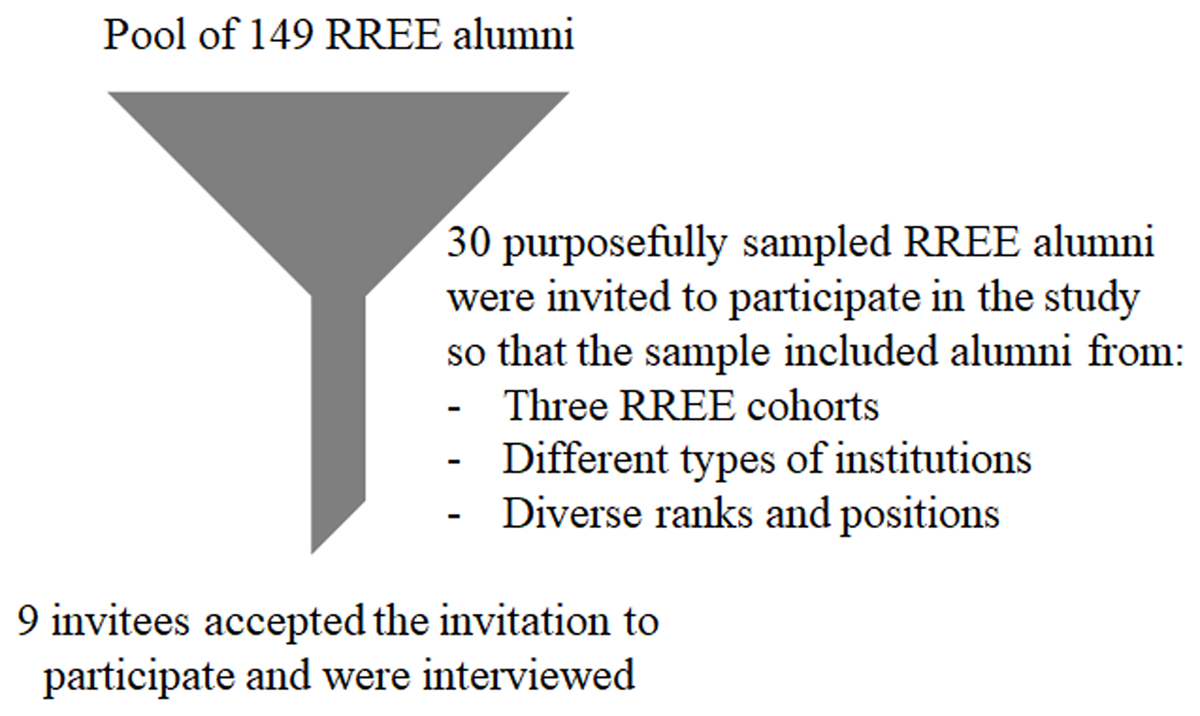
Figure 1
Sampling procedure.
Table 2
Study participants summarized by rank and institution type.
| Pseudonym | Rank at time of interview | Institution type |
|---|---|---|
| Andy | Associate Professor | Large, state university |
| Cathy | Non-tenure-track | Large, state university |
| David | Associate Professor | Large, state university |
| Edward | Associate Professor | Large, state university |
| Janet | Assistant Professor | Small, private liberal arts |
| Joanne | Assistant Professor | Engineering-focused university |
| Matthew | Professor | Mid-sized private college |
| Nick | Associate Professor | Large, state university |
| Robert | Professor | Large, state university |
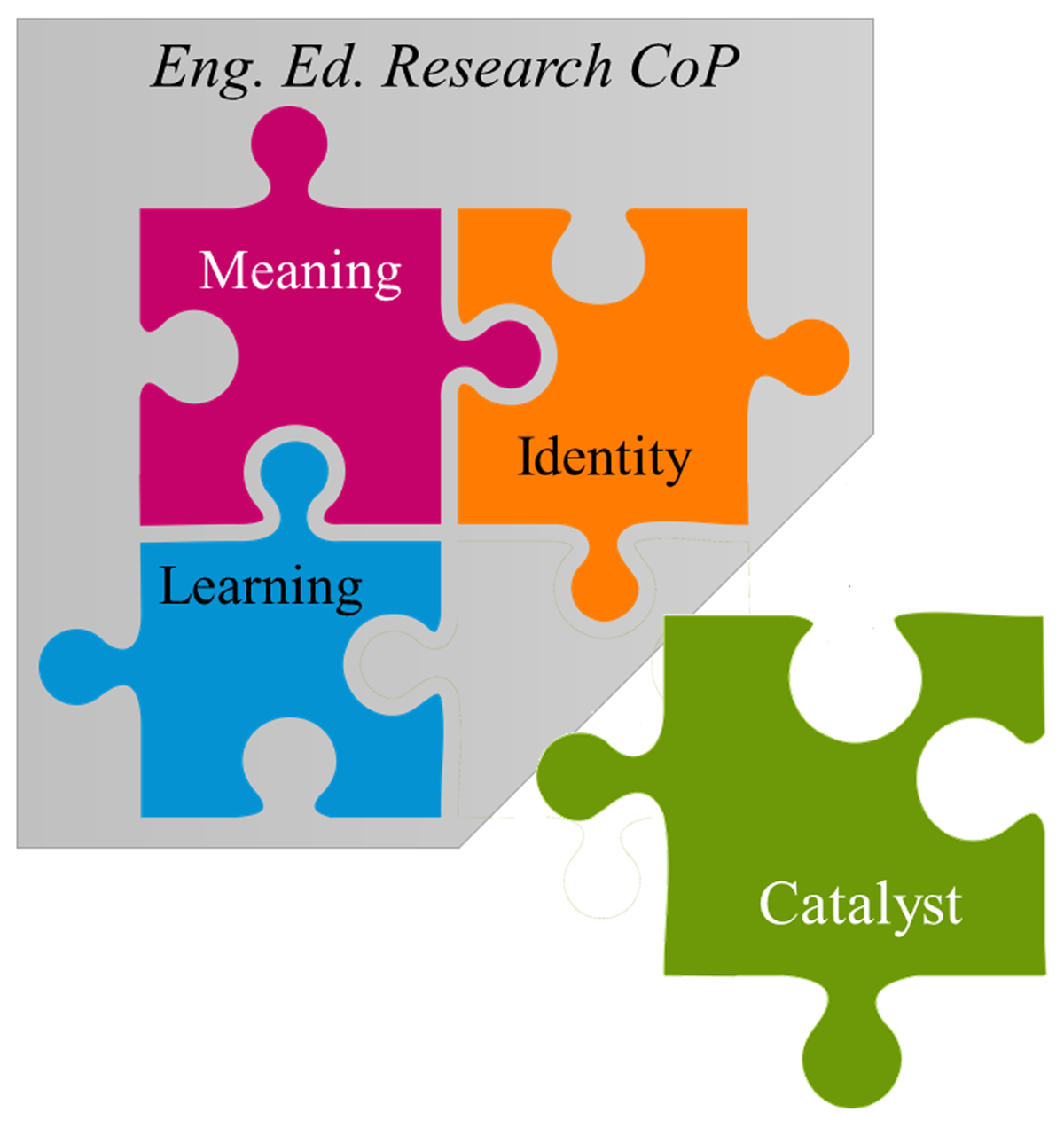
Figure 2
Summary of the impacts of the RREE reported by participants.
Table 3
Type of impact, their definitions, and number of participants who mentioned the themes.
| Themes | Definition | Number of participants |
|---|---|---|
| Learning | Understanding what is (and is not) ‘rigorous’ research in engineering education | 8 of 9 |
| Meaning | Creating and synthesizing knowledge about engineering education methods and theories | 9 of 9 |
| Identity | Being part of the RREE community and/or part of the larger EER community | 9 of 9 |
| Catalyst | How participating in the RREE project was instrumental in initiating change in a participant’s perspective about their current research endeavor and subsequent development of careers in engineering education | 4* of 9 *All those who mentioned lack of support mentioned the RREE as a catalyst. No one who mentioned a supportive environment mentioned this theme. |
Table 4
How the design of RREE workshops aligned with CoP recommendations (R. Streveler, Smith, and Miller 2005).
| Community of Practice Recommendation from Wenger et al. (2002) | Corresponding RREE Workshop Feature |
|---|---|
| ‘old-timers’ welcome and mentor the ‘newcomers’ |
|
| members of community have a variety of informal spaces to meet in ad hoc pairs or small groups for further discussion |
|