
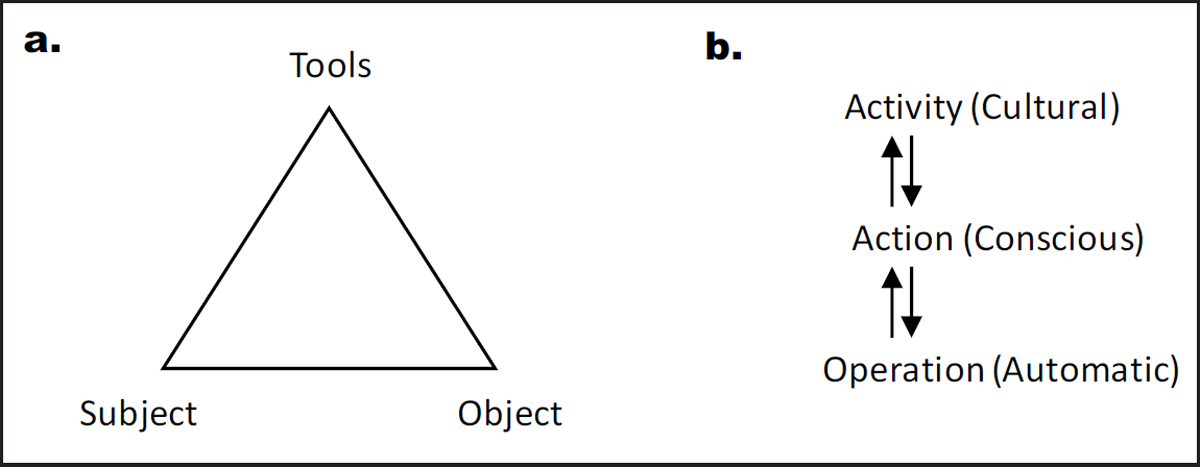
Figure 1
(a) Elements of the activity system (b) hierarchical levels in activity.
Table 1
Code list for Assignments and Assessments category.
| Code Name | Operation | Definition |
|---|---|---|
| Nature of Problem | Rote | The course work exclusively focuses on writing equations and getting numerical solutions, so that just knowing when/how to use an equation is enough to solve the problems in the course. |
| Conceptual | The course work contains non-numerical questions (such as explaining assumptions or making predictions) or problems unlike those seen previously (in class/homework/practice exams), which promotes conceptual understanding. | |
| Assessment Prompted | Rote | Exams promote rote learning behaviors since problems can be answered solely by remembering patterns from problems seen previously. |
| Conceptual | Exams promote conceptual learning behaviors because answering the problems requires an understanding of concepts, rather than merely “plug and chug” operations. | |
| Reused Problems | Rote | Many problems are similar or identical to previously assigned problems. Instead of understanding the concepts underlying these problems, students state that it is easier to simply memorize the solution path. |
Table 2
Code list for Content category.
| Code Name | Operation | Definition |
|---|---|---|
| Memorizable Material | Rote | The course material is inherently something to be memorized (facts, dates, numbers), but not understood on conceptual level. |
| Difficulty of Material | Rote | The course material is too challenging to learn conceptually and is easier to learn by rote. |
| Real World Connections | Conceptual | The course material has problems which relate to the “real world” that promote the integration of underlying concepts. |
Table 3
Code list for Classroom Practices category.
| Code Name | Operation | Definition |
|---|---|---|
| Instructor Emphasis | Rote | Course instructors promote rote learning by what they focus on in lectures. Concepts are explained only briefly or poorly, while problems are heavily emphasized. |
| Conceptual | Course instructors promote the understanding of concepts through their classroom approach. Time is allowed to fully explore underlying connections, rather than just deriving equations and solving numerical problems. | |
| Group Learning | Conceptual | Interactions and activities with other students help the student to develop a better conceptual understanding of the material. |
| Audience Response System | Conceptual | Use of an Audience Response System helps the student develop understanding of key concepts in the course. |
Table 4
Code list for Educational System category.
| Code Name | Operation | Definition |
|---|---|---|
| Importance of Grades | Rote | In order to achieve their desired grade, the student needs to resort to rote learning. |
| Conceptual | In order to achieve their desired grade, the student needs to conceptually understanding of the material. | |
| Time Constraint | Rote | The student has other parts of their life (social, personal, and work, including large course workload) and cannot spend time conceptually learning the material. The core belief expressed is that rote learning takes less time than conceptual learning. |
Table 5
Summary of coding results for the each of the categories and subcategories as percentage of responses (n = 169).
| Category Name | Percent of Total Responses | Subcategory Name | Percent of Total Responses | ||
|---|---|---|---|---|---|
| Rote | Conceptual | Rote | Conceptual | ||
| Assignments and Assessments | 73.4 | 51.5 | Nature of Problem | 49.7 | 42.0 |
| Assessment Prompted | 39.6 | 23.1 | |||
| Reused Problems | 21.3 | – | |||
| Content | 33.1 | 17.2 | Memorizable Material | 27.8 | – |
| Difficulty of Material | 8.9 | – | |||
| Real World Connections | – | 17.2 | |||
| Classroom Practices | 5.3 | 34.3 | Instructor Emphasis | 5.3 | 18.3 |
| Group Learning | – | 13.0 | |||
| Audience Response System | – | 10.7 | |||
| Educational System | 38.4 | 4.1 | Importance of Grades | 24.3 | 4.1 |
| Time Constraint | 24.9 | – | |||
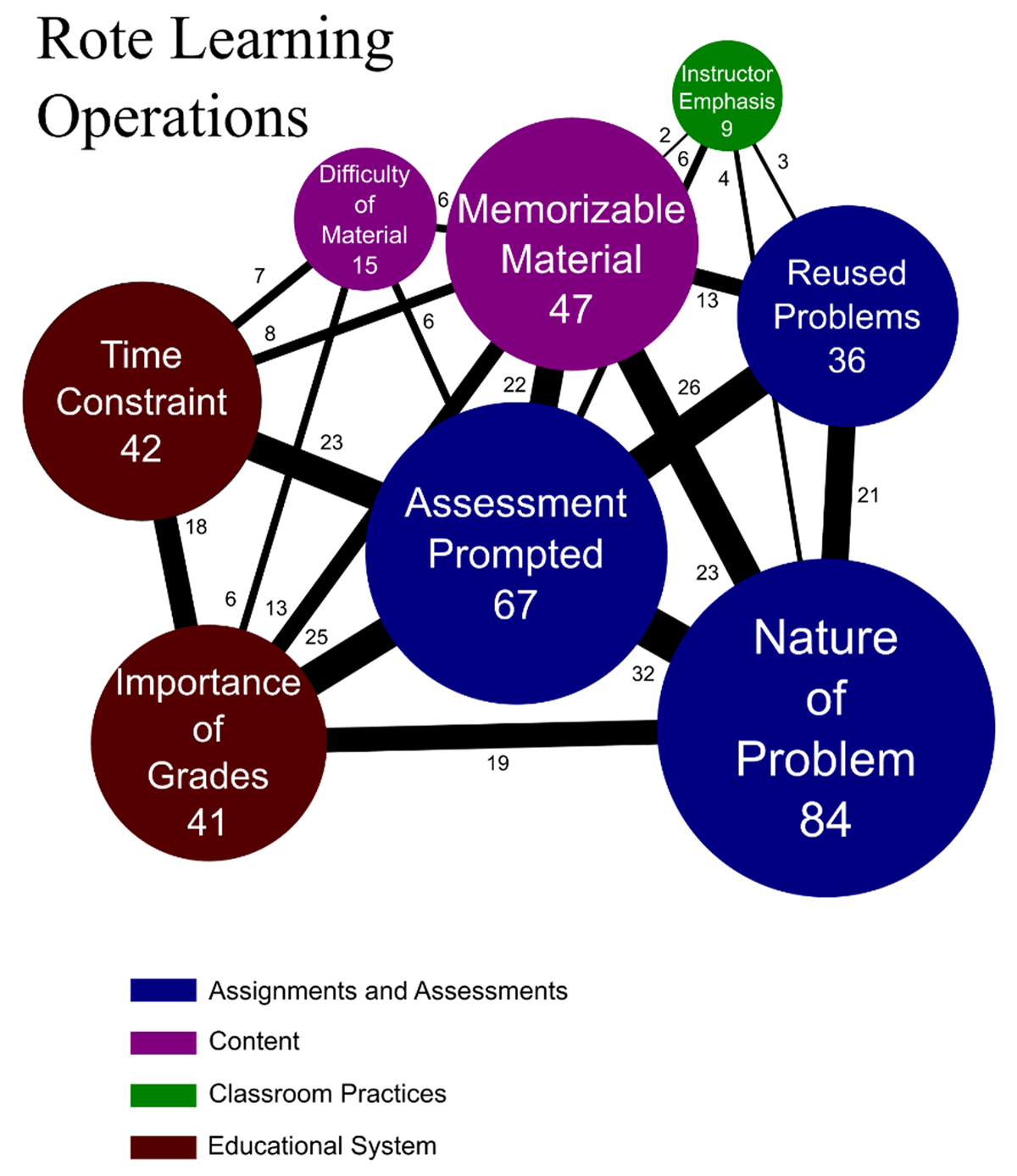
Figure 2
Network diagram for code themes of rote learning operations. The nodes are colored according to the four general categories, and the nodes and edges are sized in proportion to the number of responses.
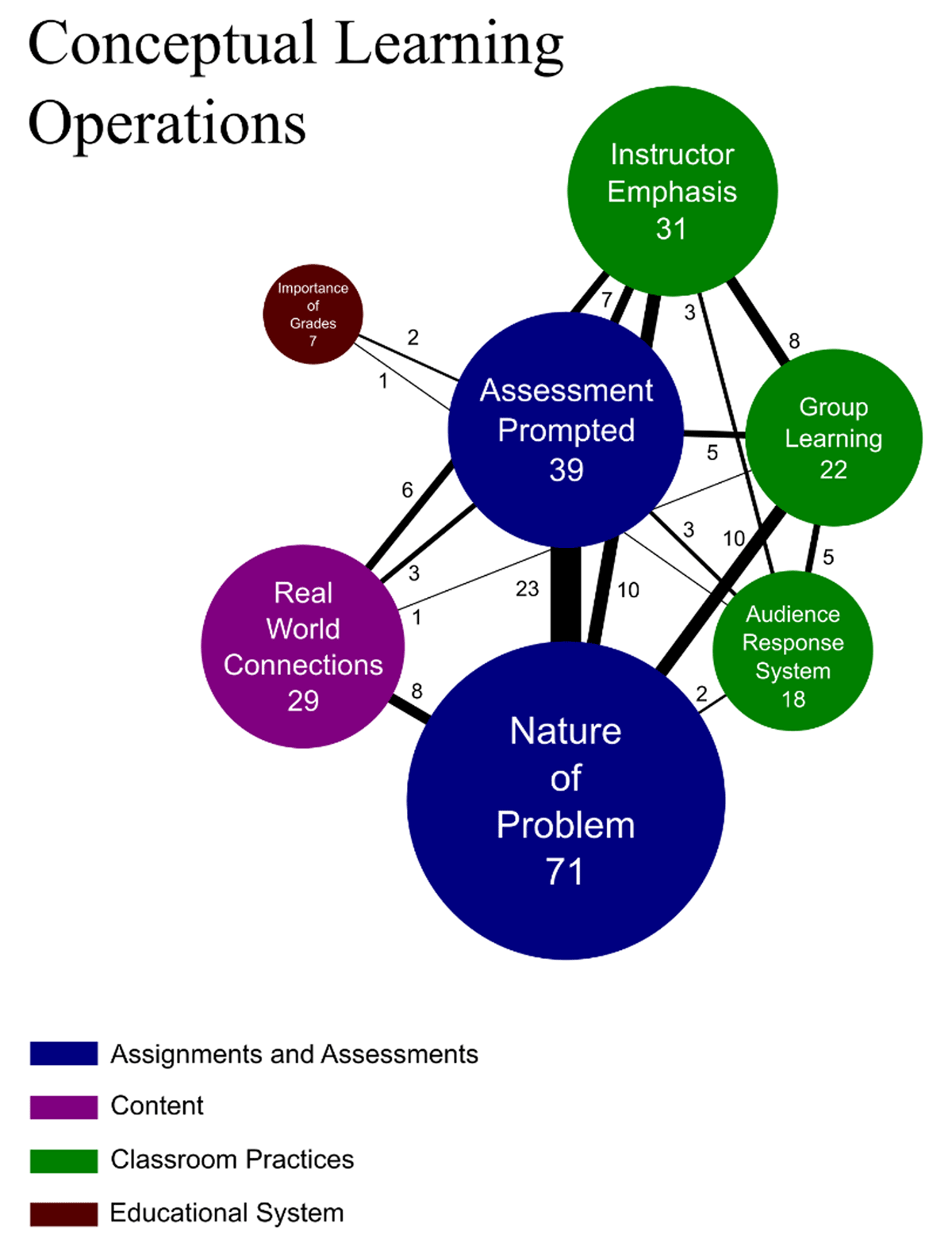
Figure 3
Network diagram for code themes of conceptual learning operations. The nodes are colored according to the four general categories, and the nodes and edges are sized in proportion to the number of responses.
Table B1
Response Examples for Assignments and Assessments category.
| Code Name | Operation | Example |
|---|---|---|
| Nature of Problem | Rote | “Rote learning might be more promoted when every single question on the midterm is based off of formulas. To be honest, sometimes it is hard to distinguish between me understanding the material and me redoing the practice problems over and over again until I can repeat it even with minor changes to the problem.” [Partial| Nature of Problem: Rote, Reused Problems, Assessment Prompted: Rote] |
| Conceptual | “[Course title] does a great job in prompting conceptual learning! Conceptual learning is promoted through homework questions and test questions where you don’t have to look at a formula sheet as much and you instead need to consider all the concepts you’ve learned and how they apply to a new problem.” [Partial| Nature of Problem: Conceptual, Reused Problems, Assessment Prompted: Conceptual] | |
| Assessment Prompted | Rote | “Rote learning is prompted in the courses where exams make up an overwhelming majority of the grade for the course. An example of this is my [course title] course. The course grade boils down to how well I do in two one hour exams, and one two hour final. I don’t have time to think about how to solve the problems because any time wasted means that I won’t finish, and will fail. Instead I have to complete practice problem after practice problem to try and have a preprepared answer in my brain for whatever I will be asked to solve” [Assessment Prompted: Rote, Importance of Grades: Rote, Time Constraint] |
| Conceptual | “Conceptual learning tends to be prompted by midterms and finals that contain qualitative questions in which students must use their understanding of different properties to predict what will occur in a system and explain why they believe in their prediction.” [Assessment Prompted: Conceptual, Nature of Problems: Conceptual] | |
| Reused Problems | Rote | “… the test is bound to be on a problem you should have seen somewhere before. It becomes a game of trying to memorize as much as you can in the hopes that you won’t fail too badly.” [Assessment Prompted: Rote, Reused Problems] |
Table B2
Response Examples for Content category.
| Code Name | Operation | Example |
|---|---|---|
| Memorizable Material | Rote | “For instance, in my [course title] course, it is all about memorizing amino acids, cycles, cell structures, and proteins and since there is not recitation or lab, I feel as though I am prompted simply to memorize everything and perform on the test. I can tell you every step of the citric acid cycle, but only vaguely understand its importance. This saddens me because I am a BioEngineer and I want to work in the field of genetic research, where knowing these concepts would be immensely helpful, but I am told that I need to go to graduate school to get an understanding and undergraduate is simply to memorize the generalities and move on.” [Memorizable Material, Assessment Prompted: Rote] |
| Difficulty of Material | Rote | “This class is also very difficult to understand conceptually, and the formulas are much easier to memorize when and how to apply rather than understanding the reasoning behind them.” [Difficulty of Material, Memorizable Material] |
| Real World Connections | Conceptual | “… being asked to solve real-world problems with numbers or information NOT provided. First go-to is conceptual understanding of the situation, rather than skimming through a textbook chapter in search of a solution algorithm (which wouldn’t exist anyway).” [Real World Connections, Nature of Problems: Conceptual] |
Table B3
Response Examples for Classroom Practices category.
| Code Name | Operation | Example |
|---|---|---|
| Instructor Emphasis | Rote | “There are classes like [course title] that seem like there aren’t even any concepts it’s just specific problems to solve. It’s very hard to learn conceptual points when the professors do not even stress it or talk about why something is happening. When the professor doesn’t stress that type of learning, it’s hard for the student to really want to spend the time to learn the answer to why something is happening.” [Instructor Emphasis: Rote, Nature of Problems: Rote] |
| Conceptual | “The formulas are presented and explained well (what variables mean what), but the professor makes a point to explain the physical phenomena behind any assumptions being made and why those assumptions have an effect on the formula. Problems to work on during class are also utilized to test a mix of mathematical understanding and conceptual understanding. While working on these problems, any questions can be asked of peers or the professor about confusion regarding any physical phenomena present.” [Instructor Emphasis: Conceptual, Nature of Problem: Conceptual, Group Learning] | |
| Group Learning | Conceptual | “I especially like it when students in the class explain why the answer is what it is because they usually do it in a way that makes sense to me, probably because they have a similar knowledge base as me.” [Group Learning] |
| Audience Response System | Conceptual | In terms of conceptual learning, I absolutely love [Audience Response System] because it helps me understand the ideas/concepts presented and not even bother looking at the math calculation of it. You use the knowledge you have to answer the question, you work in groups, and at the end the answer is revealed and explained which allows me to recalibrate my thinking. [Partial quote\Audience Response System, Group Learning] |
Table B4
Response Examples for Educational System category.
| Code Name | Operation | Example |
|---|---|---|
| Importance of Grades | Rote | “I know that I truly want the deep understanding but I’m so afraid of getting mediocre grades and not looking good for internships, scholarships, and employment.” [Importance of Grades: Rote] |
| Conceptual | “On the other hand, [course title] promotes conceptual learning because it is impossible to do well on the exams without a good understanding of the concepts.” [Importance of Grades: Conceptual] | |
| Time Constraint | Rote | “… I isolate myself from almost everything, during the weekdays, I just do homework and study and I got the gym and that it. If my family who I used to call them every other day know that there is something wrong with myself because calling them since I am super busy with school. I want to learn and I knew since 8 years ago that being a chemical engineer will require a lot of sacrifices and a lot of long nights without sleep. But, what is happening this term is upnormal. For example, I am taking [course title] this term which is a very hard course. The professor usually blames us that we don’t study and we don’t spend enough time. the course is so hard and If I spend all of my time on it, what am I gonna do with the other 3 courses ? I went to him and I asked him a question after I read the book and notes and read many articles on [subject] and I asked him a question from the book. The answer was that I did not study very well and I need to spend more time. I told him that I can’t spend more time because I am taking other course than he replied that it is not his fault, I have to deal with that. what shell I do more than I am already doing? quit sleep and spend 24 hr studying? what I am trying to say is that in order to SURVIVE this term, I have to use rote learning. Because if I am gonna use conceptual learning, I will not pass any of my class and I will not have time to do homework problems that is assigned every day.” [Time Constraint, Importance of Grades: Rote, Assessment Prompted: Rote, Difficulty of Material] |