
Introduction
The Learning Assistant (LA) Model for supporting student-centered reform in undergraduate STEM education was developed at the University of Colorado-Boulder in the early 2000s (Otero et al., 2010) and since then has been implemented in colleges across the globe (Learning Assistant Alliance, n.d.). The LA model consists of adding pedagogically trained near-peer assistants to the in-classroom or in-lab instructional staff for undergraduate courses with active learning components. Guided by training in how people learn, participation in weekly instructional preparation meetings, and their own prior experiences as learners in a course, LAs focus on deepening student sense-making, increasing student-to-student interaction, and supporting inclusion of all students (Otero et al., 2010).
In undergraduate engineering programs, faculty have been including peer instructional assistants in courses for some time, often referring to them as “peer tutors” (Brown & Poor, 2010) or “peer leaders” (Loui et al., 2013). Recently, undergraduate engineering programs have also begun to explore the LA model as a particular approach to employing near-peers to support student learning in required academic courses (Auby et al., 2024).
Empirical research has shown that courses with LAs have higher student outcomes than similar courses without LAs, as measured by drop/fail/withdraw rates (e.g., Alzen et al., 2018) and by pre and post test scores on content knowledge assessments (e.g., Hassanzadeh Gorakhki et al., 2019; Herrera et al., 2018; Sellami et al., 2017). This result holds across a number of STEM disciplines (Barrasso & Spilios, 2021), including physics (e.g., Alzen et al., 2018; Herrera et al., 2018), biology (e.g., Sellami et al., 2017), chemistry (Alzen et al., 2018), mathematics (e.g., Alzen et al., 2018), and more recently engineering (e.g., Hassanzadeh Gorakhki et al., 2019) – echoing findings about the impact of in-class peer tutors in engineering courses (Brown & Poor, 2010). Beyond conceptual learning, students also benefit from LA support in terms of engagement, attitudes, disciplinary identity, and course satisfaction (e.g., Kiste et al., 2017; Kornreich-Leshem et al., 2022; Talbot et al., 2015; M. M. Thompson & Garik, 2015; Westine et al., 2024).
Much research has focused on these benefits for students in LA-supported courses. Other research has shown how the experience affects LAs themselves. Being an LA increases their teaching strategies (Gray et al., 2016), their own conceptual understanding and epistemology (Cao et al., 2018; Lutz & Ríos, 2022; Otero et al., 2010), their metacognition (Breland et al., 2023), and their disciplinary identity (Close et al., 2016). These positive outcomes are deeply connected to the structure of the LA model and its three essential elements: (a) LAs’ instructional practice in a STEM class, (b) LAs’ engagement in instructional preparation meetings, and (c) LAs’ learning in a pedagogy seminar (Otero et al., 2010). However, in the engineering education community, research studies have just begun to characterize how these three essential elements function towards LAs’ capacity to enact student-centered instruction (Auby et al., 2024). In other words, how do engineering LAs learn to support learning?
In this paper we focus on how engineering LAs learn the craft of supporting learning. Specifically, we examine the function of one of the LA model’s essential elements – the pedagogy seminar – for LAs’ learning of how to support students in undergraduate engineering courses. We characterize in detail the mechanisms through which the weekly pedagogy seminar enables the formation of a community of practice where LAs collaboratively engage in pedagogical learning. This characterization enriches the research base on transforming undergraduate engineering instruction. Prior research has shed much light on the impacts of peer tutors and other near-peer instructional assistants in engineering courses. This study makes a new contribution by shedding light on the mechanisms for LAs’ pedagogical learning. Our findings also contribute to understandings of the instructional development of undergraduate instructional assistants and novice educators more broadly.
Literature Review: The Function of the Three Essential Elements of the LA Model for LAs’ Learning of How to Support Students
The LA model has three essential elements: practice (working with students), planning (regular meetings with the course instructor), and pedagogy (training in how to teach). Of these three elements, the one most directly related to student support is LAs’ practice in class or lab sessions. Through a variety of facilitation strategies (Carlos et al., 2023; Knight et al., 2015; A. N. Thompson et al., 2020) and social support strategies (Hernandez et al., 2021), LAs support student learning during interactions in active learning activities, conceptually and socioemotionally (Karch, Maggiore, et al., 2024; Maggiore et al., 2024). One study has shed light on how LAs learn to support students in these ways through their integration in classroom practice (Karch, Mashour, et al., 2024). Using classroom observations and interviews with LAs, this study found that LAs learn what their role is in a STEM classroom through mechanisms of consonance and contradiction with faculty ideas and practices. When learning through consonance, the LAs and faculty instructor of the class had aligned understandings of teaching and learning, and the LAs advanced their practice by finding new ways to support students in this agreed upon way. When learning through contradiction, the LAs’ understandings of student learning clashed with the faculty member’s understandings, and the LAs advanced their practice by finding ways to support students that satisfied both the faculty’s expectations and the LAs’ own sense of what students needed.
How to best support students in a given class is the subject of weekly instructional preparation meetings, the second essential element of the LA model. These meetings include the faculty instructor of a class, all LAs of the class, and any other instructors that are supporting a class, such as graduate teaching assistants (TAs). In these meetings, the instructional team reflects on student learning in past classes and plans for future classes (Learning Assistant Alliance, n.d.). Learning to support students in these meetings can happen on a spectrum from the faculty instructor mostly telling LAs how to best support students to faculty and LAs forming partnerships where they co-develop student support such as through problem design and scaffolding (Hamerski et al., 2021; Hill et al., 2023; Hite et al., 2021; Sabella & Roberts, 2023).
The third essential element of the LA Model, the one at the focus of our study, is the weekly pedagogy seminar. This seminar is an opportunity for LAs to deeply consider how people learn, discuss strategies of facilitation, and form bonds with one another (Learning Assistant Alliance, n.d.). The pedagogy seminar is a unique space for the LAs because it is filled with peer LA learners, whereas the weekly preparation session involves interactions with the faculty member whom they are assisting, and the classroom involves interactions with both the faculty and the students. The pedagogy seminar is ideally a place where LAs feel comfortable to bring up challenges they are facing in their LA role and to troubleshoot difficult interactions that they may encounter with students or faculty (Purtell et al., 2020). Prior research has explored which topics are taken up by LAs from the pedagogy course. In one study focusing on how to improve LAs’ uptake of pedagogical knowledge (Top et al., 2018), researchers analyzed LAs’ written reflections on what it means to teach and learn at multiple time points. Over the course of a semester, the LAs shifted the focus of their reflections toward the substance of student ideas, the process of knowledge construction, and the value of formative assessment. They evolved from viewing students’ initial ideas as obstacles to viewing them as resources. In another study, researchers had LAs use a virtual student avatar to practice teaching moves in their pedagogy class. The most frequently used move was closed questioning, followed by wait time and open questioning (Chini et al., 2016). Quan et al. (2017) measured LAs’ perceptions of the utility of pedagogy seminar topics and found that LAs for an engineering design course found the topic of convergent and divergent thinking to be the most productive, while cultural construction of engineering was the least productive for them. These studies shed light on which areas of content are important for pedagogy seminars, but they leave a gap in our understanding of how the LAs’ pedagogical learning unfolds in the pedagogy seminar.
Research Question
In this study, we aim to fill this gap by addressing the following research question: In the LA pedagogy seminar, what are the mechanisms through which engineering LAs learn to support student learning? We use the communities of practice framework as a lens to characterize these mechanisms. This study is not an examination of the causal relationship between LAs’ pedagogical preparation and student learning outcomes, but rather an inquiry into the processes through which LAs’ pedagogical learning occurs.
Conceptual Framework: Community of Practice
The community of practice (CoP) framework revolves around the idea of practitioners in a task or discipline (a) communicating with each other about the strategies and struggles that they have encountered while practicing their craft and (b) collectively refining their strategies and working through their struggles. These communities provide context and content for learning. Over the course of continued involvement, individuals within these communities transform from legitimate peripheral participants to core participants (Lave & Wenger, 1991; Wenger, 1998). This CoP framework has been applied to many contexts, including healthcare (Cruess et al., 2018), social workers (Cook-Craig & Sabah, 2009), and K-12 teachers (Barab et al., 2002).
In this section, we provide a domain-general introduction to the construct of CoP, which we will later apply to the specific context of the engineering LA pedagogy seminar. Wenger (1998) described three dimensions as core to a CoP. Mutual engagement consists of interactions between members of the CoP to create meaning. Joint enterprise refers to people working together toward a common goal. Lastly, shared repertoire are the common resources and practices that the community generates together. Figure 1 uses a concept map representation to operationalize a CoP in terms of time and space.
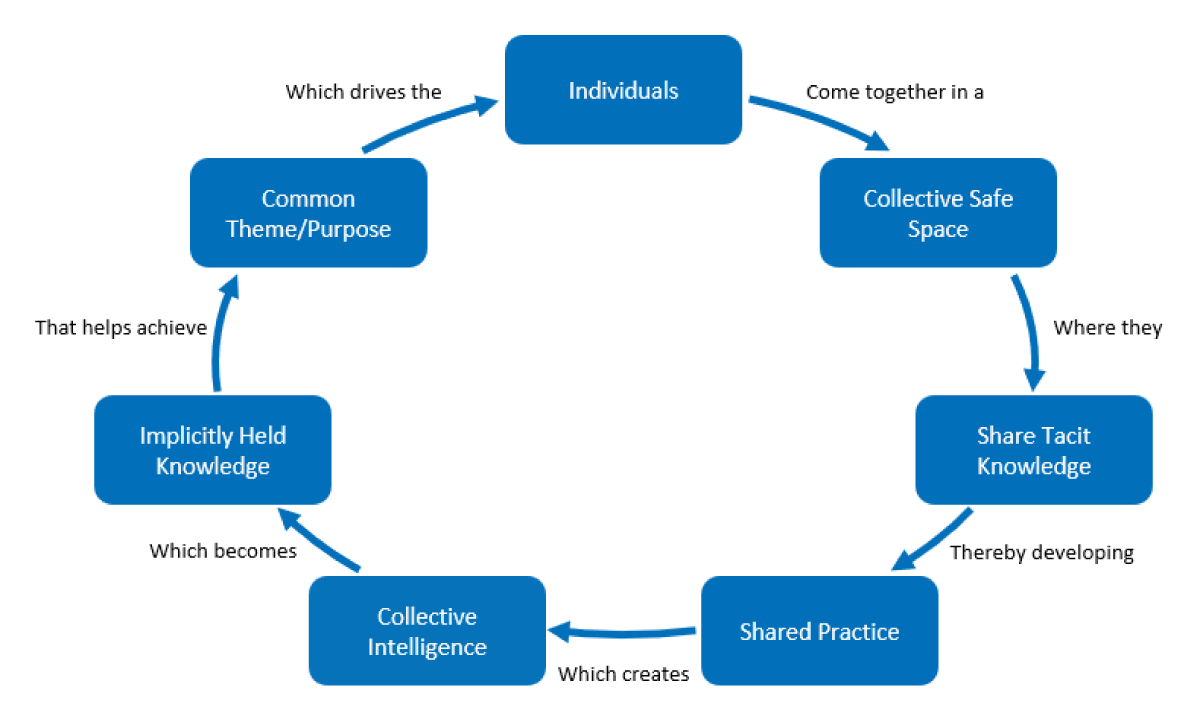
Figure 1
Community of practice concept map, adapted from Allan, 2011.
Common purpose drives individuals. The idea of joint enterprise is core to the group of individuals caring about a common purpose. A joint enterprise is more than just a stated goal but creates accountability toward the practice. The shared goal is important to each of the individuals and is a reason for why a community is formed in the first place.
Individuals come together in a collective safe space. Mutual engagement requires a diverse set of members so that group members can bring different perspectives and experiences. This requires members to show up and participate with each other. This location of sharing does not necessarily have to be physical, but it does have to be a location of psychological safety (Wenger, 1998).
They share tacit knowledge in this space. Another aspect of mutual engagement is that community members bring their own knowledge to the discussion and form relationships with each other. Because each of the community members have different experiences and perspectives, rich discussion can occur to form meaning. Wenger (1998) uses the idea of reification to label this process of naming meaning. The experiences of each member enable topics and trends to be named.
Sharing tacit knowledge develops shared practice. By sharing knowledge and naming trends and topics, a shared repertoire is developed among community members, enabling community members to discuss ideas with more speed and efficiency. They all understand each other in ways that laypeople would not immediately understand (Wenger, 1998).
Shared practice creates collective intelligence. After some time, the shared repertoire among members becomes more solidified and community members create a common understanding of the knowledge that they share. They can now negotiate meaning, a process that is ever changing but shaped by history, with community members constantly reassessing what aspects of their practice are fundamental (Wenger, 1998).
Collective intelligence becomes implicitly held knowledge. Each of the members is a part of this negotiated meaning process and thus can internalize more fully the implications of what the group deems is important. This becomes knowledge that is part of their improved practice and that is implicitly known, no longer needing to be discussed among group members.
The implicitly held knowledge aids in the common purpose. This development and internalization enable community members to fulfill their joint enterprise through active participation in the practice. To achieve this, members must align their individual work with collective goals. Effective practitioners must find legitimate ways to solve problems within standard guidelines, make appropriate situational choices, and develop a sense of what is reasonable. This entire process relies on implicitly held knowledge (Wenger, 1998).
Methods
Case study methodology enables researchers to contribute to theory about the processes underlying social phenomena (Merriam, 1998). We conducted an interpretive case study to characterize the mechanisms for the phenomenon of pedagogical learning among engineering LAs. Interpretive case studies use rich data “to illustrate, support, or challenge theoretical assumptions held prior to data gathering… with the intent of analyzing, interpreting, or theorizing about the phenomenon” (p. 38). Thus, interpretive case study is an appropriate methodological approach when the goal, like ours, is to characterize an aspect of an interesting and unique system through the lens of existing theoretical constructs. The case, or bounded system, at the focus of this study is an engineering LA pedagogy seminar over the course of its first three years of existence. We see this case as a unique system within the research literature for two reasons. First, previous work on LA pedagogical learning has not focused specifically on engineering LAs. Second, both new LAs and “veteran” LAs (those who have been LAs in previous semesters) participated in this mechanical engineering department’s weekly pedagogy seminar. Yet veteran LA participation is not typical for LA pedagogy seminars (Learning Assistant Alliance, n.d.). This seminar began as a mixed-experience group because initially the mechanical engineering LA program was the only one at the institution, and veteran LAs were included to ensure there were enough participants to sustain group discussion. While the inclusion of veteran LAs is a unique feature of the pedagogy seminar we studied, we see this as a strength of this research because it revealed mechanisms of pedagogical learning between new and veteran LAs that have implications for other engineering LA programs.
Researcher Positionality
The research team approached this study from a participant researcher perspective, as the first and second authors played both program facilitator and researcher roles. At the time of the study, the first author was a doctoral student whose duties included working as a TA in undergraduate mechanical engineering courses as well as co-facilitating the mechanical engineering LA pedagogy seminar. Her undergraduate training was in mechanical engineering, and her doctoral work was in engineering education with a focus on LA practices. She was a familiar figure to the department’s LAs because many of them had previously taken courses where she was the graduate TA. The second author, a faculty member in mechanical engineering and education, founded the mechanical engineering department’s LA program and designed its pedagogy seminar. Some of the LAs had previously been students in her mechanics course. The third author was not a participant researcher. She contributed to the research from an insider-outsider perspective. She is not a member of the mechanical engineering department, yet she is a faculty member teaching with LAs, co-leads the LA program for other disciplines at the same institution as the other two authors, and teaches its domain-general pedagogy seminar (which did not exist when this data was collected).
Context
This study examines the cohort of LAs who served for at least one semester during the second and third years of the LA program in the Mechanical Engineering Department of a private, R1, predominantly White institution in the northeastern United States. During this time period, the LA seminar was facilitated by two of the authors, who, as mentioned above, also had roles in the department as associate professor and doctoral student.
Seminar Goals and Perspectives. The major goals for the mechanical engineering LA program were to increase the depth of undergraduate student learning, to be more inclusive of students from non-dominant backgrounds in engineering and of students with different learning needs, and to help LAs themselves gain skills that could be implemented in their post-collegiate career. Goals for the pedagogy seminar in particular, as stated in the seminar syllabus, are listed in Table 1. In designing both the overall program and the details of the pedagogy seminar, we relied heavily on resources from the national Learning Assistant Alliance (Learning Assistant Alliance, n.d.). We grounded our work as seminar facilitators in the theoretical perspective of responsive teaching, an instructional approach in which educators base their moves and objectives on what their students are doing and saying (Robertson et al., 2015). Instead of pre-determining each instructor action for an entire instructional sequence, responsive teachers elicit students’ thinking around a topic, notice and interpret productive aspects of their thinking, and respond to support their disciplinary progress. We strove to demonstrate responsive teaching in the ways we supported LA learning about pedagogy. This meant that after sharing an initial resource on some aspect of pedagogy (see Table 1), we elicited and noticed LAs’ thinking about that topic before we responded to guide them toward more refined pedagogical knowledge and practice.
Table 1
Overview of the design of the mechanical engineering LA (LA) pedagogy seminar.
| SEMINAR GOALS | EXAMPLE RELATED ACTIVITIES | EXAMPLE RELATED RESOURCES |
|---|---|---|
| LAs learn to ask questions to elicit student thinking |
| |
| LAs learn to advance student thinking |
| |
| LAs learn to foster inclusion in engineering courses |
| |
| LAs develop supportive collegial relationships with each other |
| |
| LAs constructively and proactively offer feedback to instructors |
|
Seminar Structure. The pedagogy seminar met once a week for an hour in one of the department’s classrooms or, during the COVID-19 remote learning semesters, on Zoom. The LAs were paid for their time in the seminar and did not receive academic credit for it. The hour was split into two main phases. First, each LA shared a stand-out moment from their work as an LA in the previous week, whether it was an interaction they struggled with or a time where they saw a student make progress in their thinking. Second, we actively explored a pedagogical strategy through discussion or practice. Facilitating these sessions from a responsive teaching lens, we asked questions of the LAs and pushed for productive discussion. We also attended to social dynamics among the group with an emphasis on making sure that everyone’s voice was heard. The remote (Zoom) version of the seminar differed from the in-person version only by modality; the weekly routine was the same.
Seminar Content. The overarching theme of the seminar was that becoming skilled at inclusive, responsive teaching requires both knowledge of how people learn and a toolbox of pedagogical techniques. Each week, the LAs explored this theme with three main sources of information: (1) their own experiences as LAs over the course of the previous week, (2) readings or presentations by experts/researchers, and (3) video/audio of other instructional assistants in action. As detailed in Table 1, the readings and presentations were drawn from books and websites intended for practicing educators and from education research journals. Topics included questioning techniques, inclusion, active learning, types of instructor discourse moves, strategies for feedback, and the intersection of social dynamics, emotion, and learning. Although the set of topics remained the same across the semesters, most of the specific readings and activities were not repeated in consecutive semesters. The goal was for returning LAs to be exposed to new resources each semester that they participated. Each semester’s schedule of topics, activities, and resources can be found in the appendix.
Participants
After the conclusion of the third year of the mechanical engineering LA program, all students and alumni who had been LAs during program Years 2 and 3 were invited to participate in the study. Out of a total of 33 eligible LAs, 18 LAs consented to be a part of the study (Table 2). The data for this study consist of retrospective interviews with 13 of the consenting LAs and field notes from four semesters of pedagogy seminar sessions. We excluded from analysis any field note entries that described specific actions or speech of non-consenting LAs. The study participants had between one and four semesters of experience in the LA program, and they assisted in courses across all five main sub-domains of mechanical engineering, ranging from thermal fluid systems to electronics and controls (Figure 2).
Table 2
Number of novice and veteran LAs in each semester of the pedagogy seminar.
| SEMESTER | VETERAN LAs | NOVICE LAs | TOTAL LAs | ||
|---|---|---|---|---|---|
| STUDY PARTICIPANTS | NOT STUDY PARTICIPANTS | STUDY PARTICIPANTS | NOT STUDY PARTICIPANTS | ||
| Year 1 Spring | 0 | 0 | 4 | 4 | 8 |
| Year 2 Fall | 3 | 0 | 2 | 2 | 7 |
| Year 2 Spring | 4 | 1 | 4 | 3 | 12 |
| Year 3 Fall | 2 | 2 | 6 | 4 | 14 |
| Year 3 Spring | 5 | 1 | 4 | 4 | 14 |
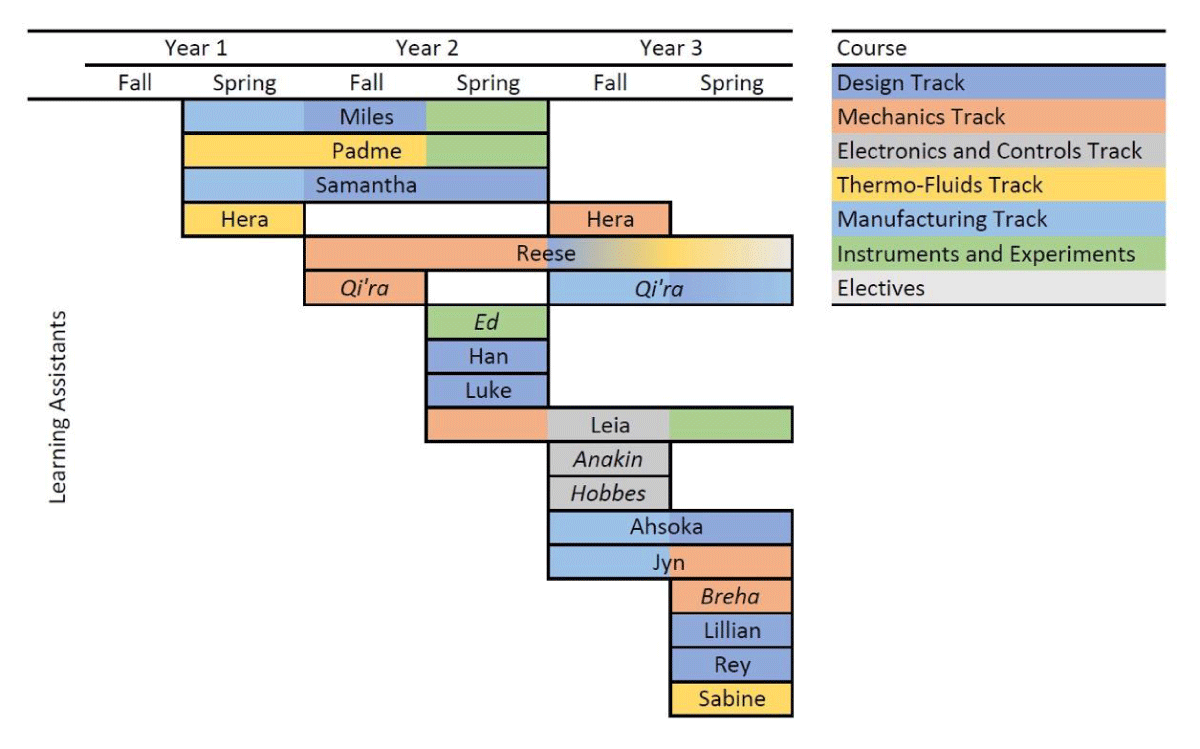
Figure 2
Courses served by LAs, organized by LA program year.
Note: All names are pseudonyms. LAs listed in italics were not interviewed. Gradient coloring indicates the LA served multiple courses in a single semester.
Data Collection
The primary data source is comprised of interviews with 13 LAs. The interviews were conducted by the first author and followed a semi-structured protocol asking the LAs to describe from their perspective the department’s LA program and pedagogy seminar and their role within it. The interviewer intentionally avoided using the word “community” until the final segment of the interview. Nine of the 13 LAs brought up ideas of community before this final segment. The interviews lasted between 12 and 47 minutes, with most taking about 30 minutes. After the Zoom video conferencing system auto transcribed each of the interviews, the first author processed all transcripts for readability and revised them while viewing all interview recordings in totality. The secondary data source included weekly field notes taken independently by both authors during and after each pedagogy seminar session for five semesters. These notes recorded information about all topics of discussion during each seminar session, ranging from the LAs’ reactions to reading assignments, their responses to reflection questions, the problems of practice they brought to the group for advice, and the guidance they shared with each other.
Data Analysis
Our data analysis methods were grounded in the approach of thinking with theory (Jackson & Mazzei, 2013). Thinking with theory involves using existing theory, previous research findings, data, and the researchers’ perspectives and incorporating them into each other to interpret the phenomenon under study. We used Wenger’s (1998) notion of CoP as the theory driving this process. This approach is similar to the version of grounded theory analysis that allows “sensitizing concepts” from the literature to guide the analyst’s attention during open coding (Charmaz, 2006). In our case, the sensitizing concept was Wenger’s depiction of a CoP as a cohort of people learning together how to achieve a common goal (their joint enterprise) through mutual engagement and shared repertoire.
To start the analysis of the interview transcripts, we conducted an initial cycle of structural coding (Saldaña, 2015) to identify all LA interview responses that could be interpreted as related to a CoP. The unit of analysis in this coding cycle was the turn of talk – that is, all of the sentences or phrases uttered by an LA between one interview prompt and the next. The first author read each turn of talk and considered whether the LA was saying something related to the joint enterprise, mutual engagement, or shared repertoire of the pedagogy seminar cohort. If so, the turn of talk was tagged as related to CoP. This initial coding cycle resulted in a data subset that included multiple CoP-related turns of talk from all 13 LA interviews.
Next focusing on the data subset generated from this initial pass, we used thematic analysis to identify common ideas voiced in the CoP-related turns of talk about the mechanisms for pedagogical learning among the engineering LAs. Our thematic analysis approach was “theoretical” because theory about CoPs provided a foundation for analyzing the data (Braun & Clarke, 2006, p. 83).
Consistent with the “generating codes” phase of thematic analysis, the first and second authors independently coded all turns of talk in the data subset for descriptions of CoP learning mechanisms. Then we compared both authors’ lists of CoP learning mechanisms. We took a “semantic” approach to generating codes and themes, aiming to capture the speakers’ explicit meanings rather than to interpret underlying ideologies (Braun & Clarke, 2006). We consolidated synonymous descriptions of mechanisms and discussed whether there was sufficient evidence to include mechanisms noticed initially by only one of the authors. Our threshold for inclusion was that a CoP learning mechanism needed to be mentioned in the accounts of at least two different LAs.
Next, moving into the “constructing themes” phase of thematic analysis, we saw that all but one of the CoP learning mechanisms that emerged from the LA interviews corresponded to one of the seven links of the CoP concept map shown in Figure 1. To depict this result, we translated the seven-link domain-general CoP concept map shown in Figure 1 into an eight-link concept map specifically depicting the mechanical engineering LA community (Figure 3). This new, data-based CoP concept map includes eight nodes and eight links between them. The nodes depict the core elements of the LA CoP. The links depict the interactions between those elements; in other words, the links are the mechanisms for the collective learning of the LAs in the CoP. Using the links on this data-based concept map as a final coding scheme, the first author moved into the “reviewing themes” phase of thematic analysis and conducted a final pass of the full set of interview data to identify additional LA reflections that would expand our conceptualization of each link. Particular attention was paid to instances when an LA mentioned another LA. The second author reviewed each additional excerpt proposed by the first author before it was added to the list of examples for a particular link. During this reviewing pass through the full set of data, the first author identified three additional mechanisms for pedagogical learning carried out in particular by the veteran LA participants. These were depicted as three additional nodes and links in a “veteran contribution” version of the LA CoP concept map (Figure 4).
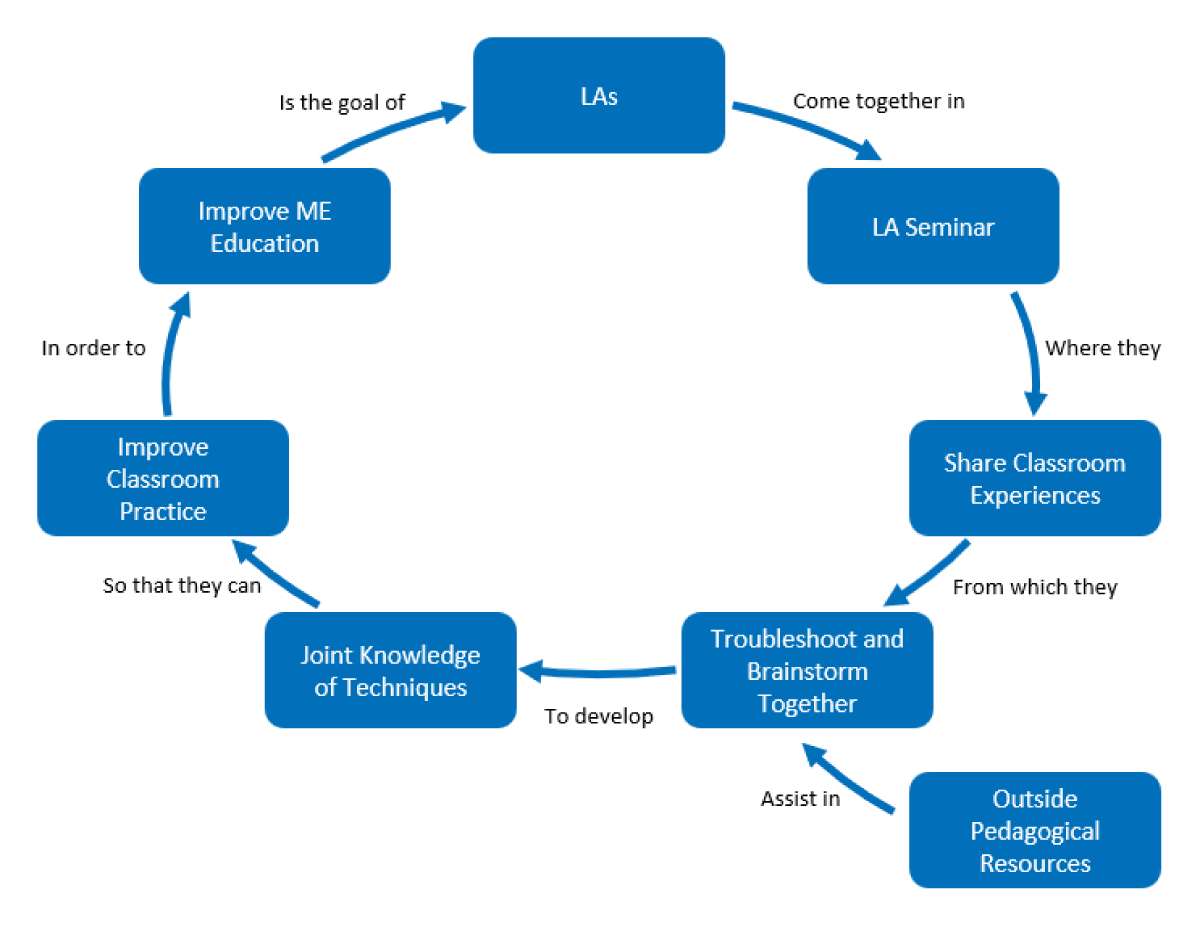
Figure 3
Mechanisms for Pedagogical Learning in the LA Seminar as a Community of Practice.
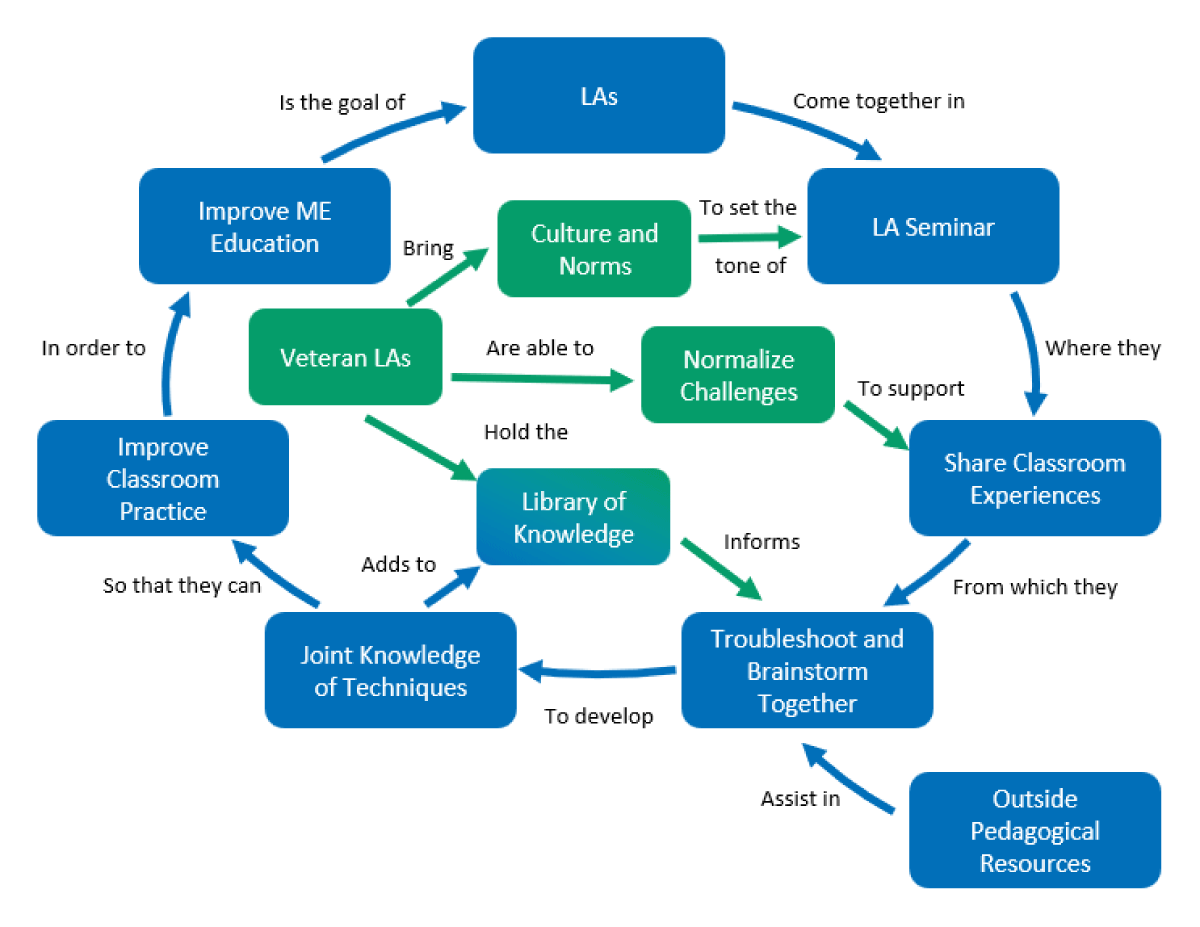
Figure 4
Veteran Contribution to the Community of Practice.
Note: The green nodes and links depict the veteran LAs’ contributions to the development of the LA CoP.
The final step of data analysis utilized the secondary data source, field notes from the pedagogy seminar sessions. The first two authors reviewed the field notes and tagged observations that exemplified the concept map links. The unit of analysis in this step was each sentence or bullet point that recorded an observation during a pedagogy seminar session. We found that all of the concept map links were exemplified by at least one observation in the field notes. This triangulation step contributes to the trustworthiness of our findings. It verified that the reflections shared in the LA interviews were consistent with the activities actually carried out in the pedagogy seminar and the pedagogical knowledge that the LAs verbalized during those activities. Additional measures taken to support the trustworthiness of our findings included maintaining two separate sets of seminar field notes, having two researchers independently conduct open coding of overlapping data, and having the third author with an insider-outsider perspective review the alignment between concept map links and representative interview excerpts.
Findings
The purpose of our interpretive case study analysis was to use the CoP framework to characterize engineering LAs’ pedagogical learning within a pedagogy seminar. In what follows, we first describe eight different mechanisms for the collective pedagogical learning of the LAs - how they embraced a shared purpose of improving undergraduate mechanical engineering education and learned together how to achieve that purpose. Each mechanism constitutes one of the “links” between nodes on the data-based concept map of their CoP (Figure 3). Second, we add three additional mechanisms to the data-based concept map that were made possible by the inclusion of veteran LAs in the pedagogy seminar. Their contributions were a unique finding from this case, with important implications even for LA programs that do not include veteran LAs in the pedagogy seminar.
CoP Link 1: The LAs share a pedagogical goal of improving the overall mechanical engineering educational experience. The LAs perceived themselves to share the goal of improving the educational experience within the mechanical engineering department. Samantha articulated the essence of this goal, helping students “think about it” and “figure it out” during learning activities:
Discussion facilitator would be the other words I would use to describe it… cause you’re asking questions and making the students think about it more, but you’re not giving it to them. You’re making them talk about it, and by talking about it, they figure it out. (Samantha)
Many of the LAs noted that the individuals who choose to be LAs share a goal of helping students. Ahsoka perceived this goal-sharing as the binding agent among the LAs:
Yes, I think it’s like, we’re all working towards the same common goal, which is probably like what brings us together. (Ahsoka)
Han expressed this shared goal as a common trait among the LAs:
I think the people that choose to be LAs like to be helpful,… to answer people’s questions and help people out… I think it’s people self-selecting by deciding to do it. (Han)
Like Han, other LAs also explained that the program attracted people who cared about the goal of helping other students learn.
CoP Link 2: Individual LAs come together in the LA Seminar. A key aspect of a CoP is that the group is not homogenous. The LAs noticed that the combination of multiple individual perspectives supported the group as a whole in meeting their goal of helping students. Different individuals in the seminar brought in unique identities, histories, and approaches as both students and as LAs. For example, Reese recalled, “I definitely remember people’s individual takes on things.” And Samantha noted,
Everyone’s kind of got their own flavor of learning assistant, some people are… kind of on the quieter side and just, you know, will stand there a little bit until someone asks them a question.… Padme’s got a big personality; Hera has a quiet personality. So Padme did a lot of the talking relative to Hera, I believe. But Hera often had good points was just much less vocal in terms of what was happening in class, and being sharp in questions. (Samantha)
The combination of individuals coming together into this collective space enabled the LAs to have rich conversations with each other.
CoP Link 3: In the LA Seminar, LAs share classroom experiences. The seminar environment allowed the LAs to feel comfortable being vulnerable with each other and share both good and bad classroom experiences. While reflecting on the feeling of interactions in LA seminar, Lillian noted,
I was really just moved by how honest people were speaking and how willingly they were able to just be vulnerable because I think that was- that’s something I struggle with just being like ‘Okay, this didn’t go well. I couldn’t answer this the student’s question’ or ‘I felt- I feel like I’m not doing a good job as an LA.’ So hearing people be vulnerable and then us having an open line of communication and everyone being responsive and participating was really a nice kind of fresh environment. (Lillian)
Lillian valued the ability for everyone to be honest with each other about challenges they faced as LAs. Rey also described what it was like to listen to others share their experiences in the context of the seminar:
It’s a… like a meeting, once a week, it’s super chill, and we talk about what was happening in our class that week or struggles that we had or sometimes things that we thought went really well. I love when people share things that are like ‘yes, finally, this- something good happened’ … Kind of like a book club, but like an ME book club, those book club vibes. Like nice, chill, no wine, but you know, sometimes food, sometimes people are eating. Like nice vibes just kind of hanging out, debriefing about the week, introducing new ideas and new material to try out. (Rey)
The LA Seminar made it an enjoyable place for LAs to share their experiences from the past week, not only the “struggle” but also what “went really well.”
CoP Link 4. LAs troubleshoot and brainstorm topics that came up in their classroom experience. In all of the interviews, LAs noted that collective troubleshooting and brainstorming sessions were crucial for their pedagogical learning. The basis for these sessions were challenges that came up during an LA’s interactions with students or faculty. For example, Padme described what happened when an LA described a difficult classroom situation:
If someone comes in and says, ‘I ran into this situation in class and I don’t know what to do and I felt like an idiot, I couldn’t answer this question da-da-da.’ Everyone’s going to support them and help them through that and discuss like ‘Oh, here are some ways you could have answered that and when you encounter a situation like this,’ ‘here’s what you can do going forward,’ da-da-da… (Padme)
Padme noticed that community members were eager to think of possible ways to handle the situation if it came up again. Sabine described how the brainstorming sessions supported LAs in identifying changes to make in their pedagogical practice:
I feel like if you don’t have that component of sharing good things and bad things um… you don’t take the time to reflect on your actions and reflect on what’s going well, or what you’re struggling with. And if you can’t really reflect on your experience with those things, then it’s really hard to make progress and identify what you can do to make changes or identify things that you want to continue doing, because you really liked the outcome. (Sabine)
Sabine’s comments suggest that collective troubleshooting and brainstorming supported individual LAs’ reflection about which pedagogical practices to refine and which to sustain.
CoP Link 5. LAs use outside pedagogical resources to aid in brainstorming. One aspect of the LA CoP that was not represented in the generic CoP concept map (i.e., Figure 3 compared with Figure 1) was the use of outside resources to further the pedagogical development of the LAs. For example, Han remembered a reading that he was able to use to come up with ideas for how to approach a SolidWorks session:
It was a reading about how to frame the problems that we gave them because we had labs that we as LAs ran, and … we had a lot of discretion on the labs in terms of what we were doing, and so the reading was how do you like create the problem to encourage the collaboration. A lot of it was about how simply you should break the steps down, how to leave it open enough that they can form their own ideas, but you don’t want to give them too much space that then they’ll go off and be stuck on where to go. So that one really stuck with me at the time. (Han)
Another set of resources that were available to the LAs were guest speakers from the discipline-based education research community. Lillian noticed connections between the guest speakers’ remarks and what she was seeing in the classroom:
With guest speakers that we were able to kind of have an open conversation and ask personal questions in terms of things we were seeing when we were at- when we were LAing in classes so kind of just getting a different outside perspective was really interesting and hearing about kind of their take on the LA role, what they’ve seen, what works, what doesn’t work was really nice. (Lillian)
The opportunity to hear from additional outside perspectives gave the LAs an opportunity to expand the range of possibilities for their role.
CoP Link 6: Troubleshooting and brainstorming together leads to a joint knowledge of techniques. The result of these troubleshooting and brainstorming sessions was a shared knowledge of best practices and techniques. Samantha described this “learning from each other”:
That was really helpful just learning from each other in terms of you know tips and tricks and those types of things you know if you’ve got like… a group of students who works really well together and a couple students who maybe don’t as much, how do you make sure that everyone’s getting the most out of this, um those types of things were really helpful… to talk about. (Samantha)
Having learned from the other LAs, a library of potential “tips and tricks” was being formed. Jyn noted that talking about how to help students improved her pedagogical technique:
Another point of view is we talk about how to help students, or like how to push students enough so that they are learning, but not giving it away, and I think we usually do activities where like you see… an LA demonstrate a lesson plan or something. And I feel like that part of the seminar is technique- learning about technique. (Jyn)
Through discussion of their interactions with students, the LAs jointly constructed knowledge of techniques for supporting learning.
CoP Link 7. Joint knowledge of techniques helps LAs improve classroom practice. The LAs applied this collectively constructed knowledge of pedagogical technique to their subsequent classroom practice. For example, Hera noticed that during her moment-to-moment work as an LA, she would remember many of the ideas the other LAs suggested:
When people would give examples of a time they were they were struggling to do that and we worked through it as a group, like what you could have said that would make it easier, … that is the problem solving that you do in your head when someone asks you a question …. Hearing the thought process of all the other LAs, plus [the interviewer] and [LA Program Coordinator] giving suggestions for things to say is kind of what played back through my head afterwards, when I would get a question like that, and I was trying to figure out what to say. (Hera)
Hera’s bank of ideas generated from discussion with other LAs allowed her to pick and choose what approach to use at any given moment. Luke also noted that the input from other LAs expanded his repertoire of teaching strategies:
[I] would have kind of come up with ideas, whether they were right or wrong, about how to best teach the subject matter. But I would have kind of gotten locked into those, and I wouldn’t have heard examples of other things that may have worked or didn’t work from some of the other LAs and other classes…. There were strategies that kind of worked that I listened to in other classes, like [Heat Transfer] that I tried to incorporate into [Engineering Design I] at the time. So I think a wide range of opinions about what worked and what didn’t. And not just opinions, but backed up with then ‘Oh, the students gave me feedback, and this in fact did work or this didn’t.’ (Luke)
Luke felt he would not have adjusted his teaching style without the weekly seminar. The evidence other LAs shared from their own teaching attempts gave him confidence to try new techniques. Jyn also made adjustments based on seminar activities:
And I think I adjusted my style of LAing a bit ever since that activity…. I relaxed a little bit more, then they would- it would be helpful for them to learn how to find the equations themselves and sort of like make the connection between the concept and [an] equation, rather than me like handing the equation to them… I didn’t stop the ideas from flowing. (Jyn)
Jyn noted that the activities and discussions in seminar helped her become a better discussion facilitator and allowed students to do more of their own thinking to solve problems. With expanded pedagogical repertoires, the LAs noticed improvement in their classroom practice.
CoP Link 8: Observable improvements to classroom practice are motivating signs of progress towards the LAs’ shared goal. The LAs perceived themselves as making progress toward their shared goal, which motivated them to continue their collective pedagogical learning. Samantha was a student in the first LA-supported class within the department. She noticed from her experiences both as an LA and as a student that more hands-on learning came out of the program:
Pushing more hands on learning, I feel like that was something that really came out of the learning assistants was more problems, more open ended problems, more… things where students have to think about it really hard in classes, helped, like kind of came out of the learning assistants….So kind of like those open ended questions was the start and has helped a lot in terms of… not having that kind of rote thinking of ‘Okay, you know, the question has this number, and this phrase in it, therefore, I need this equation’ like that kind of thinking. (Samantha)
Samantha saw that bringing in open-ended questions improved the learning experience but also impacted how the department approached learning overall. Miles also noticed that the LAs supported increased active learning components in multiple courses:
The work [on pedagogy principles] was… really propagated by way of the LA to the professors, and, you know, that feedback loop was established, and more active learning elements were blended into those courses. As the LA process progressed,… active learning and the emphasis on it definitely seems to have kind of… spread throughout the Mech E community in a way that I was really appreciative of… by- by the time I left. (Miles)
Mile sensed that the success of LA integration into mechanical engineering courses in the program’s first year made it easier to grow the program, including its support for active learning. As this diffusion of student-centered instruction occurred, the LAs felt like they were making a difference in the department.
Veteran LA Contribution to the LA Community
A unique aspect of this mechanical engineering LA program was that veteran LAs participated in the weekly pedagogy seminar. We found that veterans contributed three additional aspects to the CoP: bringing culture and norms to set the tone of LA seminar, normalizing challenges to support sharing classroom experiences, and holding a library of knowledge to support in the troubleshooting and brainstorming process (Figure 4).
Contribution 1: Veteran LAs bring culture and norms to set the tone of the LA seminar. Veteran LAs demonstrated respectful and productive interactions between LAs within the seminar. Hera had a unique perspective as a veteran LA who had taken a couple of semesters off, so she felt like a new LA:
The people who repeat semesters start to like, like that is the foundation of it and people who join, you can see that how the people care about each other and they care about helping each other. (Hera)
The LAs who were returning from previous semesters brought a culture of caring to the group. Sabine also noted that there was a good balance of how the veteran LAs interacted with the newer LAs:
The veteran LAs, I feel like they all did a really great job balancing the fact that they had, previous experience to give and also not acting like they had more knowledge than us on how to be an LA… That they were there as an extra support for new LAs but not someone to be like ‘Oh well, you should have done it this way because I’m an LA and you’re barely an LA’ (laughter)…. They didn’t do that at all, and I think it contributed to a very positive vibe. (Sabine)
Instead of being condescending to the newer LAs, the veteran LAs sent the message that they all had more to learn from each other.
Contribution 2: Veteran LAs normalize challenges that LAs face in the classroom. The veterans helped new LAs feel comfortable sharing their experiences in the classroom by normalizing conversation about challenges. Lillian, a first-semester LA, felt grateful for the way the veteran LAs affirmed that uncertainty was a normal part of the LA experience:
So they kind of helped guide the conversation, because we were very just kind of meek and we’re like ‘is this supposed to happen, are we supposed to not know what we’re doing?’ and they’re like ‘yeah it’s fine’ and I’m like ‘oh phew’ so … I was really grateful for that. (Lillian)
The veteran LAs eased Lillian’s fear that she wasn’t doing a good job. Rey also felt his concerns validated by conversations with the veteran LAs:
For me personally, because last semester was my first semester as an LA so it was kind of like “I have no idea what I’m doing or how I’m supposed to be doing this”, so hearing, even from Leia… and like [LA year above her] people that were older than me and have had this experience before that they were also struggling doing the same things I was, was really validating. (Rey)
Having the veteran LAs around to normalize what the newer LAs were experiencing boosted their confidence and allowed them to continue their progress as LAs.
Contribution 3: Veteran LAs hold a library of knowledge to support troubleshooting and brainstorming. From their previous semesters supporting students in the classroom and participating in pedagogy seminar, veteran LAs had already begun to build a library of pedagogical knowledge. Hera described how helpful it was to have veteran input during problem solving conversations:
But I think overall, it’s very helpful because our focus, like I said before, a lot is like problem solving and I think that’s the part that’s the most useful and … people who have more experience, they have more things to say. (Hera)
Rey also believed that it was necessary to have veteran LAs in the pedagogy seminar:
Yeah, no, they should have everyone [new LAs and veteran LAs] in there because… as much as it’s nice to have other people that are doing it for the first time, or their first year and, kind of experiencing the same things that you are… you don’t have the reflection of other people who have already figured it out…. It’s like inventing the wheel, but never telling anyone how to do it and then every generation after has to reinvent the wheel every single time. It doesn’t make any sense. (Rey)
Rey believed that the passing down of knowledge from veteran LAs made “sense” both for new LAs and for the program overall. Veteran LAs also perceived that their knowledge and practice as LAs was enhanced by their continued participation in the seminar. For example, veteran LA Padme found that she learned by reading or discussing a topic again but with different people:
I also think you always have something to learn, and even if you’ve read the article before, it doesn’t hurt to read it again, or just to talk about it again with different people having had different experiences. I think it is a good thing that we do that. (Padme)
Other veteran LAs also expressed appreciation for being included in the pedagogy seminar multiple times. They valued the opportunity to refresh their thinking about pedagogical ideas.
Discussion
Using a CoP framework to analyze LAs’ descriptions of their work and development as LAs enabled us to uncover the remarkably collective nature of engineering LAs’ pedagogical learning. We characterized eleven mechanisms through which pedagogical learning occurred among the novice and veteran LAs when they came together as a group in pedagogy seminar. Each of these mechanisms was consistent with Wenger’s (1998) model of a CoP. This framework helps our findings extend prior work on what LAs learn in the pedagogy seminar (e.g., Top et al., 2018), toward pinpointing how LAs learn. Based only on research on what LAs learn, one might assume that LAs learn how to build on students’ initial ideas, for example, by reading and discussing a paper on that technique with fellow seminar attendees. However, our work on how LAs learn suggests that this kind of pedagogical learning is embedded much more deeply in the shared micro-cultural practices (Cobb et al., 2001) of an LA pedagogy seminar. LAs do not learn from readings or activities alone. Rather, readings and activities assist LAs in troubleshooting and brainstorming possible responses to the classroom situations they report to each other in the pedagogy seminar. Through this intersection between their diverse classroom experiences and outside pedagogical resources, LAs construct a shared repertoire of practices that they use to work toward their common goal of improving education for fellow students. As they described their role and development as LAs in a mechanical engineering-specific LA program, the LAs in this study attributed their pedagogical learning to the community orientation of the pedagogy seminar and the collective analysis and reflection that orientation enabled.
Our study design does not allow us to claim that this mode of pedagogical learning - one highly dependent on the micro-cultural practices of a particular pedagogy seminar - is unique to LA programs in engineering disciplines. But it is possible that contextual factors inherent to undergraduate engineering education contributed to the mechanisms for pedagogical learning that we uncovered.
For example, in contrast to second- or third-year math or science courses which are often taken by students from several different majors, second- and third-year courses in engineering departments tend to be taken only or mainly by students who are majoring in the same sub-discipline of engineering. This reality means that engineering LAs likely perceive the students in the courses they are supporting as sharing an academic identity with them, belonging to the same sub-community of the university, and heading toward the same professional field. This shared identity (Holland et al., 1998) between engineering LA and engineering student may contribute to engineering LAs’ strong motivation to improve their pedagogical practice and to develop shared pedagogical repertoire among the LA cohort. They can assume that when they do their LA work well, it will have a positive impact not just on individual students but on the broader academic and professional community of which they are also members. By contrast, LAs in chemistry, biology, and physics departments often support introductory or intermediate courses that are taken by students from across several different majors. In those courses, LAs cannot assume that all the students they are supporting are pursuing the same major as themselves. Though they may be motivated to be as skillful as possible in supporting students, they may be less likely than engineering LAs to position their LA work as a means to transforming their academic major.
It is also possible that it was not the engineering context but rather the same-department nature of the pedagogy seminar that supported the mechanisms of pedagogical learning we identified in this study. When LAs in a pedagogy seminar are all majoring in the same academic discipline with a large number of required courses, the LAs can reasonably assume that all of the other LAs in the seminar have taken or will take the courses that they are supporting. When troubleshooting a challenge, they are facing in supporting students in a particular course, their discussion of that challenge in the pedagogy seminar can be highly specific both to the academic discipline and to the people that make up the academic department. They can use technical terms, mention disciplinary-specific ideas and tools, and refer to specific professors, all the while trusting that their fellow LAs will know what they are talking about. They can talk specifically and concretely about the disciplinary substance of the courses they are supporting. Research on the pedagogical development of K-12 teachers has shown again and again that disciplinary-specific training and disciplinary specific “pedagogical content knowledge” is crucial to skillful teaching (Shulman, 1986). A same-department LA pedagogy seminar creates the conditions for this pedagogical content knowledge to develop among LAs.
Implications for Research and Practice
Above, we have hypothesized on some factors that may have influenced the highly collective nature of the engineering LAs’ pedagogical learning. These hypotheses point to several avenues for future research. Researchers could conduct a multi-case study of LA pedagogy seminars that use the same resources and routines but differ by academic discipline or by whether they are homogeneous or heterogeneous to discipline. Given that there are likely important affordances and constraints of both set-ups, studies could also explore new designs for pedagogy seminars that combine interactions among different-discipline LAs with opportunities for same-discipline LAs to engage in collective reflection.
Another pathway for future work is to investigate how LA learning during the pedagogy seminar interacts with LA learning during their classroom practice. We knew previously that LAs learn from consonance and contradiction between what they think is important for student learning and what the faculty teaching the course they assist believes is most important for student learning (Karch, Mashour et al., 2024). From our study presented here, we now know that LAs also learn from what their LA community co-constructs in response to what they are experiencing as LAs in classrooms. Future studies can explore what happens in the pedagogy seminar when LAs bring up what they experience as contradictions between what they believe and what the faculty they teach with believe. Does the LA community find productive ways to change practice in response to these contradictions? Does what LAs learn through co-constructing with their peers in the seminar lead to change in their personal LA practice that ultimately leads to change in the class practice as a whole? It would also be interesting to see what role the instructional team meetings play in facilitating between learning in LA practice and learning in the pedagogy seminar.
Our findings on the collective nature of engineering LAs’ pedagogical learning also have implications for engineering education practice. Engineering programs that want their near-peer instructional assistants to support active learning should ensure that they have created structures within which those assistants can collectively analyze and reflect on their work as assistants. Those structures might include protected time and space for gatherings of assistants who are supporting classes within the same major, pedagogical readings and resources for the assistants to discuss and apply to their own ongoing pedagogical experiences, and facilitation of interactions between novice and experienced assistants. It is not necessary for a program to refer to their near-peer instructional assistants as “Learning Assistants” or to adhere to all of the elements of the LA model for these structures to be supportive of pedagogical learning. Furthermore, these same structures are likely to be supportive of pedagogical learning among engineering professors. In fact, previous research on faculty communities of practice has already shown that the use of student-centric, active-learning techniques is higher among STEM faculty who participate in a course-reform CoP than among STEM faculty who do not (Tomkin et al., 2019). Like the LAs in this study, faculty participants in pedagogically-focused communities of practice have reported that along with other CoP members, they share a vision for improved education, rely mutually on each other to improve their techniques, and benefit from each other’s unique knowledge and skill contributions (Cross et al., 2021). Universities should consider expanding opportunities for faculty within the same discipline to gather regularly for collective discussion of outside resources on pedagogy and collective troubleshooting of the challenges they face in supporting student learning. In addition, the observation of pedagogical learning in both LA communities of practice (this study) and faculty communities of practice (Cross et al., 2021; Tomkin et al., 2019) creates space for future explorations of student and faculty community partnerships.
Limitations
Several factors related to methods, participants, and context limit the conclusions we can draw from our findings. Because it was outside the scope of this study to collect data from the courses that the LAs were supporting, we could not directly observe changes in LAs’ pedagogical practices. Our claims of pedagogical learning are drawn instead from the LAs’ self-reports of their work and development as LAs and triangulated by our review of seminar field notes over multiple years. We also cannot make causal claims about the impact of the LAs’ pedagogical techniques on student outcomes. Future inquiry along both of these lines would be generative.
Another limitation is that we did not explicitly investigate the role of the facilitators in the pedagogy seminar. It would be interesting to see what impact the seminar facilitators had in forming the CoP. Our presence may have enhanced the creation of a CoP because we were able to emphasize the need for this space to be safe and confidential. However, we could have also detracted from the CoP by not actually being LAs.
Finally, our findings could be deepened with real-time data from the pedagogy seminar. Although we used field notes for triangulation, audio or video recordings of seminar discussions may have enabled us to point to specific interactions between LAs and explore which interactions contributed more or less to pedagogical learning.
Conclusion
The LA model for near-peer instructional assistants focuses on using undergraduate students not as tutors or graders but to support active learning experiences in the classroom and lab. Therefore, by characterizing the mechanisms through which engineering LAs learn to support student learning, this study expands the research base on transforming undergraduate engineering courses toward student-centered instruction. We found that when novice and experienced engineering LAs gathered in a weekly pedagogy seminar, they worked together to analyze and improve their pedagogical practices so that they could help enhance the overall student experience in their undergraduate engineering program. They encountered the pedagogy seminar as a community of people who reported on their classroom experiences and helped each other troubleshoot challenging aspects of their roles as LAs, with support from outside resources. Over time, these seminar activities led to joint knowledge of pedagogical techniques, which LAs implemented to improve both instructional practice and the overall educational experience in their undergraduate engineering program. Improved instructional practice and improved student experience become more and more deeply established as the LAs’ shared high-level goals. Having veteran LAs participate in the seminar along with new LAs brought value to the engineering LA program by sustaining the microculture of the pedagogy seminar, normalizing challenges that LAs face in the engineering classroom, and providing a library of knowledge to support troubleshooting and brainstorming of instructional moves.
Additional File
The additional file for this article can be found as follows:
Appendix
Topics, Activities, and Resources for All Semesters of the LA Pedagogy Seminar. DOI: https://doi.org/10.21061/see.214.s1
Ethics and Consent
Ethical approval was received from the Tufts University Institutional Review Board (IRB # 00001476). Participants provided consent via the IRB-approved consent process; no identifiable information is included.
Acknowledgements
We thank all research study participants and the instructors who hosted them as LAs in their courses. We would also like to thank Hoda Koushyar and Mary Emenike, who served as early readers and provided helpful feedback on our analysis and interpretation of findings.
Data Accessibility Statement
Data sharing beyond data presented in article is not available per the human subjects research protocol for the study.
Author Contributions
KBW initiated the study. IRS designed the study, conducted data collection, and led data analysis. KBW assisted with data analysis and ICG gave feedback. IRS, KBW, and ICG interpreted the findings. IRS wrote this manuscript, and KBW and ICG revised it. All authors read and approved the final manuscript.