
1. Introduction
The sociotechnical nature of engineering and technology has been discussed in the Western engineering education literature (e.g., Faulkner (2015), McGowan and Bell (2020), Trevelyan (2010)) and more extensively in the field of science and technology studies (STS) for decades (e.g., Feenberg (1999), Franklin (1999), Latour (2005), Law (1987), Winner (1989)). Yet, the perceived neutrality and objectivity of engineering remains a source of pride and methodological rigour (Pawley, 2009; Tonso, 2014; Trevelyan, 2010) and an essential part of the structure of Western engineering education (Cech & Sherick, 2015). Researchers have discussed this neutrality in terms of technical-social dualism (Faulkner, 2000) – a separation of the social and technical aspects of engineering. They have also suggested that this perceived neutrality fosters a culture of disengagement in engineering education (Cech, 2014), in which students are not only taught in neutral and decontextualized ways, but are also discouraged from engaging with engineering’s social and political dimensions.
The hierarchy between, and separation of, the social and technical dimensions of engineering may cause practitioners to consider existing social aspects of their work as not engineering, preventing full and proper engagement with them, and compromising engineering outcomes that are context and purpose-dependent –(Lim et al., 2021; Loweth et al., 2021; Trevelyan, 2010). Additionally, the ideology of neutrality in engineering narrows the competencies of practitioners, limits practitioners’ roles in society, and dictates who can be an engineer (Faulkner, 2015; Rohde et al., 2020).
More critically, perceiving engineering as a neutral, technical field constrains engineers’ ability to effectively position themselves and engage with social and environmental justice issues (Cech, 2013; Leydens et al., 2021; Lucena et al., 2010). It enables engineers to detach themselves from the negative consequences and impacts of their work (Downey, 2015) while still believing that they are working for the benefit of society as a whole (Downey, 2014), as long as they ensure safety (Rodrigues, 2020). By embracing this normative holism (Downey, 2014), engineers can work with reductionist problems without questioning – or noticing – the social influences, purposes, and impacts of their work. They can use neutrality as a shield to justify engineering as purely technical and apolitical, absolving engineers of responsibility for social consequences.
Fortunately, efforts have been made to challenge this perceived neutrality by emphasizing engagement with the social aspects of engineering (Niles et al., 2020). An example is the concept of sociotechnical thinking, recently introduced in engineering education as a way to counter discourses of neutrality. Sociotechnical thinking has been defined as the capacity to acknowledge, identify and respond to the sociotechnical nature of engineering practice (Erickson et al., 2020; Mazzurco & Daniel, 2020). The growing literature on sociotechnical thinking has discussed, among other topics, the barriers to teaching and developing sociotechnical thinking, its intersection with existing cultures and identities in engineering, and the importance of personal connections to challenge students’ perception of neutrality (Rodrigues & Seniuk Cicek, 2024).
However, despite a relatively widespread framing of engineering as sociotechnical, different strands of scholarship have presented different understandings of what the term means and focused on different aspects of its implications for engineering (Rodrigues & Seniuk Cicek, 2024). Codes of ethics, accreditation requirements, as well as some engineering education researchers primarily discuss the impact of engineering on society and the environment (e.g. Chen et al. (2023), Fajardo et al. (2022)). Meanwhile, other researchers focus on the distributed nature of engineering knowledge (e.g., Leydens (2012), Jesiek et al. (2019), Johnson et al. (2019)) emphasizing the communication and collaboration among engineers and other social groups to define problems and develop technical solutions. Lastly, some discussions focus on the social aspects that influence and shape engineering problems, knowledge, and methods (e.g. Stettler Kleine et al. (2023), Erickson et al. (2020), Downey (2015)), and how engineering projects often serve the needs of specific social groups (Lucena et al., 2010).
Each of these dimensions is fundamental to understanding the sociotechnical nature of engineering. However, considering each of them individually may prevent one from appreciating the other sociotechnical aspects of engineering, as well as the additional complexities that emerge from the interactions among them. For instance, focusing only on the social impacts of engineering without considering knowledge distribution may overlook how collaboration and negotiation shapes technological solutions. Similarly, emphasizing collaboration and communication without addressing the socially constructed nature of engineering knowledge and problems can inadvertently propagate values and ideologies embedded in engineering codes, standards, knowledge, and methods under the label of neutrality.
While several scholars over the last decade or so have presented frameworks that integrate multiple sociotechnical dimensions of engineering, each has critical limitations. One existing framework is the honeycomb of engineering (Purzer et al., 2022), which explains different types of engineering inquiry, highlighting the negotiation among stakeholders as central to all of them and focusing on the social interactions that shape problem scoping, ideation, and evaluation. Although this framework acknowledges different social aspects influencing and being influenced by engineering, its focus is on the core of the engineering work – what we call “sociotechnical translation”. It does not explore the roles of different social actors involved in – or excluded from – the engineering process, nor does it surface political aspects of the social construction of engineering and its impacts.
Another framework related to what we propose here is “engineering as, with, and for people” (Fila et al., 2014). While it is centered on the “people” dimensions of engineering and highlights the importance of collaboration and participation of different people, it does not fully distinguish between the social groups influencing, conducting, or being impacted by engineers’ work. This lack of differentiation limits both framework’s capacity to address how power dynamics are enacted within engineering and hinders the ability of engineers to challenge hegemonic purposes and the influence of dominant groups on engineering practices.
Other scholars have taken a more critical approach to understanding the social, political, and technical aspects of engineering work. Some of the prominent models that integrate political and social dimensions into engineering are Lucena et al.’s (2010) Engineering and Sustainable Community Development (ESCD) and Downey’s (2015) Problem Definition and Solution (PDS). Lucena et al.’s (2010) work critiques the application of “Design for Industry” approaches to engineering when working with and for marginalized communities. They argue that these traditional ways of doing engineering often fail to account for the social and political factors of the communities due to, among other things, the lack of historical context and the myth of neutrality. To address that, ESCD proposes that engineers must practice “contextual listening” (Leydens & Lucena, 2018) and shift their role from purely technical problem solvers to partners who prioritize human capabilities and community values over technical metrics of success. While this model is crucial in highlighting the normative aspects of traditional engineering developments, it focuses primarily on supporting engineering practice for community development and is not intended to serve as a framework for analyzing different engineering practices.
Similarly, Downey (2015), through the PDS model, challenges the well-established engineering identity of problem-solvers that perceives problem definition as a social, and therefore lesser, part of their work. Downey argues that defining a problem is a political act that involves drawing the boundaries to determine what and who should and should not be considered part of the problem. According to PDS, embodying the identity of problem-definers involves mediating the perspectives and values of those who are involved in, and impacted by, the work. This way, engineers can move beyond the role of “technical servants of dominant interests” and become active agents in the process of social change. PDS addresses important aspects of engineers’ professional identities and epistemologies that prevent them from engaging with the social and political aspects of their work. However, it offers limited detail on the structural mechanism through which the dynamics between different social groups inform and are impacted by engineering work.
Our framework contributes to this foundational work by providing a holistic, analytical tool that connects elements from these models into a process applicable to various approaches to engineering. It traces the influence and dynamics of different social actors through the three sociotechnical dimensions of engineering. Specifically, this framework disaggregates generic concepts such as “people”, “public”, “society”, and “stakeholders” into four distinct social actors – clients, engineers, users, and affected populations – and characterizes their interactions through signals, direction, timing, and distance. This allows for more nuanced description and analysis of how social dynamics are not just mediated or listened to, but materialized and enforced through the engineering process.
We draw from authors in engineering education, engineering studies and STS, to develop a conceptual framework that integrates three sociotechnical dimensions of engineering: (1) the social construction of engineering highlights how the boundaries and purposes of engineering are defined by specific social groups; (2) the sociotechnical translation in engineering illustrates how engineers translate social demands into technical solutions, embedding biases and values into technological artifacts; and (3) the sociotechnical system closure shows how technologies impact society by prescribing user behaviors, thus influencing societal norms and structures.
As engineering educators and researchers who are interested on the intersection of engineering and social justice, we, the authors, felt challenged when discussing the sociotechnical nature of engineering due to the complexity of the dynamics between its “technical” and “social” aspects. The first author felt we needed a framework that brought together the different facets of this discussion and provided a common language to describe and analyze the diverse types of engineering practices – from highly reductionist and “technical,” to humanitarian, and grassroots, and pursued the development of this framework as part of his Ph.D. research, with guidance from the other two authors. Our goal with this framework is to show how all engineering practices have the same sociotechnical elements, but their approaches and methodologies differ based on how engineers acknowledge, identify, and respond to these elements.
We hope this framework equips engineering educators, students, and researchers with a conceptual and analytical tool to explicitly acknowledge and articulate the inherently normative and political nature of engineering. Synthesizing multiple sociotechnical dimensions, their respective social groups, and the dynamics between them can reveal how engineering inherently embodies political decisions and value-laden judgments. It serves as a lens through which engineering activities can be analyzed to facilitate a critical understanding of how they can perpetuate or challenge social injustices. By surfacing these sociotechnical aspects of engineering, we – as a community – will be able to educate reflective engineers capable of recognizing diverse social realities and challenging embedded hegemonic norms in their practices.
We begin this work by discussing in more detail the sociotechnical nature of each dimension, their primary social groups and the consequences of perceiving them as neutral. Then, we zoom out to present an overview of the relationships between the dimensions. Next, we illustrate how the framework can be used to analyze different engineering design approaches and case studies. Lastly, we conclude this article summarizing its relevance and implications for engineering education.
2. The Three Sociotechnical Dimensions of Engineering
In this section, we will present our proposed three sociotechnical dimensions of engineering, their respective social actors, and the interactions between them. The first dimension, the social construction of engineering, is where social actors influence the boundaries and purposes of engineering. It draws primarily from engineering as normative practice (Downey, 2014) and the social construction of technology (Pinch & Bijker, 1984) to depict how engineering is constructed and driven by specific social groups’ worldviews – their needs, wants, values, beliefs, knowledges, practices and experiences (Koltko-Rivera, 2004). The second dimension, sociotechnical translation in engineering, is where the translation of social demands and constraints into technical solutions happens. It builds upon the ideas of translation from de Vries (2009) and Bucciarelli (2003) to represent how the worldviews of social groups that participate in the process are translated and materialized into technical features of technology. Lastly, the sociotechnical system closure is where engineers’ technical solutions require or encourage people to behave in specific ways. This dimension is grounded on the works of Radder (2009) and Akrich (1992) and illustrates how technology, as the materialization of sociotechnical translations, requires specific behaviour from social groups to work, thus creating, reinforcing or disrupting social norms (i.e., shaping society).
To appreciate each dimension, we must also distinguish the social groups included under the umbrella of “society” – or “all”, as seen in traditional engineering discourse – and understand how they influence and are impacted by engineering and each other. We discuss the social actors in terms of four groups: clients, users, affected population, and engineers. Of course, this categorization is still artificial and may mute or render certain actors invisible; just because specific agents are grouped (e.g. users), it does not mean they have the same exact needs and wants. However, this categorization is more granular than “society” and serves our purpose of distinguishing the influence that different groups have on the engineering process, their participation, and how they are impacted – differences that are not visible when actors are grouped together under the umbrella of “society”. We will discuss these social groups in more detail in their respective dimensions – Sections 2.1, 2.2 and 2.3.
All sociotechnical dimensions and their respective social groups, although separate, are interrelated. Relationships among them exist but will vary based on the scope of the engineering problem, the approach to solving it, and the autonomy and decision-making power of those involved. For instance, as presented in the honeycomb of engineering framework (Purzer et al., 2022), those working with engineering analysis are less likely to interact with social actors outside the engineering team than engineers leading user-centred design projects. Even when engineers work on projects requiring interactions with clients, users, and/or affected populations, these can often be conducted by others within the project team, who would then become the spokespersons for external social actors (Jesiek et al., 2019), preventing engineers from having those relationships. However, by shifting from “problem-solvers” to also “problem-definers”, as proposed by Downey (2015), engineers gain more agency over the interactions with different social actors and sociotechnical dimensions of their work. Therefore, we argue that four aspects of the relationship among these social groups – signal, timing, direction, and distance – exist regardless of whether the engineering work is “for industry” or for “sustainable community development (Lucena et al., 2010) and shift as engineers interact, collaborate, and negotiate within and across the three sociotechnical dimensions of engineering. We discuss these four aspects in more detail in Section 2.4.
2.1. Social Construction of Engineering
To understand engineering as sociotechnical in this first and foundational dimension means recognizing that the boundaries of engineering – its practice, body of knowledge, purpose, culture and identity – are contextualized and normative. They are contextualized because these elements are not permanent or fixed; they shift based on time and place (Stettler Kleine et al., 2023). What engineers learn and practice are tied to the current needs of social groups, the resources available, and the existing state of technology at any given period. For instance, engineering education and practice in North America in the early 1900s differ significantly from contemporary engineering knowledge and practices (Grayson, 1993). Additionally, engineering can be understood as a normative practice (Downey, 2014) because its boundaries are socially accepted or imposed perspectives about what practices, knowledges, beliefs, purposes and people constitute and belong to engineering in a given time and place (Radder, 2009). Social groups directly or indirectly shape and inform engineering codes, standards, knowledge, competencies, practice, and research focus – all based on elements of those social groups’ worldviews. These influences are often embedded in engineering codes and standards, assumptions about what problems are worth solving, the approaches to solving these problems, what counts as legitimate knowledge and work, and who is considered an “ideal” engineer.
We define the primary social group in this dimension, those that directly and indirectly inform the boundaries of engineering and the problems it solves, as clients. Our definition differs from what de Vries (2009) refers to as clients of commercial products (e.g. consumers), who we refer to as ‘users.’ In our definition, clients are those whom engineers work for. They have a direct interest in “using” engineering, own the problem, provide the context, and most of the time, own the intellectual property of engineers’ works. It is through the interaction with clients that the boundaries of engineering are stretched, reshaped, or updated.
There are two types of clients: the immediate clients who request engineering services based on the existing boundaries of engineering, and the founding clients who more directly influence the determination of those boundaries, and the required knowledge and competencies within those boundaries. The former group – immediate clients – accepts and interacts with the existing boundaries. They see engineering for what it is and for what it has done before. Competencies and knowledge needed beyond the current boundaries are usually contextual and momentary. The immediate clients have been, for the most part, companies who hire engineers’ labour to continuously accomplish their goals, and diverse customers of consulting firms. Depending on the engineer’s level of autonomy, immediate clients may include external companies, individuals and groups of citizens, governments, or internal sectors and employees who require one-time solutions that the current engineering boundary can deliver.
The latter group – founding clients – has the power and influence to permanently reshape – stretch or shrink – the boundaries of engineering. They see engineering for what it could and should be to fulfill their larger, ongoing purposes. They may, directly or indirectly, inform engineering knowledge and competencies through accreditation, internship programs, research funding for universities, research and development departments, and other strategies to determine the canon of engineering knowledge. Historical accounts of engineering education show how the purposes, skills, and knowledge of engineering have always been closely aligned with the purposes of hegemonic groups in society (Downey, 2014; Grayson, 1993). Thus, the engagement of immediate clients can be seen as instrumental, relying on the retroactive application of current engineering capabilities, while the influence of founding clients is constitutive, shaping engineering boundaries to serve their own interests and goals.
For example, studies have shown that, in North America, engineering has been primarily influenced by specific clients – government and corporations – around militarism (Grayson, 1993; Nieusma & Blue, 2012), colonialism (Arnold, 2005; Hoffman, 2004), and an over-focus on efficiency and profit at the expense of any societal and environmental considerations and consequences (Lucena, 2011; Noble, 1979; Zussman, 1985). As Noble (1979) asserts, engineering education and training in the United States have produced engineering practitioners who have “convinced themselves that they served the interests of society as a whole” when, in reality, they have “served only the dominant classes” (p. 324). For instance, as the largest tech companies in the world invest billions of dollars to develop generative artificial intelligence (genAI), engineering universities are increasingly being funded to research and pressed to teach students about genAI to ‘meet the needs of industry’ or ‘prepare them for the future of work.’ In an era of environmental degradation and energy crisis, engineering is still serving the needs of hegemonic groups, regardless of the consequences and impacts on the environment and on diverse social groups and individuals.
Although not necessarily clients as per our definition, accreditation boards and professional associations are important social groups in the social construction of engineering. They operate through formal delineation of what engineering is and should be by acting as official ‘boundary setters’. They define legitimate engineering knowledge, competencies, and practices through accreditation criteria, licensure processes, codes of ethics, and professional norms and standards. Based on the definition we provide here, accreditation boards and professional associations act as the link between founding and immediate clients: they translate broader social, economic, and political interests into the structures that actively shape engineering boundaries and determine which problems and ways of knowing belong to engineering.
Understanding engineering as a socially constructed process is fundamental to revealing the non-neutral, value-laden nature of engineering knowledge and practice. It highlights the historical and contemporary interests, values, and purposes promoted by engineering and how its goals and priorities are determined. Specifically, with this dimension we aim to expose how claims of neutrality mask engineering’s alignment with militarism, colonialism, and profit over environmental and social sustainability (Costanza-Chock, 2020; Grayson, 1993; Noble, 1979). Ignoring the social construction of engineering limits engineering to the techniques and standards inside current engineering boundaries and risks perpetuating hegemonic interests’ goals (Keshavarz, 2020; VanderSteen, 2008) even when attempting to address social and environmental justice concerns (Lucena et al., 2010). We discuss this point further in the third dimension – the impact of engineering.
To develop the awareness of the social construction of engineering, it is fundamental to expose students to engineering’s historical and contemporary alignments with dominant societal groups and their interests. Highlighting shifts in engineering codes, standards, research focuses, educational goals, and cultural practices is crucial to counter the idea of a neutral profession. We should illuminate the social influences on engineering to equip students to critically evaluate not only what they learn but, more importantly, why they learn it, and for whose interests.
2.2. Sociotechnical Translation in Engineering
The second dimension, Sociotechnical Translation in Engineering, suggests that the dynamics of what happens inside the boundaries are also inherently sociotechnical. We present this dimension as the core of the engineering process, where most practitioners focus their attention, efforts, and expertise to translate social requirements into technical features through communication and collaboration with other social actors. That is why, although multiple social groups participate in this dimension, we identify “engineers” as the core social group, given their central role in the process of sociotechnical translation.
A technology, as a product of engineering work, can be described based on its physical or functional natures (Kroes & Meijers, 2006). The physical nature deals with the measurable and properties of artifacts and systems, such as size, shape, colour, conductivity, resilience, efficiency, speed, coefficients, etc. On the other hand, the functional nature concerns the purpose and what can be accomplished with or by that product.
Clients, users, and affected populations, in most cases, refer to the functional nature of an artifact (i.e. what they want it to accomplish), while engineers’ expertise revolves around the physical nature of that artifact (how to materialize that functionality). The core of engineering, then, lies in translating social statements about the functional nature of a desired technology into technical requirements of its physical nature so it can accomplish that function. That is, engineers materialize imaginaries through the sociotechnical translation of clients, users, and affected populations’ “social” requirements into “technical” systems and artifacts.
An effective translation process requires three types of knowledge to materialize imaginaries – as a set of visions for a desirable future (Jasanoff & Kim, 2015) – into a technology: social knowledge (knowledge of the functional nature), technical knowledge (knowledge of the physical nature), and sociotechnical knowledge (knowledge of the relationship between the functional and physical natures) (de Vries, 2009). Sociotechnical knowledge is what allows the translation of social constraints into technical artifacts. It is a separate type of knowledge that usually emerges from the collaborative social dynamic in a particular context and cannot be derived from one type of knowledge or the other alone (de Vries, 2009).
As engineering work is interpreted and developed within social contexts, translation involves decisions based on individual and collective experiences, perspectives, beliefs, and biases (Jonassen, 2014; Jonassen & Hung, 2008). This means translators are not neutral or unbiased agents in the translation process, as they directly affect the results. Aspects of the first dimension also impact it, as many social constraints – directed by specific social groups’ worldviews – are already embedded in engineering knowledge, processes, software, codes of ethics, and professional standards. These can be, many times, taken for granted or assumed by engineers to be neutral while they are not, as they inherently carry biases, which in engineering, are often rooted in the founding clients’ worldviews.
To properly translate problem constraints into design solutions, the core of engineering work requires engineers to interact with various social actors, from clients to technical experts, to users and affected populations (Jonassen, 2014; Minneman, 1991). It makes social interactions, often overlooked by engineers (Trevelyan, 2014), essential for the emergence of sociotechnical knowledge to translate social actors’ requirements into technical systems – transforming ill-defined social constraints into well-defined technical problems (Jonassen, 2014; Vincenti, 1993). Or, as Downey (2015) puts it, the sociotechnical translation is the moment where unbounded real-world complexities are translated into bounded technical constraints. Additionally, the sociotechnical knowledge for binding complexities requires, by necessity, diverse types of knowledge and ways of understanding the world, from experts and professionals (de Vries, 2009; Jesiek et al., 2019), to grassroots and traditional knowledge (Cruz, 2021a; Lucena et al., 2010). The decision of whose knowledge and which types of knowledge will inform the process, and how, is a political decision.
When engineers perceive the translation as a neutral process, they may believe that only technical expertise is required, that no political dimension exists, and that communication and collaboration skills are not inherent to and an influence on the process. They may ignore the influences of their beliefs, feelings and biases and treat theirs and others’ personal experiences and perspectives as tainting an otherwise objective process (Cech, 2013). A neutral approach to the sociotechnical translation can compromise the process, where the technical features fail to address the social constraints. Engineers may argue that the technology did not work (technically) because it was (socially) misused, while other social actors may claim that the technology did not work (socially) because it was (technically) inappropriate (Akrich, 1992).
For instance, in a case detailed by Crewe et al. (1997), development agencies in Sri Lanka designed a new biomass stove with greater fuel efficiency and reduced smoke when compared to traditional open fires. The engineers involved in the process could argue that the stoves did not work (technically) because many users did not operate the stove as specified, for example by using the “wrong” types or sizes of firewood and by continuing to cook on traditional fires. However, from the users’ perspective, the stove did not work (socially) because it did not meet key needs from their everyday practices, such as providing enough ambient light and heat for evening cooking and socializing that the supposedly “inefficient” traditional stove provided.
Supporting students’ understanding of this sociotechnical dimension requires valuing and actively engaging diverse forms of knowledge – from disciplinary experts to traditional and grassroots knowledge holders. Engineers should also be educated to collaborate and communicate effectively across both “technical” and “lay” languages on social, technical, and sociotechnical knowledges. Finally, engineers must learn to critically examine the values embedded in professional standards, tools, and practices, as well as to acknowledge, identify and embrace their own and others’ perspectives, experiences and biases as inherent parts of the sociotechnical translation process.
2.3. Sociotechnical System Closure
The Sociotechnical System Closure is the third dimension of our framework. In this dimension, engineering is conceptualized as sociotechnical to capture how the outcomes of engineering work shape and influence social dynamics of distinct social groups. Specifically, we define social “impacts” as the emergent social interactions that result from the system closure. For instance, a digital medical records system “closes” a healthcare environment by mandating standardized data entry; consequently, the “impacts” are the new dynamics that emerge, such as less eye contact and interrupted dialogue between a doctor and a patient as the screen becomes an intermediary between the two. Once the sociotechnical translation process has materialized as a design product, the product embodies the knowledge, values, purposes, and biases that are, implicitly or explicitly, part of the two previous dimensions. This finished product, then, acts as a mediating artifact; a black-boxed, material condensation of social relations whose affordances (Gaver, 1991) and scripts (Akrich, 1992) shapes, stabilizes, and constrains the social worlds into which it is introduced, redefining what people how people perceive, act, and relate to the product, the world, and one another (Latour, 2005).
In this dimension, the main social groups are those impacted by engineering work with varying degrees of influence over the process: users and affected population. Users have a direct relationship with technology, experiencing impacts but also maintaining some degree of agency over whether and how they use the engineered products. Conversely, affected populations experience the impacts of technology indirectly, through third-party actions, regardless of their choice or consent.
For a technology to function consistently as intended by engineers in a specific space and time (i.e. be stable and predictable), it must be part of a “closed system”. This closed system enables the required interactions for it to work as intended by designers, and removes forbidden interactions that may hinder the technology from working (Radder, 2009). In this sense, the impacts of engineering are social manifestations of the interference and control required to make a technology function. It is important to notice that system closure is often a technical necessity that emerges from the sociotechnical translation and is not inherently negative. Closing a system requires interference and control over the material and social environments in which the technology should function. It can be done through culture and social norms, rules and regulations, or architecture and technology (Meadows & Wright, 2008). For instance, to “close a system” against impaired driving, government can have educational campaigns (culture), laws forbidding drivers to be under the influence of alcohol (rules) or install an alcohol breath screening device that prevents the vehicle from starting (technology).
The larger and more complex the spatial-temporal application and reach of technology, the more control is needed over the interactions within that sociotechnical system for the technology to work as intended. Universal technologies – those aimed at being used by multiple people across time and space – require more intensive, sustained, and far-reaching control over the required and forbidden interactions. A classic example are the railways, as discussed by Winner (1980). For trains to work predictably, material and social environments had to be transformed, such as with tracks and fences that physically transformed and divided the landscape, creating “forbidden” paths for livestock and pedestrians. More critically, the standardization of time – to primarily avoid train collisions – forced distinct communities to adopt a synchronized and connected temporal framework, whether or not they agreed or asked for these changes. Such examples illustrate “imposed closure”, where control over the expected interactions is exerted by external social groups.
On the other hand, appropriate technologies (Pattnaik & Dhal, 2015), ones developed to be localized and tailored to the specific needs of a social group, may fit into how the existing system works, or promote desired (by the group) change to the way the existing system behaves and functions. These technologies enable “desired closure”, where a social group collaborates with engineering to intentionally close their own systems for self-defined purposes. An example is the development of a feed block production machine in rural Ethiopia, which produces nutrient-dense animal feed blocks from local agricultural waste (Awgichew & Nuguse, 2024). It has decentralized control and involves a design that can be maintained by the community, which fits into their established work routine.
The process of system closure can also be understood through the concepts of affordances and disaffordances (Gaver, 1991). In this context, “required interactions” and “forbidden interactions” are, respectively, engineered affordances and disaffordances – for instance, stairs allow abled-body people to move vertically while preventing wheelchair users from doing so. Engineers, then, can materialize the system closure necessary for technical predictability through the artifact itself, effectively embedding the rules into the design – that is, the “script” of technology (Akrich, 1992).
Therefore, for engineers to design technologies that work as intended when inserted in specific systems, they must determine how much the technology fits into the current system and how much the system must adjust around the technology. The ethical consideration in this process – inherent to technology development – is not about closing the system itself, but rather about whose purposes and worldviews determine how the system should be closed. That is, who is requiring and benefiting from the closure of the system and why. Are users’ and affected populations’ systems being closed based on their own worldview? Or are they being closed according to the worldview of external social groups, such as clients and engineers? As Costanza-Chock (2020) argues in her book, Design Justice, there is no “neutral” or “universally beneficial” technology – they all impact society and different groups will be impacted differently. Therefore, the recognition of the impact of engineering as a true sociotechnical dimension allows us to shift and develop technologies for specific social and environmental impacts instead.
Some social groups, clients more specifically, may want to close a system through technology instead of culture or rules, so engineers are hired to develop technologies to make that happen. Issues can arise when clients, with their own visions and purposes, intend to impose closure on another social group’s system – i.e., the users and affected population – without their request or consent. Then, the ideology of neutrality is often invoked to facilitate this imposition without friction, so clients’ visions (first dimension) can more directly reach users’ and impacted population (third dimension) without engineers (second dimension) “tainting” (Cech, 2014) the translation process. Large-scale examples of this dynamic include the historical deployment of automated machinery designed specifically to centralize control in the hands of management and bypass the shop-floor agency of skilled workers (Noble, 2017), or the hydroelectric developments that overrides the traditional practices and sovereignty of Indigenous communities (Hoffman, 2004). As Noble (1979) suggests, when engineers have opinions, biases, and actual critical thinking about the purposes and directions of their work, they are often perceived as stepping outside of their professional boundaries. This pressure to remain “neutral” can result in systems being closed in ways that protect and advances the interests of powerful social groups at the expense of those being impacted, while framing the result as a purely technical outcome.
Similarly to the first and second dimensions, recognizing system closure as sociotechnical requires a shift from mitigating “unintended” impacts to an intentional engagement with the politics of design. While the previous dimensions of this framework focus on the sociotechnical aspects shaping the boundaries of engineering and the internal processes of the work, this third dimension is centered on the results. The social impacts of engineering are manifestations of how a system has been closed to ensure technical predictability and stability. Hence, the core of this dimension is the acknowledgement that every required and forbidden interaction – or affordances and disaffordances – are choices about whose worldview is prioritized. The recognition of this sociotechnical dimension allows engineers to move beyond the mitigation of social impacts, towards designing technologies that intentionally promote desired closure for users’ and affected populations.
2.4. The Four Aspects of Interactions in Engineering
In this section, we introduce the four aspects that mediate the interactions among social groups during the engineering process – signals, timing, direction, and distance. These aspects serve to describe those interactions, but they also carry normative implications, since they way they are managed directly influences whether an engineering process includes or marginalizes specific perspectives. Figure 1 is an abstract visualization of the three sociotechnical dimensions, their respective social groups, and the interactions between them, which are explained in the following paragraphs.
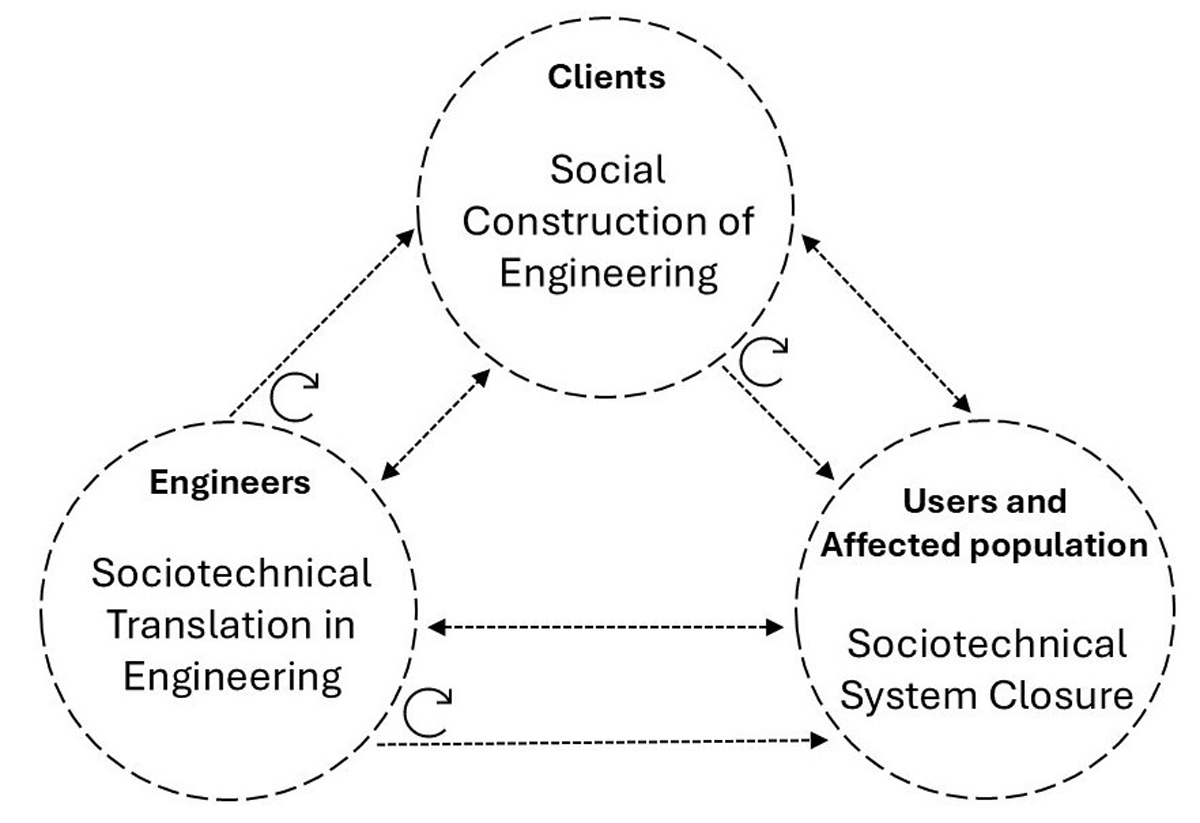
Figure 1
The three sociotechnical dimensions of engineering, their social actors, and the relationship between them.
Signals, represented by each of the lines between the social groups, are the knowledge and information shared between and among social groups to inform the engineering process. They are inputs embedded in the social realities, ideologies, and experiences of the groups involved. For example, immediate clients may provide their demands, timeline, and project budget, while also sharing, implicitly or explicitly, their ideologies, values, and experiences, often as subjective constraints (e.g. comfort, safety). Signals among technical experts (i.e. engineers) include information necessary for effective communication and collaboration, usually in technical language. The users’ and general public’s signals can range from their impressions about the technological product and their purchasing intentions to their culture, existing norms, and actual needs. From a normative perspective, the types of and degrees to which signals are integrated is a matter of justice and equity; the more direct signals from users and affected populations are embedded in the definition of a problem and the development of a technology, the less these groups will have their sociotechnical realities to be assumed or simulated by those who do not belong to it (Lucena et al., 2010).
Timing refers to when and how frequently signals flow between the social groups – and is represented in Figure 1 by the circular arrows at the beginning of some lines to represent that they can signals can be shared more than once. As a descriptive element of the process, timing can range from engineers signalling with clients only once at the beginning of the process to frame the problem, to signals happening at other stages, such as during the ideation and evaluation of the technology (Cruz, 2021a; Purzer et al., 2022). To ensure technology functions as intended, Akrich (1992) argues for a prescriptive approach of constant interactions between social actors and the material and social environments in which the technology will function. Without this intentional timing, if decisions are not checked with social actors, engineers may default to assumptions based on existing engineering practices or based on their interactions with others.
Additionally, it is important to consider the direction of interactions – represented by the arrows at the tip of each line in Figure 1 to represent the fact that signals can vary on a spectrum unidirectional (one-way) and multidirectional (two-way). Unidirectional interactions are those in which signals flow from one social group to another. From a social justice perspective, unidirectionality can lead to oppressive interactions when the needs, purposes, and decision-making are imposed by one side of the interaction and only one side has the power to make decisions (Freire, 2014). On the other hand, multidirectional interactions involve all social actors contributing to the process. In an emancipatory framework (Freire, 2014), the needs, purposes, and decision-making must flow in both directions and have the same relevance, which can support sustainable community development as the voices of all social actors, are considered (Lucena et al., 2010).
The direction of these interactions is often a reflection of the power relationships – perceived or real – among social groups that drive decision-making in engineering (Trevelyan, 2010). de Vries (2009) argues that one practical reason for unidirectional interactions is that some social groups are very heterogeneous and rarely share the same set of constraints, so engineers (or clients) must make certain decisions on their behalf. However, a concern is that, in engineering, this power is usually concentrated in the hands of specific clients – corporations, government, and privileged social actors – and can lead to decisions that prioritize perpetuating the social realities envisioned by those groups (Costanza-Chock, 2020) instead of users’ and affected populations’.
Lastly, interactions can be characterized by the distance between the social actors within and across each sociotechnical dimension – illustrated in Figure 1 by the length of the dashed lines. This distance can be geopolitical or sociological, relating to the matrix of domination (Hill Collins, 2002) which describes issues of power and oppression regarding individual and overlapping social categorizations, such as culture, political view, gender, race, social class, sex orientation, and religion. Descriptively, distance measures the gap between actors; normatively, we observe that the longer the distance between social groups involved in the process, the higher the probability of harm or imposition of different purposes, needs, contexts, beliefs, values, competencies, etc. (Radder, 2009).
3. Mapping Different Engineering Approaches
This section illustrates how our sociotechnical framework can be applied to describe existing engineering approaches. We use our framework to discuss, at a high level, aspects of two engineering projects for social development from the literature – the lighting kit (Akrich, 1992) and the community-led earthen irrigation canal (Pattnaik & Dhal, 2015) – although it is applicable to all types of engineering projects. The framework works as a “translation” tool that can help render the sociotechnical aspects of engineering stories more explicit. The goal is to show how the three-dimensional approach can surface and explain social aspects and interactions that are usually muted or ignored through single dimensions. Looking at engineering work through this framework, we can identify who belongs to each social group, their relationships (including signals, timing, direction, and distance), and whose social knowledge is being translated into technical features.
The lighting kit case discussed by Akrich (1992) highlights how ignoring certain sociotechnical aspects, especially the distinction between clients and users, of the engineering process may result in technological failure. In this case, as illustrated in Figure 2, the immediate clients were a French government agency and a French photoelectric cell company that wanted to promote new energy sources and help create a market for their products in a rural area in Africa (no specific country was mentioned in the original account). The engineers were responsible for the sociotechnical translation, inscription, and materialization of the technology based on the social knowledge provided and imposed solely by these clients, including scope, purposes, constraints and requirements.
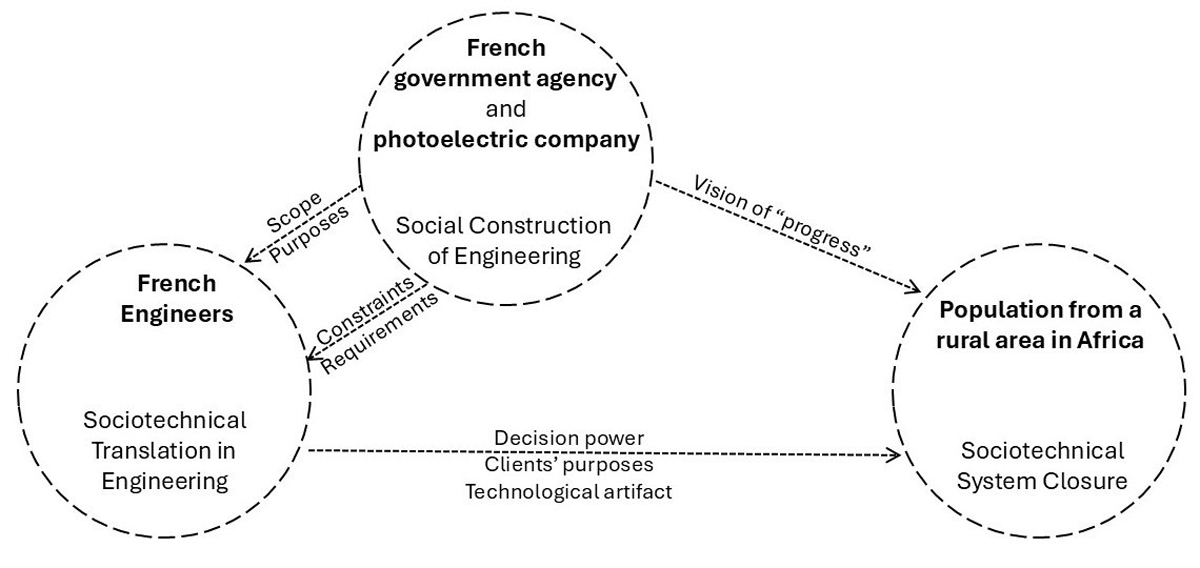
Figure 2
Simplified depiction of the social actors and their interactions in the lighting kit case in the Threefold Sociotechnical framework.
From a perspective that considers the social construction and sociotechnical translation as the only sociotechnical dimensions, the project could be considered a success. Engineers effectively converted the social constraints provided by the immediate clients – and informed by “traditional” engineering methods – into technical features. Examples include i) the constraint of cheaper energy production was translated into the use of direct current power; ii) the goal of protecting the technology from external interference resulted in watertight batteries and nonstandard connections so people could not modify its internal components; and iii) reducing the wiring length to have improved performance.
However, it is only by looking at the relationships across all three sociotechnical dimensions that we can discuss how the social impact of engineering and its social groups (users and affected populations) are neglected.
Since there were no connections from clients and engineers towards users and affected populations, the social knowledge of the later groups was not included in the sociotechnical translation. Some users’ desired functions, such as ease of use, ease of maintenance, and mobility, were not considered during the translation and materialization of the technology. Consequently, users’ handling of the lighting kits had considerable challenges: the technology’s fixed physical features made it impossible to adapt it to different space configurations, the chosen components were not available in the region, and it was not possible to repair the kits locally.
The long geographical, political and socio-economic distance between the social groups – as illustrated in Figure 2 – limited engineers’ capacity to understand, foresee, simulate, or predict users’ social knowledge and social norms appropriately. The technology was developed assuming the users would adhere to the normative behavior and be docile towards the technology, as expected by engineers and clients. In this situation, users would have three options: i) adjust their social norms – close their system – as expected by the French government agency and private company so they could benefit from the technology’s affordances; ii) adapt the technology to their existing social norms – modifying the technology to fit the existing system – or iii) reject the technology entirely. In this case, the technology was rejected and its individual components repurposed.
When such distance exists, those conducting the sociotechnical translation should strive even harder to establish connections and have frequent and multidirectional interactions with users and affected populations (Cruz, 2021b) – and that is how engineers addressed the interactions with social groups in the following case.
In this grassroots engineering scenario, described by Pattnaik and Dhal (2015), a group of local farmers was the client as well as the users and affected populations. They democratically elected a women-led Water User Group to initiate a collaboration with engineers to develop an irrigation canal to support their agricultural activities in Namhee Village, Laos. In this case, the engineers were working with a group that wanted a desired closure of their own system instead of having closure imposed by others. In similar situations, where engineers work with traditional and grassroots community, engineers may encounter conflict with and challenge the principles, values, knowledge and experiences of the groups they are working with and for. Engineers may deem their worldview as wrong, lay, or uninformed – since what is normal, trustworthy, and correct are those norms they learned in school and through traditional methods (Lucena et al., 2010; VanderSteen, 2008).
But that was not the case. Engineers engaged in multidirectional signals with the “client-susers”, acknowledging their importance to the process. Figure 3 shows the social construction and the sociotechnical system closure of engineering as one dimension, since the social actors involved in them are the same – the local farmers and villagers.
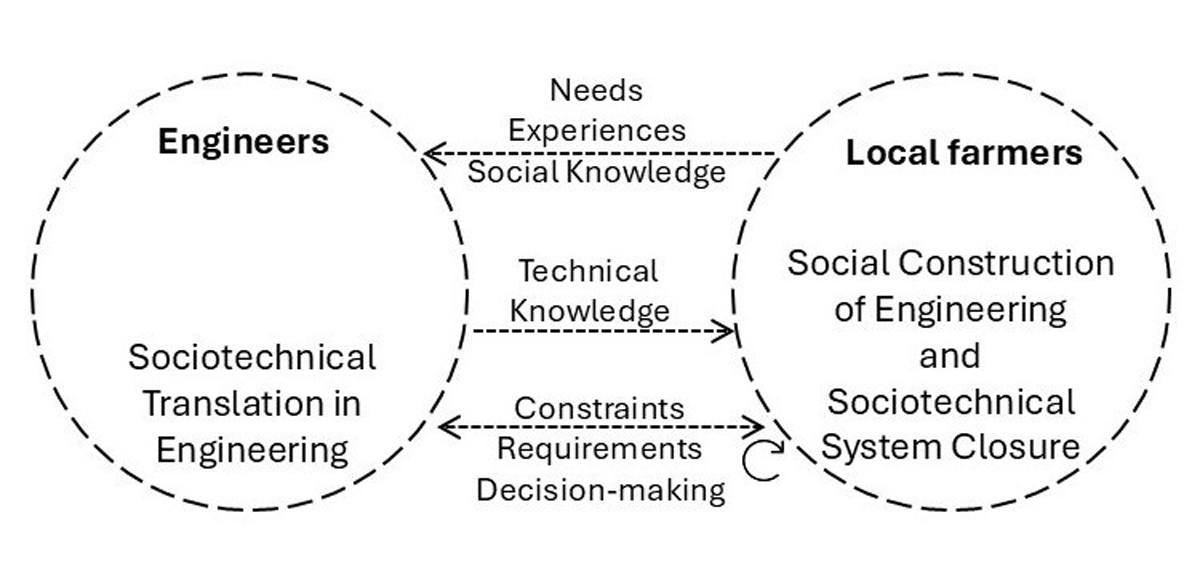
Figure 3
Simplified depiction of the social actors and their interactions in the irrigation system case in the Threefold Sociotechnical framework.
The local actors shared their needs, lived experiences, and knowledge about their context (social knowledge), while engineers brought their expertise on water flow-rate targets and soil stability (teachnical knowedge). There were frequent interactions with all those interested or involved in the development and impact of the project. Multidirectional signals included constraints, requirements, and decision power equally shared by the Water User Group and engineers. Although the project began with considerable physical, cultural, and social distance – volunteers from Korea, engineers from the capital, and villagers from Namhee – the continuous timing and multidirectional signals compensated for the distance. In Figure 3, we represent this by shortening the length of the dashed lines. This process ensured a design that reflected the priorities and realities of the villagers, rather than being shaped primarily by external social actors.
The final project used earth instead of concrete to build the canal as a decision to close the system locally because of the villagers’ resources, capacity, and needs. It also had “less optimal” or “efficient” features – according to engineering standards – but fit the cultural needs of the village. Perhaps the “inefficient” pipes and leaks along the way were not technical failures, but intentional social interactions the community chose not to forbid for a “fairer distribution of water”, or for maintaining a landmark or location, which was more important than optimal water distribution. In this case, although the system had to close around that new technology – adapting to the new possibilities and impacts of having a new irrigation system – the closing was desired and envisioned by those whose system was closed: by the villagers, for the villagers.
4. Concluding Remarks
Although engineering culture and identity are very strongly tied to neutrality and objectivity, scholars from various disciplines, including engineering education, engineering studies, and STS have extensively argued for the sociotechnical nature of the engineering process. In this work, we synthesize and expand on existing arguments and frameworks in the literature to offer a framework that presents the three sociotechnical dimensions of engineering and the interactions among their social actors.
This framework allows us to make sense of possible dynamics that become clearer when we look at engineering from a threefold sociotechnical perspective. In some engineering inquiries, such as engineering analysis or engineering science, engineers are handed a technical problem in technical language and must provide a technical output. The social aspect is reduced to the negotiation between social actors involved in this process, who are generally technical experts who also speak technical language. However, engineers involved in problem-scoping may be exposed to broader and more complex sociotechnical interactions, such as the sociotechnical translation of the communication and negotiation with social actors with, to varying degrees, different worldviews. A critical point here is that in ignoring the social construction of engineering, engineers become mere tools in the hands of founding and immediate clients. Not considering the translation as a sociotechnical process can also result in the dismissal of social aspects related to collaboration and communication between social groups. Furthermore, failing to recognize the sociotechnical nature of system closure can result in engineers unknowingly imposing closure on the systems of users and affected populations, forcing normative behaviours onto others without their consent.
For engineering education, this framework reinforces the need for a shift in curriculum design towards an integrated sociotechnical pedagogy. We encourage educators to provide students with opportunities throughout their degrees to engage in frequent and multidirectional signalling with social groups from all three sociotechnical dimensions. For that, design projects should be assessed on how well social demands are translated into technical features, especially in navigating the process of closing systems – whether they align more with imposed or desired closure. Similar to how the two examples were discussed in section 3, educators – and students – can use this framework to break down projects and illustrate the different dynamics between social actors in engineering work.
For engineering education researchers, this framework offers a holistic approach to analyze the sociotechnical nature of engineering practice. Through a broken-down view of society as different social actors – clients, engineers, users, and affected populations – researchers can better investigate the power dynamics and how the different types of interactions can affect the quality of sociotechnical translations. The four aspects of interactions – signals, timing, direction and distance – can support qualitative studies of engineering work in the analysis of the sociotechnical translation and where and how founding clients’ worldviews are embedded in the process.
Despite the potential contributions of this work to the literature, it has some limitations. While the categorization of social groups is more granular than the society or public, in practice, these groups are heterogeneous, and individuals in them often have conflicting purposes and values and overlapping roles. More critically, this work draws primarily from examples and literature rooted in Western-centric academic practices, through Western-style engineering practices, to challenge the Western myth of neutrality. Therefore, its applicability and fit for non-Western engineering contexts must be carefully examined.
Future research to further refine and advance this framework should focus on its empirical application in engineering education and practice, especially in the context of social justice and sociotechnical thinking. Specifically, for practice, it would be valuable to examine how this framework can be used to analyze the development of new universal technologies, such as generative artificial intelligence, including the signals, timing, direction and distance between clients (tech companies) and affected populations, as well as the process of system closure. For education, it would be valuable to investigate how students’ sociotechnical thinking develops in relation to each of the three dimensions.
We hope this framework helps engineering educators articulate, in a more holistic way, how the social aspects of engineering influence and are influenced by the technical aspects. Furthermore, we also hope this framework proves useful for researchers investigating the sociotechnical aspects of engineering, as they can be more specific about which dimension they are examining and consider possible emergent complexities. Our ultimate goal is for future engineers to be able to identify and respond to the sociotechnical aspects of engineering without hiding themselves behind the ‘shield of neutrality’, so they want to – and are able to – work for marginalized social groups without perpetuating the norms and purposes of more dominant groups that have more often influenced the boundaries of engineering.
Author Contributions
The first author developed this framework as part of his PhD research. All authors contributed to the conceptualization and framing of this work and have substantially revised and edited this article.