
In the United States there are over a million military undergraduate students (veterans, active duty, and reserve) who transition from their military service to higher education, approximately two-thirds of whom are enrolled at a public two-year institution (i.e., community college) (National Center for Education Statistics, 2020). Given the sheer number of veteran1 active military and veteran students attending community colleges, such colleges are the “vanguard of student-veteran transition” (Jones, 2017, p. 109), and can serve to help support students with “reacculturation into civilian society that is critical for student-veteran success” (Jones, 2017, p. 118). However, the literature surrounding military service members who transition to civilian life has well-documented myriad unique challenges veterans experience during and after the transition to civilian life, ranging from a greater prevalence of health-related challenges (psychological or physical injuries from their service) to challenges associated with navigating from a rigid and structured environment in the military to less-structured environments like those found across many postsecondary systems (Bagby et al., 2015; Dillard & Yu, 2016; Jones, 2017; Wheeler, 2012; Wyner, 2014).
Many veteran students experience what Dillard and Yu (2016) call “culture shock” when they transition from the highly regimented military life to the less-structured academic life. Themes of this culture shock in the postsecondary experiences of veteran students are prevalent in the literature (Bagby et al., 2015; Dillard & Yu, 2016; McCaslin et al., 2013; Olsen et al., 2014) and studies on community college student veterans have found that these students have lower academic outcomes relative to their civilian peers (Morrill & Somers, 2019; Williams-Klotz & Gansemer-Topf, 2018) and that student veterans of color have lower grade point averages than their peers (Morill & Somers, 2019; Williams-Klotz & Gansemer-Topf, 2018). On the social and cultural side of the research on student veterans, many of the challenges they experience in their academics are related to their interactions with other students, financial-related concerns, and the cultural/role differences in an education setting relative to their military lives (Livingston et al., 2011; Olsen et al., 2014, Wheeler, 2012).
Understanding Student Veterans’ Transition Experiences
Several theories and frameworks have been postulated to support a better understanding of military and veteran students’ transition from military to civilian life. The most prominent of these theories are Scholssberg’s Adult Transition Theory (1981) and Castro and Finkle’s Military Transition Theory (2016). While Scholssberg’s model is not exclusively about military transition, both theories have similarities in terms of emphasizing the critical interplay between individual characteristics, pre and post-transition experiences, and the support structures and resources one has that impact one’s outcomes or post-transition experiences. These theories provide useful conceptual frameworks for understanding how well, or not, students with a military background adjust to and thrive in non-military environments such as college and the possible factors influencing those post-military outcomes and experiences.
Much of the research on military and veteran students in postsecondary education, and their transition to postsecondary education, have primarily focused on students at 4-year universities (Olsen et al., 2014). For example, in one of the few studies documenting the transition experiences of student veterans at a community college, Wheeler’s case study (2012) documents the ways by which student veterans manage the process of transitioning from the military to being a community college student. Wheeler notes that for these students, their military service is a “serious risk” (p. 776), highlighting the significant impact of two common types of service injuries [Posttraumatic Stress Disorder (PTSD) and Traumatic Brain Injury (TBI)], that can have cascading detrimental effects on their post-military outcomes and experiences (e.g., drug use, isolation). While community colleges offer a wide range of academic-related resources and support services, the participants in Wheeler’s study mostly utilized services to process GI Bill benefits at the college, with varying levels of satisfaction with academic and non-academic support services such as counseling and advising.
Community Colleges’ Role in Supporting Student Veterans’ Transitions
Findings from studies that have examined the transition experiences of community colleges (e.g., Jones, 2017; Wheeler, 2012) consistently report the need for colleges to have a more centralized hub of dedicated veteran resources and services that are staffed with individuals familiar with all of the complexities surrounding military and student veteran’s needs and concerns. The most commonly provided resources and services offered by community colleges from veteran-specific support programs and centers dedicated specifically to veterans are veteran-benefits advising and counseling, and physical gathering spaces/lounges (McBain et al., 2012). Other services include financial aid assistance, orientation, information about campus clubs and social activities, and/or academic/career advising and services (McBain et al., 2012). Sitzes and colleagues (2021) found the top three resources and services utilized at community colleges in North Carolina were veterans benefits counseling, financial aid advising, and the dedicated student veteran lounge. The perception among student veterans in one Texas community college regarding the veteran-specific supports their college provided was that the services had very little impact on their academic progress and success or social integration into college; and that one of the most needed services was assistance with the actual transition process between the military and postsecondary education (Robles, 2017). Studies have found that more often than not, student veterans are dissatisfied with the transition services and feel these services are not tailored enough to their specific needs (Fletcher et al., 2022, Whitworth et al., 2020).
For many student veterans, community colleges are an appealing option after their service (Rumann, 2010), with nearly 60% of colleges reporting having specific services dedicated to student veterans (O’Herrin, 2011 as cited in Hunter-Johnson et al., 2021). In California, more than 90 of the 116 community colleges have dedicated resources and/or a center for their student veteran populations,2 and while a significant proportion of colleges offer dedicated services to student veterans, few studies focus on understanding how effective these resources and services are, or how students access and use the numerous resources and supports provided by the military (e.g., Transition Assistance Programs) and by their colleges to support their transition from the military to postsecondary education and civilian life.
This research intends to fill that gap by providing an account of the reported awareness and utilization of transition services by community college student veterans in California and their specific needs from the military and their colleges. Results from this study can help community colleges around the country ensure they have the supports necessary (both on campus and via the development of partnerships) to increase the likelihood that student veterans experience a smooth transition out of the military into the role of college student, thus increasing the likelihood they will ultimately succeed in this new role.
Method
Design
This study used a cross-sectional survey, mixed-methods research design to examine what resources and services community college student veterans utilize and need to support their transition from the military to civilian life in a postsecondary education system through an online survey comprised of a mix of open-ended and fixed-choice items. The survey was codesigned by the authors and a community college practitioner focused on aligning resources and services dedicated to veterans across the community colleges in the state.
Data for this study come from survey respondents at 63 community colleges in one state—California (55% of the state’s community colleges). The survey collection period spanned 4 months in 2020–2021, with responses collected in the Alchemer Survey platform. Convenience and purposeful sampling (Merriam, 2009) was used to recruit participants. Invitation messages were sent through a community college system listserv dedicated to veteran support staff asking them to forward the survey link to their current student veteran population. Staff were provided with boilerplate language to send to their student veterans. Students who completed the survey were entered into a drawing to receive one of two $100 gift cards as an incentive for participation. A total of 483 student veterans (2% response rate).3
Measures
The survey was designed to collect the following types of information: students’ demographics (e.g., race/ethnicity); students’ reported physical and mental health conditions and needs upon transitioning out of the military; students’ awareness of, frequency of utilization, and needs around military-provided transition supports; and students’ awareness of, frequency of utilization, and needs around college-provided transition supports. Open-ended questions asked student veterans how the helpfulness of military transition programming and why they chose to participate in such programming or not.
Data Analysis
The majority of analyses presented in this report are descriptive in nature. Close-ended questions are presented in tables giving both the n-count in response to a given question as well as the percent that n-count represents given differences in the number of student veterans responding to any given question. All open-ended responses were coded for common themes and representative quotes are presented for each theme highlighted.
Sample
The sample for this study consisted of 483 community college students. As can be seen in Table 1 (below), Army veterans were most heavily represented at 34%, though there was also large representation from the Marine Corps (26%) and Navy (23%). A small proportion of respondents were still active duty (3%), reserves (6%), or National Guard (2%), while the rest (89%) no longer served in the military (i.e., veterans). Over one-third of respondents (37%) identified as White, while 27% identified as Hispanic or Latinx. Nearly three-quarters of respondents (72%) identified as male, while 26% identified as female. The majority of respondents (55%) were between the ages of 25 and 39.
Table 1
Demographics of Student Veterans in Survey Sample.
| MILITARY BRANCH | # | % |
|---|---|---|
| Army | 162 | 34.0 |
| Marine Corps | 125 | 26.3 |
| Navy | 107 | 22.5 |
| Air Force | 51 | 10.7 |
| Coast Guard | 11 | 2.3 |
| National Guard or Reserve (federally activated) | 15 | 3.2 |
| National Guard or Reserve (never federally activated) | 5 | 1.1 |
| MILITARY STATUS | # | % |
| Active Duty | 15 | 3.2 |
| Reserves | 30 | 6.4 |
| National Guard | 9 | 1.9 |
| I formerly served in the military, but I no longer do | 415 | 88.5 |
| RACE/ETHNICITY* | # | % |
| African American/Black | 31 | 6.5 |
| Asian – South | 1 | 0.2 |
| Asian – Southeast | 24 | 5.0 |
| Asian – East | 19 | 4.0 |
| Hispanic or Latinx | 128 | 26.7 |
| Middle Eastern or North African | 3 | 0.6 |
| Native American/Alaskan Native | 4 | 0.8 |
| Native Hawaiian or Other Pacific Islander | 4 | 0.8 |
| White | 178 | 37.2 |
| More Than One Race/Ethnicity | 77 | 16.1 |
| GENDER | # | % |
| Female | 124 | 25.9 |
| Male | 345 | 72.0 |
| Nonbinary | 1 | 0.2 |
| Decline to State | 6 | 1.3 |
| Other | 3 | 0.6 |
| AGE | # | % |
| 18–24 | 69 | 14.6 |
| 25–29 | 120 | 25.4 |
| 30–39 | 138 | 29.2 |
| 40–49 | 69 | 14.6 |
| 50 and above | 76 | 16.1 |
[i] * Respondents were able to check more than one race/ethnicity. For respondents who checked more than one, they were categorized under More than One Race/Ethnicity.
Results
Physical and Mental Health Conditions and Needs Upon Returning to Civilian Life
Table 2 (below) provides data on the proportion of student veterans indicating having official diagnoses of certain conditions or believing they may be suffering from a given condition without a formal diagnosis. With respect to physical ailments, two-thirds (67%) of respondents have either been diagnosed with or believe they might have a physical disability (53% and 13%, respectively) while almost two-thirds (64%) of respondents have either been diagnosed with or believe they might have chronic pain (43% and 21%, respectively). While only 37% of respondents have been diagnosed with hearing loss, an additional 29% believe they might have this condition. Further, while only 11% of respondents have been diagnosed with traumatic brain injury, an additional 19% believe they might have this condition.
Table 2
Health Conditions of Student Veterans in Sample.
| CONDITION | YES, I HAVE BEEN DIAGNOSED WITH THIS CONDITION | NO, BUT I BELIEVE I MAY HAVE THIS CONDITION | NO, AND I DON’T BELIEVE I HAVE THIS CONDITION | |||
|---|---|---|---|---|---|---|
| # | % | # | % | # | % | |
| Physical disability | 214 | 52.5 | 53 | 13.0 | 141 | 34.6 |
| Chronic pain | 173 | 43.1 | 83 | 20.7 | 145 | 36.2 |
| Hearing loss | 149 | 37.3 | 116 | 29.0 | 135 | 33.8 |
| Traumatic brain injury | 42 | 10.7 | 73 | 18.6 | 277 | 70.7 |
| Depression | 115 | 40.9 | 48 | 17.1 | 118 | 42.0 |
| Anxiety (e.g., generalized anxiety disorder, phobias) | 114 | 40.4 | 68 | 24.1 | 100 | 35.5 |
| Posttraumatic stress disorder (PTSD) | 87 | 30.9 | 57 | 20.2 | 138 | 48.9 |
| Substance use disorder (e.g., alcohol or drug abuse) | 30 | 10.7 | 25 | 8.9 | 225 | 80.4 |
| Any other mental health disorders* | 30 | 10.6 | 46 | 16.3 | 206 | 73.0 |
| Traumatic Brain Injury (TBI) | 29 | 10.3 | 32 | 11.4 | 220 | 78.3 |
| Neurodevelopmental disorder or intellectual disability** | 27 | 9.6 | 52 | 18.5 | 202 | 71.9 |
[i] *Includes bipolar, obsessive-compulsive disorder, schizophrenia, personality disorder.
**Includes attention deficit disorder, intellectual disability, autism spectrum disorder.
Concerning mental health, anxiety and depression were most prevalent among student veterans. Two out of five veterans had a formal diagnosis of depression (41%), while an additional 17% believed they might have undiagnosed depression. Two out of five veterans had a formal diagnosis of anxiety (40%), while an additional 24% believed they might have undiagnosed anxiety. Over half of veterans had either been formally diagnosed with (31%) or believed they might have undiagnosed (20%) PTSD.
Military-Provided Transition Supports
Survey questions asked student veterans about the types of transition supports they received when leaving the military. Nearly two-thirds (66%) of student veterans indicated that they participated in a military transition program (e.g., Military TAP) upon reentering civilian life. However, over one-quarter of those who participated in such a program indicated that it was not at all helpful (27%). Ultimately only 16% indicated that the transition program was very helpful, and 58% indicated it was somewhat helpful. Student veterans who participated in a military transition assistance program were asked to share why they believed the program was helpful or unhelpful.
Helpfulness of Transition Programming
Among student veterans who found their transition programs helpful, the most common response was that the programs provided them with important information on how to access VA benefits, including healthcare, home loans, education, and vocational rehabilitation. In open-ended questions, student veterans expressed that the career preparation and workforce training offered in their transition programs was beneficial. In particular, student veterans spoke positively about the assistance they received with resume-building, developing interview skills, and conducting job searches. As one student noted:
Learning how to properly compose a resume and conduct a job interview was helpful; many people, myself included, joined the military straight out of high school and didn’t have a job before.
Other student veterans reported that their transition programs helped them better prepare for what to expect in civilian life and connected them with valuable resources. In the words of one student:
Having someone go over what to expect when getting out was of great help, as well as being informed about the benefits I could take advantage of.
Unhelpfulness of Transition Programming
Among student veterans who found their transition programs unhelpful, the most frequently cited criticism was that the program felt rushed, and there was too much information covered too quickly. Representative quotes include:
Well, first off [I suggest making the transition program] longer than 5 days. Spending almost 8 years [in the military] and [being] given a week to transition back to civilian life is ludicrous. The military preaches about giving a better product back to the civilian world, yet they invest no time in ensuring we are ready for it.
There is a lot of material that can be overwhelming … I think it’s great that we are increasing our resources for veterans, but it seems counter-productive when it is so unorganized. [It was] too much at once for me and I’ve heard many vets express the same concern.
A common theme in open-ended questions was that student veterans felt their transition programs only offered surface-level information and did not go into enough depth or provide specific details about the topics discussed. They reported that the information covered in these programs was largely common sense and lacked any real practicality. A common theme in open-ended questions was that transition assistance programming would be more useful if it was catered to individual needs, pointing out that the information and resources received were state-specific based on where they were stationed at the time their service ended rather than the state where they would be living following their departure from the military. Two students noted:
None of the material/course correlated when moving back to my home of record. [It was] too generalized and a waste of time; soldiers only go through it to get signed off for out-processing. [It] doesn’t help transitioning at all!!!
I was discharged out of Virginia, and most [of the] resources were [for] that area, but I moved back home to California, where most resources specific to the state I found on my own after leaving service.
Other student veterans reported that there was too much focus on career preparation and workforce training and not enough on higher education and enrolling in college.
Information Received in Transition Programming
Tables 3 and 4 (below) provide data on the experiences of student veterans who participated in military transition programming. Table 3 focuses on supports related to managing their life and academic career, while Table 4 focuses on mental and physical health supports. Data are presented on the proportion of student veterans who received information on various topics in their transition program, the proportion who did not receive information on a given topic but would have liked to, and the proportion who did not receive information on a given topic but were not interested in receiving such information anyway.
Table 3
Information Accessed on Available Supports Received in Transition Programming.
| YES, I RECEIVED INFORMATION ON THIS TOPIC | NO, BUT I WOULD HAVE LIKED TO RECEIVE INFORMATION ON THIS TOPIC | NO, BUT I AM NOT INTERESTED IN RECEIVING INFORMATION ON THIS TOPIC | ||||
|---|---|---|---|---|---|---|
| # | % | # | % | # | % | |
| VA benefits | 240 | 86.3 | 32 | 11.5 | 6 | 2.2 |
| Resume writing | 221 | 80.1 | 49 | 17.8 | 6 | 2.2 |
| VA Health | 210 | 76.1 | 56 | 20.3 | 10 | 3.6 |
| Career and job training | 204 | 73.9 | 61 | 22.1 | 11 | 4.0 |
| Managing finances | 193 | 70.4 | 68 | 24.8 | 13 | 4.7 |
| Enrollment into VA healthcare | 177 | 63.4 | 94 | 33.7 | 8 | 2.9 |
| Applying to college | 153 | 55.4 | 107 | 38.8 | 16 | 5.8 |
| Financial aid | 134 | 48.6 | 122 | 44.2 | 20 | 7.2 |
| How to access general medical care | 129 | 46.9 | 126 | 45.8 | 20 | 7.3 |
| How to find access dental care | 88 | 32.0 | 162 | 58.9 | 25 | 9.1 |
| How to find affordable housing | 72 | 26.1 | 157 | 56.9 | 47 | 17.0 |
| How to find affordable childcare | 51 | 18.5 | 130 | 47.3 | 94 | 34.2 |
Table 4
Information Accessed on Mental and Physical Health Received in Transition Programming.
| YES, I RECEIVED INFORMATION ON THIS TOPIC | NO, BUT I WOULD HAVE LIKED TO RECEIVE INFORMATION ON THIS TOPIC | NO, BUT I AM NOT INTERESTED IN RECEIVING INFORMATION ON THIS TOPIC | ||||
|---|---|---|---|---|---|---|
| # | % | # | % | # | % | |
| How to access mental health supports | 132 | 48.0 | 117 | 42.5 | 26 | 9.5 |
| How to access support regarding substance abuse | 103 | 37.3 | 101 | 36.6 | 72 | 26.1 |
| Recognizing the signs/symptoms of PTSD | 101 | 36.6 | 132 | 47.8 | 43 | 15.6 |
| Recognizing the signs/symptoms of other mental health issues | 95 | 34.1 | 148 | 53.0 | 36 | 12.9 |
| Recognizing the signs/symptoms of depression | 94 | 33.7 | 151 | 54.1 | 34 | 12.2 |
| How to access support related to military sexual trauma (MST) | 88 | 31.9 | 107 | 38.8 | 81 | 29.3 |
| How to access support related to military sexual trauma (MST: females only) | 24 | 36.9 | 31 | 47.7 | 10 | 15.4 |
| Recognizing hearing loss issues | 85 | 30.7 | 153 | 55.2 | 39 | 14.1 |
| How to access support regarding domestic violence | 82 | 29.9 | 112 | 40.9 | 80 | 29.2 |
| Recognizing the signs/symptoms of military sexual trauma | 82 | 29.5 | 121 | 43.5 | 75 | 27.0 |
| Recognizing the signs/symptoms of traumatic brain injury | 81 | 29.0 | 140 | 50.2 | 58 | 20.8 |
| How to access gynecological/ reproductive care (females only) | 19 | 28.8 | 32 | 48.5 | 15 | 22.7 |
Among those who participated in a transition program, more than three-quarters of respondents indicated receiving information on VA benefits (86%) and VA Health (76%), as well as resume-writing (80%). With respect to college-related supports, half of student veterans (49%) indicated receiving information about financial aid, while an additional 44% indicated that they would have liked to (see Tables 3 and 4). Over half (55%) of student veterans said that they received information regarding applying to college, and an additional 39% indicated that they would have liked to. Lastly, with respect to basic needs, approximately one in five student veterans reported receiving information on how to find affordable housing (26%) or childcare (19%), yet many more expressed interest in these topics (57% and 47%, respectively).
Fewer than half of student veterans reported that their transition programs provided information on how to access physical (47%) and/or mental health (48%) supports, while fewer than one-third of student veterans indicated that their transition programs offered information on how to access support related to military sexual trauma (32%), domestic violence (30%), or gynecological/reproductive care (29% of females) (see Table 4). Across the entire sample, 71% of respondents indicated having received information or being interested in receiving information on how to access support related to military sexual trauma, with rates being higher among female veterans (85%).
College-Provided Transition Supports
As noted in the previous section, over one-third of student veterans did not participate in a military transition program and thus did not receive the variety of information and support typically offered in such programs. However, survey respondents were also asked whether their colleges provide or help facilitate access to various supports. Figure 1 (below) provides the proportion of student veterans who accessed various college-provided supports and who would access various college-provided supports if such supports were available. Respondents were most likely to indicate having used their colleges’ veterans resource center (VRC; 83%), while over half of student veterans utilized college-provided information on veterans’ benefits related to education (60%).
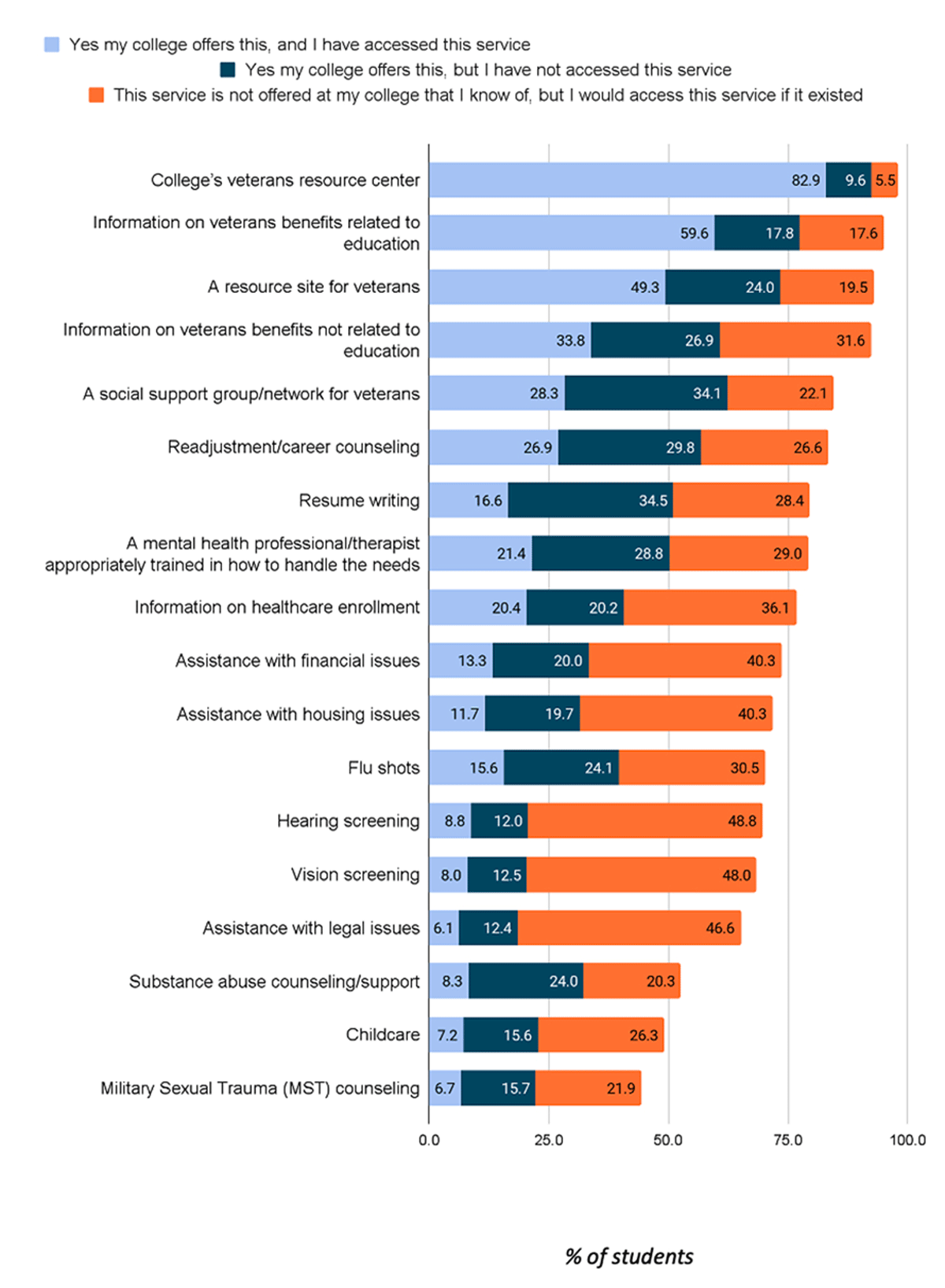
Figure 1
Survey Respondents’ Awareness and Usage of Veteran Resources by College.
Only a small proportion of student veterans indicated accessing college-provided assistance with financial aid (13%), housing (12%), legal issues (6%), or vision (8%) or hearing (9%) screenings. However, over two-fifths indicated that they did not believe their college provided such services but would access them if they existed (40–49%).
Limitations
This study is based on self-reported information gathered from a survey to a convenient and purposeful cross-sectional sample of veteran community college students in one state. Based on the sampling method and research design, the following key limitations must be considered when reviewing these findings: (a) no causal inferences can be made about what is affecting students’ awareness and utilization of services to support their transition into postsecondary education as the study was descriptive in nature; (b) the data were based on self-reported information from the students, and therefore these findings make it difficult to ascertain whether lack of utilization and/or identified needs reported by students were because students were not aware of such services or whether the military transition programs or the college was not providing such service; and (c) limited generalizability: all data were based on a sample of community college student veterans at one snapshot in time and in one state, so the results may or may not be generalizable to other states.
Conclusions
Military and veteran students face a unique set of challenges relative to their peers. High rates of both physical and mental health issues among veterans coupled with a lack of information regarding how to identify and treat such issues point to an immediate need to improve access to and availability of health-related services. While these unmet needs can threaten student veterans’ academic success, VRCs need to take an active role in connecting veterans to the services and resources that are available to address these concerns. Many colleges already offer a comprehensive suite of services to assist student veterans, but some student veterans, especially those who attend class in the evenings or online, may be unaware of these valuable supports or have difficulty accessing them. By increasing knowledge and awareness of these existing health services on-campus and in the community, VRCs can help student veterans access the care they need. VRCs can expand their presence by ensuring all of the benefits and resources available to student veterans are reflected on the college website. Additionally, VRCs can leverage virtual support options by making services that were historically only available on campus accessible in an online format and restructure their hours of operation to include days of the week where their center is open in the evening or available one Saturday a month to accommodate more students.
The majority of veterans participate in a transitory program upon leaving the military, and such programs nearly universally provide information regarding topics such as VA benefits and VA health-related information. However, more than one-third of student veterans in this study entered civilian life without participating in such a program. Further, even among those who do participate, information is not as comprehensive as they would like. VRCs can offer information to student veterans who did not participate in a TAP, including resources on financial aid, affordable housing, and childcare. Colleges can partner with local military transition assistance programs to identify gaps in information and provide feedback on what student veterans say they need most in their transition back to civilian life. If coordination with a local TAP is not feasible, VRCs can inform students how to access the online course on VA Benefits and Services offered by the US Department of Veterans Affairs for veterans who have not participated in a military transition assistance program.
Among the community college-going student veteran population, students are also eager for logistical information not often covered in military-provided transition programs, such as how to access financial aid, childcare, and/or affordable housing. Addressing these issues would likely help abate the high rates of housing insecurity and homelessness so prevalent among student veterans (Olfert et al., 2021). While VRCs at California’s community colleges provide a number of critical supports to student veterans to supplement and supplant information provided in military-provided transition programs, there is still an area of untapped need according to our participants. Veterans most often access VRCs for education-specific needs (e.g., financial aid information) yet do not realize the possibility of leveraging such services for more holistic needs regarding physical and mental health and logistical supports (e.g., food, housing, childcare). When presented with the possibility, it was clear that an interest in such comprehensive supports is high among these student veterans, especially as it relates to mental health services. Student veterans need their colleges to provide a one-stop-shop to address the myriad challenges they face as they transition out of the role of military personnel and into the role of successful student.
Notes
[3] For the purpose of succinctness, throughout this study we use the term veteran to refer to those who have served in the military at any point. While the majority of those surveyed were formerly in the military and are no longer serving, a small subset of survey respondents included active military personnel and national guard/reservists.
Ethics and Consent
This research was conducted on behalf of a community college district to support student success and equity improvement efforts and thereby is exempt from Institutional Review Board reviews and is covered under the following state and federal regulations:
California Education Code CHAPTER 1.5. Student Records, ARTICLE 5 CODE 76243 Section a7 as an organization conducting studies on behalf of educational agencies or institutions for the purpose of improving student success and equity.
US Department of Health & Human Services: The Office for Human Research Protections 45 CFR part 46, Subpart A. §46.104 Exempt research, Paragraph d: sections d1 through d4 as the research being conducted is in established and commonly accepted educational settings that do not adversely affect normal educational practices and students’ learning.
The survey administered was completely anonymous and all data kept confidential. Participants consented to their participation on the front page of the electronic survey and were provided with a full explanation of risks and benefits associated with their participation.
Acknowledgements
We would like to express our gratitude to Nancy Montgomery (Assistant Dean of Health, Wellness, and Veterans Services at Irvine Valley College), whose dedication to the academic success of both the California community college student veteran population and the centers that support these students was the impetus for this project. We would also like to recognize the participation by the California community colleges who provided their time and resources, in terms of staff and students, for us to obtain the data and information needed to conduct this study. Lastly, we would like to thank the student veterans themselves for sharing their experiences so openly with us.
Funding Information
This research was funded by Irvine Valley College.
Competing Interests
The authors have no competing interests to declare.