
The US Department of Veterans Affairs (VA; 2021a) highlighted the grim statistics related to longevity among veterans: approximately 17 veterans died by suicide every day in 2019. DeAngelis (2022) cited that these sobering numbers may be associated with the veterans’ high exposure to trauma, stress and burnout, isolation and loneliness, easy access to and familiarity with guns, and difficulties reintegrating into civilian life. Exposure to stress and trauma is associated with the development of posttraumatic stress disorder (PTSD) within 1 year of returning home from deployment (Thomas et al., 2010). Other than PTSD, characterized by four symptom clusters of intrusive memories, avoidance, negative changes in cognitions, and changes in arousal (American Psychiatric Association 2013), veterans of the recent conflicts (i.e., Afghanistan and Iraq) may also have other issues such as stress, mood, anxiety, sleep, psychotic, and addictive disorder (US Department of Veterans Affairs, 2021b). Veterans are also more likely than adults in the general population to develop physical issues such as joint and back pain, obesity-related musculoskeletal problems, and other forms of chronic pain (US Department of Veterans Affairs, 2018). A veteran’s health affects their families. Families and caregivers of veterans often experience feelings of sadness or frustration along with their own physical or mental health problems (US Department of Veterans Affairs, 2022a).
Although PTSD and other mental health issues as well as chronic pain extend far beyond the military, veterans face higher risk of suffering from PTSD symptoms and chronic pain than the general population (Reisman, 2016). They also face unique barriers to accessing adequate treatment (American Public Health Association, 2014; Reisman, 2016; US Department of Veterans Affairs, 2022b). Barriers to treatment include the requirement for either an honorable or general discharge to access the VA medical benefits, long waiting lists and travel distances to VA medical centers, social stigma associated with mental illness within military communities, and provider assumptions based on demographics. Reportedly fewer than 50% of returning veterans in need receive any mental health (MH) treatment (US Department of Veterans Affairs, 2022b). For those who receive treatment, the use of high-risk medication and polypharmacy have been associated with late-life veteran suicide (Morin et al., 2020). Veterans aged 50 and older who attempted suicide were nearly three times more likely to have been prescribed benzodiazepines and opioids compared with demographically matched controls utilizing Veteran Health Administration (VHA) healthcare in the same period (Morin et al., 2020). These findings uncovered the complex contribution of prescription medications and polypharmacy to late-life veteran suicide, with implications for prevention.
Related to these findings, the US Department of Veterans Affairs (2018) started to focus on creating individualized treatment plans to include complementary and alternative medicine (CAM). CAM is considered cost-efficient and functions as self-care, which are both critical points to consider for the long-term health of veterans. Previous studies among veterans also indicate their increased preference for alternative approaches to address their posttraumatic stress (PTS) and chronic pain. Maddox et al. (2020) reported the significant impact of the community-based nonprofit, Veterans Team Recovery Integrative Immersion Process (Vet TRIIP), which provides CAM interventions for veterans, on their quality of life, PTS, and chronic pain.
Founded in 2012, Vet TRIIP was created to ease the physical and mental difficulties veterans experience through interventions that emphasize a non-pharmacological approach. The Vet TRIIP team provides veterans access to CAM interventions including, but not limited to, emotional freedom technique (EFT), aromatherapy, meditation, energy techniques such as Reiki and qigong, therapeutic massage, chiropractic care, acupuncture and acupressure, and yoga (Maddox et al., 2020). This study describes the effects of Vet TRIIP-delivered yoga among veterans and other issues related to their participation. Since the start of Vet TRIIP, there has been no evaluation of the effects of the yoga sessions on the veteran participants’ PTS symptoms and chronic pain. Understanding factors associated with veteran participation in yoga and perceived benefits can guide the development of strategies to improve engagement.
Methods
Ethics Approval
This evaluation of the Vet TRIIP Yoga program was approved by fourth author Maria Danet Lapiz-Bluhm’s institutional review board as nonregulated human research, as defined by DHHS regulations at 45 CFR 46 and FDA regulations at 21 CFR 56 (IRB approval number: 12-205N NR).
Design
To comprehensively evaluate the program, a mixed-method approach was adopted: (a) use of quantitative data that Vet TRIIP collected before and after yoga participation and (b) collection of qualitative data from interviews of participants willing to share their experience of having participated in Vet TRIIP yoga.
A phenomenological approach was employed to establish experiences, beliefs, and perceptions of veterans related to their participation of the Vet TRIIP program. This approach is considered a powerful tool for understanding an individual’s subjective experience to gain insight into their motivations and actions and cutting through taken-for-granted assumptions and conventional wisdom (Polit & Beck, 2017). It has been used in studies aimed at understanding veterans’ experiences (e.g., Hoffman, 2020; Monteith et al., 2019). Results from these studies highlight potential avenues for further research and provide guidance for how the community, clinicians, and institutions can support veterans (Monteith et al., 2019).
Procedures
The Vet TRIIP requires all program participants to sign an informed consent as well as a disclaimer prior to their participation. The weekly yoga was open to all veterans who participate in the Vet TRIIP program. Yoga participants completed a survey based on the Stanford Pain Scale (Feinberg & Mackey, 2021) before and after each session. They were asked to rate their pain and stress before (In) and after (Out) the session using a 0–10 scale (10 maximum symptoms). Hence, data were collected for Pain In, Pain Out, Stress In, and Stress Out.
From 2018–2020, 140 veterans participated in the yoga program; their data were kept in an Excel spreadsheet. For this study, data from veterans (N = 79) who participated in at least 4 consecutive sessions were extracted for analysis. The participants completed 1095 pre and post-surveys. The average duration of participation was 13 weeks, with the longest participation period at 47 weeks.
In 2020, the veterans who participated in Vet TRIIP yoga sessions were invited to share their experiences related to their attendance. Following consent, the data collection was conducted in three platforms: (a) an in-person recorded interview following the yoga session, (b) independent completion of a form with the interview questions, or (c) through a phone call. This flexibility was afforded in consideration that individuals with PTSD symptoms may have avoidance tendencies and may not want to participate in in-person interviews.
The data collected included demographics (age, gender, and military affiliation), yoga-experience (i.e., reasons to start yoga, reasons to continue, reasons to discontinue) and feedback on the Vet TRIIP yoga program. The following were the questions asked:
How long have you been joining the Vet TRIIP yoga sessions?
What motivated you to join a Vet TRIIP yoga session?
If you have attended multiple sessions, what motivated you to join yoga frequently?
How do you feel before each session?
How do you feel after each session?
What kind benefits do the yoga sessions provide?
How long do these benefits normally last?
What are you doing at home as an extension of the Vet TRIP yoga sessions?
What do you think discourages people from joining yoga?
What more would you add to the Vet TRIIP yoga program?
Qualitative data collection continued until data saturation was reached. Data from 8 participants yielded similar responses, indicating saturation, at which point the data collection ceased.
Data Analysis
Quantitative data on pain and stress levels as well as demographics were analyzed for descriptive statistics. Data were initially analyzed for normal distribution. Pre-and post-yoga session ratings were compared using a t-test with significance at p < 0.05. Data on pain and stress before and after yoga was analyzed using paired t-test (using SPSS Statistics, IBM).
For the qualitative data, the audio recordings of the interviews were transcribed. Recorded interview data were transcribed and collated for descriptive analysis by one team member. They were subsequently analyzed for emerging themes in two phases to avoid groupthink using phenomenological approaches (Polit & Beck, 2017). For Phase 1, survey responses were audited by each team member separately, and responses were analyzed for emerging themes. For Phase 2, team members discussed the identified themes until a consensus was reached. Other issues related to trustworthiness such as credibility, dependability, transferability, and confirmability, were achieved by sharing the results, interpretations, and conclusions with Vet TRIIP leaders. Data saturation was reached when participants’ responses were similar to each other. The primary authors presented the results back to Vet TRIIP participants for member check.
Results
Demographics
Table 1 (below) shows the demographics of the 79 veteran participants. The participants were mostly female (59%) with a mean age of 56 years (range: 39–71 years old) and veterans of the following military branchess: Army (39%), Air Force (32%), Navy (11%), and Marine Corps (1.3%) with the remaining participants (16%) were caretakers of veterans who have chronic pain and stress. About 44% of the participants were White, 29% were Hispanic, and 25% were African American.
Pain and Stress Levels
Figure 1 (below) shows the mean Pain In and Pain Out as well as the mean Stress In and Stress Out scores. The mean Pain In and Stress In scores were 5 and 4.7, respectively. Following the yoga session, Pain Out decreased to 1.6, reflecting a 68% decrease. Statistical analysis shows a significant difference between Pain In and Pain Out scores (t = 45.4, p < 0.001). Similarly, Stress Out scores were significantly decreased to 1.2, reflecting a 74% decrease. There was a significant difference between Stress In and Stress Out scores (t = 41.6, p < 0.001).
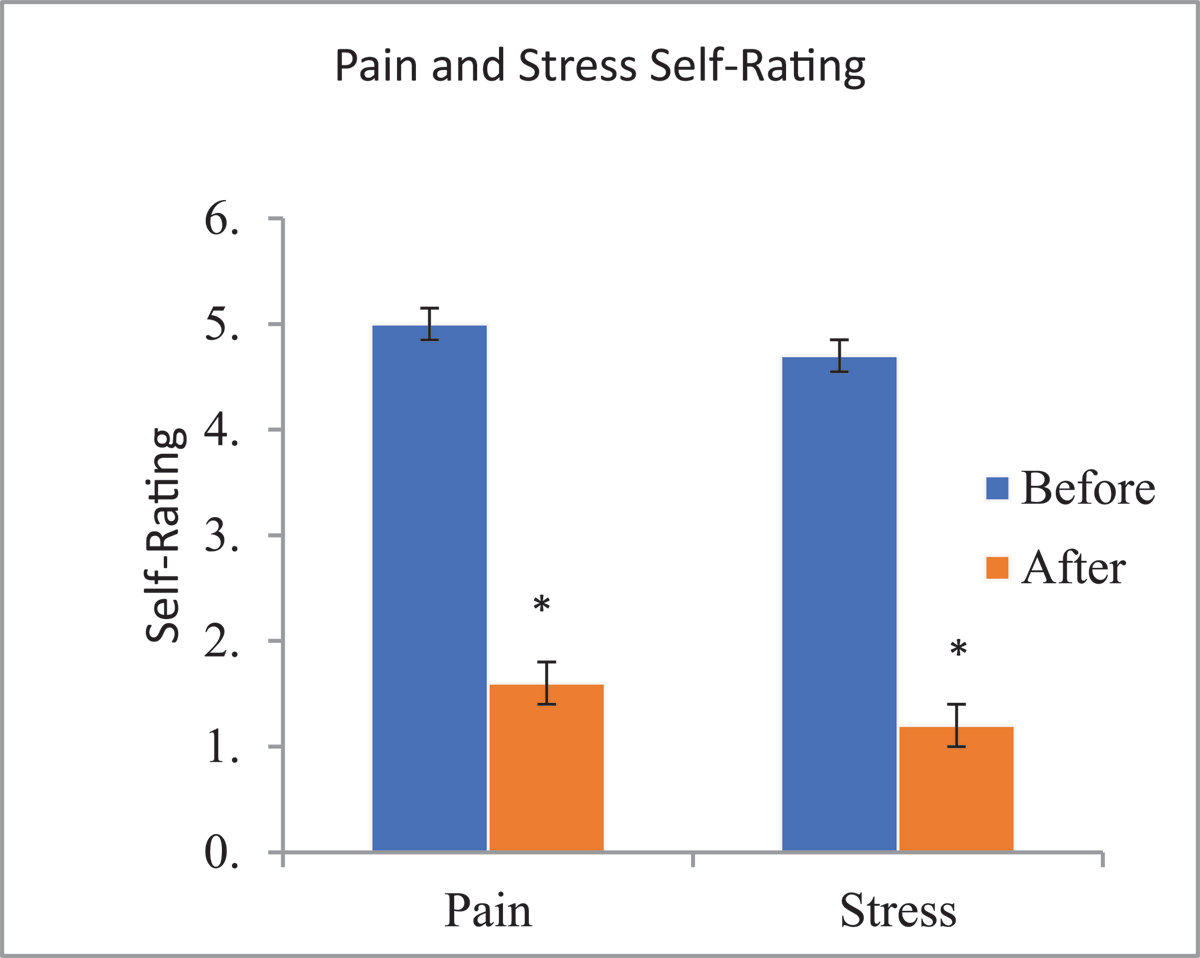
Figure 1
Pain and Stress Scores Before and After Yoga Session.
Note: Self-rating used a Likert scale of 1 (lowest) to 10 (highest); * t-test with p < 0.05.
Responses to the Questions
The 8 participants interviewed were 49–70 years old (M = 63.5 years), mostly female (63%), in the US military for 4–28 years (M = 14 years) for the following branches: Air Force (n = 3), Navy (n = 3), and Army (n = 1). One participant was a veteran caregiver. The responses of the participants to the questions are reported below.
How Long Have you Been Joining the Vet TRIIP Yoga Sessions?
The mean yoga attendance of these participants was 107 sessions. Six interview participants attended at least 90% of the yoga sessions since the beginning of the program. The themes emerging from the interview questions are reported below. Participants’ direct quotes are included throughout for illustration.
What Motivated you to Join a Vet TRIIP Yoga Session?
The participants had different reasons for joining the VetTRIIP yoga sessions. These reasons were either intrinsic (i.e., pain and PTS symptoms, desire for a healthy lifestyle) or extrinsic (i.e., recommendations from others).
Four of the 8 participants shared that they self-elected to join the yoga sessions without external influence. They wanted to deal with their pain and PTS symptoms and wanted to “get away from medication and use more holistic medical remedies for pains and symptoms.” One veteran shared that she has “body aches and pain and felt stiff throughout the body and wanted a natural remedy.” Others joined the yoga session as part of a healthy lifestyle. One “wants to become more active, healthier, and live longer.” Another indicated that yoga “makes [me] feel good, energetic.”
Four participants shared that they joined the Vet TRIIP yoga sessions because of a recommendation. Some reported that their “doctor recommended” it. One was “already part of another yoga program at [a VA facility].” Another was “curious about the benefit of yoga,” which was “Vet TRIIP recommended.”
If you Have Attended Multiple Sessions, What Motivated you To Join Yoga Frequently?
The participants shared that they attended multiple yoga sessions because of the physical and mental benefits and perceived effectiveness. Some participants’ responses are as follows.
“It worked.”
“It makes me happy.”
“[I] felt good after the first session … so energized afterward.”
Participants reported “increased balance and focus” and “flexibility” as well as “decreased aches and inflammation in the body.”
Yoga makes a “world of difference” and makes the participants be “in tune with body.” It also “provided skills to use throughout the whole day.”
Other related comments indicated that that yoga provides them “peace” and helps them feel “grounded,” “good,” and “relaxed.” The yoga sessions provide a sense of “comradery” with fellow veterans.
How do you Feel Before Each Session?
In response to the question asking how they feel before a yoga session, participants shared their physical and mental conditions as well as their anticipation of the sessions. The participants shared that they have “aches, pains, and stiffness,” and “little everyday stresses.” They have “tense muscles,” “high pain,” and “high blood pressure.” Some feel that they “must come” and feels it is a “necessity to go to yoga in order to feel good.” One shared that before a Vet TRIIP yoga session she feels “stressed and anxious” as she has to drive 30 miles to join the activity.
How do you Feel After Each Session?
Participants shared that a yoga session helps them address their current physical and mental health conditions. The comments included positive feelings and relaxation; participants reported being “more calm,” “peaceful,” and “happier” and they were “more relaxed and [have] lower pain and stress.” Yoga participation allowed them to feel “stronger” and “energized.” They were able to “move around more,” “loosen up,” and “feel the blood flowing through.” They had “increased focus and mobility.” The participant who reported having high blood pressure shared that he had “decreased blood pressure” after yoga, which was “actually measured.”
What Kind of Benefits do the Yoga Sessions Provide?
Participants shared that they experienced multiple benefits with their yoga participation especially concerning physical and mental health as well as the sense of community. Much of the sharing mirrored the post-yoga descriptive mentioned previously such as relaxation, positive frame of mind, increased focus, and flexibility, and having more energy and strength. One participant shared that yoga participation “more than eased pain and stress, [it] increased flexibility.” Yoga allowed them to also achieve a “meditative state of mind.” Interestingly, a veteran shared that yoga participation allowed her to maintain mobility: “without the yoga sessions, I would be in a wheelchair now … Yoga keeps me walking.”
A feeling of community and friendship between the veterans was emphasized by the participants as additional benefits. The veterans shared, “[coming to yoga] provides a supportive [community where we can all] depend on each other,” and that “[yoga] provides a calming environment and a good group of friends for me.” Additionally, when asked about why the participants continued returning to the weekly yoga sessions, they endorsed that “comradery” and “the company itself is a benefit.”
How Long do These Benefits Normally Last?
When asked how long the yoga benefits last, the participants shared different time frames. These time frames range from “whole day” to a “couple of days,” or “throughout the week” “until the next yoga session.” The duration of the effect is influenced by the participants’ social environment. One shared, “If it weren’t for having to take care of Mother in [a facility], it would be lasting, but as of now, [it] dies down as soon as [I] visit Mom.” Another shared that the effects would last a “couple of days, but sometimes the rush of all things after yoga can decrease the benefits.”
What are you Doing at Home as an Extension of the Vet TRIP Yoga Sessions?
The participants shared that they practice versions of yoga on their own, in between yoga sessions. These versions varied greatly and included chair yoga, deep breathing, stretches, and a YouTube routine. They performed these exercises at different times of the day, i.e., at waking, bedtime, twice a day, or just “whenever.” One shared that she does “chair yoga at home and deep breathing exercises [and] uses some movements as [she] gets out of bed.” Another does her “own style of yoga at home for 30 minutes before going to bed and after going to bed.”
What do you Think Discourages People from Joining Yoga?
Participants shared that misconceptions about yoga may discourage other people from joining. These misconceptions include the difficulty of the poses, yoga-related stereotypes, time commitment, the perception that yoga is not effective, and its religious connection. They shared, (a) “Floor yoga is the conventional way of yoga [and] can appear as difficult.” (b) “Movements seem very difficult and floor yoga is what people think of when they hear yoga.” (c) People may also think that yoga is “time-consuming and are unmotivated to be active and exercise.”
Representative quotes about other misconceptions are as follows. Yoga is “associated with femininity (men might be discouraged), shame in flexibility, [and] age.” There is a perceived stereotype that it is for “skinny white women and only for the people who are already in shape.” One shared that a “group of friends think that it’s [yoga] a girl thing” and corrected that yoga is “a people thing.” Another said that aside from “age and believing it’s for youth, people don’t believe that it’s a legitimate pathway of treatment.” The participants also shared that other “people think it’s religiously affiliated and think it’s against their beliefs,” and “others don’t have time/won’t make time in their schedules for yoga.”
What More Would you add to the Vet TRIIP Yoga Program?
When asked what more can be added to the Vet TRIIP yoga program, most (75%) participants answered “none.” They were satisfied with the program. One highlighted liking that it is “small and personal.” Others suggested a change in the yoga format and venue could be considered. They asked about having a “higher-intensity session” and maybe “doing yoga outdoors in nature.”
Discussion
The Vet TRIIP yoga program was perceived by veteran participants as effective to address their pain, anxiety, and PTS symptoms. These health issues were prime motivators for initial participation and were related to the perceived benefits of post-yoga sessions. Identified yoga benefits include physical, mental, and social wellbeing, which motivated them to attend the sessions more frequently. Some of the participants practiced yoga in their daily lives, outside the weekly Vet TRIIP yoga sessions.
Pain and stress relief were also shared among veterans who participate in other Vet TRIIP integrative complementary medicine programs (Maddox et al., 2020). Vet TRIIP significantly impacts the lives of many through stress and pain reduction, potentially preventing suicide (Maddox et al., 2020). These results support the emerging evidence of the significant impact of the Vet TRIIP program among veterans in South Texas. More importantly they indicate increased interest among veterans in complementary and integrative approaches to address their chronic health conditions related to pain and mental health. Community resources like Vet TRIIP are crucial in addressing mental health and pain issues among veterans especially as they pertain to barriers to accessing adequate treatment (American Public Health Association, 2014; Reisman, 2016; US Department of Veterans Affairs, 2022b), polypharmacy (Morin et al., 2020) and preference for nonpharmacological approach (Maddox et al., 2020). The association between polypharmacy, use of benzodiazepines and opioids, and late-life veteran suicide is a significant public health concern (Morin et al., 2020) that can potentially be addressed with the availability of CAM interventions available for the veterans whether at the VA (US Department of Veterans Affairs, 2018) or in the community.
The yoga benefits shared by study participants support the growing body of knowledge that yoga is beneficial for veterans. Cushing et al. (2018) reported that veterans of the post-9/11 conflict who practiced a trauma-sensitive yoga intervention have decreased PTSD symptomatology; improved mindfulness scores and decreased insomnia, depression, and anxiety symptoms. They concluded that yoga can be a stand-alone treatment or an adjunct to existing PTSD treatment.
A randomized controlled trial of a Trauma Center Trauma-Sensitive Yoga (TCTSY) program versus cognitive processing therapy (CPT) confirmed the usefulness of yoga as an effective treatment for PTSD among women veterans with PTSD related to military sexual trauma (Kelly et al, 2021). The study concluded that TCTSY yields symptom improvement more quickly, has higher retention than CPT, and has a sustained effect.
Veterans with PTSD who participated in gender-specific groups of yoga intervention reported improved mental health symptoms, sleep, and quality of life as well as cognitive functioning as measured by response inhibition (Zaccari et al., 2020). However there were significant differences in objective measures of cognitive performance and salivary cortisol levels in the study population. The lack of significant effects on objective measures (i.e., cognition and cortisol) highlight the need for rigorous research with bigger sample sizes to fully determine the benefits of yoga.
Despite the existing scientific evidence, there is still a lack of uptake of yoga in the community. The study participants shared that other than personal reasons related to pain and stress control, a recommendation by their healthcare provider prompted them to try yoga. This sharing highlights the need for healthcare providers to consider recommending yoga to veteran patients and even civilian patients who are experiencing chronic pain and high levels of stress. Yoga is not only beneficial during a class, but participants reported how they can incorporate the practice into their daily lives. From these perspectives it seems yoga can be a health promotion strategy for all individuals to help achieve a quality healthy life.
To encourage yoga participation, efforts must be made to address misconceptions related to yoga. Strategies need to include showing yoga as beneficial for all individuals rather than just a “feminine” activity. The perception of yoga is associated with “white, middle-aged women” or “hipsters” has also been seen in other yoga studies (Cushing et al., 2018). There is a need to counter this stereotype. Mass media messaging may include male soldiers and veterans or other men who are engaged in yoga. It can also include messaging that yoga practice can be modified to an individual’s physical capability. Hence, yoga can be high-intensity floor yoga exercises or modified chair yoga. For veterans who are used to more intensive physical activity as a regular part of their lifestyle (Cushing et al., 2018), floor yoga exercises might be considered challenging and more beneficial. Yoga was developed to improve the strength and flexibility of the body regardless of the starting point (Feuerstein, 2014). Proper education on yoga can help address both misconceptions related to its physical demands and gender bias.
This first-ever evaluation of the Vet TRIIP yoga program shows that the participants are satisfied with the structure and delivery. There were minimal suggestions for improvement. One veteran highlighted how the small class size and the personal approach were very conducive. This preference may be consistent with the social avoidance symptoms associated with PTSD (Lapiz-Bluhm & Peterson, 2014). Veterans are likely to be more comfortable with people they know and have a sense of community. Social belonging was a theme shared by Vet TRIIP yoga participants. For veterans who return from years of deployment, a lack of communal support can be extremely alienating and can further aggravate the symptoms of trauma they experience (Wilson et al., 2018). The inclusive atmosphere of the Vet TRIIP yoga program and bond with the instructor motivated repeat participation. Hence this study provides further evidence that Vet TRIIP is a trusted community platform that supports the crucial social bonds for veterans (Maddox et al., 2020).
The sample size is a clear limitation of the study, even though 56% of the initial pool (which consisted of 140 participants) of veterans continue to participate in the yoga program. With only 79 veterans who participated in more than 4 yoga sessions, the ability to generalize the results may be limited. Nevertheless, the study findings are supportive of previous yoga studies (Cushing et al., 2018; Zaccari et al., 2020). Addressing the lack of objective data on the effects of yoga remains a goal. Further studies with larger numbers of participants with rigorous biomarker component may address these questions. Biomarker studies will provide better understanding to the mechanisms related to the benefits of yoga on physical and mental health.
In conclusion the Vet TRIIP yoga classes can help address chronic pain PTS among veterans, service members, their families, and caregivers. The identified motivators and other factors associated with yoga participation could be considered in developing strategies to increase engagement in the practice. Community resources that offer CAM have the potential to address health access issues, polypharmacy, and available alternative approaches to stress and pain among veterans. Further research is needed to determine the biological mechanisms associated with benefits of yoga as well as the impact of community-based programs supporting veterans. Collaborations between academia and community programs can potentially advance scientific understanding of chronic pain and stress co-morbidities and the role of complementary and integrative approaches.
Acknowledgements
We sincerely thank Vet TRIIP for the work they do for veterans, active-duty members, families and caregivers. We salute to all veterans for their service. We especially thank the Vet TRIIP participants who contributed to this program evaluation.
Funding Information
There was no funding support for this program evaluation. This study was conducted when AB was a scholar at the University of Texas Health Science Center at San Antonio Voelcker Biomedical Research Academy, which was funded by the Voelcker Foundation.
Competing Interests
The authors have no competing interests to declare.