
While international research on public perceptions of military service personnel and veterans has received extensive academic attention (e.g., Ashcroft, 2012, 2017; Hines et al., 2015; ICM Unlimited, 2015; Institut Public de Sondage et al., 2015; Park et al., 2012; Phillips et al., 2020), little is known about Austrian public attitudes towards their service personnel and veterans. When this type of work has been done, it focused predominantly on explicit attitudinal data measures on public perceptions of the Austrian military (Prinz et al., 2019). The most thorough and recent representative survey was conducted by Statista (2021b), surveying 1,020 Austrians above 15 years of age between spring 2017 and spring 2021. This work revealed that the majority of the surveyed population hold a favourable view of the Austrian military, with 94% to 98% of the participants trusting their Armed Forces.
Additionally, research has outlined that the Armed Forces can so be a source of internal wealth of a country by drawing upon civilian-defence knowledge transfers that can improve the innovation and productivity of companies (Acosta et al., 2019; Briones-Peñalver et al., 2020). In this sense, the Armed Forces accelerate research and development besides supporting small and medium companies by drawing on inter-organizational relationships and cooperation among firms (Acosta et al., 2019; Briones-Peñalver et al., 2020). However, not least to the lack of empirical evidence, there is an ongoing academic dispute whether or to which extent similar favourable views are held of the Austrian Armed Forces’ personnel and its veterans (e.g., Amtliche Publikation der Republik Österreich Bundesminister für Landesverteidigung und Sport, 2014; Daxner, 2017; Hessel, 2002; Giller et al., 1992; Vogel, 2002). The present study addresses this by examining and comparing word-associations that correspond to recruits, soldiers, and veterans of the Austrian Armed Forces.
Unlike predominantly appreciative attitudes towards service personnel in many democratic countries (e.g., Ashcroft, 2012, 2017; Park et al., 2012; Statista, 2014), the public image of the Austrian Armed Forces’ personnel may be more problematic (e.g., Pirker, 2018; Daxner, 2017; Berger, 2011; Giller et al., 1992; Rauchensteiner, 2002). This is because public knowledge and sense-making processes always include a historical aspect that relates to a culture’s past (e.g., Liu & Hilton, 2005). In this sense, Jovchelovitch (2001) argued that the historicity of knowledge is evidenced by the interdependence between today’s knowledge and historical knowledge, and, its temporal, transformative character. Therefore public knowledge commonly draws on comparisons between “today” and “the past” and interrelates different temporal perspectives (Jovchelovitch, 2001). For example, to understand feminists’ or human right activists’ emphasis on equality, it is necessary to draw on historical notions indicating that, at times, specific groups of people such as women or Black people were defined as inferior. In the same way public perceptions of recruits, soldiers, and veterans may respond to historical perspectives.
While in some countries like the US and the UK the conceptualisation of soldiers is often intertwined with heroic representations (Ashcroft, 2012; Dandeker et al., 2006; Statista, 2014), conceptualisations of Austrian soldiers are less positive due to its history of National Socialism during the Second World War (Pirker, 2018; Rauchensteiner, 2002). For example, Austrian war memorials of WWI and WWII have commonly been rewritten, relabelled, and occasionally removed (Giller et al., 1992; Pirker, 2016). Monuments now refer to soldiers as “victims” (Opfer) or the “fallen” (die Gefallenen; Giller et al., 1992; Pirker, 2016, 2018).
This is particularly relevant in the light of Liu and Hilton’s (2005) study, which evidenced the long lasting and permeating character of historical representations on cultural identity. Culturally shared representations of history, such as legacies of WWI and WWII, become in this sense a narrative framework that provides an incontestable reality, serving as a foundation for societal decision-making processes (Liu & Hilton, 2005). For example, the UK, France, and Germany faced a similar challenge after the terrorist attack on the US World Trade Center on September 11, 2001, as they were all obliged by NATO to offer support to the US. Nevertheless, the UK dispatched troops immediately, whereas France promised military aid with more reticence and Germany called a vote of confidence in the government (the first in over 20 years) before dispatching troops. Liu and Hilton (2005) argued that these discrepancies can be explained in culturally shared representations of European military history. While the UK sees itself as world policemen that together with the US defends democracy just like in 1941, France understands its role as defending mainly human rights, resistant to Anglo-Saxon world hegemony, and Germany is on a quest of developing a “normal” role without arousing historically grounded fears of German aggression. Austria, a country that shares (military) history and language with Germany, may therefore experience similar challenges of redeveloping its military identity in the context of history. In this sense, the permeating character of historical representations may also affect the public image of those who currently serve in the Austrian Armed Forces or have served and are now veterans negatively.
This negative spillover effect may be a particular issue in the light of the lack of media coverage that the Austrian Armed Forces receives (Suppan, 2019; van Boom et al., 2017; Vogel, 2002). Despite the support the Austrian Armed Forces receives from its public relations department, neither positive nor negative aspects of the Austrian Armed Forces are widely communicated and propagated by the media (Suppan, 2019; van Boom et al., 2017; Vogel, 2002).
Similarly, the Austrian Armed Forces receives little attention at individual events aside from a traditional parade on the Austrian Staatsfeiertag, happening on the 26th of October each year, while schools focus on the presentation and discussion of mere facts of Austrian military history (Hessel, 2002; van Boom et al., 2017). More serious discussions surrounding today’s Armed Forces in connection with recognition for its members and veterans, only take place in relatively rare instances when concrete missions or deployments are decided upon or immediate aid is to be delivered locally or overseas (Hessel, 2002; van Boom et al., 2017). In this sense, it can be argued that the Austrian Armed Forces are placed on the margins of societal attention, widening the civil-military gap as a possible consequence thereof (Hines et al., 2015; Rahbek-Clemmensen et al., 2012). This is problematic, as an absence of knowledge regarding what individuals in the military do on a daily basis may deter recruitment and cause disaffection among those who are currently serving (Hines et al., 2015). Additionally, little knowledge about service members’ daily routines may be particularly detrimental for veterans from the Austrian Armed Forces. While most international research outlines that soldiers and active service personnel are beneficially viewed (e.g., Ashcroft, 2012, 2017; Hines et al., 2015; ICM Unlimited, 2015; Institut Public de Sondage et al, 2015; Park et al., 2012; Phillips et al., 2020), public perceptions of veterans are often dominated by representations of damaged, aging, and war-weary individuals (Ashcroft, 2012, 2017; Bulmahn, 2012; Daxner & Mann, 2016; Park et al., 2012; Phillips et al., 2020). For example, in a free-word association task in which 1,250 German respondents provided immediate associations to the stimulus word “veteran,” the majority of the respondents did not provide any, or, only generic responses relating to war or old-age (Bulmahn, 2012). Also, if associations were provided that characterised a veteran, then only a minority of 3% was positive and appreciative, whereas 11% were negative and victimizing associations. These results are mirrored by studies conducted with members of the UK and US public, suggesting that veterans are predominantly conceptualised as labile and fragile victims of warfare (Phillips et al., 2020; Schreger & Kimble, 2017). This is problematic as negative perceptions of veterans, even if held implicitly, may influence the veterans’ transition into civilian society, as skills may not be recognized and so impede the veterans’ civilian re-employment (Hines et al., 2015). Therefore, an absence of societal discourses thematizing the Austrian military and its members may have negative consequences as contributing to the civil-military gap.
However, the argument that Austrian civilians may know little about members of their Armed Forces due to low levels of societal attention and thematization stands in stark contrast to Austria’s conscription of all male citizens (Hessel, 2002; Rauchensteiner, 2002; van Boom et al., 2017; Vogel, 2002). Since 1955, all male-identifying Austrians who are 18 years or older are conscripted into the Austrian Armed Forces, with an option of civilian service being introduced in 1975. As conscripts enjoy more advantages such as serving a shorter period of time (being conscripted for 6 months versus being a civilian servant for 9 months) and have greater career prospects (i.e., becoming a private or starting a career as a pilot), the majority of young men decide to join the Austrian Armed Forces (Statista, 2019).
Conscripts undergo three stages of basic military training. First, they are taught the correct handling of the equipment and military proceedings. In the second and third stages, conscripts are assigned to units and undergo a more specific training (e.g., identify mines and booby traps, learn how to use specific kinds of weapons such as mortars, etc.). After completion of the obligatory 6 months of military service, the roughly 17,000 conscripts per year (Statista, 2019) can decide whether they want to join the Austrian Armed Forces full-time to pursue a career in the military as a non-commissioned officer or an officer, or, whether they prefer to become part of the Austrian Militia. The approximately 25,000 militia-soldiers, together with the 950,000 reservists (non-active militia) and the roughly 17,000 conscripts per year supplement the relatively small Austrian all-volunteer Force of 14,000 soldiers (Bundesheer, 2021).
Only around 5% of the Austrian’s all-volunteer Force is currently deployed. This is due to the Austrian State Treaty of Neutrality, which declares that “In all future times Austria will not join any military alliances and will not permit the establishment of a foreign military base on its territory” (Federal Constitutional Law on the Neutrality of Austria, 1955, p. 1). Under the Declaration of Neutrality (Federal Constitutional Law on the Neutrality of Austria, 1955), Austrian troops can only be deployed to peacekeeping missions and operations that aim to provide humanitarian aid or disaster relief. As such, Austria has a relatively small presence across different countries (see Table 1 below).
Table 1
Austrian Military Deployments.
| COUNTRY | MISSION | NUMBER OF SOLDIERS |
|---|---|---|
| Bosnia | The stabilization of the military in accordance with the Paris Peace Agreement; Helping to establish a permanent military presence to prevent a renewed threat to the peace. | 284 |
| Kosovo | Maintaining security in Kosovo based on UN Resolution 1244 (1999). | 304 |
| Libanon | Ensuring the safety of the population. The deployment in Lebanon is based on UN Resolutions 425 (1978), 426 (1978) and 1701 (2006). | 172 |
| Moldawia | Securing and safeguarding of weapon stocks. | 7 |
| West Sahara | Monitoring of the ceasefire agreement, etc. based on UN resolutions 690 (1991) and 1359 (2001). | 4 |
| Mali | European Union Multinational Training Mission and UN mission to stabilize Mali. | 5 |
| Italy | EUNAVFOR MED Op IRINI: EU operation against people smuggling. | 5 |
| Cyprus | Preventing renewed inter-ethnic hostilities by being present within the buffer zone based on UN Resolution 186 (1964). | 3 |
| Middle East | Peacekeeping based on UN Resolutions 48 (1948), 50 (1948) and 73 (1949). | 4 |
| Georgia | Monitoring compliance with the ceasefire between Georgia and Russia | 4 |
| Mosambique | EU crisis management mission in Cabo Delgado province | 1 |
[i] Note: This table has been recreated from Bundesheer (2022).
While the Austrian Armed Forces has emphasized equality and gender mainstreaming and working on anti-discrimination acts (Mathes & Gruber, 2019), only approximately 5% of the Austrian’s Armed Forces personnel is female. However, due the high number of reservists (approximately 950,000 members) who supplement the active militia (approximately 25,000 members) and the all-volunteer Force (approximately 14,000 members), it can be assumed that approximately every 9th of the 8.96 million people living in Austria is somewhat associated to its Armed Forces. This makes it considerably likely that most people who live in Austria also know someone who serves in its Armed Forces.
Additionally, the Austrian Armed Forces has increased its public visibility since the COVID-19 pandemic, as recruits, soldiers, and the militia played a vital role in crisis management. This was positively received by the majority of the Austrian public. Specifically, a total of 64% of the surveyed population stated that the Austrian Armed Forces response to the COVID-19 crisis improved their appreciation for the Austrian Armed Forces (Prinz et al., 2020). Additionally, the majority of the population (54%) felt reassured by the presence of soldiers in public spaces (Prinz et al., 2020). In conclusion, members of the Austrian general public are not only likely to either have served themself or know someone who has served in the Austrian Armed Forces. Therefore, it may well be possible that Austrian public perceptions of its Armed Forces’ recruits, soldiers, and veterans is more beneficial than scholars (i.e., Hessel, 2002; Vogel, 2002) assume.
However, without empirical data that substantiates arguments surrounding Austrian’s public perceptions of members who serve and have served in its military, knowledge remains limited and based on assumption. The present study addresses this gap in knowledge by utilizing the structural approach in Social Representation Theory (Abric, 1989; Moscovici, 1988, 2000, 2001).
Theoretical Framework
To understand members of the Austrian publics conceptualisations of recruits, soldiers, and veterans, complex interactional processes at societal and individual levels need to be considered. These processes involve cultural structures of inter-individual propagation of information and intra-individual meaning-making processing that evaluates the propagated information (Jovchelovich, 2001; Sellars et al., 1997). As content and process, social representations form a modality of knowledge that takes such interactional processes into account (Moscovici, 1988, 2000, 2001). In this sense, social representations are “a form of knowledge, socially produced with a practical function, namely to contribute to the construction of a reality shared by a social group or entity” (Jodelet, 1991, p. 36). To that end they are culturally shared sets of understandings of socially significant realities with four main functions: (a) Social representations have a function of knowledge (explaining reality), (b) a function of identity (defining and maintaining individual and group identity), (c) a function of guidance (guiding behaviours), and (d) a function of justification (justifying behaviours; Abric, 1989). Therefore, social representations capture how people make their world meaningful by observing communication processes that determine the content and structure of beliefs and practices (Moscovici, 1984). As a constitutive paradigm of social psychology (Abric, 1989; Jovchelovich, 2001), many qualitative and quantitative methodological perspectives have been used to examine social representations (e.g., Abric, 2012; Jovchelovich, 2001; Lo Monaco et al., 2016, 2017).
This study focusses on the structural approach in Social Representation Theory (Abric, 1989) that defines social representations as a hierarchical, coherent system of structured and organised sets of meaning, beliefs, and attitudes. As such, social representations comprise two interacting and qualitatively different subsystems: the central system and the peripheral system. The central system has a stabilising function and is composed of a small number of unambiguous and consensual elements. These central elements are unconditional, essential, constitutive properties that give meaning to the entire representation. In contrast, the peripheral system constitutes an interface between the representation of reality and reality itself. The peripheral system is composed of contextually and situationally dependent components that are conditional in nature (i.e., peripheral elements; Guimelli, 1993).
From this perspective, social representations of recruit, soldier, and veteran are composed of a set of hierarchically structured elements. More important elements, central elements, are unconditional descriptors that refer to the basic constituents of beliefs about recruits, soldiers, and veterans. Without these basic constituents, a person could not be classified as a recruit, soldier, or veteran. Serving or having served in the Austrian Armed Forces would be an example for such a basic constituent. In contrast, less important, situationally dependent descriptors would represent peripheral elements. For example, specific personality dispositions such as smart may be an adequate descriptor in some instances, but not in others. Therefore, the structural approach will allow to differentiate between important core elements that are considered as unambiguous elements in descriptions of recruits, soldiers, and veterans, and less important, situationally dependent descriptors.
Study Aims
The aim of this study was to investigate perceptions of recruits, soldiers, and veterans in an Austrian cohort and compare these perceptions with each other. As there is little to no previous research in this area, the present study is highly exploratory. The present study examined original associations to recruits, soldiers, and veterans and structured these beliefs hierarchically. This study aimed to address the following research questions:
What are the central and peripheral elements of perceptions of recruits, soldiers, and veterans? Which perceptions of recruits, soldiers, and veterans are contextually and situationally dependent and which are globally consistent?
How do the central and peripheral elements of perceptions of recruits, soldiers, and veterans compare with each other?
Methods
Participants
After receiving ethical approval from Robert Gordon University, a convenience sample of 266 participants who lived in Austria was recruited between December 2020 and March 2021. The sociodemographic characteristics of the recruited population are indicated in Table (below). As outlined in Table 2, the recruited population includes a high proportion of females (75.2%) with an average age of 27.51 (SD = 11.53). It is also evident that a high percentage of the recruited cohort has lived in Austria for a long period of time and had no specific preference for a political party (middle of the road: 56%).
Table 2
Participant Demographic Information.
| DEMOGRAPHIC CHARACTERISTICS | FREQUENCY |
|---|---|
| Gender | Female: 200 (75.2%) Male: 66 (24.8%) Non-Binary: 0 (0%) |
| Age | M = 27.51, SD = 11.53 |
| Education | Above A-levels (“Matura”): 91 (34.2%) A-levels or equiv. (“Matura”): 161 (60.5%) Below A-levels (“Pflichtschule”): 14 (5.3%) |
| Nationality | Austrian: 254 (95.5%) Other: 12 (4.5%) |
| Religion | No religion: 54 (20.3%) Christian: 177 (66.5%) Muslim: 10 (3.8%) Other: 25 (9.4%) |
| Opinion about the Austrian Armed Forces | Very high: 46 (17.3%) High: 130 (48.9%) Low: 75 (28.2%) Very low: 15 (5.6%) |
| Social distance to the Austrian Armed Forces | No contact to the Austrian Armed Forces (no member/ex-member in a social circle): 47 (17.7%) Distant contact (a member/ex-member in distant social circle): 78 (29.3%) Close contact (a member/ex-member in close social circle): 107 (40.2%) Being a member of the Austrian Armed Forces oneself: 34 (12.8%) |
| Time since residing in Austria | Before 2011: 233 (78.9%) Between 2002–2011: 29 (10.9%) Between 2012–2015: 0 (0%) Between 2016 and now: 4 (1.5%) |
| National pride | Very proud: 138 (51.9%) Proud: 108 (40.6%) Rather not proud: 14 (5.3%) Not proud: 6 (2.3%) |
| Political opinions | Left wing (i.e. Green Party/Liberals): 32 (12%) Somewhat to the left: 67 (25.2%) Middle of the road (i.e., SPÖ, ÖVP): 149 (56%) Somewhat to the right: 14 (5.3%) Right wing (FPÖ, Team HC Strache): 4 (1.5%) |
Materials and Procedure
After giving informed consent, three successive steps were carried out. Free Word Association Task: Participants were asked to produce the first three words that came to their mind when seeing the stimuli terms “recruit of the Austrian Armed Forces” (Rekrut des österreichischen Bundesheeres), “soldier of the Austrian Armed Forces” (Soldat des österreichischen Bundesheeres), and “veteran from the Austrian Armed Forces” (Veteran des österreichischen Bundesheeres) on a computer screen. Participants were randomly presented with either stimulus first and, to ensure they answered rapidly, a timer was displayed on the screen beneath the free-text entry fields (i.e., free association task; see Clemence et al., 2014; Di Giacomo, 1980; Lorenzi-Cioldi, 1988; Sarrica & Contarello, 2004).
After the three-word associations for each stimuli word (recruit, soldier, and veteran) were provided, participants were asked to rank the importance of their word associations in describing each of the three stimuli words on a 5-point Likert scale (extremely important, very important, moderately important, slightly important, not at all important). This process was not timed, and participants were encouraged to be reflective in their rankings (Abric, 2012; Dany et al., 2015; Lo Monaco et al., 2016). In the third and final step, participants were asked to provide sociodemographic information about themselves.
The three stimuli words of recruit, soldier, and veteran were chosen in order to present a full lifespan of a career in the Austrian Armed Forces. In this way possible differences in perceptions of Austria’s Armed Forces Personnel could be best outlined.
Data Analysis
Content Analysis
A theme-based content analysis (Bardin, 1977) was conducted to facilitate further analyses. A process of grouping together semantically similar answers assisted with data-aggregation and made the corpus of data more uniform and less ambiguous (Bolasco et al., 1999; Sarrica & Contarello, 2004). Semantically similar answers such as items that expressed the same semantic content and differed in grammatical form, expression, spelling or upper or lower cases, were put together (i.e., honor – honour, bravery – brave). The evaluation of saliences, frequencies, and characteristics of associations informed by relevant literature (i.e., Joffe, 2007; McCulloch, 1995; Sarrica & Contarello, 2004), guided the subsequent construction of the theme-based categories.
Hierarchical Evocation Method
The Hierarchical Evocation Method was utilized to distinguish between central and peripheral elements (Dany et al., 2015; Lo Monaco et al., 2017) and is commonly used in social representational research (e.g., Baquiano & Mendez, 2016; Dany et al, 2015; Lévy et al., 2010; Lo Monaco et al., 2017). It satisfies two criteria. First, the frequency of element-occurrence and secondly the hierarchical order of valence (importance). Cross-referencing frequency and importance produced a four-area chart (see Figure 1 below). The threshold for frequencies is determined by the number of associations divided by the number of previously defined elements (thematic clusters). The distinction between high and low importance of these elements is made by utilizing the importance ratings’ mean as the cut-off point.

Figure 1
Hierarchical Evocation Method Model.
The upper-left corner of the chart contains the representation’s central elements based on high frequencies and importance. These central elements ought to be defined by the homogeneity of group understandings, stability, coherence, change resistance, and rigidity. The bottom left cell comprises categories that were named by fewer people but were still considered very important. This zone, the contrasting zone, represents elements that may be important to sub-groups in the recruited population. The first and second periphery contain mutant elements, oscillating in the adaptation to the situation and social context (Baquiano & Mendez, 2016). While the first periphery contains frequent but unimportant elements, the second periphery is constituted of infrequent and unimportant elements. The first and second periphery allow for the integration of individual experiences and tolerate heterogeneity and contradictions.
Results
The 266 participants generated a total of 2,394 word associations (798 per stimulus term). These were downloaded from the online survey-tool Qualtrics and transposed to SPSS along with the participants’ importance rankings and the sociodemographic information. The word associations were then grouped into thematically coherent clusters utilizing Content Analysis. These clusters were indicative to differentiate between central and peripheral clusters in the subsequent Hierarchical Evocation Models.
Content Analysis
An inductively-driven coding chart was generated. Findings from previous literature (i.e., Joffe, 2007; McCulloch, 1995; Sarrica & Contarello, 2004) were used to amend the original coding chart into the final 13 thematic cluster chart. Inter-rater reliability was validated by concordance in category ratings with an academic linguist (93.4% inter-rater concordance). An overview of the thematic clusters together with their frequency of evocation can be found in Table 3 (below).
Table 3
Category Definition, Examples, and Frequencies.
| CATEGORY | DEFINITION | EXAMPLES | TOTAL FREQUENCY OF CATEGORY OCCURRENCE |
|---|---|---|---|
| Positive personality dispositions/character traits | References to personality characteristics and traits that are beneficial and pro-social | Helpful Intelligent Eager | 837 (34.96%) |
| Heroization | Associations relating to superiority and heroism; Descriptions referring to looking up to service personnel | Hero Fearless Saviour | 289 (12.07%) |
| Negative personality dispositions/character traits | References to personality characteristics and traits that are negative and anti-social | Racist Idiot Dumb | 204 (8.52%) |
| Older age and experienced | Associations which characterise stimuli words by higher age and experience | Old Experienced Has seen a lot | 199 (8.31%) |
| Victimization | Associations which refer to suffering from illnesses or injustice | Amputee Trauma Injured | 198 (8.27%) |
| Athletic | Associations which refer to elevated levels of fitness | Active Trained Fit | 122 (5.1%) |
| Young and inexperienced | Associations which characterise stimuli words by low age and inexperience | Young Inexperienced Newbie | 118 (4.93%) |
| Physical description | Physical description of a person | Man Woman Green uniform | 94 (3.92%) |
| Branch of military service | Reference to a group within the Forces/to the membership within this group | Soldier Pilot Pioneer | 75 (3.13) |
| War & deployment | Associations, conceptualising the term “war” (i.e. Sarrica & Contarello, 2004) | War Bomb Explosion | 75 (3.13%) |
| National belonging | Associations which refer to being Austrian or in-group belonging; associations grounded on national inclusion or more subordinated group belonging | One of ours Austrian Our soldier | 74 (3.09%) |
| Other | Associations which did not fit any other categories | ? Don’t know A/A | 57 (2.38%) |
| Job/occupation | Associations which refer to jobs, being employed and descriptive synonyms of these aspects | Occupation Job Employee | 52 (2.17%) |
Hierarchical Evocation Method (HEM)
HEM models were created for the stimuli phases “recruit of the Austrian Armed Forces”(Rekrut des österreichischen Bundesheeres), “soldier of the Austrian Armed Forces” (Soldat des österreichischen Bundesheeres), and “veteran from the Austrian Armed Forces” (Veteran des österreichischen Bundesheeres). The mean frequency (f) threshold was created by dividing the number of words included in the analysis (798 associations per stimulus word) by the number of categories (13 thematic categories), resulting in a value of 61 for each stimulus words. The mean value for the importance ratings (Average Order of Evocation, AOE) was 3.35 for the stimulus term “recruit of the Austrian Armed Forces” (Rekrut des österreichischen Bundesheeres). For the stimulus term “soldier of the Austrian Armed Forces” (Soldat des österreichischen Bundesheeres) the AOE was 3.41, and for “veteran from the Austrian Armed Forces” (Veteran des österreichischen Bundesheeres) it was 3.27. The associations that were grouped into thematic clusters through the categorization in the content analysis were handled as elements and allocated to the central, contrasting and peripheral zones of the HEM models (see Figures 2, 3, and 4 below).
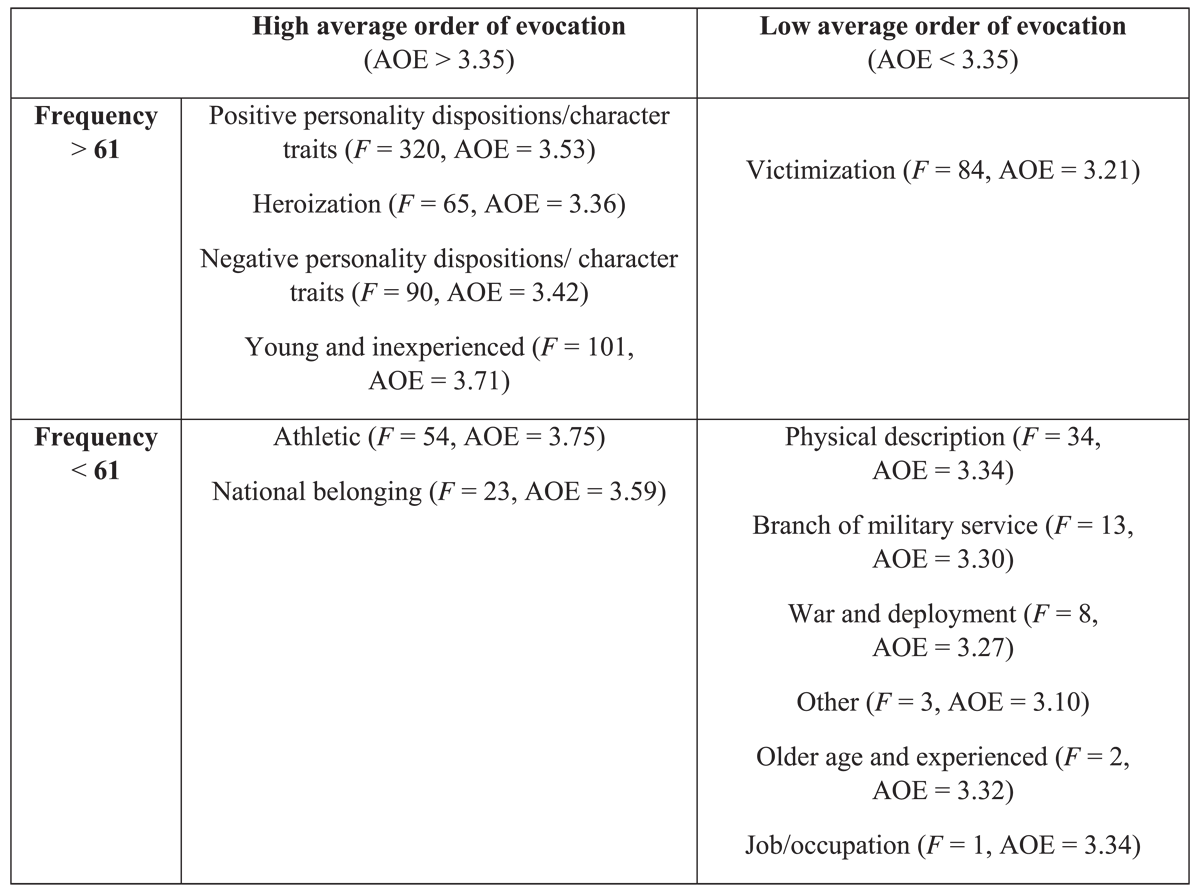
Figure 2
Hierarchical Evocation Method Model: Recruit.
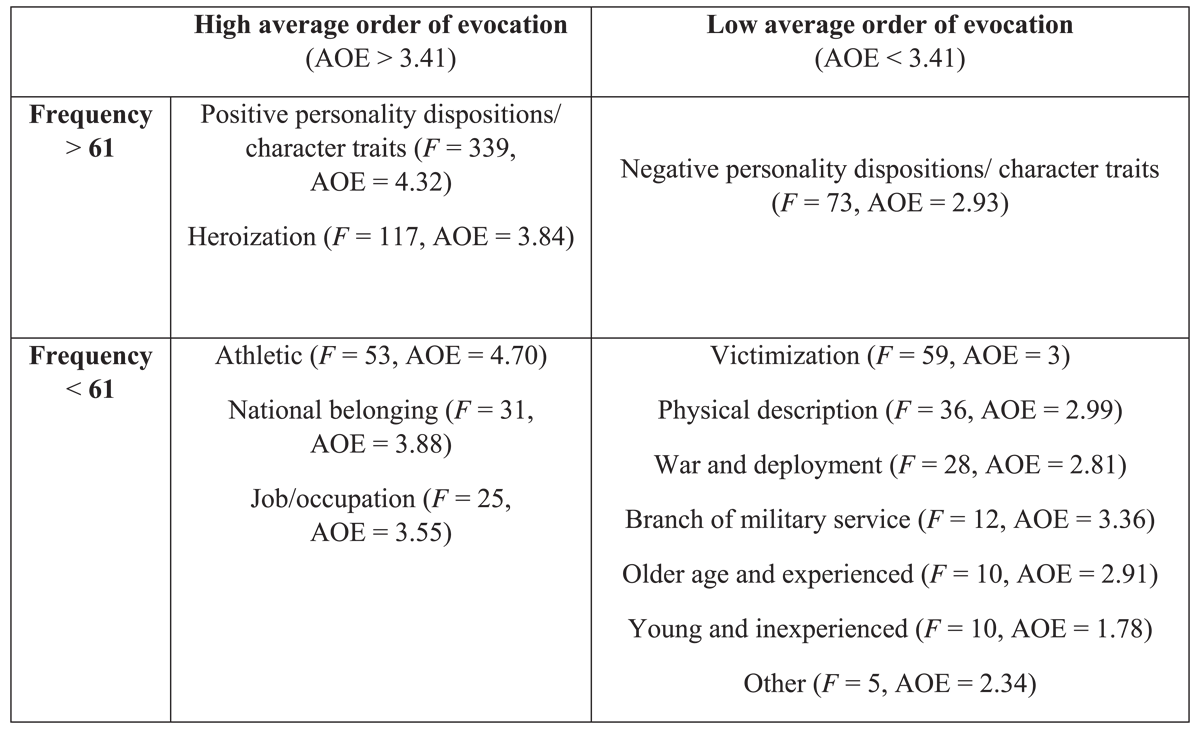
Figure 3
Hierarchical Evocation Method Model: Soldier.
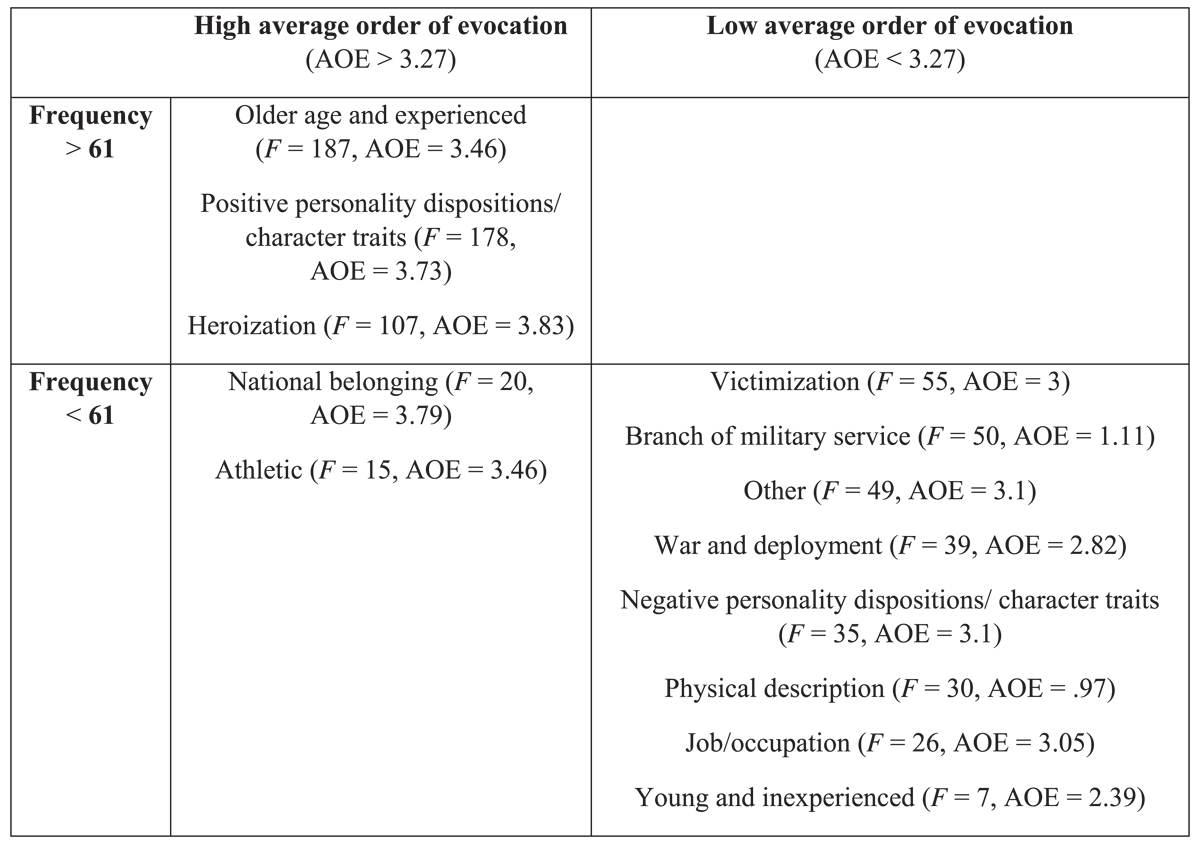
Figure 4
Hierarchical Evocation Method Model: Veteran.
The results suggest that the three stimuli words—recruit, soldier, and veteran—are well-defined representations with organized and distinct central cores. The three stimuli words are structured around stable, highly salient and evocative cores. Out of 13 thematic clusters, only five clusters were part of the central core or the contrasting zone the HEM models of the three stimuli words. The other eight thematic clusters were part of the second periphery, indicating very little importance.
For recruit, the central elements focused on descriptions of the personality (whether positive, negative, or even heroizing) and on references to immaturity and inexperience. Therefore, at first sight, characterisation of a recruit may appear to be indifferent or generic, as both positive and negative character dispositions are anticipated. However, the evocation of various character dispositions may well also reflect insight into the recruitment system practiced by the Austrian Armed Forces. Essentially, the decision to join the Austrian Armed Forces as a recruit can be—not at least due to the many advantages when compared to civilian service—less inspired by intrinsic motives or altruism than when individuals sign up voluntarily. Therefore, the multitude of personality characteristics that reside in the recruit’s central core are no contradiction but, together with anticipations of young age, the representation of reality, as Austrian recruits may come from various backgrounds and have different reasons for joining (i.e., understanding military service as more time efficient than civilian service).
In contrast to recruits, the stimuli phrase “soldier of the Austrian Armed Forces” (Soldat des österreichischen Bundesheeres) had solely positive and heroizing sentiments in its central core (see Figure 3 above). As already seen in the recruit’s contrasting zone, the soldier’s contrasting zone contains similar references to Austria as a nation state, which may reflect that only Austrians can join its Armed Forces, and thematizes the fitness of the individual, which lies in the nature of the profession. However, besides the thematic clusters “national belonging” and “athletic,” the contrasting zone also included references conceptualising service as an occupation, while negative characterisations of the personality are pushed to the representation’s outer periphery. This may well reflect the participants’ knowledge about recruitment and retention, as individuals who have completed their basic training can voluntarily join the Austrian Armed Forces in its different capacities.
Similar to soldier, the stimulus term “veteran of the Austrian Armed Forces” (Veteran des österreichischen Bundesheeres) comprised thematic clusters that referred to positive personality traits and heroization in its central core. Besides the attribution of beneficial dispositions and characteristics, references to older age and experiences were made. This aligned with the etymological origin of veteran, referring to the Latin word veteranus meaning old age (Stevenson, 2010). However, as victimizing sentiments were in the second periphery, the image of the elderly that is stained by negative stereotypes of ill-health and economic inactivity (Tuckman & Lorge, 1953), seemed inapplicable to perceptions of veterans. While veterans are perceived to be older and more experienced, they are neither related to damaged or war-weary individuals who cannot look after themselves. The contrasting zone suggested the opposite, with references to high levels of fitness, besides the veteran’s nationality, being made. In addition, the absence of words in the first periphery indicated that the stimulus phrase “veteran of the Austrian Armed Forces” (Veteran des österreichischen Bundesheeres) may be a culturally-hegemonic representation with a set of uniform and widely shared understandings. In conclusion, the HEM models suggest that recruits, soldiers, and veterans are not only positively perceived, but also well-defined representations.
Discussion
This exploratory study examined how beliefs about recruits, soldiers, and veterans of the Austrian Armed Forces are structured, and how these beliefs compare with each other. A series of analyses that investigated the structure of recruit, soldier, and veteran from a social representational perspective produced explorative key findings. Essentially, the HEM models suggest that positive personality dispositions/character traits and heroization are core elements in individual perceptions across all military ranks (recruits, soldiers, and veterans).
In contrast, negative personality dispositions/character traits and young and inexperienced are only part of the central core in perceptions of recruits, but not of soldiers and veterans. Additionally, the results show that the thematic cluster older age and experience is only part of veterans’ central core. The results therefore suggest that the representations of recruit, soldier, and veteran are similarly structured and favourably viewed. While veteran was considered to describe an older population, negative stereotypes of ill-health commonly associated with elderly individuals (Tuckman & Lorge, 1953) were not prevalent in descriptions of veterans. In contrast, descriptions of recruits entailed the clusters positive personality dispositions/character traits and negative personality dispositions/character traits in their central core. This may be explained by the participants’ knowledge about the Austrian Armed Forces’ conscription, with its low-level entry requirements, excluding individuals only if suffering from relevant physical or psychological health conditions (e.g., chronic pain, arthritis, PTSD).
Results suggest that the recruited population neither holds overtly negative sentiments towards its service personnel, nor do the results indicate limited awareness of recruits, soldiers, and veterans. On the contrary, results indicate that perceptions of recruits, soldiers, and veterans are similarly favourable as perceptions of the Austrian military (Prinz et al., 2020; Statista 2021b). This questions the influence of Austria’s problematic military history on the image of today’s service personnel and veterans (Giller et al., 1992; Liu & Hilton, 2005; Rauchensteiner, 2002). While WWI and WWII monuments today may have novel insignias, referring to soldiers as victims (Opfer) or the fallen (die Gefallenen; Giller et al., 1992), this seems to have very little relevance in participants’ perceptions of contemporary soldiers and veterans. Historical representations may have a long-lasting, permeating effect on cultural identity (Liu & Hilton, 2005), however, rebranding the Austrian Armed Forces as peace army with its members primarily responding to disasters (Ogris, 2012) was seemingly successful. This is further evidenced by the absence of the “war and deployment” cluster in all three stimuli words. While the Austrian Armed Forces does deploy its troops around the globe (e.g., Kosovo, Lebanon, Mali, Afghanistan), occasionally even to active theatres of war, little focus is being placed on the destructive nature of warfare (Sarrica & Contarello, 2004) and possible consequences for soldiers and veterans.
This may also explain why our results are not aligned with previous studies in Germany, the US, and the UK, which have suggested that public perceptions of veterans are often victimizing and pitying (Ashcroft, 2012, 2017; Bulmahn, 2012; Daxner & Mann, 2016; Schreger & Kimble, 2017; Park et al., 2012; Phillips et al., 2020). In this sense, the Austrian Armed Forces may have successfully distanced itself and established a new sense of identity that is based upon crisis management, delivering assistance and aid (Ogris, 2012). This is also reflected in the Austrian Armed Forces’ motto “protection and aid” (translated “Schutz und Hilfe”) which responds to the essence of Western core values, helping to maintain peace and looking after each other (McCulloch, 1995). Therefore, the Austrian Armed Forces also distances itself towards increasingly devalued concepts such as the use of Force and violence (McCulloch, 1995). Importantly, this newly established identity may have been propagated and communicated to a greater extent through personal experiences with the Armed Forces and (former) members of the Armed Forces than through media, public relations campaigns, or societal discourses (Schörghuber, 2009; Vogel, 2002).
This study may therefore provide evidence that allows to conclude how perceptions of the Austrian military and its (former) members can be improved in international settings. Results suggest that opinions about members and former members of the Austrian Armed Forces may depend on individual perceptions of the missions they completed. If these missions are perceived to promote the greater good by helping citizens, eliminating threats, or responding to natural disasters, then those who completed these missions are beneficially viewed. This is aligned with evidence from publications in the UK and US contexts (Phillips & Albanesi, 2022; Phillips et al., 2022), indicating that individual conceptualisations of mission legitimacy impact individual conceptualisations of those who were engaged in these missions. Specifically, these studies suggest that those who understand the UK and US missions in Iraq and Afghanistan as illegitimate, conceptualize veterans as passive, naïve actors who had to submit to the agency of the anthropomorphic described government. In conclusion, it may be the case that justifications for deployments need to be societally distributed to improve public perceptions of (former) service personnel. Evidence from this study suggests that personal contact with the Austrian Armed Forces may be crucial. Therefore, conscription may have multiple disadvantages such as draining a country’s resources due to economic inactivity of a specific population or a conscripted military looking far stronger on paper than it actually is (Sands, 2001; Van Doorn, 1975). It may be very effective in implicitly communicating a revamped military identity to the majority of a population.
Limitations
While the present study produced evidence to understand how the public image of Austrian service personnel and veterans may be improved, caveats must be taken into consideration. First, considerations regarding the time of data collection must be reviewed. Essentially, data was collected between December 2020 and March 2021, during which Austria announced the second and third COVID-19 lockdowns. During this time recruits and soldiers played a vital role in testing, coordinating vaccinations, and immigration control. This was appreciated by the majority of the Austrian public (Prinz et al., 2020) and may have subsequtenly tainted individual perceptions of recruits, soldiers, and veterans.
This caveat highlights an important limitation regarding the study’s cross-sectional design. Data was collected at a single point in time, meaning that longitudinal variations in individual understandings and conceptualisations of Austrian recruits, soldiers, and veterans were not taken into account. As the study’s data was collected during a global crisis, characterized by instability and uncertainty, participants may have had a higher appreciation for individuals who work in professions that maintain order and security (Prinz et al., 2020). However, as women feel less reassured by an increased visibility of soldiers during the pandemic than men (Prinz et al., 2020), the study cohort’s high percentage of women may reduce this possible bias.
This also responds to the study’s limitation regarding the recruited cohort. As a convenience sample, the recruited cohort included a high proportion of well-educated women in their late-20s, which may not be representative for the Austrian general public. While studies suggest that older people and men tend to be more supportive of their military (Prinz et al., 2019), women are considered to have less knowledge of the Austrian Armed Forces and are less likely to express interest in joining the military (Statista, 2021a). Therefore, it could be argued that females have generally a lower interest in the Austrian Armed Forces, making the Austrian Armed Forces a less significant institution for them. This may be particularly problematic in the context of the HEM models, being descriptive in nature. Therefore, it would be advisable for future studies to recruit a more representative population.
Conclusion
Our results provide a formulative, exploratory analysis of the structures of predominant beliefs regarding Austrian recruits, soldiers, and veterans. By investigating the social representational structure of Austrian Armed Forces’ recruits, soldiers, and veterans, our study provides some of the first insights in this area. Overall, data suggest favourable views of Austrian recruits, soldiers, and veterans. Victimizing sentiments that are particularly prevalent in international studies on characterisations of veterans (Bulmahn, 2012; Phillips et al., 2020) were less prevalent. This may be explained through a revamped image of the Austrian Armed Forces engaging in societally appreciated missions that are aligned with the essence of Western core values and the Austrian Armed Forces distancing itself from the use of force and violence (McCulloch, 1995). These results may be vital in discussions surrounding improvement of the veteran’s image in the international context, as they provide evidence that public perceptions of missions may have an impact on public perceptions of recruits, soldiers, and veterans.
Competing Interests
The authors have no competing interests to declare.