
Table 1
Sample Demographic Information (N = 309).
| CHARACTERISTICS | RANGE | MEANS (SD) OR % (N) |
|---|---|---|
| Age | 24–83 | 46.2 (13.9) |
| Gender (% female) | — | 18.4% (57) |
| Race/ethnicity | — | |
| Caucasian | 87.1% (269) | |
| African American | 3.6% (11) | |
| Hispanic or Latino | 9.4% (29) | |
| Native American or American Indian | 1.3% (4) | |
| Asian/Pacific Islanders | 2.3% (7) | |
| Sexual Orientation | — | |
| Straight | 95.8% (296) | |
| Gay or Lesbian | 1.6% (5) | |
| Bisexual | 1.6% (5) | |
| Other | 1% (3) | |
| Marital status | — | |
| Single - never married | 12% (37) | |
| Married or domestic partnership | 72.8% (225) | |
| Widowed | 1.3% (4) | |
| Single-Divorced | 12.3% (38) | |
| Separated | 1.6% (5) | |
| Education Level | — | |
| High School | 6.5% (20) | |
| Some college, no degree | 19% (59) | |
| Associate degree | 11% (34) | |
| Bachelor’s degree | 29% (91) | |
| Master’s degree | 30% (94) | |
| Doctoral degree | 3% (8) | |
| Professional degree (MD, JD) | 1% (3) | |
| Most recent branch of service | — | |
| Army | 44.3% (137) | |
| Marines | 14.9% (46) | |
| Navy | 21.7% (67) | |
| Air Force | 15.5% (48) | |
| Coast Guard | 2.6% (8) | |
| National Guard | 1% (3) | |
| Employment Status | — | |
| Currently employed | 74% (228) | |
| Retired | 26.6% (82) | |
| Unemployed | 5.5% (17) | |
| Homemaker | 2.3% (7) | |
| Student | 17.5% (54) | |
| Unable to work due to disability | 8.1% (25) |
Table 2
Future Self-Continuity and Suicidality Variables for non-TBI (n = 269) and TBI groups (n = 39).
| MEASURE | 1 | 2 | 3 | 3.1 | 3.2 | 3.3 | M | SD |
|---|---|---|---|---|---|---|---|---|
| 1. TBI | — | .21* | –.05 | –.05 | –.01 | –.05 | — | — |
| 2. SBQ-R | — | –.3* | –.11 | –.25 | –.33* | 5.8 | 3.02 | |
| 3. FSCQ | — | .7* | .77* | .7* | 3.86 | .82 | ||
| 3.1 Similarity Subscale of FSCQ | — | .24 | .11 | 3.75 | 1.14 | |||
| 3.2 Vividness Subscale of FSCQ | — | .54* | 3.54 | 1.12 | ||||
| 3.3 Positivity Subscale of FSCQ | — | 4.34 | 1.15 |
[i] * Correlation is significant at the 0.01 level (2-tailed).
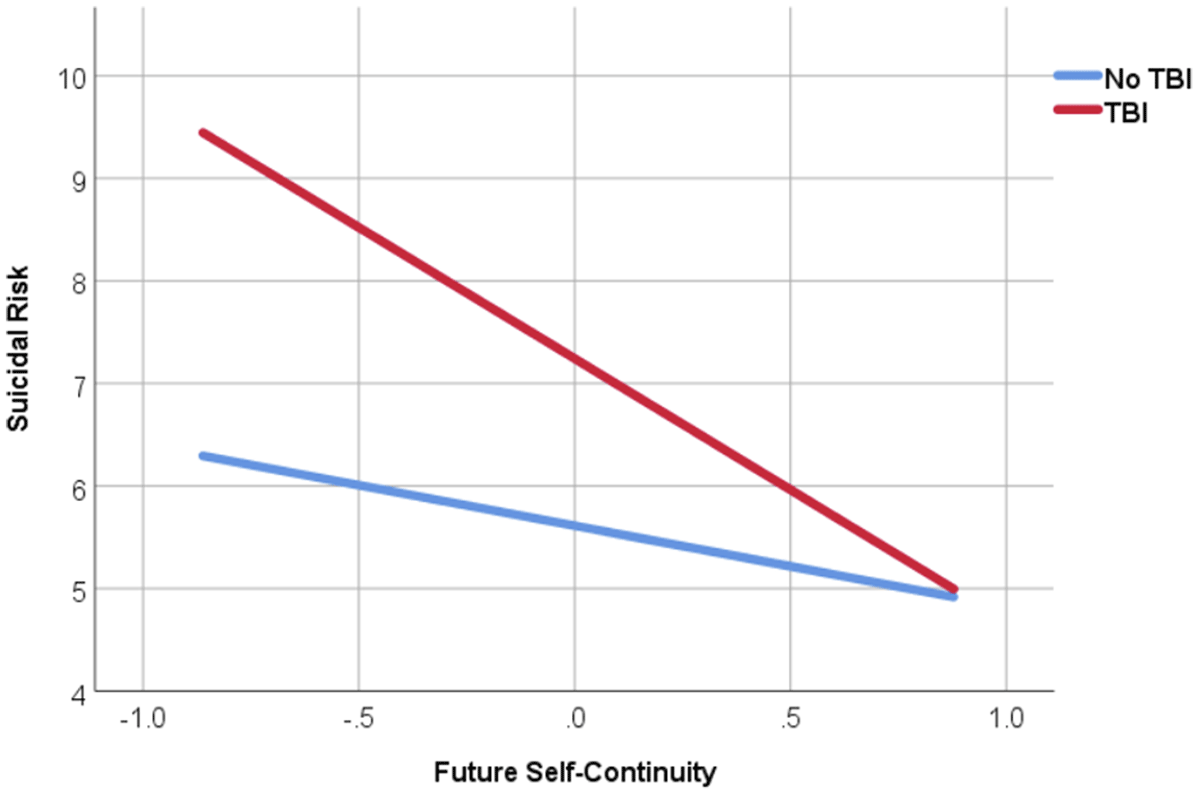
Figure 1
Presence and Absence of TBI Mediates Future Self-Continuity’s Association with Suicidal Risk.