
Figure 1
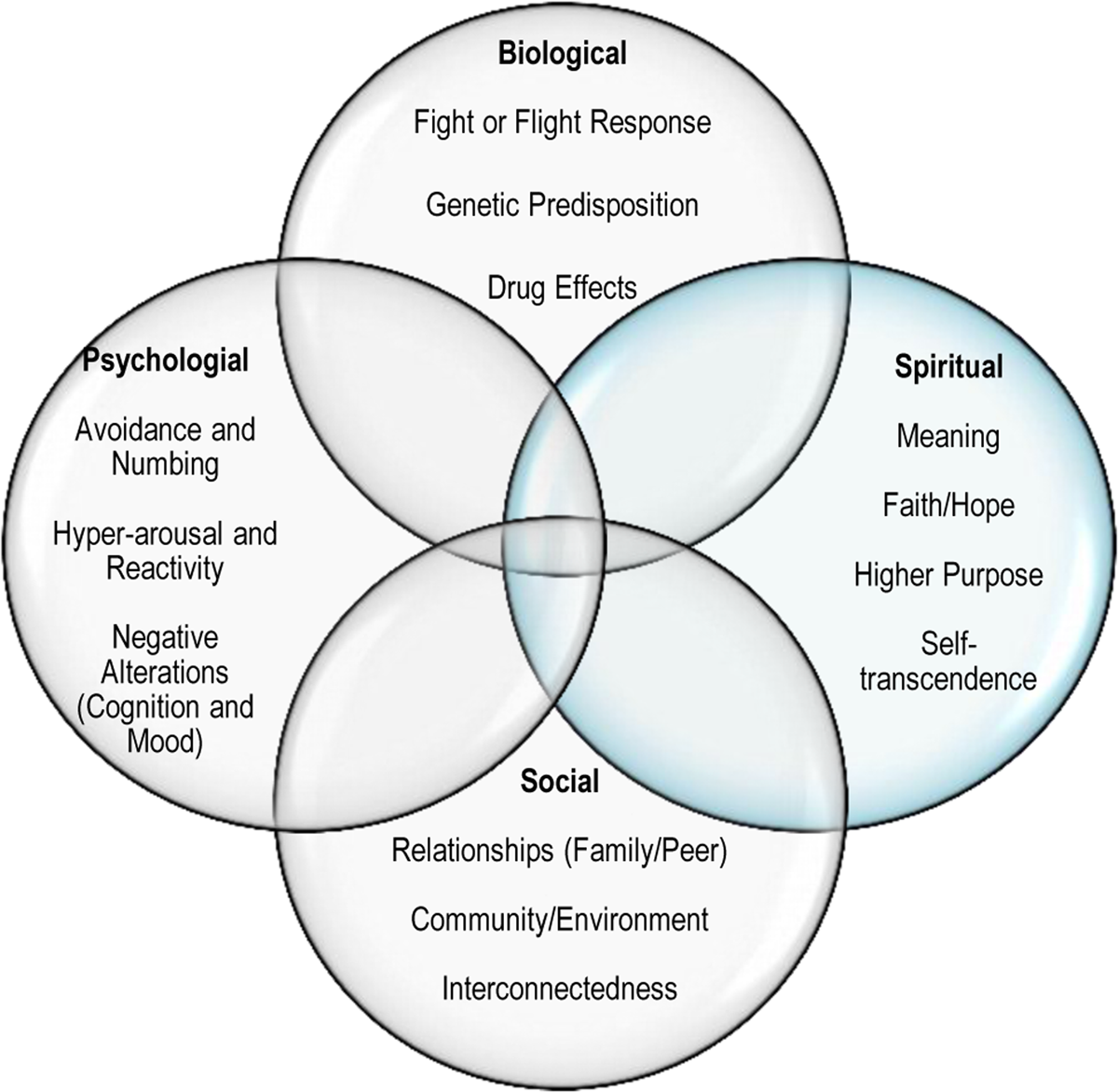
An Integral Blueprint: The Bio-Psycho-Social-Spiritual Model.
Note: The model depicts the different inter-lapping components of Engel’s (1980) bio-psycho-social model with the added spiritual component.
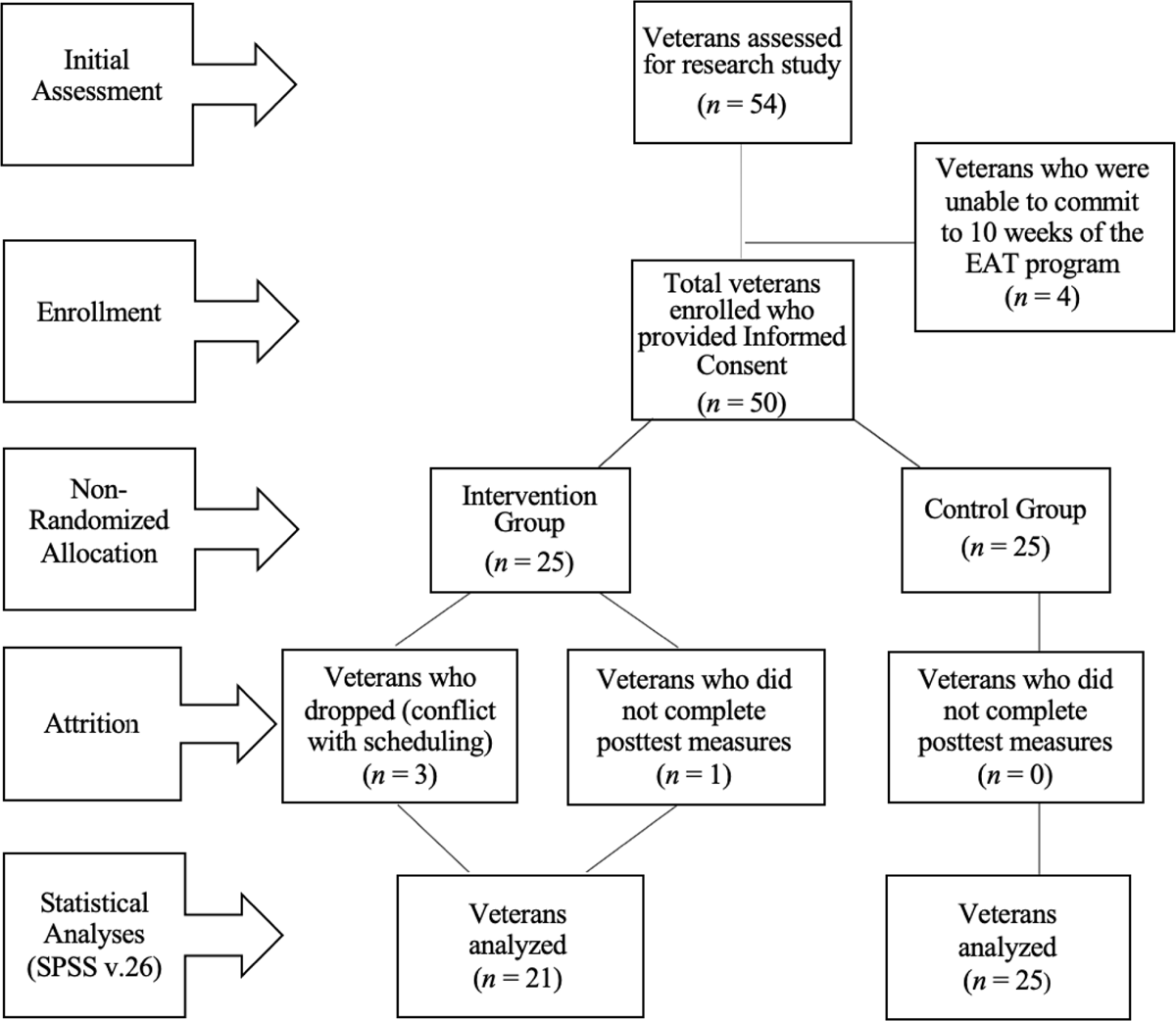
Figure 2
Sampling and Flow of Participants Through a Quasi-Experimental Nonrandomized Control Group Study Design.
Note: Adapted from “Improving the Reporting Quality of Nonrandomized Evaluations of Behavioral and Public Health Interventions: The TREND Statement,” by D. C. Des Jarlais, C. Lyles, and N. Crepaz, 2004, American Journal of Public Health, 94(3), 361–366.
Table 1
McCormick Research Institute Equine Assisted Therapy Curriculum Overview©.
| Description | Session Overview |
|---|---|
| Week 1: Welcome; introductions; confidentiality; group rules; overview of program; safety. | Theme: Trauma Intelligence: understanding PTSD – arousal, avoidance; triggers; awareness – feelings/thoughts/emotions (Handout: Body Language). |
| Equine Assisted Activities (EAA) Wrap-up | Focus: Building confidence/communication skills; (Handout: Parts of Horse); Activity: Choose or Be Chosen (horse behavior [fight or flight response]; body language; herd dynamics; leading/grooming; nonverbal communication) Self-reflection: overcoming challenges; building confidence; adapting; Q&A. |
| Week 2: Welcome; Introduce present moment experience. EAA Wrap-up | Theme: Awareness of Feelings (Handouts: Myths/Symptoms of PTSD; Awareness Wheel; Emotional Regulation); hyperarousal; self-regulation of emotions/feelings to a place of rest/calm for endurance/survival. Focus: Continue building connection/trust; Activities: Grooming with Intention; Around the World (incongruency of intention versus behavior); group work. Self-reflection: awareness; nonjudgmental; teambuilding; reframing; Q&A. |
| Week 3: Welcome; Review: feelings; introduce “Around Me” + “Actions” (thoughts/behavior) EAA Wrap-up Week 4: Welcome; Review from previous weeks: Awareness Wheel and Triggers (handouts). EAA Wrap-up | Theme: Triggers (Handout: Triggers); response/reaction to triggers; review emotional regulation; practice being present, fully attentive, focused on task at hand. Focus: Building confidence/assertive communication; Activities: Grooming with Intention (continue building connection, trust); Activity demo for triggers: demonstrate desensitization; tack-up/riding (bonding with horse). Self-reflection: empowerment; healthy ways of coping with triggers; importance of grounding: mental/emotional states; present moment awareness; Q&A. Theme: Problem Solving; (Handout: A+B=C (Antecedent, Behavior, Consequences); exploring habits; (Handouts: Stress Cycle and Setting Goals); problem solving (working through resistance and fear). Focus: Problem-solving; (Handout: Colors of Horses); demonstration on saddling; Activities: Saddling/Leading horse over tarp with obstacles (associations to triggering stimuli; flooding of emotions; reframe/replace emotions); Riding (how to stop, turn, ride forward). Self-reflection: problem-solving; addressing fears; analyze maladaptive behaviors (Handout: Relaxed Breathing Techniques); learn/practice diaphragmatic breathing; Q&A. |
| Week 5: Welcome; Review feelings: Awareness Wheel; stress cycle (old versus new behavior); setting goals. EAA Wrap-up | Theme: Regulating Your Energy – positive energy/emotional fuel to accomplish goals; negative energy can derail goals; Review: Body Language i.e., how we communicate nonverbally/with words; (Handout: Passive-Assertive-Aggressive). Focus: Energy: passive-aggressive-assertive; (Handout: Lunging); walk-trot-canter; safety related to lunging/kick zone; Activity: Lunging a Horse. Self-reflection: communication style (energy); reflect on energy style; what needs to change (commitment); Handout: Communication; Q&A. |
| Week 6: Welcome; Awareness Wheel; Communication style: passive/assertive/aggressive. EAA Wrap-up Week 7: Welcome; Communication: interaction of triggers, beliefs, and feelings; impact on (irrational) thinking styles. EAA Wrap-up | Theme: Telling your story – Poor Choices vs. Healthy Choices Poor choices: avoiding/numbing/suppression/reactionary. Healthy choices: action oriented versus reactionary; avoidance eliminates processing traumatic event/feelings. Focus: Desensitization; Art Activity: Telling your Story; (Handouts: Symbols of Indians and Horse Markings). Self-reflection: storytelling/symbolic communications; recognize the transcending of trauma memories using art; Q&A. Theme: Communication/Actions (review story from last week) Communication: use of tone (passive-aggressive-assertive); energy (positive or negative); Goal of good communication: keep space safe, be heard & hear other (way to connect, to feel heard/cared about, bonding). Actions: awareness of thoughts/unresolved issues; emotional intensity (reactionary vs action-oriented). Focus: Communication: listening; teamwork; Activity: Rotating Appendages (teamwork rotations to halter/saddle the horse). Self-reflection: equine activity: being in different roles? preference? (Handouts: I-Messages/Imago Dialogue; Reflective Listening); Q&A. |
| Week 8: Welcome; Awareness Wheel; Communication (review body language). EAA Wrap-up | Theme: Listening (when trauma memories resurface; disconnect from feelings; difficulty concentrating); keep space safe; reflective listening/mirroring; assertive/passive/aggressive). Focus: Trust/communication/leadership; Activity: Blindfold Obstacle Course (discerning between internal vulnerability/external fear; strategy for being assertive but compassionate). Self-reflection: equine activity: was it easy to receive or give instructions? (frustrations/anxiety/tolerance; self-efficacy); Q&A. |
| Week 9: Welcome; Review: feelings/listening. Equine Assisted Activities Wrap-up | Theme: Communication and Connection (defusing conflict; being hypersensitive to tone of voice; lack focus). Focus: listening and connecting; Activities: Grooming and Tacking, Drill Team Exercises (walk/canter side by side; simple formations); focus on communication (verbal and non-verbal); learn to be assertive with the horse or adjust communication style/pattern when necessary; building confidence. Self-reflection: communicating skills; leading horse through drill team formation; mindfulness – were you mindful of other horses and the rider’s needs; coping – on learning new skills; Q&A. |
| Week 10: Welcome; Overview of weekly themes. EAA Wrap-up | Theme: Words of Affirmation: write words of affirmation for each other; sharing among group. Focus: purpose and meaning behind trail ride; Activity: Trail Ride (grooming, tacking, saddling, riding). Self-reflection: communicating with/leading horse during trail ride; describe feelings-sense of accomplishment; reflect on transition (learnings, next steps, goal setting); Q&A; opportunity to continue participating in weekly drill team (to maintain connection with horse). |
Table 2
Results from Baseline Characteristics and Paired Sample Statistics.
| Descriptive Statistical Analysis | Mean (Std. Deviation) | |
|---|---|---|
| Age | 48.7 (12.0) | |
| Time Since Separation (Years) | 16.1 (12.5) | |
| Years of Service | 11.7 (9.7) | |
| Frequency Statistical Analysis | Number (%) | |
| Gender | ||
| Male | 37 (74%) | |
| Female | 13 (26%) | |
| Race | ||
| Hispanic | 23 (46%) | |
| White or Caucasian | 19 (38%) | |
| Black or African American | 8 (16%) | |
| Military Branch | ||
| Army | 31 (62%) | |
| Navy | 10 (20%) | |
| Marine | 4 (8%) | |
| Air Force | 3 (6%) | |
| Mixed Military Branches | 2 (4%) | |
| Military Rank at Separation | ||
| Non-Commissioned Officer–NCO | 24 (48%) | |
| Junior Enlisted | 11 (22%) | |
| Senior NCO | 8 (16%) | |
| Junior Officer | 4 (8%) | |
| Senior/Chief Warrant Officer | 2 (4%) | |
| Other | 1 (2%) | |
| History of Mental Health (Comorbid Disorders) | ||
| Yes (Various) | 27 (54%) | |
| Mood Disorder | 17 (34%) | |
| No | 3 (6%) | |
| Obsessive-Compulsive | 1 (2%) | |
| Generalized Anxiety Disorder | 1 (2%) | |
| Schizophrenia | 1 (2%) | |
| TBI or Other Concussion Symptoms | ||
| No | 31 (62%) | |
| Yes | 19 (38%) | |
| Results of Paired Samples Statistics: PCL-M & FACIT-Sp | Mean (Std. Deviation) | |
| For PCL-M: | Pretest | Posttest |
| Intervention Group | 63.43 (12.18) | 48.57 (15.97) |
| Control Group | 59.56 (11.08) | 53.04 (14.05) |
| For FACIT-Sp: | Pretest | Posttest |
| Intervention Group | 21.57 (8.02) | 31.52 (9.74) |
| Control Group | 25.00 (9.61) | 32.32 (9.49) |
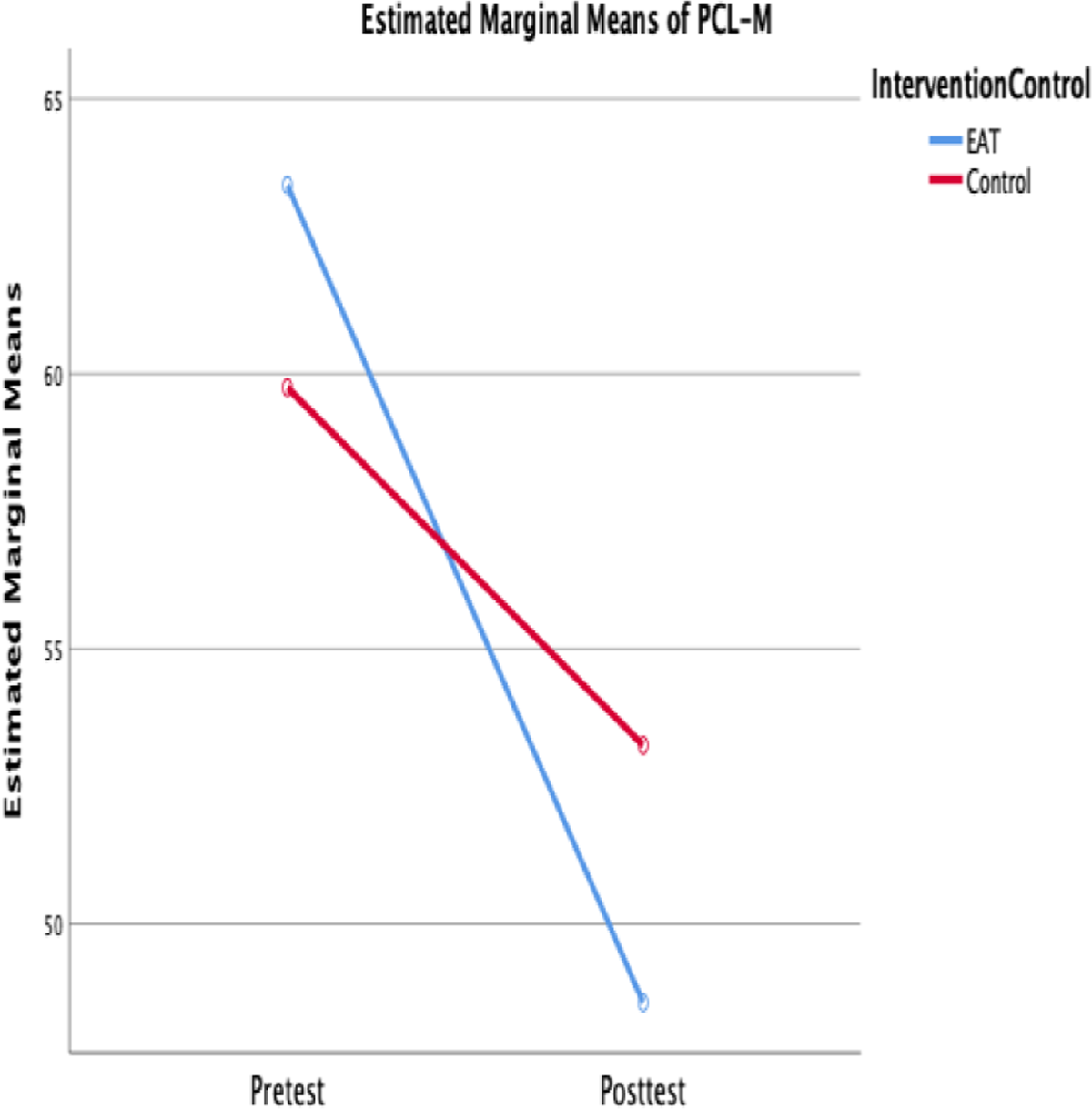
Figure 3
Change in PTSD Symptom Scores Pretest-Posttest.
Note: The posttest scores significantly reduced by almost 15-points for the EAT completers when compared to control group where posttest scores decreased by only 7-points.
Table 3
PCL-M Paired Samples Test – Intervention and Control Groups.
| Mean | Std. Deviation | Std. Error Mean | 97.5% Confidence Interval of the Difference | t | df | Sig. (2-tailed) | |||
|---|---|---|---|---|---|---|---|---|---|
| Lower | Upper | ||||||||
| Intervention Group | Pretest – Posttest | 14.857 | 15.951 | 3.481 | 6.423 | 23.291 | 4.268 | 20 | .000* |
| Control Group | Pretest – Posttest | 6.520 | 10.859 | 2.172 | 1.327 | 11.713 | 3.002 | 24 | .006* |
Note: t = the t-test statistic; df = degrees of freedom; Sig. = Significance level/p-value; * p < .025.