
Every service member who leaves the military goes through a military-to-civilian transition (MCT). MCTs require veterans to readjust to civilian life. Readjustments include finding employment, pursuing education, addressing mental and physical health challenges, and forming new social connections (Castro et al., 2019; Flack & Kite, 2021; Hachey et al., 2016). While most veterans do well at negotiating MCTs, a substantial minority report reintegration challenges (Castro & Kintzle, 2017; Karre et al., 2024). These challenges include finding employment (Barrera & Carter, 2017), accessing the United States (U.S.) Department of Veterans Affairs (VA) healthcare system (Elnitsky et al., 2013), and re-establishing a civilian identity (Orazem et al., 2017), among others.
A commonly reported challenge among post-9/11 veterans is making interpersonal and social connections (Dang et al., 2019; Grenawalt et al., 2023). Veterans often only trust other military-connected individuals (Brewster et al., 2021), as they frequently report not feeling understood by their civilian peers (Feaver & Kohn, 2000). For some veterans, particularly those with health and disability concerns, making social connections can be challenging (Wilson et al., 2018). To help find support, connection, and understanding post-9/11 veterans often turn to social media (Cameron, 2014).
Veteran Use of Social Media
Social media use is ubiquitous in the U.S. as nearly 250 million Americans have access to it (Kemp, 2024) but very little is known about the social media use of post-9/11 veterans (Haugstvedt & Koehler, 2023). For example, the number of post-9/11veterans using social media is not known, as the VA and Department of Defense (DoD) do not systematically collect this data. Research has found that veterans may use the internet more than their civilian peers (National Telecommunications and Information Administration, 2017) and use a range of social media platforms to connect with each other. Platforms include Reddit, Facebook, RallyPoint, Yik Yak, and GroupMe (Dosono et al., 2017; Evans et al., 2020; Teo et al., 2018). For example, there are more than 19 million veterans, service members, and their families active on TikTok (Faris, 2026). A Facebook report stated that 900,000 people engage in approximately 2,000 military-focused groups (Meta, 2019). Military- and veteran-related content on social media has been viewed billions of times (Faris, 2026).
Many veterans report that social media connections are important and helpful to them as they transition from military to civilian life (Angel et al., 2018). There are many social media sites and groups that focus on providing veterans and their families with information on resources that can be used to help with their transitions, such as finding jobs (Alonso et al., 2021), accessing healthcare information (Kelly et al., 2020), and navigating VA and other healthcare benefits (Zhou et al., 2022). Veterans also use social media to connect with other veterans to discuss their transition experiences, seek guidance, and receive social support (Teo et al., 2018). The VA and many veteran serving organizations (VSOs) have social media presences across platforms so that veterans can access transition resources (e.g., the VA’s official blog, VAntage Point).
While there are many potential ways in which social media can be helpful to veterans as they transition to civilian life, there is a darker side to their social media use. For example, social media platforms can be places where disinformation, misinformation, and fake news are propagated (Sharma et al., 2019; Shu et al., 2017). Undergirding disinformation, misinformation, fake news, and the like is deception. Deception is used for nefarious purposes, often to persuade social media consumers to believe in or do things they would not otherwise consider (Aïmeur et al., 2023). The tactics used by bad actors have concerning consequences such as increasing political conflict, cementing political polarization, inculcating confusion and belief in false narratives, and undermining trust in democracy and democratic institutions (Bueno, 2023; Hwang, 2020; Jamieson, 2020).
Unfortunately, military connected individuals are a common target of bad actors in social media (Gallacher et al., 2018; Goldsmith, 2019; Jackson, 2023). Studies of the social media network maps of service personnel and veterans have found that outside actors push significant amounts of misinformation into these networks. Nefarious actors co-opt military language and symbols, such as marketing movements and “digital armies,” using “meme warfare,” and couching disinformation as “ammunition” (Goldwasser, 2021; Jensen et al., 2022). Russian and European right-wing agents frequently link to military and veteran focused social media sites to post inflammatory political views, fuel conspiratorial ideas, and publish anti-democratic propaganda (Blair, 2012; Blue Star Families, 2024; Gallacher et al., 2018; Goldsmith, 2019). Social capital theory provides a helpful lens for understanding how social media influences its consumers.
Social Capital, Social Media Use, and Political Fragmentation
Social capital theory posits that elements of social organizations (e.g., network connections, norms, trust) have value for people in these organizations (Putnam, 1994). Social capital facilitates cooperation, builds norms for reciprocity, and helps coordinate efforts for the mutual benefit of organization members (Putnam, 1994). At its best, social capital “is productive, making it possible the achievement of certain ends that would not be attainable in its absence” (Coleman, 1988, p. S98). In addition, some social scientists theorize that social capital undergirds good government, economic progress, and high-functioning democracies (Putnam, 1993, 1994).
On the other hand, some theorists have a more skeptical perspective on social capital, particularly as it relates to its salutary impact on democracy (Putzel, 1997). Here, theorists make a distinction between components that build trust (e.g., operation of networks and group norms) and the ideas that are communicated through such networks. The ideas communicated are independent of the components and therefore may or may not positively influence democracy and democratic functioning. In other words, social capital’s potentially positive impact on democracy carries risks and may be undermined by factors like imperfect information, uncertainty, unsupported information, and the like (Graeff, 2010). There is growing evidence that social capital, as expressed through social media, may be having deleterious consequences on the state of U.S. democracy.
Social media and its use play a major role in modern democracy by influencing how people engage with political issues, access information, and form opinions (Kim & Ellison, 2022; Li et al., 2021). Social media provides a public space for individuals to exchange information and opinions and build community connections (Dalomba, 2022). Social media platforms have also been used as spaces where people can organize in order to respond to disasters and other emergencies (Aboualola et al., 2023) and unite for collective political action (Chen et al., 2021). Social media platforms were central to organizing several large-scale political events (e.g., Unite the Right in Charlottesville and the January 6, 2021, attack on the U.S. Capitol) and social movements (e.g., Occupy Wall Street and Black Lives Matter).
While these platforms create opportunities for discussion and civic participation, they also contribute to problems like misinformation, polarization, and ideological isolation (Tucker et al., 2017). A significant concern today revolves around the use of social media to propagate political conflict and polarization, undermine trust in democratic institutions, and harm democracy and national defense (Harper & Sykes, 2023).
Social media does not create a neutral space for political discussions, and social media use can actively shape how people encounter and process information (Kreiss, 2021). Computer scientists and software engineers have developed algorithms for online platforms designed to maximize user engagement by prioritizing content that elicits strong emotions, such as outrage, anger, or fear (Ribeiro et al., 2020). This process creates feedback loops that often reinforce ideological silos and push users deeper into partisan viewpoints (Persily & Tucker, 2020).
Dissatisfaction with mainstream social media sites’ content moderation has resulted in a user migration to alternative social media platforms that are minimally moderated (MM) or are ideologically oriented (IO)—Parler, Gab, Truth Social, and, more recently, Bluesky. This migration has further fragmented the digital landscape and has created isolated information spaces that function differently from mainstream social media sites such as Instagram and Facebook (Dixon, 2025). These platforms often serve as an “[e]cho chamber,” (Dehghan & Nagappa, 2022, p. 11) where users primarily engage with ideologically aligned people and content and, thus, users have little exposure to opposing viewpoints.
MM/IO platforms have also played a role in real-world political events. For example, research suggests that Parler was used to coordinate aspects of the January 6, 2021, Capitol attack, which illustrates how online communities can influence offline action (Otala et al., 2021). Importantly, alternative platforms do not operate in isolation. Content originating in these spaces often re-enters mainstream digital spaces, and this action demonstrates how misinformation can spread across platforms and influence wider political discourse (Dehghan & Nagappa, 2022).
Veterans’ Engagement with Political Content Online
Post-9/11 veterans’ use of social media should be examined closely for several reasons. First, Service members and veterans tend to be held in high regard by the public (Kleykamp et al., 2023). Given the public’s trust in veterans, nefarious national and international actors, who are motivated to decrease the public’s support and trust in the U.S. democracy and the U.S. military, often target veterans with misinformation and disinformation via social media (Gallacher et al., 2018). In fact, foreign intelligence agencies have pursued U.S. service personnel, while deployed overseas, and details of their personal lives, taken from social media platforms, have been used to attempt to influence service personnel’s online communications (Eddington, 2020). Due to concerns regarding outside influence, the VA has issued guidelines to veterans on safe social media use (Department of Veterans Affairs, 2025).
Some data indicate that veterans are disproportionately represented in far-right political spaces, though the reasons for this remain debated (Dunlap, 2022; Haugstvedt & Koehler, 2023). For example, a Military Times poll conducted in 2019 found that nearly 25% of all service members have seen signs of White nationalism within the military, while 42% of non-White respondents reported witnessing White nationalism within the military (Shane, 2019). Factors contributing to radicalization among some military personnel appear to include social isolation, identity struggles post-service, and experiences of moral injury or trauma (Simi et al., 2013). In addition, the military culture’s emphasis on hierarchy, authority, and nationalism may align with certain ideological perspectives prevalent in far-right movements (Villamil et al., 2024).
Social media platforms played an important role in organizing and carrying out the insurrection attempt on January 6, 2021. Prior to the mob overrunning the U.S. Capital, President Donald Trump (2021) told the crowd, “We fight. We fight like Hell. And if you don’t fight like hell, you’re not going to have a country anymore.” Various social media platforms, such as Twitter (now X), were used by the mob to reinforce the President’s message and mobilize action. For example, MM/IO platforms, such as Gab and Parler, were used to share real-time directions to Capitol entry points, identify which tools were needed to breach the Capitol, and provide information to other insurrectionists as to how to avoid the police (Frenkel, 2021). Those with military experience were overrepresented in the insurrection attempt on January 6, 2021. While veterans represent only 6% of the population, approximately 20% of the 691 individuals charged with crimes during the January 6, 2021, incident (e.g., crimes including obstructing an official proceeding and assaulting Capitol police officers) had a military background (Ricciardelli, 2023).
The Current Study
The social media use of post-9/11 veterans has been woefully underexplored. As a result, there is a concerning gap in our understanding of the perspectives of this important group of U.S. citizens. There are between 3.5 and four million post-9/11 veterans, and this number increases by approximately 200,000 per month (Schuler et al., 2025). Post-9/11 veterans are also held in high esteem by the public and, therefore, may be in a position to persuade others to hold particular kinds of beliefs—including beliefs based on foreign and domestic bad actors seeking to destabilize the functioning of U.S. democracy (Bennett & Livingston, 2018). It is also important to understand the social media use of post-9/11 veterans because they are overrepresented on far-right platforms, often hold extreme political views, and appear to be willing to use violence in political protests (Haugstvedt & Koehler, 2023; Helmus et al., 2023; Simi et al., 2013).
The current study was designed to estimate the proportion of post-9/11 veterans using social media and the platforms they use. The study also analyzed the association between post-9/11 veteran social media use and their attitudes toward democracy and the government’s handling of the end of military operations in Afghanistan. Because the sitting president was a democrat at the time of the data collection, it was hypothesized that veterans who used conservative leaning MM/IO media platforms would hold more negative views of the U.S. democracy and of the government’s handling of Afghanistan compared to those veterans who used mainstream platforms or did not use social media.
Methods
Participants and Procedures
Data for the current study come from The Veterans Metrics Initiative (TVMI) and Veterans Engaging in Transition Studies (VETS). These two studies followed a large cohort of post-9/11 U.S. veterans who transitioned out of the military between August 2016 and November 2016 and monitored them for the first 6.5 years of their transition to civilian life. TVMI, which occurred from 2016 to 2019, collected six waves of data. VETS continued to follow the TVMI cohort beginning in 2020, and this study included Waves 7 and 8. Details regarding TVMI’s methodology have been previously published (Vogt et al., 2018). Over 9,500 veterans completed the Wave 1 survey (n = 9,566). Participants selected for the current study (n = 2,968) were veterans who had completed the Wave 8 survey (administered 6.5 years post-separation) as this wave included the questions on social media use, perceptions of democracy, and views on the end of the Afghanistan war. Links to the surveys were emailed to participants, and they received a $50 gift card for completion. Table 1 displays pertinent sample characteristics. Ethical approval for the TVMI study was obtained from ICF International, Inc., and from the Pennsylvania State University’s IRB for VETS, and all study participants provided informed consent prior to completing the Wave 1 survey.
Table 1
Wave 8 Sample Characteristics.
| ELIGIBLE POST-9/11 VETERAN POPULATIONa | WAVE 8b | MM/IO USERS | |
|---|---|---|---|
| (n = 48,965) | (n = 2,970) | (n = 84) | |
| Male | 84.1% | 81.6% | 88.2% |
| Female | 15.9% | 18.4% | 11.8% |
| Army | 32.1% | 31.7% | 30.6% |
| Navy | 18.8% | 19.9% | 16.5% |
| Air Force | 13.5% | 20.0% | 28.2% |
| Marines | 17.2% | 16.1% | 10.6% |
| National Guard/Reserve | 18.4% | 12.2% | – |
| E1–E4 junior enlisted | 41.4% | 29.0% | 16.5% |
| E5–E6 mid-grade enlisted | 29.5% | 29.9% | 24.7% |
| E7–E9 senior enlisted | 13.4% | 16.2% | 31.8% |
| W1–W5 warrant officers | 1.1% | 1.3% | 5.9% |
| O1–O3 junior officers | 6.4% | 9.6% | |
| O4–O10 senior officers | 8.1% | 14.0% | 21.2% |
| White non-Hispanic | – | 70.1% | 73.8% |
| Black non-Hispanic | – | 8.0% | 2.4% |
| Hispanic | – | 13.0% | 11.9% |
| Asian Hawaiian Pacific Islander non-Hispanic | – | 2.7% | – |
| Other race non-Hispanic | – | 6.1% | 11.9% |
[i] Notes: aThe race/ethnicity categories in the eligible post-9/11 veteran population data set were different from those used in TVMI/VETS data collection; therefore, a comparison was not possible. bWave 8 occurred about 78 months post-separation.
Measures
Social Media Use
Social media use was assessed at Wave 8 with two items that were developed for the study. The first item included the question: “Which social media platforms do you use?” Respondents were asked to select all the options that apply. The answer options included Facebook, Instagram, Twitter, Truth Social, TikTok, Redditt, Parlor, Truth Social, YouTube, and do not use social media. The second item asked veterans about their frequency of use, and answer options ranged from hardly ever to nearly constantly throughout the day. In addition, veterans were asked how many different platforms they used; their choices ranged from 1 to 8. For the purposes of the present investigation, the sample was split into three groups: those who indicated using Parler and/or Truth Social (MM/IO), those who indicated no use of Parler and/or Truth Social (non-MM/IO), and those who indicated no use of social media (no social media).
Perceptions of U.S. Democracy
Perceptions of democracy were assessed at Wave 8 with six items. The first item, which was rated on a five-point scale, asked “How concerned are you about the condition of democracy in America today?” Answers ranged on a five-point scale from “not at all concerned” to “extremely concerned.” The other five items asked respondents to rate the following aspects of society: “Protections of our personal freedoms,” “Young generation’s changes to be better off than their parents,” “Ability to hear a wide range of views on political issues,” “People getting engaged in civic and political issues,” and “Equal rights and protections,” as follows: were getting worse (–1), staying the same (0), or getting better (1). For the purposes of the present investigation, these five items were analyzed separately.
Perception of the Military’s Exit from Afghanistan
The Afghanistan exit was extensively covered over social media and traditional media outlets and led to significant political and often contentious debate (Caputo & Seligman, 2021) and thus would elicit strong and divergent opinions of the participants. On this survey, one item was used to assess veteran perceptions of the exit strategy used in Afghanistan and to assess whether any documented associations between social media use and perceptions were narrow (e.g., limited to perceptions of democracy) or broad (e.g., inclusive of perceptions of democracy and other issues). Specifically, respondents were asked, “How satisfied were you with the end of the twenty-year war in Afghanistan?” Answers ranged on a five-point scale from “very dissatisfied” to “very satisfied.”
Data Analysis Plan
Frequencies were generated to address social media use by platform. ANOVA analyses were performed in SPSS 30 to assess whether exposure to different social media platforms is associated with perceptions of the health of democracy. Three groups were specified for the social media use item: No social media use (n = 437), use of platforms other than Parler or Truth Social (n = 2,446), and use of Parler or Truth Social (n = 85). Social media platform use was treated as the independent variable. The dependent variables were perceptions of democracy and perceptions of the Afghanistan exit.
Results
Veterans’ Use of Different Social Media Platforms
As shown in Figure 1, only 15% of post-9/11 veterans reported that they did not use social media. Of those who reported using social media, most used Facebook (66%) and YouTube (50%). Slightly less than half of these veterans used Instagram (45%), 21% used Reddit, and 20% used TikTok. Only 2% and 1% of veterans used Truth Social and Parler, respectively.
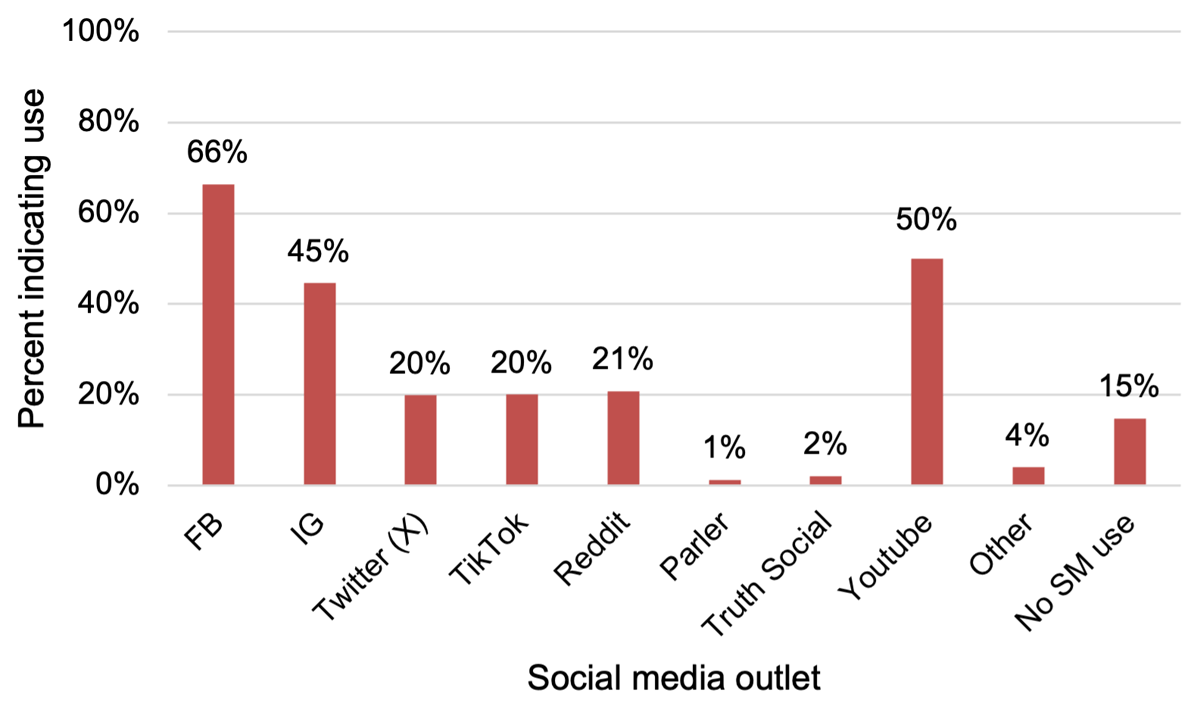
Figure 1
Veterans’ Use of Various Social Media Platforms.
Notes: N = 2,968 respondents, two failed to provide a response. FB = Facebook; IG = Instagram; No SM use = no social media use.
Of the 85 veterans who reported using Parler or Truth Social, 28% used Parler only, 58% used Truth Social only, and 14% used Parler and Truth Social. As shown in Figure 2, veterans who reported using Parler and/or Truth Social were exposed to a statistically greater number of platforms (µ = 4.16; σ = 1.67) than those veterans who were not exposed to Parler and/or Truth Social (µ = 2.63; σ = 1.36; t (2529) = –10.15, p < .001).
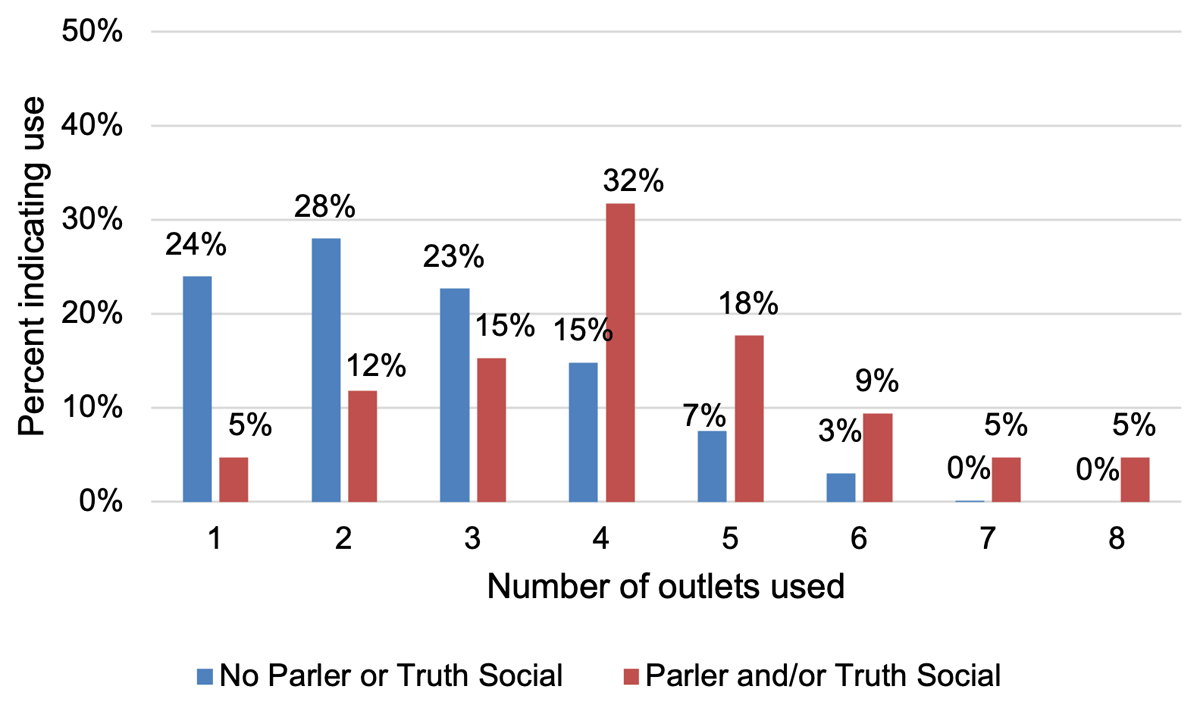
Figure 2
Use of Varied Social Media Outlets as a Function of Parler or Truth Social Engagement.
Notes: N = 2,968 respondents, two failed to provide a response and 6,596 did not complete the Wave 8 survey. 84 respondents indicated having used Parler and/or Truth Social, with the following breakdown in usage types: n = 24 Parler only, n = 49 Truth Social only, n = 11 Parler and Truth Social.
Perceptions of U.S. Democracy as a Function of Social Media Platforms Used
Figure 3 displays veteran perceptions of social conditions as a function of the social media platforms they use. A greater proportion of Parlor and Truth Social users have negative perceptions of each of the six dimensions of democracy assessed. A one-way ANOVA revealed a statistically significant difference in concerns about the condition of the U..S democracy by social media platform use groups (F[2,2961)] = 12.06, p < .001), and MM/IO respondents (µ = 4.31, σ = 1.06) exhibited statistically significantly higher levels of concern than the no social media group (µ = 3.57, σ = 1.36) or the non-MM/IO groups (µ = 3.69, σ = 1.25). Descriptive statistics are provided in Table 2.
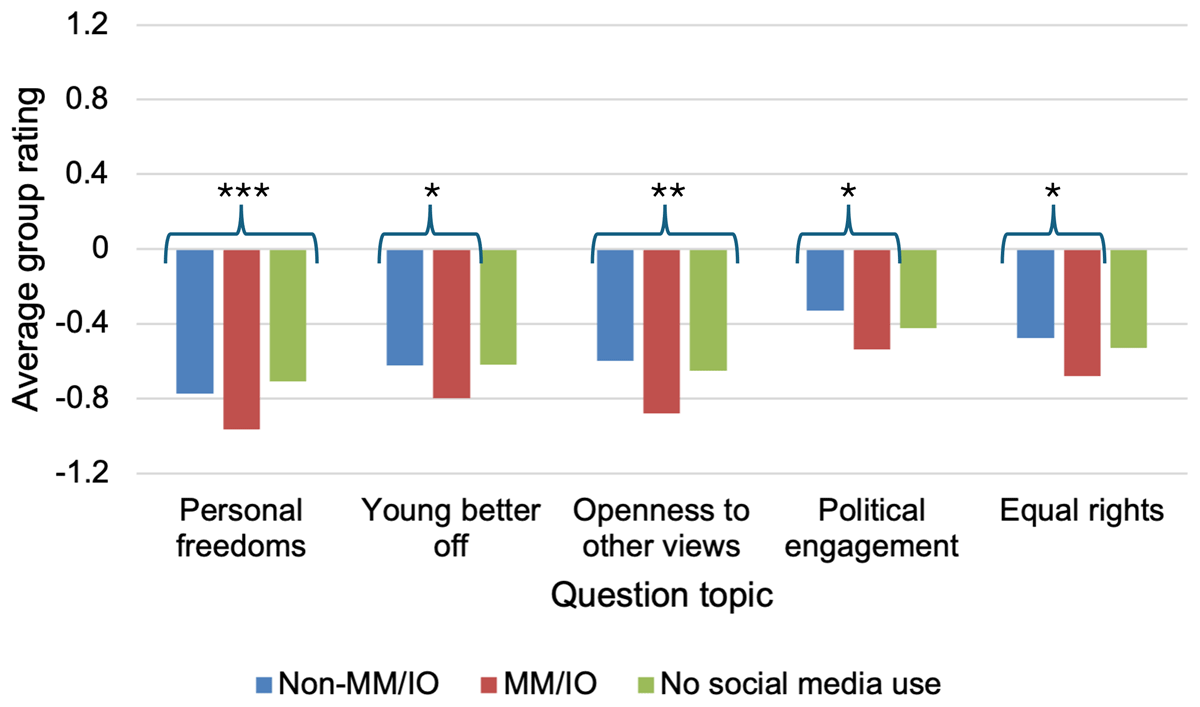
Figure 3
Veteran Perceptions of Social Conditions as a Function of Social Media Platforms Used.
Notes: Non-MM/IO (n = 2,442), MM/IO (n = 85), No social media use (n = 435). Personal Freedoms , -.96, –.71; s = .46, .24, .52; Young better off , –.80 vs. –.62; s = .64, .46, .61; Openness , –.88, –.65; s = .65, .36, .57; Political engagement , –.54 vs. –.42; s = .72, .67, .67; and Equal rights , –.68, –.53; s = .71, .56, .66. Post hoc Bonferroni tests were used as a conservative multiple comparison procedure between groups. *** = p < .001; ** = p < .01; * = p < .05. N = 2,968 respondents, two failed to provide a response, and 6,596 did not complete the Wave 8 survey.
Table 2
Outcome Descriptive Statistics.
| NON-MM/IO USERS | MM/IO USERS | NO SOCIAL MEDIA | |
|---|---|---|---|
| (n = 2,442) | (n = 84) | (n = 435) | |
| Perceptions of | |||
| Personal freedoms | –.77 (.46) | –.96 (.24) | –.71 (.52) |
| Young better off | –.62 (.64) | –.80 (.46) | –.62 (.61) |
| Openness to other views | –.60 (.65) | –.88 (.36) | –.65 (.57) |
| Political engagement | –.33 (.72) | –.54 (.67) | –.42 (.67) |
| Equal rights | –.48 (.71) | –.68 (.56) | –.53 (.66) |
| Perceptions of democracy | 3.69 (1.27) | 4.31 (1.06) | 3.57 ( |
| Satisfaction with the withdrawal from Afghanistan | 2.20 (1.22) | 1.52 (1.01) | 2.02 (1.17) |
Similar statistically significant effects were found for the sum of perceptions of democracy across five different items (F [2,2953] = 10.82, p < .001). Respondents who reported engagement with MM/IO platforms (µ = 3.88, σ = 1.37) reported significantly higher perceptions that the U.S. democracy is getting worse compared to those who do not use social media (µ = 2.93, σ = 2.26) or those who use social media but not Parler or Truth Social (µ = 2.80, σ = 2.14). Descriptive statistics are provided in Table 2.
Veterans’ Perceptions of the Condition of US Democracy
Figure 4 shows the extent to which post-9/11 veterans were concerned about the condition of US democracy as a function of their exposure to non-MM/IO or MM/IO and no social media exposure. Very few respondents were not concerned at all, a little concerned, or had no opinion. Approximately 20% those who used MM/IO or did not use social media were moderately concerned about the condition of US democracy, while approximately 30% of those who used non-MM/IO platforms were moderately concerned. Of those who were extremely concerned, approximately one-third used non-MM/IO or did not use social media. A much larger proportion of those significantly concerned used MM/IO platforms.
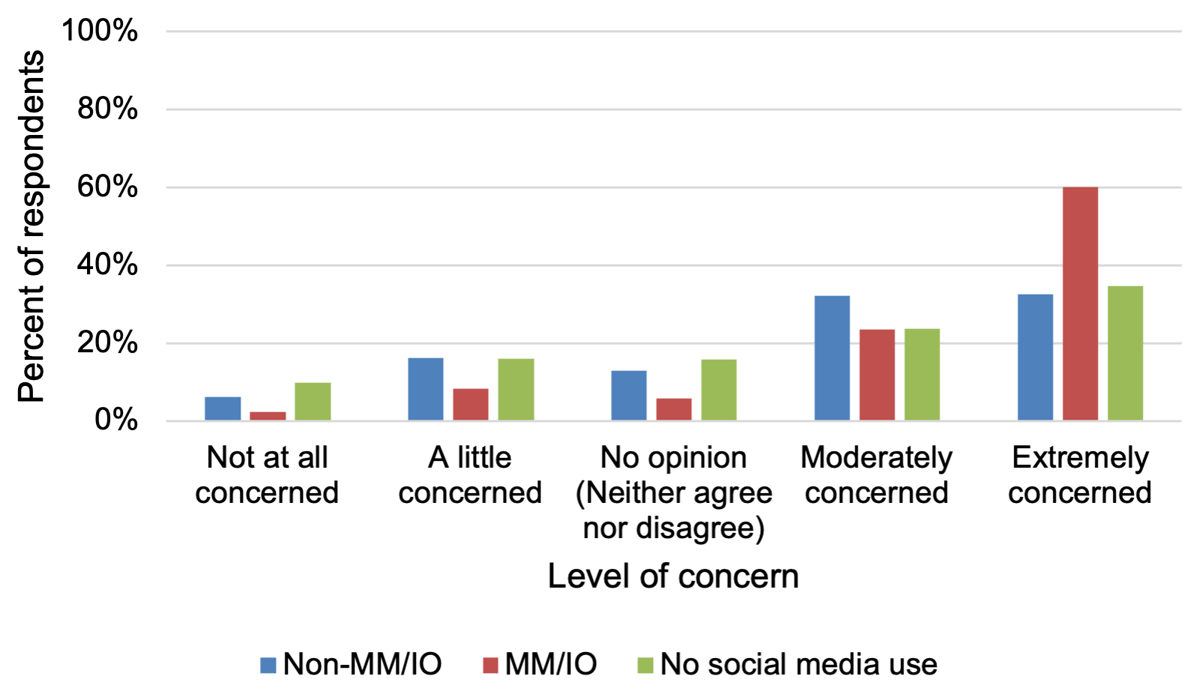
Figure 4
Perceptions of the Condition of Democracy.
Notes: Non-MM/IO (n = 2,443), MM/IO (n = 85), no social media use (n = 436). Democracy , 4.31, 3.57; s = 1.25, 1.06, 1.36; Post hoc Bonferroni tests were used as a conservative multiple comparison procedure between groups. *** = p < .001 for Bonferroni multiple comparison procedure–MM/IO users reported statistically significant greater concern about the condition of democracy than either the non-MM/IO or the no social media group. N = 2,968 provided a response, two failed to provide a response, and 6,596 did not complete the Wave 8 survey.
Veterans’ Perceptions of the Military’s Exit from Afghanistan
Figure 5 illustrates veterans’ degree of satisfaction or dissatisfaction with the US military withdrawal from Afghanistan. Results from a one-way ANOVA revealed the presence of a statistically significant between-group difference (F [2,2962] = 16.49, p < .001). MM/IO respondents (M = 1.52, SD = 1.01) reported statistically significantly lower satisfaction with the withdrawal from Afghanistan than the no social media group (M = 2.02, SD = 1.17) or the non-MM/IO groups (M = 2.20, SD = 1.22). Descriptive statistics are provided in Table 2.
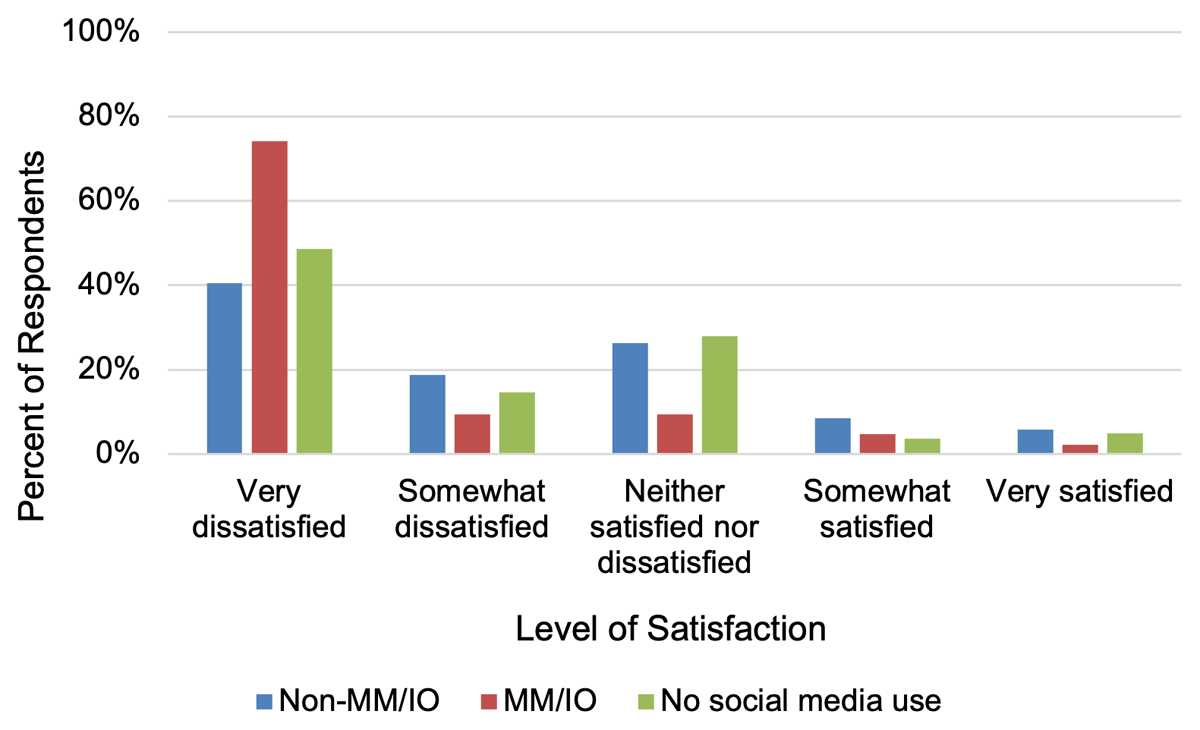
Figure 5
Level of Veteran Satisfaction with the Military Withdrawal from Afghanistan.
Notes: Non-MM/IO vs. MM/IO vs. no social media use (, 1.52, 2.02; s = 1.22, 1.01, 1.17). N = 2,965 provided a response, four failed to provide a response, and 6,596 did not complete the Wave 8 survey. RQ2: Is the type of social media platform used associated with feelings toward the health of Democracy? Post hoc Bonferroni tests were used as a conservative multiple comparison procedure between groups. *** = p < .001 for Bonferroni multiple comparison procedure–MM/IO users reported statistically significant lower levels of satisfaction with the withdrawal than either the non-MM/IO or the no social media group. N = 2,968 provided a response, two failed to provide a response, and 6,596 did not complete the Wave 8 survey.
Discussion
Veterans are an important and distinct group within U.S. society, and their views on various issues, including U.S. democracy, are important and varied. This study found that the vast majority (85%) of post-9/11 veterans use social media. Prior evidence suggests that military-connected individuals, who are often viewed as living symbols of patriotism and civic duty, may hold far-right extremist views, including White nationalism and antisemitism (Anti-Defamation League, 2021). Evidence from January 6, 2001, attack on Congress and the Unite the Right rally in Charlottesville, Virginia, suggests that military-connected individuals may be overrepresented among those who use political violence, which could make military-connected individuals, including veterans, potentially dangerous actors in future political unrest.
This study found that veterans who used MM/IO social media outlets had more intense negative views of the U.S. democracy and were more concerned about the condition of democracy than those veterans who did not use social media or veterans who used social media that did not include MM/IO sites. Similarly, veterans using MM/IO outlets also had significantly more negative views about the U.S. exit from Afghanistan. In fact, results suggest a more general negative bias may exist among veterans who use MM/IO sites regarding current events and democratic concepts, such as personal freedoms and political engagement. Why would post-9/11 veterans using these social media outlets have such negative views about democracy and the government?
First, as previously mentioned, bad actors target veterans who are on social media, knowing that they are held in high regard by the public (Kleykamp et al., 2023). The targeting, often done by Russia’s Internet Research Agency (IRA) and Iranian state actors, is sophisticated and focuses on sowing seeds of discontent and distrust in democracy (U.S. Congress House Committee on Veterans’ Affairs, 2020). Disinformation directed at veterans exploits social divisions and existing grievances among veterans (Speckhard & Ellenberg, 2023; U.S. Congress House Committee on Veterans’ Affairs, 2020), and likely represents an understanding of how social media echo chambers can hijack the healthy desire for camaraderie, purpose, and support. Unfortunately, the tactics used for targeting of veterans rapidly change, making it difficult to develop strategies to stop bad actors from targeting veterans or for veterans to develop strategies to protect themselves from falling prey to propaganda and disinformation (Goldwasser, 2021).
Second, some research suggests that exit from the military can create a “pathway” toward radicalization (Simi et al., 2013). It is thought that new veterans reach out to social media where they can find other veterans with whom to connect. If they connect with veterans who have adopted extreme political views, it is possible they will be radicalized. Veterans who struggle with their transition to civilian life (e.g., trouble finding employment, lack of social support, or exposure to trauma) may experience a loss of personal significance making them susceptible to extreme political and social views (Atuel & Castro, 2025). Called the “3T model,” the theory suggests that veterans who (a) receive messages legitimizing prejudice; (b) experience trauma and adversity; and (c) encounter situations or events that change their personal identity are ripe for adopting extreme views. Moreover, the model suggests that veterans who struggle with the transition to civilian life are at risk for developing grievances that can find voice on social media platforms. Indeed, a high proportion of veterans who reported prior support for extremist beliefs reported experiencing trauma during military service (e.g., combat and administrative conflicts) or significant transition difficulties (e.g., lack of military camaraderie, housing instability, and legal problems) during their transition to civilian life (Brown et al., 2024).
Third, theory and research on heuristics and cognitive biases (Yasseri & Reher, 2022) finds that one’s perception of reality bends toward pre-existing beliefs (Palminteri & Lebreton, 2022). Thus, veterans who hold negatively biased views of the military, the DoD, VA, diversity, and believe in conspiracy theories related to the deep state and political corruption, and the use of political violence are expected to engage with social media and messages that reinforce their pre-existing beliefs (Akram & Nasar, 2023).
Many post-9/11 veterans, including 80 of the 85 respondents using MM/IO platforms, engage with at least one mainstream social media platform, which may expose them to other perspectives. Results indicate, however, that despite using multiple platforms that could potentially expose them to diverse political perspectives, respondents who use MM/IO sites hold more negative views, on average, than those respondents not using MM/IO platforms. Perhaps veterans who visit MM/IO platforms may find themselves exposed, either as a result of algorithms designed to increase engagement through negative emotions or through their own deliberate search behavior, to content that aligns with their existing beliefs. Future studies should investigate the mechanisms behind these effects, and whether and how beliefs change over time as a result of exposure to different information environments.
Reducing the Influence of Social Media Misinformation and Disinformation on Veterans
Various strategies have been suggested to help prevent the development of radicalized views among veterans. There have been many calls for social media platforms to develop much stronger filters to catch and thwart bad actors. Platforms need to strengthen online accountability by verifying accounts, use artificial intelligence (AI) and other technologically savvy solutions to root out false information, and prevent users from financially benefiting from posting disinformation (Francis, 2021; Tan, 2022). In addition, social media companies have been urged to change their use of individually tailored algorithms that serve to connect users to the same types of content over and over again (Draper & Neschke, 2023). Unfortunately, social media platforms have been slow to respond effectively to these calls for change, although civil litigation may serve to move companies to change more quickly. An added complexity standing in the way of structural changes in this space is the desire on the part of free-speech enthusiasts to find spaces that are minimally moderated, resulting in a market demand signal that will continue to drive some current and future social media companies to reduce or eliminate proactive moderation, and thereby increase the amount of exposure to misinformation.
Perhaps, prior to leaving the military, service members receive mandatory formal and in-depth training on the use of social media (Giles, 2021), while also participating in a voluntary training program for military families and civilians employed by the DoD (Francis, 2021). Training should focus on several areas. These include understanding the tactics that bad actors use on social media to target military-connected individuals, learning how to evaluate online content’s credibility, how to identify false and manipulative information, and strategies to debunk conspiracy theories and other questionable content (Francis, 2021; Singer & Johnson, 2022). Given the sophistication of bad actors (Aryaeinejad & Scherer, 2024; Potter, 2021), training efforts would need to be dynamic, with re-fresher courses available. The VA has published a “guide” to social media use; however, it is extremely brief and offers basic and rudimentary strategies (e.g., separate fact from fiction and protect your finances)––there are no concrete suggestions on what veterans can do to protect themselves from bad actors. As of this writing, there is no currently pending legislation regarding protecting veterans from social media targeting. Obviously, this is a serious policy gap.
There is no current research assessing interventions for veterans to prevent them from being politically radicalized and exploited. Based on the 3T model (Atuel & Castro, 2025), veterans are encouraged to take their own personal steps (e.g., become more cognitively and behaviorally adaptable, identify and pursue a new purpose, and connect with organized post-military peer networks to help identify a positive civilian identity) to avoid falling to negative and radicalizing social media. However, several general strategies have been put forth to prevent negative social media interactions. These include critical social media literacy, propaganda recognition, understanding platform algorithms, and inoculation and resilience training prior to exposure to content (Akram & Nasar, 2023; Cohen et al., 2021).
Future research should conduct intervention studies to evaluate the extent to which they work in reducing social media radicalization. Interventions facilitated at specific leverage points, such as system goals (e.g., fostering informed civic participation rather than maximizing engagement time) or paradigms (e.g., reframing digital civic space as a public good rather than a market), and especially interactions among them, could support more resilient democratic norms among veterans. Incorporating deeper leverage points into future research may offer the potential to reshape how digital ecosystems influence political-belief formation. Doing so would require that a greater investment be made in interdisciplinary research, stakeholder co-design, and longitudinal evaluation.
Limitations
The directionality of the effect of exposure to content on MM/IO social media outlets was not tested. As such, whether respondents’ perceptions had changed over time, and, if so, in what direction the change occurred is not clear. Across all three groups, dissatisfaction was the predominant response to the state of US democracy and the exit from Afghanistan.
MM/IO platforms represent a crude proxy for the content to which respondents are exposed. This study did not, for instance, attempt to identify whether a respondent consumes content from one or more social media platforms that is counter to their ideological preferences. Moreover, even if veterans who use MM/IO platforms use the traditional platforms, researchers do not know if these veterans seek content that aligns with their beliefs or if they look at a range of content including information that differs from their own beliefs. Nonetheless, the present results that indicate veteran negative perceptions of U.S. democracy are likely enhanced among users of MM/IO outlets is concerning. One potential explanation for the observed effect is that MM/IO outlets are fundamentally different in some respects (e.g., the scale of the divisive rhetoric used on the sites). Collecting information on the content consumed across platforms would represent an important extension of the present research.
The present study did not ask about traditional media consumption (e.g., NPR, Fox News, CNN, MSNBC, One America News) or podcast content and, thus, cannot decouple the observed effects from any effects that may have arisen from one’s broader media ecosystem. Finally, this study cannot explain the directionality of effects. Perhaps, individuals who are predisposed to right-leaning political content are drawn to outlets that are MM/IO. Maybe, when social media users consume information from outlets that are MM/IO, these individuals become more radicalized. Further, right-leaning political content on mainstream media may propel users to outlets that are MM/IO.
A fuller test of veterans’ social media use and its association to belief would ideally have included left-leaning social media sites that are minimally moderated, however BlueSky did not appear in the market until after the Wave 8 data collection and appears to have a more active stance to content moderation. BlueSky’s website indicates that they use proportional enforcement to ensure the safety of its users, while attempting to have open dialogue. Sites like Parler offer less moderation and encourage users to block other users to create the kind of content they want. Truth Social prefers that users or user-provided content not be removed at all and they state that they will not eliminate content on the basis of a user’s point of view. As a result, comparing Bluesky users to Parler and Truth Social users will likely be confounded by content moderation differences.
Data Accessibility Statement
Access to the data used in this study will be available at ICDS in 12–18 months.
Ethics and Consent
Ethical approval for the TVMI study was obtained from ICF International, Inc., and from the Pennsylvania State University’s IRB for VETS, and all study participants provided informed consent prior to completing the Wave 1 survey.
Acknowledgements
Support for the Veterans Engaging in Transition Studies (VETS) Wave 8 survey was provided by the Wounded Warrior Project, The Heinz Endowments, May & Stanley Smith Charitable Trust, and The Arthur M. Blank Family Foundation.
The Clearinghouse for Military Family Readiness at Penn State is the result of a partnership funded by the Department of Defense between the Office of the Deputy Assistant Secretary of Defense for Military Community and Family Policy and the USDA’s National Institute of Food and Agriculture through a cooperative agreement with the Pennsylvania State University. This work leverages funds from the USDA’s National Institute of Food and Agriculture and Hatch Appropriations.
Any opinions, findings, conclusions, or recommendations expressed in this publication are those of the author(s) and should not be construed to represent any official USDA or U.S. Government determination or policy.