
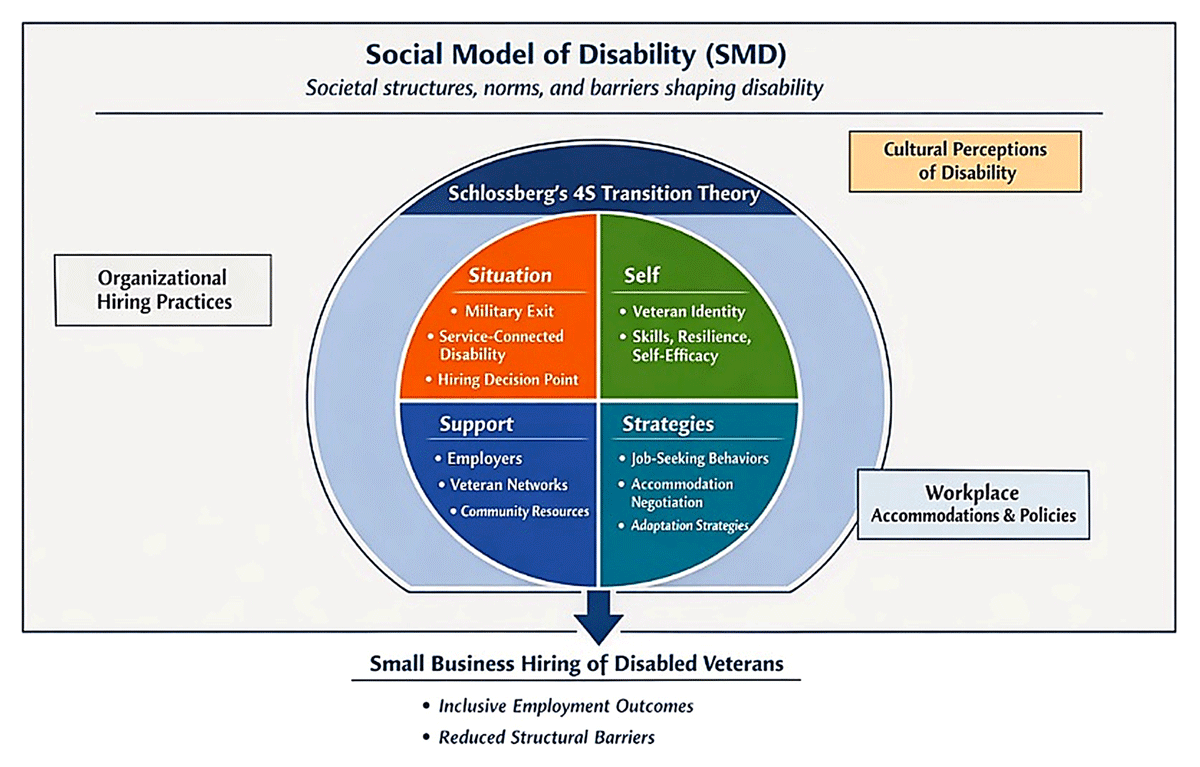
Figure 1
Frameworks Intersection.
Table 1
Participant Demographic Information.
| PARTICIPANT | U.S. MILITARY BRANCH | RANK | COMBAT DEPLOYMENT | TIME OWNED BUSINESS | BUSINESS TYPE |
|---|---|---|---|---|---|
| P1 | Army | Enlisted, E6 | Yes | 2 years | Barbershop |
| P2 | Air Force | Enlisted, E4 | No | 18 years | Mechanic and Towing; Real Estate; Mobile Shop Bistro; Food Trailer; Landscape; Taxi & Limousine; Private Security |
| P3 | Army | Both, O4 | Yes | 18 years | Landscaping |
| P4 | Army | Enlisted, E5 | Yes | 5 years | Film Production Company |
| P5 | Army | Both, O3 | Yes | 26 years | Restaurant; Staffing and Trucking; Group Homes; Daycare |
| P6 | Army | Enlisted, E4 | No | 5 years | Real Estate; Writing |
| P7 | Army | Officer, O4 | Yes | 7 years | Service-Based Digital Platform |
| P8 | Navy | Warrant Office, CWO4 | Yes | 7 years | Jewelry; Events; Consulting; Dog Daycare; Swimming Pool Construction and Service |
| P9 | Air Force | Officer, O5 | No | 11 years | Education Consulting |
| P10 | Army | Enlisted, E8 | Yes | 8 months | AI and IT |
| P11 | Marine Corps | Enlisted, E7 | Yes | 11 months | Land-Clearing |
[i] Note. P = participant.
Table 2
Research Questions Aligned with the Themes From Findings.
| RQs | THEMES |
|---|---|
| 1. What practices do small veteran-owned business owners describe using to hire disabled veterans, and what outcomes do they associate with those practices? | 1A. Disabled veterans are perceived as high-value employees due to skills, leadership, adaptability, and work ethic. 1B. Prior military and civilian experience is viewed as facilitating successful participation in civilian workplaces. 1C. Employing disabled veterans aligns with owners’ values, identity, and commitment to the veteran community. |
| 2. What practices do small veteran-owned business owners describe using to integrate, support, and retain disabled veterans, and what outcomes do they associate with those practices? | 2A. Owners describe using intentional support practices, including mentorship, flexibility, and reasonable accommodations. 2B. Owners emphasize the importance of a workplace culture that acknowledges medical and mental health needs. 2C. Owners associate these practices with positive employee and organizational outcomes, including retention, well-being, team functioning, and business performance. |