
When Anna Cherepnina enlisted in the United States (U.S.) Army Reserves in 2009, she hoped to fulfill her strong desire to help others by serving the country that had welcomed her from Ukraine at the age of 12. Subsequently, during her deployment in Afghanistan, Anna served as a Mental Health Specialist, supporting her fellow soldiers. A series of losses and challenges of her own led to a transformative experience that inspired her current mission to support the wellbeing of military and veterans through her non-profit work. Anna now embraces every opportunity to share her moving story of hope. In the following interview, she describes her unlikely journey from a modest beginning in Ukraine to serving in the U.S. Army and her eventual triumph in hiking to Everest Basecamp despite a diagnosis of multiple sclerosis (MS).
JY: Anna, thank you so much for agreeing to share your story. Could you start by talking a bit about your background and what led to your decision to join the military?
AC: I was born and raised in Ukraine––we were dirt poor; no running water or electricity. My grandparents essentially raised me since my mom was often absent. She had me when she was young, and because of that, I never really developed the typical mother-daughter bond with her. In 2001, at the age of 12, my mom told me we were moving to the United States. I’ll never forget the moment we were at the airport in [the] Ukraine. As I looked back, I saw my grandparents standing there, waving and crying, and that was when I broke down in tears myself. I wondered if I would ever see them again. We settled in Washington state shortly before September 11th, 2001. I vividly remember seeing military recruitment ads everywhere, and as a young girl, I felt a deep desire to someday give back to the country that presented me with so many opportunities—opportunities I could never have imagined if I had stayed in [the] Ukraine. In 2009, when I turned 21, I made the decision to sign the papers and I was presented with two job options: truck driver or mental health specialist. Given my interest in psychology, I chose the mental health specialist role and went on to complete Army Reserve basic training, followed by Advanced Individual Training (AIT) to specialize in mental health.
JY: Around this time, you had one of the major losses that have been so prevalent in your life. Could you talk about how these experiences affected you and influenced your life course?
AC: About nine months after I returned from training, my boyfriend died in tragic circumstances. He was not associated with the military, but, after that, I set out to advocate for suicide prevention and resiliency training through my work in the Army Reserves. That same year, in 2009, I deployed to Afghanistan, where I was tasked with running a combat stress control clinic, focusing on traumatic event management. When I returned to Washington state in 2013, I met Nick. He had just come back from his own deployment to Afghanistan, where he served in the Special Forces. He moved back to Baltimore, MD, and although we kept in touch, the long-distance relationship wasn’t working. Then, out of the blue, a friend from Delaware asked if I wanted to move there. So, I packed up and made the move. While there, I enrolled in college and completed my undergraduate degree in psychology. Then, Nick reached out again, and we started dating. In 2015, he asked me to move to Baltimore, which I did. That’s when I applied and was accepted into the graduate program in occupational therapy at Towson University (TU).
JY: Then, when you were enrolled at TU, you experienced another terrible loss when Nick died during military free-fall training. Can you talk about how this impacted you at the time?
AC: Losing Nick was absolutely devastating. Though we weren’t married, we had been together for six years, living together for most of that time. His loss shattered me, and I seriously considered dropping out of school. But thanks to a strong support system, I found the strength to keep going, and somehow managed to finish and graduate. A year later, in 2021, I received orders to deploy overseas for the second time, and deep down, I knew that once again, something bad was going to happen again.
JY: It seems that your intuition was correct because soon after this, you began to notice some issues with your health. Can you talk about how it started?
AC: About three months into my deployment, I started experiencing tingling and numbness that gradually worked its way up from my feet to my ribs. The aid station initially suggested it was probably just vertigo and told me to drink more water, but I suspected that something was seriously wrong, so I kept advocating for myself. After my fifth visit to the aid station, I was finally referred for an MRI off base. The neurologist gave me two possible diagnoses: a tumor on my spine or, as he put it, something “sexy” like multiple sclerosis. Give me the sexy thing I told him, trying to find humor in this situation. I was medevacked out and spent the next six months at Walter Reed Military Hospital. Yet it took nearly a year before I finally received a definitive diagnosis of multiple sclerosis. When the news sank in, the weight of it hit me all at once; I had a neurological condition that would affect me for the rest of my life. It could worsen over time, and there was no going back. On top of that, I knew my military career was over.
JY: How did this affect you?
AC: Finding out that I would be medically retired was an incredibly difficult blow. Providing support to others had always given my life meaning, so suddenly losing that sense of purpose was overwhelming. As I began to come to terms with this loss, I received devastating news—my grandpa had passed away in [the] Ukraine. I couldn’t go back to say goodbye because of my ongoing issues with MS, and with the world still dealing with COVID-19 in 2021, travel wasn’t an option. He had been like a father to me, and his loss cut deeply. I fell into a dark depression, but I tried to mask it from those around me, struggling in silence with the weight of it all. Despite everything, I found a way to pick myself up and start moving forward. That is, until the war in [the] Ukraine began. I felt a deep urge to give back, but didn’t know how, so I started a small fundraiser for my childhood friends and my grandma, who was in a nursing home there. But then, just two weeks later, on March 4, 2022, I received the heartbreaking news that my grandma had passed away. This loss sent me into a downward spiral. I struggled to find motivation and felt emotionally paralyzed. I couldn’t do anything. I was consumed by depression, withdrawing from everyone, and pushing people away. When I finally received the news that the military had decided to medically retire me, it was another heavy blow that left me feeling lost and overwhelmed. I reached a breaking point, and on December 12, 2022, I felt like I had lost all hope and made a plan to die. Luckily, some friends intervened, and I did not follow through, but made a promise to myself that I was going to get help.
JY: This marked a turning point for you and led to your connection with the non-profit you now work for. Can you talk about how that happened?
AC: After reaching that breaking point and seeking help with the support of my friends, I reached out to a veteran service organization that offers a variety of supports and programs. They connected me with mental health resources, and I was paired with an incredible therapist who helped me work through some of my struggles. Slowly but surely, I started to see the old version of myself begin to resurface. Hope was returning, and I started to regain my motivation. As I worked on rebuilding myself, I began updating my resume. Then, in 2023, I came across a job posting for a position in the DC office with the same organization. I applied right away, and fortunately, I was offered the job. I was back to doing what I love––supporting others—and it felt like a new chapter in my journey.
JY: So much has happened in a year, and you are in such a different place now, leading to the invitation for you to lay a wreath at Arlington. What did that mean to you?
AC: About six months into my new job, I was honored to be selected to lay a wreath at Arlington National Cemetery for Veterans Day. It was an incredibly humbling experience, especially since that’s where Nick is buried. Not long after, I had the opportunity to tour the White House during the Christmas lights display. I couldn’t help but laugh at the irony—this Ukrainian girl who grew up with an outhouse for a bathroom was now walking through the halls of the White House. It felt truly surreal, a reminder of how far I’ve come. Throughout this journey, I’ve been able to help and support so many other veterans while also pushing myself both mentally and physically. I love my job and approach everything with my core value—kindness. It’s become the foundation of how I serve and connect with others every day.
JY: It seems that the diagnosis of MS led to an unexpected turn of events and a powerfully transformative experience for you. Could you explain how the Everest Base Camp trip came about?
AC: While scrolling through a Facebook group for women with MS, I came across a post inviting women to trek to Everest Base Camp (EBC) in May 2024. Since May 24th is my birthday, I immediately felt that celebrating my life by reaching Everest Base Camp would be an unforgettable and empowering way to mark the occasion. I immediately thought, “Sign me up,” and six months later, I found myself on my way to Nepal. During the trek, I had the privilege of meeting an incredible group of individuals, all of whom had also taken a leap of faith after seeing that same post. Our group consisted of seven women living with MS, a few of their partners, and our guides. Each of us faced our own mental and physical health challenges, but we made a pact to go at the pace of the slowest person. More often than not, that person was me, and I embraced it, taking the time to truly soak in the experience, to be present.
JY: What were the physical challenges like as you trekked to base camp?
AC: We were trekking for five to eight hours a day, and it was undeniably challenging. While I can walk for long stretches on flat terrain, the slightest incline becomes a real struggle with MS. My quads, the most affected by the diagnosis, would tire quickly, and any elevation became particularly difficult. As fatigue set in, I started losing my balance, and there were several moments when I stumbled and fell. In those instances, I reminded myself, “It’s okay to slow down and truly listen to my body.”
JY: Talk about the flags that you carried and the meaning that this held for you.
AC: On this trip, I brought two flags with me, a Ukrainian flag and a flag that was signed by all the warriors I supported in the 1 year I had been working with the non-profit, intending to carry them all the way to Everest Base Camp. The day we left the lodge to EBC, thanks to the forgetfulness caused by MS, I left the flags behind in the lodge. I was incredibly disappointed in myself, that I had forgotten the two flags I’d carried with me for such a meaningful purpose. Determined to make up for it, the next day, a fellow hiker and I decided to wake up at 5 a.m. and leave the lodge again to hike even higher than EBC to catch the sunrise. This time, I made sure to bring my flags to capture the moment (Figure 1). It was important for me to recognize my people in [the] Ukraine and the community of veterans I now serve in the USA.
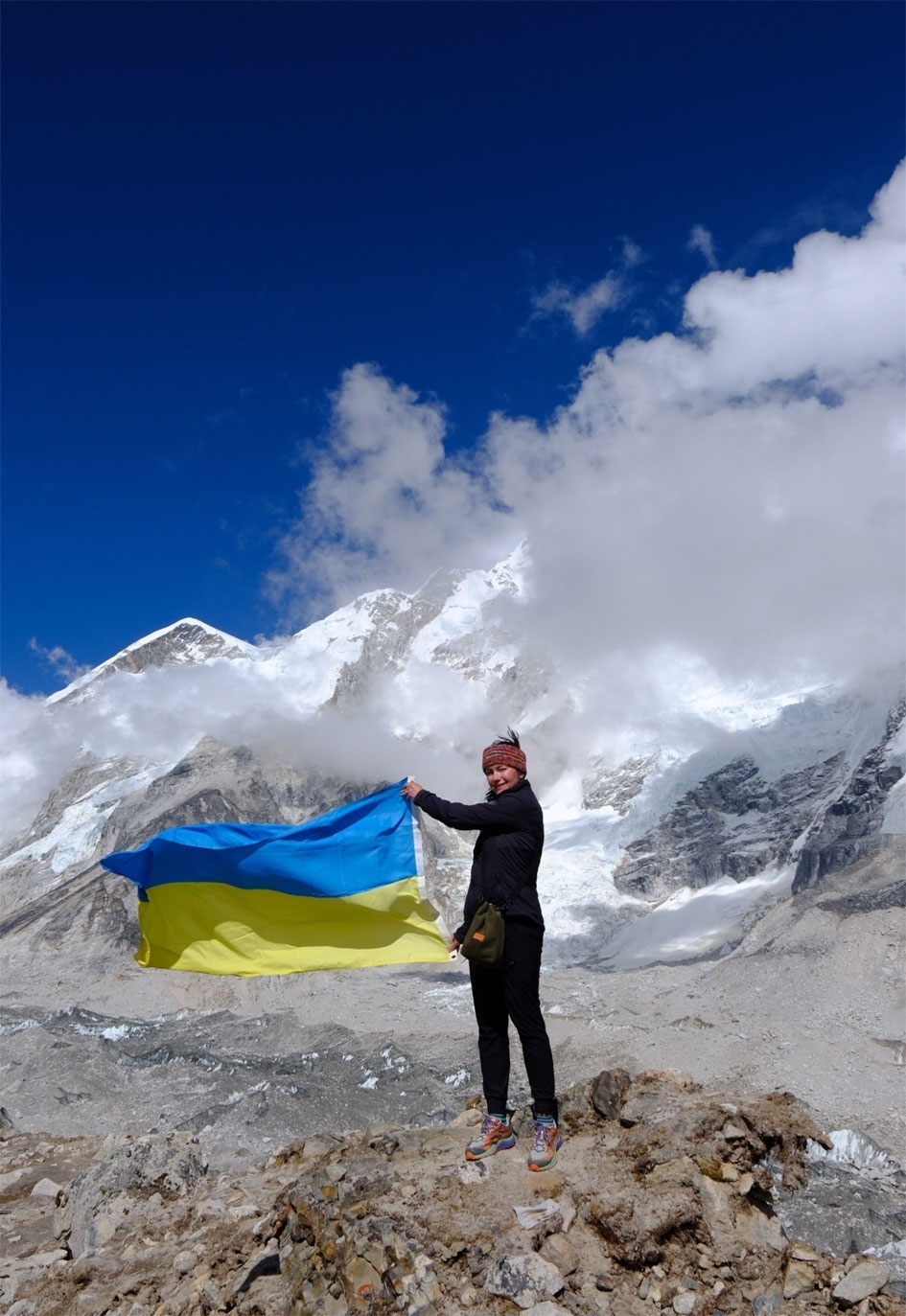
Figure 1
Army Sergeant First Class Anna Cherepnina holding Ukrainian Flag at Mount Everest.
JY: You ended up celebrating your birthday on the mountain. What happened on that day?
AC: Before reaching Everest Base Camp, I decided to open up to the group and share my ongoing journey through grief. On my birthday, something incredible happened—the clouds parted, and for the very first time, Everest revealed itself to us. It felt like a special gift from the mountain. I had planned to treat myself to a simple luxury for my birthday—a hot shower—but to my surprise, the entire group pitched in to cover the cost, making it the most meaningful birthday gift I’ve ever received. Later that day, we hiked to the next lodge, and as we were sitting down for dinner, the lights suddenly went out. To my amazement, they brought out a cake with candles. It was truly the best birthday I’ve ever had.
JY: How did it feel to have accomplished something so challenging in the midst of everything else about your journey?
AC: The entire trip was nothing short of epic, and what I realized was that when you’re in the right mental space, your body can achieve and accomplish far more than you might think. Physically, I wasn’t in the best shape, but my attitude was the key. I approached the journey with a positive mindset, staying open to change and embracing the obstacles along the way. This allowed me to push through when things got tough. When the trek became particularly challenging, I’d pop in my headphones for a quick 30-second dance party, and with a little dance on a steep hill, I found the motivation to keep going. After completing the climb and returning to the airport to fly out, I suddenly broke down in tears and couldn’t stop crying. It was as though my body and mind had been pushing through the entire trek for the past two and a half weeks, and now, everything was pouring out all at once—joy, sadness, and an overwhelming sense of accomplishment. It was an experience unlike anything I’d ever known, as if the high from the journey was slowly leaving my body.
JY: Did things change when you came back afterward? Did you feel differently having completed such an epic trek?
AC: When I returned from the mountain on June 4th, 2024, the sense of accomplishment was overwhelming. Just two years prior, I had been at my lowest point, and there I was, standing next to the tallest mountain in the world. It felt incredible. I was thrilled to be back, and everyone around me was excited for what I had achieved. But soon after, a wave of depression hit. I experienced the post-event blues, something I’d felt before after my deployments to Afghanistan. While this wasn’t a deployment, it felt similar in many ways—we had the bare essentials, living out of our bags, eating simply, and embracing a minimalist lifestyle. What we truly connected with on the trek was the human bond, the shared struggles, and the experiences we all went through together. And then, as the excitement wore off, I found myself asking, “What’s next?”
JY: But you ended up having some profound realizations from your time on the mountain, and you seem to have turned the experience into a story that you can share to help others.
AC: While I was on the mountain, I had a profound realization: I am exactly where I’m supposed to be in this moment, in this vast universe; it was an incredible feeling of peace. I felt immense gratitude for still being here, for having fought through the challenges I’ve faced, including my time in the military. But I also still have my low points. What many don’t discuss about grief—especially when you lose a loved one or a partner—is that it’s not just the person you’re mourning, but also the future you had envisioned with them. The plans, the dreams, everything you thought would be. It’s something few people talk about, and during my own grieving process, many didn’t know how to support me. That experience made me realize how important it is to normalize conversations about death, grief, and love—because these are part of life, too.
JY: At around this time, you started getting invitations to share your story and to talk about what grief has meant in your own life. What has that been like?
AC: I was recently invited to speak at a storytelling event, and it went incredibly well. I made people laugh, I made them cry, and by the end, several people came up to me, expressing how much my story resonated with them. They said things like, “Thank you for sharing that. I’ve felt so alone, and it’s comforting to know others have gone through the same thing and made it through.” In that moment, I realized that I am truly ready to share my story, and it felt so empowering. I can feel that I’m in a part of my healing journey where I’m prepared to open up and help others along the way. May I read you part of what I shared?
JY: Absolutely.
AC: With all the losses I went through, I have come to realize that we’re bound to experience two powerful forces in life, and that’s grief and love. While we talk freely about love, we’re often times afraid to talk about grief. While grief may cast shadows upon our days, it’s a reflection of the depth of our capacity to love. In its visual form, grief is like a cross, bearing the weight of the pain in our hearts. And when we bid farewell, it is the weight that settles within us when life takes unexpected turns. Yet grief is also a tribute to the love we shared, the memories we cherish, and the immense impact of those we hold dear. Love, conversely, serves as a guiding light to life’s darkest moments. It emanates warmth when we embrace our loved ones; it grants us strength, purpose, and hope. So let us not fear grief, for it’s a testament to the profound connections that bind us. Instead, let us honor it, allowing it to remind us of the precious gift of love within our hearts, and let us always hold on to the truth that in the end, love will always prevail. And if you’re struggling today, just know that there is help out there for you.
Acknowledgements
This interview took place in person over several hours. The author would like to thank Anna Cherepnina for her time and for graciously sharing her story.
Competing Interests
The author has no competing interests to declare.