
War and veteran memorials are important objects of public commemoration. Societies demand much from them and, in return, they grant them extraordinary authority and there is an expectation that national war and veteran memorials draw coherent narratives from numerous, often contradictory, experiences. Unconsciously, these memorials can define the essence of conflicts from years ago and can shape individual and social notions of truth for generations (Piehler, 2019). However, can a memorial spur the society it serves to a higher level of truth: a public reconciling and healing truth? Or, as powerful as they sometimes can be, are our military memorials just another way to reinforce existing and incomplete narratives? Using a four-truth framework, this research explored that question in relation to the Global War on Terrorism (GWOT) Memorial, which is now in the early stages of development and, within a few short years, will be sited on the National Mall in Washington, D.C. (Global War on Terrorism War Memorial Act, 2017).
On August 18, 2017, President Donald Trump signed the War on Terrorism Memorial Act, authorizing the establishment of a memorial to the GWOT in Washington, D.C. Then, on December 27, 2021, President Joe Biden signed the Global War on Terrorism Memorial Location Act, which authorized the establishment of the GWOT memorial within “the reserve.” That is, “[t]he great cross axis of the Mall, which generally extends from the United States Capitol to the Lincoln Memorial and from the White House to the Jefferson Memorial” (Straus, 2023, p. 19). The final location and design of the GWOT Memorial will be established through a labyrinth of processes that include boards, commissions, private sponsors, and federal agencies. Beyond Congress, the National Park Service emerges as a key political actor; it maintains primary jurisdiction over the National Mall and oversees both general maintenance and master planning initiatives. Several federal and local agencies are involved in approving any memorial or monument, including the Commission of Fine Arts, the National Capital Memorial Advisory Commission, the National Capital Planning Commission, the United Stated (U.S.) Army Corps of Engineers, the American Battle Monuments Commission, and the D.C. Office of Historic Preservation (Benton-Short, 2006).
The purpose of this qualitative research was to discern the implications for site programming at the future GWOT Memorial, considering the contested narratives surrounding that war and era. For the purpose of this study, the Global War on Terrorism is defined as the era in American society that started with the September 2001 terrorist attacks on American soil and ended with the American military departure from Afghanistan in August 2021. This framing guides the study’s primary research question: When the four-truth framework is applied to how veteran identities and experiences are reflected in the current war memorials on the National Mall, what implications emerge for site planning, programming, and interpretation at the future Global War on Terrorism Memorial?
Of course, the idea of creating a space to reflect on the past two decades of war is commendable, but the idea requires substantial effort to make the site meaningful. The task is so significant that some critics believe the GWOT Memorial should not even be built. They contend that the time is not right, the era is on-going, the story remains incomplete, or the lessons have not yet been learned. Yet, the GWOT Memorial has congressional support, corporate sponsorship, and excellent professional project management (Global War on Terrorism Memorial Foundation, n.d.). Because the GWOT Memorial will be built, this research establishes a venue for engaging with the tough questions and evolving narratives of the GWOT so the memorial can successfully and inclusively help our society move toward a healing or reconciliatory truth.
The research findings suggest that for the GWOT Memorial to meet the challenge, it must be designed with a deliberate capacity to enable shared reflection, honor multiple perspectives and evolving stories, and acknowledge new insights over time. This is the essence of crucial engagement. If executed effectively, the GWOT Memorial has the potential to contribute meaningfully to the nation’s cultural landscape by serving as a powerful storytelling instrument, a site that helps shape both individual and collective memory and understanding of the conflict and its broader era. In doing so, it may also promote healing, reconciliation, and progress. But if that place becomes the monumental equivalent of a “thanks for your service” delivered in stone, steel, and architectural design, the GWOT Memorial will fall short of its potential.
Literature Review
Scholars who think about truth, memory, change, and placemaking include educators, architects, urban planners, artists, rhetoricians, social scientists, humanists, and more. So, rather than portray disciplinary silos where silos do not exist, this review is formatted thematically. In the sections that follow, the literature is organized around four themes. For structure’s sake, they are portrayed as distinct, however, they are not. For example, the concept of “truth” is critical to placemaking, and, at the same time, a place may be among the key elements required to establish truth. The themes below not only overlap, but they also affect and shape one another.
The Four-truths
The Merriam-Webster Dictionary (2023) defines truth as “the body of real things, events, and facts” (para 1a). This definition is succinct but incomplete. For this research, truths are not always equivalent to facts or real things. Truth has layers of meaning. One essential piece of literature concerning the multifaceted essence of truth in a social space is the work of the South African Truth and Reconciliation Commission (TRC), led by Archbishop Desmond Tutu in the late 1990s. Volume 1 (1998) identified and defined four-truths as:
forensic truth: truth related in a factual, chronological, or even legal structure;
personal truth: the how and why as processed through one’s own perspective;
social truth: the truth that is generally agreed to after multiple personal narratives interact over time; and
restorative truth: a process that places the other truths and what they mean in the context of human relationships.
The TRC’s four-truth framework provides a mechanism for a location, action, or event to hold diverging, even contested, notions of truth in the same truthful space. But as powerful as it is, the four-truth framework does not provide clear answers concerning understanding and interpreting contested sites. Instead, this framework provides a process, a set of markers, that can mark the progress on a journey to reconciliation or healing (Coble & Cid, 2023). These concepts also intersect with research on veteran identity. Veterans often encounter public narratives that affirm, distort, or silence their personal experiences, producing tension between individual and social truths (Martin, 2022). Placing the four-truths framework alongside this literature highlights how memorials may either reinforce simplified narratives or create space for more complex accounts of service and sacrifice. These insights shape how visitors interpret memorials and, in turn, how memorials influence what visitors accept as truth.
Meaning-making Transforms a Space into a Place
There is no shortage of scholarly thought devoted to transforming space into place. Creswell’s (2014) well-known scholarship teaches us that a place is more than simply a location; it is a space that holds, projects, or makes meaning. Within the context of this research location and topic, this literature review would be lacking without highlighting two key thinkers: Benton-Short and Park. In addition, Ladino’s work on place, trauma, and public memory adds depth to this analysis.
The concept of space and place is conspicuous in Benton-Short’s important book, The National Mall: No Ordinary Public Space (2016). For Benton-Short, heated debates over memorials on the National Mall are, in fact, debates over national identity, the national story, and interpretation. Benton-Short tells us the entire National Mall is imbued with meaning and, therefore, has been transformed. Meaning, more accurately meaning-making, is the catalyst in transforming from space to place, and meanings are derived (or made) from known, learned, or ascribed truths. Memorials that have what she calls “high-emotional quotient” do not do well next to each other because each is a place where meaning-making has become knotted to the space (e.g., terrain and architecture) it occupies. Set too closely, memorials invite meaning creep, an overlap of meanings that can spill outside the space, affecting nearby spaces and places.
The work of Park (2010) is also instructive in understanding meaning-making at the personal level. In her work, Park systematically reviewed the existing literature about meaning-making and proposed a method for the personal meaning-making process. Park points to ways of identifying and understanding those spaces where a discrepancy exists between appraised and global meanings; what she has termed “ascribed meanings.” Applying the space-to-place concept alongside the ascribed meaning concept, it becomes clear that the ability to make meanings at a location is the critical component of a process that transforms a space into a place. The existence of existing meaning alone is not enough.
The question of who is supported in meaning-making at these sites is an interesting consideration. Ladino (2019) spoke to this question directly using the concept of the “implied tourist” at memory sites. Ladino worked to discern how site designers constructed and planned to manage the overall visitor experience. Ladino writes, “The implied tourist is the visitor to whom the memorial and its managers direct their rhetoric” (p. xviii). Visiting National Park Service sites in the American West, Ladino avoided the formal meaning-making constructs and exhibits, which she argues are always designed for the implied tourist. Instead, she attempted to engage with the sites using divergent viewpoints, perspectives, and physical access points. In doing so, meaning-making occurs best when a memorial fosters both the ability for meaning enhancement and challenge. It happens least when a site declares a meaning and discourages exploration beyond that prescription. This literature sets the stage for understanding how veterans interact with these spaces and how those interactions inform public memory.
Veteran Truths are Varied, National Support is Illusory, and Memorials to American Wars Have Evolved Over Time
In the opening chapter of the important veterans studies book, War and Homecoming, Martin (2022) presents the underpinnings of a “theory of veteran identity.” This theory, which is distinct to the post-9/11 veteran generation, is reinforced by the realization that nearly all who interact with veterans, project their own socialized worldview onto them. This circumstance puts veterans and non-veterans in untenable positions. When adulation is called for, praise is usually performative or self-congratulatory. When concern is called for, that worry is often provided in the same dysfunctional manner.
Martin’s theory of veteran identity would resonate with Best et al. (2021), whose Journal of Veterans Studies article, “Fighting for a Seat at the Table: Women’s Military Service and Political Representation,” highlighted that women veterans experience being veterans differently than their male counterparts. They are not afforded the same credibility to engage in government leadership as their male veteran peers. In addition, women veterans who hold government leadership roles use the rhetoric of combat service far less than their male peers.
In the book, Our Veterans, Gordon et al. (2022) corroborate society’s superficial connection to veterans, but they extrapolate that notion into the national political and policy arena. The authors look critically at the notion that American policies and politics always support their veterans and that our decision-makers know, or even care, what is best. To the authors, American society has failed and continues to fail our veterans mostly due to the overwhelming and superficial expectation to “support our troops.” When most citizens do not understand what support means or how to support well, society becomes susceptible to hucksters and profiteers. Gordon’s work suggests that the GWOT Memorial might be an idea that is rooted in goodness but clouded by overwhelming societal expectations and a lack of genuine understanding.
A political framing fits with the memorial research of Piehler (2004), who, in the book Remembering War the American Way, explored why some wars are strongly claimed in American memory while some are culturally forgotten. Piehler’s research reveals that monuments and memorials to wars are rarely the result of unanimity and social agreement; instead, they reflect the contemporary vision of those who created them. Even though it is over 20 years old, this book remains critical to understanding the people, organizations, and processes that make the development of American war memorials unique, and how these memorials get updated or not.
Without Process, The Goal of Reconciliation May Be Unattainable
The Model for Engaging with Contested Heritage (Figure 1) helps scaffold the analysis concerning whether a place supports the level of meaning-making that can facilitate healing (Coble et al., 2024; Coble et al., 2025; Switzler et al., 2025). This model was originally designed for application at established heritage sites; however, it also shows great promise when applied to American war memorials, even those still under development.
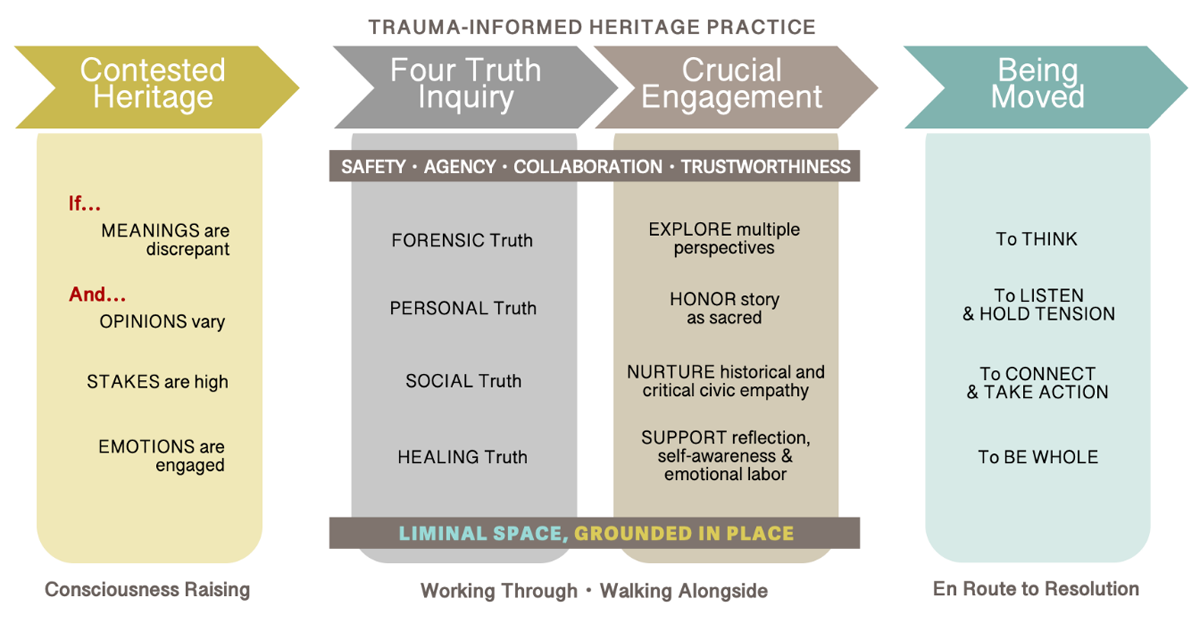
Figure 1
A Model for Engaging with Contested Heritage.
Note. By Coble et al., (2024), Coble et al., (2025), and Switzler et al., (2025).
The model posits a process to consider practices that focus on inquiry and engagement, and it describes a process enabling a search for healing truth in shared places. The simplicity of that idea belies deep complexity. The designers of the model argue that it provides:
[a] way to think about trauma-informed heritage practice that center four-truth inquiry and crucial engagement, that happens in a supportive “liminal space, grounded in place” context, and that culminates in healing and reconciliation that’s activated, in part, by the emotional experience of being moved (2025, p. 7).
Not only are there few established models to design a site that promotes healing, but there is also a lack of shared understanding around the concepts of truth, place, and crucial engagement. Truth exists in various forms concurrently, including in personal space and the social domain. For example, the truth of a war inevitably differs from a soldier’s perspective and society’s understanding. This dichotomy affects how truths are sensed, absorbed, and shared. Place holds similar formless properties. Returning to the literature on placemaking, it is understood that a place is more than a physical location—it is an entity rich in meaning. Through places, “[w]e make the world meaningful” (Cresswell, 2014, p. 12). Meanings, when tied to location, make places more powerful than spaces. But meanings can also make places more complicated and contentious because meanings are often conflated or equated with truths. Ultimately, the Model for Engaging with Contested Heritage argues that crucial engagement is required to progress through a process toward healing and reconciliation. In the model’s telling, crucial engagement includes activities that create space for participants to share personal experiences, hold tension as they encounter differing perspectives, honor stories, and practice efforts to see others’ experiences from their own perspectives (Coble et al., 2025).
The Model for Engaging with Contested Heritage also shows that reconciliation, healing, and meaningful connection outcomes are only achievable through shared action. This action-oriented idea relates closely to the early work of Harvard-based leadership professor Heifetz. Heifetz coined the term “adaptive work” to describe what is required by an individual or a group to adapt, survive, improve, and thrive in a changing world (1994, p. 37). He chose the word “work” deliberately. Therefore, to him, achieving such complex personal or social healing goals requires sustained and coordinated effort. In the Heifetz model, like the Model for Engaging with Contested Heritage, guiding people through the (adaptive) work is the essence of leadership. In the Model for Engaging with Contested Heritage, the left side of the model is analogous to Heifetz’s identification of an adaptive challenge. The middle area reminds us of what Heifetz called a “holding environment,” a social system that serve to keep people engaged with one another in spite of the divisive forces generated by adaptive work (p. 305). In a brave space, a participant cannot avoid a problem but feels secure enough to experiment with new ways to engage with potential solutions. The far right of the model identifies the change desired: growth, connection, and wholeness.
Across the literature a highlighted tension emerges. War memorials often stabilize a dominant narrative rather than support the ongoing interpretation of contested truths. Scholars continue to debate whether memorials can invite inquiry, sustain public conversation, and adapt to new interpretations. This study enters that debate by examining how a four-truths framework may guide the GWOT Memorial toward design choices that support evolving narratives rather than fix them in place.
Research Design and Methods
Research Design
This research focused on the challenges of establishing an impactful memorial to the Global War on Terrorism on the National Mall. To address this topic, this study used qualitative research techniques and developed the data through on-site observation, analysis of already-existing documents and artifacts, semi-structured interviews, and oral history interviews (Merriam & Tisdell, 2016). The data was analyzed with a reflective thematic analysis methodology (Terry & Hayfield, 2021).
Research Site(s)
The primary research site was the west end of the National Mall in Washington, D.C. Specifically, the area known as “The Triangle” (Figure 2), which encompasses the Lincoln Memorial, the Korean War Veterans Memorial, and the Vietnam Veterans Memorial (VVM).
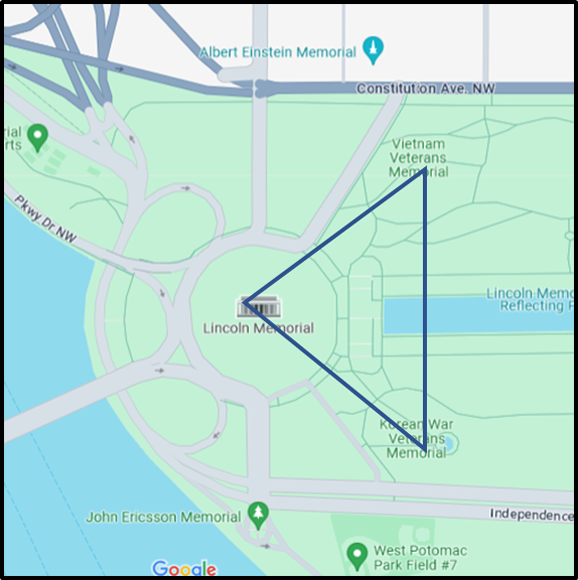
Figure 2
The Memorial Triangle on the west end of the National Mall.
Note. This graphic was designed by the author using Google Maps.
These memorials were visited in the Fall of 2023 and again in the Summer of 2024 to observe their design and how those designs affect the visitor experience. The researcher attempted to decode how these memorials shape various narratives about war and remembrance. On the same occasions, the GWOT Memorial’s future site was visited (Figure 3), which is currently a municipal softball field 200 yards west of the Vietnam Veterans Memorial.
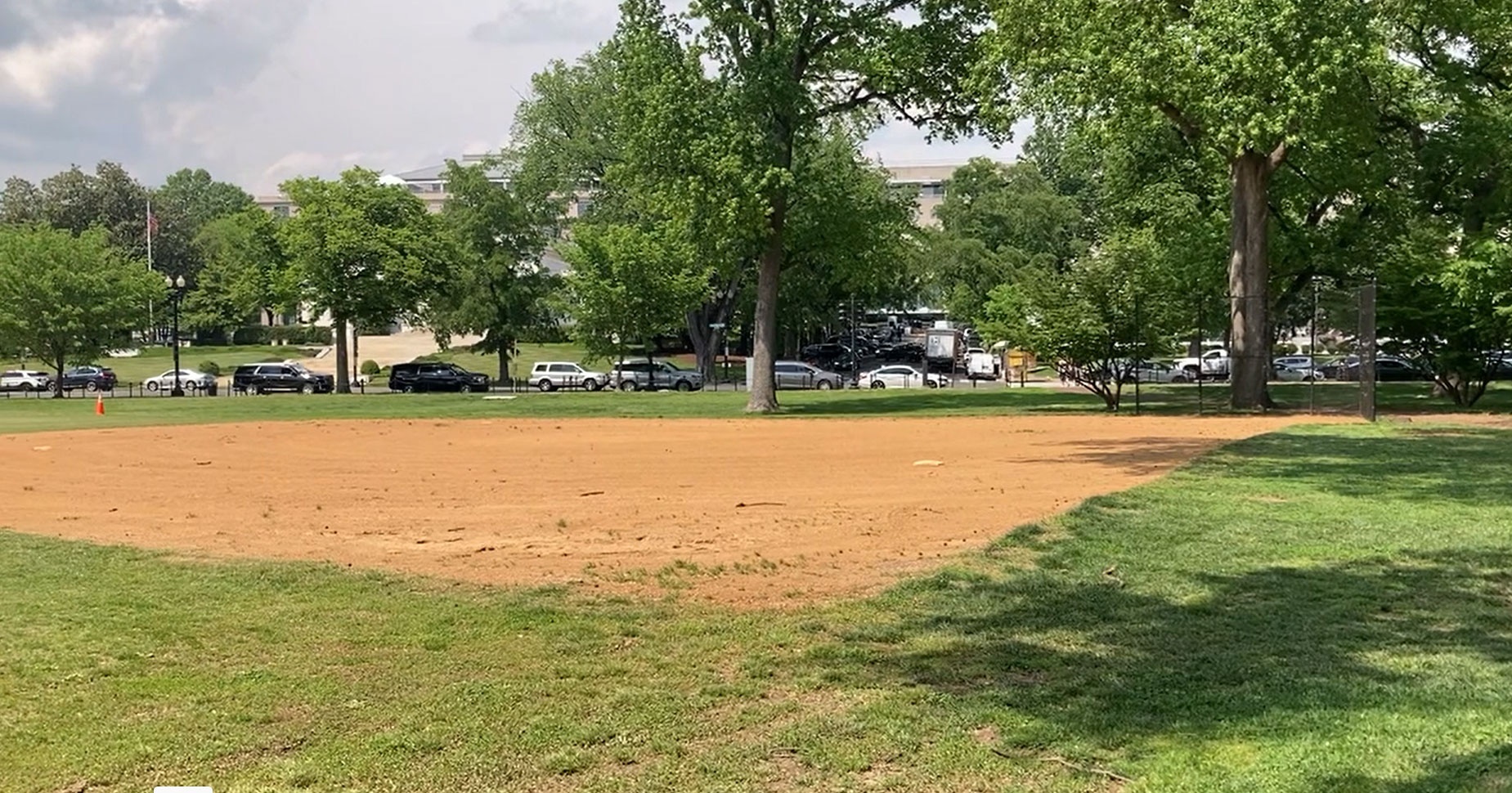
Figure 3
The Future Home of the GWOT Memorial.
Note. Photo taken by the author in 2023.
Participants
In addition to a literature survey, this research draws on semi-structured interviews with eight veterans of the GWOT era. The participants were five males who deployed as combat or combat support soldiers and three females: one army clerk, one who deployed as a navy support tech, and another who did not deploy. Additional interviews included a National Park Service executive who, at the time, served in a leadership role at the National Mall in Washington, D.C., a leader in the Global War on Terrorism Memorial Foundation, a former advisor to the Battle Monument Commission, and a former NPS senior executive. Additionally, the data includes the oral histories of three female reservists who were activated and deployed during the GWOT. Included in this study is the published news stories of Master Sergeant Trevor DeBoer and his son Payton, who deployed to the same location in Afghanistan 20 years apart. Finally, following the methods of reflexive thematic analysis, the personal recollections and reflections from the researcher as an infantryman who was in uniform for the entirety of the GWOT, which included a 15-month deployment to Iraq, was incorporated.
Data Collection
This study employed purposive sampling to capture varied experiences within the GWOT era. The eight veterans selected for interviews reflected differences in gender, deployment status, occupational specialty, and component. This approach supported a focused inquiry into how individuals interpret their veteranness within shifting public narratives. The included oral histories of women reservists applied a narrow filter into the Wisconsin Veterans Museum online collection to ensure relevance to the research purpose. All interviews followed a semi-structured format as approved by the University of Missouri-St. Louis institutional IRB (Project #2096737). Consent was obtained, each session was recorded, and the interviews were transcribed for analysis. These steps provided a consistent foundation for comparing interviews, oral histories, and site observations.
The on-site observations focused on the Vietnam Veterans Memorial during two different site visits. The literature review focused on the establishment of several current memorials, including the policy and politics of their establishment, funding, design, and site selection, the evolving social theories around veteran identity, theories around truth and healing, memorialization, and leadership.
Analytic Process
Reflexive thematic analysis (RTA) was used as the analytical framework. This approach allowed the researcher to have an active role in the dataset, and it incorporates regular re-evaluation of data, which included several iterations of review, code making, and theme development and refinement. In RTA, codes are not verbatim representations of the data; instead, they represent the researcher’s interpretations of patterns of meaning across the dataset (Byrne, 2022).
For the oral histories and interviews, each transcript was read a minimum of three times, working through them in parallel. Wherever possible, interviews were read sequentially before returning to the first and starting the process again. The initial readings were used to become immersed in the data, with a personal prohibition against attempting to code or categorize it. During this read-through, a series of analytic memos in each interview was written. On the second read, codes were developed to represent emerging concepts and ideas. To further distill the data, several a priori codes and open coding techniques were used (Saldaña, 2013). On the third read, some of the previous codes were modified, added, and deleted and critical quotes from each participant were identified so that they could be used as representatives of emerging concepts and ideas.
At the end of the reading and coding, all the codes were reviewed and grouped into categories. Finally, axial/second-cycle coding techniques were used to identify the most important categories and explore how the categories related to each other. In this step, candidate concepts and themes grounded in the data were developed. As more interviews were completed and more literature reviewed, this allowed new ideas to develop rather than focusing on existing codes or searching for ideas that reinforced the candidate themes. Throughout the process, critical reflexively allowed the author’s experiences to be included in the data. The final step was to review and refine candidate themes. The goal in this part of the analysis was to produce a small set of themes, grounded in the data, that best relate to the research question.
To achieve this, candidate themes were compared against the data to confirm that each was grounded and provided a solid and relevant interpretation. Some themes faded; others were refined (Byrne, 2022).
Strategies to Enhance the Trustworthiness of Results
To strengthen the credibility of the findings, several techniques recommended by Merriam & Tisdell (2016) were utilized. For instance, drawing on a diverse set of sources, including personal experiences, academic literature, government documents, and interviews allowed for triangulation. This approach enabled the researcher to corroborate themes that emerged from multiple sources, which demonstrated a thorough examination of the subject. Additionally, to mitigate bias, I remained aware of my positionality throughout this research, engaged in reflexivity by critically examining my experiences alongside the participants, even as I included pieces of my own stories. Where possible, I tried to use “thick” descriptions to capture the complexity of the subject matter, especially at the Vietnam Veterans Memorial.
Results
Analysis of the data revealed three key themes: (1) the Global War on Terrorism is more than a war, (2) individuals perceive their veteranness differently than society does, and (3) the GWOT Memorial must include the ability to incorporate evolving narratives of the war and the era. Each of these themes are outlined and accompanied by a quote from the dataset.
1. The Global War on Terrorism is as much an era in society as it was a war: “We’ve widened the scope of the war on terror.” For the participants in this research, the GWOT has so many overlapping and contested meanings that it is hard to describe it as simply a war. One interview participant, a male combat veteran, spoke of his excitement related to a possible deployment, stating, “I thought by the end of that day I would be on a helicopter somewhere specific to do harm to specific people. Right? I mean, I was 18, and I didn’t know where Afghanistan was.” But later in the interview, he reflected unhappily on the changes to society because of the GWOT, stating:
We went to Afghanistan and then to Iraq and then all these other places. We’ve applied the same kind of anti-terrorist logic to combating the drug trade and those kinds of things back home. We’ve widened the scope of this war on terror.
The insight that the GWOT changed society was near ubiquitous among my participants and the literature.
The GWOT became more than just a war; it was an era. It did not only change people, but it also changed society in ways both profound and superficial. Today, in America, militarization runs deep. There is a shadow of the GWOT military in the video games children play, our workouts at gyms, the warplane flyovers at sporting events, and the gear and attitudes worn by many civilian police. Even though America’s retreat from Afghanistan is over, the country is far from done fighting the GWOT overseas and locally. America also continues to pay and carry the financial burden of the GWOT. According to a 2021 report from the “Cost of War Project” at Brown University, the American response to the unprecedented and horrific 9/11 attacks have, so far, cost eight trillion dollars and ended nine hundred thousand lives prematurely, with the vast majority being non-American deaths (Watson Institute, Brown University, 2021)—both numbers will continue to climb.
Another participant, who deployed in the early months of the conflict in Afghanistan, discussed the idea that he should fight now so the fighting would not last long. When asked why he wanted to go, he replied, “So my sons don’t have to fight in this war.” Like almost all who deployed in the early phases of the conflict, this soldier was determined to win the GWOT immediately. Unfortunately, it did not work out that way.
Eighteen years later, this participants son, now a soldier himself, walked in the same dirt, breathed the same air, and took up the same mission his father did nearly two decades earlier. “An inch is an inch. Progress is progress no matter what” he remarked in an interview with Stars and Stripes Newspaper (Wellman & Lawrence, 2020). Maybe because of his age and hard-gained wisdom, his dad was more circumspect in that same interview, wondering if we “[a]re just chasing our tails?”
2. Individuals perceive their veteranness, or connection to the era and their veteran status differently: “I was almost embarrassed to say, ‘Yes, I’m a veteran,’ because, to me, the veterans were the ones that were in the heat of it.” This research corroborated Martin’s (2022) Theory of Veteran Identity in that the veterans interviewed for this study all considered their veteranness through a social lens. This lens is built by former generations of veterans and a society mostly unconcerned with the specifics of military service.
My experiences are also reflected in this theme. Just four weeks after the birth of my first son, my battalion was ordered into the “Iraq surge.” In 2007, I left my young family for my chance to win the war in the muddy and bloody streets of North Baghdad. When I returned home 15 months later, my family was different, and so was I. My boy had grown into a toddler who was skeptical of the stranger his mom was so happy to see. I was skeptical too, mostly of the society that sent me to a war but continued to operate as if nothing was happening. For a while, I was physically at home with my family, but emotionally and mentally, I was in Baghdad. To me, the flag-waving support of my neighbors seemed superficial. People would talk with me, but they always seemed a step too distant, as if on edge about my potential for a violent reaction. I reciprocated with the same distance, struggling with important social interactions like making conversation, developing personal connections, and caring about anyone except my combat brothers and sisters. With time, the patience of my family, and the advice of a few experienced soldier colleagues, I fully came home. My experiences in Iraq and the quiet struggle of those early months after my return are core to my GWOT story and my veteranness. I do not think I am alone.
Recent work in the Journal of Veterans Studies (JVS) reinforces these patterns. The JVS scholars have shown how veterans navigate externally imposed expectations about legitimacy, sacrifice, and social worth. Their findings highlight how gender, component, and cultural narratives shape the ways veterans articulate their experiences and interpret public responses. These insights align with these findings and clarify why veteranness remains central in current debates about representation and public memory.
The stories of reserve and national guard soldiers, especially women servicemembers in those units, provide different examples of how some experienced the GWOT. One soldier, whose oral history is included this data, grew up in south-central Wisconsin, watching her dad, a U.S. Army Reserve medic, proudly wear his uniform on weekends. Following the family example, she enlisted in 1999, attending basic training between her junior and senior years of high school. This veteran recalls enjoying the physical and teamwork challenges of military life, stating, “We’d get smoked in the gravel, and yeah. It was really fun, though. I mean…looking back, it was fun” (McMeans, 2015).
Five years later, now an Army Reserve administrative specialist, she spent her 2004 deployment in the relative security of the largest U.S. base in Iraq. With the responsibility of tracking the in-processing and out-processing of transiting combat soldiers, her job was clerical and important, and she performed it exceptionally well. By all accounts, this soldier served with honor in a combat zone. Yet, she holds doubts about what it means to be a veteran and whether she even has the right to claim that honorific, stating, “I hear people’s stories, and it makes me feel guilty, almost.” She added, “Like how drastically different one person’s experience versus another, and there were times where I was almost embarrassed to say, ‘yes, I’m a veteran,’ because, to me, the veterans were the ones that were in the heat of it” (McMeans, 2015).
The widespread use of the phrase “thanks for your service” is a relatively recent development, achieving near ubiquity in the U.S. as the GWOT expanded, peaked, and retreated. Before that, Americans generally remained silent or expressed their support in more private ways. This phrase has become so ritualized that, for some, it has lost its true meaning. The participants of this study report that this phrase can be akin to a polite “bless you” following a sneeze rather than a sincere expression of gratitude.
In the interviews for this study, it became clear that one issue at the heart of this phrase is the assumption that all military service is not only inherently commendable, but it also ranks above other ways to serve; for these participants that is not the case. Service in the armed forces, particularly in the context of the GWOT, defies easy categorization as praiseworthy. Thanking someone for their service can feel trite when it comes from those with little inclination to connect to an individual’s experience of that service. One participant explained that this superficiality can even feel like condescension, as though people are saying, “[o]f course what you did was important, and I’m grateful, but I don’t want to dig any deeper into the complexities of your experiences, and most of all, I am sure glad I didn’t do it.”
3. The GWOT Memorial must include the ability to incorporate evolving narratives of the war and the era: “…if it’s just the platitude of thank you for your service—that’s probably pretty empty.” Observing people interact in and with it confirms that the Vietnam Veterans Memorial is a reverential space. But it was not always that way. Proposed by a well-connected veteran in 1979, the VVM was to be funded differently from previous national military memorials. Instead of federal planning and funding, the memorial would be organized, designed, financed, and built by private citizens and corporations, then handed to the National Park Service to run and maintain (History of the Vietnam Veterans Memorial Fund, n.d.). This model, which has become the norm, allowed the organizers to design a space focused on veterans and imbued with a desire to heal the civil divisions stemming from the war.
The idea quickly garnered business funding and political attention. But like the war that sparked its creation, the memorial soon became controversial. The location near the Lincoln Memorial was a legislative compromise, and the requirement to list each name was initially an unwelcome mandate (Lin, 2000). The winning design, Maya Lin’s black granite walls and sunken angle, was criticized at the highest levels of the government and the architecture community. One opinion published in the NY Times, called the design a “black gash of shame and sorrow, hacked into the national visage that is the Mall” (Carhart, 1981).
Opponents of the memorial design had powerful allies. Interior Secretary James Watt temporarily blocked the groundbreaking, calling the VVM “[a] statement of shame” (Associated Press, 1982) with 27 congressmen sending a letter to President Ronald Reagan denouncing the design (Withdrawal sheet re Vietnam Veterans Memorial, 1982). Yet, as if to demonstrate its sponsors’ influence and the power of corporate funding, the VVM was dedicated in 1982 with few modifications.
Today, the VVM is the second most visited memorial in the country (Archie, 2023), attracting nearly five million visitors annually. Only its next-door neighbor, the Lincoln Memorial, draws more visitors. The powerful and near-universal response of reverence that the VVM evokes remains remarkable in American memorial history. The literature indicates that this phenomenon exists because VVM is more than a space, it has become a place. It is a location imbued with meaning and meaning-making (Rose-Redwood et al., 2022).
My observations show that the VVM presents a powerful and important narrative about the war in at least three of four-truths. Forensically, the VVM chronicles the timeline of the war. The names of the dead are listed in chronological order, beginning at the apex of the two walls. The depth at this center point evokes the scale of loss. Each name also offers a personal truth: the loss of life, the shattering of a family, and a tear in the fabric of a community. Unplanned, socially constructed rituals reinforce those personal truths. The easiest of these rituals to spot is the ubiquitous tendency for people to touch the wall, which turns visitors into participants. Reaching for and feeling the etches in granite establishes a physical, almost primitive, connection from the present to the past. Then, looking deeply at the wall, past the names, one sees their reflection, connecting each participant to the dead memorialized there.
Considering the social truths, the VVM wall has become a place of reverence and group ritual. Walking through the memorial is a social act performed in concert with other participants. The leaving of items at the base of the wall has become a traditional rite that reinforces a social narrative about respect and loss. Although the tools are readily available, I rarely observed someone searching the guidebook/phone app for a specific name & location, and even when they did, not one of those participants simply found a name, touched it, and departed the way they entered. Instead, most visitors enter the VVM at the west end, which faces Lincoln’s Memorial, and exit at the east toward Washington’s Memorial, traversing with fellow participants through the 20 years of war as if it were a singular event.
Yet the power of the wall’s design prevents the memorial from allowing new narratives to blossom or to incorporate evolving interpretations about the era. The VVM is not well-suited to handle new ideas. There have been attempts to expand the memorial to grapple with new narratives about the Vietnam War nearly every decade since its opening. The Frederick Hart statue, “Three Soldiers” was added to the memorial in 1984. The Vietnam Women’s Memorial statue was added in 1993 to supplement the names of seven women etched in stone. An “In Memory” plaque was added in 2004 commemorating those who returned from Vietnam only to die later as a result of their service (Vietnam Veterans Memorial Fund, n.d.). These additions attempt to share new truths and establish new service narratives, but the research shows that the wall’s influence is too strong. New stories are rarely noticed or acknowledged, and the additions lack the magnetism of the black granite slabs.
Some could argue that the VVM is not static; the additions show that the memorial at least tries to share new stories. But looking closer and watching people interact with the memorial proves otherwise. The VVM is the wall, and the wall is the VVM. The memorial establishes a broad narrative about the conflict, showcasing the ultimate sacrifice of a generation of American fighters now deemed uniquely patriotic. That meaning is uncontested. The newer parts may be present, but for most visitors, those spaces are overshadowed by the immense narrative authority of a nearby place. Updates and additions notwithstanding, the essence of the VVM is the wall, a design that conveys an already existing narrative with no room for new interpretation and lacks the capacity to evolve interpretations and acknowledge new insights over time.
If this insight is applied to other military/veteran memorials, an interesting realization presents itself. The military/veteran memorials are often not designed to open conversations; instead, they do the opposite—they tend to end the discussion. One interview participant put it succinctly, stating, “If you can unite people around this thing [the GWOT Memorial], then great. But if it’s just the platitude of thank you for your service—that’s probably pretty empty.”
Discussion
Considerations and Limitations
Limited to the American experience, the findings of this study highlight the challenges of creating a memorial to an ongoing conflict, where the narratives are still evolving and the truths are varied and contested. This research is complicated by the subject and the potential for trauma or re-trauma in simply raising these issues. Still, this interpretation of the four-truth framework suggests that healing truth is the only truth that must be accessed in groups. As such, this research attempted to alleviate the traumatic potential by walking along with readers and participants. This research is also complicated by using the comparison of an already-established memorial to an unbuilt one. This method is inherently imprecise and incomplete. Yet, the Global War on Terrorism Memorial planners purposely sought a site next to the Vietnam Veterans Memorial, indicating that they believe proximity to the VVM is important and that the meaning-making at the VVM can serve as a model for their design efforts.
Practical and Theoretical Implications
This research suggests that the GWOT Memorial could be designed to alleviate the capacity problems found in the VVM. The funders and designers should consider ways to incorporate new and evolving narratives about this complex era in the nation’s social and political history. The act of choosing a design will inherently exclude some ideas. Yet, the forensic, personal, and social truths for those affected by the GWOT are still developing, and the stories we do not yet know will need a space for reflection. Therefore, the GWOT memorial should build in the capacity for regular revisions. For example, the GWOT Memorial Foundation could sponsor and publish new research and the collection of oral histories of those touched by the GWOT. Or, the National Park Service could establish an interpretive renewal and revision process for the GWOT Memorial that cycles quicker than the normal 7–10 years. In addition, the designers should cultivate the capacity for regular narrative reviews and revisions. The design might include space for active and deliberate interpretation, and the memorial managers could encourage physical and virtual areas where new GWOT stories coexist with previously existing narratives and themes.
The GWOT Memorial design should include space that encourages deliberate participant engagement, conversation, and interpretation. An example of where this is done well is the National Native American Veterans Memorial, which encourages communication between visitors and the memorial by incorporating water for ceremonies, spaces for participatory actions, and benches for gathering (National Museum of the American Indian, n.d.). Interpretation is the act of helping visitors make their own connections to a site and its stories. Without it, site visitors are relegated from participants to implied tourists, who forced to accept the narratives presented or self-interpret new ones. While this is not inherently flawed, self-interpretations can reinforce existing ideas, leaving little room for conversation, questions, and new insights. For example, the GWOT Memorial could host on-site presentations or reflections by various groups affected by the era’s conflicts, partner with diverse veteran and other civic organizations for exhibitions and special programs on and off-site, establish itself as a place where new interpretations are welcome and new narratives can coexist with previously existing ideas.
The Model for Engaging with Contested Heritage tells us that successful four-truth inquiry and crucial engagement require a liminal space grounded in place. The GWOT Memorial can be such a place if designed for process, not a pre-ordained conclusion. For example, the GWOT Memorial should regularly survey participants to determine which communities are visiting the site and which are not. Using that information, it could develop outreach projects for communities that are unable to visit the memorial. In summary, these findings point to several practical steps for the GWOT Memorial planners:
The memorial should include a structured interpretive review cycle that allows new perspectives and research to be incorporated over time.
The design should include a physical area intended for narrative updates, reflection, and public dialogue.
Memorial managers should support regular public programs, both on-site and virtual, that invite a broad range of voices to share their stories.
These measures would strengthen the memorial’s capacity to support inquiry, engagement, and evolving interpretations.
Areas for Additional Research
The results of this research could inform the design decisions of the National GWOT Memorial Foundation. The GWOT Memorial can invite inquiry and support broad engagement if designed to facilitate a narrative process and meaning-making at multiple levels. This research could also inform policies and processes for conceptualizing, developing, and maintaining future war memorials, emphasizing the importance of ongoing interpretation and community engagement. This research extends the four-truth framework to the context of war memorials and the results may challenge an implicit societal assumption that war memorials should be static, even heroic, national representations of the military service narrative. Finally, this research opens opportunities for additional research into the impact of war memorials on public memory and national identity, particularly in the context of ongoing conflicts. In the end, this work hopes to contribute to the immediate discussion around the GWOT Memorial design and aspires to impact how Americans conceptualize and create public memorials that can be effective for generations.
Conclusion
The findings indicate that the Global War on Terrorism Memorial will be most effective if it is designed to support the evolving truths of the GWOT era rather than to fix a single interpretation in place. Across interviews, site observations, and the literature, the GWOT emerges as a prolonged social era shaped by shifting policies, lasting cultural effects, and still-developing narratives. The data affirm that personal and social truths differ according to the era and that public understanding tends to simplify experiences that are complex and unevenly shared. Site observations at the VVM further demonstrate that powerful design can anchor meaning, while at the same time, it can limit the capacity for new stories to emerge.
These insights point to a clear implication: the GWOT Memorial must be built for change. To foster crucial engagement, the GWOT Memorial should include structured opportunities for interpretive renewal, capacity for narrative updates, and programmatic efforts that invite shared reflection. Such features align with the Model for Engaging with Contested Heritage, which emphasizes shared processes and group-based inquiry as necessary conditions for accessing healing truth. A memorial designed around these principles would help visitors encounter varied perspectives, hold tension, and participate in meaning-making rather than receive a predetermined conclusion. If the GWOT Memorial is built to support crucial engagement, it can become a place where meaning-making continues and where four-truths are possible. If it does not, it risks becoming another static representation that closes conversation rather than opens it.
Data Accessibility Statement
The qualitative interview transcripts generated and analyzed during this study are not publicly available, as the Institutional Review Board (IRB) approval for this research and the subsequent participant written consent did not include permission to share this data outside of the research team and their ultimate dissemination of the findings through publications and presentations.
Ethics and Consent
Approved by University of Missouri Saint Louis IRB Review #392821 on 6/16/2023.
Competing Interests
The author has no competing interests to declare.