
I know I am getting older because I find myself complaining about the traffic on my street, and more relevant to this context, advocating for and contributing to the efforts of collecting, organizing, and preserving evidence. The latter concern inspired this roundtable—for the Journal of Veterans Studies’ (JVS) 10-year anniversary—to spotlight and formally record the efforts of dedicated individuals—many of whom were supported by innovative institutions—to promote the academic study of veterans studies. For many years, I, too, have been committed to promoting veterans studies as an academic discipline, and I was fortunate to collaborate with all the participants of this roundtable. Because I have shared my experiences and contributions to veterans studies elsewhere (see Grohowski, 2022; Forte & Higgins, 2022; Lewis, 2022), I did not formally participate in this roundtable; instead, participants were encouraged to freely share their efforts so readers could learn from their endeavors.
This roundtable not only highlights three academic programs in veterans studies—(a) a certificate from the University of California, Irvine; (b) a minor from the University of Missouri–St. Louis; and (c) a Bachelor of Arts in Applied Military and Veterans Studies from Arizona State University—it also spotlights two initiatives: (a) the Veterans in Society (ViS) Initiative at Virginia Tech and (b) efforts within the field of rhetoric and composition that convened at its annual flagship Conference on Composition and Communication (CCCC). Together, these efforts have laid the groundwork as important disciplinary efforts in veterans studies.
Participants
The individuals who accepted the invitation to participate in the roundtable1 are listed in alphabetical order, by last name, below:
Manuel (Manu) G. Avilés-Santiago, PhD, MS, is interim dean and professor of communication and culture in Arizona State University’s (ASU) College of Integrative Sciences and Arts (CISA). He previously served as CISA’s vice dean, associate dean of academic programs and curricular innovation, and director of the Office of Veteran and Military Academic Engagement (OVMAE). In that role, he was instrumental in coordinating ASU’s certificate in the Study of Veterans, Society, and Service, and the fifth ViS Conference.
Anita Casavantes Bradford, PhD, is a professor of Chicano/Latino Studies and History at the University of California, Irvine (UCI). She is the founder and director of the Veterans Studies Certificate Program; established in 2019. She developed the syllabus for the program’s Veterans in History and Society course and authored a 2021 JVS article Latinx Veterans, Outsider Patriotism and the Motives Behind Minoritized Military Service that was instrumental on highlighting Latinx veterans’ experiences of military service and patriotism. She is the daughter of a Korean War U.S. Army Special Forces veteran, and her husband, a Marine Corps F/A-18 pilot, served 13 years on active duty and continues to serve in the U.S. Marine Corps Reserves.
Jim Craig, EdD, is associate dean of the College of Arts and Sciences, department chair of sociology, and teaching professor of Veterans Studies and Sociology at the University of Missouri-Saint Louis (UMSL). He established the Student Veterans Center and founded UMSL’s Veterans Studies Program. He retired from the U.S. Army after 25 years of service at the rank of lieutenant colonel. He is a founding member of the JVS editorial board and the Veterans Studies Association (VSA).
James (Jim) Dubinsky, PhD, is an associate professor of English at Virginia Tech (VT), where he served as lead faculty member for the Veterans in Society (ViS) Initiative and helped organize the first four ViS conferences, as well as the 2021 online symposium held during the COVID-19 pandemic. He has built an international community linking the academy to ViS through three NEH grants and two Virginia Humanities grants. The 2014 Virginia Humanities grant was instrumental in continuing the conference series, and the 2016 NEH grant—a three-week Summer Institute for Higher Education Faculty—helped create the core community for the VSA. Subsequent grants include the 2020 NEH Dialogues on the Experiences of War grant in partnership with Clemente Veterans Initiative (supporting four semesters of 13-week classes for veterans and their family members from 2021–2023); a 2022 NEH Summer Institute for K–12 teachers, where he served as co-director and brought in other VT veterans); and a 2023 Virginia Humanities grant focused on the rise of women in the military, in partnership with Uniting US, a veteran-run nonprofit. He retired from the U.S. Army after 28 years of service at the rank of lieutenant colonel. He is a founding member of the JVS editorial board and the VSA.
D. Alexis Hart, PhD, is the Thomas M. and Sarah Stewart St. Clair professor of English and director of writing at Allegheny College as well as a U.S. Navy veteran. She has published and edited scholarly work on student veterans in composition studies and was the co-recipient, with Roger Thompson, of a 2010 CCCC Research Initiative grant to study veterans returning to college writing classrooms. She served as co-chair of the CCCC Task Force on Veterans and co-founded the CCCC Special Interest Group, now a Standing Group: Writing with Current and Former Members of the Military. She helped write the CCCC policy statement on student veterans in the writing classroom and co-authored the book Writing Programs, Veterans Studies, and the Post-9/11 University: A Field Guide on the same topic. She is a founding member of the JVS editorial board.
Corrine Hinton, PhD, is dean of humanities, arts, communication, and English at Lincoln Land Community College and president of the VSA. She co-founded the JVS and served as its associate editor for six years and remains on the editorial board. She is a military caregiver for her husband, a U.S. Marine Corps veteran, and an active national advocate for military caregivers and families. She is also an active member of the CCCC Special Interest Group and Standing Group: Writing with Current and Former Members of the Military.
Eric Hodges, PhD, is an associate professor of political science at Longwood University and serves as department chair. A U.S. Marine Corps veteran, he earned his doctorate from VT, where he conducted his research into how civic engagement can help veterans reenter civil society. While at VT, he chaired the inaugural ViS conference, which aimed to bring together scholars focused on the veteran experience. He has continued to help plan the ViS conferences and is a founding member of the JVS editorial board and the VSA executive board. Since 2016, he has been involved with the NEH’s Standing Together Initiative, receiving a two-year grant to explore the wartime and homecoming experiences of Black Vietnam War veterans and has also served as a grant reviewer.
Bill Maurer, PhD, is a professor of anthropology, law, and criminology; director of the Institute for Money, Technology and Financial Inclusion; and dean of the School of Social Sciences at the UCI; a position he has held since 2013. The UCI School of Social Sciences houses three veterans studies courses that comprise the Veterans Studies Certificate Program, which he was instrumental in establishing.
Bruce Pencek, PhD, is an associate professor and the social science and history librarian at VT. He co-founded the ViS Initiative and helped organize the first four ViS conferences as well as the 2021 online symposium. With James Dubinsky, he co-directed the seminal NEH funded 2016 Summer Institute; ViS: Ambiguities and Representations. He is a founding member of the JVS editorial board and the VSA.
Wanda Wright, MBA, MPA, MEd, is an assistant professor in Arizona State University’s (ASU) College of Integrative Sciences and Arts and has served as the director of the Office for Veteran and Military Academic Engagement (OVMAE) since 2023. She chairs the Veterans Affairs Advisory Committee on Women Veterans. Prior to her current role, she led the Arizona Department of Veterans Services and had a 26-year military career, including service in the active-duty U.S. Air Force and the Arizona National Guard retiring, at the rank of colonel.
Methods
As the moderator of this roundtable, I (MG) arranged five Zoom meetings with these 10 participants in the field of veterans studies over a three-week period. Scheduling constraints, time zone differences, and a 60-minute time limit per session prevented a single meeting, while ensuring everyone had an equal chance to speak. Consequently, the combined transcript from all meetings spilled over to 47 single-spaced pages and therefore had to be significantly truncated to honor the journal’s submission guidelines. An appendix is available, which includes contributors’ additional comments on the unique features of their veterans studies academic programs and future goals for said programs. Prior to submission, all 10 contributors were invited to review and edit the emerging document over a 10-day period. Each contributor participated, resulting in a truly collaborative manuscript, which is why all participants are listed as coauthors.2 The remainder of the manuscript is organized by question (in bold) with speaker’s names proceeding their responses (in bold italics). A figure (Figure 1) follows the responses to the first question, providing a visual timeline of the participants’ key efforts.
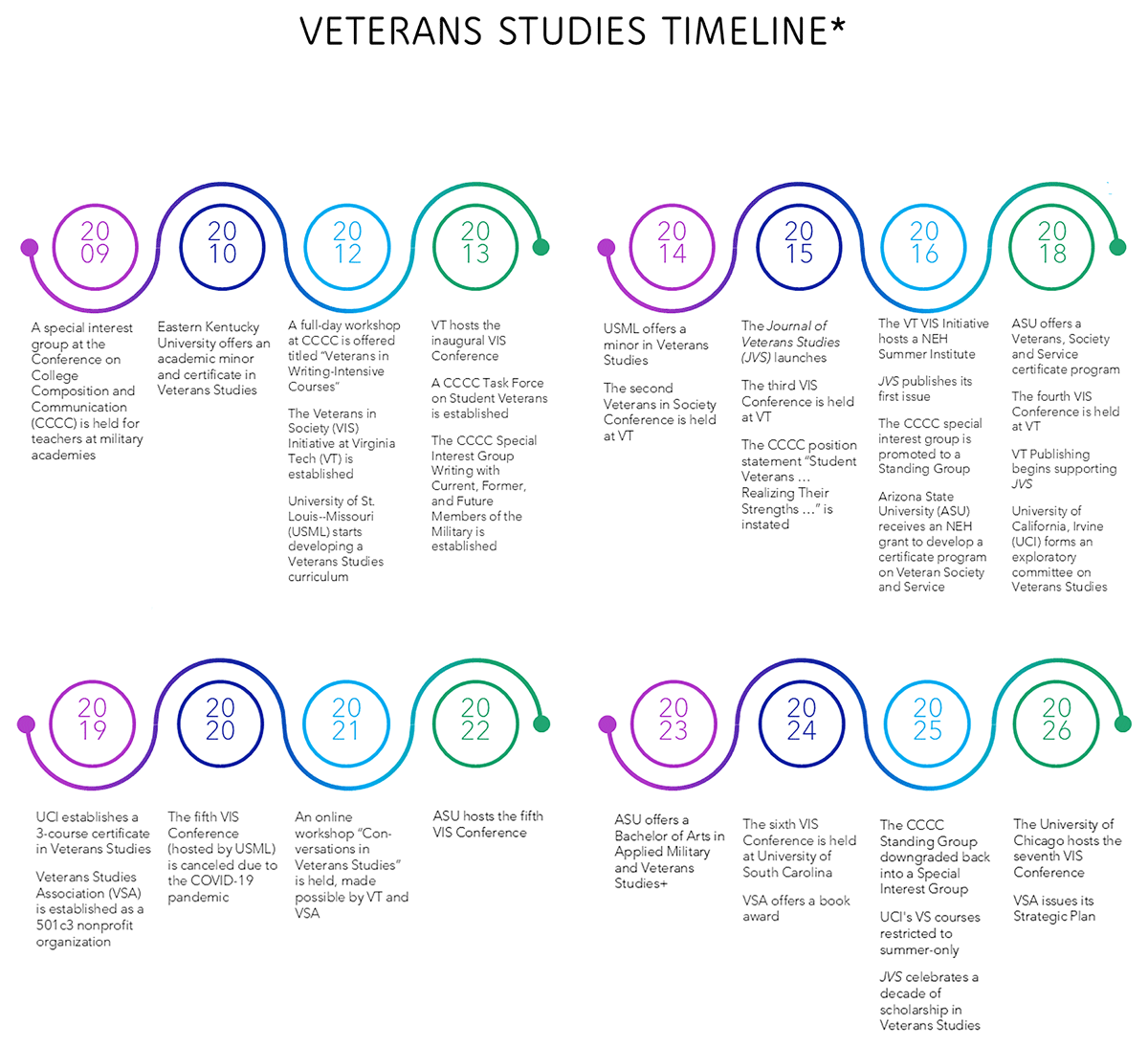
Figure 1
Veterans Studies Timeline.
Note. Key dates and activities discussed in this roundtable are outlined above.
Roundtable Discussion
Can you trace the origins and early development of your efforts to establish veterans studies as an academic discipline, noting the challenges you faced or witnessed?
Bill Maurer: At UCI, we had, for a number of years, a course designed specifically for veterans’ transitions. It was intended as a “University Life 101” type of class for our student veterans and was taught for many years by a faculty member who was himself a veteran. We also had several other similar classes aimed at supporting different student populations. However, a few key changes occurred. First, Proposition 209 in California made it more difficult to designate courses for particular student populations; now, every course had to be open to all students. While we adapted to this, our faculty governance body—the academic senate—began reviewing these courses and raised concerns about their academic rigor. They argued that these were more like student support activities rather than academic coursework.
Then, the faculty member who led the veterans’ transitions course retired, creating both a challenge and an opportunity. At that point, Professor Anita Casavantes Bradford and I, in my role as dean, began working together to determine the best way forward. We also consulted with our campus veterans group, which had taken over much of the hands-on mentoring for student veterans. As a result, we realized there was no longer a need for the kind of course previously offered, so we began to consider what could take its place.
Around this time, Anita brought to my attention a workforce need she had heard about from her colleagues and relatives at the VA [Department of Veterans Affairs]. The VA Hospital in Long Beach, just up the road from us, had found their hiring pool very limited. Many potential applicants assumed only veterans could apply for these roles and therefore didn’t pursue them. Anita proposed creating a formal certificate program comprising a sequence of three courses to give both veteran and nonveteran students a broader and deeper understanding of the veteran experience in the United States.
Anita Casavantes Bradford: The program really began because our dean, Bill Maurer—who has long advocated for veterans, both personally and professionally—asked me to review the syllabus for a one-credit course the School of Social Sciences had offered for several decades. This course was designed to help veterans transition to university life.
Recently, our academic senate has become stricter about awarding credit for non-academic work. So, in 2017, as part of his due diligence, Bill asked me to evaluate the class to determine whether it contained sufficient academic content and whether it was a good use of instructional time. He chose me because I was one of the few faculty members who openly identified as military-affiliated and experienced in working with veterans.
When I reviewed the syllabus, I found the course lacking in substantive content. Much of the advice offered for university success was more appropriate for high schoolers who had never worked or been in the real world. I remember thinking that any veteran would, at best, roll their eyes—or, at worst, feel insulted by being told things like “show up on time.” I told Bill the class was not meeting the needs of veteran students and recommended discontinuing it. Instead, I proposed we create one or more courses that would seriously engage with the diversity of veterans’ experiences. If we wanted to support veterans in the academy, we needed to recognize that what they have lived is worthy of study.
Bill was intrigued and suggested we form an exploratory committee on veterans studies. He asked me to gather a group, so I brought in colleagues—veterans from the Army, Navy, and Marine Corps. Bill recruited a VA colleague and veteran students at UCI to discuss what a veterans studies curriculum might cover.
At that time, I was unaware that veterans studies was an established discipline. But after searching academic databases, I discovered JVS. We examined published articles, including Jim Craig’s piece on the emergence of the discipline. Knowing there was already an emerging multidisciplinary intellectual community gave us a valuable foundation for moving forward. We also discussed what both veteran and nonveteran students at UCI might want to learn and sought input from our VA colleague about what knowledge and skills students would need to work effectively with veterans in the future. These conversations led us to focus on three core areas—Veterans in History and Society; Veterans Voices; and Veterans’ Transitions—which became the basis of the three courses in the Veterans Studies Certificate Program.
The next challenge was finding qualified scholars—people with PhDs who were also veterans—to help develop the curriculum. Then we navigated the usual institutional processes: submitting courses to the academic senate for review, ensuring they met university standards, and getting them approved. We brought in a couple of veteran scholars to develop the curricula for two of the courses—Veterans Transitions and Veterans Voices—since they were best qualified for those topics. I developed the curriculum for the original Veterans in History and Society course myself.
At UCI, where academic freedom is valued and broadly interpreted, our goal was to create a template syllabus for each course—a “skeleton” that fulfilled university requirements—while allowing instructors to bring their own expertise and creativity to teaching. One thing that was not a challenge was securing resources for the certificate program. From the beginning, we had the dean’s enthusiastic support. Even as public funding declined, Bill was able to find ways—through small alumni donors who are veterans and by prioritizing the program in the school’s budget—to fund instructor hires and program development.
Bill stands out for his openness to faculty innovation, and UCI, as a whole, fosters an innovative culture. I also tend to be entrepreneurial; when I see a need, I build programs. For colleagues interested in creating veterans studies programs at their institutions—especially if they’re veterans themselves—I recommend approaching this with the same initiative and problem-solving skills learned in military service. Don’t wait for direction—identify what needs to be done, knock on doors, ask questions, and make your case. You’ll find allies and advocates. Even if, at your university, only a single course is possible, one class can make a significant difference in students’ lives.
There have been, and will continue to be, ups and downs in the trajectory of our program. As of 2025, UCI, like many other universities, is grappling with how to withstand extreme budget cuts, and this has meant that, for the time being, we will only be able to offer our Veterans Studies courses during summer session. But as long as Bill and I are around, veterans studies will continue to be important at UCI.
Jim Craig: The early establishment of the program at [the] University of Missouri, St. Louis (UMSL) started around 2012, when I was still in uniform and the professor of military science at Washington University (down the street from UMSL). Through my relationship with the UMSL dean and others, I learned that UMSL was struggling with its veteran population. Many veterans were enrolling at UMSL—especially around 2011 and 2012—because it’s a large public university and accessible, but many left after only a semester for two [reasons], feeling unfulfilled and unhappy. Most were not transferring to other universities but simply dropping out altogether.
As I neared retirement from service and was considering my next steps, the dean called and asked if I could come meet with him and the chancellor; they had a proposal for me. In that meeting, they asked if I would be willing to work for UMSL to address what they called their “veteran problem.” I thought about it for a while and returned a week later to say that I was interested, but I did not want to work in Student Affairs. I would much rather be faculty. Eventually, they said they would put me in a non-tenure track position and find a way to let me teach if I came to work on their “problem.”
I accepted and began working in the Veteran Center, providing veteran services and support, but I was always thinking about the class I would teach. I started researching veterans in transition and how other universities were addressing these issues. That’s when I discovered Eastern Kentucky University (EKU) and Travis Martin’s work in their veteran studies program. To be honest, I borrowed heavily from their approach, adapting it to fit our specific context at UMSL. Personally, I wasn’t interested in teaching nonveteran students how to salute or march—as EKU did to give nonveterans a sense of military experience. I wanted to focus more on reading, thinking, and fostering discussions between veterans and nonveterans in the classroom.
I brought this idea to my dean, who was very supportive and told me to build the class. I taught the course, and it was reasonably successful for our campus—about 20 to 30 students enrolled. Afterward, I suggested that we could build something even larger out of this program, and he encouraged me to go for it. The rest is history.
This journey answers a few important questions. First, I consider EKU and Travis Martin’s work to be foundational for this era. Second, regarding institutional support, I was very fortunate to receive almost a blank check from my dean, which is rare and may not even be possible today, as there was more funding available back then. I also had a chancellor who supported simply having UMSL be part of the regional conversation about veterans in higher education. To be honest, part of the motivation came from seeing universities like St. Louis University and others receive more public recognition for supporting veterans, even though UMSL had far more veteran students—about 400 compared to their 50. The chancellor wanted UMSL to be recognized for serving veterans as well.
So, much of my work was being out in the community, raising awareness. At that time, there was strong national and policy support for veteran programs—the window of opportunity was wide open. One lesson I’ve learned in veterans studies is that such windows open and close with time, and while it may be closing now, it will open again someday. We have to strike while the iron is hot in that work, I guess.
Manu Avilés-Santiago: I believe that the development of our programs really began with oral history. Early on, I was involved in the Voices Oral History Project at the University of Texas at Austin (UTA), where I interviewed hundreds of veterans from World War II, Korea, and Vietnam. That experience made me realize both the depth of the veterans’ stories and the broad interest in them. We developed an archive, and soon scholars from a variety of fields—history, communications, psychology, and more—began using these stories for their own research. I could see there was real demand for veteran perspectives from many academic angles.
When I joined Arizona State University (ASU) in 2012, I met Dr. Mark von Hagen, who became a key mentor. He led an oral history course with many veteran participants, and he noticed how powerful their stories were. Motivated by this, he advocated for the creation of the Office for Veterans and Military Academic Engagement (OVMAE), which soon became a central hub for research, teaching, and community outreach at ASU. I joined the office as a collaborator. Together with Dr. von Hagen and other colleagues, we secured an NEH grant in 2016–2017 to develop a certificate program on the study of veteran society and service. This was an important step, allowing us to develop new courses, assess what programs existed nationally, and build something both distinctive and responsive to the interests of our own community. We saw engagement not just from faculty across colleges and disciplines, but also from students eager for these learning opportunities.
The first course we launched focused on representations of veterans in media and the arts—it generated a great deal of interest. Though the initial class had about 20 students, the next grew to over 75, showing significant student demand. After Dr. von Hagen’s passing, I became director of OVMAE and continued the work, now with a broader perspective. One early challenge was finding a permanent home for the certificate program, which initially sat under the Provost’s Office—making faculty hiring and course planning difficult. I was able to bring both the certificate and the office into the College of Integrative Sciences and Arts, where I was already based, which made logistics much smoother.
As director, I faced new challenges—especially when we had to pivot online during COVID-19, which delayed some plans but also enabled us to reach students interested in veterans studies from all over the country. This expanded our audience and the impact of our certificate offerings. Hosting the ViS conference further helped me see the potential for growth and inspired me to dream bigger; instead of just a certificate, why not develop a full degree in this area at ASU?
With support from the Provost’s Office and collaboration from faculty in our college, which specializes in applied learning within the liberal arts and sciences, we designed a degree program that emphasizes real-world application and community engagement. The proposal was approved in October 2023, and faculty eagerly stepped up to create and teach the new courses.
A particularly exciting moment was hiring Wanda Wright as the new director of OVMAE. Her leadership has had a transformative effect on the program, the college, and on veterans at ASU broadly.
In my previous role as associate dean of Academic Programs and Curriculum Innovation, I’ve worked closely on course design, helping secure general studies designations and supporting Wanda’s leadership throughout her transition. She’s brought new energy and vision to the degree, and her impact is already clear. Overall, this journey—from oral history interviews to the creation of a certificate, to the launch of a full degree and a new director’s leadership—captures the origin and evolution of veteran[s] studies at ASU.
Wanda Wright: I was one of the early stakeholders in this initiative. Back when Mark von Hagen and Nancy Dallett were working hard to get things started, I served as the director of the Arizona Department of Veteran Services. One of our ongoing programs actually began when we gave a grant to ASU, allowing them to visit Colorado to study the Huts for Vets program. As a result, we were able to establish the Treks 4 Vets program here, which is now in its fourth or fifth year. It’s great to see everything come full circle. Mark made sure we had a dean who is a strong advocate, which has been absolutely essential for our progress. Without that level of support from both the dean and Manu—who was involved from the very beginning—I don’t know where we’d be today. We should also make sure to mention the dean by name: Joanna Grabski, who has been deeply committed to this work for several years.
D. Alexis Hart: In some ways, my earliest inklings of how to bring my experiences as a military veteran into academic spaces began when I was at the Navy Supply Corps School. While still on active duty, I was teaching officer training during the day and attending graduate school at night. I took a composition pedagogy course, which led me to reflect on how teaching happens both in the military and the academy. I asked if I could write about my work as a military officer, and that ‘yes’ from my professor opened a door for me. It showed me the possibility of bringing the military and academic worlds—sometimes called the “military-academic complex”—into conversation with each other.
After graduate school, my first teaching position was at a senior military college—the Virginia Military Institute. There, I continued to think deeply about pedagogy in a military-affiliated college context. Later, I became involved with the scholarly journal Kairos when, in 2008, Mike Edwards, who was teaching at West Point, proposed a special issue on military rhetoric. Mike and I worked together to edit that issue in the summer of 2010, which really launched our involvement in this field. We presented at CCCC and heard Marilyn Valentino speak about the ethical obligations educators have toward military veterans. In 2009, Mike and I also started a special interest group for those working at military academies—another formative experience.
Throughout this time, my work in veteran[s] studies has been closely tied to rhetoric and writing studies. Attending panels at the College English Association conference—including one organized by the Association of Departments of English—helped me connect with others exploring how higher education, especially writing instruction, intersects with veterans’ experiences. Pieces like Melanie Burdick’s (2009) Grading the War Story, or Galen Leonhardy’s (2009) work at two-year colleges, deepened my understanding of how other educators grapple with veterans’ issues in the classroom.
One ongoing challenge I’ve faced is building trust with research participants. As a former officer and now a PhD, many of the student veterans I work alongside are enlisted, and they can be wary or suspicious of my background and intentions. Earning their trust—demonstrating that my research is collaborative and supportive, rather than exploitative—takes time and sensitivity. Another persistent challenge is determining where this interdisciplinary research “fits” in the academy. I often wonder, “Where do we place research like this?” It doesn’t always fit neatly into a single department.
Eric Hodges: I became interested in veterans studies while searching for a dissertation topic. At the time, I was focused on democratic citizenship, civic engagement, social capital, and the loss of community in American society—issues that seemed to have significant impacts on our society and our government. One reason I was drawn to these topics was the strong sense of community I had experienced in the military. The camaraderie I felt there was profound, and after leaving the military, I found myself mourning that loss and searching for ways to recreate it.
Around 2011/2012, I noticed that many veterans were returning from Iraq and Afghanistan and struggling to adjust to civilian life—a trend that received considerable media attention. Remembering my own challenging transition from the military to college, I wanted to help fellow veterans make that adjustment. So, I got involved in starting student veterans’ groups at VT, helping to launch a chapter of Student Veterans of America.
On one side, I was engaged in service work with student veterans on campus; on the other, my academic interests centered on civic engagement. My two interests came together when I discovered a paper by Mary Yonkman and John Bridgeland (2009) from the Civic Enterprises Institute, which examined rates of civic engagement among veterans. This paper helped me see how veterans might be key to reinvigorating community and civic engagement in American society. I also began to think that supporting civic engagement could help veterans transition back into society and rediscover their sense of mission.
With this in mind, I chose to focus my dissertation on whether military training serves as a type of civic education for veterans. I already knew Jim [Dubinsky] at VT—he ran the Center for Civic Engagement and was also a veteran—so I reached out to ask him to serve on my committee. Through a political science class, I’d heard positive things about Bruce, who not only shared my scholarly interests but also had expertise in library science, which I thought would be invaluable for my research. Both Jim and Bruce agreed to join my dissertation committee, and I began my research.
We quickly realized that academic work focused on veterans was both limited and scattered across various disciplines and journals, making it difficult to find and synthesize. This led to conversations about how we might bring this scholarship together, highlight ongoing work related to veterans, and encourage more research in this area.
Inspired by the existence of other interdisciplinary programs like Appalachian Studies and Women’s Studies at VT, we began to ask “Could we build something similar for veterans?” As a first step, we decided to organize a conference on the topic. We assembled a committee and began planning, and from there, the momentum only grew.
James (Jim) Dubinsky: My work, linked to the creation of the Veterans Studies Association (VSA), has been focused on building a community of scholars and practitioners to develop an academic focus on the issues veterans and their families face, as opposed to the many initiatives focused on serving veterans and their families directly. The “roots” are my 28 years of service, my family’s military history, and my commitment to service following retirement. The catalysts are the friendships I made during my three-year “tour of duty” from 2008–2011 to help shape and serve as the inaugural director of the Center for Student Engagement and Community Partnerships (now VT-ENGAGE) after the tragic shooting here at VT. During those three years, I met Eric Hodges in 2009 and Bruce Pencek in 2010. Eric was working with friends of mine in the community, whom I knew from my task force and engagement work, including Andy Morikawa. He was a master’s student and had a deep interest in veterans and service, which I discovered while working collaboratively on two community-based projects; Community Voices and the Global Dialogue, which was led by Andy and Dr. Max Stephenson, who became Eric’s dissertation director. Eric was one of the few graduate students involved in these community-based projects, and when I returned to the English department in August 2011, we began collaborating more closely.
As part of that collaboration, I created an independent study on the rhetoric of citizenship. Our discussions were foundational because Eric brought a different perspective—having been enlisted and coming directly to college from the military. My background, having been an officer commissioned via ROTC, earning my graduate degree while on active duty, and then teaching at West Point, meant I had a “map” of the university and its infrastructure. I had, quite simply, a lay of the land and a familiarity with higher education that many, if not most, veterans returning to college do not have.
Eric’s insights deepened my understanding of the challenges student veterans faced, particularly those with families, as they returned to college. We both recognized that there was something unique about the intersection of military experience and civic engagement, though we weren’t always sure what that “something” was. I appreciated Eric’s explorations of this topic, and I’ve been proud of his work ever since. Around the same time, when I returned to the English department, I was also asked to step in as executive director of the Association for Business Communication (ABC). Simultaneously, I was involved in a community group called Dialogue on Race—a group that still operates today. That group provided another connection with Andy Morikawa. These multiple community connections taught me a lot, especially about the power of convening—bringing a critical mass of people together to address important issues.
In 2011 to 2012, Eric and I began our conversations with Bruce Pencek about “convening,” about bringing people together through conferences to see if there was a sufficient interest in the questions we were forming about veterans, their identities, and their places in “society.” Our different perspectives coalesced as we recognized the growing societal dichotomies, especially concerning how veterans—and their families—were portrayed. We knew the portrayals weren’t accurate or fair. We had learned about how convening works in the community. The next step was to see if we could form a community around these issues of civic engagement and veterans (Veterans in Society at VT, n.d.).
The idea to name our first conference—Changing the Discourse—was a brilliant one (I can’t remember whose suggestion it was) because it captured a key academic issue—how veterans are represented and described in limited and often dichotomous ways. Eric chaired that first conference as a graduate student. He had the energy and discipline to make it work, and that event was crucial because it began building a real community around these ideas. We all contributed to its creation and direction. The Great Recession also influenced us. As someone who’d taught poetry and writing at West Point, I understood the value of the humanities, which led to the 2014 theme Humanizing the Discourse (and the resultant focus on arts, literature, and music at many of the conferences). This focus countered a growing backlash against the humanities in the university and in society at large. Around then, I became interim director of the Center for the Study of Rhetoric and Society. This position gave me the opportunity to continue building the “critical mass” via the second conference.
The 2014 conference brought together important participants, including those from EKU (i.e., Travis Martin and Luke McClees), D. Alexis Hart, Mariana Grohowski, Jim Craig, and, as Bruce mentions, was followed by an NEH grant in 2016. That event was especially significant; it united scholars and teachers from nine academic areas (Veterans in Society, 2016). This group became the initial leadership core of our community. We had an initial Future of Veteran[s] Studies panel at the 2014 conference and continued these conversations at the 2015 conference with its focus on race and reconciliation, and the 2018 conference on global frames around veterans (Bruce’s emphasis). These efforts provided a foundation for ongoing conversation and action, including the launch of the Journal of Veterans Studies by Mariana. With the critical mass of scholars, some of whom, like Mariana and Jim Craig, took key leadership roles, Bruce and I could begin spreading out the work, and the initial VSA team recruited leaders for the 2022 and 2024 ViS conferences at ASU and the University of South Carolina. My work has continued via grants and doing what I can to support the efforts of others, including serving on dissertation committees for three veterans, including Eric and Bryon Garner—another emerging leader.
Corrine Hinton: As a burgeoning rhetoric and composition scholar, I found it challenging to substantiate my dissertation topic—veteran[s] studies—as both a credible research avenue and a path to employment. My committee faculty were deeply invested in ensuring their candidates would be competitive on the job market, so I had to prove not only the scholarly value of my topic but also its marketability. Sometimes, I struggled to get my faculty to see the worth of my research—not necessarily the inherent value of studying veterans, but its legitimacy as a scholarly pursuit—especially when my faculty lacked deep training in both rhetoric and composition and empirical research methods.
This personal journey began with just getting approval to do the research I wanted. Then, when I attended the Conference on College Composition and Communication (CCCC or Cs), I didn’t immediately see my interests reflected. If Cs was representative of the broader discipline, my work felt invisible. That started to change when there was a full-day workshop on student veterans in the writing classroom, which then grew into a special interest group. It certainly would have made things easier if veteran[s] studies had been a more established subfield in rhetoric and composition, but there was also excitement in being part of that foundational work as a graduate student, even if it felt like I was fighting for my research, my scholarly identity, and the broader legitimacy of veteran[s] studies within and beyond my field.
A significant turning point for me was finding colleagues who were also committed to this work. I remember our early conversations, “What if there was a journal for work like this?” It was both the best and hardest timing. On the one hand, I was creating scholarship that would carve out new space within my discipline. On the other, I worried about the future of my work and my job prospects, along with some imposter syndrome, as I tried to carve out space for veteran[s] studies just as I was about to defend my dissertation.
JVS was established in November 2015, which was about three years after I finished my PhD in 2012. During those years, I was navigating the job market, helping to build a disciplinary space for veteran[s] studies in CCCC, and recruiting others inside and outside rhetoric and composition to support developing the journal. It was a hectic time, and there were opportunities I missed because I was spending my own money traveling around the country to conduct interviews for my research, often in person since this was before the Zoom era.
Gaining approval for my graduate research and then arguing for the value of a dissertation on student veterans within rhetoric and composition, particularly for the academic job market, was tough. Some institutions didn’t see its immediate relevance. I ended up at a regional university focused on teaching, where research was encouraged but not strictly regulated. This freedom let me continue pursuing veteran[s] studies without senior faculty gatekeeping my research agenda.
In addition to my research, I was highly active on my own campus—working directly with student veterans, helping to adapt Green Zone training for our faculty and staff, attending Student Veterans of America (SVA) conferences, and serving as the first nonveteran advisor for our SVA chapter. I organized trips to national SVA conventions, which established a precedent for our chapter and led to further opportunities for our students. This experience was invaluable for shaping my future research and reinforcing the importance of staying closely connected to the community I aimed to study and serve.
This timeline is limited by the participants included and the efforts they recounted. It does not account for all efforts or years of activity related to the development of veterans studies as an academic discipline. +Saint Leo University launched its BA in VS in 2021, three-years before ASU (see Sanchez, 2001).
Can you identify and discuss the role of pioneering institutions and/or historical and social factors that contributed to the emergence of veterans studies as a distinct academic discipline at your university, profession, or in your purview?
Bruce Pencek: First, Jim Dubinsky and Eric Hodges were the veteran voices in our group, while I’m the lifelong civilian here at Virginia Tech. It’s important to acknowledge that we have been very fortunate. Virginia Tech is an R1—a major research university—with significant resources, both intellectual and financial, and a strong ambition to raise its research profile even further. A lot of things came together for us, sometimes by accident, but they came together nonetheless, starting with Dr. Hodge’s dissertation.
From that work, we went on to organize four in-person ViS conferences. One of these conferences was linked with the National Endowment for the Arts’ Big Read grant at Radford University, our neighboring public university down the road. That grant funded readings and related events centered around Tim O’Brien’s The Things They Carried, and we were invited to participate because we had established a solid local reputation. One of the highlights was that Jim managed to pull together the funding needed to bring Tim O’Brien in for both a conference presentation and a public talk.
At the 2018 conference, we held the very first meetings to create the VSA. During that same event, we also facilitated the move of the JVS to VT Library’s VT Publishing unit, relaunching it as a platinum open-access journal. That means VT Libraries cover the overhead costs, so there are no fees for authors, readers, or the editor, or for the VSA. Open access has been a consistent priority for both the ViS community and VT Libraries since our first conference. All of our conference proceedings have always been open access, which I think has helped establish our legitimacy. And being affiliated with an R1 university also gave us a credibility boost. But even more importantly, open access means that anyone, anywhere in the world with an internet connection, can access the work we’ve cultivated. The journal remains the most visible and enduring example of that commitment.
Early on, we also held an invitation-only symposium for conference participants. The idea was to gain a sense of where the whole Veterans in Society concept might go. Half the meeting took place at Jim’s house, the other half in his department. We also organized a National Endowment for the Humanities (NEH) Summer Institute for Higher Ed Faculty in 2016, which was another marker of our project’s credibility—getting NEH support was a big deal for us. The Summer Institute helped us bring together college faculty—our primary audience—but it was also an opportunity for outreach to other institutions and scholars like Jonathan Shay, exposing our work to a broader network.
More recently, when COVID canceled our plans for what would have been the first ViS conference outside Virginia Tech, we organized an online Conversations in Veteran[s] Studies symposium instead. Pre-COVID, Jim [Dubinsky] and I were regularly invited to NEH headquarters for meetings with program directors of their Dialogues on the Experience of War grants. Those were valuable networking opportunities and suggested that NEH saw value in what we were doing. We’ve tried to maintain thorough documentation of our activities on veteransinsociety.org, including archives of the Summer Institute and open-access conference proceedings—at least, back when people were contributing to those proceedings, although that’s tapered off for reasons I’m not entirely sure of.
D. Alexis Hart: I want to express a lot of gratitude and give credit to the Conference on Composition and Communication (CCCC) leadership. Mike Edwards and I had proposed a special interest group, which is a group, organized around a specific interest that meets at the annual conference, and I’m trying to remember what our original name was; I think it was “Writing at the Military Service Academies” as our first iteration—then it evolved into “Writing with Current, Future, and Former Members of the Military.” Our first gathering started back in the early days of Facebook. We even had a Facebook group that really helped us begin to connect with each other.
This was happening during a time when we were witnessing a real influx of military-affiliated students returning to higher education—military members either being discharged or still on active duty were coming into our classrooms, especially our writing classrooms. As Roger Thompson and I have often said, the writing classroom is somewhat unique in higher education, particularly first-year writing classes. These tend to be smaller, which encourages close engagement among students; especially during peer review sessions. Professors typically know their students’ names. I remember someone once saying, ‘I know how to respond to a story about rape or domestic abuse, but I don’t know how to respond to a war story.’ That was a powerful reminder of the new challenges we were facing.
There were people entering this space, and as Bruce and Jim have pointed out, there haven’t historically been many people transitioning from the military into academia, especially in the humanities. So, we were trying to help bridge that gap. I often return to Phil Klay’s (2014) Failure of Imagination op-ed, because that feeling of “I don’t know how to respond” was, and is, very real. A lot of the early energy around this work came from our Special Interest Group, which eventually gave us the capacity to apply for, and be approved as, a Standing Group—a standing group has more clout during the conference, including ensuring a panel on the group’s topic will make the program.
At that point, CCCC leadership asked us to write The Statement on Teaching Student Veterans in the Writing Classroom, which was a wonderful opportunity they provided (CCCC, 2015/2022). Later, when CCCC launched the community engagement grants for conferences, that really allowed us to come together as academics and spend meaningful time in the communities where the conferences were held. We practiced place-based education; finding out what’s happening locally, meeting with organizations working with veterans and military family members, and engaging with groups focused on job support and related needs. Those were such rich opportunities, and I feel so fortunate that we were able to take advantage of them.
Corrine Hinton: For me, the standing group functioned as the first formalizing—and then formalized—body within our field. A lot of that process was bureaucratic; it happened alongside our efforts to create space within an established, longstanding organization like CCCC.
During this time, the goals and activities of the group shifted somewhat as we worked to formalize ourselves. For example, one of our first and most instrumental and lasting accomplishments was the position statement with Cs (2015/2022), crafting that statement, developing a bibliography, and even updating the bibliography just a couple of years ago. That update, in particular, was a chance for me to reflect and think, “Wow, look at how far we’ve come in ten years.” Initially, there was just a small collection of work—often from other disciplines—but we’ve now reached a point where there’s significant scholarship within our own field, within rhetoric and composition, focused broadly on veteran[s] studies.
I’m not claiming we were absolutely the first, but I do believe that our standing group—especially our core team who worked on the position statement—were probably the first to formalize and cement an asset-based approach to student veterans (CCCC, 2015/2022). That’s a legacy, helping to define, for our discipline, what it means to support student veterans and military-connected individuals in post-secondary education, especially given our responsibility in first-year writing programs, which are such an important connection point for these populations. That, I believe, will be one of our most significant legacies.
Additionally, those of us involved in the standing group—whether junior, senior, or past chairs—helped cultivate leadership opportunities and created a genuine community for scholars in rhetoric and composition doing this work. There was, and still is, a huge desire to serve. I’m especially proud that, for several years—probably more years than not—we participated in community engagement projects through those grants. When we came together for conferences, we didn’t just “do the things,” we also went out into the communities of conference sites and asked, “How can we help?” Whether it was resume-writing workshops, storytelling sessions in Portland, or working with military caregivers in Kansas City, our reciprocal service work stands out as a flagship of what we do. It exemplifies how we view the relationship between service and scholarship, a continuous exchange and reciprocity. We weren’t just there to “share out,” the standing group has always offered, in my view, a true space for conversation. That conversation extended beyond the scholars who gathered, beyond session participants or those new to our work; it included student veterans and military-connected people in the communities where we held our conferences.
What future changes (e.g., challenges and opportunities) do you anticipate your program in veterans studies and/or the field of veterans studies will face in upcoming years?
Bill Maurer: I won’t be the dean in three years. That’s why all the work we’ve done to promote this program—getting coverage, having people talk about it, and gaining recognition—is so important to ensure its endurance; another real challenge is staffing the courses. We’ve mostly relied on part-time lecturers, which has worked well, but the pool of people truly qualified to teach these courses is small.
As dean, I continually speak to some of my donors to emphasize the importance of this program. It would be wonderful to have a dedicated donor or two specifically for our veterans studies program to help sustain it. I’ve even reached out to organizations like the Defense Council of Credit Unions, with whom I have connections from my own research career. Even so, I remain concerned about the program’s long-term institutional continuity and success.
What I really want is a tenure-line faculty member dedicated to veterans studies but achieving that depends on convincing a department to prioritize such a hire over other competing needs.
Jim Craig: The issue Bill raises is not unique to Irvine. For example, I’m non-tenure track and contingent; my position could disappear if, say, state funding were lost or for similar reasons. There simply isn’t an established structure around this field, nor is there a groundswell of interest among the population we study to study themselves—it’s a unique dynamic. We face those same structural challenges. If I were to stop teaching my course, there’s no one else who would step in—it would simply disappear. That’s a real concern, especially as I transition into my current role as associate dean. There’s a foreseeable time when I may no longer teach, but I love that course and the topic needs to be taught. I’m not sure how this challenge will be resolved within our field.
Anita Casavantes Bradford: On a more theoretical level, I continue to hope that the field of veteran[s] studies will do more to not only recognize but truly embrace the fact that veterans’ experiences vary significantly depending on their identities and backgrounds. I think that awareness is already present across much of the discipline, but I’d love to see scholars in the field lean further into critical, comparative, and analytical approaches. This isn’t meant as a criticism, but rather as an observation about the way fields evolve. My perspective as a historian is that, for example, Latinx and Chicanx history began in the 1970s by simply documenting the existence of communities—just as women’s history did—and then evolved from there. I look forward to seeing veterans studies similarly develop, with more comparative, relational, and intersectional research. I hesitate to use those terms, because unfortunately, they’ve kind of become buzzwords, which I dislike. But the fact is, all people, veterans included, live their lives within and across a complex range of positionalities and identities.
Things get interesting when, for example, you look at the people I interviewed for my 2021 article in JVS on how Latinx veterans understand service and patriotism–it’s immediately apparent that each of them embodies a wide range of experiences and perspectives. The same is true whether a veteran is white, Black, Brown, Asian; male, female or transgender; citizen or non-citizen; gay or straight; able-bodied or disabled; or a combination of these and other identities. The complexity of veterans’ experiences is what excites me most, and I hope to see more of these nuances uncovered in future research.
Wanda Wright: Let me start with this, having an Office for Military and Veteran Academic Engagement is essential because it creates opportunities for our future. This office helps us envision what’s possible for our students and the program itself. Over the past few years, as I’ve learned more about the needs of our students, we’ve started several initiatives to provide continued support, such as maximizing GI Bill benefits.
For example, we’re in discussions with other colleges about establishing accelerated master’s programs. I envision a pathway where students earning an associate’s degree in military studies can seamlessly transition into our Applied Military and Veteran Studies Bachelor of Arts, and then potentially into graduate programs in global security or public administration, especially those interested in government service. The goal is for students to see a clear educational future—a bridge from applied learning to their careers.
We’ve also received an endowment to support internships and mentorships; as Manu mentioned earlier. I see our office not just as an academic hub but also as a gathering spot for workforce support, providing “concierge-style” assistance to students seeking internships and, ultimately, employment. We’ve been working on this and are planning a convening this month for all military and veteran[s] studies programs, faculty, deans, and staff across ASU to meet, share ideas, and discuss programming. ASU is a vast university with many campuses, so it’s valuable for us to get together and talk about these things.
My hope is to make these gatherings a regular occurrence and possibly to extend them to a tri-university level in the coming years. We’d like to have major discussions, perhaps even about legislation for veteran[s] students.
We’re also considering collaborations with ASU’s various wellness and counseling clinics, adding veteran-specific programming, and bringing in VA support so that our student veterans have robust resources. These are just a few ways we’re thinking about growing the office and supporting our students moving forward.
Manu Avilés-Santiago: Adding to that, from a field-development perspective, our experience shows that bridging both military and veteran[s] studies makes sense and enables more interdisciplinary connections. Our college—the College of Integrative Sciences and Arts—emphasizes applied learning, and integrating these two areas aligns well with our mission.
We’ve also managed to maintain a good balance of military-affiliated and civilian students in our classes, which makes for rich classroom discussion and diverse perspectives. I think that’s something we should try to preserve, as it brings great value to the program.
I also want to commend the work the journal is doing with roundtables like these. Sharing our successes and failures helps us all learn [that] this is still a young field, and honest reflection is needed. Not every university needs a full program in military or veteran[s] studies; some might benefit more from professional development programs, micro-certificates, or smaller credentials. The key is understanding your audience and designing programs that have a real, measurable impact.
Furthermore, especially with the current pressures in higher education, it’s vital that we show how these programs benefit the wider community. Having the office allows us to pilot programs, see how students respond, and then expand successful efforts into full courses—as we did with our Verse for Vets poetry and veteran’s class.
Intentional collaboration is also critical. Early on, I wanted to collaborate with every college and make this the most interdisciplinary program possible, but I learned that not every partnership was a great fit. Wanda has been valuable in refining our collaborations and building meaningful partnerships where they make sense, especially with Watts College.
Wanda Wright: Sometimes, partnerships emerge by chance. For example, I considered pursuing a PhD at Watts College; I have an MPA and visited Professor Shannon Portillo there. We discussed how many veterans don’t realize that federal services aren’t the only option—local governments offer great opportunities too. Watts is closely connected to Arizona’s local governments, and through our conversation, we identified an opportunity to develop an accelerated master’s program that would connect our students to fellowships and career pathways through Watts College.
It’s important for veterans especially to be able to see a clear path forward. By outlining these opportunities, we help students understand the steps they can take to reach their goals. Watts College has been a great partner, open to collaborating on internships and workforce initiatives, even though we are in different colleges. Our relationship is strong, and we look forward to building on these efforts.
James (Jim) Dubinsky: The future of veterans studies is still in doubt, given the wide range of forces at work, including the shift in the national discussions about identities. While I don’t believe the current administration would want to try to deny that veterans have an identity that deserves recognition, the focus on shifting away from identity politics—and diversity and inclusion overall—will put some restraints in place for how we can argue for and pursue coursework and disciplinary status. Given that our “footprint” remains small and given that some of those footholds depend almost entirely on the work of one individual—such as Jim Craig at UMSL— I am not convinced we have the necessary critical mass we need to forge forward. We still seem like a forward outpost in the disciplinary world.
Have there been shifts in focus or priorities within veterans studies over the years? If so, what prompted these changes? And how do you envision the field of veterans studies evolving over the next decade and what challenges and opportunities do you see facing the field of veterans studies in the upcoming years?
Corrine Hinton: Over the years, the focus and priorities of veteran[s] studies have shifted, often influenced by public discourse and societal changes. For example, when troop drawdowns brought more veterans onto campuses after 9/11, there was a surge of interest and scholarship in this area. Some scholars contributed briefly during these peaks and then moved on, while others, like myself, remain dedicated to the field.
One challenge has been the field’s cyclical popularity and the lack of a clear disciplinary identity. While the growth of organizations like the Veterans Studies Association, Veterans in Society, and JVS has provided new opportunities and a sense of community, we’re still establishing ourselves compared to more recognizable disciplines. We benefit from our flexibility and interdisciplinarity, but this can also feel chaotic, as we lack unified methodologies or theories—a sort of academic “wild west.”
Looking forward, a major challenge is supporting scholars—especially new ones—who often struggle to find mentors or committee members within veteran[s] studies. Connections too often depend on chance or access to conferences, which disadvantages those without resources. To advance, the field needs a strategic plan with clear priorities and structure—particularly for mentorship—while maintaining our inclusive and open spirit. Structure doesn’t have to limit us; it can help us clarify who we are and how we can best support one another and new scholars. Our opportunity lies in building a more connected, accessible, and recognized field, with formal support networks and clearer academic pathways.
D. Alexis Hart: Of course, there’s been some drop-off in focus and effort since those days. I include myself in that; I moved to a different institution, and Roger Thompson and I published our book right in the midst of the pandemic. But interest and activity in this area have started to decline. I think ViS as a group has picked up that work and is now capitalizing on the energy and interdisciplinarity of veteran[s] studies. The fact that veterans studies is not confined to a single discipline is, in my view, hugely beneficial.
Is there anything else you want to say about the idea of the development and maturation of veterans studies as an academic discipline?
Jim Craig: I’d just like to say that there are real people doing this work; people who are deeply committed to it, not just for their institution or campus, but for the field itself. They’re genuinely trying, and it’s hard! Who knew that building an entire academic discipline from scratch would be so difficult? Of course it is. What I’ve noticed is that, across the country, there were these isolated “oil spots” of people with similar ideas, each adapting their approach to fit their unique context or institution. Many of us reached out—like the Voyager probe—just to see who else was out there working on this. At the same time, various universities with veterans’ initiatives or research centers were doing similar work. The chance to actually come together and meet each other was crucial.
You can’t underestimate what happened at VT in 2013. People like Eric Hodges, James [Jim] Dubinsky and Bruce Pencek simply put out a call—“Let’s have a conference and see what happens”—and it was incredibly powerful. That’s really how the field has been able to coalesce; through these connections and gatherings.
I think the field’s development always comes down to the particular place and the people building it. For example, Anita has been at the forefront of thinking about veterans studies in an intersectional way, which wasn’t my initial focus—I was more interested in public policy and administration, based on my background. Others, like those at VT, were focused on issues like citizenship and leadership. The great thing is that, when everyone comes together, there’s a spirit of openness—of saying, “That’s cool, too,” rather than excluding others with different approaches. Maybe that attitude is possible because the field is still small and everyone seems to get along, at least for now. In many academic associations, people become territorial, but so far, that hasn’t been the case here.
Bill Maurer: It’s really helpful for me as dean, when I make arguments for resources, that there are conferences. And there is a journal—having those trappings of discipleship really matter when one is making the case for supporting such a program. Another thing I’ve noticed as I watch this field develop is how the conversation has broadened beyond psychology and social work into film and media studies, literature, history, ethnic studies; this growth is just very interesting in terms of the formation of a discipline.
James (Jim) Dubinsky: This roundtable’s discussions have been constructive. An essential element to creating lasting change is having, as Corinne notes, a strategic plan. That work should fall on the shoulders of VSA leaders first but be spread out. When I was elected to office at ABC, one of my first duties as VP was to lead a task force to create a strategic plan called the Future of ABC. It was not unlike the work I did when I led the VT task force on Student Engagement. Both efforts required reaching out to the many stakeholders and communities involved. At VT, for instance, we couldn’t have those conversations without speaking with the stakeholders beyond the university’s walls, as they would be the people and organizations that VT students engaged with—we need to listen. For ABC, I counted over 480 voices for an organization of about 1000 members. That diverse input helped us create lasting change, which I would call infrastructural change. In the discussions above, there are many fantastic ideas about how to frame the disciplinary work (i.e., connecting with military studies). But as Jim says, we need to have ideas that are not explicitly linked to one institution; we need ideas that are flexible enough to be adapted to the contexts in which we work and live. I look forward to seeing the conversation “broaden” as Bill describes.
All in all, one thing is clear: veterans studies as a field has had a number of core contributions. Some are disciplinary, such as the one Corrine and Alexis describe; some are pedagogical and local/regional, such as the ones Jim, Wanda, and Bill describe; some are architectural or (infra)structural, such as the organization of VSA itself. But something was needed to weave these various threads together into the interdisciplinary, international, and infrastructural quilt we now call veterans studies.
The conversations about the idea of veterans studies began at a range of sites. They did not happen simultaneously, but they do seem to have begun sometime around the beginning of the second decade of this century (2010–12). While different folks may want to claim to be the first to have this idea, those conversations and ideas remained local or regional, at best, for quite some time. And, even with various smaller gatherings, such as CCCC, the process of convening the individuals who had these ideas and conversations into a cohesive whole began with the ViS conferences [in] 2013. JVS followed [in] 2015 by the organization of VSA as a nonprofit, leadership, and organizational hub [in] 2019. Many folks contributed to these events and activities. Equally important are the various voices and support structures that have been willing to help fund the many projects, workshops, seminars, institutes, and conferences. I want to highlight NEH specifically and Dr. Victoria Sams, specifically. Many of the folks in this roundtable have received funding and support from her and the NEH. I cannot say that without their funding, veterans studies would not be alive and well, but I do believe that it “happened” on a much faster timeline with that support.
Conclusion
This roundtable has brought together the voices and efforts of 10 individuals from across the United States, heralding from different academic disciplines and institutions, who all had a hand in promoting veterans studies as a legitimate academic discipline from 2009 to the present. Of course, there were others acting in parallel, in country and abroad, as well as others who acted well before them and likely attempted similar feats. We certainly know of one individual, Willard Waller3 (1944), a U.S. Navy veteran of WWI, prominent American sociologist, and author of the book The Veteran Comes Back. In the final paragraphs of his book, Waller charges readers to “build up a body of social knowledge,” a “science,” as he called it, to “understand the veteran in order to help rehabilitate him and solve”—what Waller argues (over 300 pages) was the greatest sociological problem facing Americans in 1944—“the veteran problem” (p. 308), which many have echoed in subsequent eras ever since.
Calling this “body of social knowledge … a science of ‘Veteranology’ analogous to criminology, which draws upon all fields of knowledge for help in solving peculiar problems” (Waller, 1944, p. 308), the participants of this roundtable—and many others—have come together around veterans studies to act with a vision similar to Waller’s: to legitimize and formalize the study of military veterans and their families in society, both within and outside the United States. Thus, the future of veterans studies, just like the future of Waller’s Veteranology, is, as he said, “for the future to discover” (p. 308). This roundtable is one small act of ensuring that the future has something to discover.
Additional File
The additional file for this article can be found as follows:
Notes
[1] I asked several other people to participate, including individuals with known veterans studies programs: Eastern Kentucky University, Saint Leo University, and the University of Utah. Individuals either did not respond or declined the invitation. I also want to hold space for the many people, groups, and institutions not included herein that have made memorable contributions to Veterans Studies and could be the focus of a future roundtable that catalogues other important twenty-first century efforts to formalize the academic area of veterans studies: Samuel Lewis and his Service to Service Podcast; Michael Visconage and the VA History Office; all of the important work happening outside of the United States, for example, in the United Kingdom, such as the Forces in Mind Trust; the work of publishers like UMass Amherst with its series in veterans studies; editors and contributors to the Canadian Journal of Military, Veteran, and Family Health; those working in nonprofits for veterans like BriGette McCoy; and so many more.
[2] James M. (Jim) Dubinsky is listed as second author because he contributed the most to the final version of this manuscript; all others are listed alphabetically but all reviewed the final manuscript prior to submission.
[3] Some scholars of veterans studies see Waller as a pivotal voice in championing an academic or scholarly study of veterans. Indeed, three of the participants in this roundtable once argued such (see Veterans Studies Association, 2021).
Competing Interests
JMD, JC, DAH, CH, EH, and BP disclose their roles as inaugual members of the Journal of Veterans Studies editorial board. MG and CH disclose their roles as cofounders of the Journal of Veterans Studies. All authors disclose their affiliation as members of the Veterans Studies Association, which supports the Journal of Veterans Studies. MG, JMD, JC, CH, EH, and BP disclose current or previous executive roles in the Veterans Studies Association. MG discloses her previous role as editor in chief of the Journal of Veterans Studies.