
Veteran reintegration is a multidimensional and evolving process that is attracting increasing international scholarly attention, with majority of the literature concentrated in the United States (US) and the United Kingdom (UK). Research in these countries primarily examines psychosocial aspects of the transition to civilian life, including effects on mental health, social well-being, and identity (Heward et al., 2024; McGlinchey et al., 2024; Romaniuk et al., 2024; Verkamp, 2021). While this body of work has expanded understanding of the social and psychological effects of leaving the military, it has nonetheless given less attention to the structural and institutional barriers that restrict access to essential reintegration services.
Programs such as the US Veterans Metrics Initiative broaden the scope of inquiry by examining post-service well-being outcomes across key domains, including employment, education, financial stability, health, and interpersonal relationships (Vogt et al., 2018). These efforts, however, focus on individual-level indicators, with less emphasis on the systems that design, coordinate, deliver, and evaluate supports for veterans and their families. This pattern privileges individual metrics over critical analysis of the policy, institutional, and service delivery frameworks that govern the reintegration experience.
In the Australian context, veteran transition support is managed predominantly in silos. For instance, government agencies, commercial contractors, and non-profit organisations operate with dispersed responsibilities and without a central coordinating body (Department of Veterans’ Affairs [DVA], 2018; Royal Commission into Defence and Veteran Suicide [Royal Commission], 2023). This fragmentation weakens information exchange, duplicates responsibilities, and delays access to essential services, creating gaps and placing significant navigational strain on veterans and their families (Laaksonen-Sherrin, 2025; Productivity Commission, 2019a). These systemic inefficiencies obstruct equitable access and diminish the overall coherence of the veteran support ecosystem.
The national context is also shaping reintegration experiences through healthcare systems, welfare policies, and societal attitudes toward military service. Given the structural and cultural convergence among the Five Eyes nations (Fikretoglu et al., 2022), veterans across these jurisdictions are likely to face comparable adjustment challenges. By contrast, institutional arrangements vary across countries and produce barriers specific to each setting. In Australia, for example, enlisted permanent members of the Australian Defence Force (ADF) receive a comprehensive package of entitlements targeting key domains of well-being, such as secure employment, competitive income, subsidised housing, free healthcare, and opportunities for personal development through study and training (Department of Defence, 2023; Green et al., 2022). Upon discharge, many of these supports are withdrawn, leaving veterans and their families to navigate a complex and often unfamiliar civilian system without coordinated guidance (Royal Commission, 2023). This transition marks a sharp shift from integrated military provision to a civilian landscape characterised by service fragmentation and discontinuity of care.
The withdrawal of institutional supports at discharge heightens vulnerability during the transition to civilian life, which Australian and international research recognises as a period of elevated psychosocial risk (Binks & Cambridge, 2017; Kleykamp et al., 2021; Sokol et al., 2021). During this time, veterans will often experience cultural dislocation, emotional distress, and identity disorientation linked to the loss of structured military roles and routines (Heward et al., 2024; Wadham et al., 2025). They also report persistent feelings of social alienation as they attempt to rebuild relationships, re-establish belonging, and adapt to unfamiliar social norms beyond the military sphere (Wadham et al., 2023a). These challenges correlate with poor mental health and reduced long-term well-being (Barnett et al., 2022; Guthrie-Gower & Wilson-Menzfeld, 2022; Wadham et al., 2023b). In Australia, this concern is acute, as suicide rates among ex-serving veterans significantly exceed those seen in the general population (Australian Institute of Health and Welfare, 2022).
These outcomes arise from the institutional arrangements that shape veterans’ post-service experiences. Achieving stability after military service requires more than individual resilience or clinical intervention; it hinges on the ability to navigate a civilian landscape marked by fragmentation, limited coordination, and uneven access to services. Evaluations of ADF transition programs indicate that many veterans and their families remain insufficiently prepared for the transition to civilian life (Royal Commission, 2023), with approximately half reporting substantial difficulties during their transition (Maguire et al., 2022). These findings reinforce the need to examine more closely how reintegration support systems are structured and experienced by this population.
Aim and Objectives
This scoping was conducted to identify key factors associated with access to and navigation of post-service support for Australian veterans and their families. Using a systems-orientated lens, it synthesises peer-reviewed and grey literature to examine how service design and delivery generate compounding and interrelated barriers, clarifies factors affecting service availability, continentality, and coordination, and informs evidence-based reform. Although grounded in the Australian context, the findings contribute to international debates on veteran reintegration and support cross-disciplinary collaboration while minimising duplication.
Objectives
Identify and map Australian peer-reviewed and grey literature on barriers to securing post-service support across the health, social, and community domains.
Synthesise the available evidence to highlight priority areas for intervention and guide improvements in policy and practice.
Methods
This scoping review was conducted to identify key factors associated with the barriers to accessing post-service support for Australian veterans and their families across the specified domains. To ensure methodological rigour, the review followed the JBI Manual for Evidence Synthesis (Peters et al., 2020) and adhered to the framework outlined in the PRISMA Extension for Scoping Reviews (PRISMA-ScR) guidelines (Tricco et al., 2018). The decision to adopt this approach stemmed from the need to critically engage with a dispersed and underdeveloped body of scholarship. Research on veteran reintegration in Australia spans multiple disciplines, policy contexts, and grey literature, which complicates synthesis using conventional approaches such as systematic reviews, meta-analyses, or narrative reviews. Systematic and meta-analytic methods typically require narrowly defined research questions and consistent evidence bases (Munn et al., 2018), whereas narrative reviews lack structured protocols and are ill-suited to provide comprehensive insights into fields that are conceptually diffuse and methodologically diverse (Nundy et al., 2022). Employing a scoping methodology, therefore, offered a more appropriate means of mapping the existing knowledge landscape, identifying conceptual blind spots and empirical gaps, and integrating diverse sources into a coherent analytical framework.
Research Question
The research question was formulated using the Population, Concept, and Context (PCC) framework (Munn et al., 2018; Peters et al., 2020). Within this framework, the population comprises Australian veterans and their families, the concept refers to the barriers they encounter when seeking post-service support, and the context includes peer-reviewed studies and grey literature examining these barriers across the health, social, and community domains to answer the following research question: Which barriers within the health, social, and community domains are reported in contemporary Australian literature as affecting veterans and their families during reintegration?
Search Procedure
The search strategy was designed in consultation with a senior research librarian. It began with an exploratory phase across major databases, including MEDLINE, CINAHL, PubMed, Scopus, and Google Scholar. The primary objective of this phase was to identify relevant terms and formulate a comprehensive search strategy centred around three core concepts: Australian veterans and their families, challenges or barriers, and the broader domains of health, social, and community support. As per Table 1, this review used a broad search string to capture all services and resources aimed at supporting reintegration and enhancing the post-service well-being of veterans and their families.
Table 1
Search String.
| # | FIELD(S) | SEARCH TERM(S) APPLIED TO TITLE (TI) OR ABSTRACT (AB) FIELDS |
|---|---|---|
| 1 | TI OR AB | (Australia*) |
| 2 | TI OR AB | (military AND veteran*) OR (ex-servi*) |
| 3 | TI OR AB | (barrier* OR challenge* OR difficulties OR difficulty OR issue* OR problem* OR obstacle*) |
| 4 | / | #1 AND #2 AND #3 |
| 5 | LIMIT | year = 2013–2024 |
| 6 | LIMIT | academic journals only |
| 7 | / | Exported/duplicates removed |
The academic journal searches were conducted across seven databases (CINAHL, JBI EBP Database, MEDLINE, PubMed, PsycINFO, Scopus, and Web of Science) and supplemented by targeted grey literature searches in Google Scholar (Table 2). The search was limited to English-language studies and reports published between 2013 and 2024, with a geographic focus on the Australian context. This timeframe was selected to prioritise contemporary insights and reflect the evolving nature of service delivery and the barriers encountered by veterans in recent years. Minor adjustments to truncation symbols and parentheses were made to accommodate the specific search functionalities of each database. Both Australian/British and American spellings were included to ensure comprehensive coverage.
Table 2
Number of Returns for Database Search.
| DATABASE | HITS |
|---|---|
| CINAHL | 9 |
| JBI EBP Database (Ovid) | 12 |
| MEDLINE (Ovid) | 24 |
| PsycINFO (Ovid) | 95 |
| PubMed | 115 |
| Scopus | 75 |
| Web of Science | 163 |
| Grey literature (reports): | |
| Google Scholar | 16 |
| Total | 509 |
[i] Note. Original search was run on 28 September 2023, updated on 5 December 2023 and again on 10 April 2024.
Selecting Relevant Studies
A total of 509 studies were imported into the Covidence Systematic Review Software (Veritas Health Innovation Limited, 2022). Before screening, two reviewers (A.P. & M.S.) piloted a random sample to calibrate inclusion and exclusion decisions and refine the screening parameters. Each reviewer then independently assessed titles and abstracts in Covidence against the exclusion criteria. The platform blinded assessments and automatically flagged any conflicts. When a conflict occurred, both reviewers re-examined the record and discussed it with reference to the written protocol. If consensus could not be reached, a third reviewer (E.R.) independently assessed the study and made the final determination. Throughout the screening process, progress updates and any disagreements were reported to the wider authorship group to ensure transparency and collective oversight. All exclusion decisions and conflict resolutions were documented within Covidence to maintain a complete audit trail.
Studies were excluded at the title and abstract stage for several reasons. These included the absence of reference to barriers faced by Australian military veterans, insufficient focus on services or resources within the health, social, or community domains, or exclusive attention to families without including veterans. For this review, “veteran” referred to individuals who had previously served in the ADF. Full-text articles and reports that passed the initial screen were assessed by the same reviewers. Any discrepancies at this stage were resolved using the same procedure, with the third reviewer acting as arbiter. To be eligible for inclusion, studies were required to (1) feature original research, (2) be published in English between 2013 and 2024, (3) focus on Australian military veterans, and (4) examine barriers across the specified domains. The screening process, summarised in Figure 1, resulted in the inclusion of seven articles and nine reports.
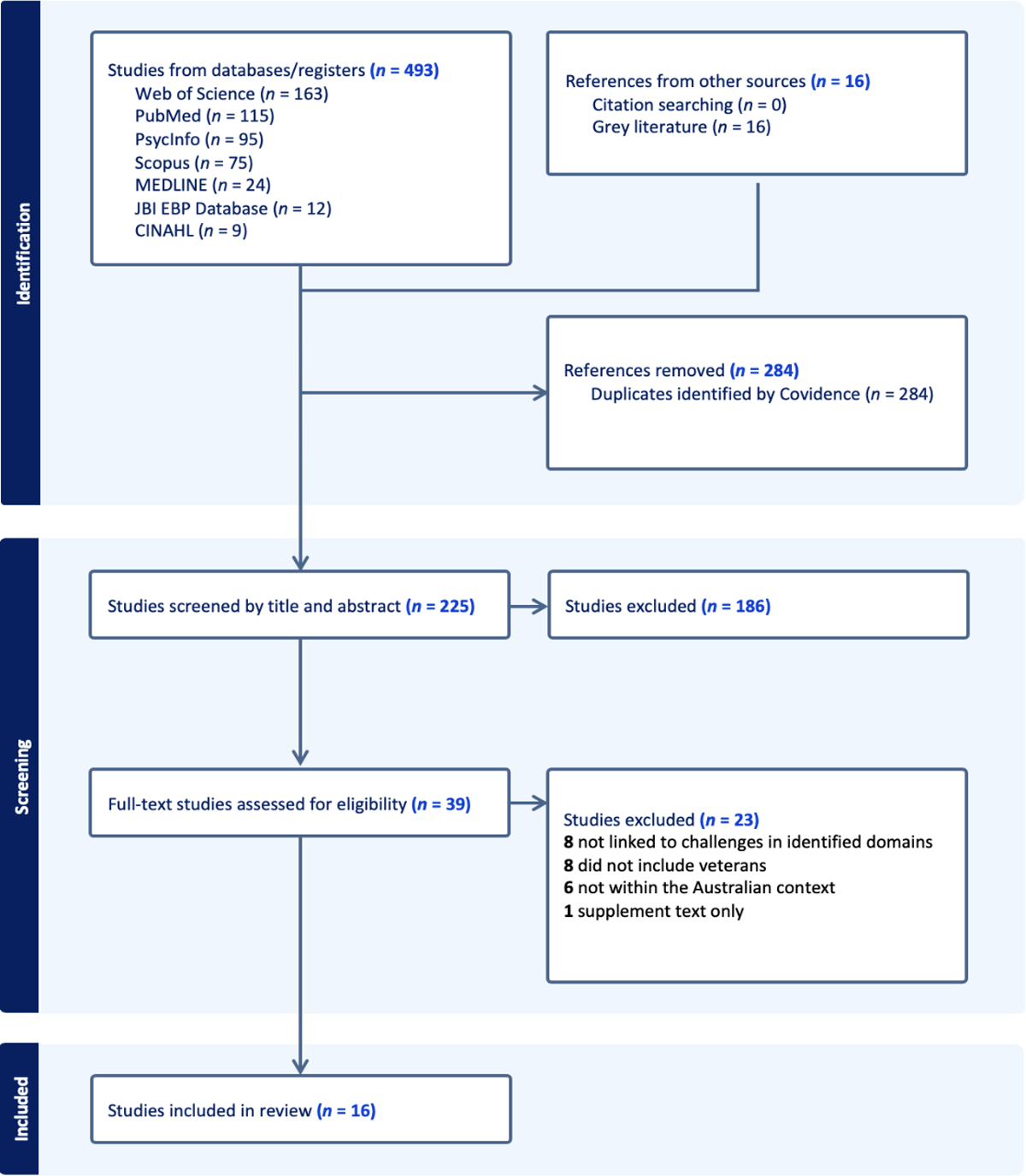
Figure 1
PRISMA Flow Diagram of the Selection of Studies.
Note. Adapted from Covidence Systematic Review Software (Veritas Health Innovation Limited, 2022).
Quality Assessment
Following the Joanna Briggs Institute (JBI) standards for scoping reviews, the included studies underwent a rigorous quality assessment. A minimum of two reviewers from the authorship independently evaluated each study using the JBI’s critical appraisal tools tailored to the respective study design (Joanna Briggs Institute, 2023). Studies were categorised by methodological strength as strong (<2 missing criteria), moderate (2–3 missing criteria), or weak (>3 missing criteria). To facilitate consistent comparisons, checklist scores were normalised to a mean of nine, accounting for variations in checklist length (Lockwood et al., 2015).
Of the assessed studies, three were classified as strong and seven as moderate. Quality ratings were determined objectively and independently rather than compared across studies within the review. Owing to the absence of an appropriate JBI checklist, one article and five reports were not assessed for quality. The unassessed article by Forbes & Metcalf (2014) is a thematic overview rather than an empirical study and therefore lacks the defined study design, sampling procedures, and outcome reporting required for standard critical-appraisal tools. Although the unassessed reports include original research, their mixed or non-standard designs and reporting formats likewise did not align with the structure of existing JBI checklists, making formal appraisal impractical. In accordance with scoping review guidelines, all studies were included regardless of quality ratings, reflecting the exploratory nature of this review and its focus on broadly mapping the available literature (Tricco et al., 2018).
Data Extraction
NVivo (version 1.7.1, QSR International, 2024) was utilised for data charting and qualitative thematic analysis, guided by the framework outlined by Pollock et al. (2023). In the preparation phase, a coding framework was developed, encompassing a broad category for barriers. During the organising phase, team members independently reviewed the studies, recording informal notes relevant to the research question. In the coding phase, barriers faced by veterans and their families in navigating health, social, or community domains were identified, categorised, and consolidated into codes derived from the literature. Provisional themes were generated by grouping similar or overlapping codes under unifying elements. These themes were refined and finalised through team discussions. To ensure consistency, coding was conducted by one team member (A.P.), using a predefined framework, with regular reviews by co-authors to minimise bias and errors. Three scheduled peer-review meetings were held with two co-authors to verify consistency, resolve ambiguities, and refine the codebook as needed. This collaborative verification process reflects recommended practice for scoping reviews that synthesise heterogeneous evidence (Tricco et al., 2018).
Results
Table 3 summarises the characteristics of the 16 studies included in this review that were published between 2013 and 2024. Four studies were published in 2018 (25%) and 2022 (25%), three in 2019 (19%) and 2023 (19%), and one each in 2014 (6%) and 2016 (6%). All research took place in Australia, with two involving US-based co-researchers (Becker et al., 2022; Maguire et al., 2022) and one including a Canadian collaborator (Lawn et al., 2022). The studies covered diverse topics across four key areas. Health-related research and social science studies were equally represented (38%). Within health-related fields, four studies examined mental health and two investigated broader health and well-being. In the social sciences, five studies analysed veteran support systems and one focused on homelessness. Workforce development accounted for three studies (18%), including two on employment and one on career construction. One study (6%) specifically addressed the transition process.
Table 3
Summary of Included Studies.
| CITATION | STUDY FORMAT (METHODOLOGY) | SAMPLE | STUDY AIM | QUALITY ASSESSMENT | BARRIERS IDENTIFIED: | |||
|---|---|---|---|---|---|---|---|---|
| COMPLEXITY AND POOR SERVICE COORDINATION | ACCESSIBILITY | EMPLOYMENT AND TRANSFERABILITY OF MILITARY SKILLS | AWARENESS OF AVAILABLE SERVICES AND RESOURCES | |||||
| Aspen Foundation, 2016 | Report (Mapping) | – | To assess the needs of veterans and their families, map ESO focus and services, and identify gaps or overlaps within the sector. | – | ✓ | ✓ | ✗ | ✓ |
| Becker et al., 2022 | Article (Qualitative/interviews) | n = 31 Ex-serving ADF veterans | To identify ways for human resource management professionals to improve veteran integration and retention in a civilian workplace. | Moderate | ✗ | ✗ | ✓ | ✗ |
| Carra et al., 2023 | Article (Qualitative/interviews) | n = 10 Ex-serving ADF veterans | To explore rural veterans’ experiences of participating in occupations and its influence on their health and adjustment. | Strong | ✗ | ✓ | ✓ | ✗ |
| Cornall, 2018 | Report (Scoping) | – | To examine the range of advocacy and welfare services available to veterans and their families. | – | ✓ | ✗ | ✗ | ✗ |
| Daraganova, Smart, & Romaniuk, 2018 | Report (Mixed Method/survey) | n = 8,490 Currently serving ADF members n = 4,337 Ex-serving ADF veterans n = 2,573 Family members | An examination of the health and well-being of family members associated with current and former ADF personnel, accompanied by a comparative analysis. | Moderate | ✓ | ✓ | ✓ | ✓ |
| Forbes & Metcalf, 2014 | Article (Descriptive) | - | An overview of veteran mental health care delivery. | – | ✓ | ✓ | ✓ | ✗ |
| Forbes et al., 2018 | Report (Qualitative/interviews and survey) | n = 20,031 Currently serving ADF members n = 4,326 Ex-serving ADF veterans Mixed sub-sample = 1,384 | To assess pathways to care for ex-serving veterans and Regular ADF members, including those with a probable 30-day mental disorder. | Moderate | ✓ | ✓ | ✗ | ✓ |
| Lawn et al., 2022 | Article (Qualitative/interviews) | n = 25 Family members of ADF veterans and emergency service first responders. Note. n = 14 of the sample had also served. | To examine how families experience supporting veterans and emergency services first responders in accessing mental health care, and to explore the significance of these interactions. | Strong | ✓ | ✓ | ✗ | ✗ |
| Maguire et al., 2022 | Article (Qualitative/focus group and interviews) | n = 18 Frontline service providers n = 16 Family members of veterans | To gather detailed information on the complex needs of veteran families and explore experiences of accessing and navigating the veterans’ support system. | Strong | ✓ | ✓ | ✓ | ✓ |
| Muir, 2018 | Report (Cross-sectional) | n = 25 Family members of veterans | To explore family strategies in managing transition into civilian life. | Strong | ✗ | ✗ | ✓ | ✓ |
| Productivity Commission, 2019a | Report (Descriptive) | – | To assess the benefits and impacts of the veteran support system on the lives of veterans. | – | ✓ | ✗ | ✓ | ✓ |
| Productivity Commission, 2019b | Report (Descriptive) | – | To assess the benefits and impacts of the veteran support system on the lives of veterans. | – | ✓ | ✓ | ✗ | ✓ |
| Romaniuk et al., 2023 | Article (Qualitative/interviews) | n = 35 Ex-serving ADF veterans (interviews) | To examine post-discharge civilian employment challenges for Australian military veterans. | Moderate | ✗ | ✗ | ✓ | ✗ |
| Ross, Prguda & Setchell, 2023 | Article (Qualitative/interviews and survey) | n = 93 Ex-serving ADF veterans | To identify veterans’ experiences of healthcare, including challenges in transitioning to the civilian healthcare system. | Moderate | ✓ | ✓ | ✗ | ✗ |
| Royal Commission into Defence and Veteran Suicide, 2023 | Report (Descriptive) | – | The inquiry is underpinned by the objective to enhance the lifetime well-being for serving and ex-serving ADF members and their families. | – | ✗ | ✗ | ✓ | ✗ |
| Van Hooff et al., 2019 | Report (Quantitative/survey) | n = 4,324 Ex-serving ADF veterans | To offer a nationwide veteran homelessness estimate and analyse homelessness characteristics among former ADF members. | Moderate | ✗ | ✓ | ✓ | ✓ |
All studies centred on Australian military veterans, with 10 (63%) also including veteran family members. Definitions of “family” varied; three studies (30%) adopted a broad definition that included spouses, parents, siblings, adult children, and other relatives, three (30%) provided no explicit definition, two (20%) included partners, children, widow(er)s, dependants and parents or siblings, and two (20%) restricted the term to spouses or partners and children. The synthesis of the included literature identified four key themes related to barriers encountered during reintegration.
Narrative Synthesis
Theme 1: Complexity and Poor Service Coordination
The most frequently reported barrier was the complexity and lack of coordination across core support systems, discussed in 11 of the 16 studies. Three studies described the Australian service landscape as fragmented and difficult to navigate, particularly in health, social, and community domains. This fragmentation was attributed to the co-existence of multiple payer-provider schemes operating across different levels of government, alongside a diverse mix of service delivery actors such as commercial contractors and non-profit organisations (Forbes & Metcalf, 2014; Maguire et al., 2022; Ross et al., 2023). The Productivity Commission (2019a) reported that overlapping roles of key federal government departments, including the Department of Defence (DoD), Department of Veterans’ Affairs (DVA), National Disability Insurance Agency, and My Aged Care, further complicate service navigation for veteran families. Forbes and Metcalf (2014) stressed that this maze of intersecting institutions generates bureaucratic delays, inadequate coordination, and increased burdens for veterans, often causing them to fall through service gaps.
Three studies highlighted how the shift from a structured military environment to an unstructured civilian system creates significant navigation challenges for veterans and their families (Forbes et al., 2018; Lawn et al., 2022; Ross et al., 2023). The absence of agreed service standards, formal communication structures, and a unified entry point in the veterans’ non-profit sector further intensifies these challenges (Aspen Foundation, 2016). Four studies also reported that veterans face substantial barriers in navigating the intricate framework of compensation and rehabilitation legislation (Cornall, 2018; Daraganova et al., 2018; Productivity Commission, 2019b; Royal Commission, 2023). Legislation governing access to services such as healthcare and income payments often obliges veterans to navigate complex Acts and administrative processes, creating a need for external advocacy assistance (Prevett & Lâm, 2025; Productivity Commission, 2019a). However, Cornall (2018) noted that access to a qualified advocate remains a significant barrier, particularly for younger and women veterans, who frequently hesitate to engage with traditional ex-service organisations (ESOs) and their predominantly male-dominated advocacy services.
Theme 2: Accessibility of Services and Support
Ten studies reported constrained access to services and resources as a persistent barrier for veterans and their families. Six studies highlighted the difficulties veterans encounter when relocating to rural or remote regions, where essential provisions are often unevenly distributed or absent altogether (Aspen Foundation, 2016; Carra et al., 2023; Daraganova et al., 2018; Forbes & Metcalf, 2014; Maguire et al., 2022; Ross et al., 2023). The Aspen Foundation (2016) found that younger veterans are more represented in these isolated areas compared to urban centres, which lack adequate support services compared to metropolitan regions with more established ESO and healthcare networks. Rural veterans often experience both social and geographic isolation, compounding the difficulty of securing specialised care amid hospital closures, workforce shortages, and limited healthcare infrastructure (Daraganova et al., 2018; Maguire et al., 2022; Ross et al., 2023). Forbes and Metcalf (2014) observed that Australia’s vast size, sparse population, and long distances between rural towns and major cities intensify these spatial disparities.
Seven studies identified financial barriers, particularly travel costs, as compounding accessibility challenges, especially for veterans with limited financial resources after service (Daraganova et al., 2018; Forbes et al., 2018; Forbes & Metcalf, 2014; Maguire et al., 2022; Productivity Commission, 2019b; Ross et al., 2023; Van Hooff et al., 2019). These studies show that veterans and their families experience financial strain after losing ADF support, a situation exacerbated by the high cost of living and the expense of civilian healthcare. Inadequate DVA coverage or denied claims can further intensify these financial barriers. Under such conditions, securing clinicians in remote areas willing to accept DVA clients becomes more difficult, a challenge especially acute for homeless veterans (Van Hooff et al., 2019; Lawn et al., 2022).
Theme 3: Employment and Transferability of Military Skills
Eight studies identified the difficulty of translating military skills into civilian employment as a major barrier to reintegration. The Royal Commission into Defence and Veteran Suicide (2023) emphasised that meaningful civilian employment is essential for veterans’ financial stability and mental well-being, both of which underpin successful reintegration. Carra et al. (2023) further described a profound sense of loss many veterans feel after leaving military service and their strong desire to regain purpose and fulfillment in civilian life through meaningful work. Becker et al. (2022) reported that veterans often struggle to present their military expertise in terms understandable to civilian employers. This difficulty was shown to significantly affect veterans’ success in securing employment (Romaniuk et al., 2023). Two studies also found that many veterans lack preparedness for civilian employment, particularly when it came to tasks such as resume preparation, job applications, and interviews (Maguire et al., 2022; Royal Commission, 2023). Three studies acknowledged that Australian workplaces generally fail to recognise military skillsets or translate them into formal qualifications (Becker et al., 2022; Muir, 2018; Productivity Commission, 2019a), placing veterans at a disadvantage in the civilian job market (Van Hooff et al., 2019).
The Productivity Commission (2019a) observed that, during transition, veterans may face reduced incomes from not securing employment at the same time as incurring additional costs for relocation, housing, and healthcare. Veterans leaving the ADF due to illness or disability encounter even greater challenges due to diminished income-earning capacity (Productivity Commission, 2019a). Becker et al. (2022) found that reskilling or formalising military experience is frequently necessary to obtain suitable employment, creating unexpected financial costs. According to Daraganova et al. (2018), these employment barriers have left some veterans unable to meet mortgage or rental payments, prompting them to pawn or sell belongings, and seek financial assistance from friends, family, or community organisations. Van Hooff et al. (2019) noted that such financial pressures increase the risk of homelessness, and for those affected, unstable housing creates additional obstacles to obtaining stable employment and achieving successful reintegration into civilian life.
Theme 4: Awareness of Available Services and Resources
Seven studies documented limited awareness of available services and resources as a critical barrier for veterans and their families. Several highlighted that this lack of awareness contributed to the underutilisation of essential support services (Daraganova et al., 2018; Forbes et al., 2018; Muir, 2018). Muir (2018) reported that veterans expressed a need for resources or services that were already available, though unknown to them. Maguire et al. (2022) further noted that some families struggled to locate service providers who were culturally competent and familiar with the unique aspects of military life. The Productivity Commission (2019a; 2019b) found that unawareness of DVA entitlements, including mental health support, led many veterans to forgo available transition services.
This lack of awareness extended to DVA-funded treatment for mental health conditions under non-liability arrangements and the broader availability of mental health services (Productivity Commission, 2019b). Given the heightened risks of mental health issues and suicide during reintegration, this barrier can have especially serious consequences for transitioning veterans and their families. Veterans experiencing housing instability also frequently require access to a range of specialised services. Van Hooff et al. (2019) observed that although such support was needed, most individuals who had experienced homelessness within the past 12 months did not seek assistance, with almost one in three attributing this to limited awareness of available services.
Discussion
This scoping review maps the institutional and structural barriers that Australian veterans and their families encounter when seeking support in the health, social, and community domains. Analysis of the 16 selected studies identified four interrelated themes: system complexity and poor coordination, limited accessibility, obstacles to employment and skills transfer, and limited awareness of available resources. Adopting a systems-oriented lens, the review shows that structural conditions, rather than individual factors alone, drive reintegration difficulties. Comparative insights from other Five Eyes nations reinforce this point. In the US, support for military veterans is delivered through a broad, decentralised network spanning federal government departments, state and municipal agencies (Huitink et al., 2018). There are more than 40,000 veteran non-profit organisations, and thousands of local health and human service providers (Huitink et al., 2018). This patchwork frequently produces fragmented delivery, duplicated processes, and gaps in care (Sjoberg et al., 2022; Vanneman et al., 2025). In the UK, the Armed Forces Covenant provides a framework for cross-sector collaboration; however, its implementation varies by area (House of Commons Defence Committee, 2025). In some regions, funding supports dedicated Covenant hubs and veteran-centred outreach; elsewhere, services default to generic national health service pathways with limited coordination (Ministry of Defence, 2024; Osborne et al., 2021).
Despite comparatively centralised welfare systems, Canada and New Zealand continue to deliver fragmented and weakly coordinated services (Atlas Institute for Veterans and Families, 2025; Social Wellbeing Agency, 2024). Compounding this, provider shortages in rural and remote areas, and unreliable digital infrastructure disrupt veterans’ continuity of care. These shared system-level tensions, including fragmentation and uneven coordination indicate that Australia’s challenges mirror those seen across allied democracies. The following sections examine each theme identified in this review and consider its implications for national reform in Australia.
Complexity and Poor Service Coordination
Veterans are transitioning from a highly structured and centralised military system into a civilian environment that is fragmented, inconsistent, and difficult to navigate (Wadham & Morris, 2019). Overlapping jurisdictions, multiple providers, and unclear eligibility criteria generate confusion. Consequently, many veterans need to engage with several agencies, including the DoD, DVA, and mainstream health and welfare services. Each organisation applies its own rules and administrative processes, forming a complex service landscape that many veterans struggle to navigate without guidance or sustained advocacy.
This complexity intensifies for veterans experiencing mental health issues, financial stress, or social disconnection. The absence of a unified entry point and weak communication between providers creates delays and gaps in care. These barriers disproportionately affect groups already at higher risk of disengagement, including younger veterans, women veterans, and those who choose not to engage with traditional ESOs (Prevett et al., 2025). Addressing these challenges requires investment in integrated service systems, clearer pathways of support, and reforms that reduce the administrative burden on veterans.
Accessibility of Services and Support
Access to services remains uneven across Australia, with veterans in rural or remote areas facing greater structural disadvantages than those in urban centres. Studies report shortages of qualified providers, long travel distances, and limited public transport options. For veterans experiencing financial insecurity, the cost of reaching specialist services can be prohibitive. These conditions often result in delays in treatment, missed appointments, or complete disengagement from the support system (Prevett et al., 2024).
Telehealth extends the reach of services; however, it cannot fully substitute for in-person care, particularly for long-term mental health or rehabilitation needs. Digital solutions also assume reliable internet access and digital literacy, which are not universal. Addressing these disparities requires investment in regional health infrastructure, targeted funding for rural healthcare, and subsidised travel programs, ensuring that geography does not determine the standard of care veterans receive.
Employment and Transferability of Military Skills
Translating military skills and experience into civilian employment remains a pressing challenge. Many ADF roles have no direct civilian equivalent, which limits formal recognition of prior learning (Wadham et al., 2024). Competency-mapping frameworks could help identify and validate transferable capabilities that align with civilian job requirements. In their absence, however, veterans often need to undertake additional training or education, which can delay workforce entry and increase financial strain.
Military service cultivates broad and transferable skills in leadership, logistics, risk and safety management, project planning, and effective communication. Employers and the Registered Training Organisation (RTO) system do not consistently recognise these competencies (Australian Skills Quality Authority, 2025). Risk-averse assessment practices can tend to favour conventional civilian pathways over military experience (Wadham et al., 2024). Addressing these gaps requires expanding recognition mechanisms beyond the traditional RTO framework and allowing tailored assessment of military-acquired skills.
Effective transition programs could prioritise converting military skills into formal civilian qualifications, complemented by career coaching and job-readiness support. Educating employers about the value of military experience can reduce bias and improve inclusion. Financial measures, such as a veteran education allowance, can offset the costs of reskilling and enhance employability. Together, these actions would strengthen financial stability, reduce mental health risks linked to unemployment, lower the likelihood of homelessness, and support long-term well-being.
Awareness of Available Services and Resources
Across the reviewed literature, a recurring theme is limited awareness of what services exist, how to access them, and who is eligible. Some veterans mistakenly believe that certain supports are no longer available to them after discharge, while others are unaware of DVA entitlements or non-liability mental health programs. As a result, many appropriate services go unused. Family members, who play a central role in facilitating access to care, also report confusion when navigating the civilian system. They describe difficulty finding providers familiar with military culture and receiving inconsistent information across sources. Addressing these issues requires clear and consistent communication, accessible online directories, and targeted outreach. Communication strategies should be designed to reach diverse veteran populations and account for cultural, linguistic, and digital barriers.
Interconnected Barriers and System-Level Implications
Although the four themes identified in this review are discussed separately, they are tightly interconnected. Difficulty securing employment is leading to financial insecurity, which in turn limits the ability to travel for healthcare. Poor coordination increases the risk of disengagement, further reducing awareness and access to services. These interdependencies highlight the need for system-level reform rather than isolated solutions. Establishing integrated entry points, improving cross-agency communication, and aligning funding and accountability across sectors could address multiple barriers simultaneously.
Evidence Gaps and Future Directions
This review highlights important existing gaps in the evidence base. Few studies use nationally representative data, and many rely on small qualitative samples. Research on the experiences of specific groups, including Indigenous veterans, women veterans, LGBTQIA+ veterans, and those discharged for medical reasons, remains limited. Longitudinal studies are also scarce, making it difficult to track how reintegration barriers change over time.
Addressing these gaps will ensure that reforms are based on a comprehensive understanding of veterans and their families. Key priorities include longitudinal cohort studies that follow individuals from pre-separation through reintegration, alongside independent evaluations of current reintegration services to measure effectiveness, identify unmet needs and duplication, and highlight opportunities for innovation and scaling of best practices. It is also critical to embed strong ethical safeguards in future research, particularly in studies involving vulnerable veteran populations such as those experiencing homelessness or mental health challenges. This includes trauma-informed approaches, culturally safe practices, clear and ongoing consent, and robust privacy and data protections. Building these safeguards into study design and evaluation will help protect participants, improve the quality of findings, and support the ethical integrity of veteran research.
To ensure practical implementation, the Department of Veterans’ Affairs is well-positioned to lead these efforts. As the national agency responsible for supporting the holistic well-being of Australian veterans and their families, it holds both the policy mandate and operational capacity to drive reform and embed ethical standards across funded initiatives. Its broad reach and established partnerships with government departments, service providers, research institutions, and the veteran community make it uniquely capable of translating evidence into systemic change.
Major Recommendations
Drawing on the evidence synthesised in this review, we propose five system-level actions to improve access, coordination, and outcomes for Australian veterans and their families:
National intake and navigation system: Establish a nationally coordinated intake and navigation service. Veterans using this system can enter via a single phone number, web portal, or any existing service point. Each person is assigned a single point of contact who organises referrals and provides ongoing case coordination across the veteran support ecosystem.
Service co-ordination and transition planning: Develop national standards for care planning, referral pathways, and transfer of care to civilian services during transition.
Rural and remote access: Expand outreach clinics and travel subsidies. Use blended telehealth models with in-person follow-up and offer targeted incentives to attract and retain professionals in underserved areas.
Employment and skills transfer: Develop a national skills crosswalk and recognition of prior learning pathway. Provide tailored career coaching and employer education to translate military experience into civilian qualifications and roles.
Service awareness and advocacy: Strengthen awareness and uptake of resources and support services through an accessible, plain-language, regularly updated service directory. Fund paid, professional advocacy programs with particular attention to the needs of younger and women veterans.
These recommendations are designed to be nationally scalable and implementable through partnerships across government and community providers.
Strengths and Limitations
This scoping review has several strengths. It methodically examined the available literature on the barriers encountered by Australian veterans and their families. By incorporating both peer-reviewed and grey literature, it broadened coverage in a field where research remains sparse. The research team consistently applied rigorous methods guided by a protocol developed and reviewed by an experienced team specialising in scoping reviews and knowledge synthesis. In collaboration with a senior research librarian, the team designed a search strategy that drew on seven electronic databases and an internet search engine to capture a wide range of relevant studies.
To enhance reliability and transparency, two reviewers independently screened and assessed all records, resolving disagreements through discussion and, when needed, third-reviewer adjudication. These procedures, together with the use of PRISMA-ScR reporting and JBI guidance, strengthen the credibility of the findings. Updated searches in December 2023 and April 2024 ensured that the review reflects the most current evidence.
Several limitations also warrant acknowledgment. The review’s broad scope was constrained by the paucity of research focused on Australian veterans. Only 16 studies met the inclusion criteria, highlighting the limited evidence base on reintegration, which may reduce the robustness and generalisability of the findings. For example, although studies frequently described barriers to care, the absence of longitudinal studies or large-scale national datasets prevents firm conclusions about the prevalence and universality of these barriers.
Including grey literature, which accounted for slightly more than half of the sources, enabled the review to capture a broader perspective while also introducing material that often lacks the consistency and rigour of peer-reviewed studies. Restricting the search to English-language publications and reports from 2013 to 2024 may also have excluded relevant studies in other languages or outside this time frame. Although two reviewers conducted data screening to enhance reliability, a single reviewer performed the thematic coding of extracted data, which may have introduced bias. This risk was mitigated through regular team reviews and validation of coding. Together, these strengths and limitations illustrate the challenges of conducting a scoping review in a field with limited literature. The findings emphasise the value of the existing evidence base and call for further large-scale, longitudinal, and representative studies to strengthen understanding of the barriers faced by Australian veterans and their families.
Conclusion
Veteran reintegration depends not only on individual effort; it also relies on the structures and institutions that provide support. This review demonstrates that Australia’s support systems remain fragmented, inconsistent, and difficult to navigate. Veterans and their families transition from a tightly organised military setting into a civilian environment marked by administrative complexity, unclear pathways, geographic inequities, and limited recognition of military skills. Although many policy initiatives aim to assist veterans, they often overlook these structural barriers that complicate reintegration. Veteran reintegration challenges do not reflect individual failings. They reflect systems misaligned with their lived experiences. While mental health, social networks, and community belonging remain essential, framing reintegration primarily as an individual psychosocial issue risks obscuring the structural conditions that shape post-service life.
Overcoming these structural barriers requires a shift in focus. Systems must adapt to the needs of veterans, rather than expecting veterans to adapt to existing systems. This involves designing policies and services that offer clarity, coherence, and genuine access, while recognising that post-service identity and contribution take many forms. Reintegration efforts must also reflect the diversity of veteran experiences, including the distinct circumstances faced by younger cohorts, culturally diverse individuals, women veterans, and those living outside major urban centres. Progress requires more than technical reform. It calls for sustained collaboration across governments, service providers, advocacy organisations, researchers, policymakers, and the veteran community, supported by stronger data and inclusive research. Although Australia’s context is unique, the structural barriers discussed in this article are not confined to national borders. Comparable Five Eyes nations face similar tensions, and through coordinated comparative initiatives, they can foster shared learning and practical innovation to strengthen veteran reintegration systems globally.
How a nation supports its veterans after service reflects its values. Reintegration should not be left to chance or depend on a veteran’s ability to navigate a system that was never designed with them in mind. Acting on the evidence synthesised here is not only a practical imperative; it is a moral and ethical obligation. Veterans and their families deserve more than symbolic recognition. They deserve post-service systems intentionally built to deliver clear, coherent, and dignified support.
Data Accessibility Statement
The data that support the findings of this study are available from the corresponding author upon reasonable request.
Ethics and Consent
This review was based exclusively on secondary analysis of published studies. All data were publicly available, and no new data were collected from human participants. The review was conducted in accordance with established ethical standards for secondary data analysis.
Acknowledgements
The authors would like to thank senior research librarian Claudio Dionigi from Charles Sturt University for his guidance and support in designing the search strategy used in this article.
Competing Interests
The authors have no competing interests to declare.