
America has a history of challenging the idea of who is capable of military heroism and questioning the selfless service of non-white service members (Boyd, 2021). Although enslaved Black men have been a part of American warfighting since the Revolutionary War, Black men have rarely, if ever, received the same notoriety of being deemed heroic or selfless because these terms were historically reserved for white men (Boyd, 2021). The ideology of whiteness has created exclusive boundaries around what it means to be American, an American hero, and a patriot by excluding minority groups (Theiss-Morse, 2009). Consequently, the association between heroism, selflessness, and whiteness is reinforced through media representation, historical narratives, and political rhetoric that have excluded and marginalized the contributions and perspectives of Black service members.
However, in the Persian Gulf during Operation DESERT SHIELD, there was a shift in how the Department of the Army would represent its fighting force through art. The purpose of this manuscript is to showcase artworks as more than just portraits but to present them as a disruption of the status quo and as an acknowledgment to the service members from underrepresented backgrounds who have served in the most complex and dangerous conditions while navigating societal prejudices. By showcasing Blackness as a marginalized identity, the chosen artist emphasized the individuality and humanity of each portrait subject, creating a deeper appreciation for the diverse experiences within the military while inspiring viewers to consider the broader implications of heroism, selfless service, and sacrifice.
The Artist
In 1992, the Department of the Army established an artist-in-residence position, which designated one active-duty artist to the U.S. Army Center of Military History (Forgey, 2024). The artists’ mission during their tenure was to document the contemporary Army through their preferred choice of artwork. Since its inception, numerous artists have depicted training activities, exercises, and deployments supporting the Global War on Terrorism through paintings, photography, and sculptures. The Army’s first artist-in-residence was Sergeant First Class Peter G. Varisano (later promoted to Master Sergeant [MSG]) (Forgey, 2024).
MSG Varisano contributed to two art teams–in 1989, he documented training exercises with the Wisconsin National Guard, and in 1990, he was tasked with capturing the events of Operation DESERT SHIELD. MSG Varisano served as the Noncommissioned Officer in charge of the U.S. Army Art Team at the Center of Military History for three years before his retirement (U.S. Center of Military History, 2024). During his tenure, MSG Varisano created several impressive watercolor portraits that disrupted the idea that Black service members had a small presence in American warfighting by capturing the crux of heroism and selfless service centered on Black male soldiers as his portrait subjects.
The Art
Three artworks were chosen from MSG Varisano’s collection to counter the prevailing stereotypes of Black men in the Army and highlight their heroism, selfless service, resilience, and leadership. The intent is for these artworks to allow the viewer to move beyond the stereotypical one-dimensional depictions of a soldier. Moreover, it accurately portrays Black men in America’s fighting force. In the following artworks, MSG Varisano’s decision to use watercolors to add softness to the portraits is in juxtaposition to the softness generally not awarded to or recognized in Black men because of stereotypes that depict them as aggressive, angry, and dangerous (Boyd, 2020). This softness creates a humanistic perspective to ensure their stories are conveyed with the dignity and respect they deserve.
American Hero
Varisano’s American Hero (1991a) is balanced carefully with the soldier as the focal point. This portrait is of a Black American male soldier wearing his battle dress uniform and Kevlar helmet whose presence is both powerful and sincere. His uniform has the rank of Staff Sergeant and the 82nd Airborne Division All-American shoulder insignia. He stands with his head held high and shoulders back, maintaining a soft but uncompromising look in his squinted eyes (See Figure 1).
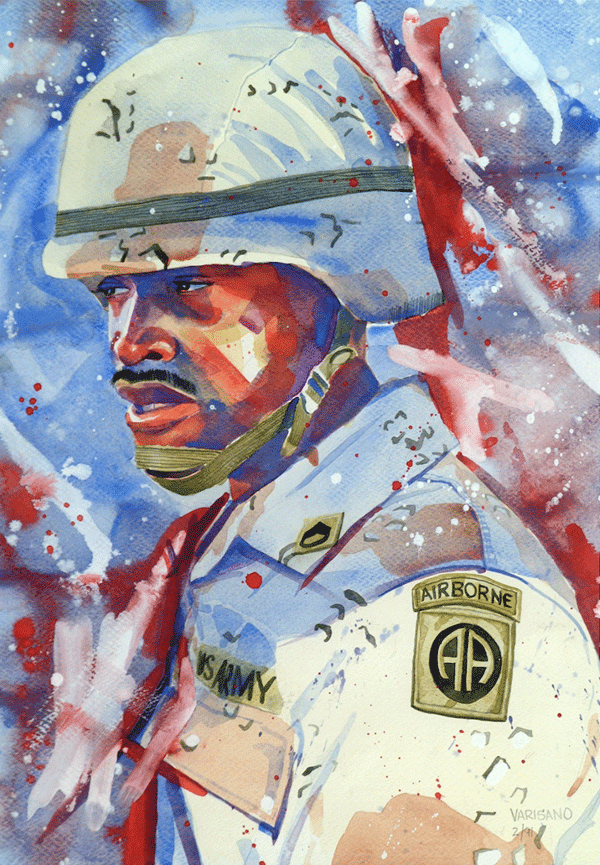
Figure 1
American Hero.
Note. By MSG Peter G. Varisano, 1991, This digital image is public domain from Catalog Number 1.51.91, U.S. Army Art Collection, National Archives Catalog.
The artist’s use of muted, earthy shades reflects the DESERT SHIELD military campaign and the desertic atmosphere. The brown, yellow, and red saturated tones of the soldier’s complexion add a rarely seen dynamic element within Army art and racial representation in the military. Additionally, the stark contrast of the red, white, and blue, indicative of the American flag, adds a vibrancy to make the soldier appear closer to the foreground, allowing him to invade the viewer’s space and forge a connection. One of the most notable aspects of American Hero is the emotion conveyed through the soldier’s realistic expression and posture, which speaks to the soldier’s sense of duty–unafraid and steadfast, underscoring his commitment to his country and the people he serves while also providing a snapshot of his identity as a leader. These attributes bring this subject to life by emphasizing the intensity and seriousness of combat and allowing the viewer to observe a moment of contemplation or decision-making, accurately representing an Army leader.
The title, American Hero, is straightforward and emphasizes themes of altruism and courage, which urges viewers to recognize his unquestionable heroism. MSG Varisano’s decision to choose this portrait subject instead of the usual white male soldier reinforces the approach to humanizing the historically dehumanized service member. Moreover, by creating a lens that looks beyond the ideologies of whiteness and by framing this Black American soldier, MSG Varisano disrupts the connotation between military service and white maleness that is often reinforced through media representation and historical narratives.
Chaplain Davis
Varisano’s Chaplain Davis (1991b) is more of a calming artwork that highlights the strength and compassion of a Black Army chaplain. This artwork depicts the portrait subject in his desert battle dress uniform, boonie hat, and thick black framed military-issued glasses. Unlike American Hero, he faces the viewer with his posture upright, maintaining his relaxed and calm yet firm demeanor. His placement makes it appear that he and the viewer are conversing with the portrait subject gazing directly out of the canvas. This allows the viewer to see directly into his eyes, which conveys a sense of empathetic intimacy and compassion, suggesting he is a soldier who carries the weight of his responsibilities without question while offering spiritual guidance and comfort to those he serves. His open-lipped smile exposes his broad, radiant teeth, which exude warmth and reinforce his patience and spiritual and emotional resilience during combat (See Figure 2).
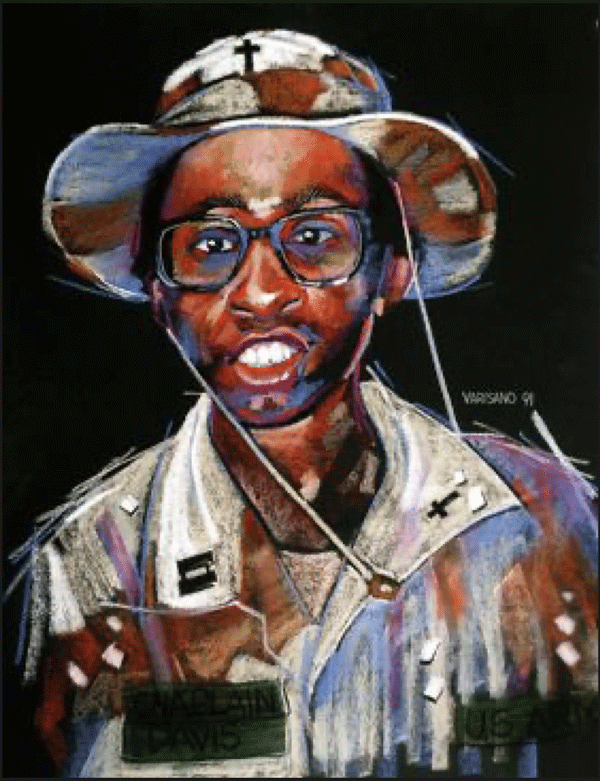
Figure 2
Chaplain Davis.
Note. By MSG Peter G. Varisano, 1991, This digital image is public domain from Catalog Number 1.51.91, U.S. Army Art Collection, National Archives Catalog.
The background, rendered in all black, leaves the viewer unaware of the environment, suggesting a sense of privacy and seclusion from wandering eyes and listening ears, which also illuminates Chaplain Davis in the portrait. This minimalist approach draws the viewer’s attention to his deep brown colored skin and the crucifix centered on his boonie hat and left collar–both critical symbols of his work as a spiritual leader and as a commissioned officer.
Unlike the vibrant use of color in American Hero, the artist’s use of the black background with the delicate blended layers of blues and varying browns to create a dreamlike sense of serenity presents the portrait subject as a representation of spirituality and the structured military environment. MSG Varisano captures the essence of an Army chaplain who serves as a beacon of optimism and spiritual care during uncertain times. The use of this portrait subject subtly addresses the theme of anti-black racial discrimination, as Black men were only allowed into the Chaplain Corps in restricted numbers beginning in 1918 (Slater, 2023). By focusing on a Black American soldier in a prominent and honorable role initially reserved for white men, Varisano’s Chaplain Davis challenges traditional narratives that Black men were incapable of holding and thriving in these positions. He offers a nuanced portrayal of a Black Army soldier and chaplain who is often overlooked and marginalized in the Army and visual history.
101st Ready for It
Varisano’s 101st Ready for It (1991c) is a more formidable artwork that indicates intense focus and readiness. This portrait centers on a single Black American soldier from the 101st Airborne Division. With his square masculine jaw, he is depicted in full combat gear, standing in a dynamic three-quarter profile position, holding his loaded rifle with a firm single-handed grip. Unlike American Hero and Chaplain Davis, the soldier’s expression and gear draw the viewer’s focus to his tactical readiness. His Kevlar helmet creates such an intense shadow that his face and eyes can barely be seen as he maintains his expression of concentration and preparedness, conveying a sense of anticipation for combat action (See Figure 3).
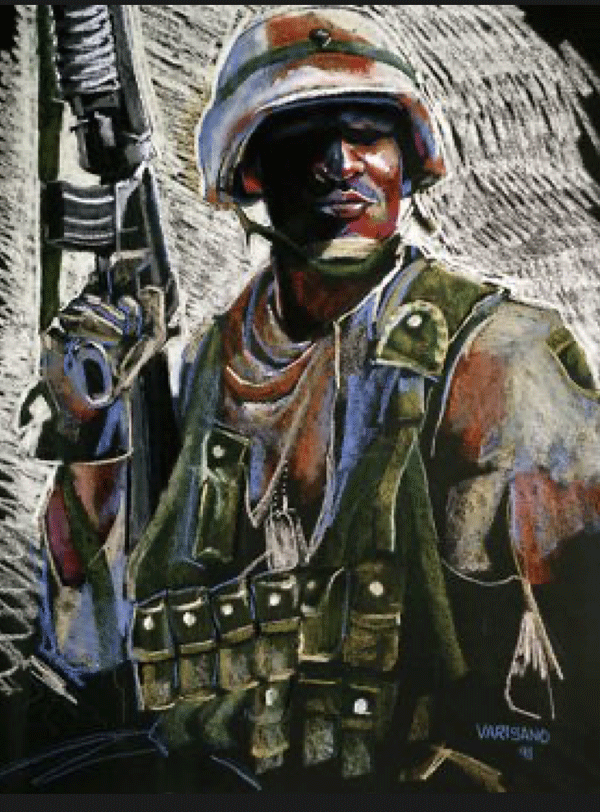
Figure 3
101st Ready for It.
Note. By MSG Peter G. Varisano, 1991, This digital image is public domain from Catalog Number 1.51.91, U.S. Army Art Collection, National Archives Catalog.
In this portrait, the artist uses correlating colors of concentrated greens and black to create deep shadows to activate the viewer’s imagination. The contrast between light and dark creates a moody yet suspenseful implication of the environment and future events. The background comprises white, rugged, textured brushstrokes, emphasizing the contrast in shadows to illuminate the soldier as the focal point. The harsh lines of his shoulders and his grip on the rifle handle create tension between stillness and action as a reminder to always be ready for sudden change. The portrayal of a Black American soldier in this role is significant because this representation not only honors his bravery but the bravery of individuals like him and acknowledges the contributions and sacrifices of every Black man who has served.
Discussion
These artworks symbolize varying experiences within the military, emphasizing that heroism and commitment to duty transcend and enrich the collective story of military service in America. Through art, MSG Varisano has captured his portrait subjects’ humanity, heroism, and selfless service by highlighting the Black men who dedicate their lives to a country that has marginalized, oppressed, and denied them equality. Moreover, his artwork disrupts commonly held stereotypes and representations of soldiers, particularly in the context of race. Traditional narratives in American military art and history have often centered around white male figures, which can overshadow the significant contributions of soldiers from diverse racial and ethnic backgrounds. By depicting Black American soldiers in a position of focus, composure, strength, and readiness, MSG Varisano emphasizes the critical role that Black men have played in the U.S. Army. This representation broadens the understanding of what it means to be a soldier, underscoring that heroism and dedication to duty are not limited to a specific race. These artworks testify to MSG Varisano’s skill and deep understanding of military life. His ability to convey the visual elements and his subject’s emotional and psychological well-being makes his artwork stand out in the U.S. Army Art Collection. View more artworks from MSG Varisano at https://catalog.archives.gov/search?page=1&q=Peter%20G%2C%20Varisano.
Conclusion
This manuscript aimed to interpret and communicate the significance and impact of the artworks of MSG Varisano by offering insight into a broader context. Also, it encourages the viewers to think more deeply about the artworks, their message, and the chosen aesthetic conveyed by enhancing the appreciation for the art and, most importantly, its portrait subjects.
Competing Interests
The author has no competing interests to declare.