
Estonia is a very small country with only 1.3 million inhabitants over an area of 45,000 square kilometres. The country has a 339 km land boundary with Latvia, a 207 km land boundary (including rivers) with Russia, and a lake boundary of 126 km with Russia. Its overseas neighbours are Finland, to the north, and Sweden, to the west.
Since maintaining a professional army with sufficient capabilities would be burdensome for such a small population, Estonia has chosen to build its national defence based on the reserve army model. Therefore, all male citizens are obligated to enter into conscript service, while female citizens can volunteer.
Conscript service lasts between 8 and 11 months, after which the person is assigned to a military wartime post and exercises are organised annually. The national defence obligation register contains the data of 269,920 persons (Republic of Estonia Ministry of Defence, 2021, p. 8), which includes both serviceman who have entered the reserve and call-up selectees. On 1 January 2021, there were 3,655 active servicemen and 3,516 conscripts (including 54 female conscripts) in daily peacetime service (Republic of Estonia Ministry of Defence, 2021, p. 5).
The largest military force is the Army, while the Navy and the Air Force are smaller. Conscripts only serve in the Army and the Navy, with the Air Force being comprised only of professional servicemen.
The Estonian Defence League, a volunteer national defence organisation with regional district units and nearly 26,000 members, is also an important part of Estonia’s national defence (Republic of Estonia Ministry of Defence, 2020, p. 5). These are volunteer men and women who have committed to at least 48 hours of training each year. The Defence League also participates with its units in deployments. In a situation of war, the Defence League is having a significant role of providing territorial defence.
The Military Development of Etonian National Defense in 2031 (Republic of Estonia Ministry of Defense, 2022) defines the broad approach to the defence as a vital principle. According to the idea, in case of a crisis, the government will use all capabilities and personnel (including non-military) to protect the country.
Definition of a Veteran
In 2012, the Government approved the Policy Regarding Veterans of the Defence Forces and the Defence League (Republic of Estonoia Ministry of Defence, 2012, p. 5). The policy defined three criteria under which a serviceman or member of a Defence League district may qualify for veteran status. According to the policy, a veteran is a person who:
Has participated in the military defence of the country as a member of the Defence Forces;
Has participated in an international or collective self-defence operation as a member of the Defence Forces and on the basis of the International Military Cooperation Act;
Has suffered a service-related permanent disability while discharging duties in the Defence Forces or in Defence League military training.
Fortunately, Estonia has not had to defend itself militarily since World War II, and the group of veterans is therefore made up of persons meeting Criteria 2 and 3.
According to Dandaker and coauthors (2006), the definition of a veteran can be inclusive, in which case a very large number of servicemen receive veteran status, or exclusive, in which case a very small number of servicemen receive veteran status on the basis of a specific criterion (p. 162). It can be said that the definition of a veteran in Estonia is exclusive, granting the status to only a select few.
Most of the 3,400 veterans have been granted the status due to their participation in a mission, and almost 200 veterans have been granted the status due to an injury sustained in the line of duty. It is also worth noting that the Afghanistan deployment has been the largest mission by the Estonian Defence Forces, with nearly 1,500 veterans having received their status during the Afghanistan mission.
Veteran status also extends to conscripts; if a conscript suffers a permanent injury while discharging service duties, they are awarded veteran status. Veteran status is awarded for the lifetime of a member of the Defence Forces, it cannot be rescinded.
It should be noted that veteran status in Estonia does not require leaving the service. After a foreign deployment, a serviceman is awarded veteran status and is free to serve for many years and go on repeated missions.
The group of veterans can be split approximately in half—with half serving and other half as service-leavers. Figure 1 (below) shows the breakdown of the total group of veterans by age and service status with the largest group of veterans in the 30 to 50 age range.
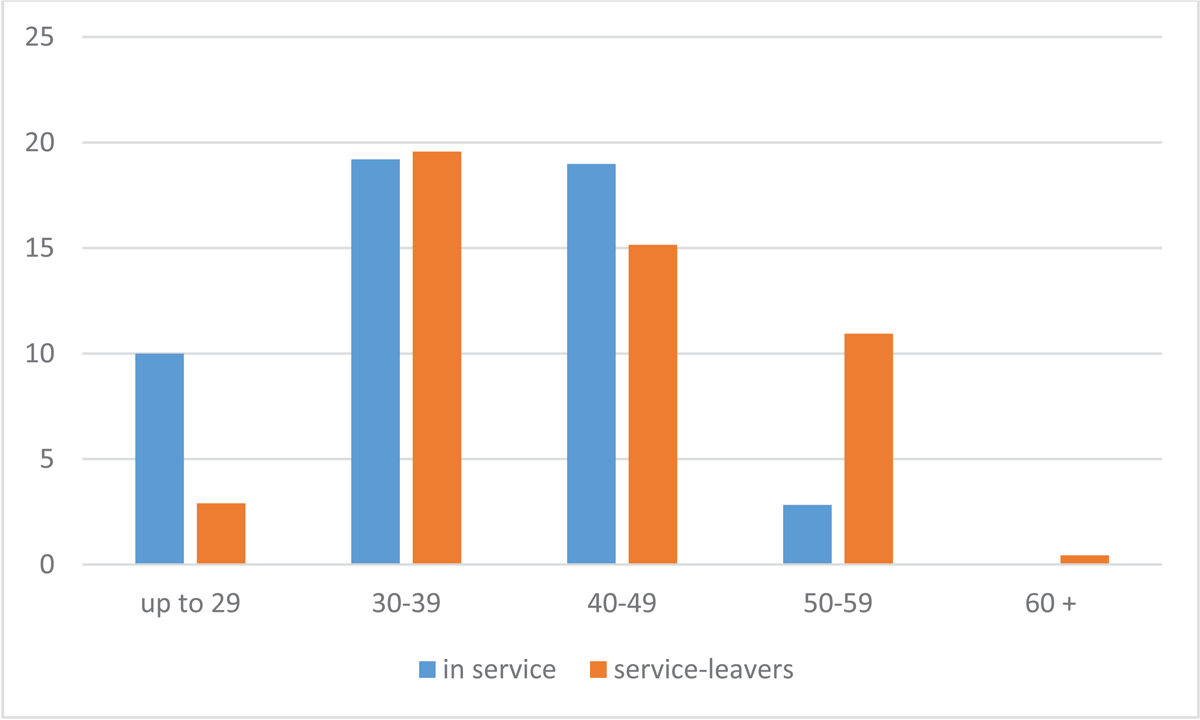
Figure 1
Veterans According to Age and Service Status (in %).
Helping to explain the average age of veterans is the fact that the Estonian Defence Forces were re-established following the end of the Soviet occupation in 1991, and participation in the first foreign missions began in 1995. As a result, the relatively young age of the Estonian Defence Forces also ensures that the average age of veterans is not very high.
Similarly, being permanently injured in the line of duty does not necessarily mean leaving the service. It is also possible to find a suitable post for an injured serviceman in the Defence Forces, to permit them to continue serving, and many of them do so.
The Policy Regarding Veterans of the Defence Forces and the Defence League (see Republic of Estonoia Ministry of Defence, 2012), lists a total of 51 activities or services provided to veterans. The nature of these services is supportive of the military-civilian transition, i.e., that the veterans policy provides for their reintegration into society and subsequent self-sufficiency. Veterans policy services are needs-based—a corresponding need for assistance must be identified in order to receive a service or benefit. It is also necessary for the professional to be able to organise the assistance in such a way that it solves the specific problem.
To recognise and raise awareness about veterans, Veterans Month has been celebrated each April since the approval of the veterans policy in 2013, culminating in the open-air Veterans Rock concert on April 23, which is free to all and broadcast on national television.
The hepatica flower has been adopted as the symbol of veterans (see Figure 2 below), it is sold on a charitable basis every April, with the proceeds received traditionally supporting the fields of rehabilitation and mental health. It is important to point out that the nonprofit organisation Union of Wounded Troops, which organises the sale of liverwort flowers, is not collecting the money for itself, instead supporting civil society organisations. This is done in order to avoid creating the stereotype of veterans being dependent on assistance and to promote the message that veterans are self-reliant people who help the weakest members of society.

Figure 2
Symbol of Estonian Veterans.
Problems Faced by People Leaving the Service
It is true that public opinion tends to expect veterans to have problems, be they social, medical, psychological, economic, or other. What is mostly overlooked is that Estonian veterans are 30–50 year old men who are in above-average shape, and so it would be reasonable to ask how they will continue to realise themselves and contribute positively to society after they have completed their service in the armed forces. On the other hand, it is also fair that if the traumas they experienced in the line of duty present an obstacle to coping later on, it would be socially responsible for the Defence Forces, as the former employer, to address these problems. In order to ensure that people in need have access to services in a timely manner, it is of course important to start the process of raising awareness and offering opportunities for assistance before going on a mission. At the same time, the families of veterans must also be informed about the opportunities available to them for obtaining assistance. Information on the possible need for assistance must also be collected methodically, to ensure the availability of the best and most appropriate assistance. Moreover, needs mapping also depends on what is being studied, what research questions are being asked, and what research methods are being used.
Concerning service-leavers there might be also subjective issues as the perception of losing recognition. Truusa and colleagues (2019) found that those veterans who have left the service are perceiving less societal recognition. Even though that perception is subjective, and in reality, all veterans are treated by the government on equal basis, it creates a ground for lower self-esteem and life satisfaction (Truusa et al., 2019).
In the 2021 Veterans Survey (Siplane, 2021), I used a questionnaire to find out from what type of institutions veterans, in general, would like to receive help from after their mission. It turned out that the most support is actually needed from family and friends. This was followed by superiors and fellow servicemen, who were considered important helpers, while professional helpers (psychologists, chaplains and social workers) emerged as the third group of helpers (Siplane, 2021, p. 3). The situation depicted in Figure 3 (below) means that a large share of need assistance remains unregistered within the formal support system and the nature of the need assistance remains unknown. At the same time, it also represents a challenge for better cooperation between professionals and family members in the future.
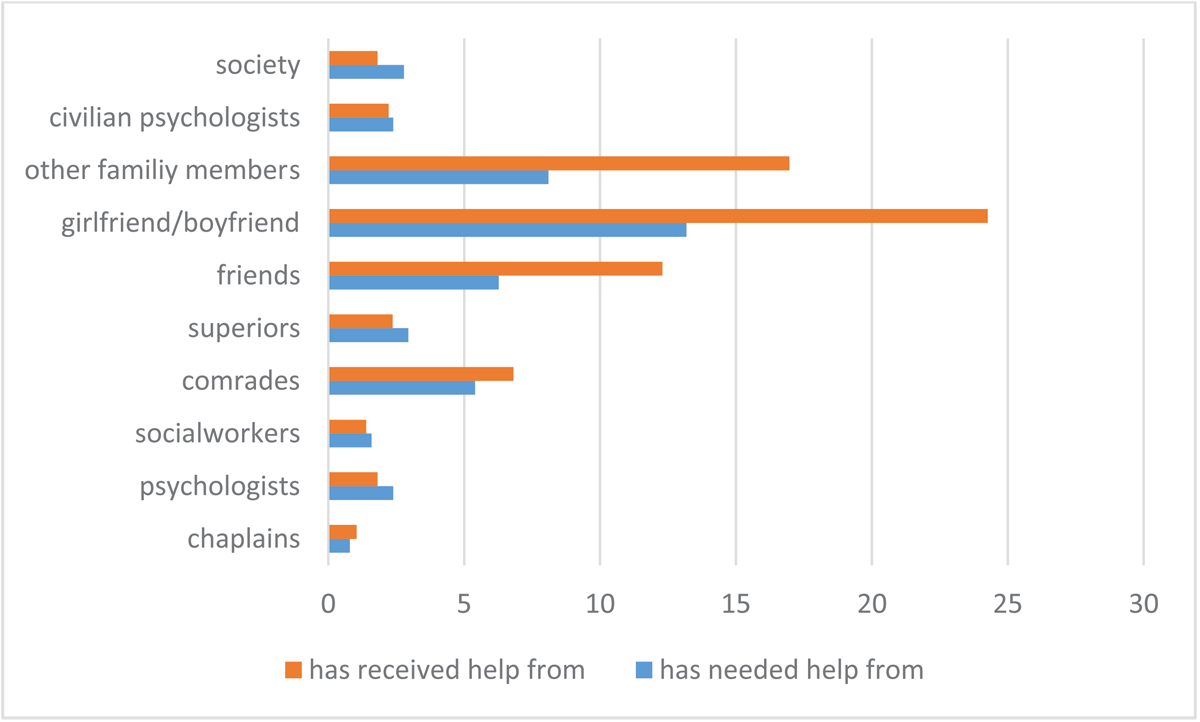
Figure 3
From Whom Does a Veteran Receive Help?
Note. Numbers are based on percentages.
In one of my previous articles (see Siplane, 2016), I noted that people leave the Estonian Defence Forces with unrealistically high expectations regarding their civilian career. While it is claimed that a new and better job in the civilian sector is waiting when leaving the service, records show that very often (more often than, for example, ex-police officers), they experience unemployment soon after leaving the service. They then undergo a civilian retraining programme as unemployed, and in the vast majority of cases, the new job of the unemployed ex-serviceman is in maritime or onshore logistics (Siplane, 2016).
Moving from the specific issue of employment to general well-being, in the 2021 questionnaire survey (see Siplane, 2021, p. 6), I asked veterans who had left the service to rate their satisfaction with their lives in general. The respondents were able to estimate their life-satisfaction on a 100-point scale where higher numerical scores reflected higher satisfaction with life. Figure 4 (below) shows that the vast majority rate their coping and well-being highly.
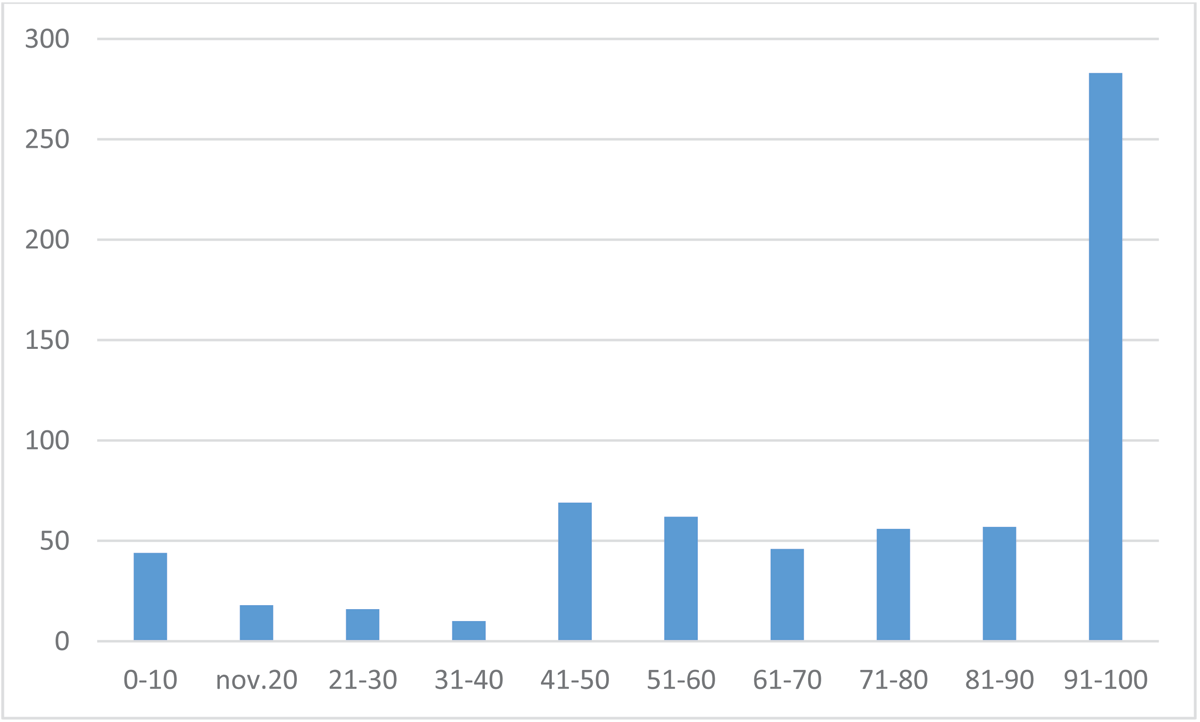
Figure 4
How do Service-Leavers Rate Their Post-Service Well-Being.
Note. Absolute figures. From Siplane, 2021.
If we were to search for a variable that predicts a lower assessment of one’s coping, it is experiencing unemployment. This means not only being unemployed at the time of the survey, but experiencing unemployment in general at one point or another after leaving the service (Siplane, 2021).
Assistance Provided
The assistance provided for veterans from governmental support mechanisms can be divided into two types: assistance that is offered to everyone, without imposing any additional criteria, and assistance that is only available for certain specific needs. All veterans have the right to free social, psychological, medical, vocational, and pastoral counselling, both during and after leaving the service. A member of the veteran’s family has the same right to counselling.
All veterans have the right to claim the payment of retraining costs by the Defence Forces at the time of leaving the service and also have the right to apply for a loan guarantee from the state when taking out a housing loan.
If a veteran has a disability and the disability is service-related, then the services and rehabilitation is provided by the governmental support mechanisms, even if the person is no longer in service, or if years have passed since the initial trauma. This is especially critical in the field of mental health, because the consequences of trauma can reveal themselves several years later.
If a veteran has sustained a permanent injury (including a mental health disorder) in the line of duty, then needs-based and much more comprehensive support measures apply. An injured veteran receives a one-time compensation of up to 96 times the average monthly wage in Estonia (Defense Service Act, 2013) and a monthly pension, which can be more than the average gross wage, depending on the severity of the injury. The injured veteran is provided with medical treatment, assistive devices, and home or workplace adaptations as needed. If necsessary, transport to a medical institution and accommodation for a family member visiting the injured person will also be provided. These expenses will also be covered in the case when a person has left the service.
A servicemember who has lost their life in the line of duty is also considered a veteran, and it is understood that support should be provided to his or her family members. For family members, a one-time benefit of 150 times the average wage is foreseen for the loss of a loved one. If the family member was a dependent, a survivor’s pension is prescribed. Of course, in this case, the family member is also guaranteed social, psychological or pastoral counselling.
The voluntary sector of society is responsible for organising anything that falls outside of the state-guaranteed package of services and benefits. For example, injured veterans have set up an association to help them get involved in sports. These veterans’ associations also assist their members in those situations where services are not provided by the national support structure (e.g., for veterans in trouble with the law).
Public Image of Veterans
In the former Soviet sphere, the concept of a veteran is still ambiguous, because for the older generation, it is associated with the veterans of the Red Army of World War II (WWII), who were provided with a number of state benefits and privileges (which, at the same time, meant that in the conditions of chronic shortages in the Soviet Union, ordinary people were deprived of their hoped-for new home or car). The public opinion polls show that still, in 2022, 39% of respondents who linked the concept of veterans with the veterans of WWII, while 36% of respondents tied it to the deployment veterans of modern Estonian Defence Forces (Estonian Research Center, 2022, p. 8). Despite the Soviet legacy, the Independent Republic of Estonia also had to pay tribute to the veterans of its Defence Forces, because of the many sacrifices made on deployments (especially in Afghanistan). In order to better disseminate and consolidate the new definition of veterans, a symbol has been created (see Figure 2 above) and a Veterans’ Month (April) has been launched, together with a number of popular events (fun runs, concerts, etc.).
In her Master’s thesis, Tiia-Triin Truusa (2014) studied the changing image of veterans in the Estonian press between 2007 and 2014. She found that between 2007 and 2010, the dominant narratives in the media were that veterans were not understood, veterans were not recognised, the needs of veterans were not being met, and Estonian veterans were treated worse than veterans from allied countries. Articles published between 2012 and 2014 began to introduce new narratives, according to which veterans are the heroes that protect us, that they are strong and resilient, and that veterans support society. However, the message that Estonian veterans are treated worse than their counterparts in allied countries continued to resonate in the later observation period.
Figure 5 (below) shows the percentage of public support for celebrating Veterans Day, based on the annual public opinion polling on the topic of defence which includes also the questions related to veterans. The approval rate for celebrating Veterans Day reached 77% in 2019 (Republic of Estonia Ministry of Defence 2019, p. 88).
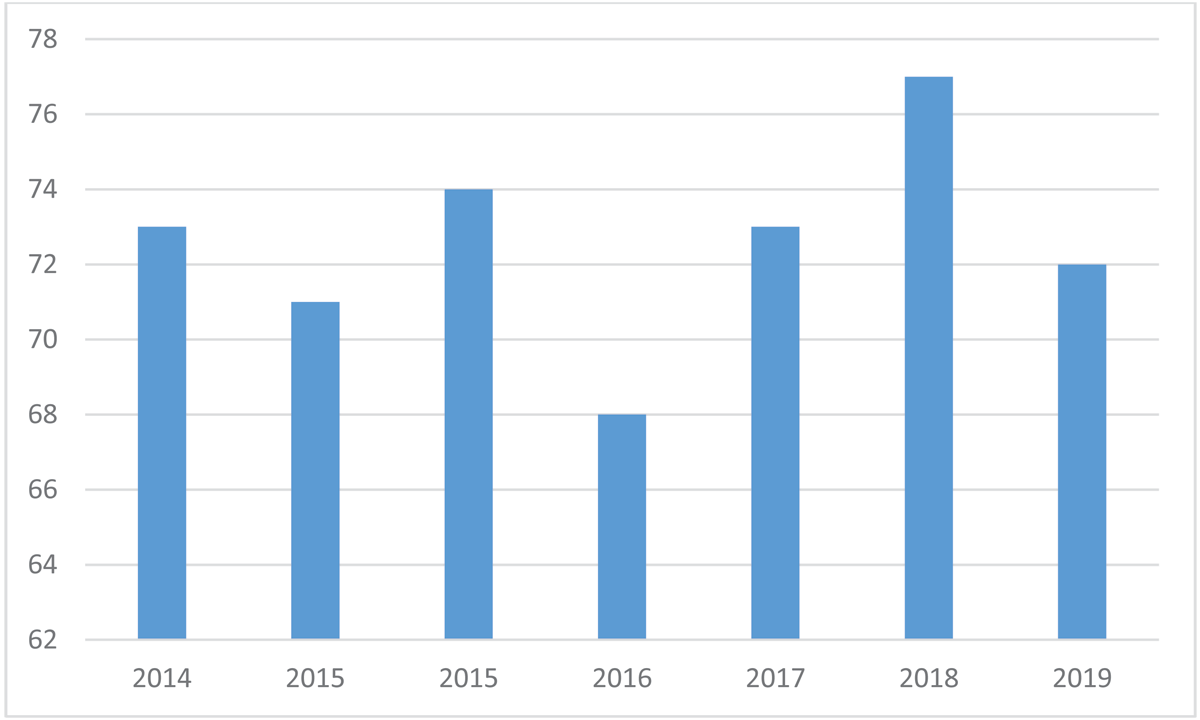
Figure 5
Is it Necessary to Celebrate Veterans Day?
Note. Numbers are based on percentages.
In a 2018 public opinion survey (see Republic of Estonia Ministry of Defence, 2018, p. 65), respondents were asked whether they had purchased a veteran’s support badge, whether they had worn it, and whether they had participated in any Veteran’s Month events. A total of 35% of respondents said they had made a donation to acquire a veteran’s support badge, 25% had worn that badge, and 13% of respondents confirmed that they had personally participated at least in one of Veteran’s Month events. The positive image of veterans is certainly helped by the fact that money raised as part of the Veteran’s Month charity campaign goes back into society. The money is used to build public outdoor gyms, support hospitals in their acquisition of rehabilitation equipment, and fund mental-health campaigns. Thus, the symbol representing veterans often appears in a positive context and creates a good image for veterans.
Discussion
The above description of the situation on the welfare of Estonian veterans is that which is specific to peacetime conditions. The war in Ukraine allows us to look at the situation from another perspective. In such a war, it is not going to be a small group of people who would become veterans or veterans’ families; instead, nearly a quarter of society could become veterans and nearly half of the population veterans’ families. In such a situation, the idea of defining veterans separately and treating them with separate support measures than the rest of the society would become inappropriate—if the civilian is not directly a member of the veteran’s family, they may nevertheless have had traumatic experiences (being under fire, helping the wounded, organising an evacuation, etc.). In such a war as it is taking place in Ukraine right now, every medic becomes a military medic, every social worker a military social worker, every psychologist a military psychologist, and every clergyman a military chaplain.
While our peacetime support system is currently presuming that there are limited number of casualties at a time it might be different in case of a full-scale war. The example that we can see in Ukraine is that in the real crisis one has to cope with hundreds of cases of dead or injured soldiers daily. That is obviously the volume of work that we have to be prepared for.
The current support system for veterans in Estonia must therefore be viewed in the same way as the military world views the organisation of military plans for national defence in peacetime—with a moment of training and rehearsal for much more tragic situations. Let’s hope, of course, that these situations never arrive.
Future Challenges
The support system for veterans is a marathon, not a sprint. It is not only the question of benefits and services that are stipulated in the legal acts; the public support, the image of the servicemember, and the overall attitudes of the society are equally important.
As emphasised in the introduction, the Estonian defence is relying on a broad approach. The central idea of the approach is that protection of the country is a joint effort of all inhabitants and that all resources (including non-military resources) will be contributing to solving the crisis. The metaphor of service-provider and service-user can be applied here. There will be no distinct line between those groups, which also means that the government will face challenges as defining veterans.
On individual level, in the immediate aftermath of an incident, it is difficult to look at a soldier who has lost his legs, or a mother who has lost her son, in the eye. But in supporting veterans and their families, it is important to remember that the need is not just in the present moment, but that the promises made and policies adopted today, must be followed decades later. Equally important is the feedback that the family of the veteran receives from the society. As veterans are young people, we have to consider that they will be living among us for another 50 years, and so our policies and assistance should be designed with this in mind.
The mission in Afghanistan has shown that mission veterans continue to have unique mental health needs a decade later. It must also be taken into account that, while veteran amputees from Afghanistan are still relatively young, as they get older their needs for treatment will increase. In this sense, it must be noted that the deployment in Afghanistan is not over.
The second category of challenges is avoiding dependence on the support system. Most deployment veterans are capable of managing their lives perfectly well and we should not instil in them the idea that they are helpless. The support system must also be geared towards maximum self-reliance, which often means that the person receiving assistance must make an effort and take responsibility for their own coping.
Public attitudes are also important. It is important that public opinion supports the Defence Forces and veterans. It is important to a servicemen that society values their service in the armed forces. Of course, limits must also be observed. However, as the policy of the Soviet Union towards its veterans remains fresh in our minds, we also know that we do not want to create an image of veterans as being over-privileged and separate from society.
In a small society like Estonia, veterans and servicemen are not a closed, separate group; instead, national defence preparedness should in fact be part of civic identity. Of course, veterans have performed services in defence of the country that are worthy of recognition and veterans should be treated as individuals among us and not as some type of separate group.
Conclusion
The composition of Estonian veterans varies greatly depending on the international security challenges. Currently, the largest group of veterans comes from the deployment in Afghanistan. If the missions in the Sahel region had been expanded, it could have been that the largest group of veterans in the future would possibly have gained their service experience there. It is necessary to note that the policy regarding veterans is an evidence-based policy. Veterans should be offered help and support only in the cases of objective need for help. At a moment in Estonia the policy to support veterans is addressing its services and measures for most of the veterans to the moment of military-civilian transition. In case of wounded veterans and their family members, the policy is addressing the issues of rehabilitation. But if the objective needs for intervention are changing, so should the policy. Therefore, it is necessary to monitor and analyse the situation of veterans and their family members regularly. As mentioned earlier, most of the veterans are receiving the status of veteran through participation in the deployment. In recent years the number of deployed veterans is decreasing. It would be too much to hope that it means the pacification of the international security situation.
Competing Interests
The author has no competing interests to declare.