
Introduction
Agriculture and related industries in Iowa contribute 20% of total Iowa jobs (Nelson, 2023). However, farming is one of the most stressful and hazardous occupations (Fetsch, 2011). Stress is linked with several diseases and illnesses, such as heart attack, disease, hypertension, and diabetes (Fetsch, 2011). Kearney et al. (2014) explain that identifying stressors among farmers is beneficial for health experts, who can then improve health outcomes and reduce stress by creating targeted services and strategies.
Previous studies have shown that men and women deal with stress differently and need different kinds of help to treat it. For example, a study showed that male farmers are more stressed by weather conditions, while female farmers are more stressed by geographical isolation (Rudolphi et al., 2024). While previous studies have used surveys, interviews may give more detailed information. Moreover, generational differences should be considered part of the farm stress level, as agricultural activities now use more technology than before (Nelson, 2023). If there are any differences, recommendations for reducing farmers’ stress should differ by gender and generation. The findings from this study can inform the development of mental health resources and research initiatives designed to alleviate stress among Iowa farmers.
The research aims to determine whether there are differences between generations and genders in farm stressors and whether having children on the farm increases stress levels. Finally, the study aims to determine the strategies Iowa agricultural producers use to manage stress.
Literature Review
Considering several topics related to farm stressors is essential. The following literature review will cover farm stress, gender and generational differences, and the research gap.
Farm stress
Farm life can contribute to the burden of life’s stresses. Stressful life events are known to correlate with an increase in the development of generalized anxiety disorder Francis et al. (2012). This fact is directly related to previous studies that have identified a variety of farm stressors impacting American farmers. For example, Arora et al. (2020) studied farmers in Iowa, Ohio, and Missouri and found that finance, weather, farm workload, and management were perceived as higher psychological stressors among agricultural duties.
The 1980s farm crisis is a good example of how financial stressors impact American farmers. Olson et al. (1986) identifies financial stressors as among the most critical farm stressors and suggests that financial programs could help alleviate them.
Furthermore, when farm workload is cooperative, such as multiple family members working together to complete farm tasks, this can reduce stress levels. A study by Donham and Thelin (2016) examined American farm family members and found that those who do not contribute to the farm can create conflict within the family. This lack of input into farm activities can create a stressful situation that can affect the farm’s overall well-being.
Farm management can also contribute to an increased stress burden in farm life. Among farmers, most are independent farm managers. Their spouses have different jobs outside the farm and do not contribute to farm management tasks. Therefore, when the spouse returns home, they usually talk about unrelated experiences regarding the farm. This situation can have an isolating effect on the farm manager, leading to further stress.
Moreover, various transitions in farm family life are stressful for adolescents. Plunkett et al. (1998) found that adolescent adaptation to American farms was dependent on demographic variables, family stressors, events, and family coping strategies.
Additionally, in a review of studies on farm stressors, Braun (2019) argued that farm-family stress is a public issue. The study shows that farmers experience stress due to multiple responsibilities, loneliness, losses of animals and crops, commodity price volatility, and reduced cash flow. The consequences vary from minor injuries to suicide or homicide. In some cases, people try to forget their problems by relying on the consumption of drugs. The author suggests that, to help, people should consider the impact of ‘geographical isolation, community values, and resources in conducting successful interventions’ (Braun, 2019, p. 4).
However, the studies mentioned did not examine how stress levels differ by gender or generation. Therefore, there is a need to investigate these stress differences to inform strategies to help mitigate the mental health challenges of Iowa farmers.
Generational and Gender Differences
Farm work is typically a generational occupation. Depending on its upbringing, each generation manages the farm, work duties, preferences, and expectations differently. As a result, work expectations and farm stress may vary from generation to generation (Hall et al., 2022). According to Generations on the Farm (2020), family members such as parents, grandparents, aunts, and uncles, as well as church members, daycare providers, neighbors, and healthcare professionals, all contribute to daily farm activities in the community.
Farm tasks are often taught by parents and grandparents as family members typically pass farm lessons from generation to generation. Although many farmers pursue college degrees in animal science, agronomy, agribusiness, and other related fields, most knowledge of daily farm tasks (e.g., where to plant seeds, when to turn the bulls out) is passed down through generations. Many lessons have been learned through the years, and several techniques have changed, but many farming bases remain the same.
An important question to address is whether farm stress levels differ between genders. There are studies that consider differences in stressors by gender; for example, Stoneman and Jinnah (2016) noted that farming is often considered a male-dominated occupation. Their study found that fathers (males) operate tractors and spend longer hours on the farm than mothers (females), contributing to the added stress.
Additionally, Rudolphi et al. (2024) showed that farm stressors have some similarities and differences by gender. A similar number of female and male farmers reported high stress levels about time pressure and personal finances. However, men reported greater stress related to weather and financial conditions; women reported high stress due to geographic isolation.
Although males report higher levels of farm-related stress, male agricultural producers tend not to visit doctors or therapists. In contrast, Hopkins et al. (2024) demonstrated that females often take additional time, regardless of their duties, to discuss their healthcare, while males are less open to discussing mental health. In the same study, additional healthcare challenges for farmers included time constraints and the cost of accessing care, regardless of gender.
In summary, the reviewed literature discusses critical stressors in American farm life, including financial pressures, unpredictable weather, heavy workloads, management challenges, isolation, and family dynamics. These stressors are linked to mental and physical health consequences, including anxiety, injuries, substance abuse, and, in extreme cases, suicide. Existing studies present combinatorial causes of farm stress and its impact on family well-being, but most do not examine how these experiences differ across generations or genders. This gap highlights the need for research into how generational and gender perspectives shape farm stressors, particularly the influence of children on the farm. Therefore, this study can inform strategies that Iowa farmers can use to manage family farm stressors.
Research gap
Previous studies on farm stress are outdated (more than 15 years old) and were not conducted in Iowa. An Iowa-based survey by Arora et al. (2020) did not consider the influence of parents and grandparents. Therefore, this study aims to investigate the experiences of farm stressors among parents and grandparents. In other words, farm stress experiences may be influenced by generation or gender.
In this study, farmer interviews help to gather more information about their thoughts and who is in charge of teaching farm chores to children. Interviews are a valuable tool for conducting qualitative research. Additionally, the research will examine the impact of having children on the farm and how they influence stress levels. To fill this gap in the literature, this study will try to answer the following research questions (RQs):
RQ 1. What are the experiences of parents and grandparents with farm stress?
RQ 2. What are the experiences of men and women with farm stress?
RQ 3. What are the experiences of stress with children on the farm?
RQ 4. What strategies do Iowa farmers use to manage stress?
The objective of this study is to identify the main stressors affecting Iowa farmers. Additionally, understanding how having children on the farm contributes to stress will provide deeper insight into farmers’ experiences. These findings could help professionals in the field offer more effective guidance to Iowa farmers on reducing stress, lowering injury risk, and maintaining overall well-being.
Methods and Procedures
Materials and methods
This study analyzed how to improve health outcomes and reduce farm stressors by considering farmers’ generations and genders. The researcher aimed to explore the experiences of parents, grandparents, and male and female farmers regarding farm stress. This study included asking different generations and genders: Did having children on the farm increase stress? Moreover, what strategies did Iowa farmers use to manage stress?
Participants
The target population consisted of Iowa farm families with children or grandchildren residing on or visiting the same farm. Convenience sampling was used because it enables the interviewer to select any candidate who meets the requirements. According to Emerson (2015), convenience sampling involves identifying individuals who meet the study’s criteria using any available method. A total of 11 grandparents and 15 parents of children under 18 participated in the study. Stated differently, interviews were conducted with four grandparent couples, two single grandparents, seven parent couples, and a single mother. Grain and livestock, dairy, and grain orchard farms were among the types of farm participants lived on.
Procedure
The measuring instrument was an interview. The interview was confidential, and each response was assigned a number rather than a name; all participants signed a consent form. Before the interview, an email was sent explaining the study. To set up an in-person or online interview (using Zoom, Microsoft Teams, or Webex), the interviewer contacted participants by phone or email. An email reminder was sent to them one week and one day before their interview, after the time had been determined and communicated. The last part was sending a thank-you message to all participants. With all the information collected, the researcher analyzed the results using descriptive statistics, compared them with previous studies, and shared the findings with occupational health and safety experts.
Instruments
The instrument was a group interview. This study addressed the research questions by examining Iowa farmers’ experiences with farm stressors and the influence of children on the farm. The interviews explained in detail farm experiences and the points of view of two generations and genders regarding farm stressors, the influence of children on the farm and in farm chores, and methods for managing stress among Iowa farmers.
Interview
Interviews with farm couples were used. The interviews were valuable because they provided detailed insights into farm stress and the influence of children on the farm. Iowa farmers were able to describe their own experiences: not all farmers have the same farm stressors. As a result, in-person farm interviews seem to be an effective way to gather information. If a farm stressor was not clear in the study, the farmer could explain it in an interview. The interviews were also compelling for clarifying different interpretations among farmers; for example, ‘money’ could be interpreted by some farmers as a loan, by others as expenses, and by others as fluctuations in the market price of their products. Interviews provide a better research model for clarifying the details of the questions being asked (Jain, 2021).
The group interviews included married couples, parents, or grandparents (Table 1). The interviews lasted 30 to 45 minutes because more extended interviews would have interfered with the farmers’ daily work. Castillo (2016) described the importance of the four-phase process: ensuring interview questions align with the research questions, constructing an inquiry-based conversation, receiving feedback on the interview protocol, and piloting the interview protocol.
Table 1
Interview Questions.
| INTERVIEW QUESTION | RQ1 | RQ2 | RQ3 | RQ4 |
|---|---|---|---|---|
| 1. What are some causes of stress? What makes you feel stressed? | X | X | ||
| 2. What parts of farming are stressful? | X | X | ||
| 3. Which farm events or activities are more likely to cause stress for you? | X | X | ||
| 4. Does having children on the farm influence stress levels? | X | |||
| 5. What kinds of farm work do your children/grandchildren do? | X | X | X | |
| 6. Are there any differences in the farm tasks based on children’s gender? | X | X | X | |
| 7. Is it stressful to assign these tasks to children? | X | |||
| 8. When you feel stressed, what do you do? | X | X | X | |
| 9. What are some ways to alleviate farm stress? (i.e., do outdoor activities) | X | X | X | |
| 10. Do you have any resources to help reduce your stress level? | X | X | X | |
| 11. What kind of resources could be helpful to reduce the farm stress level? | X | X | X |
Data analysis
Coding and theme development process
The researcher reviewed the interviews and followed the Thematic Analysis (TA) protocol for analyzing themes and the Grounded Theory (GT) approach for identifying subthemes (Kiger and Varpio, 2020; Creswell, 2015, p. 432).
The coding and theme development process involved six steps.
Familiarization: The researcher read and re-read all transcripts multiple times, noting initial impressions and potential patterns.
Open Coding (GT-inspired): Each transcript was coded line-by-line or incident-by-incident. Initial codes were generated directly from the data (e.g., ‘money,’ ‘weather,’ ‘equipment breakdown,’ ‘supervising kids’).
Constant Comparative Analysis: Codes were compared across incidents, participants, generations (parents vs. grandparents), and genders. Similar codes were grouped, and differences noted (e.g., variations in how men vs. women described time pressure).
Axial/Organizing Coding and Theme Development (TA + GT): Codes were collated into potential subthemes and overarching themes (e.g., Weather, Financial Situation, Time Management). Memos were written throughout to track evolving ideas, definitions, and relationships between codes.
Review and Refinement: Themes were reviewed against the full dataset to ensure they accurately represented the data. Some codes were collapsed (e.g., ‘money’ → ‘money issues’ → ‘Financial’ subtheme) or split as needed. An audit trail of codebooks, memos, and decision logs was maintained.
Final Definition and Naming: Clear definitions and names were developed for each theme and subtheme, supported by rich quotations from participants.
Observational techniques for theme identification from Bernard et al. (2016) were applied, including repetition (e.g., frequent mentions of ‘money’), connectors (e.g., ‘because’ statements linking weather to crop loss), and similarities/differences across generations and genders.
Measures to ensure trustworthiness and rigor
Several trustworthiness techniques were used to ensure the rigor of the collected data. A peer debriefing of themes was conducted for a credibility check. An audit trail (including audio and video recordings, electronic transcripts, and analysis decisions) was maintained for dependability and confirmability. Multiple rounds of coding and comparison reduced researcher bias. Transferability of participants’ interview data involved detailing descriptive characteristics and qualities, context, and farm types (Tables 1 & 2); this was provided to enable readers to assess applicability to other settings. Limitations of convenience sampling are acknowledged. The researcher maintained a reflexive electronic journal to document personal assumptions and how they were managed during analysis.
Results and Discussion
The current study conducted interviews to gather more information about gender and generational experiences regarding the subthemes of farm stressors and the influence of children on the farm. Table 2 provides details of the target geographic, demographic, and employment status.
Table 2
Description of participants.
| PARTICIPANTS | GENERATION | FARM TYPE | OTHER DETAILS |
|---|---|---|---|
| GM1 & GF1 | Grandparents | Grain and livestock (dairy) farm | GM1 is a part-time farmer, and GF1 is a retired farmer. |
| M1 & F1 | Parents | Grain and livestock (dairy) farm | Both parents work as full-time farmers; they share with their grandparents (GM1 & GF1). |
| GM2 & GF2 | Grandparents | Grain and livestock farm | Both grandparents work as full-time farmers. |
| M2 & F2 | Parents | Grain farm | Both parents work as part-time farmers. |
| GM3 & GF3 | Grandparents | Grain and livestock farm | Both grandparents work as full-time farmers. |
| M3 & F3 | Parents | Grain and livestock farm | Both parents work as full-time farmers. |
| GM4 & GF4 | Grandparents | Grain and livestock farm | Both grandparents work as full-time farmers. |
| M4 & F4 | Parents | Grain and livestock farm | Both parents work as full-time farmers. |
| GF5 | Grandfather | Grain farm(Christmas tree business) | GF5 is a widowed retired farmer. |
| M5 & F5 | Parents | Grain farm | Both parents work as part-time farmers. |
| GM6 | Grandmother | Orchard and small animal farm | GM6 works as a part-time farmer. |
| M6 & F6 | Parents | Grain farm(Christmas tree business) | Both parents work as part-time farmers; they share the farm with GF5. |
| M7 | Mother | Orchard and small animal farm | M7 is a part-time farmer who shares the farm with her mother, GM6. The husband has a job not related to farm activities. |
| M8 & F8 | Parents | Grain farm | Both parents work as part-time farmers. |
Interview results
Farm stressors detailed by subthemes
The following section presents each theme and participants’ replies, as outlined in the methodology regarding farm stressors. Figure 1 illustrates the farm stressors experienced by participants.
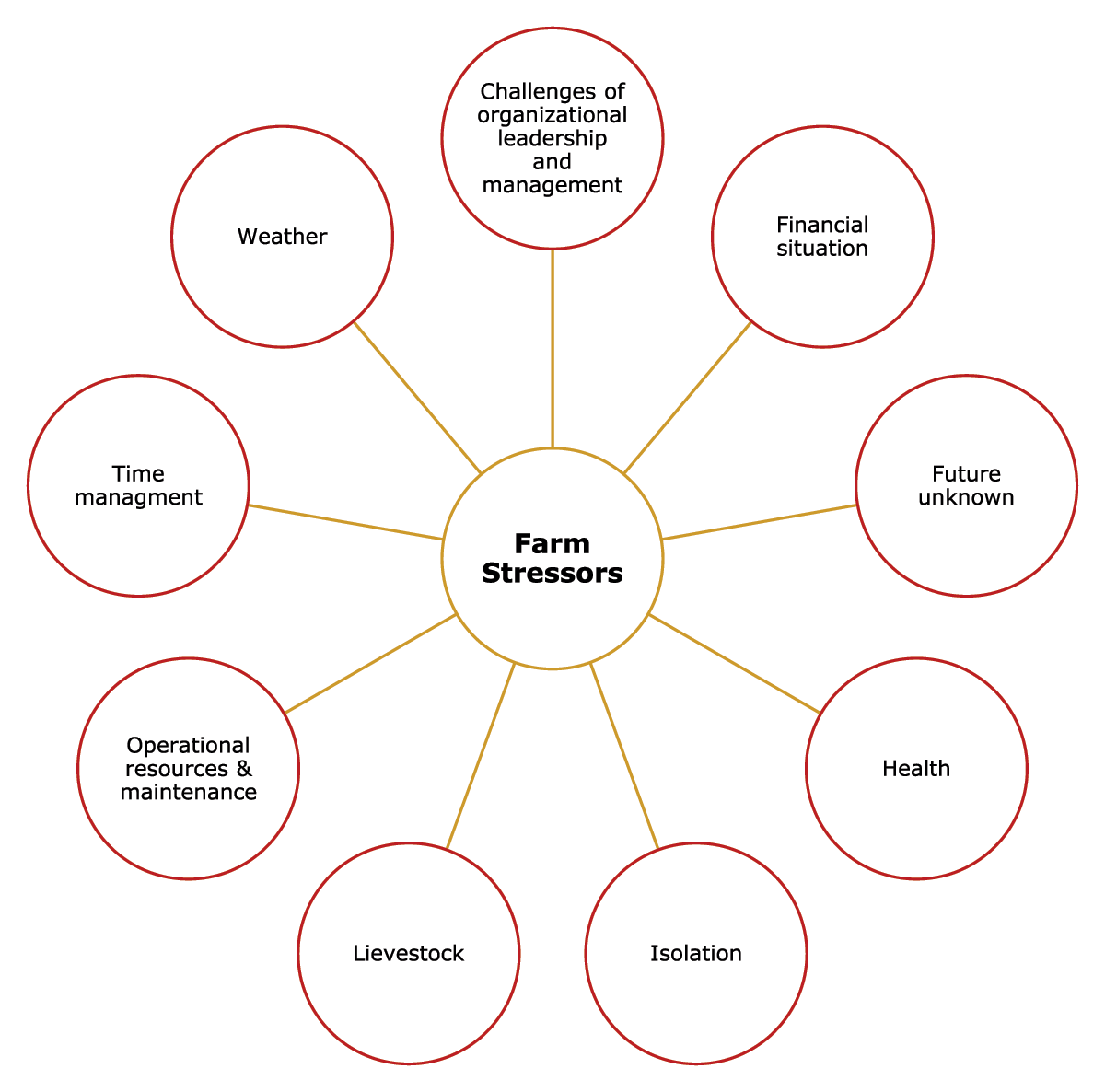
Figure 1
Subtheme: farm stressors.
Subtheme: Weather
Weather emerged as a pervasive and uncontrollable source of stress among the participants. Uncertainty related to conditions such as snow, cool summers, wet springs, drought, hail, and extreme events like tornadoes was described as particularly distressing because of its potential to disrupt daily farm activities and threaten both livelihoods and personal safety. Weather-related challenges were closely tied to fears of crop loss, financial instability, and the loss of long-term investments, underscoring how a single adverse event can jeopardize an entire season’s work. The pressure to ‘beat the weather,’ especially during critical periods such as planting and harvesting, further intensified stress. Overall, weather was portrayed as a dominant stressor due to its unpredictability and far-reaching consequences for farm operations, income security, and future planning.
Subtheme: Time management
Time management is stressful in different ways, for example, balancing multiple jobs, family life balance, and farm activities. In this study, many participants highlighted the difficulty of managing overlapping schedules, in which competing commitments led to conflicts, such as unintentionally scheduling two activities at the same time. Participants mentioned that the sheer volume of tasks and the limited time available to complete essential farm work—particularly during planting and harvest—further intensified this stress. For those engaged in farming on a part-time basis, time pressure was especially pronounced, as farm duties often had to be concentrated into weekends or non-working hours. In addition to work-related demands, balancing family life with farm responsibilities was described as emotionally taxing. Managing children’s daily routines alongside farm operations added to the strain, particularly during busy seasons. The farmers in this study stated that the demands of agricultural work sometimes reduced time spent with family, leading to feelings of absence and missed connections with children.
An additional time management farm stressor was related to planting and harvesting, often viewed as the most challenging phases of farm work. The need to complete harvest tasks within narrow time windows heightened stress, as delays could threaten crop quality or yield. Planting was likewise characterized as stressful, reflecting similar concerns about timing and efficiency. Overall, the interviewees’ responses illustrated how time management stress in farming extends beyond scheduling challenges, affecting both work efficiency and family relationships.
Subtheme: Financial situation
Money is one of the main farm stressors mentioned by participants, including the profit potential of farm activities, the capital required for investment, and the expenses of repairing or acquiring new machinery. Fluctuations in commodity prices were described as particularly stressful, especially when prices declined while input costs and land rents rose. Broader market conditions—such as yield variability, pre-sale forecasts, and stock levels—were also identified as factors that intensified financial anxiety. In addition, challenges related to marketing agricultural products added another layer of pressure.
Beyond day-to-day financial management, concerns about long-term economic viability were evident, as farm income was often described as essential not only to sustain the operation but also to support family needs. The analysis further underscores a shared recognition that farming rarely offers quick financial returns; instead, it demands sustained hard work and commitment, often without commensurate economic rewards.
Subtheme: Operational resources and maintenance
Operational resources and maintenance emerged as important sources of farm-related stress, particularly regarding equipment management and machinery breakdowns. Challenges associated with handling farm chemicals added to operational pressure, while reliance on aging equipment often intensified stress due to the need for frequent repairs and limited capacity to invest in newer machinery. Preparing equipment for use was also described as demanding, especially when newer technologies were involved and required skills or knowledge that were difficult to master. In many cases, farmers were responsible for repairing machinery themselves, which increased both their workload and stress. Unplanned equipment failures were especially problematic during critical periods, as breakdowns could delay farm operations, incur unexpected repair costs, and result in financial losses.
Subtheme: Health
Health-related concerns emerged as a meaningful source of stress within farm life, affecting both individuals and family systems. Ongoing health problems within the household were described as particularly stressful, as they could limit work capacity and increase emotional strain. In some cases, severe illness and loss within the family raised concerns about long-term health risks associated with farm work, including potential exposure to agricultural chemicals and their possible effects on family members. Aging was also identified as a source of stress, as declining physical capacity introduced new limitations and uncertainties about the ability to continue farm operations. These concerns extended beyond individual health, reflecting broader anxieties about the well-being of family members across generations and the sustainability of farm life amid physical decline.
Subtheme: Challenges of organizational leadership and management
Finding and managing employees was mentioned as a notable source of stress in farm operations, particularly during peak seasons when workloads intensify. Securing enough workers to complete essential tasks was described as challenging, with labor shortages increasing pressure on farm operators. Beyond recruitment, managing employees also contributed to stress, as it required time and effort to train, supervise, and support workers while maintaining productivity. The responsibility of coordinating people alongside performing demanding farm tasks added a layer of strain, highlighting labor management as a critical and ongoing challenge in agricultural settings.
Succession was identified as stressful because family members sometimes did not want to take over the farm. The uncertainty about who would assume responsibility for the farm created emotional strain, especially when land had been passed down through generations. However, it was no longer actively cared for by successors. The absence of interested or experienced family members heightened concerns about the operation’s future, making succession decisions difficult and stressful.
Subtheme: Isolation
Isolation emerged as a notable source of stress in farm life, mainly due to the physical distance between farms and essential services. Farms located far from mechanical shops, hospitals, schools, supermarkets, and extended family heightened feelings of vulnerability and concern. Being alone on the farm was described as particularly stressful, especially when help could not be reached quickly in an emergency. For part-time farmers or families living away from the farm, long travel distances further intensified this stress, limiting the ability to respond promptly to unexpected situations.
Subtheme: Future unknown
Uncertainty about the future emerged as a major source of stress in farming, driven by unpredictable market conditions, adverse weather events, and shifting government regulations. The inability to control or accurately anticipate factors such as droughts, freezes, or sudden price fluctuations heightened concerns about potential crop losses and the risk of significant investment losses. Navigating this uncertainty required constant preparedness and emotional adjustment, as farmers described the need to accept uncontrollable conditions while remaining resilient and adaptable. Stress was also linked to the timing of harvests and the instability of commodity prices, reinforcing the sense that farming involves ongoing exposure to unknown and changing circumstances.
Subtheme: Livestock
Livestock care emerged as a significant source of stress, particularly when animals became ill or required urgent attention. The responsibility to protect and care for animals during extreme weather events intensified this stress, at times placing farmers in physically dangerous situations. Uncertainty surrounding animal health—especially when the cause of illness or loss was unknown—was described as emotionally taxing and distressing. In operations where responsibilities were shared among family members, coordinating tasks related to animal care, nutrition, production, and distribution added further pressure.
Experiences of parents and grandparents with farm stressors
RQ1 asked about parents’ and grandparents’ experiences with farm stress.
The findings indicate that both grandparents and parents identified weather as one of the most prominent sources of farm-related stress.
Grandparent: ‘Try as much as possible in growing seasons, as long as you have a wet spring. If you have a fabulous summer that puts off harvest later in the fall, and then you deal with snow and stuff like that, that’s probably the biggest one.’ (GF2)
Parent: ‘Know if the if it is a bad weather year or whatever, I start to feel the stress on him and of him. And so I don’t know. Then I started worrying about that too.’ (M3)
Across generations, challenges related to equipment and maintenance were also emphasized, particularly when machinery failures disrupted farm operations and delayed essential tasks.
Grandparent: ‘Unplanned breakdowns. When working with farm equipment, especially on a farm the size of ours, we can’t afford new equipment, and even new equipment breaks down. Most of our equipment is old, and unplanned breakdowns are the most stressful.’ (GF4)
Parent: ‘I would say equipment is something that stresses him out too because you know, when you’re trying to get equipment ready or fixed, it seems like there’s always something that needs to be fixed and it’s not like you can just drive, you know, a mile away and get your tractor fixed right away like you’re always waiting on parts or needing to go get parts, or drive somewhere 30–40 miles away to get something, and so I know when it was time to plant, you know, it’s like right up until the go day.’ (M8)
Overall, the generational analysis shows strong alignment between generations in both perceived farm stressors—especially weather and equipment issues—and preferred methods for alleviating stress, underscoring shared experiences and coping strategies within farming families.
Experiences of men and women with farm stressors
RQ2 focused on the experiences of men and women with farm stress. The results showed similar experiences of farm stressors across genders. The findings suggest that both women and men identified weather as a primary source of farm-related stress, particularly when conditions interfered with farm activities.
Man: ‘I usually find stress in events that I have no control over. I don’t know why that is, because if you can’t control it, why should you be stressed out about it? But if there is a weather problem, we must have some protocol to compensate for what the weather does to us.’ (GF1)
Women: ‘Actually, two things are the most stressful for us. Probably is the weather is number one all the way. I mean everything from drought to freeze. There’s one freeze in an orchard, and you’ve lost your crop, and yet you’ve got all of your investments already there. So, number one would be drought. And the second concern is finding enough labor.’ (GM6)
Equipment malfunction and ongoing maintenance demands were also commonly described as daily stressors across genders.
Man: ‘… a piece of equipment breaks down or whatever, they’re not, you know, doing something about it, you know, they call me and say, hey, I got a flat tire, come do something about it. So that part’s a little stressful …’ (F6)
Women: ‘The stressors are stuff that’s really out of your control, weather, you know, equipment breaks down, you got to, you got to get stuff done in a timely manner before the snow hits the ground, get all the harvest in.’ (M6)
Overall, the analysis indicates strong similarities across genders in both perceived farm stressors—especially weather and equipment-related challenges—and preferred ways to reduce stress, highlighting shared experiences in agricultural work and family life.
Dealing with stress related to children on the farm
Figure 2 shows the sources of stress related to children on the farm. According to participants’ responses to RQ3, raising kids on a farm can occasionally make things more stressful. The presence of children on the farm elicited varied, sometimes contrasting, perspectives on stress. For many participants, having children on the farm increased stress due to the need for constant supervision, particularly when children were young or when farm machinery and animals were involved. Adults described the added responsibility of monitoring children’s whereabouts, adjusting work pace, and implementing stricter safety practices to prevent injuries. Ensuring children’s safety often required slowing down farm operations, providing personal protective equipment, and carefully limiting the types of task children could perform.
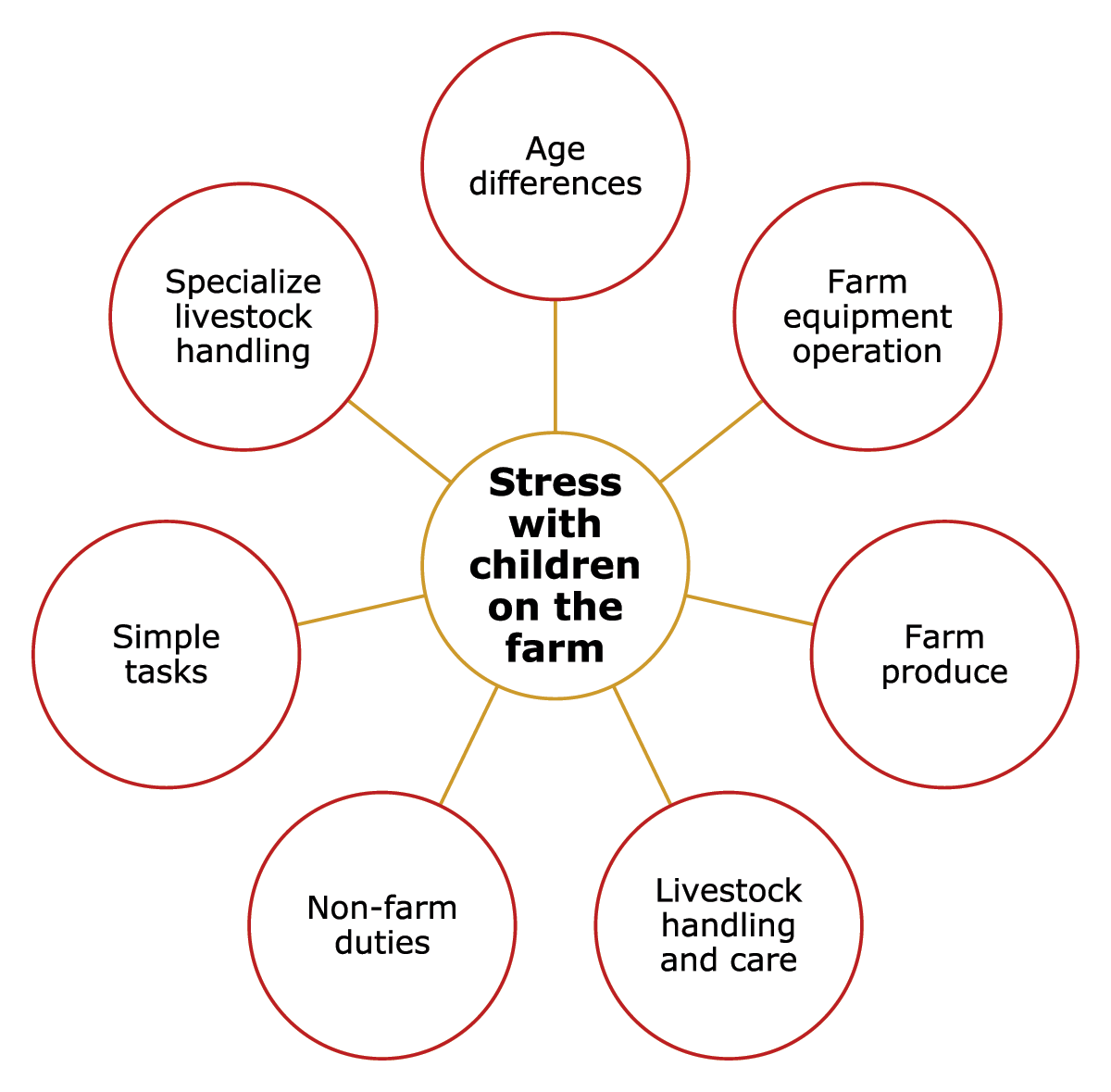
Figure 2
Subtheme: stress with children on the farm.
Assigning farm chores to children was generally not viewed as stressful in itself; rather, stress arose when children were reluctant to complete tasks or when adults worried about the risk of injury while children worked. The balance between encouraging responsibility and maintaining safety created ongoing tension. In some families, managing children’s school obligations alongside farm duties further compounded stress, making it challenging to coordinate daily schedules and responsibilities.
At the same time, some perspectives emphasized positive aspects of having children on the farm. Children were described as a reminder to prioritize family, slow down, and enjoy daily life, even when farm tasks remained unfinished. For these families, children contributed to a sense of joy and continuity, though their presence still influenced safety practices and required greater caution.
Overall, children on the farm can both increase and alleviate stress, depending on their age, assigned activities, safety considerations, and family dynamics. This theme underscores the complex interplay between caregiving, safety, productivity, and family values within farm environments.
Strategies Iowa farmers use to manage stress
In response to RQ4, the current study identified various strategies participants used to alleviate stress. Many focused on identifying stressors, understanding their root causes, and taking steps to address them, while also accepting uncontrollable factors, such as weather, and preparing for future challenges. Faith and attending church were important coping mechanisms for some, while others found emotional relief through crying. Adequate sleep, including naps, and social support from family, friends, or spouses were commonly cited as effective ways to alleviate stress.
Engaging in personal and leisure activities—such as reading, exercise, meditation, yoga, outdoor recreation, gardening, or hobbies—also helped participants unwind. Some found enjoyment in unrelated tasks, social gatherings, or relaxing at home through cooking or watching TV. A few noted that they had previously relied on food or alcohol for stress relief, but no longer did. Others preferred informal coping strategies, such as spending time with family or discussing challenges with a spouse, over formal support systems.
External resources, including extension programs, conferences, online support groups, podcasts, and professional counseling, were identified as valuable. Some participants recalled community-based groups that had facilitated sharing experiences and expressed interest in their return.
The farm families’ combined experiences with the stressors of farm life revealed many shared practices for dealing with financial, emotional, physical, and social problems. Participants emphasized the importance of balancing practical problem-solving with emotional support and personal well-being to cope with the demands of farming.
Discussion
Generational differences further enriched the understanding of farm stress in this study. In this study, parents and grandparents had different perspectives regarding farm stressors. A previous study by Weigel and Weigel (1987) found significant differences in stressors and coping strategies between the two generations. Parents may have been more concerned about their mortgages and debts, while grandparents may have been more concerned about their retirement. For example, the younger generation experienced different stressors than the first generation. The results of the present study had similar perspectives to those of previous studies.
The devastation of financial farm stress is a historical theme. For example, the farm crisis of the 1980s in Iowa included extreme weather events, market price changes, an increase in input costs, bankruptcies, and high rates of farm suicides (Morris and Arbuckle, 2024). The current study found that most participants, regardless of generation or gender, mentioned that weather events, including derechos, droughts, floods, and financial situations, as well as life events that could not be controlled, usually caused stress.
The next most frequently mentioned stressor for grandparents and parents, regardless of gender, was machinery breakdown and the maintenance of machines and equipment, for example, when considering whether to replace or repair a tractor or all-terrain vehicle during the planting season. The current study supported the results from Freeman et al. (2008) and Arora et al. (2020), who described the stressors among agricultural workers as financial, climate/weather, workload and management, family/personal, farm activities including breakdown and maintenance, health and safety, and related laws.
Farm stress is unavoidable but manageable (Iowa Soybean Association, 2020). Iowa Soybean Association offers a variety of options to manage stress, including email support, live chat, and podcasts. However, the current study found that most grandparents and parents preferred to nap, relax, and get away from the farm.
Moreover, across genders, participants chose to believe in and rely on God. Another way to reduce stress is to spend time talking with family, relatives, or friends. According to other participants, stress can be reduced by identifying the underlying causes and attempting to change the situation, or by finding a solution, accepting and learning from uncontrollable circumstances, and preparing for new challenges.
A study in Ohio described how children and their needs could be integrated into the farm business. The study specifically discussed the challenges of high rates of injuries and fatalities associated with children on the farm (Mulhollem, 2024). Another study by The National Farm Worker Ministry (n.d.) noted that children working on farms can experience extreme conditions, including exposure to harsh weather, chemicals, and hazardous equipment.
The current research also found that raising kids on the farm can sometimes lead to increased stress levels, as delegating and asking kids to do farm chores can be stressful. Grandparents also mentioned that stress levels could increase for children on the farm if they did not follow safety procedures, depending on the type of task or activity. Some mothers believed that having children on the farm was not stressful, because it helped parents relax and reminded them that the farm was not their only life; they also had other activities, such as school, games, and concerts. Thus, in this perspective children encourage their parents to take things at a leisurely pace, appreciate the moment, and put off farm chores for another day.
Conclusions and Recommendations
This study has identified the most common stressors for Iowa farmers. It could help identify the root of their problems and reduce the risk of injury. By identifying stressors and health concerns, professionals can develop a program to educate farmers on managing and reducing their stress levels. Thus, the programs could alleviate the pressure of daily farm work, increase productivity, and reduce injury rates.
The research showed that Iowa farms are often family-run and passed down through multiple generations, creating strong ties, traditions, and values linked to the land, but also showed that some families experienced that determining who would succeed to the business was a farm stressor because, in some cases, members did not want to follow the same family business and preferred different jobs. Historically, gender roles on farms have shifted, according to participants’ experiences; for example, farm chores were assigned based on children’s preferences rather than their gender. The stereotype of ‘male’ equal to ‘farmer’ has changed; in this study, several women were in charge of the farm, including managing farm operations and acting as decision-makers and leaders, while their spouses had a different job outside the farm. Some women participants reported being in charge of the farm with their mothers. Future studies will conduct more interviews with women farmers and collect their experiences with farm stressors and with children on the farm.
A recommendation for future research is to expand this study of stress among farmers to other states. Some factors could be more stressful for one farmer from one state than another. For example, weather conditions differ for a person in Iowa versus a person in California. Researchers could compare and analyze responses from various regions and discuss them with health professionals to develop the most appropriate educational program to reduce stress levels.
Future research on farm generations and gender would benefit from broader methodological diversity. Large-scale patterns can only be identified through quantitative studies based on census data; however, qualitative methods that reflect the real-life experiences of farm families must also be employed. The complicated issues of labor distribution, succession planning, and authority negotiation between genders and generations can be clarified through case studies, oral histories, and ethnographic research. The current study did not examine how gender and generation interact with immigrant farmer communities, ethnicity, and race in the United States, but culture can significantly influence farm management.
Ultimately, future research should examine the role of policy and institutional frameworks. Women in agricultural networks, land-grant university programs, and United States Department of Agriculture programs all influence leadership opportunities, education, and access to resources. For a thorough understanding, it is essential to assess how these policies either increase or decrease inequality in farm businesses.
Additional Files
The additional files for this article can be found as follows:
Supplemental Data Excel File
The original interview data with the study participant are shown on the file Supplemental Data Excel File. DOI: https://doi.org/10.21061/jts.450.s1
Ethics and Consent
This study received ethical approval from the Iowa State University Institutional Review Board (IRB ID: 23-213, Exemption Date: August 4, 2023). The project was granted exemption under category 2018-2(iii). All participants gave informed consent, and confidentiality was maintained using participant identifiers (see Supplemental Figure 1).
Data Accessibility Statement
The qualitative interview transcripts and datasets generated and analyzed during the current study are not publicly available due to ethical restrictions and participant confidentiality agreements. The data contain sensitive information regarding personal experiences of farm stress, family dynamics, and mental health. Access to de-identified data may be granted upon reasonable request to the corresponding author (Dr. Steven Freeman/sfreeman@iastate.edu), subject to approval by the Iowa State University Institutional Review Board (IRB) and execution of a data use agreement to ensure the protection of participant privacy. The codebook and de-identified thematic analysis files can be made available upon request. Limited codebook data available in the supplemental data (see the supplemental data Excel file).