
Table 1:
Qinghai survey questions.
| 1. | I believe that most people in this group of four people doing this experiment right now are willing to join a team to remove traps. (PDN1) | |||||||
| 2. | Most people in this group approve of giving our time to remove traps. (PIN2) | |||||||
| 3. | The majority of nomads in my township think that giving time to remove traps is an important thing to do. (PIN) | |||||||
| 4. | The other three members of this group would disapprove of me if I didn’t join the team to remove traps. (PIN) | |||||||
| 5. | The majority of people in this group would be on a team to remove traps. (PDN) | |||||||
| 6. | The majority of people in this group think that giving time to patrol with a team and remove traps is an important thing to do. (PIN) | |||||||
| 7. | Most people in this group will give their time to patrol with a team to remove traps. (PDN) | |||||||
| 8. | I believe that most nomads in my township approve of giving our time to remove traps. (PDN) | |||||||
| 9. | The majority of people in this group would work with a team to remove traps from the landscape. (PDN) | |||||||
| I usually sacrifice my self-interest for the benefit of others. (GO3) | ||||||||
| 10. | It is important for me to maintain harmony with others. (GO) | |||||||
| 11. | To me, pleasure is spending time with others. (GO) | |||||||
| 12. | I feel good when I cooperate with others. (GO) | |||||||
| 13. | My work as a nomad is an important part of how I see myself. (GID4) | |||||||
| 14. | Being a nomad is an important part of who I am. (GID) | |||||||
| 15. | How many of the people in this group did you know before today? | |||||||
| Please think about people in this group for these questions. On the whole, how similar do you think most people in this group are to you… | ||||||||
| Extremely similar | Not at all similar | |||||||
| 17. | Intellectually? | 1 | 2 | 3 | 4 | 5 | 6 | 7 |
| 18. | In the way they think? | 1 | 2 | 3 | 4 | 5 | 6 | 7 |
| 19. | In their values? | 1 | 2 | 3 | 4 | 5 | 6 | 7 |
| 20. | In their behaviors? | 1 | 2 | 3 | 4 | 5 | 6 | 7 |
Notes:
Questions 1–15 are Likert-scale questions with the following possible responses: Strongly Disagree/Disagree/Neutral/Agree/Strongly Agree.
1PDN: perceived descriptive norm.
2PIN: perceived injunctive norm.
3GO: group orientation.
4GID: group identification.
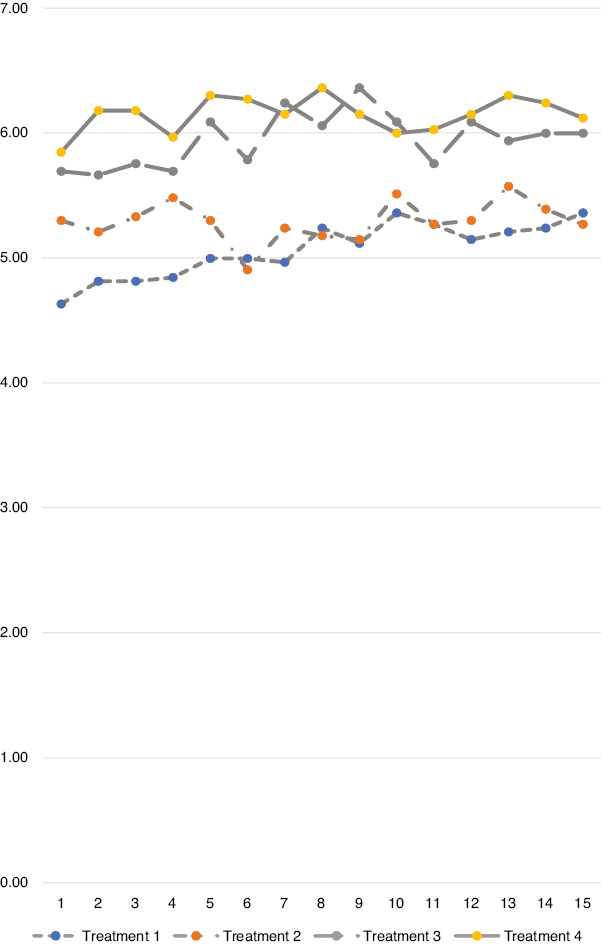
Figure 1:
Mean days volunteered for anti-trapping patrol (vertical axis) by treatment and round (horizontal axis).
Note: Treatments: Control, Injunctive norms (IN) message, payment, injunctive norms (IN) message+payment.
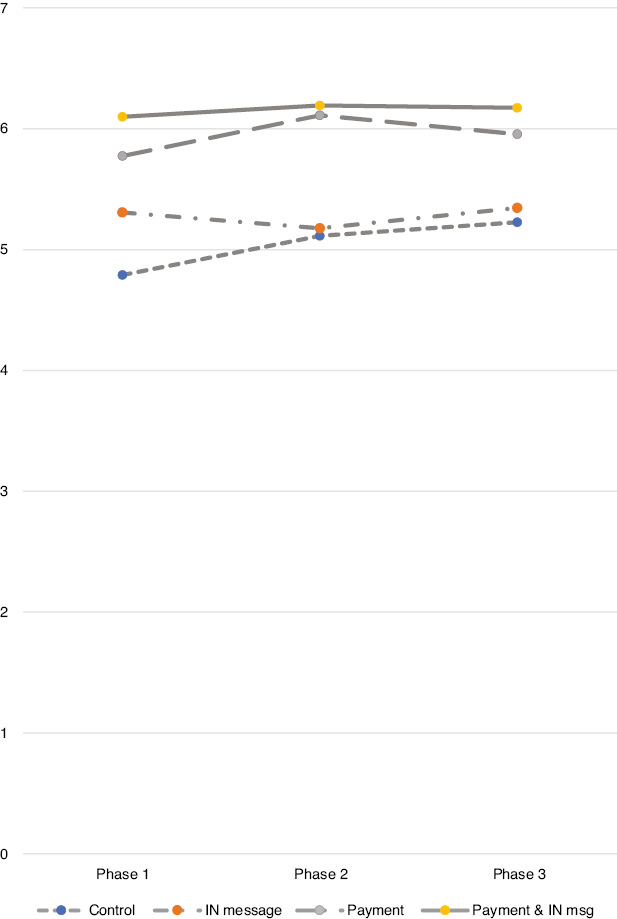
Figure 2:
Mean days volunteered for anti-trapping patrol (vertical axis) by treatment and phase (horizontal axis).
Note: Treatments: Control, Injunctive norms (IN) message, payment, injunctive norms (IN) message+payment.

Figure 3:
Perceived descriptive norms (vertical axis) by treatment, rounds 1, 5, 10, 15 (horizontal axis).
Note: perceived descriptive norms measures are a composite of responses to survey questions 1, 5, 7 and 8 in Table 1, each of which reflects descriptive norms. Treatments: Control, Injunctive norms (IN) message, payment, injunctive norms (IN) message+payment.
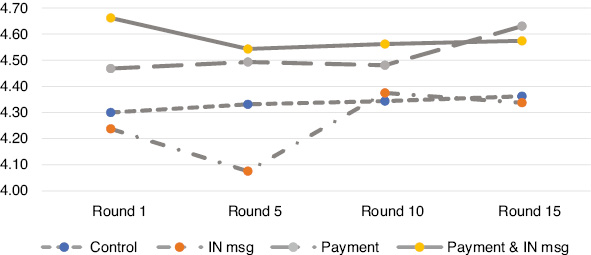
Figure 4:
Perceived injunctive norms (vertical axis) by treatment, rounds 1, 5, 10, 15 (horizontal axis).
Note: perceived injunctive norms measures are a composite of responses to survey questions 2, 3, 4 and 6 in Table 1, each of which reflects injunctive norms. Treatments: Control, Injunctive norms (IN) message, payment, injunctive norms (IN) message+payment.
Table 2:
Summary statistics of variables in the model.
| N | Minimum | Maximum | Mean | Std. Deviation | |
|---|---|---|---|---|---|
| Days volunteered for antitrapping patrol | 1920 | 0.00 | 7.00 | 5.605 | 1.69 |
| Initial group average days (in round 1) | 1920 | 128 | 1.0 | 7.0 | 5.35 |
| Collective descriptive norm (CDN)1 | 1920 | 1792 | 0.0 | 7.0 | 5.61 |
| Perceived descriptive norm (PDN)2 | 512 | 1.00 | 5.00 | 4.45 | 0.76 |
| Perceived injunctive norm (PIN)2 | 512 | 1.80 | 5.00 | 4.42 | 0.68 |
| Injunctive norms message3 | 1920 | 0.00 | 1.00 | 0.50 | 0.50 |
| Financial incentive4 | 1920 | 0.00 | 1.00 | 0.17 | 0.37 |
| Post-financial incentive5 | 1920 | 0.00 | 1.00 | 0.17 | 0.37 |
1Lagged average days for other participants in the group (the non-self mean). Round 15 is excluded.
2PDN and PIN are computed using confirmatory factor analysis on the responses to survey questions listed in Table 1 designed to measure PDN and PIN, respectively.
3Dummy variable set equal to 1 for cases in the injunctive norms message treatment. This message is delivered in all 15 rounds.
4Dummy variable set to equal 1 for cases in the financial incentive treatment groups during phase 2 when the financial incentive is in effect, otherwise zero.
5Dummy variable set to equal 1 for cases in the financial incentive treatment groups during phase 3, when the incentive has been withdrawn.
Table 3:
Estimation results: number of days volunteered.
| Model 1 | Model 2 | Model 3 | |
|---|---|---|---|
| Initial group avg. days (phase 1, round 1) | 0.10 (0.06)* | 0.11 (0.05)** | 0.11 (0.5)** |
| Financial incentive | 0.12 (0.10) | 0.10 (0.09) | 0.36 (0.42) |
| Post-financial incentive | 0.15 (0.09) | 0.13 (0.08) | −0.28 (0.49) |
| Collective descriptive norm (CDN) | 0.00 (0.06) | −0.02 (0.05) | −0.02 (0.06) |
| Own days volunteered in previous round | 0.73 (0.06)*** | 0.71 (0.06)*** | 0.70 (0.06)*** |
| Injunctive norms message | −0.01 (0.09) | ||
| Perceived descriptive norm (PDN) | −0.01 (0.08) | −0.01 (0.07) | |
| Perceived injunctive norm (PIN) | 0.17 (0.06)*** | 0.16 (0.07)** | |
| Financial incentive*perceived injunctive norm | −0.06 (0.09) | ||
| Post-financial incentive*perceived injunctive norm | 0.09 (0.10) | ||
| N | 1792 | 1792 | 1792 |
| r2 | 0.60 | 0.60 | 0.60 |
Notes: OLS regression; standard errors in parentheses, * p<0.10, ** p<0.05, *** p<0.01. All models contain a variable for round (1–5) and dummy variables for phases 2 and 3.
Table 4:
Estimation results: perceived injunctive norm.
| Initial group avg. days volunteered (phase 1, round 1) | −0.05 (0.02)*** |
| Financial incentive | 0.11 (0.05)** |
| Post-financial incentive | 0.12 (0.05)** |
| Injunctive norms message | 0.03 (0.03) |
| Collective descriptive norm (CDN) | 0.12 (0.02)*** |
| Own days volunteered in previous round | 0.16 (0.02)*** |
| N | 1792 |
| r2 | 0.07 |
Notes: OLS regression; clustered (by group) robust standard errors in parentheses, * p<0.10, ** p<0.05, *** p<0.01.
Model also contains a variable for round (1–5) and dummy variables for phases 2 and 3.
Table 5:
Mediation model: regression of days volunteered on perceived injunctive norms (mediator) and payment (exogenous variable).
| Panel A: regression of perceived injunctive norms (mediator) on financial incentive | ||
|---|---|---|
| Model 1 | ||
| Financial incentive | 0.06 (0.03)* | |
| Constant | 1.02 (0.08)*** | |
| N | 1792 | |
| r2 | 0.66 | |
| F | 435.5 | |
| Model 2 | Model 3 | |
| Perceived injunctive norms (mediator) | 0.17 (0.08)*** | |
| Financial incentive (independent variable) | 0.10 (0.09) | 0.09 (0.9) |
| Constant | 0.39 (0.28) | −0.26 (0.22) |
| N | 1792 | 1792 |
| r2 | 0.6 | 0.6 |
| F | 337.09 | 301.44 |
Notes: Control variables: initial group average days, collective descriptive norm, own number of days volunteered in previous round, perceived descriptive norm, round, phase 1, phase 2.
OLS regression; standard errors in parentheses, * p<0.10, ** p<0.05, *** p<0.01; Sobel-Goodman Tests indicate 31% of the variance in perceived descriptive norms is explained by the mediator, Sobel coefficient=0.032; SE=0.018, z=1.82, p=0.10.
Table 6:
Mediation model: regression of days volunteered on perceived injunctive norms (mediator) and post-payment (exogenous variable).
| Panel A: regression of perceived injunctive norms (mediator) on post-financial incentive | ||
|---|---|---|
| Model 1 | ||
| Post-financial incentive | 0.07 (0.03)** | |
| Constant | 1.01 (0.08)*** | |
| N | 1792 | |
| r2 | 0.65 | |
| F | 436.09 | |
| Model 2 | Model 3 | |
| Perceived injunctive norms (mediator) | 0.17 (0.07)*** | |
| Post-financial incentive (independent variable) | 0.13 (0.11) | 0.12 (0.09) |
| Constant | −0.26 (0.22) | |
| N | 1792 | 1792 |
| r2 | 0.6 | 0.6 |
| F | 337.4 | 301.67 |
Notes: Control variables: initial group average days, collective descriptive norm, own number of days volunteered in previous round, perceived descriptive norm, round, phase 1, phase 2.
Standard errors in parentheses; * p<0.10, ** p<0.05, *** p<0.01; Sobel-Goodman Tests indicate 28% of the variance in perceived descriptive norms is explained by the mediator, Sobel coefficient=0.037; SE=0.017, z=2.12, p=0.05.