

Figure 1:
Community members gather together prior to the public hearing for Hā‘ena’s community-driven rules package, many wearing “lawai‘a pono” t-shirts (a Hawaiian phrase that translates to “responsible fishing”) to show their support. Photo by Kimberly Moa. Used with permission.
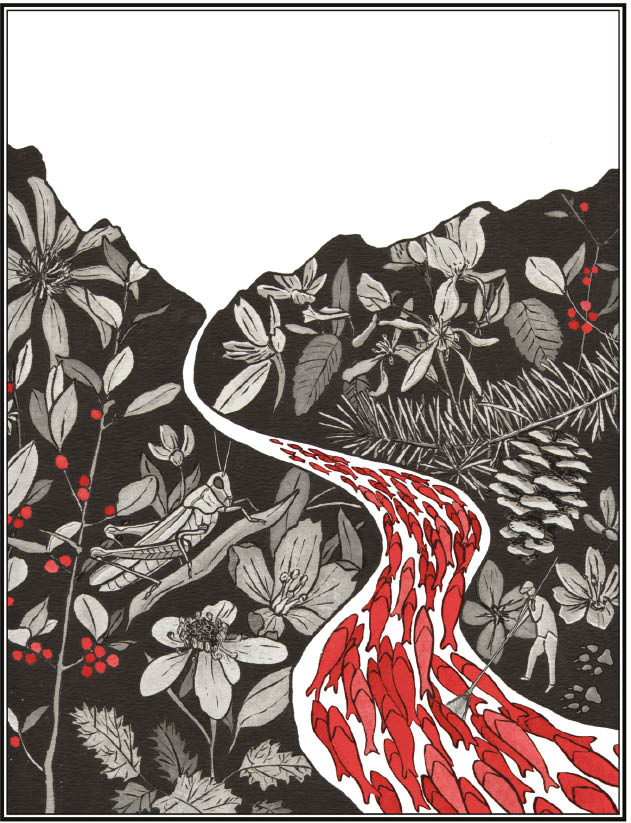
Figure 2:
This conceptual image represents some of the reciprocal relations between the Xáxli’p First Nation community and Fountain Valley. It is mountain snowmelt that ultimately flows into the main stem, Fraser River, to help keep the water cool for migrating salmon in the summer. The buttercups flower in the spring and signal that the Spring Salmon is coming up the river—the yellow of the buttercup evokes the yellow of the salmon’s eye. When the grasshoppers start singing, this means that it is time for drying the summer sockeye along the river. Traditionally, sticks from Tsáqwәm bushes (Saskatoon) were gathered by Xáxli’p people and used for many parts of drying the salmon. You can also see Coyote’s footprint at Six-Mile (Sxetl’), where the mythical figure Coyote created one of the Xáxli’p community’s main fishing places—a place where Xáxli’p people continue to dipnet for salmon today. Concepts depicted here were shared by Herman Alec. Illustration was provided by Lichia Liu. Used here with permission (see XCF Memorandum on Information Sharing).
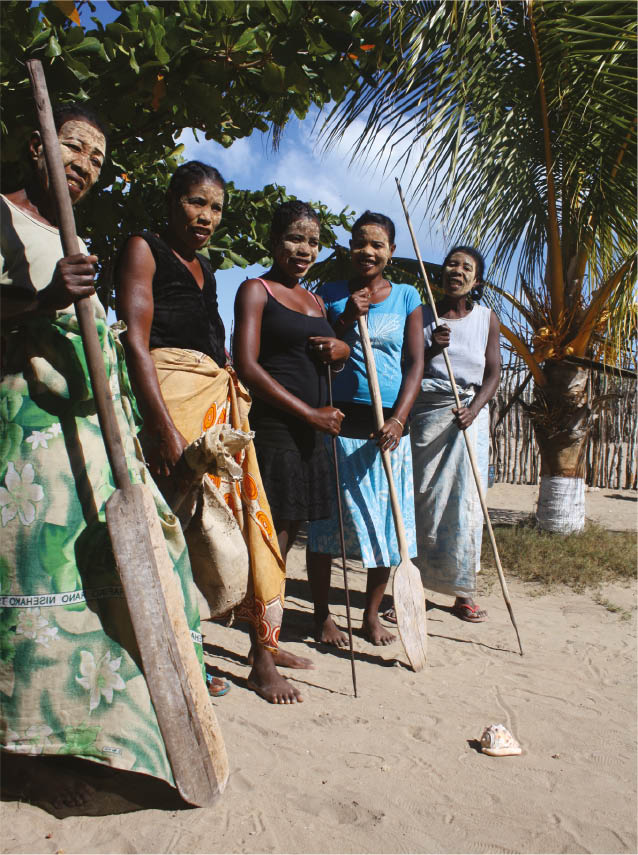
Figure 3:
Women from a coastal village in southwestern Madagascar who go out and fish together. There are multiple generations within a family line in this photo, plus another woman who has married into the family. Photo by Merrill Baker-Médard.
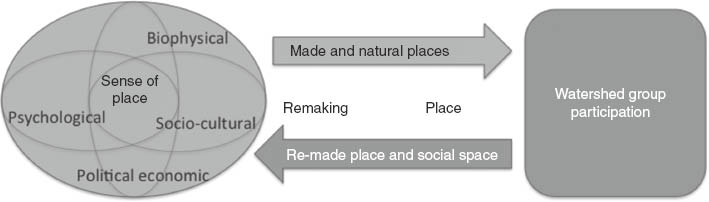
Figure 4:
Places motivate participation, and participation in place-protective actions re-makes places. Source: Lukacs and Ardoin (2013, 6). Used here with permission.
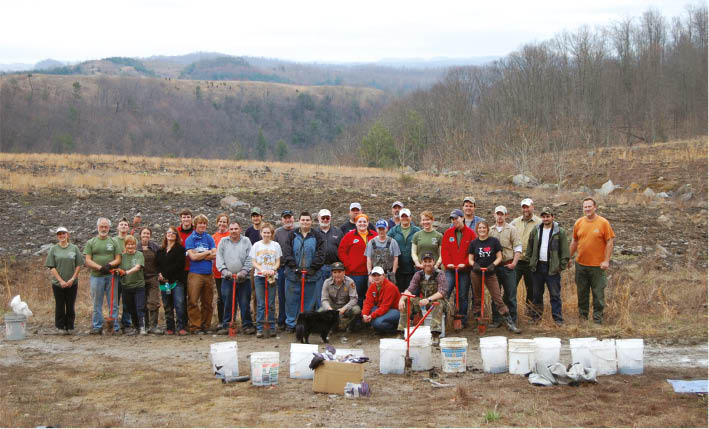
Figure 5:
Watershed group volunteers, foresters, and others plant trees on a valley fill at a former surface coal mine site in southern West Virginia as part of the Appalachian Regional Reforestation Initiative. Photo by Heather Lukacs.