
Table 1:
Ostrom’s (1990) design principles (adapted from Ostrom 1990).
| DP 1: Clearly defined boundaries | Both physical boundary of natural resource along with a list of eligible users should be clearly defined |
| DP 2: Congruence between appropriation, provision and tailored to local conditions | Those who derive benefits from use of natural resources should concomitantly contribute towards provisioning and maintenance activities. Such interventions should be tailored to local conditions to ensure long-term sustainability |
| DP 3: Collective-choice arrangements | Those who depend on natural resource should actively participate in decision-making processes such as developing norms and rules |
| DP 4: Monitoring | Monitoring is vital to deter potential defaulters and free riders |
| DP 5: Graduated sanctions | All defaulters must be penalised for non-compliance and penalty increased according to the severity of the offence |
| DP 6: Conflict resolution mechanisms | Conflicts must be resolved quickly, cheaply and fairly |
| DP 7: Minimal recognition of rights to organise | Natural resource users must be given some degree of freedom and flexibility to organise themselves to enhance relevance, applicability of rules and norms |
| DP 8: Nested enterprise | For larger resource systems, a nested approach is recommended for easy coordination, networking and being responsive to specific situations |
Table 2:
Summary of case study site characteristics.
| Yak herding | Yak herding | Yak herding | Sedentary livestock | Yak herding | |
|---|---|---|---|---|---|
| Region | East | East | West-Central | West-Central | West |
| No. of households | 80 | 14 | 3 | 27 | 20 |
| Tsa-drog type | Winter | Winter | Winter | All season | Winter |
| Property rights regime | Communal tsa-drog | Private use rights-absentee landlady | Private use rights – local temple | Leasing | Private use rights-herders/absentee landlords/central monastic body |
| Tsa-drog management regime | Communal tsa-drog with internal parcelisations | A group of 10 herders rent a portion of tsa-drog belonging to an absentee landlady and manage it communally | Shared with sedentary livestock farmers | Individual plots allocated for improved pasture development | Fewer households with larger herd size |
| Informal/customary norms and rules- prior agreed entry-exit timing issued by a sub-district administration | Same as Cheabling except entry-exiting timing is decided by the group of 10 herders | Informal/customary norms and rules and there is no entry-exit timing | Informal/ have written group constitution and by-laws | Informal/customary norms and rules, entry-exit timing for summer tsa-drog (rented from central monastic body and managed communally) | |
| Tsa-drog degradation | Encroachment of tsa-drog by unpalatable tree species | Same as Cheabling | Encroachment of tsa-drog by unpalatable tree species. | Weed problem | Encroachment by unpalatable tree species |
| Lopping of fodder trees from nearby State forest | Weed problem | Marshy | Wild pig depredation of tsa-drog | ||
| Flash floods and landslides wash away tsa-drog | |||||
| Overgrazing and trampling by livestock | |||||
| Type of livestock reared by herders and livestock farmers | Yak, dzo dzom (yak cross, cattle, sheep, goat, horse | Same as Cheabling except goat | Yak, sheep, horse | Jersey and Swiss brown cross, local cattle | Yak, sheep, horse |
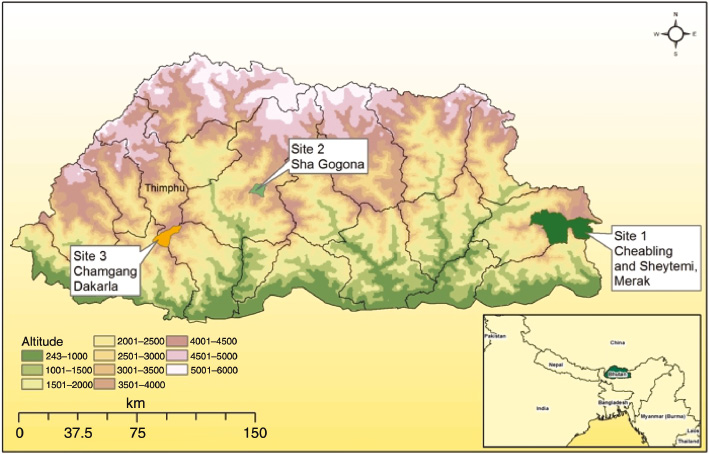
Figure 1:
Map showing high altitude rangelands in the three case study sites.
Table 3:
Research participants.
| Male | Female | Male | Female | |||
|---|---|---|---|---|---|---|
| Case study site 1: | ||||||
| (i) Cheabling | 6 | 3 | 14 | 15 | 38 | 25% |
| (ii) Sheytemi | 4 | 1 | 8 | 3 | 16 | 11% |
| (iii) Downstream communities | 6 | 0 | 25 | 5 | 36 | 24% |
| Case study site 2: | ||||||
| Sha Gogona | 5 | 1 | 5 | 20 | 31 | 21% |
| Case study site 3: | ||||||
| Dakarla | 2 | 3 | 3 | 3 | 11 | 7% |
| Government agencies | 9 | 0 | 8 | 2 | 19 | 13% |
| Total by gender | 32 | 8 | 63 | 48 | 151 | 100% |
| % by gender | 80% | 20% | 57% | 43% | 100% |
Table 4:
Sample sizes for the interviews and focus groups.
| Participating households | % of total | Participating households | % of total | ||
|---|---|---|---|---|---|
| Site 1: (i) Cheabling | 80 | 9 | 11 | 29 | 36 |
| Site 1: (ii) Sheytemi | 12 | 5 | 42 | 11 | 92 |
| Site 2: Sha Gogona | 30 | 6 | 20 | 25 | 83 |
| Site 3: Dakarla | 20 | 5 | 25 | 6 | 30 |
| Total/average | 142 | 25 | 18 | 71 | 50 |
Table 5:
Conformance of high altitude tsa-drog governance arrangements to Ostrom’s (1990) design principles in the three case study sites.
| Clearly defined boundary | Congruence between appropriation and provision activity | Collective choice arrangements | Monitoring | Graduated sanction | Conflict resolution | Minimal rights to organise | Nested enterprise | ||
|---|---|---|---|---|---|---|---|---|---|
| Case study site 1: (i) Cheabling | |||||||||
| i) Winter tsa-drog of Cheabling | Communal tsa-drog | Natural landmarks used as boundary markers Internally sub-divided into 5 parcels along with a list of eligible herders’ households’ for each parcel The list of eligible users includes 80 herder households (as of 2013). Any new herder households separating from their parents’ households get automatic rights to the communal tsa-drog | Provisioning and maintenance activities not permitted under existing tsa-drog property rights regime | Generally, the concept of mang provides an arena for making collective choice arrangements. The size or membership of mang may differ depending on the size of the community, group or sub-group. Both men and women participate in the decision-making process (see page 21) For instance, the mang of Cheabling comprises 80 herder households. The sub-district administration (dungkhag) and block administration (gewog) and mang of Cheabling together stipulated the entry-exit timing for winter tsa-drog of Cheabling. The decision was passed in the form of a decree (kasho) issued by the sub-district administration The mang decided to stop sub-leasing of rights to communal tsa-drog to outsiders to minimise grazing pressure and tsa-drog degradation | Have a system of appointing community stewards on a rotational basis Herder households who have farm labour shortage must pay fee in lieu of their contribution of community stewards | Have a graduated penalty system A fine of Nu. 50 or US $1/livestock head for encroachment is levied for first offence The fine amount is doubled for repeat offenders | Informal conflict resolution mechanisms include dialogue and third party mediation Formal conflict resolution mechanisms include arbitration and adjudication in the court of law | Does not feature explicitly in local natural resource governance discourses and narratives | Does not feature explicitly in local natural resource governance discourses and narratives |
| Case study site 1: (ii) Sheytemi | |||||||||
| ii) Winter tsa-drog of Sheytemi | Private tsa-drog The majority of tsa-drog in the area used to belong to an absentee landlady | Natural landmarks used as boundary markers A barbed wire boundary fencing erected in 2012 to prevent cattle encroachment from downstream communities. The list of eligible users include 10 member households from Merak who rent a plot of tsa-drog from the absentee landlord and Other user include 4 private use right holder herders (2 each from Merak and downstream community of Chaling Shongphu) | -same as above- | In Sheytemi, the mang effectively comprises 10 tenant households for matters related to management of rented tsa-drog. A group of 10 herders from Merak rent a part of tsa-drog from an absentee landlady. However, the absentee landlady via her nagzip (care-taker yak herder who is also the landlady’s representative at the community level) stipulates what is allowed and not allowed by tenants Operational rules include fixing entry-exit timing is decided through a bottom up process among the tenants. For instance, tenants are only allowed to build their camps within the boundary of an identified area for better sanitation and freeing up of tsa-drog for grazing | -same as above- | -same as above- | -same as above- | Tenant herders have to seek prior consent from the absentee landlord for any activities to be implemented on the rented private property | -same as above- |
| In contrast to the 10 tenant herders, the other 2 herder households each from Merak and the downstream community of Chaling Shongphu do not rent tsa-drog from the absentee landlady. They have their own private use right tsa-drog and they have the flexibility and authority to manage them as they best see fit | |||||||||
| Case study site 2: Sha Gogona: (i) Yak herding component | |||||||||
| iii) Winter tsa-drog of Sha Gogona | Private tsa-drog It used to belong to the local temple | Natural landmarks are used as boundary markers. The list of eligible herders includes all the members of Sha Gogona community. However, currently there are only three yak herders (one yak herder quit yak herding in 2012) use private tsa-drog belonging to the local temple | -same as above- | The local temple and the 30 households of Sha Gogona comprise the mang of Sha Gogona responsible for making collective choice arrangements Those members of community using tsa-drog have to pay annual rent in the form of butter and cheese to the local temple. The rent to be paid to the local temple is decided by the mang | There is no system of appointing community stewards | There is no system of a penalty system | -same as above- | -same as above- | -same as above- |
| Case study site 2: Sha Gogona: (ii) Sedentary livestock farming component | |||||||||
| iv) Pilot leasing program | Mixed property regime It exhibits both private and common property characteristics | Under the aegis of the pilot leasing program, the Bhutan government leased non-forest barren government forest land to members of a farmer’s group Individual plots approximately measuring 2.5 Ha allotted to members and are fenced using barbed wire and local fencing materials since 2004 The list of eligible members includes 28 member households of the farmers’ group of Sha Gogona. Three yak herders are part of this group | Under the aegis of the pilot leasing program, the Bhutan government made an exception and granted lease rights to herders and farmers Members are allowed to grow improved pasture and erect fencing which are not permitted otherwise under the existing tsa-drog governance regime in other areas | The 30 member households of the farmer group comprise the mang for the leasing program. Collective choice arrangement rules include decision to allot individual plots nearest to their respective hamlets to facilitate monitoring and for easy transportation of fodder from and manure to respective plots Operational rules include fencing of individual plots and establishing improved pasture @ one acre/year starting 2004 and instituting a graduated sanction Both collective choice and operational rules are codified in the form of a written group constitution and by-laws drafted by the members themselves The farmer group’s general assembly, comprising 30 member households, is vested with the power and authority to make changes to collective choice arrangements based on democratic norms such as simple majority rule or through consensus. For example, the management committee is elected by the group’s general assembly | All members of the farmers’ group and the management committee elected by farmers’ group, in particular, are responsible for monitoring and enforcement of collective choice and operational rules and norms | Have penalty rates mentioned in the group constitution for contravention of group constitutions and by-laws Termination of membership and revoking of lease right for repeat defaulters invoked as a last resort | The management committee and the general assembly of members of the farmer group provide arenas for conflict resolutions Group constitution and by-laws provide the basis and foundation for conflict resolutions | Members of the farmers’ group allowed to develop im proved pasture as mentioned under DP 2 | -same as above- |
| Case study site 3: Chamgang | |||||||||
| v) Winter of Chamgang | Private/rented Herders, absentee landlords and monastic body (dratsang) used to own winter tsa-drog in and around Chamgang area | Natural landmarks used as boundary markers | Provisioning and maintenance activities not permitted under existing tsa-drog property rights regime | -Not applicable- | -Not applicable- | -Not applicable- | Have both informal and formal conflict resolution mechanisms | Not explicitly mentioned in local natural resource governance discourses | Not explicitly mentioned in local natural resource governance discourses |
| vi) Summer tsa-drog | Private/Communal/Rented Similar to winter tsa-drog, herders, absentee landlords and monastic body (dratsang) used to own summer tsa-drog in areas located above Chamgang | -same as above- | -same as above- | 20 herder households comprise the mang of Wang-dro sub-group of herders of Dakarla. The collective choice arrangements include setting of prior agreed entry-exit timing to summer tsa-drog which is rented from the Central Monastic Body but managed communally. As their counterparts in Cheabling and Sheytemi, herders are required to set up camps in their respective identified areas | Appoint community stewards (Risup) on rotational basis Community stewards start guarding summer communal tsa-drog a month before the herds return from their winter tsa-drog | In kind fines in the form of butter and cheese imposed on defaulters in commensuration with the degree and extent of damage caused due to cattle encroachment Replacement tsa-drog must be provided if the damage is extensive Fines collected in the form of cheese and butter are used to give a feast to the entire community before they leave the communal summer tsa-drog | -same as above– | -same as above- | -same as above- |