
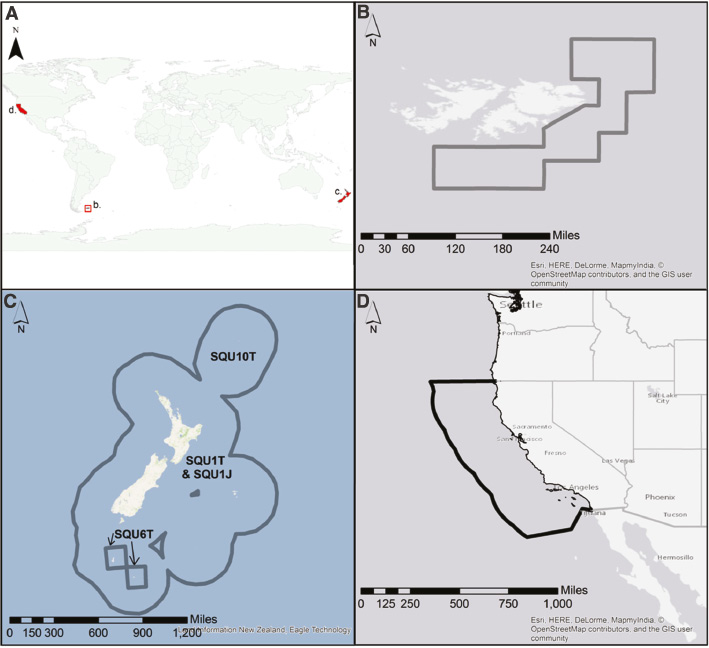
Figure 1:
Map of case studies locations. (A) World map highlighting in red the three case studies locations with the following markings: (b) Falkland Islands; (c) New Zealand; (d) California. (B) The grey box marks the ‘Loligo Box’ fishing zone off the Falkland Islands. (C) The four arrow squid fishing zones of New Zealand, including the region of concern in this study, the 6T region in the south. (D) The economic exclusive zone (EEZ) of California, marking the zone in which federal management monitors market squid (though most of the fishing occurs within 3 miles of the coast line within this marked region).
Table 1:
Coded components per case.
| Case | Time period | Governance system | Environmental commons | Actor 1 (Managers) | Actor 2 (Fishers) |
|---|---|---|---|---|---|
| Falkland Islands | 1986–2016 | Falklands Interim Conservation and Management Zone (FICZ) | Patagonian squid (Loligo gahi) | Falkland Islands Government (FIG) Fisheries Department | Patagonian Squid Trawling Fishermen |
| New Zealand | 1987–2016 | New Zealand Quota Management System | Arrow Squid (Nototodarus spp.) | New Zealand Ministry of Primary Industries | New Zealand Deepwater Fishermen |
| California | 2005–2016 | California Department of Fish & Wildlife Market Squid Fishery Management Plan | California market squid (Loligo opalescens) | California Department of Fish and Wildlife Coastal Pelagic Species Team | California WetfishRoundhaulFishermen |
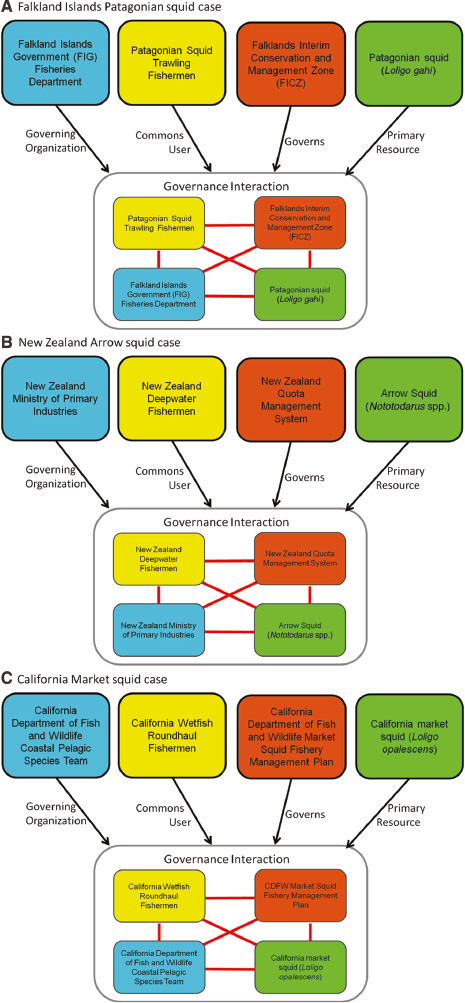
Figure 2:
SESMAD coding diagram for each case. Each colored box indicates a separately coded component. In the governance interaction, each colored box is coded again, but in relation to the other components. Red lines represent the linkages among the four coded components indicating that within the governance interaction, each component takes the others into consideration.
Table 2:
Outcome summary.
| Variable | Falkland Islands | New Zealand | California |
|---|---|---|---|
| Governance System Effect | Met goals (Stabilize the fishery) | Met goals (Minimize mortality rates of the New Zealand sea lion from fishery interactions) | Met goals (Maintain sustainable squid population for social and ecological considerations) |
| Commons Condition (Squid Population) Trend | Remained the same | Remained the same | Remained the same |
| Basin Switch (Has the squid population switched stable states?) | No, in desirable state | No, in desirable state | No, in desirable state |
| Fisher Well Being | Improved | Improved | Remained the same |
| Fisher Compliance | Yes | Yes | Yes |
Green indicates outcome increased/improved during analyzed time period, yellow indicates consistent/ no-change outcome, and red (which is absent) would indicate outcome decreasing/weakening.
Table 3:
Coding results of variables contributing to presence of design principles.
| Design principle | Variable | Falkland Islands | New Zealand | California |
|---|---|---|---|---|
| 1A. Clearly defined community boundaries | 1.1a Actor group (fisher) boundary clarity | Clear boundaries (3) | Clear boundaries (3) | Clear boundaries (3) |
| 1.1b Commons boundary negotiability (negotiability for outsider-fishers to access squid) | Rigid (3) | Rigid (3) | Moderate (2) | |
| 1.1c Actor group (fisher membership) boundary fuzziness | Rigid (3) | Rigid (3) | Rigid (3) | |
| 1.1d Outsider exclusion (fishers can exclude others) | Some exclusion (2) | No exclusion (1) | No exclusion (1) | |
| 1B. Clearly defined resource boundaries | 1.2 Commons (squid) boundaries | Somewhat unclear boundaries (2) | Somewhat unclear boundaries (2) | Somewhat unclear boundaries (2) |
| 2A. Appropriation and provision rules conform to local conditions | 2.1 Social-ecological fit | High (3) | Medium (2) | Medium (2) |
| 2B. Congruence between appropriation and provision rules | 2.2 Proportionality of costs and benefits (fishers) | Yes (3) | Yes (3) | Yes (3) |
| 3. Collective-choice arrangements | 3a Participation in rule making (fishers) | Medium (2) | Medium (2) | Medium (2) |
| 3b Commons political power (fishers) | Medium (2) | High (3) | Medium (2) | |
| 3c Collective action | Medium (2) | High (3) | High (3) | |
| 4. Monitoring | 4a Self monitoring | Yes (3) | Yes (3) | Yes (3) |
| 4b Environmental monitoring (managers) | Moderate (2) | Moderate (2) | High (3) | |
| 4b Environmental monitoring (fishers) | High (3) | High (3) | Low (1) | |
| 4c Participation in environmental monitoring | Medium (2) | High (3) | Medium (2) | |
| 4d External monitoring | Yes (3) | Yes (3) | Yes (3) | |
| 5. Graduated sanctions | 5a Self sanctions | No sanctions (1) | No sanctions (1) | No sanctions (1) |
| 5b External sanctions | Yes | Yes | Yes | |
| 5c Participation in social monitoring | Medium (2) | High (3) | Medium (2) | |
| 6. Conflict resolution mechanism | 6 Conflict resolution (existing mechanisms) | Yes (3) | Yes (3) | Yes (3) |
| 7. Minimal recognition of rights to organize | 7 External recognition | Moderate – some recognition (2) | Moderate – some recognition (2) | High – complete recognition (3) |
| 8. Nested enterprises | 8 Multiple levels | Coordination among multiple levels (3) | Coordination among multiple levels (3) | Coordination among multiple levels (3) |
Colors indicate a variable’s association with CPR theory, green indicates the value is more likely to contribute to resource sustainability, yellow to be somewhat met, and red indicates it is least likely to contribute to resource sustainability, according to CPR theory. Of the coded numbers, (3) indicates that component to its specific principle is met, (2) indicates principle component somewhat met, and (1) indicates principle component absent.
Table A.2.1:
Social-ecological outcome variable characteristics from SESMAD information from SESMAD, 2014.
| Variable | Variable type | SESMAD question | Coding options |
|---|---|---|---|
| Commons Condition Trend | Ordinal | Based on your answers to the Beginning Condition and End Condition variables, would you say that the condition of this commons has improved, remained the same, or worsened during this time period? | 1 Worsened,2 Remained the same,3 Improved |
| Basin Switch | Categorical | Does this natural resource show evidence of switching stable states during this time period? If not, is the current stable state considered to be in a desirable/undesirable state? If yes, is the new stable state considered to be desirable/undesirable? | Yes desirable,Yes undesirable,No desirable,No undesirable, Unclear – system may be transitioning |
| User Group Well-Being Change | Ordinal | How has the well-being of this commons user group changed during the time period identified in this interaction? | 1 Worsened,2 Remained the same,3 Improved |
| Compliance | Ordinal | Do members of this actor group follow the rules of this governance system with respect to the emission or appropriation of this commons? | 1 No,2 Somewhat,3 Yes |
Table A.2.2:
Characteristics of SESMAD variables contributing to design principles information from SESMAD, 2014.
| Design principle | SESMAD variable | Variable type | SESMAD question | Coding options |
|---|---|---|---|---|
| 1A. Clearly defined community boundaries | 1.1a Actor group boundary clarity | Categorical | Are there clear rules that are followed about who and who isn’t a member of this group? | No boundaries, Unclear boundaries, Clear boundaries |
| 1.1b Commons boundary negotiability | Ordinal | How negotiable is access by non-members of this actor group to this environmental commons? | 1 Rigid, 2 Moderate, 3 Negotiable | |
| 1.1c Actor group boundary fuzziness | Categorical | Is membership in this actor group subject to ongoing negotiations (fuzzy boundaries)? Or are the boundaries the group more rigid? | Fuzzy, Rigid | |
| 1.1d Outsider exclusion | Ordinal | To what extent are members of this commons user group able to exclude non-members (outsiders) from using this commons? | 1 No exclusion, 2 Some exclusion, 3 Total exclusion | |
| 1B. Clearly defined resource boundaries | 1.2 Commons boundaries | Ordinal | Are the boundaries that define the spatial extent of this commons clearly defined and highly visible? | 1 Very unclear boundaries, 2 Somewhat unclear boundaries, 3 Clear boundaries |
| 2A. Appropriation and provision rules conform to local conditions | 2.1 Social-ecological fit | Ordinal | To what extent (low, medium, or high) do the institutional arrangements of this governance system fit well with the ecological or physical features of the commons on which they are implemented? | 1 Low, 2 Medium, 3 High |
| 2B. Congruence between appropriation and provision rules | 2.2 Proportionality of costs and benefits (fishers) | Binary | Is there general proportionality between the amount of costs group members incur and the amount of benefits received? | Yes, No |
| 3. Collective-choice arrangements | 3a Participation in rule making | Ordinal | How high is the level of participation of this actor group in the process that determines how this environmental commons is governed? | 1 Low, 2 Medium, 3 High |
| 3b Commons political power (fishers) | Ordinal | How much power does this actor group have in the process that determines the governance of this commons? | 1 Low, 2 Medium, 3 High | |
| 3c Collective action | Ordinal | What is the current level of collective action within the members of this actor group with respect to the use or management of this commons? | 1 Low, 2 Medium, 3 High | |
| 4. Monitoring | 4a Self monitoring | Binary | Does this actor group monitor its own activities with respect to the use of this commons? | Yes, No |
| 4b Environmental monitoring | Ordinal | How much environmental monitoring of this commons does this actor group engage in? | 1 Low, 2 Moderate, 3 High | |
| 4c Participation in environmental monitoring | Ordinal | How high is the level of participation of this actor group or their representatives in environmental monitoring? | 1 Low, 2 Medium, 3 High | |
| 4d External monitoring | Binary | Do external actors/organizations monitor the activities of this commons using actor group with respect to the use of this commons? | Yes, No | |
| 5. Graduated sanctions | 5a Self sanctions | Categorical | Are sanctions applied by and to the members of this group for violations of rules regarding extraction or emission? And if so, are these sanctions graduated (increasing with severity and repetition of offenses)? | Graduated sanctions, Non-graduated sanctions, No sanctions |
| 5b External sanctions | Binary | Are sanctions applied by other actor groups to the members of this group for violations of rules regarding extraction or emission? And if so, are these sanctions graduated (increasing with severity and repetition of offenses)? | Yes, No | |
| 5c Participation in social monitoring | Ordinal | How high is the level of participation of this commons user group or their representatives in social monitoring (enforcement)? | 1 Low, 2 Medium, 3 High | |
| 6. Conflict resolution mechanism | 6 Conflict resolution | Binary | Are mechanisms in place to address conflicts that arise over the use of this commons by this actor group? | Yes, No |
| 7. Minimal recognition of rights to organize | 7 External recognition | Ordinal | Within this governance system, do larger governmental jurisdictions (i.e. international agreements, nation states) recognize the autonomy of lower-level jurisdictions (states, regions, communities), and their right to make decisions regarding this commons? | 1 Low – no recognition, 2 Moderate – some recognition, 3 High – complete recognition |
| 8. Nested enterprises | 8 Multiple levels | Categorical | Does this governance system contain multiple levels, with each level having a set of actors who conduct tasks with respect to the management of this commons? If so, is there active coordination across these levels, or not? | Single-level governance, Coordination among multiple levels, Multiple levels but no coordination |
Table A.3.1:
Coding results summary of key variables contributing to study outcomes.
| Variable | Falkland Islands | New Zealand | California |
|---|---|---|---|
| Economic Dependence | Very dependent (3) | Moderately dependent (2) | Moderately dependent (2) |
| Science-Based Policy | Yes (3) | Yes (3) | Yes (3) |
| Leakage of Benefits/Fringe Benefits | Yes Benefits (3) | Yes Benefits (3) | Yes Benefits (3) |
| Flexible Rights | Yes (3) | Yes (3) | Yes (3) |
Colors indicate a variable’s association with CPR theory, green indicates the value is more likely to contribute to resource sustainability, yellow to be somewhat met, and red (which is absent) would indicate it is least likely to contribute to resource sustainability. (3) Indicates the variable is present, (2) indicates it is somewhat present, and (1) would indicate the variable is absent.
Table A.3.2:
Characteristics of key SESMAD variables contributing to study outcomes information from SESMAD, 2014.
| SESMAD variable | Variable type | SESMAD question | Coding options |
|---|---|---|---|
| Economic Dependence | Ordinal | How dependent are the members of the group on this commons for their economic well-being? | 1 Not/slightly dependent 2 Moderately dependent, 3 Very dependent |
| Science-Based Policy | Ordinal | Is/are the policy/ies regarding this commons use and/or management set in accordance with the current scientific consensus? | 1 No, 2 Somewhat, 3 Yes |
| Leakage (of Benefits/Costs; e.g. Fringe Benefits) | Categorical | Has the governance of this commons led to the leakage of costs or benefits onto other systems? For costs, has the governance of this commons increased extraction/pollution pressures? | Yes, leakage of benefits, Yes, leakage of costs, No leakage |
| Flexible Rights | Binary | Does the relevant governance system allow for changing rights and restrictions applied to this actor group in accordance with environmental shifts and new scientific knowledge? | Yes, No |