
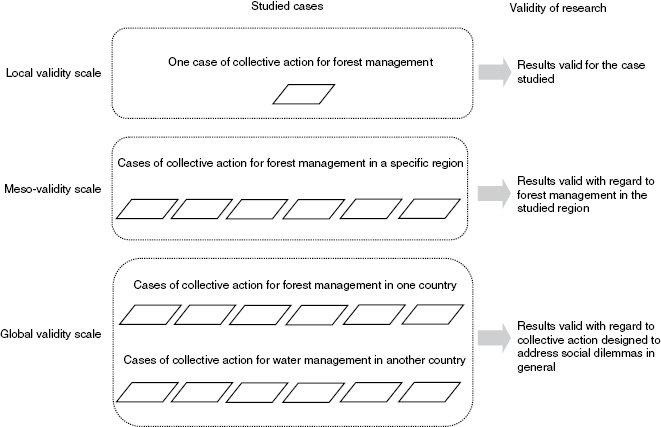
Figure 1
Examples of research on collective action using different validity scales.
Table 1:
How the theoretical bases used by Shah (1995 and 1996) and Ben Mustapha (2016) address the criticisms of sociologists and anthropologists with regard to the IESD school of thought.
| Shah | Ben Mustapha | |
|---|---|---|
| Multiple issues and social embeddedness | The qualitative component of the analysis takes into account multiple issues and social embeddedness | The interactions between actors were studied with regard to several issues |
| Multiple values, objectives and definitions of performance | A social constructivist approach of performance | A social constructivist approach of performance |
| External actors and factors | The study takes into account supporting institutions and economic context | The influence of major actors external to the irrigation scheme is taken into account |
| Power relationships | Power relationships are taken into account in the qualitative component of the study | There is an assessment of how actors attempt to impose their viewpoints, alone or in coalitions |
| History and processes | This component is considered in the qualitative component of the study | The study involved an assessment of the evolution of the relations between actors over a 4-year period |