
Table 1
Summary of four existing concepts used to explain natural resource management conflicts and their limitations in applying three levels of rules.
| Concepts | Issues addressed by the concepts | Potential causes of conflicts | Limitations of the concepts | References |
|---|---|---|---|---|
| Legal pluralism | Recognizes the interplay at the constitutional-choice rule level by addressing the co-existence of multiple sets of legal systems, or constitutional choice rules (between formal, codified, and informal, historically and culturally evolved institutions) | Conflict arises between actors operating under formal and informal constitutional-choice rules due to differences in codification, formality, legality, and legitimacy | Addresses multiple constitutional level rules and their divergent cultural and knowledge sources, but not the spinoff into divergent rule making at subsequent rule levels | Meinzen-Dick and Pradhan 2001; Bavinck and Gupta 2014 |
| Institutional void | Explains the absence or lack of recognition of collective action initiated by informal actors (e.g. community members) by constitutional choice rules of formal institutions | Conflict develops where there exists insufficient organization, institution, or entity to bridge the gap between formal constitutional choice rules and modern institutional spaces (e.g. new actors, movements) | Explains how collective action is initiated by informal actors in a dynamic and changing environment in the absence of agreed upon rules but does not address gaps at other rule levels associated with these diverse rulemaking interests | Hajer 2003, 2009 |
| Structural hole | Identifies the role of networks or structural social capital (i.e. connectedness of actors) in shaping ideas, and influencing information, communication and material resource flows at the operational level | Conflict develops in situations where subgroups or communities have no connection between them. These situations create a competitive advantage for and often abused by a third party that brokers the flow of information and control the interactions between the disconnected parties | Deals with missing network connections that limit knowledge flow and coordination but fails to demonstrate how this disconnect may result from the absence of common understanding and rule making between operational actors | Burt 2000, 2004 |
| Cultural mismatch | Explains the lack of recognition by formal institutions of informal constitutional rules associated with ethnically diverse groups in post-colonial societies (e.g. with distinct cultural practices- resource ownership, cultivation pattern, and sharing of resources and outputs) | Conflict arises when there is insufficient understanding or appreciation of locally embedded constitutional choice rules by formal rule practitioners, resulting in formal practitioners’ exclusion from broader informal constitutional rules and practices | Explains the failure to recognize informal constitutional rules in ethnic diverse societies but does not address how cultural differences can interfere with common understanding and rule making at other rule levels | Acheson 2006; Mills et al. 2010 |
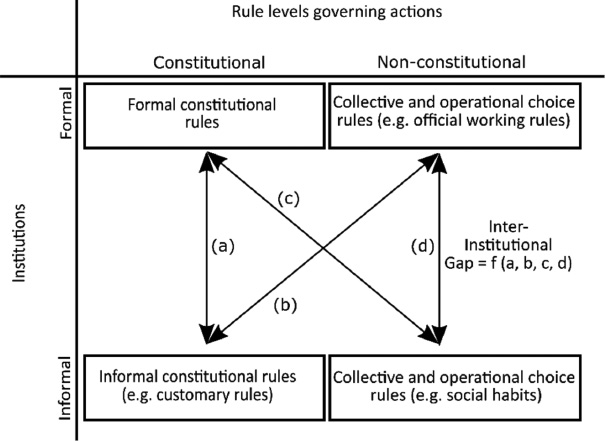
Figure 1
Conceptual diagram depicting inter-institutional gap framework, highlighting the gap as the function (f) of four possible interactional gaps that could occur between formal and informal institutional regimes. These are: (a) gap between formal and informal constitutional choice rules (i.e. between ‘constitutional laws’ and ‘customary laws’); (b) between informal constitutional choice rules and formal collective and operational choice rules (i.e. ‘customary laws’ and ‘binding working rules’); (c) between formal constitutional and informal collective and operational choice rules (i.e. “constitutional laws’ and ‘social rules/habits’); and (d) between formal and informal collective and operational choice rules (i.e. ‘binding working rules’ and ‘social rules/habits’). Actions axis involves constitutional (guided by constitutional choice rules) and non-constitutional (guided by collective choice and operational choice rules) actions.
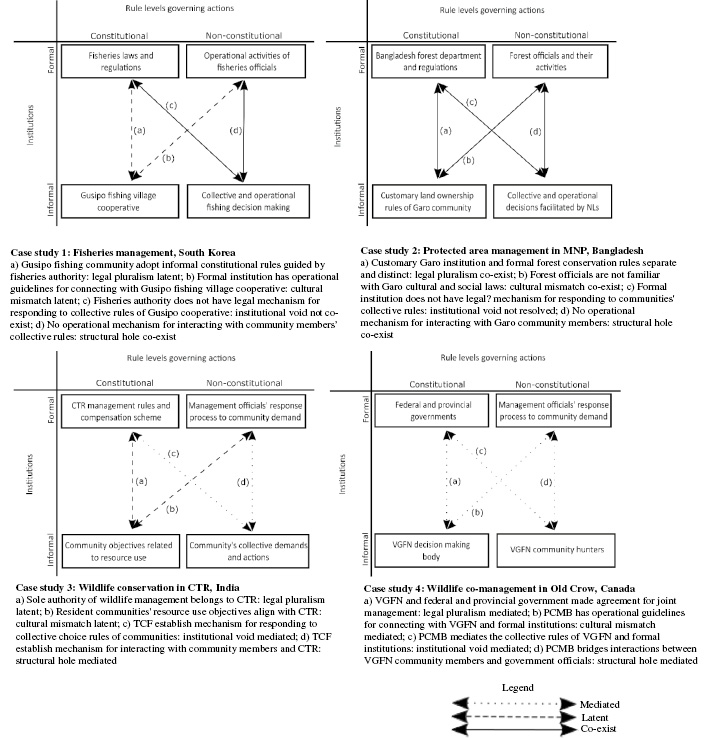
Figure 2
Case study analysis. Mediated: indicates the presence of rules that establishes coordination between formal and informal institutions; Latent: indicates the presence of mediating actors with non-permanent mediation rules; Co-exist: indicates the complete absence of coordination rule.