
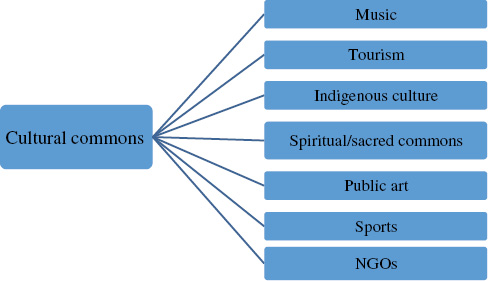
Figure 1:
Cluster of cultural commons (Adapted from Hess 2008).
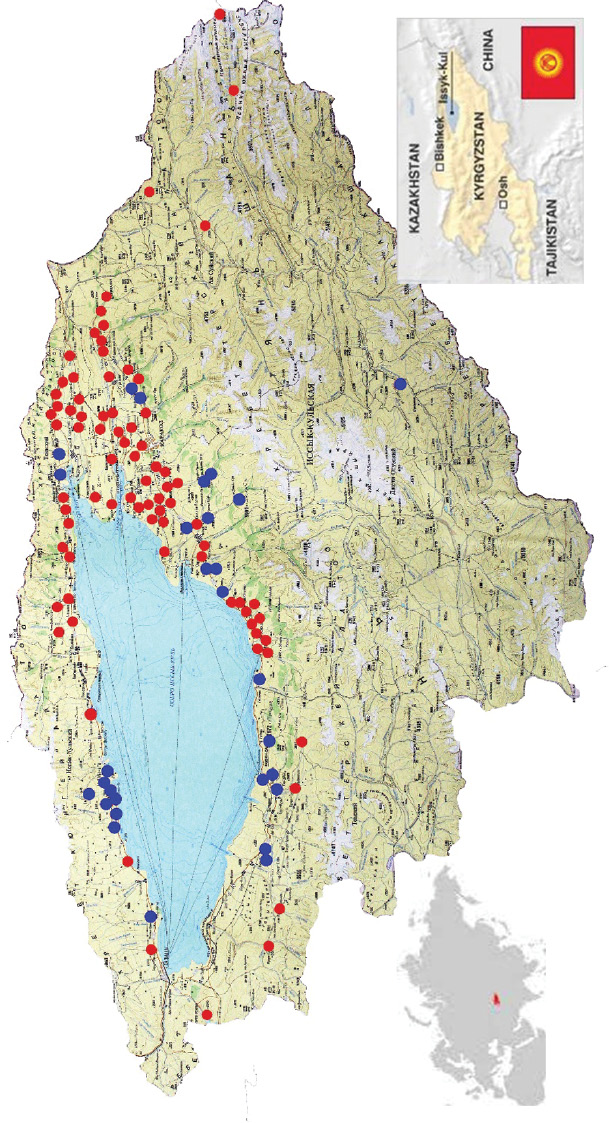
Figure 2:
Red and blue dots show approximate location of sacred sites within the Ysyk-Köl Biosphere Reserve.
Table 1
Topics, number of participants and date and location of a focus group discussion (FGD) and group discussions (GD) carried out during the field research.
| Title/subject | Participants | Date and location |
|---|---|---|
| FGD: Role of sacred sites and their guardians in conservation | 15 | Bishkek, October 26, 2014 |
| GD: Nurturing, preserving and losing sacredness | 50 | Bishkek, October 27, 2014 |
| GD: Meeting of government officials with local community leaders on establishment of Khan-Tenir National Park | 70 | Karakol, July, 2014 |
| GD: Meeting with traditional practitioners on indigenous research ethics at Aikol Orgo | 35 | Kok Jar village, October 1, 2014 |
| GD: Spiritual practices and livelihoods in sacred sites in mountainous areas | 30 | Bishkek, October 28, 2014 |
Table 2
Diversity of sacred sites in the Biosphere Reserve with respect to biophysical elements perceived as sacred.
| Biophysical elements of sacred sites | Number | Example |
|---|---|---|
| Vegetation | ||
| Apple tree | 3 | Alma [apple] mazary, a site with a very old, single apple tree |
| Apricot tree | 10 | Oruk [apricot] mazar, a big, old apricot tree grows on a hill. There is no vegetation around. |
| Birch tree | 1 | Kyzyl-Jar [red cliff], a birch tree has grown on the burial place of a sheyit, an innocently killed person. |
| Brushwood shrubs and bushes | 4 | Bala [child’s] mazar is part of bigger sacred site called Chungkur-Bulak [spring in the hole]. |
| Dog rose bush | 1 | Chong-Kyzyl-Suu [big red water], a dog rose bush is located near the entrance to the Jyluu-Suu [Warm water] sanatorium (health spa) |
| Fir tree | 6 | Oluya Zaur Ata [oluya Zaur father] is a big fir tree with three intertwined trunks. |
| Hawthorn | 6 | Mai-Bulak [oil spring] consists of a hawthorn tree, a boulder and a spring. Local people believe that the guardian-spirit of local land lives there. |
| Juniper bushes and trees | 7 | Archaluu [place with juniper] has juniper bushes and trees that grow in a hilly terrain with no other vegetation around it. Mostly people who want to have a child come for a pilgrimage. |
| Mountain ash tree | 4 | Aziz [a respectful term for snake] is a mountain ash tree with prayer flags tied to it. A white snake is believed to be the guardian-spirit of the place. |
| Persian olive | 1 | Jiide, the site, has an old silver berry tree, also known as Persian olive or oleaster, locally called jiide. |
| Pine tree | 1 | Altyn-Bulak [golden spring] is a pine tree with a warm spring next to it. |
| Poplar (various species) | 26 | Ak-Terek [white poplar] consists of six poplars and a spring. The poplars have grown bending into each other and they look like a yurt. The spring starts a little higher than the trees and flows to them. |
| Rowan tree | 1 | Sary-Bulung [yellow gulf] is the name of the village where a sacred rowan tree and a spring are located. |
| Sea-buckthorn bushes | 3 | Kessengir [mountain ridge covered with tall grass] consists of sea-buckthorn bushes and a spring at the beginning of the Kes-Senir canyon. |
| Walnut tree | 1 | Talip-Akun-Ata [father Talip Akun] consists of a walnut and a willow tree. It was named after a very wise and skilful person who built a school in olden days. |
| Willow (various species) | 28 | Mazar Bulak [mazar spring] is a cluster of old willow trees and a spring. According to local beliefs, this is one of the oldest sacred sites. |
| Water bodies | ||
| Lakes | 2 | Tuzduu-Suu [salty water] is a small salty lake whose waters are known to cure skin diseases. |
| Ponds | 3 | Bakaluu-Kol [frog lake] is a pond which used to be a big lake according to folk history. Sacred white frogs were believed to inhabit this lake. |
| Springs | 42 | Manjyly-Ata [father Manjyly] contains seven springs, each of which has distinct kasiet [spiritual power]. |
| Geological formations | ||
| Rocks and cliffs | 3 | Jeti-Oguz [seven oxen], a red limestone formation that resembles seven oxen. |
| Hills | 2 | Kindik-Dobo [belly button hill] is a sacred hill with a shape resembling a belly-button. |
| Mountains | 2 | Han-Tengir [Tengir is the name of the Creator] is a tall mountain with a sharp peak about 7000 meters high. |
| Salt formation | 1 | Tuz [salt] is a hole with salt crystals in it. |
| Stone | 13 | Tamga-Tash [stamp boulder] is a boulder with natural marks resembling a stamp (seal) |
| Ecosystems | ||
| Grove ecosystem | 1 | Kamanduu-Kol [wild boar lake] is a grove with different kinds of trees and shrubs; springs come out from under the roots of some of the trees. |
| Alpine ecosystem | 2 | Tastar-Ata [father Tastar] is a valley named after a mountain with the same name. Alpine summer pastures are located at the higher elevations. |
| Lake ecosystem | 1 | Ysyk- Köl Lake, the second largest high altitude lake in the world, is considered a sacred site as a whole. |
| Built elements | ||
| Mausoleums | 7 | Karga-Ake is a recently built mausoleum for a historical figure known for his wisdom and justice. |
| Tombs/graveyards | 12 | Karakol-Ata [Father Karakol] comprises a tomb, three yellow willow trees, a poplar tree and a spring. This complex is located in a Muslim cemetery. |
Table 3
Some of the main reasons why local people visit particular sacred sites.
| Purpose of visiting sacred sites | Example from Ysyk-Köl region |
|---|---|
| Wellness/health | Pilgrims often come to the Karakol-Ata sacred site and pray for wellness and health. |
| Fertility related | Women and couples wishing to have children visit Archabai (Archaluu) sacred site. Some of them bring cradles with them and conduct certain rituals. |
| Riches, wealth-related, livestock | Cholpon-Ata is a pir1 for sheep and that is why it is generally considered to be a sacred site where people ask for wealth of different kinds. |
| Power/career | Er-Tabyldy is named after the 18–19th century hero who fought for the Kyrgyz people. Pilgrims say that those seeking political power and authority and those wishing to have fortune in their career should come to this site. |
| Knowledge and wisdom | Kalygul-Oluya is named after a historical figure well-known as an oracle and for his wisdom. That is why this place is associated with those seeking knowledge. |
| Finding and accepting one’s spiritual call (kasiet) | Bugu-Ene mazary is a site named after a mother deer that serves to provide for a person’s spiritual call for healing, fortune telling, Manas reciting, etc. |
1Pir is a guardian-spirit of a person, place or animal (Aitpaeva 2013, 235).
2Manas is the heroic epic of the Kyrgyz people and a key element of traditional culture and worldview.
Table 4
Some rituals conducted on sacred sites by individuals and communities.
| English transliteration | Literal translation | |
|---|---|---|
| Aidar (Niyaz) chach aluu | Cutting Aidar (Niyaz) hair | Aidar chach is a lock of hair, which is left on the long-desired baby’s head after the first haircut to assure well-being and protection of the baby. The ritual of aidar chach is usually conducted at a sacred site by healers or sacred site guardians. |
| Ak chachuu | Scattering the white | Traditionally, this is a ritual of pouring out something white such as milk, yogurt, or flour to appease, show respect, and drive snakes out of person’s house, garden, or any other place. Sometimes it is also used to greet and show respect to sacred site guardian spirits. |
| Aktykty moyunga aluu | Accepting whiteness | This is a ritual of person’s accepting his/her spiritual mission such as healing (physical and/or psychological conditions), fortune telling, and/or spiritual channeling. The form and content of this ritual varies from case to case, although frequently it is conducted at sacred sites. |
| Jar saluu | Singing Jar | This is a ritual of singing/reciting/chanting words from the Quran and inviting spirits who support you. |
| Jeti tokoch | Seven flat breads | Tokoch is a type of round fried or baked bread. It is usually prepared by pilgrims before visiting sacred sites. This ritual is done to honor the guardian spirit of a sacred site and other invisible forces. |
| Sham jaguu | Lighting a candle | Sham is a ritual hand-made candle. A wisp of cotton is soaked in plant oil or animal fat and is usually wrapped around a dry reed stalk. Sham jaguu is a ritual of lighting these candles; it can be conducted both at home and on a sacred site. The ritual may be done for various purposes such as to show respect to guardian spirits, to pray, and to receive spiritual information from them in memory of the departed. This ritual is outlawed by the followers of radicalized Islam, and in some sacred sites it is prohibited. |
| Tuloo | Sacrifice | This sacrifice ritual is dedicated to a particular occasion. It is done to divert bad luck, overcome misfortunes, or safeguard individual or collective well-being. Livestock such as sheep, goats, cattle, and horse as well as poultry are acceptable sacrificial offerings. |
| Zikir chaluu | Chanting Zikr | Zikr is an Islamic ritual of reciting the names of Allah and glorifying his greatness, qualities, and omnipotence. This ritual is a part of other healing rituals. |