

Figure 1
Study area: Sampangi lake as situated within the city boundaries of 1885.

Figure 2
Methodological framework used.
Table 1
Timeline of events relating to Sampangi lake.
| Year | Description | References |
|---|---|---|
| Approximately 1537 AD | Founding of Bengaluru city by Kempe Gowda, creation of the Sampangi lake | Sudhira et al. 2007; Nair 2005; Samana and Gopinath 2012 |
| Between 10th and 16th century | Migration into Bengaluru city of Vannhikula Kshatriyas – They would become famous as horticulturists who were responsible for landscaping some important landmarks of the city like the Lal Bagh. | Srinivas 2001 |
| 1807–1809 | Establishment of British Cantonment in Bengaluru. Sampangi lake a central point between the Pete and Cantonment, supplying water to the Cantonment, while being part of the Pete or the native city. | Gist 1957; Vyasulu and Reddy 1985 |
| 1864–1870 | Establishment of Cubbon Park | http://www.horticulture.kar.nic.in/cubbon.htm |
| 1876–1878 | Severe famine in Bengaluru, during which time rights to excavate the tank bed for wells were granted to the native population. | Dikshit et al. 1993 |
| 1881 | Bengaluru city administered as assigned tract by Mysore rulers. Colonial Cantonment and the Mysore ruler administered native city separated, though Sampangi lake still provided water to the Cantonment. | Rice 1897; Bangalore Development Committee 1954 |
| 1886 | Establishment of St. Martha’s Hospital also on the wetlands surrounding Sampangi lake. | http://www.dnaindia.com/bangalore/report-bangalores-st-martha-hospital-completes-125-years-1538842 |
| ~1895 | Water supply from Sampangi lake stopped | Subramanian 1985 |
| 1898 | Inception of St. Joseph’s Indian High School, both on part of the lake bed as well as the wetlands surrounding the lake. | http://www.stjosephsindianinstitutions.com/?page_id=9 |
| 1957 | Cattle fairs on lake bed suggesting partial drying of the lake | Venkatarayappa 1957 |
| 1945 | Establishment of the City Improvement Trust Board (CITB), which initiated land acquisition in the area surrounding the lake leading to conflicts between the residents and the board. | Bangalore Development Committee 1954 |
| 1946–1954 | Formation of residential extensions among which Sampigehalli slum is featured | Bangalore Development Committee 1954 |
| 1949 | Lake bed now Kanteerava Stadium. Huge decline in tree cover and open space and increase in built up area | Srinivas 1999 |
| 1997 | Renovation of Kanteerava Stadium for the National Games event. | Heitzman 1999 |
| 2014 | Sampangi lake becomes a small tank due to rapid urbanization | Samana and Gopinath 2012 |

Figure 3
Sampangi Lake – 1885.
Table 2
Archival records relating to Sampangi lake: time period 1: before 1900.
| Date | Source of information | Details |
|---|---|---|
| 1864 | File Number 354 of 1909, Revenue | “The area ….was a paddy flat irrigated by wells with no tank above”. Provides a description of the area occupied by the tank. |
| 1883 | File number 354 of 1909, Revenue | Dispute between the Civil and Military Station concerning the supply of water to Millers Tanks from feeder channels of this lake (file makes no mention of its resolution). “Correspondence regarding Sampige Tank and its feeder channel began as early as 1883 when there was a dispute between the Civil and Military Station and the Durbar ….” |
| 16th March 1884 | Order No. 15401/LJ 205-93 (File number 302-93, (1–11), Municipal) | Prohibited firing of bricks in the bed of the tank citing sanitary grounds. “The tacit acquiescence of Government in the leasing of the tank bed for grazing purposes by the municipality does not imply permission to injure and disfigure the tank bed by digging unsightly holes and pits and otherwise injuring it.” |
| 2nd July 1892 | Ruling (File number 354 of 1909, Revenue) | “The sinking of wells or any other extensive excavation for any purpose whatever are prohibited within an area which includes the Sampigehalli Tank bed”. |
| 18th July 1894 | Order No. 926-261/2/LJ 233-92 (File number 302-93, (1–11), Municipal) – through the Senior Surgeon and Sanitary Commissioner | “The deepening of the bed i.e. the making of raw bricks be stopped. There is not much use in deepening the bed as the passages for supply of water to the tank had been blocked up”…. “The burning of bricks in the locality is unobjectionable provided all useless debris is cleaned up and the place is not fouled.”– This order re allowed for brick making in the neighbourhood of Sampangi Tank. |
| 1894 | Speech made by Dewan Seshadri Iyer (Dikshit et al. 1993) | “Undue importance was given to the responsibility of Government for the upkeep of tanks, the ryots liability being altogether ignored and when Government found that its costly agency, could not with any prospect of return for its capital, undertake the management of the tanks, in the province, the ryot was called upon to take charge of the majority of tanks. But the ryot by this time lost all traditions of contribution for works of public utility, nor were the civil officers in a position to enforce the ryot’s liability in an efficient manner.” |
| 6th April 1895 | Government Proceedings of the State of Mysore No. 16404-5/LF 233.92(File number 302-93, (1–11), Municipal) | “The central position of the bed of the Sampangi Tank with the city on one side and the Civil and Military Station on the other and especially its close proximity to the Maternity and St. Martha’s Hospital on one side and to the road leading from the crossing of the South Eastern Corner of Cubbon Park to the Lalbagh which is largely frequented by visitors to the latter places and to inhabited houses……” |
| April 1895 | Representation from Mr. Lee, the Sanitary Engineer (File number 302-93, (1–11), Municipal) | “It is not desirable or necessary to store any water in the tank. Its feeders have been cut off and The present beautifully levelled tank bed should not be allowed to be dug into unsightly pits to be hereafter used as latrines” |
| 6th April 1895 | Government Proceedings No. 16405-5/LF 233.92; (File number 302-93, (1–11), Municipal) Response from the President of the Municipal Council | “Mr. Lee’s fears as to the bed of the Sampangi Tank being converted into rubbish pits were unfounded, but that as the Hesaraghatta Scheme would bring in a plentiful supply of water, the deepening of the bed might be stopped.” “The Government observes that the Sampigehalli tank bed is included in the areas prescribed by the Chief Commissioner’s Notification no.188 dated 24 October 1872 within which all lands are reserved for public purposes and the erection of buildings and excavations without previous sanction of the Government are strictly prohibited” “the tacit acquiescence of the Government in the leasing out of the tank bed for grazing purposes by the municipality does not imply permission to injure and disfigure the tank bed by digging holes and pits” Arguments were also made regarding the feasibility of deepening the tank further due to fear of inundation of the bungalows of “Major Wahab, Dr. Gay and the Campbells” by this act. |
| 1895 | Letter from the President of the City Municipal Council to the Chief Secretary to the Government of Mysore (File number 302-93, (1–11), Municipal) | “During the scarcity of 1891–92, Government sanctioned the deepening of the bed of the Sampangi Tank as relief work but when sanction was granted, the season of scarcity had passed. Also, then the scheme of water supply had not matured and so it was felt necessary to deepen the bed as the springs of wells in the neighbourhood depended on the water in the tank”. |
| 5th April 1895 | Order No. 16404-5/LF 233-92 (File number 302-93, (1–11), Municipal) by B.V. Narasimmiyengar, General Secretary of the Government of Mysore | The municipality should not permit the “excavation of earth in the bed or its injury and disfigurement”, laying emphasis on the aesthetic nature of the lake. |

Figure 4
Sampangi Lake – 1935.

Table 4
Archival records relating to Sampangi lake: time period 3: between 1935 and 1973.
| Date | Source of information | Details |
|---|---|---|
| 1937 | Speech made by the Dewan Sir Mirza Ismail in inaugurating the hospital fete (Government Press 1949) | “…You acknowledge the help given by the departments of Government and private individuals in converting the Sampangy Tank into a delightful carnival ground, in organizing the carnival and in sanctioning an effort to secure that the Mysore money which would otherwise go outside Mysore should be retained within the State. … the creation of a fund to be named “The Maharaja’s Hospital Fund” to promote the establishment of new hospitals and the maintenance of existing ones, and the establishment of a permanent stadium in these grounds for the holding of large-scale athletic contests. …The question of a stadium is another proposal which appeals very strongly to us all. This is regard as one of the essential measures of preventive medicine… For all these a proper stadium is an essential necessity, and a proposal was made long since for the establishment of one, also in a tank bed at Mysore. A similar stadium is necessary in Bangalore. It is true you have some excellent grounds on South Parade, the mere fact that you have to make special arrangements for enclosing them whenever there is an important competition in progress shows how necessary it is to have a regular stadium with gates and stands to serve this purpose.” |
| Late 1930s | Speech addressed to the Tigalars (also known as Vannhikula Kshatriyas) made by Dewan Sir Mirza M Ismail at the Dharmaraya Swamy Temple (Government Press 1949) | “Referring to the services of the Vannhikula Kshatriyas, the Dewan said that they had for a long time past been engaged in the vegetable trade in Bangalore and had grown and supplied the city with vegetables. When it was realized what an important place vegetables occupied in the dietary of the individual, one could not but concede that the members of the Vannhikula Kshatriya class were rendering no small service to the community in general. Bangalore had made a name for itself in vegetables and large quantities of them were daily exported from the city. … As regards the general conditions and standard of living of the Vannhikula Kshatriya community, the Dewan expressed his regret that they had not shown greater self-reliance and readiness to help themselves. Those engaged in a similar occupation in Western countries were well educated and had developed the trade to a high degree of efficiency and profit on principles of cooperation… The Dewan however cautioned them against letting their love for their profession as vegetable-growers diminish on account of any education they might be able to receive. To discourage them in the pursuit of their traditional occupation was the last thing which the Dewan would like education to do for them.” |
| 6–8th Feb 1946 | The Cottonian (Magazine of Bishop Cotton Boys High School) of 1946 | “All India Olympic Games at the new stadium in Sampangi Tank” |

Figure 5
Sampangi Lake – 1973.
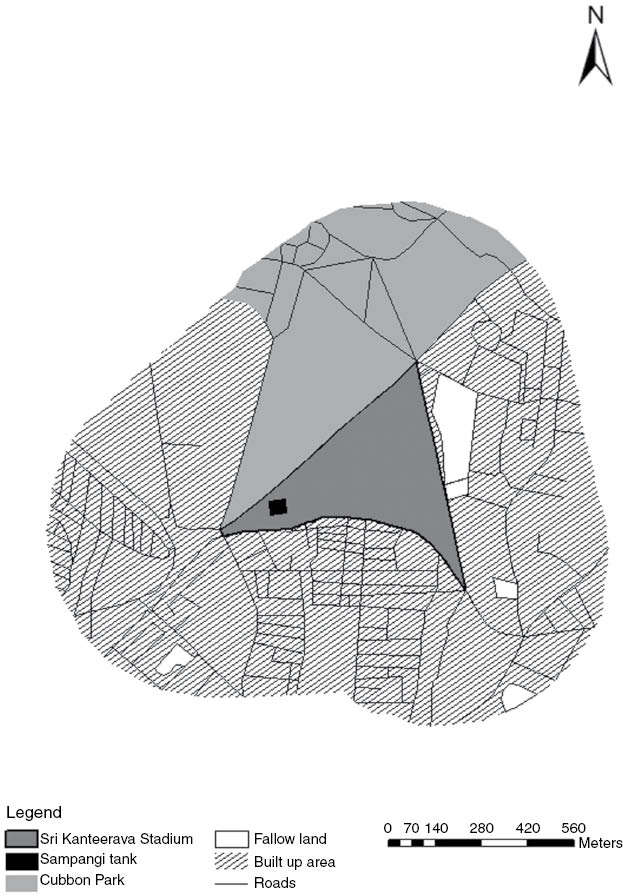
Figure 6
Sampangi Lake – 2014.
Table 5
Actors, their property rights bundles over time and ecosystem services accessed around Sampangi lake.
| Actors | Property rights bundles at various periods in time | Ecosystem services accessed | |||
|---|---|---|---|---|---|
| Before 1900 | 1900–1935 | 1935–1973 | 1973–2015 | ||
| State – British Government | A, P, M, L* | A, P, M, L | A, P, M, L (till 1947) | NA** | Provisioning of water for supply to the Cantonment |
| State – Rulers of Mysore | A, P, M | A, P, M, L | A, P, M, L (till 1947) | None*** | Provisioning of water for supply to the Pete |
| Independent State of India | NA | NA | A, P, M, L (from 1947) | A, P, M, L | None |
| Municipal Council | A, M | A, M | NA | NA | Provisioning of water for supply to the Pete |
| City Improvement Trust Board | NA | NA | A, M | NA | None |
| Lake guards | NA | A, M | None | None | None |
| Residents of the Cantonment | A | A | None | None | Aesthetic appreciation and recreation (walking, jogging) |
| British recreationalists | A | A | NA | NA | Aesthetic appreciation and recreation (walking, jogging) |
| Native recreationalists | A | A | None | None | Aesthetic appreciation and recreation (fishing) |
| Horticulturists | A, P | A, P | None | None | Provisioning of water for farms |
| Fishermen | NA | A, P | None | A, P | Provisioning of fish – both for subsistence and for commercial purposes |
| Workers in brick kilns | A, P | None | None | None | Provisioning of water and mud for use in the manufacture of bricks |
| Other communities near the lake | NA | NA | A | None | Provisioning ofa) Water for domestic purposesb) Grass from the banks of the lake for use as fodder |
| Other recreationalists (stadium) | NA | NA | A (After 1946) | A | None |
| Vannhikula Kshatriyas and Kurubas | A | A | A | A | Provisioning of fish for subsistence and cultural appropriation of the resource for the Karaga and the Ganga Pooja |
| Bengaluru Development Authority (BDA) and Bruhat Bengaluru Mahanagara Palike (BBMP) | NA | NA | NA | A, P, M, L | None |
*A=Right to access, P=Right to appropriate, M=Right to manage, L=Right to alienate (Ostrom and Schlager 1992).
**NA=Actor not present in the landscape at that point in time.
***None=Actor present but does not possess usufruct rights to the resource.