
Table 1
Measures of neighboring in the literature.
| Measure of neighboring | Reference |
|---|---|
| Identify neighbors in personal network through name-generating question (e.g. With whom did you…) | (van Eijk 2012) |
| Social/political activities together | |
| Small tasks in/around house | |
| Ask for small help when sick | |
| Borrow groceries/tools | |
| Talk personal/consider opinion | |
| In previous three months | |
| Visited each other | |
| Had dinner together | |
| Did outdoor activities together | |
| Frequency contact | |
| Frequency of unplanned interaction with one's neighbors | (Lund 2003) |
| Frequency with which one gives/receives assistance to/from neighbors | |
| During the past year, have any of your neighbors asked you to: | (Bolland and McCallum 2002) |
| Watch their home while they are away? | |
| Loan them some food? | |
| Take care of their kids? | |
| Talk with them about a personal problem? | |
| Visit them in their home? | |
| Give them information about neighborhood activities? | |
| Friendly recognition, or “Saying Hi” | (Kusenbach 2006) |
| Parochial helpfulness, or the “Cup of Sugar” | |
| Proactive intervention, or “Watching Out” | |
| Embracing or resisting diversity |
Table 2
Response rates and sample size for two surveys.
| Green River | Harmon Creek | Green River | Harmon Creek | |
|---|---|---|---|---|
| Response rate | 76% | 94% | 67% | 72% |
| Sample size (N) | 19 | 33 | 25 | 23 |
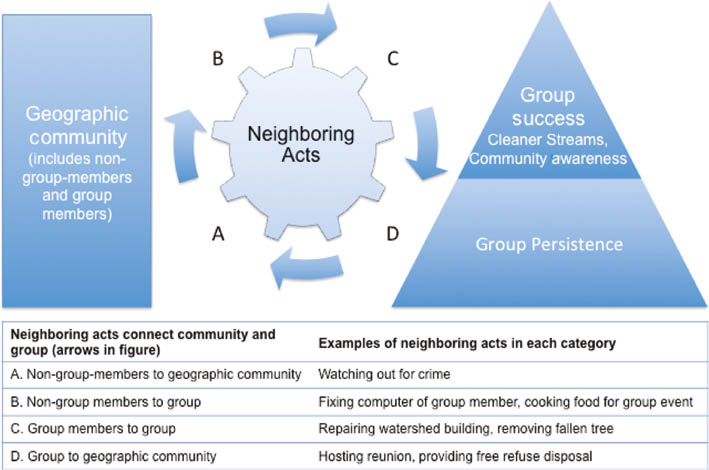
Figure 1
Neighboring acts connect geographic community and watershed group.