
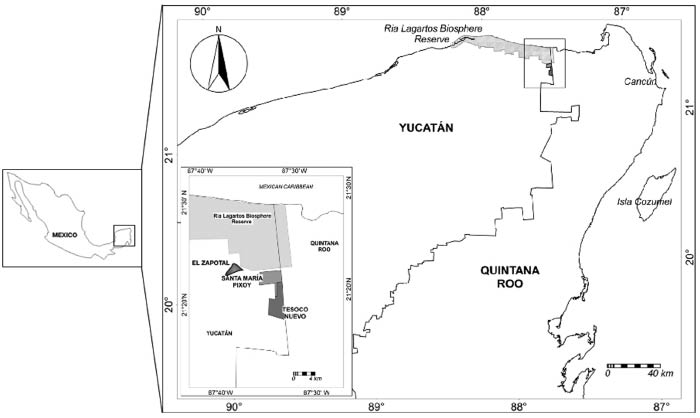
Figure 1:
Location of the ejidos of Nuevo Tesoco and Santa María Pixoy, Yucatan, Mexico.
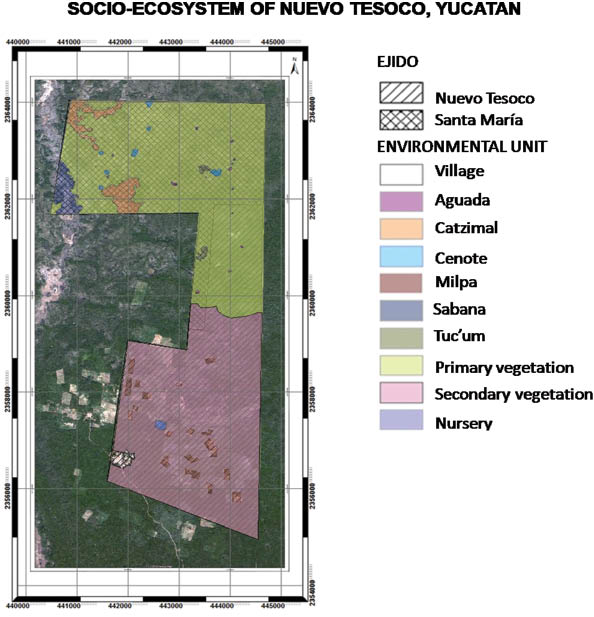
Figure 2:
Environmental heterogeneity in the ejidos of Nuevo Tesoco and Santa María Pixoy, Yucatán.
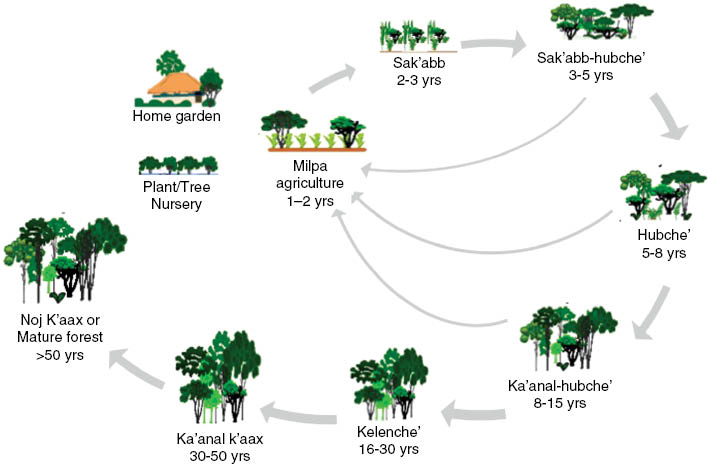
Figure 3:
Successional dynamic of the secondary vegetation of Nuevo Tesoco, Yucatán. The tropical forest of 3–15 years may return to use as the milpa agricultural system, mainly during the hubche’ stage (5 and 8 years).
Table 1
Main themes registered during field work. Qualitative tools included: semi-structured and in-depth interviews, historical timelines, participative mapping, and walks through land-use units.
| Topics | Subtopics |
|---|---|
| Productive activities | Environmental unit where is developed |
| Characteristics of the environmental unit | |
| Destiny of obtained products | |
| People involved | |
| Landscape units | Size |
| Animals and plants associated | |
| Movement of animals | |
| Ecological interactions | |
| Institutions for managing landscape units | |
| History | History of events affecting the socio-ecological system |
| History of organization | |
| History of local institutions | |
| History of land-use change | |
| Drivers and change | Environmental units affected by an event |
| Effects of events within the socio-ecological system | |
| Responses generated after an event | |
| Land-use change at ejido level |
Table 2
Productive activities developed in different land use units of the socio-ecological system. Activities are developed for the market for auto-consumption.
| Market | Self-consumption | |
|---|---|---|
| Polycultures | Nursery | Milpa |
| Vegetable gardens | Homegardens | |
| Livestock production | ||
| Forestry species | ||
| Successional forest | Apiculture | Extraction of guano |
| Reforestation | Firewood | |
| Hunting | ||
| Timber | ||
| Extraction of plant species | ||
| Mature forest | PES: Monitoring and Clearing |
Table 3
Characteristics of secondary vegetation mentioned by interviewees describing the successional dynamics of the forest within the socio-ecological system.
| Scientific name | Common name | |||
|---|---|---|---|---|
| Sak’aab | <1 | 2–3 | Viguiera dentata | Tajonal |
| Sak’aab hubche’ | 1 | 3–5 | Bejucos | Bejucos |
| Hubche’ | 4–5 | 5–8 | Sabal mexicana | Guano |
| Brosimum alicastrum | Ramón | |||
| Ka’anal hubche’ | 5 | 8–15 | Lysiloma latisiliquum | Tsalam |
| Bursera simaruba | Cha’ka | |||
| Kelenche | 10 | 15–30 | Manilkara zapota | Zapote |
| Enterolobium ciclocarpum | Pich | |||
| Ka’anal k’aax | 15 | 30–50 | Cordia sp. | Bojón |
| Thrinax radiata | Chit | |||
| Suhuy k’aax | >15 | >50 | Simaruba glauca | Pa’sak |
Table 4
Formal and informal institutions that structure the management strategy of natural resources in the transformed environment (TE), secondary vegetation (SV) and in the old-growth tropical forest (OGF) of Nuevo Tesoco, Yucatán.
| TE | SV | OGF | |
|---|---|---|---|
| Access to natural resources | |||
| Division of the socio-ecosystem in two ejidos | x | x | x |
| Plots under informal agreements | x | x | |
| Individual exploitation of the space | x | x | |
| Milpas in plots which do not belong to the individuals (SMP community members with no land title) | x | ||
| Regulation of natural resources | |||
| Extraction of resources | x | x | |
| Fines for overexploitation of natural resources | x | ||
| Prohibition of cutting large trees | x | x | x |
| Protection of jaguar and puma | x | x | x |
| Subsistence hunting | x | x | |
| Prohibition to sell guano | x | x | x |
| Taxes for cutting valuable wood | x | ||
| Management of natural resources | |||
| Creation of two ejido committees: NT and SMP | x | x | x |
| Community management of space | x | x | |
| Individual management of space | x | x | |
| Community monitoring and surveillance | x | x | x |
| Maintenance and clearing of roads and firebreaks | x | x | |
| Chac-chac (Religious ceremony) | x | ||
| Joint hunting (Clamoreo) | x | x | |
| Municipal committee | x |
Table 5
Main institutions associated with the response of the socio-ecological system of Nuevo Tesoco to: Hurricane Wilma, Payment for Environmental Services program, and Creation of the community nursery.
| BEFORE THE EVENT | AFTER THE EVENT | |
|---|---|---|
| Hurricane Wilma | Provision of temporary labor for remuneration Monitoring | Clearing of combustible material Clearing of combustible material Monitoring Provision of temporary labor for remuneration |
| Payment for Environmental Services | Community management Establishment of areas for conservation Extraction of plant resources Hunting Land use change Monitoring Protection of jaguar and puma | Clear boundaries of the ejido Community management Establishment of areas for conservation Monitoring Protection of jaguar and puma |
| Community nursery | Reforestation Seed collection | Clear delimitation of reforested areas Reforestation Production of plant species for sale Prohibition of extractive activities Seed collection |