
Table 1
Sector wise annual fish production (Source: FRSS 2015).
| Fisheries sector | Water area (hectare) | Total production (metric ton) | % |
|---|---|---|---|
| A. Inland fisheries | |||
| i. Inland open water (capture) | |||
| 1. River & estuary | 853,86 | 167,373 | 4.72 |
| 2. Sundarbans | 177,770 | 18,366 | 0.52 |
| 3. Beel | 114,161 | 88,911 | 2.51 |
| 4. Kaptai lake | 68,800 | 8,179 | 0.23 |
| 5. Floodplain | 2,595,529 | 701,330 | 20.09 |
| Total of capture | 3,910,053 | 995,805 | 28.07 |
| ii. Inland closed water (culture) | |||
| 1. Pond | 371,309 | 1,526,160 | 43.01 |
| 2. Seasonal cultured water-bodies | 130,488 | 193,303 | 5.45 |
| 3. Baor | 5,488 | 6,514 | 0.18 |
| 4. Shrimp/prawn farm | 275,274 | 216,447 | 6.10 |
| 5. Pen culture* | 6,775 | 13,054 | 0.37 |
| 6. Cage culture | 7 | 1,447 | 0.04 |
| Total of culture | 789,341 | 1,956,925 | 55.15 |
| Total capture and cultured inland fish | 4,699,394 | 2,952,730 | 83.22 |
| Marine fisheries | 595,385 | 16.78 | |
| Country total | 3,548,115 | 100 | |
*Pen culture is also a kind of FPA.
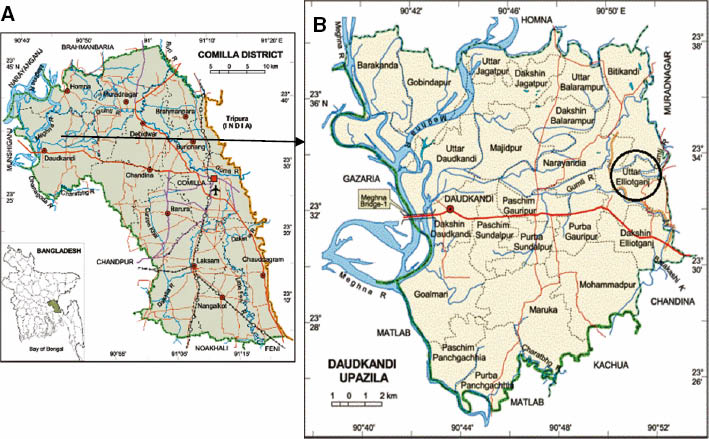
Figure 1
Research area of the Elliotganj union. (A) Comilla district. (B) Daudkandi upazila (sub-district).
(Source: http://www.mapsofbangladesh.com/Comilla_District.php, http://www.mapsofbangladesh.com/Daudkandi-Upazila.php).
Table 2
Pankawri Fisheries Limited at a glance (Data compiled from official documents of Pankawri Fisheries Ltd.)
| Area | 115 hectares (285 acres) |
|---|---|
| Total land owners | 395 |
| Total number of shares | 2000 |
| Total number of shareholders | 387 |
| Share price | 1000 |
| Share limit | 20 shares (1% of total shares) |
| Community shares | 1600 |
| SHISUK shares | 400 (20%) |

Figure 2
Development and operational cycle of FPAs under the Daudkandi model.
Table 3
Design Principles characterized most long-surviving CPR institutions (Ostrom 2000).
| 1. Clearly defined boundaries |
| Individuals or households with rights to withdraw resource units from the common-pool resource and the boundaries of the common-pool resource itself are clearly defined. |
| 2. Congruence |
| A. The distribution of benefits from appropriation rules is roughly proportionate to the costs imposed by provision rules. |
| B. Appropriation rules restricting time, place, technology, and/or quantity of resource units are related to local conditions. |
| 3. Collective-choice arrangements |
| Most individuals affected by operational rules can participate in modifying operational rules. |
| 4. Monitoring |
| Monitors, who actively audit common-pool resource conditions and appropriator behavior, are accountable to the appropriators and/or are the appropriators themselves. |
| 5. Graduated sanctions |
| Appropriators who violate operational rules are likely to receive graduated sanctions (depending on the seriousness and context of the offence) from other appropriators, from officials accountable to these appropriators, or from both. |
| 6. Conflict-resolution mechanisms |
| Appropriators and their officials have rapid access to low-cost, local arenas to resolve conflict among appropriators or between appropriators and officials. |
| 7. Minimal recognition of rights to organize |
| The rights of appropriators to devise their own institutions are not challenged by external governmental authorities. |
| For common-pool resources that are part of larger systems: |
| 8. Nested enterprises |
| Appropriation, provision, monitoring, enforcement, conflict resolution, and governance activities are organized in multiple layers of nested enterprises. |