
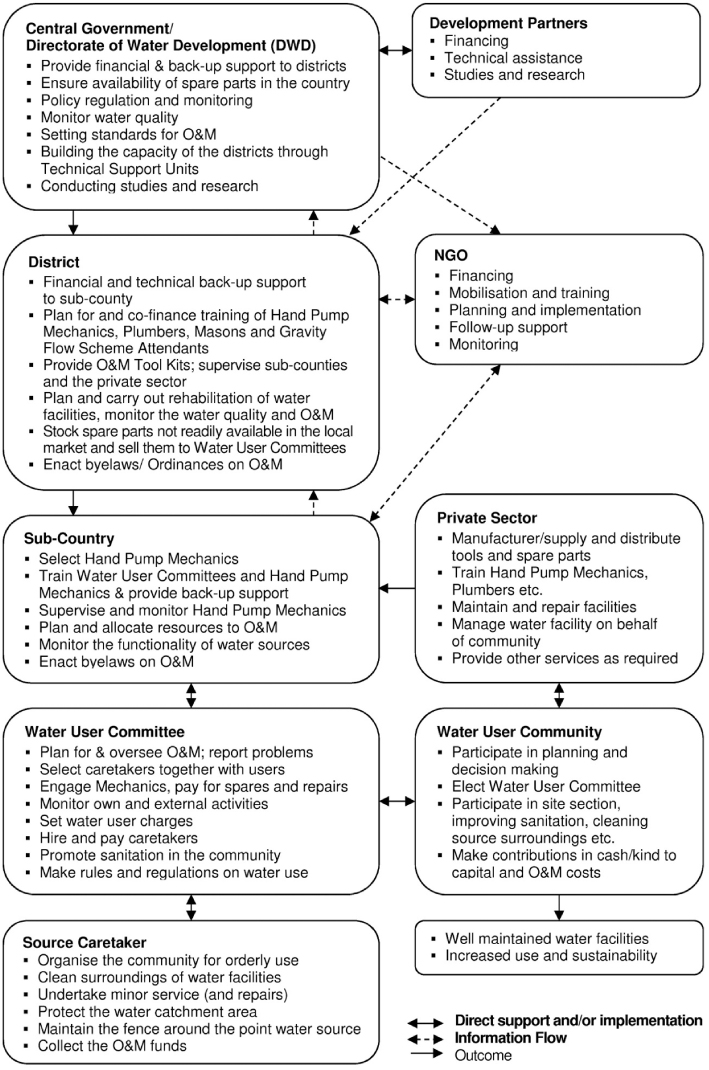
Figure 1
Formal roles and relationships of key actors (own illustration according to DWD 2011a).
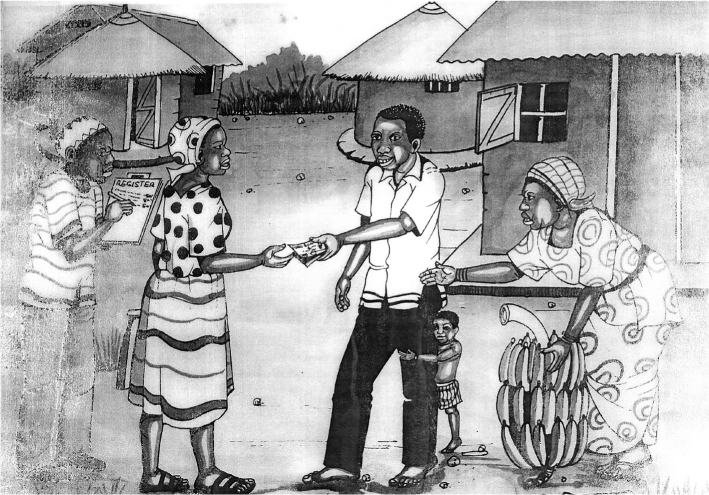
Figure 2
Illustration supporting community awareness building (the women selling the food-crop to raise money for paying the water user fees) (Isingiro district community sensitisation tool kit).
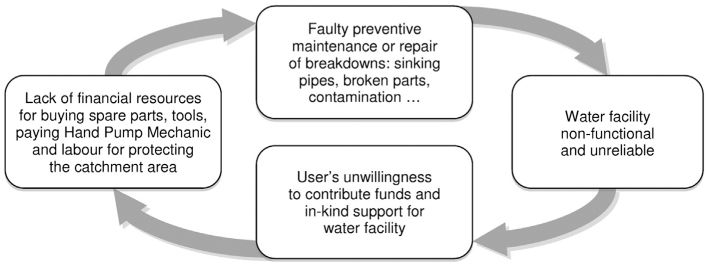
Figure 3
The vicious circle of inadequate institutions challenging effective O&M and sustained access to safe water.
Table 1
Design principles.
| Principle | Explanation | |
|---|---|---|
| 1 | Clearly defined boundaries | Clearly defined boundaries of resource system and its legitimate users. |
| 2 | Congruence | The appropriation and provision rules are congruent with local social and environmental conditions and should allocate benefits in proportion to the inputs, such as labour, material or money. |
| 3 | Collective-choice arrangements | Most individuals affected by the operational rules can participate in modifying them. |
| 4 | Monitoring | Monitors who are accountable to the users monitor the appropriation and provision levels of the users and the condition of the resource. |
| 5 | Graduated sanctions | Users who violate operational rules are likely to face graduated sanctions. |
| 6 | Conflict-Resolution Mechanisms | Users and their officials have rapid access to low-cost local arenas to resolve conflicts. |
| 7 | Minimal recognition of rights to organise | The rights of users to devise their own institutions are not challenged by external or higher authorities. |
| 8 | Nested enterprises (for CPRs that are part of larger systems) | Appropriation, provision, monitoring, enforcement, conflict resolution, and governance activities are organized in multiple nested layers. |
Source: Ostrom 1990; Cox et al. 2010.
Table 2
Design Principles and situation in the study area.
| Design Principle | Situation in case study area |
|---|---|
| 1. Clearly defined boundaries | Challenges regarding the excludability of external water users. |
| 2. Congruence | No, as nationally defined rules do not fit with local contexts. |
| 3. Collective-choice arrangements | Partially yes, however no, if WUC is missing or non-functional. |
| 4. Monitoring | Mostly no, as monitoring is rarely carried out. |
| 5. Graduated sanctions | Usually no sanctions against free-riding. |
| 6. Conflict-Resolution Mechanisms | No explicit conflict resolution mechanisms in place. |
| 7. Minimal recognition of rights to organise | Partially yes; self-governance however is contradicted by NGOs and higher-level authorities providing top-down services without any or with only limited local participation. |
| 8. Nested enterprises (for CPRs that are part of larger systems | Water users and WUCs are not organised or represented at higher levels (no bridging organisations). |