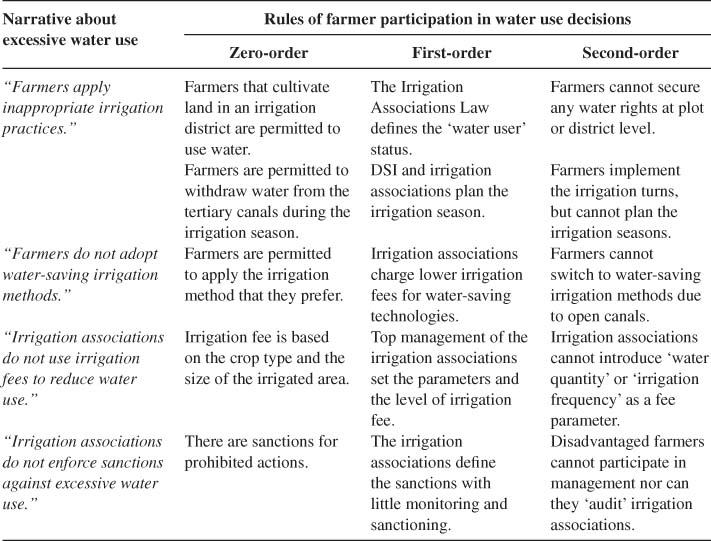
Table 1:
The institutions of farmer participation in decisions about water use.
| Level | Questions | Rules about water use |
|---|---|---|
| Zero-order | What? | • Requirements to have permission to use water |
| • Periods that the water can be used | ||
| • Irrigation methods that the users are permitted (or obliged) to use | ||
| • Basis to determine the amount of water to be used | ||
| • Basis to determine the irrigation fee to be paid | ||
| • Prohibited actions | ||
| • Sanctions for prohibited actions | ||
| First-order | Who decides? | • Permissions to use water |
| How? | • Periods to use water | |
| • On-farm irrigation methods | ||
| • Basis to determine the irrigation fee | ||
| • Prohibited actions | ||
| • Sanctions for prohibited actions | ||
| • Monitoring of compliance to rules | ||
| Second-order | What? | (For each first-order rule) |
| • Possible reasons to change the rule | ||
| • Type and proportion of users that participate in changing the rule | ||
| • Proportion of rule changes that involve the users | ||
| • Phase(s) of the rule-changing process that the users participate in | ||
| • Timing that non-participant users are informed about the changes | ||
| • Means to inform the non-participant users about the changes | ||
| • Means to take and respond to non-participant users’ inquiries |
Source: Adapted from Özerol (2012).