
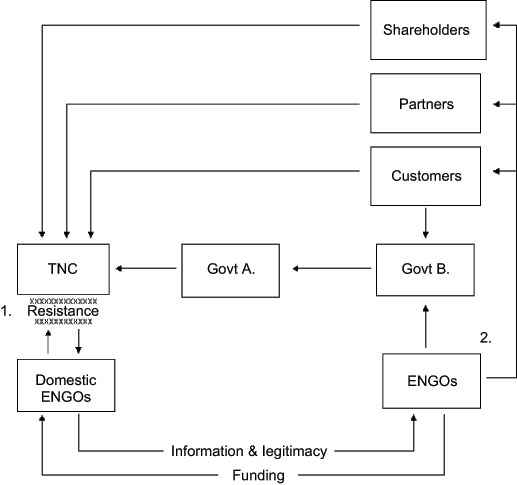
Figure 1
Blanket strategy by ENGOs targeting transnational corporation (TNC). Adapted from Keck and Sikkink (1998). (1) Initially the TNC resists pressure from domestic ENGOs, who then contact peers in other countries for assistance (2) thereby increasing the intensity of the pressure on the TNC through targeting the TNC’s customers, shareholders and partners. Lines / Arrows indicate pressure, except dashed lines for illustrating the relationship between ENGOs. Govt A=Government of host country of TNC operations, Govt B=Government of country that hosts partners of TNC.

Figure 2
Location of the case studies. Gunns, Australia (au), Veracel, Brazil (br), MacMillan Bloedel, Canada (ca), APP, China (cn), Metsahallitus, Finland (fi), APRIL, Indonesia (id1), APP, Indonesia (id2), UFS, Kalimantan (id3), Pan Paper, Kenya (ke), Mondi, Swaziland (sz), Northern Spotted owl, USA (us1), International Paper, USA (us2), MetsäBotnia, Uruguay (uy1), Ence, Uruguay (uy2).
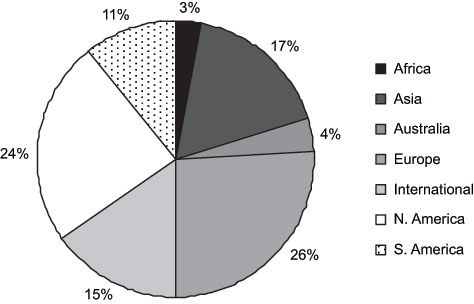
Figure 3
Distribution by regions of the ENGOs screened (N=202).
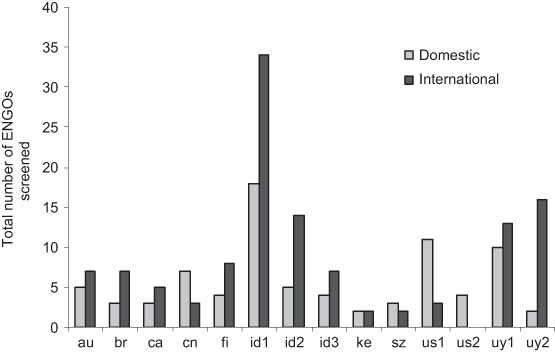
Figure 4
Total number of ENGOs screened in each case study, according to their location. Domestic ENGOs refer to ENGOs based in the same country of the case of study. International ENGOs refer to ENGOs based in other countries than the case study or when they act at a global level.

Figure 5
Partners of the companies involved in the conflicts to their shareholders and financiers and main customers, compared to the links of the campaigning ENGO with their target. Lines link the conflict case with the centre of the countries associated at each case (flow). For visual interpretation, the conflicts are grouped in: au, ca, fi, us1, us2 (left) and br, cn, id1, id2, id3, ke, uy1, uy2, sz (right).
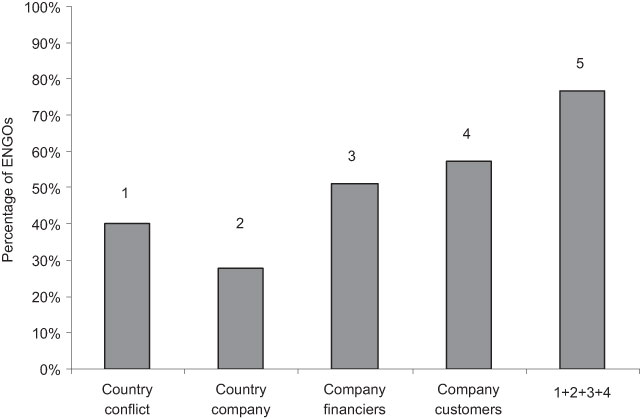
Figure 6
Distribution of the campaigning ENGOs according to: 1: Country where the conflict is located, 2: Country where the company involved has its headquarters or there are shareholders, 3: Country where the company involved has its main financiers, 4: Country where the company involved has its main customers, 5: ENGOs active in one (or more) of options 1–4. The percentages of 1–4 are not additives.
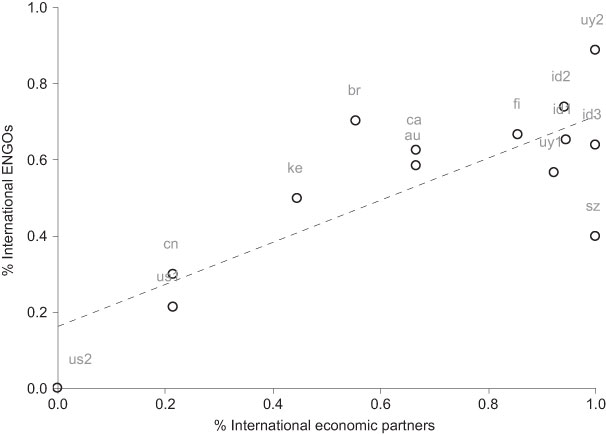
Figure 7
Percentage of international ENGOs (i.e. not acting in the country where the conflict took place) compared to the percentage of international economic partners (i.e. shareholders, customers and financiers). R2=0.64, p-value<0.001.
Table 1
Description of the case studies (for more information on the case studies see Appendix). Conflict issues: 1. Conflicting land uses, 2. indigenous rights, 3. biodiversity, 4. deforestation, 5. illegal logging, 6. monoculture plantations, 7. old growth, 8. clear felling, 9. pollution, 10. diplomatic incident, 11. forced migration, 12. workers’ rights, 13. perceived government failure. For more information on the background of the 14 case studies see Appendix 1.
| Case study and code | Period | Keywords | Examples of related academic articles (in English) | Examples of related material from (E)NGOs |
| Gunns, Tasmania, Australia (au) | 2000 – present (Origins go back to 1980s) | 4, 9, 13 | Gale (2005); Buckman (2008) | WRM (2005a, 2008) |
| Veracel, Bahia, Brazil (br) | 2003 – present | 2, 6, 9, 11, 13 | Fig (2007) | WRM (2006a); Urgewald (2007) |
| MacMillan Bloedel Clayoquot Sound, Canada (ca) | 1970s – present | 2, 7, 8, 13 | Stanbury and Vertinsky (1997); Lertzman and Vredenburg (2005) | Greenpeace (no date a); Greenpeace (2008) |
| APP China, Yunnan, China (cn) | 2004 – present | 4, 5, 6, 13 | Barr and Cossalter (2004); Xia (2008) | WRM (2005b); Bank track (no date) |
| Metsähallitus, Upper Lapland, Finland (fi) | 1960s – present | 1, 2, 8, 13 | Kyllönen et al. (2006); Raitio (2008) | Greenpeace (no date b); Greenpeace (2004) |
| APRIL, Riau, Indonesia (id1) | 1993 – present | 1–6, 13 | Gritten and Kant (2007); Gritten and Saastamoinen (In press) | Matthew and van Gelder (2002a); Eyes on the Forest (2006) |
| APP, Riau, Indonesia (id2) | 1982 – present | 1–6, 13 | Barr (2001); Pirard and Rokhim (2006) | Matthew and van Gelder (2002b); WWF (2006) |
| UFS, Kalimantan, Indonesia (id3) | 2001 – present | 1–4, 6, 13 | Jurgens et al. (2005) | DTE (2006); Pulp Inc. (2006) |
| Pan Paper, Kenya (ke) | 1974–2009 | 2, 4, 9, 13 | Situma et al. (2002) | WRM (2007); ELAW (2008) |
| Mondi, Swaziland (sz) | 1990s – present | 6, 13 | Chamshama and Nwonwu (2004) | WRM (2004, 2006b) |
| Spotted owl, Pacific Northwest, USA (us1) | Mid-1980s – present (Origins go back to 1950s) | 3, 7, 13 | Lange (1993); Yaffee (1994) | Audubon (2009); Earth Justice (2009) |
| International Paper, Androscoggin mill, Jay, Maine, USA (us2) | 1980s – present | 9, 13 | Hill et al. (2002) | PfLP (no date); NRCM (2005) |
| MetsäBotnia (uy1), Uruguay | 2003 – present | 9, 10, 13 | Lima-Toivanen and Mikkilä (2006); Joutsenvirta and Vaara (2008) | Bank Track (no date); Illegal Logging (2007) |
| Ence, Uruguay (uy2) | 1990–2009 | 9, 10, 13 | Lima-Toivanen and Mikkilä (2006) | Guayubira (2006); WRM (2009) |
Table 2
Correspondence between the location of ENGOs and the companies’ economic partners. Country based ENGOs (N=171), ENGOs links corresponded to economic links (N=130), ENGOs’ flows not corresponding to economic partners (N=41), and economic partners’ flows not corresponding to ENGOs’ (N=71).
| International ENGO | ENGOs | Correspond to economic partner | Percentage (%) | |
| au | 4 | 8 | 5 | 63 |
| br | 2 | 8 | 6 | 75 |
| ca | 0 | 8 | 8 | 100 |
| cn | 1 | 9 | 7 | 78 |
| fi | 3 | 9 | 9 | 100 |
| id1 | 9 | 43 | 34 | 79 |
| id2 | 3 | 16 | 16 | 100 |
| id3 | 0 | 11 | 5 | 45 |
| ke | 2 | 2 | 2 | 100 |
| sz | 1 | 4 | 1 | 25 |
| us1 | 1 | 13 | 13 | 100 |
| us2 | 0 | 4 | 4 | 100 |
| uy1 | 2 | 21 | 14 | 67 |
| uy2 | 3 | 15 | 6 | 40 |
Table 3
Example of methods employed by six ENGOs (three Indonesian and three non-Indonesian) against APRIL and its partners, and the outcomes where known. It should be noted that APRIL is a private company (i.e. it has no shareholders).
| ENGO | Target | Strategy | Outcome |
| Indonesian ENGOs | |||
| WALHI (Friends of the Earth (FoE) Indonesia) | APRIL | Working with other ENGOs in Indonesia (e.g. Jikalahari) and abroad (e.g. FoE EWNI) Using Indonesian media to target the company | APRIL still accused by numerous ENGOs and academics of various unsustainable practices |
| Jikalahari | APRIL | Working with other ENGOs in Indonesia (e.g. WWF Indonesia) and abroad (e.g. FoE EWNI) Using Indonesian media to target the company | As above (WALHI) |
| WWF Indonesia | APRIL | Working with other WWF offices and WALHI and FoE EWNI. Using international media (CNN) to target company | As above (WALHI) |
| Non-Indonesian ENGOs | |||
| FoE England, Wales, Northern Ireland | APRIL | Working with Indonesian and non-Indonesian ENGOs. British media coverage of campaign | As above (WALHI) |
| Paper merchants (UK) | Meeting with paper merchants before launching of campaign. British media coverage of campaign (including BBC and Guardian newspaper) | As of 2008 five of the nine paper merchants no longer stock APRIL paper (PaperOne) | |
| UK Government | British media coverage of campaign | Not implemented any of recommendations of campaign | |
| Financial institutions | British media coverage of campaign | No formal information available | |
| FoE Finland | APRIL | Working with Indonesian and non-Indonesian ENGOs. Publication of book and coverage in Finnish media | As above (WALHI) |
| UPM-Kymmene (UPM) | Working with Indonesian and non-Indonesian ENGOs. Shareholder activism at UPM AGM and its coverage in Finnish media. Publication of book and coverage in Finnish media | Since the launch of the campaign UPM has been slowly reducing its association with APRIL. In Autumn 2009 it had ended all formal links | |
| Robin Wood | APRIL | Working with Indonesian and non-Indonesian ENGOs | As above (WALHI) |
| Paper merchant (Germany) | Campaign including demonstration outside offices of Papier Union covered in German media | As of 2009 continues to stock PaperOne | |