
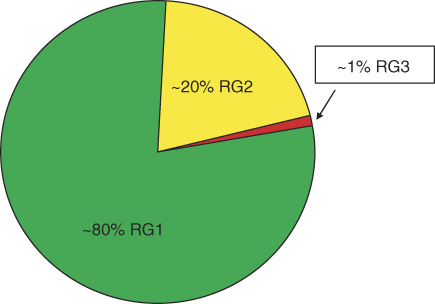
Figure 1
Percentages of Bacteria allocated to Risk Groups 1, 2 and 3.
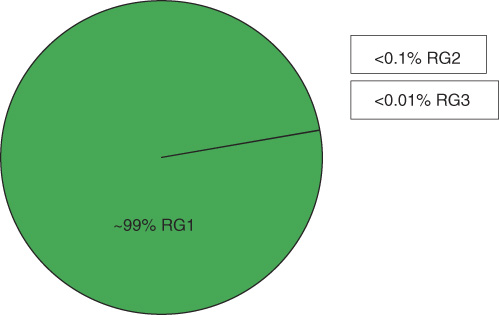
Figure 2
Percentages of Fungi allocated to Risk Groups 1, 2 and 3.
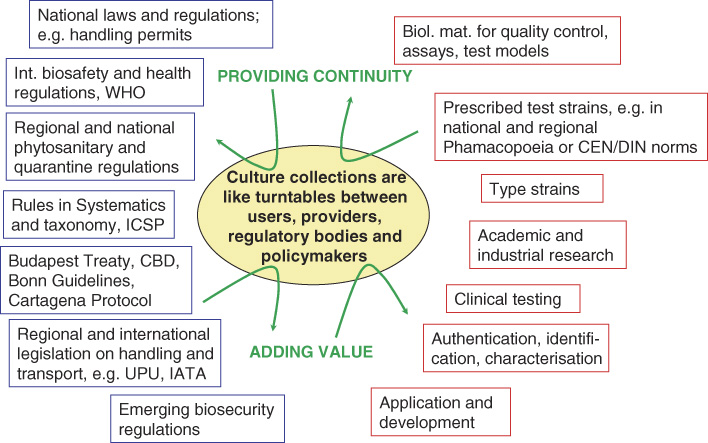
Figure 3
Collections of living biological material: Hubs of interest.
Examples for legislation and regulations affecting collection work (left, blue) and examples for potential and prescribed uses of the biological material (right, red).
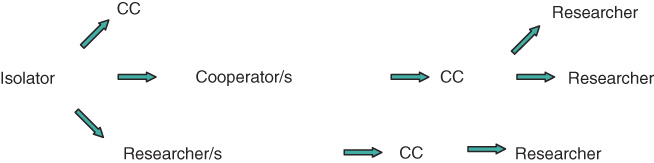
Figure 4
Problem of ‘multiple ownership’ of microbial cultures.
Abbreviations
| ABS | Access and Benefit Sharing |
| BRC | Biological Resource Centres |
| CABRI | Common Access to Biological Resources and Information |
| CBD | Convention on Biological Diversity |
| CEN | European Committee for Standardization (Comité Europeen de Normalization) |
| COP | Convention of the Parties |
| CWA | CEN Workshop Agreement |
| DSMZ | Deutsche Sammlung von Mikroorganismen und Zellkulturen GmbH |
| ECCO | European Culture Collections’ Organization |
| EBRCN | European Biological Resource Centre Network |
| EU | European Union |
| GBRCN | Global Biological Resource Centre Network |
| ICSP | International Committee for Systematics of Prokaryotes |
| IDA | International Depositary Authority according to the Budapest Treaty |
| IATA | International Air Transport Association |
| JBA | Japan Bioindustry Association |
| MGRs | Microbial Genetic Resources |
| MAT | Mutually Agreed Terms |
| MTA | Material Transfer Agreement |
| OECD | Organization for Economic Cooperation and Development |
| PIC | Prior Informed Consent |
| RG | Risk Group |
| UPU | Universal Postal Union |
| WFCC | World Federation for Culture Collections |
| WHO | World Health Organization |
| WIPO | World Intellectual Property Organization |