
1 Introduction
During 2020–2022 the Swedish/Nordic streaming service Viaplay appeared to be an alternative to US giants Netflix, HBO Max and others. Headlines in the financial and trade press envisioned Viaplay as ‘Anti-Netflix’ and ‘Europe’s challenger to Netflix’.1 The ambitious expansion did not last long. Under financial pressure Viaplay reversed its strategy in June/July 2023, left several markets and sold content assets before, in February 2024, when their shares had lost 99.8% of their peak value, Viaplay itself was rescued/bought by French Canal+ and Czech investment fund PPF. It is an extraordinary trajectory, which raises questions about what Viaplay sought to offer, and what space there was for such content within an evolving Swedish streaming landscape.
Viaplay’s parent company went public in March 2019 and raised further SEK 4,35 billion in February 2021 to secure expansion.2 At that time Viaplay, already established in the Nordic countries, launched streaming services in the Baltics (March 2021), followed by Poland, USA, Netherlands and, finally, UK (November 2022). Viaplay’s own scripted content would play an outsized role in a catalogue otherwise dominated by international content acquisitions (from Sony, MGM and other studios) and add-on premium sport packages. According to their 2019 stock exchange listing prospect, local productions would enable Viaplay to ‘deliver an exclusive, local material of high quality to its audience’3 and when they two years later expanded internationally their chief content officer Filippa Wallestam envisioned that:
the real ramp up will be on local productions and our own originals. Our learning from the Nordics is that, while the library hours are heavily skewed to US, the local content and our originals are the value drivers.’4
Another two years later, when the crisis hit, Viaplay’s originals were no longer seen as value drivers but as commercial mistakes, and production was halted (Figure 1). Crisis CEO Jørgen Madsen Lindemann suggested that many scripted originals were not paying off and that ‘It’s not bad content but commercially it’s not right.’5 But what kind of content was this and was it any different from global streamers’ offerings? This article explores the distinctiveness of Viaplay’s content strategy by tracing which series were acquired by competitors, and which were passed over, and by contrasting commissioning and narrative strategies within the young adult genre. Did Viaplay offer something distinct within the Swedish streaming landscape?
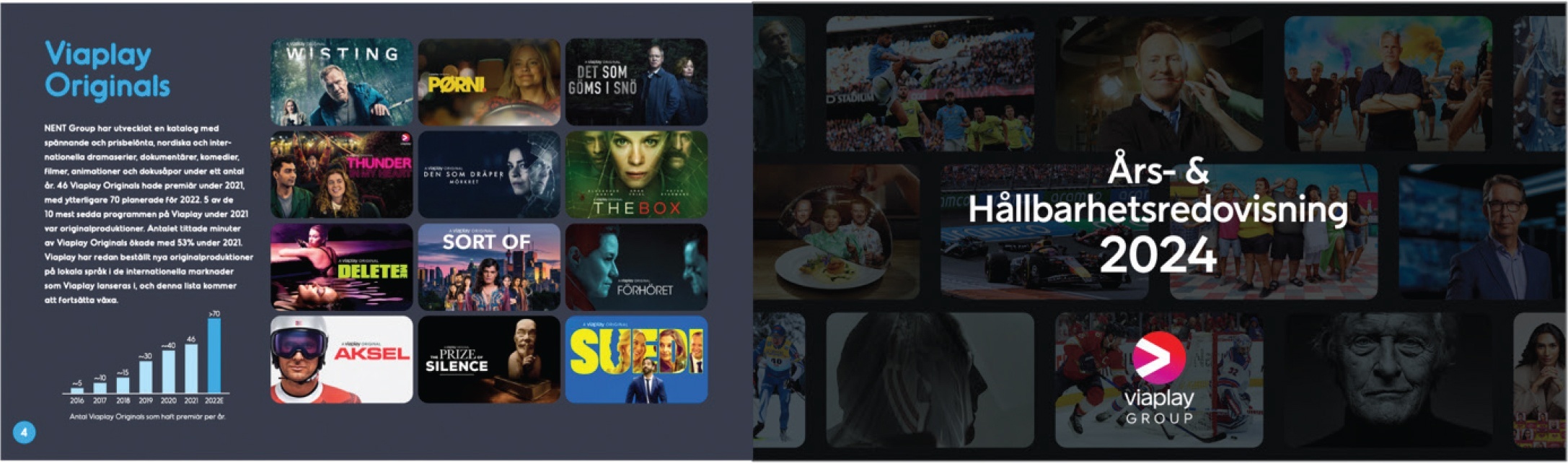
Figure 1
Originals gone missing. In the annual report for 2021 Viaplay Originals has its own confident page: ‘NENT Group has developed a catalogue of exciting and award-winning Nordic and international dramas, documentaries, comedies, films, animations and reality shows over a number of years. 46 Viaplay Originals premiered in 2021 […], with a further 70 planned for 2022. 5 of the top 10 most watched programmes on Viaplay in 2021 were original productions. The number of minutes watched of Viaplay Originals increased by 53% in 2021. Viaplay has already commissioned new original productions in local languages in the international markets where Viaplay is launched, and this list will continue to grow.’ (4). The 2024 report has no page for Viaplay Originals but the cover illustrates what is left – sports and reality programming – in a subdued, barely visible manner. Still, Jørgen Madsen Lindemann’s CEO statement sees it from the bright side: ‘We focused on local, relevant and commercial formats that have proven to engage broad audiences across multiple platforms, combined with the most impactful and captivating international scripted formats. Audiences across the Nordics have been captivated by the drama of Paradise Hotel, entertained by the participants of Charter Fever, inspired by the strategies and survival skills of the Robinson Expedition, and drawn into long-standing favorites such as Master Chef, Wanted and The Luxury Trap. This fantastic entertainment, combined with top-class Hollywood films and series, beloved children’s content and carefully selected in-house drama series, helped make our content even more engaging, competitive and commercially relevant in 2024.’ (7). It is a stark contrast to the earlier expansive optimism.
2 Content Migration. Viaplay Commissions in the Swedish Streaming Landscape
When Viaplay halted its expansion, they sought to ‘accelerate amortisation of scripted content’,6 i.e. offering their productions for sale. Tracing Viaplay’s more or less completed series offers a unique opportunity to assess how its content matched competitors’ ambitions in the Swedish streaming landscape.7
In 2019 Netflix and HBO joined local players Viaplay, SVT and TV48 with their first commissioned Swedish productions. While HBO’s ambitious quality slate was abruptly discontinued in 2022,9 Netflix gradually expanded focussing primarily on crime, international-resonating biopics, and a multitude of adaptations of contemporary bestsellers. Others – Amazon Prime Video, Disney Plus, SkyShowtime, Apple – had not yet been commissioning locally when Viaplay’s crisis put well-produced Swedish series on sale.
2.1 What Competitors Acquired
Four of six series (Figure 2) acquired by other streamers were Nordic noirs, a predictable choice given that it was a major Viaplay genre well established both nationally and internationally.10 Viaplay’s CEO Anders Jensen stressed its importance: ‘demand for Nordic noir and sports will make Viaplay the largest European-based streaming service’ whereas in USA the ambition was to become ‘The Home of Nordic Noir’.11 Prime Video’s crime/action Paradise City is less concerned with a woman investigator’s troubling past experiences than the four noirs, but it too is an adaptation from the limitless pool of bestselling Swedish crime fiction. Although these series were well received, further commissioning in this direction remains uncertain. Prime Video added series from Viaplay-originated projects, such as STHLM Blackout (2024) and Blinded (2025), while SkyShowtime only commissioned a second season of Veronika. Instead, their output and statements signal an emphasis on light-hearted series such as Where the Sun Always Shines (2025) and reality programming like Girls of Stockholm (2025) or ‘Real housewives Göteborg’.12 This resembles post-crisis Viaplay – far from its earlier ambitions.
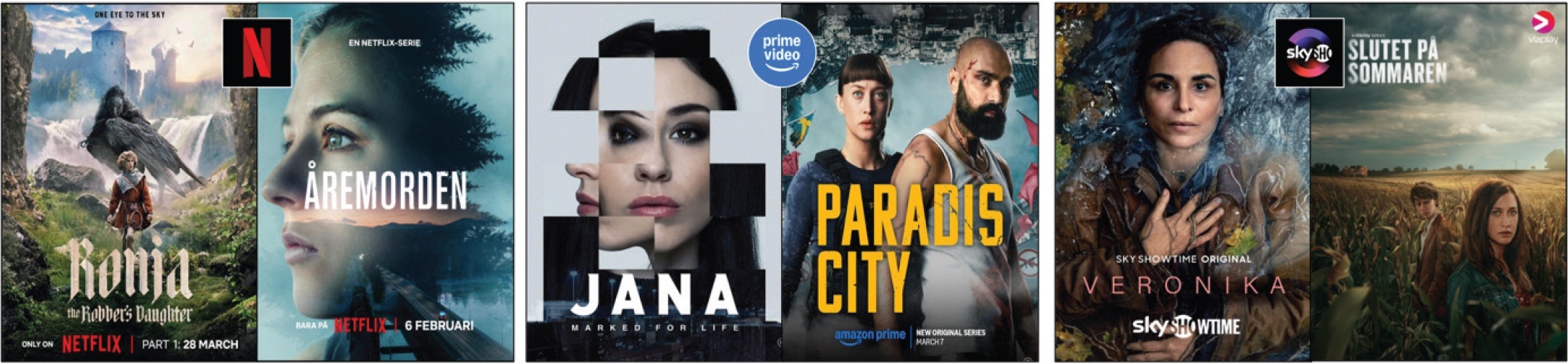
Figure 2
Key art for the first six Viaplay-productions acquired by competitors. Netflix: Ronja the Robber’s Daughter (2024), The Åre Murders (2025). Prime Video: Jana – Marked for Life (2024), Paradise City (2025). SkyShowtime: Veronika (2024) and End of Summer (2024). Four of the images are Nordic noirs where female protagonists visually dissolve into their landscapes, suggesting inner disintegration. The exceptions – Ronja’s children’s fantasy and Paradise City’s near-future dystopian action – stand apart in both genre and aesthetics. Posters accessed by the author from marketing made available at and by Netflix, Amazon Prime Video and SkyShowtime respectively.
Ronja the Robber’s Daughter stands out. In September 2021 Anders Jensen considered Viaplay ready ‘to take things to a new level’ and Ronja, adapted from Astrid Lindgren’s modern children’s classic, was a prestige project: ‘Competition in the streaming landscape is fierce and it’s hard to find your edge or niche, but this story will give us exactly that’.13 In many respects Ronja matches Netflix’s flagship productions revisiting national classics and spending every effort (and money) perfecting it. Acquiring a completed and discounted Ronja is, however, different from producing it, and it appears unlikely anyone will risk a similar project in Sweden.14
2.2 What Competitors Passed Over
Beyond content acquired by competitors, what they passed over is equally revealing. Other streamers only acquired six (Figure 2) of the eleven series executive produced for Viaplay by Sara Askelöf (head of scripted content in Sweden) during this period, as listed on IMDb. The other five initially remained with Viaplay – revealing both the range of Viaplay’s offer and the limits of competitors’ interests (Figure 3).
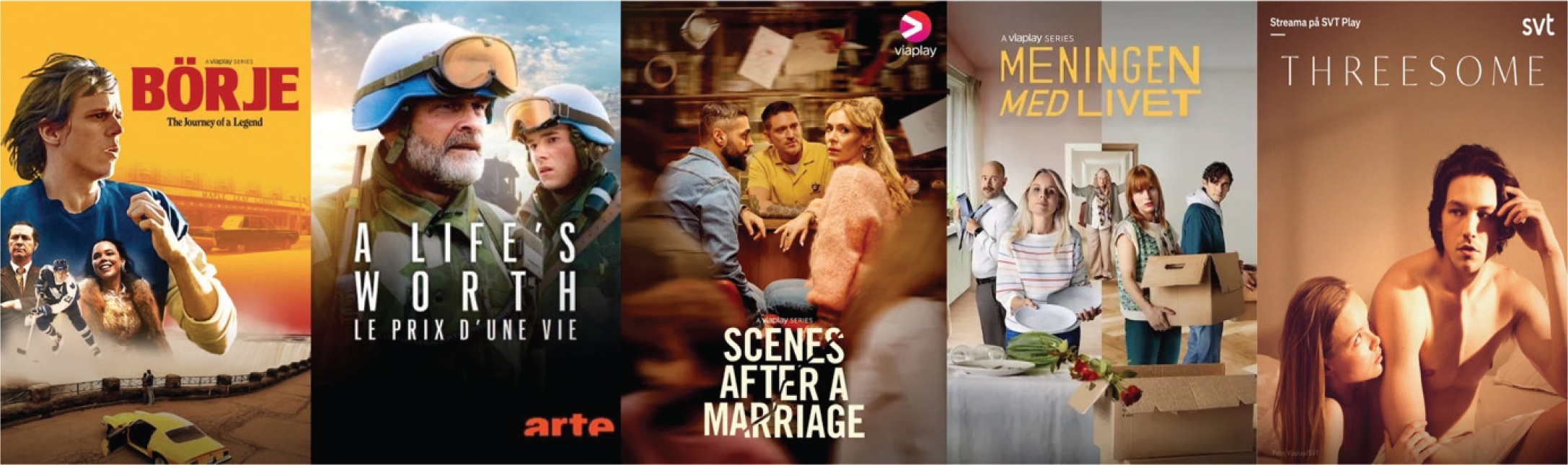
Figure 3
Five series other streamers passed over when Viaplay first sought to monetize its content late 2023 and into 2024. Börje – The Journey of a Legend (2023), A Life’s Worth (2025 – not yet released in Sweden), Scenes after a Marriage (2026 – not yet released in Sweden), The Meaning of Life S2 (2025) and Threesome S2 (2024). Posters accessed by the author from marketing made available at and by Viaplay, Arte, Viaplay, Viaplay and SVT respectively.
Börje, a biopic about Börje Salming’s career with Toronto Maple Leafs, perfectly matches Viaplay’s focus on sports and Swedish audiences, but is perhaps too local for globally oriented catalogues. Perhaps the other four series were too serious and uncompromising? A Life’s Worth is a war series based on Magnus Ernström’s recollections of Swedish UN peacekeeping in Bosnia 1993.15 The life-crisis dramas Threesome and The Meaning of Life already had first seasons at Viaplay before their second seasons were left in limbo. Scenes after a Marriage references Ingmar Bergman’s 1973 divorce drama and appears equally frank.
Or perhaps there is something particular in Viaplay’s storytelling? In 2023, executive vice-president Vanda Rapti explained:
Whether we produce a show in the Nordics or in our new international markets, we tell stories in a Nordic way. That means portraying the world as it is, without unnecessary polish, and through characters who are nuanced and multi-layered. We do this regardless of whether we are working on a crime show, a dramedy or a show for young adults, and it really works for so many viewers.16
‘Portraying the world as it is’ might involve too much social and cultural authenticity for other streamers? Although cultural authenticity – ‘a reflection of the local culture in which a series’ narrative is situated’ – is discursively used by Netflix executives, as Michael L. Wayne and Deborah Castro have demonstrated, its textual meaning remains unclear.17 If ‘the value of cultural difference’ according to Netflix ‘is only realized when it loses its specificity,’18 then series retaining social and cultural specificity resist universalizing strategies aspiring for global circulation – making them less attractive for streamers that only discursively cherish authenticity while actually preferring the universal. To understand what this means in practice the following section explores how different approaches, i.e. to authenticity and universality, appear in series within the young adult genre – a genre targeting a key streamer demographic where also one of Viaplay’s commercial competitors has been active.19
3 Young Adult TV: Commissioning Logics and Textual Approaches
Beyond the relative variation in Viaplay’s commissioning (i.e. Börje or Ronja) it is worth asking if there is also something distinct – a ‘Nordic way’? – in its series. A tentative study of two Viaplay and two Netflix productions within the young adult (teen TV) genre will be used to tease out preliminary differences.20 Focus will be on how streamers conceived and positioned these series – through key art, trailers and creator statements – as well as on story, theme and embeddedness in Swedish contexts.21 It is beyond the scope of this enthusiasm paper to also discuss public service television, but it should be noted that Sveriges Television (SVT) has traditionally been, and remains, active in youth drama, in accordance with its responsibility to offer high-quality local content to a broad variety of audiences in Sweden.
3.1 Netflix: Genre-Driven Commissioning?
Starting with Netflix’s Young Royals (2021-2024) (Figure 4) and its reformulation of the already well-known. Writer Lisa Ambjörn explains:
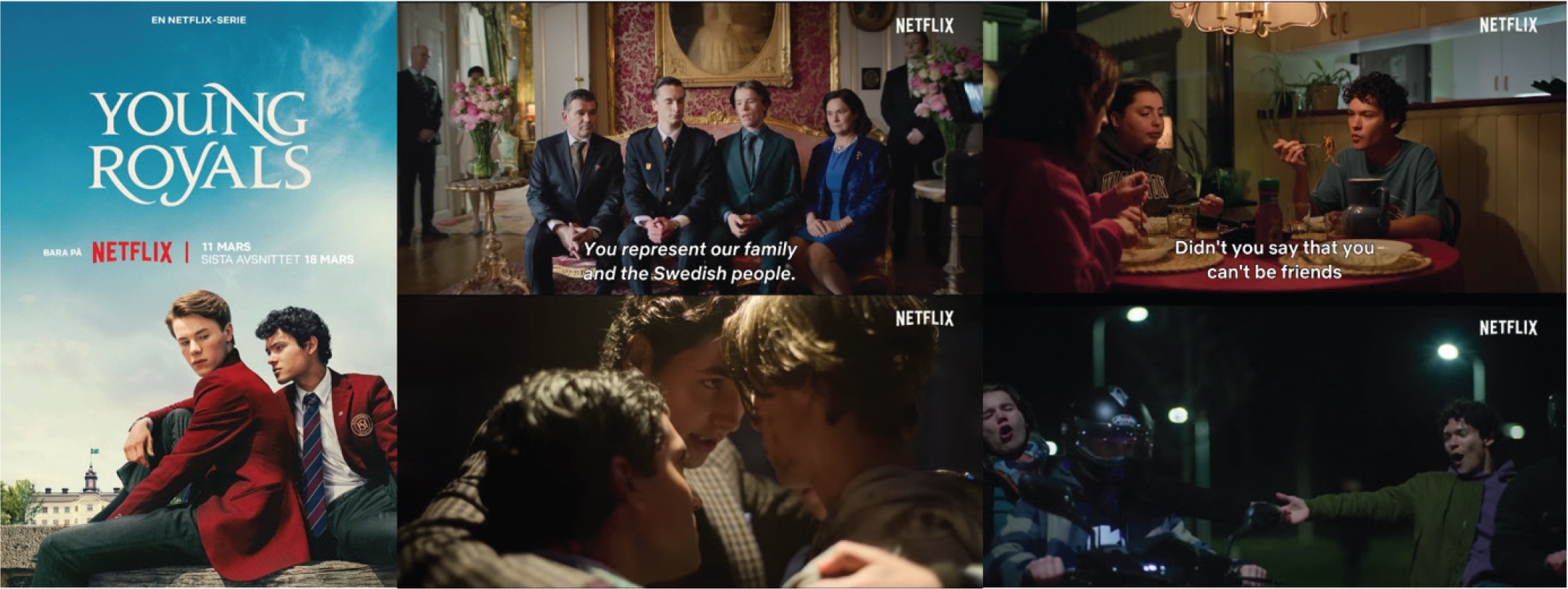
Figure 4
Poster and trailer place Young Royals in a boarding school – extremely unusual in Sweden – narrating a story of romance across the divide, between prince Wilhelm and Simon, the son of an immigrant working class single mom. A seemingly tight friendship, based on protocol rather than genuine affection, forces aristocrats together while keeping others out, whereas Simon’s circle of friends and family appear closer and freer. Poster and screenshots created by the author from the series’ trailer made available at and by Netflix.
When the producers first pitched the idea to me, it was a different genre, more of an Elite, Riverdale story, starting with a murder, then going back to the whodunnit. It didn’t awake anything particular in me…until I understood [the gay love affair]. I couldn’t stop thinking about it. How would it be for a young [royal] person, so restricted, to experience this. Overnight I changed the genre and storyline. It felt powerful and unique.22
Video 1
Trailer for Young Royals, Netflix, S1, 1 July 2021.
Indeed, instead of criminality Young Royals’ conflicts stem from an elite institution’s warped understanding of ’duty, status, loyalty’ and how these constrain ’love’. This love encompasses being gay, working-class, and of immigrant background, issues related to diversity, so prominent in Netflix’s transnational strategy. Although generic crime elements were disregarded in Young Royals, other conventions remained, i.e. regarding how ’the lens of wealth and class’ recur in stories ’of young outsiders, generally from working and/or middle-class families arriving at elite schools populated by wealthy students.’23 Relying on generic conventions and settings atypical for Sweden can rewardingly represent gay love and critically view elite structures vis-a-vis working class, but may renounce local specificity. In a study on Netflix teen series Axelle Asmar et al. find that ‘diversity and narratives on representation are strategically detached from […] social relations’ in which they are embedded […] to facilitate the transnational circulation.’24 Their findings suggest a difference between prioritizing global circulation and ‘portraying the world as it is, without unnecessary polish.’
Young Royals’ creation grounded in genre conventions is shared with Barracuda Queens (2023-2025). Frida Asp recalls brainstorming ideas with fellow producer Fatima Varhos and writer Camilla Ahlgren when ‘Fatima said she liked heist series, with girls in the lead. Then a year ago we chatted with Netflix - they said we’d like to do a heist type of series and we said - we have something!’25 It is telling that both creators and Netflix were responding to the popularity of heist series such as La Casa de Papel (2017-2021) and Lupin (2021-2026), which resulted in a story of rich girls in debt who resolves their problems through a series of heist burglaries (Figure 5).
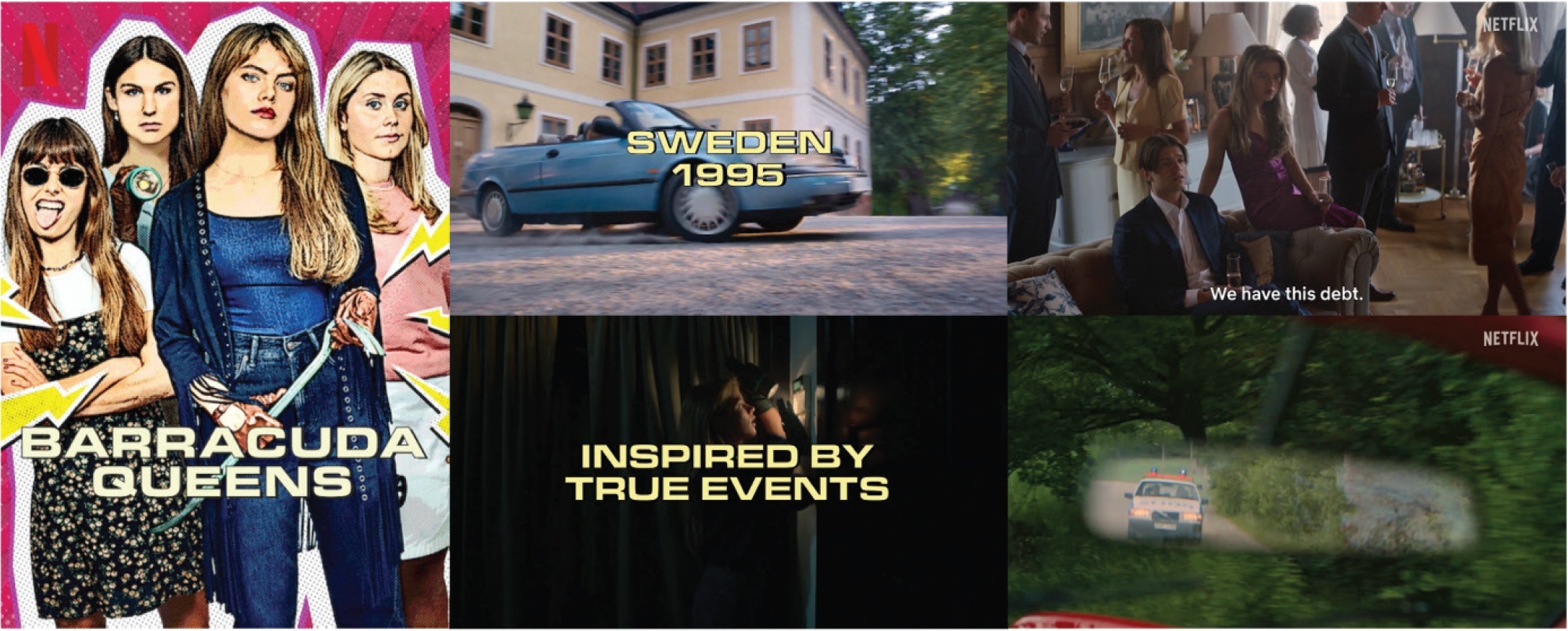
Figure 5
Barracuda Queens offer generic pleasures – heist, true crime, feminist ethos, upper-class period distance – rather than a realistic dramatization of contemporary Sweden. Yuppie-era settings are exclusive and upper-class where, however, the young female friends feel a bit purposeless. Typically, when the landscape is shown, it comes with a police car in the rear-view mirror. And when the series references ’inspired by true events’, the true events have been significantly re-interpreted and complemented with dramatic invention to serve quite a different story. Poster and screenshots created by the author from the series’ trailer made available at and by Netflix.
On top of the trendy heist story, Netflix’s press release foregrounded ‘inspired by true events’ and let retrospective ‘feminism’ motivate the crimes: ’young women […] commit burglaries in an attempt to liberate themselves from the expectations on women - long before feminism became a household idea’.26 Although there are ’true’ resemblances with the ’Lidingö Gang’ – i.e. privileged upper-class burglars, a red Rolls Royce, and champagne glasses as calling cards27 – the alterations are overwhelming; the actual Lidingö burglars were men and, although feminism was actually a well-known idea in Sweden at the time, these men had no known feminist agenda aligned with the trailer’s girl-power criminal resourcefulness or insight that ’all men are pigs’. These alterations expose past me-too-situations in an upper-class world, but do not make them urgent today.
Video 2
Barracuda Queens, Netflix, S1, 5 June 2023.
Similar to Barracuda Queens the Italian series Baby (2018-2020) explores written-about upper-class crimes but, as Romana Andò and Danielle Hipkins argue, also retains ‘dissonant pleasures’:
the aesthetic pleasures of the series: girl fun and friendship, the glamour of the setting, the ‘kinaesthetic’ pleasures of dance […] that constitute the fantasy elements of the series, more transnational in tone, are also often interwoven with the more ‘realist’, or darker news story-based, Italian elements […] that connote negative affects of anger, insecurity and stress.28
Much of this is true also for Barracuda Queens, but, crucially, ‘the more realist, or darker news story-based [national] elements […] that connote negative affects’ are not there. Consequently, the series does not trigger ‘a complex set of responses in […] teen audiences that speak to their context in a particular way’.29
4 Viaplay: Personal Experience and Social Realism?
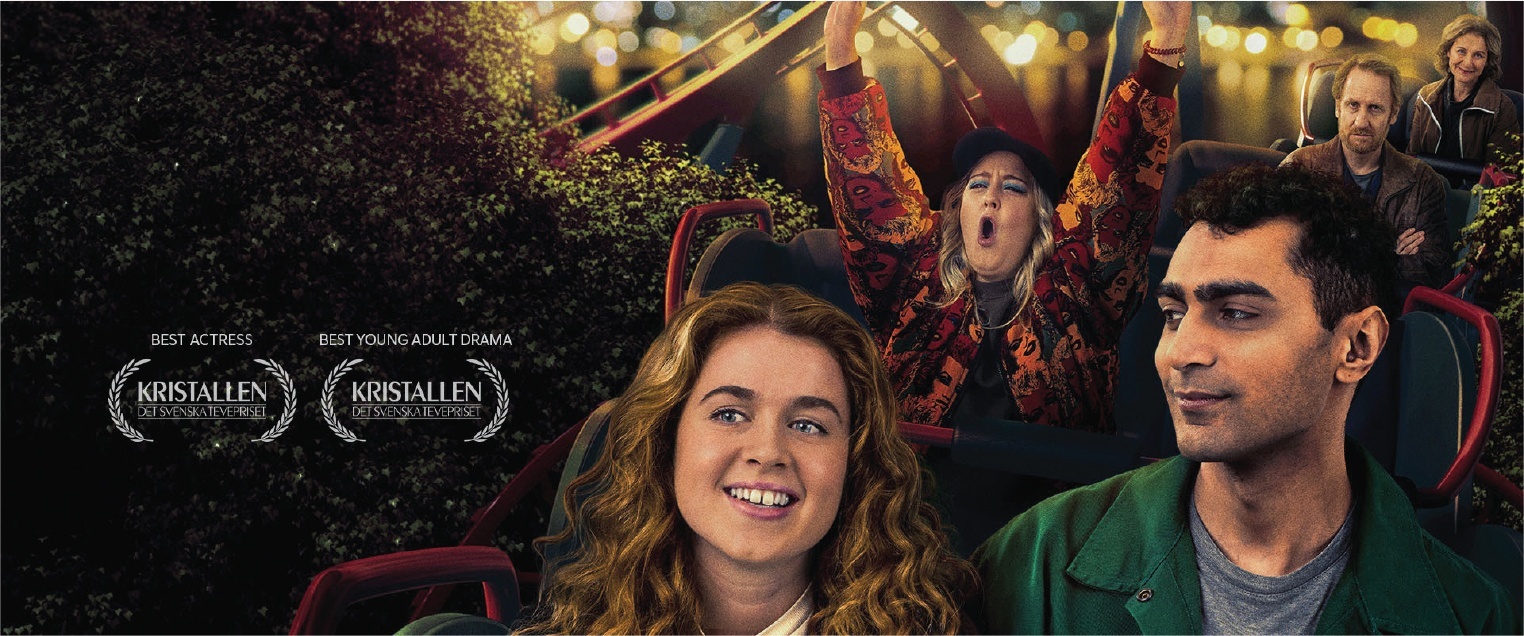
Viaplay approaches the young adult series differently. When Thunder in My Heart (2021-2023) won Kristallen’s ‘Best Young Drama’ award it was characterized as a ‘a series that, with perfect pitch and empathy, refuses to be conventional or predictable as it intimately portrays the main characters’ attempts to find their way in life’.30 Instead of foregrounded narrative enigmas, the series linger on everyday settings and situations exploring life’s challenges in a social realist manner.31 Although Young Royals displays a similar reality, through Simon and his family and friends, these are glimpses used for contrast and class conflicts, whereas in Thunder in My Heart everyday reality is everything (Figure 6).
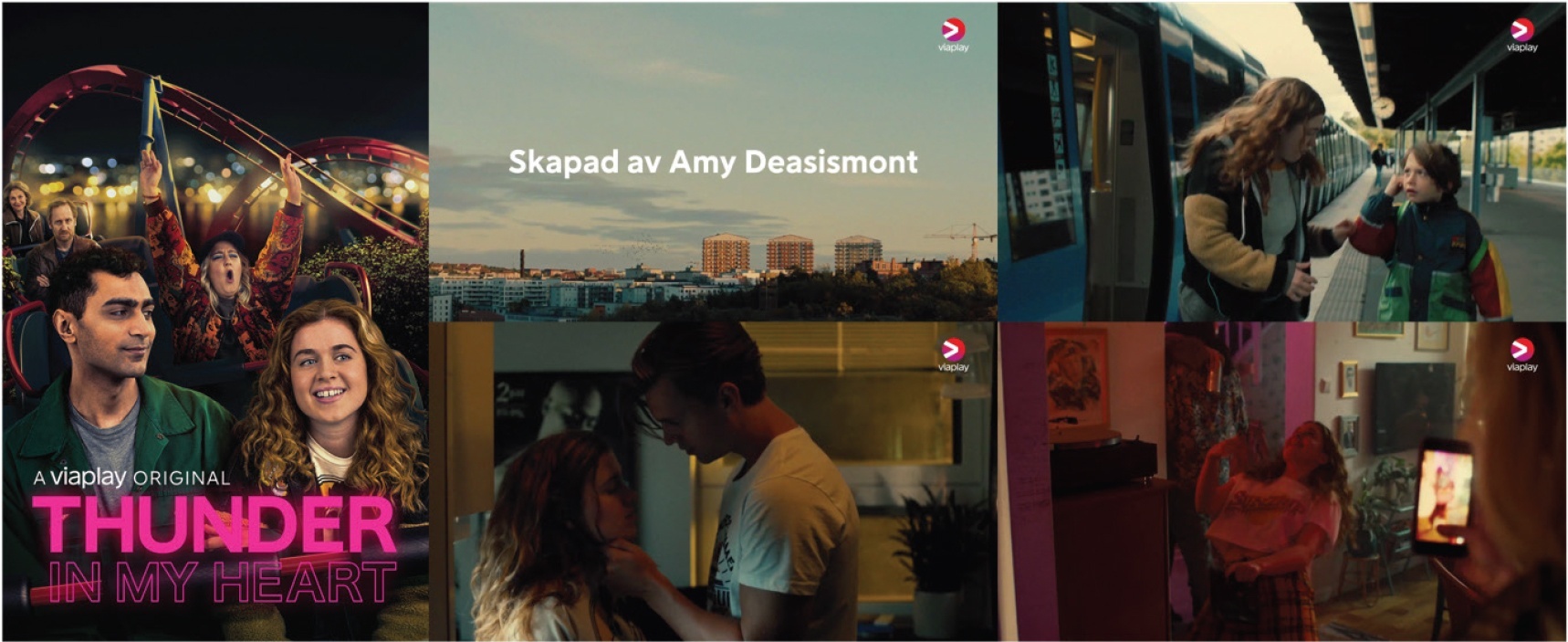
Figure 6
The poster and trailer to Thunder in My Heart (2021) show main character Sigge across everyday, modest suburban settings where shifting relations with friend/wannabe boyfriend, family, friends and ex-boyfriend matter more than a tight plot – prioritizing emotional exploration over narrative-necessitated characterization. Poster and screenshots created by the author from the series’ trailer made available at and by Viaplay.
Video 3
Trailer for Thunder in my heart, Viaplay, S1, 7 July 2021. Watch the video here.
Initial ideas for Thunder in My Heart came from personal experiences of series creators Amy Deasismont:
when she was 23, she started reading old notes from a relationship she had when she was 20. Detailed texts full of seriousness and indignation that now made her laugh. She realized that they could be reworked into entertaining scenes, and started writing based on these. Now it has become something completely different, but this is where Thunder in my heart began.32
And similarly for Threesome writer and director Lisa Linnertorp:
Partly it was my own life and relationships […]. When I was 19, I moved to Dublin for a year with my then-boyfriend. There’s a part of him in David, and a part of who I was then in Siri. […] I wanted to break down my main characters’ relationship and look at its components in the rubble, and for that I needed a catalyst.33 (Figure 7)
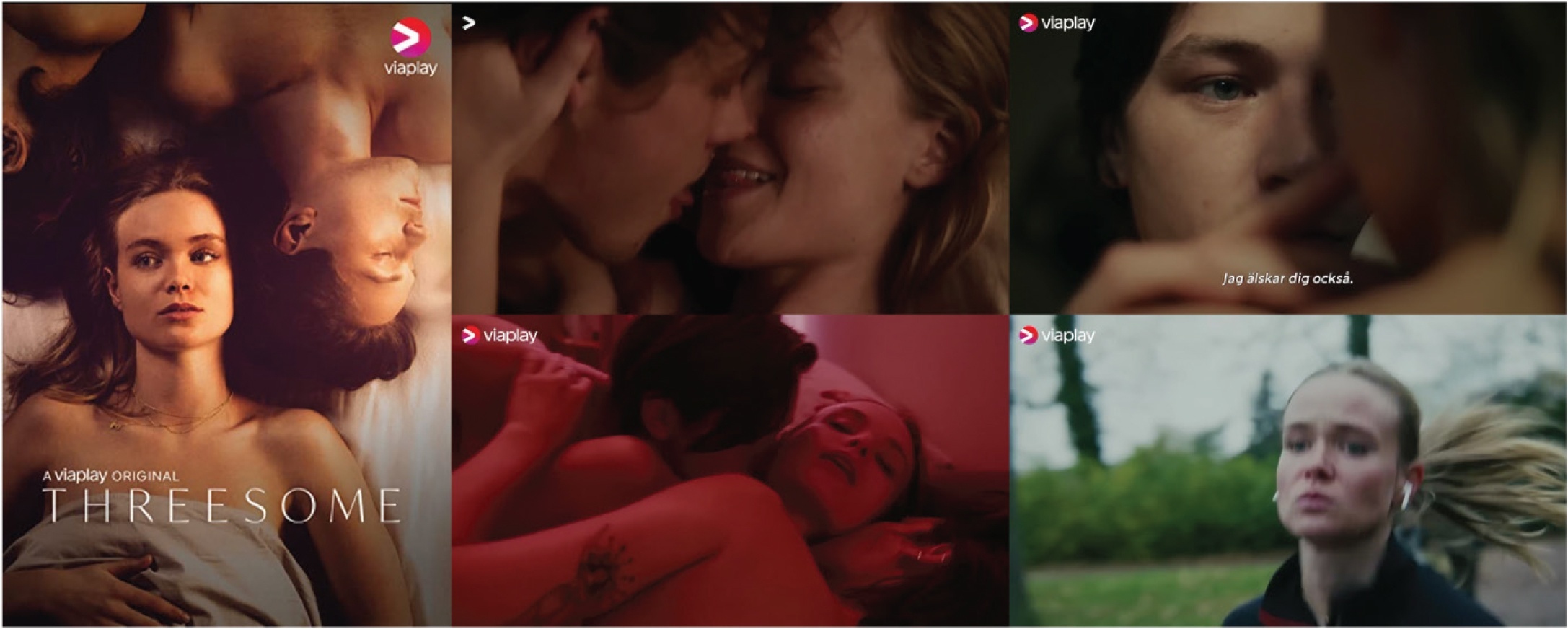
Figure 7
The first and last images of Threesome’s (2021) trailer are close-ups: first Siri and David united in amber-toned, intense and joyful lovemaking, then divided in muted colours, each saying but not believing, ’I love you’. The flushed, sensually shot threesome is intercut with Siri running in overcast light, shocked and distraught, marking the disruption that will be explored throughout the series. Poster and screenshots created by the author from the series’ trailer made available at and by Viaplay.
In contrast, both Young Royals and Barracuda Queens developed from genre conventions and global trends rather than personal experiences, which might be attributed to different ‘streamer imaginaries’ – Petr Szczepanik’s concept to capture creatives’ expectations and beliefs regarding working with streamers.34 Linnertorp’s writing process involved focus groups where participants shared intimate experiences regarding sex and relationships35 – suggesting she imagined Viaplay would value authentic depictions of sensitive topics.
Thunder in My Heart mildly follows Threesome’s recipe to ‘break down’ Sigge (losing job, boyfriend, flat) and explore ‘the components in the rubble.’ Young Royals and Barracuda Queens show less interest in such exploration and consequently fewer, and more superficial, components are explored. Where Young Royals uses Simon’s working-class background primarily as an obstacle to the romance, and Barracuda Queens treats economic pressure as heist motivation, Thunder in My Heart and Threesome linger on the emotional and social consequences of precarious situations – not as plot devices but as focus for further exploration. Whereas Netflix’s commissioning logic might be imagined favouring generic conventions and universalized content, Viaplay’s encouraged creators to explore personal experiences and social realist storytelling.
Video 4
The trailer to Threesome, Viaplay, S1, 29 August, 2021.
6 Conclusion
Viaplay’s ambitious but discontinued expansion reveals a distinct approach to streaming content. While most series operated within familiar genres, Viaplay also commissioned projects competitors hesitated to include - and demonstrated a ‘Nordic way’ prioritizing social and cultural authenticity over strategic universalization. This becomes evident both in what competitors acquired (Nordic noir and prestige fantasy) and what they passed over (war, everyday life crisis dramas and local biopics). Comparative analysis of four series within a single genre, young adult TV productions, shows how Netflix’s genre-driven commissioning logic contrasts with Viaplay’s creator-driven emphasis on personal experience and social realism - differences aligned with distinct ‘streamer imaginaries’ shaping production expectations. Whether this approach appeared across Viaplay’s full genre range requires further study, as do questions about production culture: what industry conditions, if any, might revive such commissioning? Viaplay’s trajectory suggests that while its approach proved commercially unsustainable,36 its cultural value - offering content that explores rather than displaces local specificity - remains significant in a Swedish globalized streaming landscape.
Notes
[1] ‘Anti-Netflix’ is used by DWDL 12 October (2022) and Linkiesta 23 September (2021). Financial Times’s headline ’Europe’s challenger to Netflix steps up global expansion plans’ is from 22 September (2021).
[2] Viaplay Group, ”Kv1 2021 kvartalsrapport januari-mars”, Press release: Stockholm Viaplay Group, April 22, 2021, https://www.viaplaygroup.com/sv/investors/reports-and-presentations/kv1-2021-kvartalsrapport-januari-mars.
[3] Nordic Entertainment Group AB, “Upptagande till handel av aktierna i Nordic Entertainment Group AB (publ) på Nasdaq Stockholm.” Prospectus. Stockholm: Nordic Entertainment Group AB. Approved by Finansinspektionen, March 8, 2019: 48. https://www.mtg.com/wp-content/uploads/Documents_Pdfs/Nordic-Entertainment-Group-AB-Prospectus-Swedish.pdf
[5] Max Goldbart, “’We Have Too Much Scripted,’ Says New Viaplay Boss As He Signals Major Content Pivot”, Deadline, July 20 (2023).
[7] Library analysis helps us understand what a streaming service offers viewers and assess how they complement and compete with each other. See: Amanda D. Lotz, Oliver Eklund, Stuart Soroka, ”Netflix, library analysis, and globalization: rethinking mass media flows”, Journal of Communication, 2022: 512.
[8] TV4 owned C More, also a significant streamer. Since 2025 TV4 belongs to the Norwegian foundation-owned media conglomerate Schibsted Media. SVT, Sweden’s public service, is now the only major Swedish-owned commissioner of television content.
[9] Manori Ravindran, “HBO Max Halts Originals in Parts of Europe in Major Restructure”, Variety, Jul 4, 2022.
[10] See i.e.: Kim Toft Hansen, ”Nordic Noir from within and beyond: Negotiating geopolitical regionalisation through SVoD crime narratives”, Nordicom Review, 41(Special Issue 1), (2020): 123–137.
[12] ’Real Housewives Göteborg’ is, so far, only a suggestion by SkyShowtime’s chief content officer Kai Finke. Eric Diedricks, ”SkyShowtime är öppna för lokal reality: ’Real Housewives of Gothenburg’”, November 14, 2024, https://www.realitytopp.se/nyhet/skyshowtime-skyshowtime-ar-oppna-for-lokal-reality-real-housewives-of-gothenburg.
[13] Annika Pham, ”Hans Rosenfeldt to bring contemporary edge to Astrid Lindgren’s Ronja The Robber’s Daughter”, Nordisk Film- & TV-fond, September 7, 2021.
[14] For comparison: Disney Plus’ only Swedish commissioning so far, the lavish adaptation of Mikael Niemi’s bestselling historical novel To Cook a Bear (2025), was still nowhere close to Ronja’s visual effects, number of actors, set constructions, etc.
[16] John Elmes, ”Staying on top in distribution”, Broadcast, 14 April (2023). Similarly, receiving Variety’s Vanguard Award in 2021 Anders Jensen acknowledged that in countries like Sweden ‘local content has always played a very important role […] because the tonality of how we do things is slightly different’. Elsa Keslassy, ”Variety Honors Scandi Streaming Sensation: Nent Group’s Anders Jensen takes Viaplay to the vanguard of scripted content”, Variety, 6 October (2021): 61.
[17] Michael L. Wayne and Deborah Castro, ”Cultural Authenticity as Netflix Televisuality: Streaming Industry Discourse and Globally Commissioned Original Series”, Media and Communication 13 (2025): 11.
[19] For a recent overview of key aspects of the genre, including audience and industry, see: Jeanette Steemers, Vilde Schanke Sundet and Pia Majbritt Jensen, ”Screen entertainment and the ‘youth challenge’: Home advantage, audience preferences and industry responses”, Critical Studies in Television 21, No. 1 (2026): 3–15.
[20] The series were selected based on their perceived quality, as indicated by awards or nominations in the best youth drama category at the Swedish Kristallen television award between 2022 and 2024 (the only years this category existed). Young Royals won in 2022, when Threesome was also nominated. Thunder in my Heart won in 2023 and Barracuda Queens won in 2024. See http://kristallen.tv/nominerade.
[21] A study on transnational teen television on trailers, thematic and narrative aspects: Axelle Asmar, Tim Raats and Leo Van Audenhove, “Netflix and the Transnationalisation of Teen Television”, Television & New Media 26, No. 5 (2025): 552–569.
[22] Annika Pham, “Creators & actor of Netflix’s Young Royals say the magic on screen came from trust”, Nordisk Film & TV Fond, October 28, 2021, https://nordiskfilmogtvfond.com/news/stories/creators-actor-of-netflixs-young-royals-say-the-magic-on-screen-came-from-trust.
[23] Axelle Asmar, Tim Raats and Leo Van Audenhove, “Netflix and the Transnationalisation of Teen Television”, Television and New Media 26, no. 5 (2025): 559.
[24] Axelle Asmar, Tim Raats and Leo Van Audenhove, “Netflix Teen Series and the Globalization of Difference”, European Journal of Cultural Studies 28, no. 4 (2025): 1185
[25] Annika Pham, “Quicksand producers launch own company Asp Varhos with two Netflix shows”, Nordisk Film & TV Fond, September 6, 2022, https://nordiskfilmogtvfond.com/news/stories/quicksand-producers-launch-own-shingle-asp-varhos-with-two-netflix-shows.
[26] Viaplay (2022), “Netflix presents Barracuda Queens – A new Swedish drama series from the producers of Quicksand”, 2 June, https://about.netflix.com/en/news/netflix-presents-barracuda-queens-a-new-swedish-drama-series-from-the.
[27] The case is well covered in a radio documentary: Anton Berg, “Lidingöligan och lyxstölderna”, Sveriges Radio [2008] 2021, https://www.sverigesradio.se/avsnitt/lidingoligan-och-lyxstolderna-repris-fran-2008-p3-dokumentar.
[28] Romana Andò and Danielle Hipkins, “Teen Identity, Affect and Sex in Rome. Italian teen girl audiences and the dissonant pleasures of Netflix’s underage prostitution drama Baby”, in Studi culturali, Rivista quadrimestrale 2 (2022): 227.
[30] Kristallen, “Prismotiveringar”, Kristallen: Det svenska tevepriset [award] (no year), http://kristallen.tv/nyheter/2023/08/29/4194.
[31] Birger Langkjær, “Realism as a Third Film Practice”, MedieKultur: Journal of Media and Communication Research 27, no. 51 (2011): 48–51.
[32] Samuel Mesterton, “Amy Diamond om nya karriärvalet – berättar själv”, Femina, May 20 (2021), https://www.femina.se/intervju/amy-diamond-om-nya-karriarvalet-berattar-sjalv/7564115.
[33] Kjell Häglund, ”Liv till varje pris! Är Lisa Linnertorp nya Bo Widerberg?”, tvdags, June 30 (2024), https://tvdags.ghost.io/167-threesome-linnertorp-land-of-women-red-eye-nina-terese-rask/.
[35] Helena Larand, “THREESOME - att berätta en stor berättelse genom att visa det lilla: Yellow Birds producent Helena Larands produktionsberättelse”, Jarowskij YellowBird [web site], no date (2020), https://yellowbird.se/threesome/.