
1 Introduction
Advancing the aims of this themed issue – to explore how streaming platforms have reconceived the aesthetics, narratives and forms of audiovisual content – this article argues that Netflix’s premium original series The Crown (2016–2023) exemplifies a distinctive strategy by which the platform positions itself as the latest technological successor in an ongoing history of televisual memory production. It does so on two simultaneous registers. First, at the level of textual content: the drama explicitly stages the history of broadcasting technology as itself constitutive of historical consciousness, making the centrality of television to collective memory-making a recurring and self-aware preoccupation. Second, at the level of production practice: Netflix’s deployment of digital technologies – VFX, post-production distressing, uncompressed archival preservation – functions as an active acknowledgement, interrogation and transformation of prosthetic memory; the memory we acquire not through lived experience but through the media forms that have historically carried the past to us. To analyse these two registers together, this article proposes a theoretical framework grounded in media archaeology.
This intervention builds on a preoccupation with materialist media histories, where transcultural mediated histories and memory are made under transnational conditions.1 I understand media history as layered, simultaneous and non-synchronous, embedded in the very materiality of the audiovisual. Different mediated memories write and overwrite earlier ones without fully erasing them, accumulating layers of cultural meaning across time. I read the audiovisual text as a site where multiple temporal and technological layers coexist – what Andreas Huyssen2 describes as layers of cultural memory accumulating across time and space, materials available for reinterpretation and experimentation. The Crown focuses attention on a historical drama whose memories of events were originally produced in media technologies now rapidly becoming obsolete; these images carry a sense of something disappearing and evoke an urgency in preserving and reinterpreting cultural memory. In this ‘historical awakening’ – borrowing from Walter Benjamin’s anthropocentric framework3 – of archival media artefacts, traces and memory within the latest generation of TV production technologies, a constellation forms between past and present, illuminating both.
Methodologically, this study applies the framework of media archaeology as an analytical lens to investigate The Crown as a case study, examining its production aesthetics, post-production strategies and archival practices as material sites of memory formation. The series’ fidelity claims relate significantly to its use of old media – radio, newspapers, photographs, newsreels, broadcast news, television documentaries – both as research tools for historical accuracy and as incorporated elements that embed authentic period details within the fiction as a mark of creative and cultural ambition.4 Yet the series’ preoccupation with historical authenticity – a claim that, as discussed below, has been both defended and vigorously contested – is less important here than what that preoccupation reveals: a sustained and self-reflexive engagement with the role of media technologies in making and unmaking collective memory. The Crown directly excavates, restages and re-signifies pivotal media moments: the 1953 Coronation at Westminster Abbey, the first televised Christmas message in 1957, royal scandals including the Princess Margaret–Peter Townsend affair and Princess Diana’s Panorama interview, broadcast on the main public service channel BBC 1 on 20th November 1995. In doing so, the series positions Netflix not merely as a distributor of historical drama, but as an active participant in the long and layered history of television as a memory machine.
In an era of streaming saturation and industrialised overabundance, the past is no longer remembered: it is licensed. This study explores why certain narratives – royal, historical, media-reflexive – achieve premium status. As platforms compete for subscriber attention and cultural prestige, understanding the mechanics of manufacturing verisimilitude as a prestige commodity – always a construction, never a recovery – becomes increasingly urgent. This analysis illuminates how contemporary prestige television functions as both an archaeological site (excavating and restaging old media forms) and memory machine (simulating new ways of knowing a past it has already decided) within the broader political economy of the Netflix platform itself.
The article proceeds as follows. The first section introduces the theoretical framework of media archaeology as mediated memory practice, establishing the analytical tools through which The Crown is subsequently analysed. The second section contextualises the series within Netflix’s global ecosystem, examining how its production model and institutional identity position it as a new chapter in the history of televisual memory production. The third section reads The Crown as ‘travelling memory’,5 comparing the BBC’s 1953 Coronation broadcast and Netflix’s series as structurally analogous yet institutionally opposed moments of televisual memory-making and establishing the case for Netflix as technological successor. The fourth section analyses the series’ post-production strategies – its digital reconstruction of the Coronation, its artificial ageing of footage, its attention to period-accurate television technology and its speculative archival logic – as media archaeological practices that produce, rather than merely represent, historical memory. The conclusion argues that in the streaming era, cultural memory is materially constituted not only through visual aesthetics but through platform infrastructure itself.
2 Media Archaeology as Mediated Memory Practice
While existing scholarship on The Crown has emphasised memory-making primarily as a mediated cultural and narrative practice shaped by representation and power,6 this study extends that work by combining memory studies with media archaeology, examining the series as a technical object whose very existence is conditioned by the media temporalities embedded in contemporary streaming infrastructures. The central claim is that Netflix’s use of The Crown to position itself as a technological successor in televisual memory production operates through two distinct but interconnected registers: the textual – how the drama recognises and stages television’s historical role in memory-making – and the technical – how digital production technologies are used to acknowledge, interrogate and transform prosthetic memory.7 Media archaeology supplies the framework that allows both registers to be analysed together.
Media archaeologist Wolfgang Ernst argues that memory is inscribed in media – in the technical operations, signal processing, material substrates and temporal logics (algorithmic time, processing time, storage time) of communication technologies themselves.8 His approach builds on Michel Foucault’s ‘archaeology of knowledge’,9 which analyses the rules governing what could be thought and said in different historical periods. Ernst adapts that framework to examine how technical infrastructures shape what can be articulated and conceptualised, foregrounding the non-human temporal regimes through which media operate: ‘an archaeology of the technological conditions of the sayable and thinkable in culture, an excavation of how techniques direct human or non-human utterances’.10 Memory, authority and meaning are structured, he argues, not only by human agency or ideology but by technologies, protocols, archives and media systems. Advancing these insights, this study recognises streaming platforms as temporal infrastructures that condition cultural memory through algorithmic curation and digital temporalities. In the case of The Crown, Netflix’s technological architecture shapes not only how the series circulates as historical memory but how its relationship to historical time is fundamentally structured, independent of the show’s storytelling or creators’ intentions.
My approach to media archaeology acknowledges these technical and infrastructural conditions through which The Crown performs memory work within the very material production and aesthetics of the text itself. Media archaeology is attuned to histories of media technologies, or what Jay David Bolter and Richard Grusin call ‘remediation’11 – a concept that references the memory of media itself. In this case, I relate it to how The Crown carries memories of past and present television production histories: a history of cultural memory as a history of television production. I peel back material layers of The Crown’s production – its VFX, its post-production. In the interplay between different media forms and the crossing of technological boundaries (digital/analogue, print/moving image, radio/TV), the production process remediates the past through present action, while also excavating the attitudes, beliefs and protocols that shaped mid- to late-twentieth-century media culture.
I reposition debates around historical fidelity to offer a mnemo-history grounded in TV materiality. This mnemo-history – drawing on ‘technologies of memory’ (Marita Sturken),12 ‘travelling memories’ (Astrid Erll)13 and ‘globital memory’ (Anna Reading)14 – reveals the ambivalences of mediating the past, or what Erll observes as explicit (conscious) choices and implicit (unconscious) burdens.15 By this she means cultural memory encompasses both intentional memory – shaped by deliberate choices about what to remember – and underlying dynamics that operate below conscious awareness. Mnemo-history helps us detect hidden institutional agendas and technical operations, suggesting how mediated transcultural histories and memories reorder messy ones within a thick description of television materiality.
Bridging media archaeology and memory studies, I rethink the textual materiality of TV memory – the indexical traces of mediated mnemonic memory layered within a culturally British yet industrially transnational TV drama – to ask: why remember this history (the British monarchy), why now (the streaming era)? I ground The Crown within an interdisciplinary materialist approach, working from the premise that production technologies and platform operational logics themselves carry ‘memory’. By examining VFX and post-production as archaeological media layers, I claim the TV production process is itself a site of memory formation, not merely the content. ‘Technologies of memory’ activate an experience of history, wherein Netflix enables and transmits a locally specific British historical drama as global cultural memory. This media archaeology addresses both the visible aesthetic remediation that produces cultural memory and the invisible technical operations constituting the memory practices of the streaming platform, operations that confer value and prestige on Netflix as a premium global brand.
3 Understanding The Crown as a Netflix Original
Media scholars such as Ramon Lobato16 and Mareike Jenner17 argue that Netflix has functioned as a disruptive force in transforming television. The US-based global subscription-based streaming service has fundamentally, according to Jenner, ‘reorganised what television is and how television viewing is structured’.18 Its transition from a US DVD-by-mail rental service into an international streaming service between 2007 and 2016 has reinvigorated debate about convergence, media globalisation and cultural imperialism.19 Scholars combining media analysis with cultural theory have studied the tensions – media regulation, policy and politics – involving how digital streaming has redefined the boundaries of national TV industries,20 with Jenner describing how Netflix ‘integrates itself into local media systems as transnational broadcaster’21 while simultaneously inserting ‘itself into an ideology of “the nation”’.22 Such scholarship theorises how streaming platforms forge paradoxical formations: content rooted in locally-specific national ideologies repositioned as transnational cultural idioms through global circulation as part of a content library, a catalogue. The Crown is an exemplary case of this formation, but what matters most here is not its reach but its type: a prestige historical drama that makes television’s own history as a memory medium its explicit subject matter.
Regarding The Crown, Roberta Pearson23 sees Netflix’s entrance into the UK TV ecosystem as disrupting PSB broadcasting norms in production and distribution. The series features high-end production values – elaborate period costumes, meticulously recreated historical settings, high-budget cinematography – that would be difficult to sustain in traditional broadcast television. Netflix’s deep pockets facilitated a specific aesthetic approach beyond the capacities of UK PSB, with industry reports estimating the first two seasons cost around $130m (£93m), making it the most expensive series at the time of its release in 2016.24 Andy Harries, Chief Executive of Left Bank and producer of The Crown, gave evidence to a House of Lords select committee:
If you want a comparison with The Crown, The Crown is between £5 million and £10 million an hour. It is one of the most expensive shows in the world and we probably would never have got it made had we not sold it to Netflix.25
Despite interest from the BBC and ITV, Netflix made possible a different level of technical production and global circulation, justifying investment ‘partly to help roll out its services in English-speaking countries around the world’.26 Matt Hills27 views Netflix’s commissioning of The Crown as a direct attempt to occupy and challenge the BBC’s public service broadcasting role as a source of nationally unifying stories. The economic and institutional logic is clear: Netflix needed The Crown to establish cultural prestige and territorial reach; The Crown needed Netflix to achieve the production scale that would allow its archaeological ambitions – the painstaking reconstruction of broadcasting history – to be realised.
Critical to understanding The Crown’s function as a mediator of knowledge about the British monarchy, particularly among younger generations with no direct memory of its subject28, is the persistent debate surrounding the series’ conflation of historical fact and dramatic fiction.29 Royal historians like Hugo Vickers30 have publicly criticised the series for distorting facts and misleading viewers through its veneer of authenticity, prompting Guardian journalist Simon Jenkins to declare that ‘fake history is fake news entrenched’.31 However, as memory studies scholar Sturken reminds us, cultural or collective memories are never a stable record of the past but are instead ‘produced through objects, images, and representations’.32 These ‘technologies of memory’, of which The Crown is one, do not merely represent history but actively shape what is remembered and how emotions become attached to the past. As Sturken argues, memory is produced through representation, and representation itself is a process of mediation where legitimacy is gained through affect more than evidence.33 In this framework, representation becomes memory of the past.
In their study of The Crown, Renira Rampazzo Gambarato and Johannes Heuman34 explore the ethical implications of the series’ mediated memory work and transmedia storytelling. Their research adopts Erll’s multidimensional model of cultural memory35 to illustrate how memory is constructed through three dimensions: intra-medial (how memory is expressed within the show itself);36 inter-medial (how the series interacts with other media forms – from podcasts to journalism – to reinforce or alter narratives of historical events);37 and pluri-medial (the broader context of memory-making, including how audiences consume and discuss the show across platforms).38 The authors argue that The Crown actively participates in cultural memory formation, shaping what audiences remember and forget about the British Royal Family and post-war British history. Their concern is not whether the series gets details right but how its narrative authority influences collective memory in powerful yet unexamined ways. José van Dijck’s work in this respect reconceptualises this type of mediated memory-work, toward the technological and institutional conditions under which memory is digitally produced, stored and circulated. Building on these foundations, I extend the argument to capture what is at stake in The Crown: not just how memory is narrated or circulated, but how the history of television as a memory medium is itself remade through digital production. That is the task of the media archaeological analysis that follows.
4 Television and Technological Succession: The Crown as Travelling Memory
Just as Netflix heralded a new media paradigm, so the BBC inaugurated one with the 1953 Coronation. The BBC transformed the Coronation from ceremonial state occasion into a media landmark through its pioneering live broadcast technology (Figure 1) and international distribution, establishing television as the dominant medium of the modern age. If the Coronation was genuinely inaugural – forging the template for television as national ritual and collective memory – The Crown arrives at a different historical juncture, consolidating rather than initiating Netflix’s pivot toward prestige production. Yet the structural parallel is not incidental: both moments mark a platform’s assertion of cultural authority through a televisual event that is simultaneously a demonstration of new technological capacity.
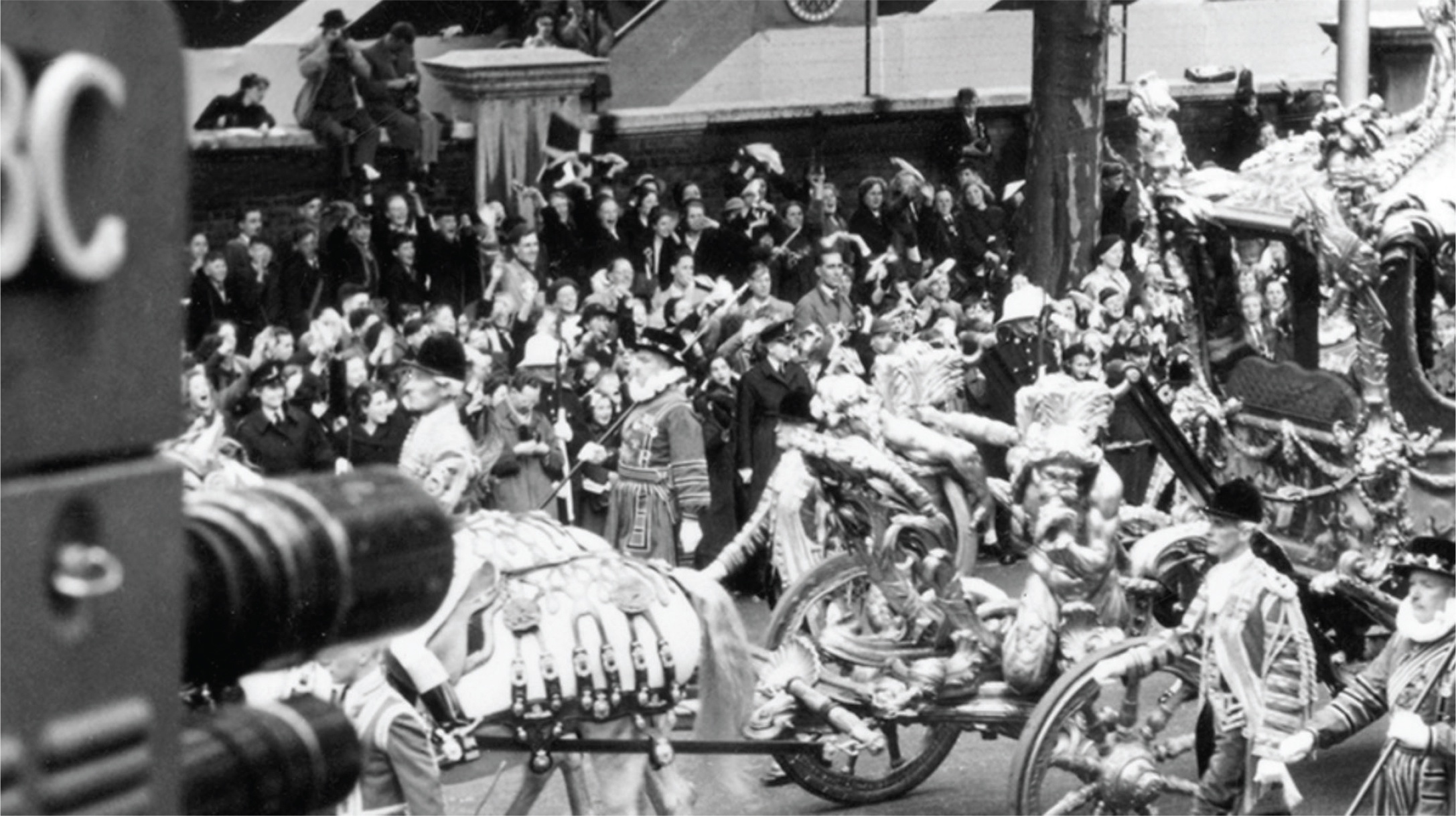
Figure 1
BBC outside broadcasting filming the coronation. Source: BBC Archive.
Erll’s concept of ‘travelling memory’39 illuminates how both function as mnemonic content migrating across temporal, spatial and social boundaries through shifting media carriers. The BBC produced the Coronation as travelling memory through its very mediation, establishing a ‘media memory template’ that would travel both geographically and temporally. Geographically, the event circulated through Eurovision relays,40 transatlantic film transfers41 and multilingual commentary in 41 languages;42 temporally, it entered BBC institutional lore as origin myth.43 The Crown operates as second-order travelling memory, remediating the already-mediated 1953 Coronation through digital streaming infrastructure. Where the BBC produced a memory template, Netflix remediates it, producing memory of a memory: a self-conscious and technologically sophisticated engagement with the history of how television itself has carried the past.
This comparison encodes fundamentally divergent institutional identities that are also different regimes of memory production. The BBC’s transmitter network – four high-power transmitters beyond London (Sutton Coldfield, Holme Moss, Kirk o’Shotts, Wenvoe) plus temporary installations for northeast England and Northern Ireland – materialised universal service ideals, reaching the nation as public obligation. Netflix’s global content delivery network (CDN) materialises algorithmic personalisation as a commercial advantage. Both systems transform technical reach into cultural authority, yet their underlying economics reveal opposed institutional logics: the BBC preserved the Coronation as national patrimony sustained by the licence fee; Netflix owns The Crown as proprietary intellectual property within a subscription economy. The succession is not neutral; it is ideologically freighted.
The 1953 French transmission surfaces in the series when the Duke of Windsor (Alex Jennings) gathers guests to watch the Coronation at his Parisian residence (‘Smoke and Mirrors’, 1:5) (Figure 2), an emblem of his exile, yet simultaneously a transnational connection materialising what Daniel Dayan and Elihu Katz term ‘ceremonial participation’.44 Such broadcasts enabled dispersed audiences to inhabit synchronous ritual time without leaving the intimacy of the home. Netflix’s infrastructure dissolves this temporal collectivity: The Crown travels everywhere simultaneously yet is experienced by no collective audience at the same time, an asynchronous participation through which algorithmic architecture fragments the viewing public while paradoxically claiming ‘global’ reach. What matters here is what this shift reveals about the different kinds of memory subjects produced by each platform. Where the BBC constituted collective memory through synchronous national ritual, a shared moment of reception that was itself part of the event, Netflix reconstitutes it through personalised, algorithmically curated, temporally unbounded access. The Crown is not experienced as a national event but as an individual encounter with a curated past; and in doing so, Netflix enacts its own claim to be the latest successor medium in an unbroken history of televisual memory-making.
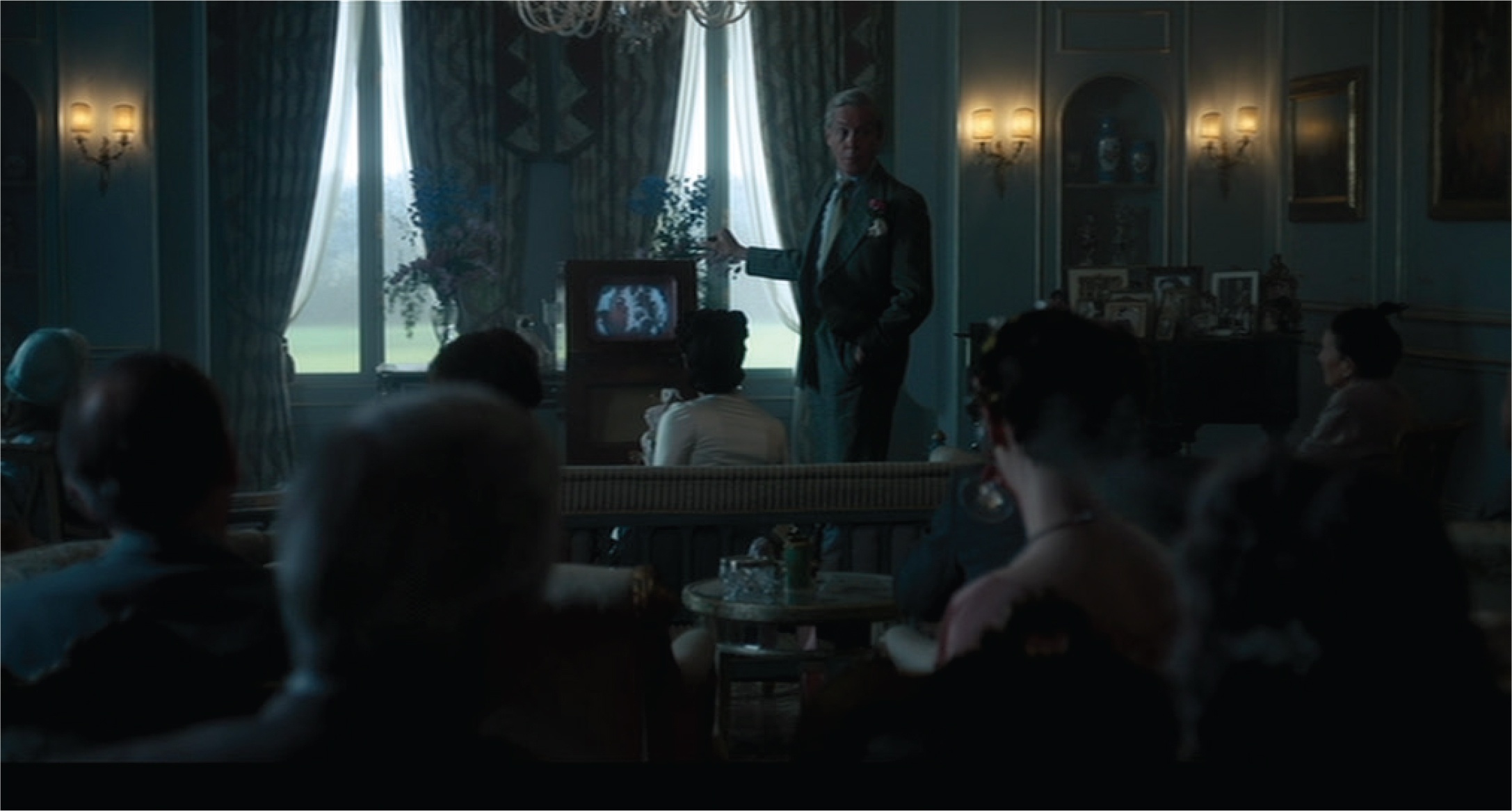
Figure 2
The Duke of Windsor explains arcane rituals, gathering his guests to watch the Coronation on TV. Source. The Crown (‘Smoke and Mirrors’, 1:5).
5 The Seen and Unseen of The Crown as Media Archaeology: Television, Reverence and Recreation in the Material Making of Memory
The Coronation itself in The Crown is structured through the lens of the Windsors’ social soirée (‘Smoke and Mirrors’, 1:5), where the Duke speaks in English over the original French broadcast commentary to offer expert insights into the arcane rituals for his guests. This is a diegetic mediation that simultaneously explicates the event for the contemporary viewer at an extra-diegetic level (Figure 2). The actual 1953 Coronation filming within Westminster Abbey was itself extensively rehearsed, with BBC crews meticulously testing lenses, angles and compositional strategies during preparations (Figure 3). This facilitated a highly choreographed media presentation orchestrated by Peter Dimmock, head of BBC TV outside broadcasting (Figure 4). The stated objective, according to Dimmock, was to craft something befitting the historical moment, exemplified by the BBC’s selection of Edward Elgar’s ‘Pomp and Circumstance’ to accompany the Queen’s exit through the west door.45
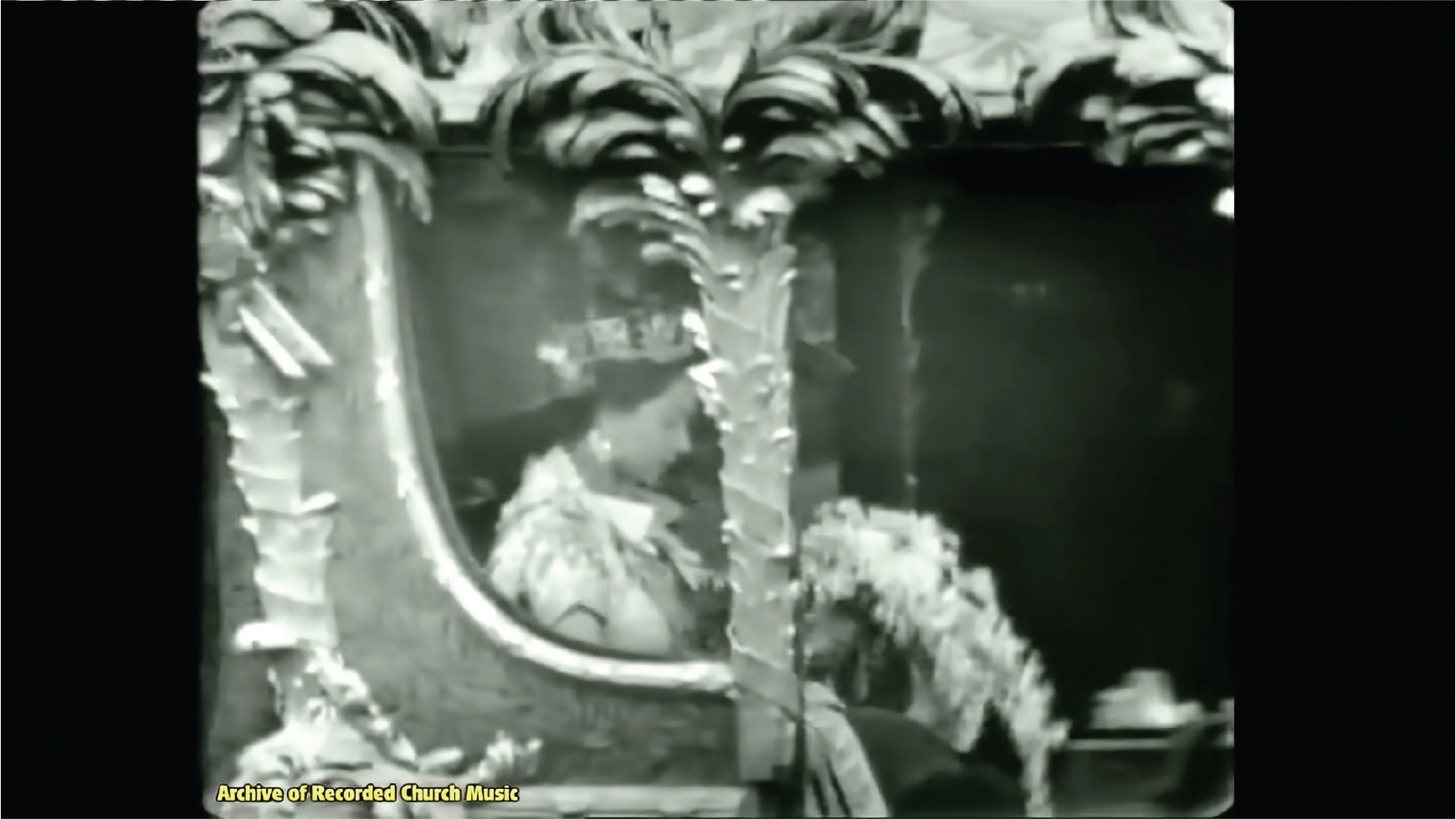
Figure 3
BBC TV Coronation of Queen Elizabeth II: Westminster Abbey 1953 (narration by Richard Dimbleby). Archive of Recorded Church Music. Source: https://www.youtube.com/watch?v=52NTjasbmgw.
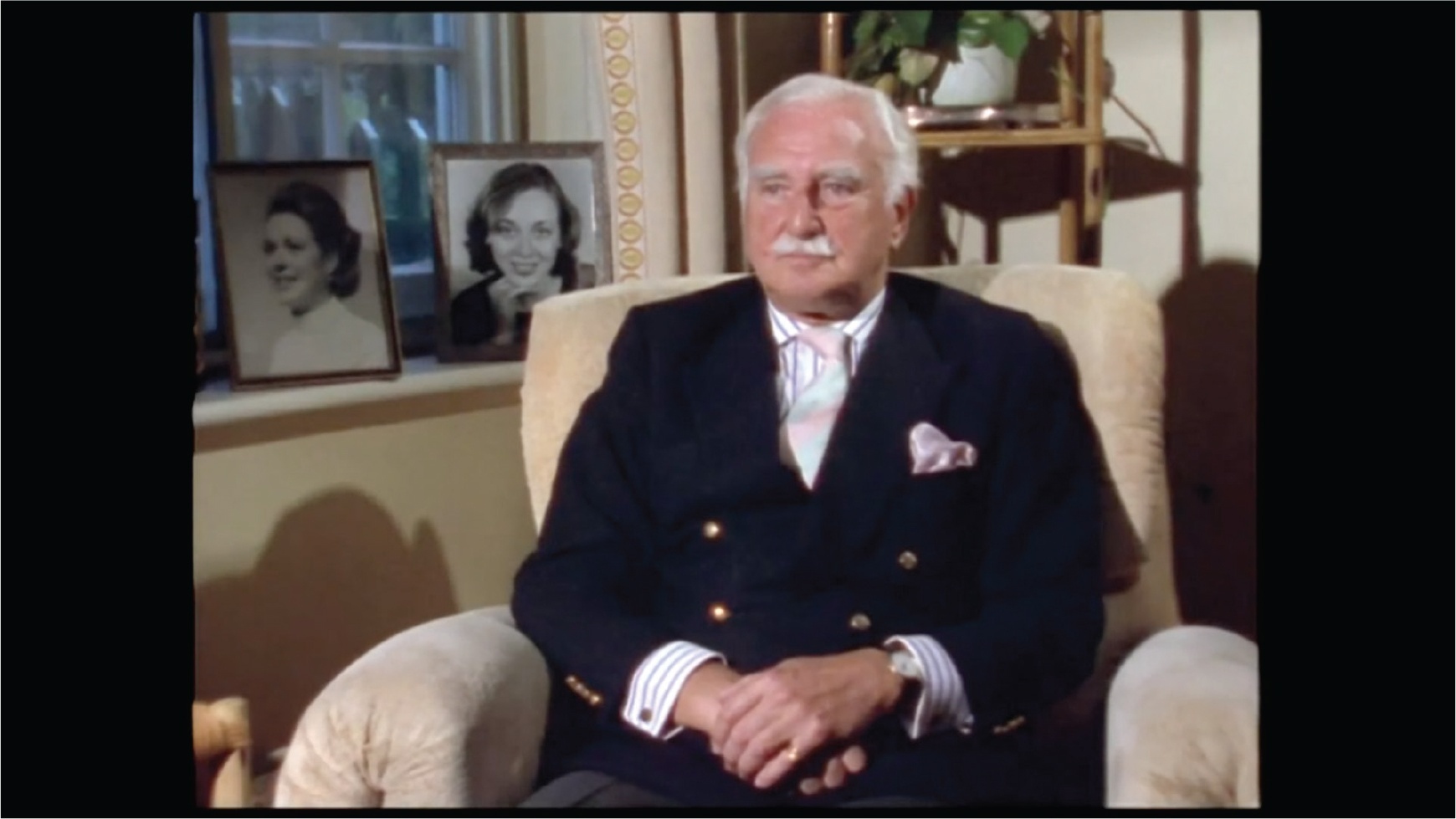
Figure 4
Interview with Peter Dimmock about the 1953 Coronation, Coronation, 1989. Source: https://www.bbc.co.uk/programmes/p019qsxf.
Yet the presence of BBC television cameras within the Abbey exposed a fundamental tension between the sacred and television as intervention. TV was a modern, experimental intrusion into an ancient ritual. At the ceremony’s most hallowed moment – the anointing, when the monarch receives holy oil from the Archbishop of Canterbury – the cameras deliberately avert their gaze. (Screens of cloth, richly embroidered, were brought and held around the Coronation Chair, forming a temporary enclosure that shielded the Queen from cameras and congregation alike, shielding the anointing from many within the Abbey). Yet the audio – the choir, the words of the service, Handel’s Zadok the Priest – continued throughout. The BBC was compelled to negotiate what Dimmock termed ‘privileged security’ (Figure 4),46 with absence signifying both deference to the weight of the establishment – to the Church, the Crown and the continuity they represented – and the technological limits and institutional constraints of television as an emergent medium in 1953. The Crown mediates not merely the historical event, but how that history was itself made and mediated – its staging of liveness, of a choreographed, institutionally managed event – while simultaneously adding its own re-enacted layer of mediation.
The Crown’s post-production apparatus reveals how contemporary high-end television drama mediates historical memory through sophisticated technological intervention. The series filmed its coronation sequence in 4K using Sony F55 cameras before migrating to One of Us studio, who approached the work with feature film-level budget and methodology.47 The Soho-based visual effects studio delivered 428 shots employing industry-standard software including Maya, Nuke, Photoshop and the photogrammetry software Enwaii,48 all calibrated to produce what VFX supervisor Ben Turner terms ‘exclusively invisible, photo-real effects’.49 This formulation – ‘invisible, photo-real effects’ – articulates a central paradox of Netflix’s technological succession: the platform achieves aesthetic legitimacy through the erasure of its own apparatus. The more seamlessly the digital machinery vanishes, the more naturalised the reconstruction becomes. Audiences experience these digital fabrications as ‘authentic’ precisely because the technological effects are not noticeable – a disappearance that carries its own ideological weight – and one that rhymes with 1953: as the BBC’s broadcast was the cutting-edge mediation of its moment, naturalised through institutional deference and the spectacle of access, so Netflix’s is of ours, naturalised through the erasure of its own digital apparatus.
The granular inventory of post-production transcends technical specification, charting how television’s capacity to simulate the past demands substantial budget and specialised expertise. Feature film-level investment – ‘we have treated it more like a 10-hour movie rather than a TV series’, said Turner50 – positions historical reconstruction as prestige cultural production, requiring dense technological scaffolding – digital set extensions, environment construction, crowd replication – to render historical events like the 1947 royal wedding (Figure 5) and the Coronation as apparently unmediated historical witness. The historical archive becomes not recovered but computationally manufactured, creating TV aesthetics that shape what and how we remember the past.
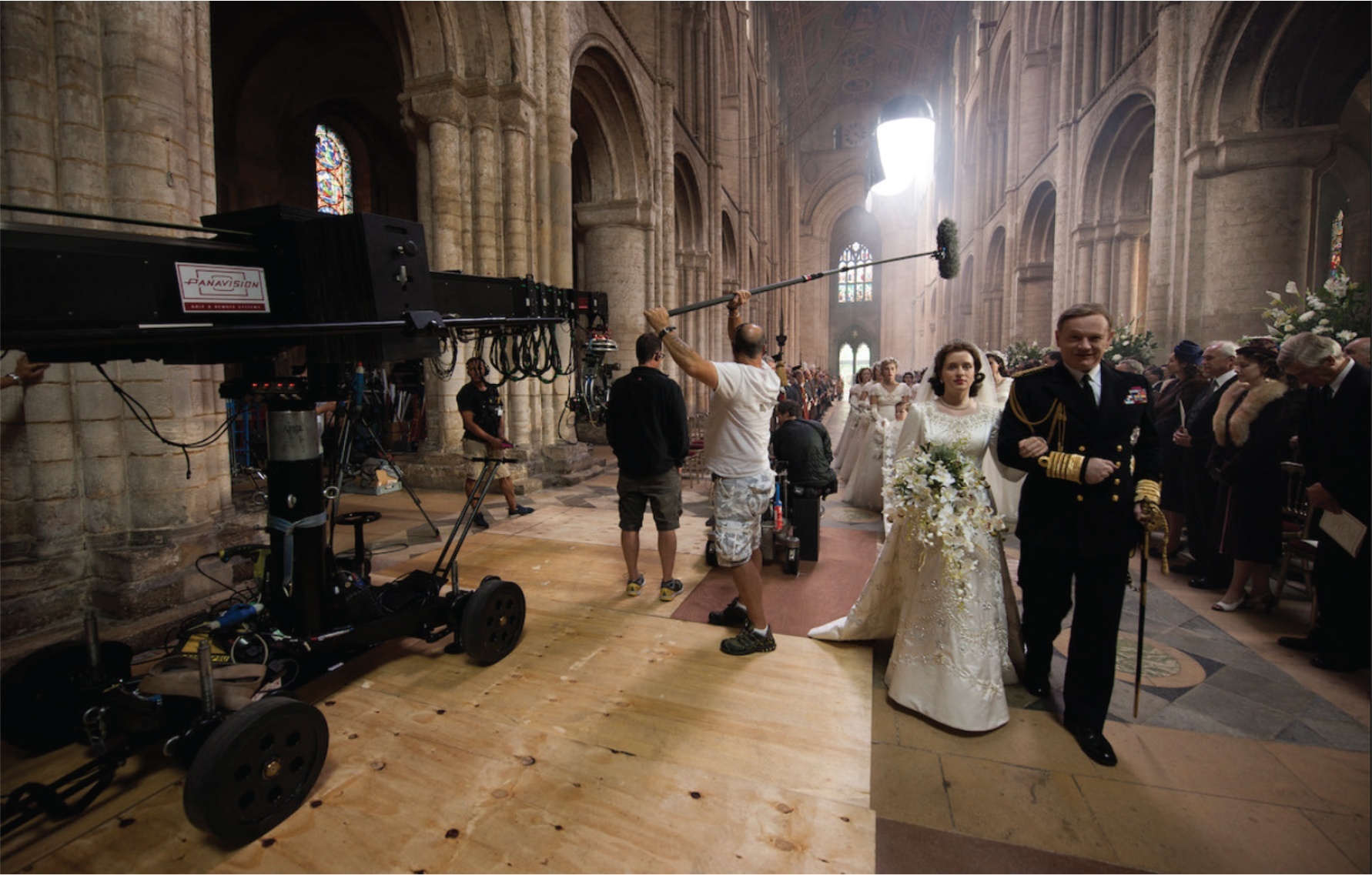
Figure 5
The Crown (‘Wolferton Splash’, 1:1). Filming the 1947 royal wedding inside Ely Cathedral. Source: Alex Bailey/Netflix.
Where the BBC’s cameras turned away in 1953, The Crown turned toward, reconstructing the very scenes original television audiences never witnessed. Photography remains prohibited inside Westminster Abbey itself, so Ely Cathedral served as stand-in (Figure 5), with Turner explaining: ‘What we ended up with is an amalgamation of the Abbey and Ely. The actual coronation scene was shot on a green screen stage at Pinewood Studios. The rest plays out through the BBC’s footage from the time. Creating the scale of the Abbey – but without being able to go in and photograph it – was certainly a challenge’.51 This composite architecture – Ely Cathedral plus green screen plus digital extension – produces a ‘Westminster Abbey’ that may be more visually coherent than any single photograph could capture. The Crown does not simply depict Elizabeth II’s crowning; it stages an encounter between 2016 television production and 1953 television broadcast, between digital manipulation and analogue recording, between prohibited photographic access and unlimited digital fabrication.
The use of digital effects to achieve a materiality of pastness is a well-established practice in heritage television and film, and The Crown’s deployment of that toolkit is in many respects unremarkable. What is distinctive here is not the technology but the choices it serves: specifically, the decision to reconstruct and show what the BBC’s cameras were forbidden to record. The anointing ceremony’s deliberate exclusion from the 1953 broadcast reflected a negotiated hierarchy between the British establishment and television: the BBC could witness the Coronation but not its most hallowed moment. The Crown inverts this logic entirely. Where the BBC’s cameras deferred to institutional and ecclesiastical authority, the series’ digital apparatus faces no such constraint. Its reconstructed sequence moves in close (‘Smoke and Mirrors’, 1:5): the Archbishop of Canterbury’s (played by Ronald Pickup) trembling hands, the holy oil placed on the Queen’s body (Figure 6), her expression at the moment of consecration – the private face of a public dedication (Figure 7.). The digital also restores the colour and spatial richness – the deep golds, the embroidered cloths, the ceremonial fullness of Westminster Abbey – that live television broadcast could not render. The Crown’s reconstruction not only fills the void left by the original broadcast but fabricates a visual coherence that exceeds what the BBC outside broadcast cameras could have captured in 1953: Westminster Abbey rendered more spatially legible, more visually complete, than the actual space historically permitted. If digital fabrication can now produce images of ‘what could not be seen’ with greater apparent authority than the archive itself, what remains of the distinction between the mediated event and its simulation? The Crown does not merely supplement the historical record; it supersedes the conditions – institutional, ecclesiastical, technical – under which that record was produced in the first place. This is precisely what technological succession means at the level of memory politics: not just doing more, but doing what could not previously be done and, in doing so, reshaping what counts as the historical real. For Ernst,52 the medium does not merely transmit history, it constitutes the conditions under which history can be known at all; and when those conditions change, as they do between the BBC’s 1953 outside broadcast and The Crown’s digital reconstruction, so does the historical real itself.
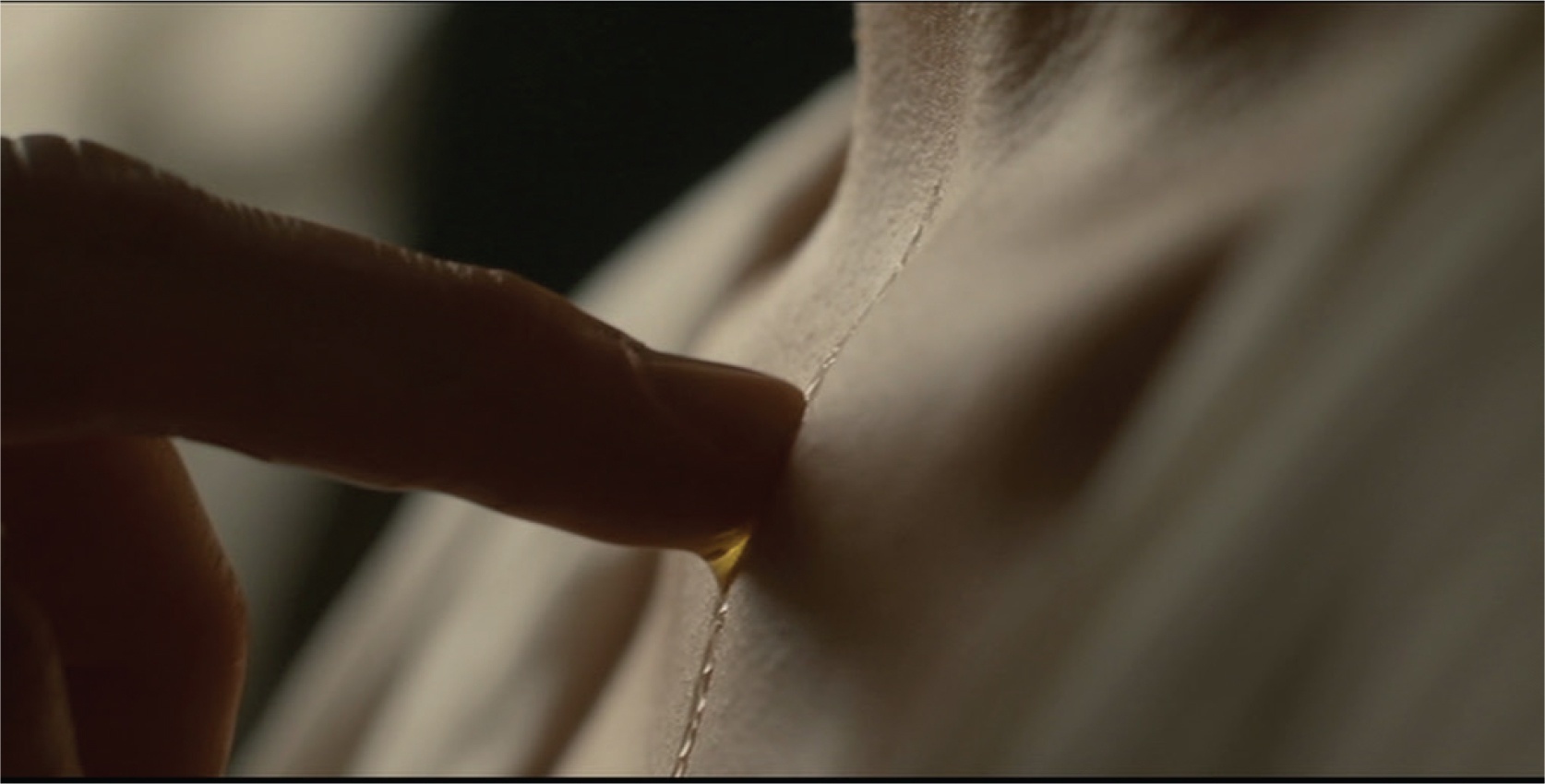
Figure 6
The holy oil anoints the Queen’s body. Source: The Crown (‘Smoke and Mirrors’, 1:5).
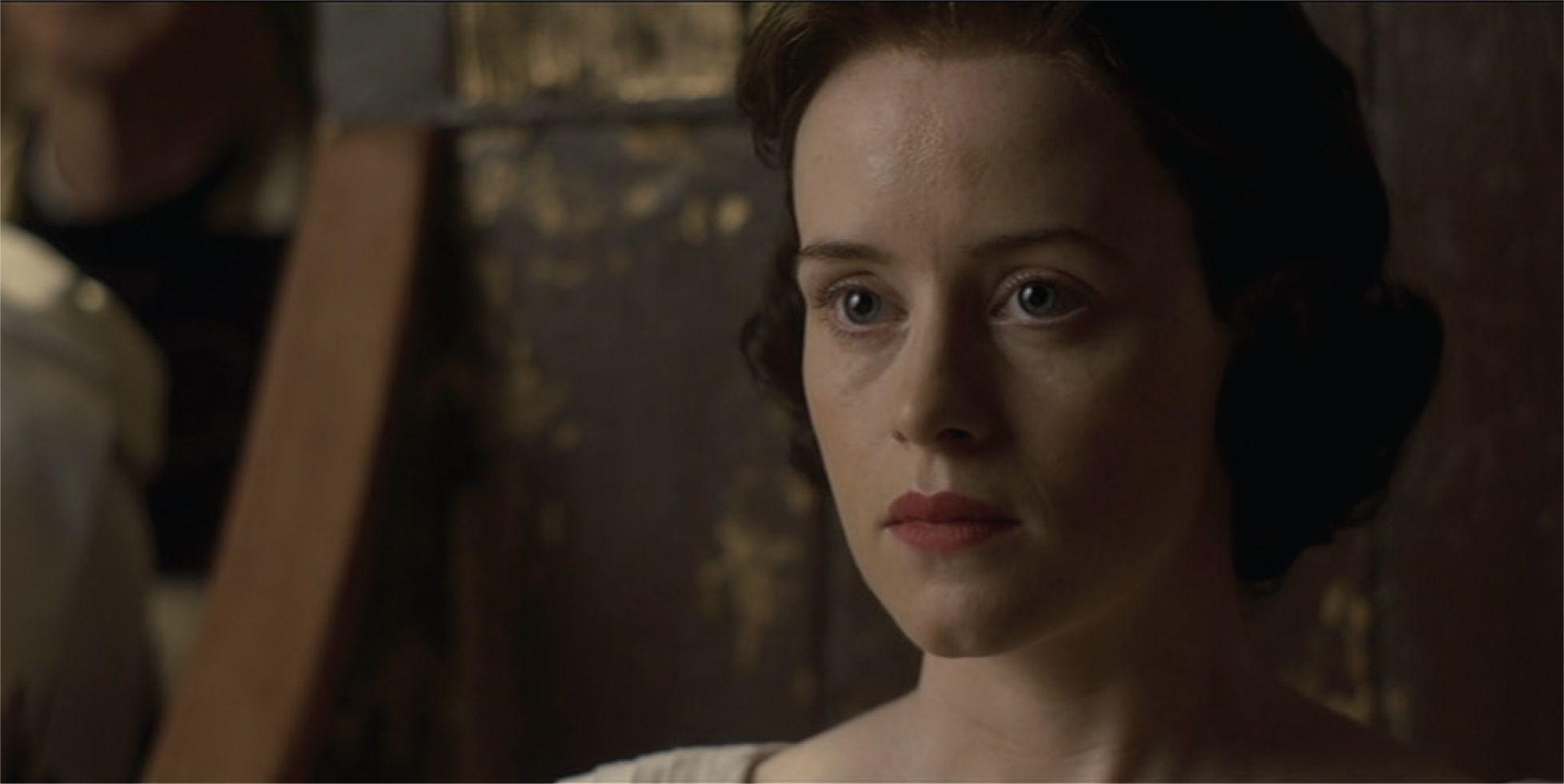
Figure 7
Elizabeth Mountbatten becomes the Queen. Source: The Crown (‘Smoke and Mirrors’, 1:5).
The resulting sequence embodies what Erll identifies as memory’s fundamental mobility: ‘Memories do not hold still; on the contrary, they seem to be constituted first of all through movement’.53 This amalgamation travels from sacred architectural space through digital modelling software into televisual representation and finally into viewers’ mental landscapes as ‘authentic’ historical environment. Erll situates prosthetic memory54 – memory acquired through media rather than lived experience – within a broader framework of transcultural and mediated memory studies, where memory circulates through media forms that travel across cultural boundaries. The Crown’s relationship to prosthetic memory is not passive: it actively interrogates the conditions under which prosthetic memory of the 1953 Coronation was produced, adapts them through digital fabrication and in doing so, generates new prosthetic memories that carry the traces of both the original mediation and its digital transformation.
The Crown’s memory work operates as a form of media archaeology. The series practices remediation by reconstructing 1950s and 1960s television broadcasts as diegetic content, the footage that characters watch on their television screens within the show’s diegesis. To create this period broadcast content, The Crown deploys original archival footage alongside newly shot material that is digitally aged and distressed to mimic the material traces of mid-century television technology,55 artificially introducing visual signatures – grain, flicker, scratches, resolution degradation – that signal ‘pastness’, representing not simply historical events but the mediated experience of royal tours and ceremonies as they appeared on analogue television. The series further complicates this through compositing techniques that insert Claire Foy, as Queen Elizabeth II, directly into authentic period footage, blurring the boundary between document and reconstruction. In later episodes this logic is turned on the show itself: when the older Elizabeth (Imelda Staunton) remembers the launch of Britannia (‘Queen Victoria Syndrome’, 5:1), Foy reappears in a newly shot sequence deliberately styled as 1950s newsreel. The Crown applies its own distressing and ageing techniques to its own earlier protagonist, rendering her indistinguishable from the archival material it reconstructs elsewhere. The younger Elizabeth is not retrieved from old footage; she is manufactured as archival footage.
‘The archive footage used in the show informed us on how things ended up looking, especially the royal wedding’, Turner notes56 (Figure 5) Soho-based Molinare worked with One of Us to create bespoke archive sequences, taking pristine digital footage all the way back to projected 16mm film newsreels. The series does not reconstruct historical events; it archaeologically reconstructs the texture and grain of historical media itself. By making new footage look archival, The Crown collapses the distinction between primary source and dramatic interpretation, treating the BBC’s original broadcast not as a transparent window onto the event but as a mediating artefact in its own right.
The deliberate ageing and distressing of newly shot footage reveals what Sturken57 theorises as the entanglement of cultural and technological memory. The grain, flicker and tonal limitations of 1953 broadcast technology become aesthetic markers that signal ‘pastness’ and ‘authenticity’ to contemporary viewers, even when digitally simulated rather than materially inherited (Figure 8). These visual signatures function as what Sturken calls ‘memory objects’58, material traces that authenticate historical claims while simultaneously revealing memory’s technological contingency. By working with and through the materiality of obsolete media forms and formats, The Crown makes visible (even as it reproduces) the processes by which historical memory becomes televisual.
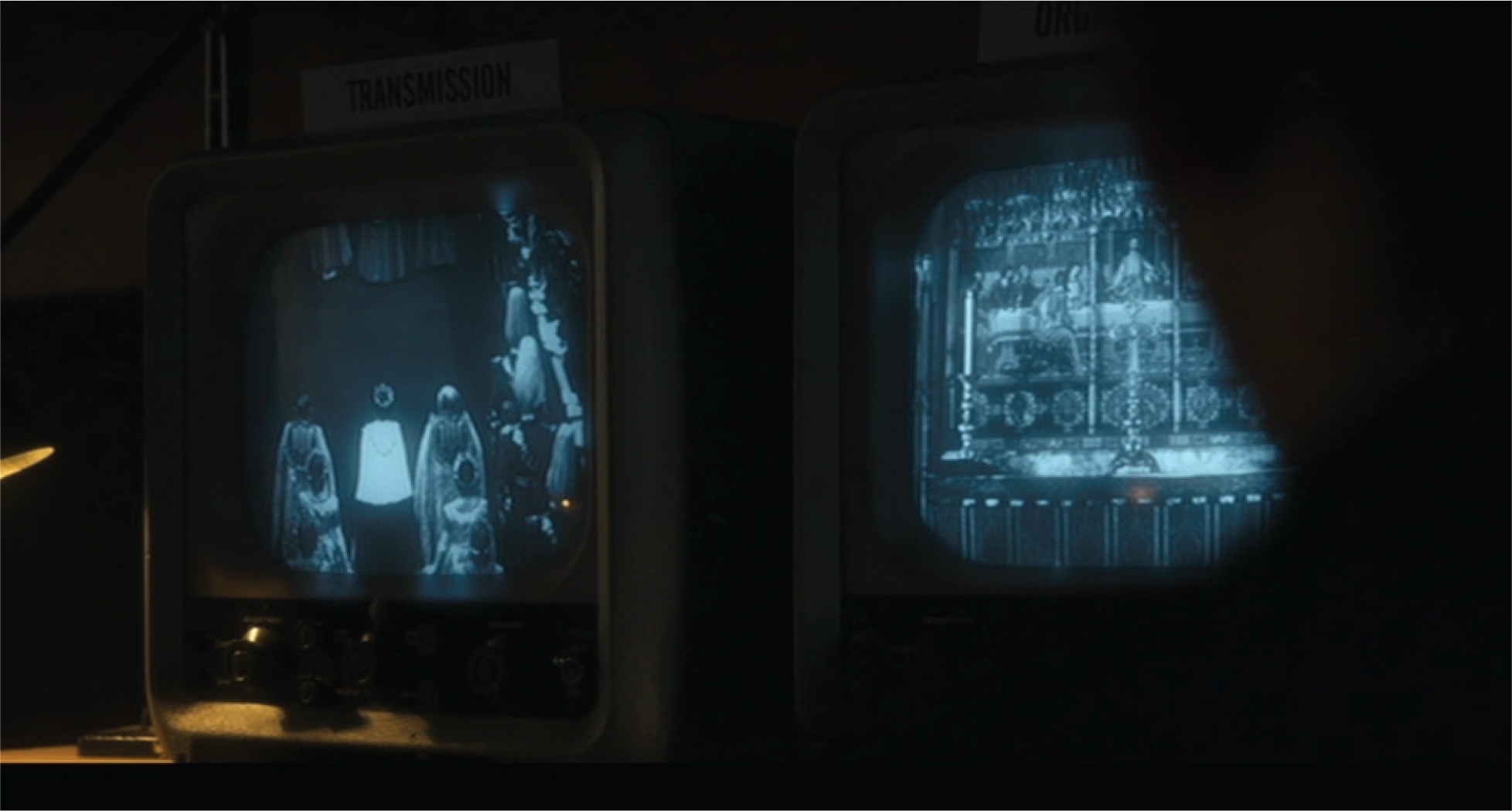
Figure 8
Replicating the image, ageing the TV image. Source: The Crown (‘Smoke and Mirrors’, 1:5).
The ageing process in The Crown carries particular ideological weight. Royal historians and cultural commentators have accused the drama of fabricating history behind a veneer of authenticity; the deliberate ageing of footage constitutes a visual counter-argument inscribed in the image itself. Rendering newly shot material indistinguishable from archival sources, the series performs documentary legitimacy at the level of the pixel. Yet this performance reveals its own constitutive paradox: the most sophisticated digital technology available is deployed to simulate analogue imperfection. The grain is not found but manufactured; the flicker is not material but machinic. This loop – digital technology producing the aesthetic signatures of pre-digital media to authenticate a digital reconstruction of the past – is inflected in The Crown by the specific conditions of its reception: because the series’ historical claims are so publicly contested, the materiality of pastness functions simultaneously as aesthetic effect and epistemological argument, inviting viewers to read reconstruction as recovery and artifice as authenticity.
The series essentially creates ‘synthetic archives’, images that function as historical evidence despite being contemporary constructions. A striking example occurs in the recreation of the Queen’s first Christmas broadcast from Sandringham in 1957 (Figure 9) (‘Marionettes’, 2:5). The scene meticulously replicates the BBC’s production apparatus and the rituals of national life that surrounded this moment in broadcasting history (Figure 10). The cameras, lighting rigs and even the nervous energy of technicians are reconstructed to evoke not merely the event itself but a mediation of it; how the live broadcast was captured, transmitted and received by millions of viewers. This is historiography focused not on the monarchical body but on the technological apparatus that made that body nationally visible.
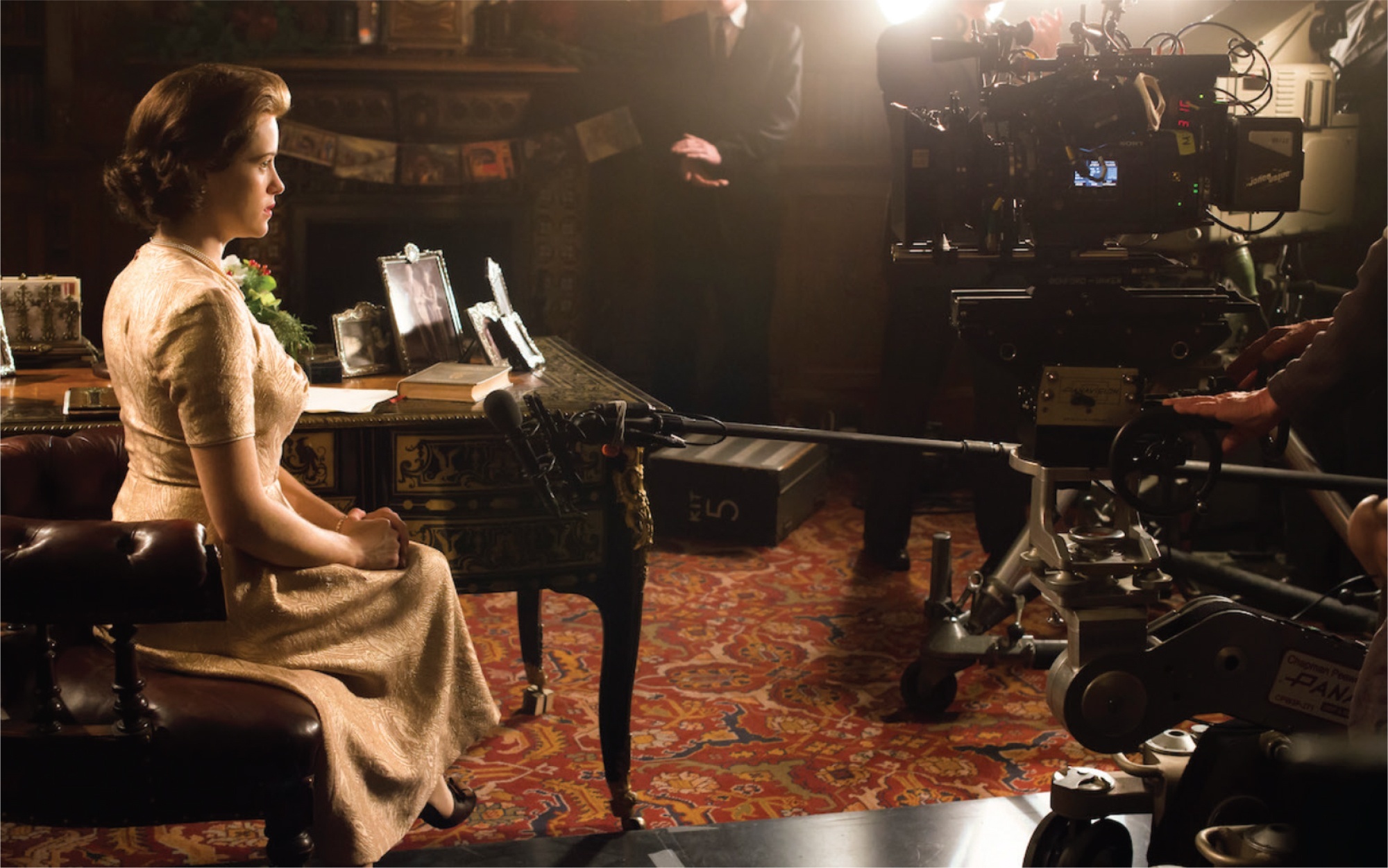
Figure 9
Claire Foy as Queen Elizabeth II, first Christmas TV broadcast. Source: The Crown (‘Marionettes’, 2:5).
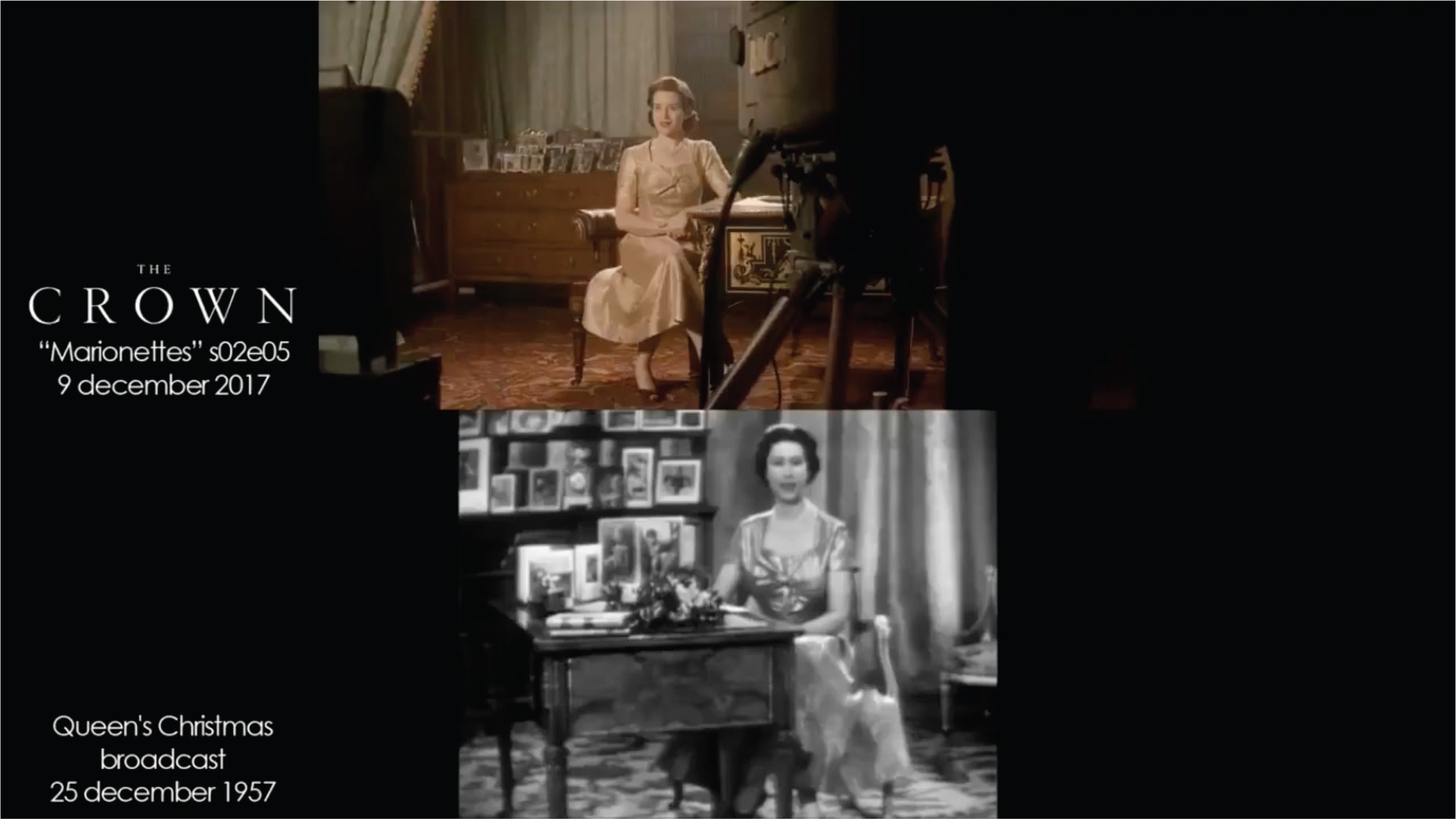
Figure 10
Queen Elizabeth II and Claire Foy – The Christmas TV Broadcast 1957 and 2017. Source: https://www.youtube.com/watch?v=20cB9uqTk70.
The Crown also foregrounds the television technology itself within the TV frame: period-accurate TV sets that carry the mediated monarch into British homes, including the royal palaces: from news of the various royal tours to the vox pop reflecting popular sympathy for Margaret (Vanessa Kirby) to marry Peter Townsend (Ben Miles) (‘Pride and Joy’, 1:7); from the ITN Impact interview with Robin Day (Tim Steed) probing Lord Altrincham (John Heffernan) on the monarchy’s need to modernise (‘Marionettes’, 2:5) to the family gathering to watch the moon landing (‘Moondust’, 3:7) and Charles’ (played by Josh O’Connor) 1969 investiture as Prince of Wales (‘Tywysog Cymru’, 3:6). History appears doubly mediated through analogue technologies that are now obsolete and, for some contemporary viewers, unfamiliar relics of a recent past that others still remember. The series gives visibility to a rapidly disappearing material culture – Bakelite radios, bulky wooden cabinets, cathode ray tubes – along with an entire ecosystem of technological practice: the TV rental shop below the dentist’s office where Lord Altrincham visits, when the rental model made television access a marker of class aspiration.
The older television sets function as both technological apparatus and domestic furniture: small convex cathode ray tube screens (10–17 inches) producing grainy black-and-white images prone to interference and ‘snow’; physical dials controlling a handful of channels; antennas requiring constant manual adjustment. The royal family arrange furniture around the television, gathering to watch the Impact interview (2:5) or the unveiling of Winston Churchill’s (played by John Lithgow) 80th birthday portrait (‘Assassins’, 1:9). The TV set’s occasional failure – as when the Queen Mother (Victoria Hamilton) strikes the malfunctioning rental television (1:9), or when Prince William (Senan West) helps his grandmother upgrade from analogue to satellite (‘The Way Ahead’, 5:5) – is, in Ernst’s sense, the moment when the medium’s material conditions become briefly legible, the technological apparatus asserting itself against the transparency it otherwise maintains. Embedding old media within the digital frame reveals a sedimented history of television technology itself, not as comic nostalgia but as the frustrating mundanity of a quotidian object.
This sedimented history is also, for the characters who inhabit it, a history of experience. In ‘Dear Mrs. Kennedy’ (2:8), Elizabeth watches the televised aftermath of the Kennedy assassination, with Jackie Kennedy (Jodi Balfour) descending from Air Force One still wearing the pink suit, accompanying her husband’s coffin. As Barbie Zelizer argues, the assassination was ‘a critical incident for the US media’, the moment that ‘called for the rapid relay of information during a time of crisis’, but also ‘legitimated televised journalism as a mediator of national public experience’.59 The Crown reconstructs not the distant event but the broadcast of its aftermath, and then, crucially, the experience of watching it at home. What Elizabeth recognises is a scene of private identification: Jackie’s simultaneous vulnerability and political composure, the impossible performance of grief as dignity, a position she herself knows only too well. In ‘Moondust’ (3:7), Prince Philip (Tobias Menzies) watches the 1969 moon landing, television bearing witness to a world-historical technological achievement,60 but experienced in The Crown as private reckoning: watching other men make history, Philip confronts what he has made of his own life. In both sequences, history arrives on screen and is then felt, internalised, measured against the private cost of public duty: both Elizabeth and Philip knowing, more than most, the cost of living inside historical events.
This attention to material detail creates productive ironies. We watch in high definition as characters struggle with low-resolution images; we stream seamlessly on Netflix while witnessing the precarity of broadcast reception. The Crown uses contemporary media’s transparency to make visible the opacity of historical media. When Elizabeth II watches her visit to Belfast on a temperamental screen (‘Gelignite’, 1:6), the moment becomes doubly mediated: we witness her watching herself being watched by millions, through the technology that shaped what counts as historical presence – foregrounding how television did not merely transmit royal events but constituted them as a specific kind of public event, experienced through material constraints.
By recreating these conditions, The Crown performs media archaeology, excavating not just what was watched but how watching occurred: the bodily practices, spatial arrangements and technological frustrations that shaped televisual experience. By staging the history of television as a succession of material configurations, each conditioning what could be known and seen, The Crown implicitly positions Netflix’s own configuration as the latest – and most capable – chapter in that history.
Post-production was handled by Molinare, who at Netflix’s request worked with uncompressed 4K, preserving every pixel value for grading and VFX mastering. ‘Having discussed it with Netflix’, explains Richard Wilding, general manager of technology at Molinare, ‘we decided that this was the best way to preserve the original shot content and to keep everything that the camera captured’.61 Preserving The Crown in uncompressed 4K with separate ungraded masters represents what Ernst would recognise as an archaeological approach to media memory, one privileging technical substrate over narrative content. The ungraded camera-native files function as what Ernst terms ‘cold’ memory62, raw data awaiting future activation. Unlike graded episodes (‘warm’ memory, already interpreted for consumption), the uncompressed 4K preserves colour information beyond current display capabilities. Netflix’s substantial investment in storage infrastructure – high-speed Isilon clusters, latest-generation Flame and Baselight systems – makes visible memory’s material substrate. Cost is not incidental but constitutive of preservation itself.
The implications embody what Ernst calls ‘technological a priori’63, the structural preconditions embedded in technical systems that shape what future cultures will be able to think, see and represent. Netflix’s preservation decision is not merely a storage protocol but a wager on future technological capability, banking on systems yet to exist to unlock latent potentials currently beyond display or interpretation. As Wilding notes, ‘modern cameras capture more than can readily be displayed with current technology’.64 Netflix practises what might be termed speculative memory: not nostalgia – a backward orientation toward a lost past – but anticipation. This forward orientation is toward an as-yet-unrealised future in which AI systems, enhanced display technologies or unimagined processing tools will regrade and reactivate the image in ways we cannot presently conceive. Where nostalgia mourns what has been lost, speculative memory banks on what has not yet been found, inscribing more than can currently be read.
This is ‘media time’ in Ernst’s sense:65 temporality structured not by human remembrance but by storage protocols, compression standards and deferred technological redemption. Netflix archives not merely The Crown’s audiovisual textures but the technical conditions of their possibility. This is memory without a subject, pure machinic inscription awaiting reactivation by technologies whose nature cannot currently be specified. Where the BBC preserved the 1953 Coronation as a completed cultural artefact, Netflix archives The Crown as a technical promise to a future it cannot predict, positioning itself not as custodian of an established memory tradition, but as the platform through which televisual memory will be reactivated and re-experienced by generations yet to come.
6 Conclusion: Critical Intervention
This article has argued that prestige streaming dramas like The Crown operate as media archaeology on two simultaneous levels, through which Netflix positions itself as the latest technological successor in an ongoing history of televisual memory production. At the textual level, the series stages the history of broadcasting technology as itself constitutive of historical consciousness – period-accurate television sets, reconstructed BBC production apparatus, attention to how watching occurred – making television’s centrality to collective memory-making a self-aware and recurring preoccupation. At the technical level, Netflix’s deployment of digital production technologies – VFX fabrication, digital ageing, uncompressed archival preservation – acknowledges, interrogates and transforms the prosthetic memory produced by the historical broadcasts it remediates. Both registers together constitute Netflix’s claim to cultural authority as a memory institution. The BBC’s 1953 Coronation broadcast and Netflix’s Crown are not merely analogous moments but structurally connected episodes in a single, discontinuous history of television as a memory machine, each platform asserting cultural authority through the demonstration of new technological capacity.
Media form does not just reflect memory politics: it is memory politics. How Netflix technologically processes, transmits and defines television within its audiovisual practices constitutes a form of historiography as powerful as any narrative content. Understanding how the invisible technical operations of a streaming platform both inherit and transform the conditions under which historical memory is produced is, this article has argued, one of the most urgent tasks facing television studies in the streaming era.
Notes
[1] Janet McCabe, “Awakening Contaminated Lands: (Re)mediated Landscapes as Transcultural TV Memory Work, a case study of Sky/HBO miniseries, Chernobyl (2019)”, Critical Studies in Television 19, no. 3 (2024): 332–351; Janet McCabe. “Unseen Particles in Time: Co-producing Transcultural Memory as a Discourse of TV Legitimacy within the Sky/HBO Miniseries TV event, Chernobyl (2019)”, in TV Drama in the Multiplatform Age: Transnational Coproduction and Cultural Specificity, eds. Trisha Dunleavy and Elke Weissmann (London: Palgrave Macmillan, 2023): 141–164.
[2] Andreas Huyssen. Present Pasts: Urban Palimpsests and the Politics of Memory (Stanford: Stanford University Press, 2003).
[3] Walter Benjamin, “Thesis on the Philosophy of History (1940)”, in Illuminations: Essay and reflections, ed. Hannah Arendt, trans. by Harry Zohn (New York: Schocken Books, 2007), 253–264.
[4] Kate Samuelson, “How The Crown Uses Real History to Make Drama”, Time (4 November 2016) https://time.com/4542526/the-crown-netflix-queen-elizabeth-history/; Emily Zemler, “Here’s How The Crown Researches Its Royal Subjects”, Tudum by Netflix (12 November 2022), https://www.netflix.com/tudum/articles/the-crown-season-5-accurate; see also Renira Rampazzo Gambarato and Johannes Heuman, “Beyond Fact and Fiction: Cultural memory and transmedia ethics in Netflix’s The Crown”, European Journal of Cultural Studies 26, no. 6 (2023): 809.
[6] Gambarato and Heuman, “Beyond Fact and Fiction”, 803–821; see also Will Stanford Abbiss, “Proposing a Post-Heritage Critical Framework: The Crown, Ambiguity, and Media Self-Consciousness”, Television & New Media 21, no. 8 (2020): 825–841.
[7] See Alison Landsberg, Prosthetic Memory: The Transformation of American Remembrance in the Age of Mass Culture (New York: Columbia University Press, 2004).
[8] Wolfgang Ernst, Digital Memory and the Archive (Cambridge, MA: MIT Press, 2013); also Wolfgang Ernst, Chronopoetics: The Temporal Being and Operative of Technological Media (London: Rowman & Littlefield 2016); Wolfgang Ernst, “Media Archaeography: Method and Machine versus History and Narrative of Media”, in Media Archaeology: Approaches, Applications, and Implications, eds. Erkki Huhtamo and Jussi Parikka (Berkeley: University of California Press, 2011), 239–255.
[9] Michel Foucault, The Archaeology of Knowledge. Translated by A. M. Sheridan Smith (New York: Pantheon Books, 1972).
[11] Jay David Bolter and Richard Grusin, Remediation: Understanding New Media (Cambridge, MA: MIT Press, 1999).
[12] Marita Sturken, Tangled Memories: The Vietnam War, the AIDS Epidemic, and the Politics of Remembering (Berkeley: University of California Press, 1997).
[13] Astrid Erll, Travels in Time: Essays on Collective Memory in Motion (Oxford: Oxford University Press, 2025); Erll, Travelling Memory, 2011.
[15] Astrid Erll, “The Hidden Power of Implicit Collective Memory”, Memory, Mind & Media 1 (2022); also Astrid Erll, Memory in Culture (Basingstoke: Palgrave Macmillan Memory Studies, 2011).
[16] Ramon Labato, Netflix Nations: The Geography of Digital Distribution (New York: New York University Press, 2019).
[19] Lobato, Netflix Nations, 135–161; also Toby Miller, The Global Media Industries. 3rd Edition. (Cambridge: Polity Press, 2020); Amanda D Lotz, Portals: A Treatise on Internet-Distributed Television (Ann Arbor: University of Michigan Library/Michigan Publishing, 2017)|.
[20] Lobato, Netflix Nations; Amanda D Lotz, We Now Disrupt This Broadcast (Cambridge: MIT Press, 2018): 113–178.
[23] Roberta Pearson, “‘The Biggest Drama Commission in British Television History’: Netflix, The Crown and the UK Television Ecosystem”, in A European Television Fiction Renaissance: Premium Production Models and Transnational Circulation, eds. Luca Barra and Massimo Scaglioni (London: Routledge, 2021): 86–100.
[24] Bex Palmer, “How The Crown Got Made”, Backstage (25 June 2021), https://www.backstage.com/uk/magazine/article/how-the-crown-got-made-73552; Susannah Guthrie, ‘The Crown: Netflix unveils the most expensive TV show ever made,’ The Daily Beast (28 September 2016).
[25] Lords Select Committee (Communications), “Public service broadcasting: as vital as ever”, Chapter 3: TV production (October 2019): 149, https://publications.parliament.uk/pa/ld201919/ldselect/ldcomuni/16/1606.htm.
[27] Matt Hills, “Black Mirror as a Netflix Original: Program Based ‘Overflow’ and the Multidiscursive Forms of Transatlantic TV Fandom”, in Transatlantic Television Drama, eds. Michele Hilmes, Matt Hills and Roberto Pearson (New York: Oxford University Press, 2019): 213–236.
[28] Ana Garcia Sancho, “The Crown’s impact on young Britons and the monarchy”, Meer (4 September 2023) https://www.meer.com/en/74647-the-crowns-impact-on-young-britons-and-the-monarchy.s.
[29] Elinor Evans, “Netflix’s The Crown: the Real History behind the Royal Drama”, History Extra (14 December 2023), https://www.historyextra.com/period/20th-century/real-history-netflix-the-crown-series-queen-elizabeth-prince-philip-charles-camilla-what-really-happened/.
[30] Hugo Vickers, “Is The Crown Factually Correct? Royal Historian Reveals The Truth”, Tatler (15 December 2023), https://www.tatler.com/video/watch/is-the-crown-factually-correct-royal-historian-reveals-the-truth.
[31] Simon Jenkins, “The Crown’s fake history is as corrosive as fake news”, The Guardian (16 November 2020), https://www.theguardian.com/commentisfree/2020/nov/16/the-crown-fake-history-news-tv-series-royal-family-artistic-licence.
[35] Astrid Erll, “Literature, Film and the Mediality of Cultural Memory”, in A Companion to Cultural Memory Studies, eds. Astrid Erll and Ansgar Nünning (Berlin: De Gruyter, 2010): 389–398.
[40] Andreas Fickers and Andy O’Dwyer, “Reading Between the Lines: A Transnational History of the Franco-British Entente Cordiale in Post-War Television”, VIEW: Journal of European Television History and Culture 1, no. 2 (2012), 56–70, https://viewjournal.eu/articles/jethc019; Ministry of Works: coronation of HM Queen Elizabeth II, 2 June 1953.
[41] Randy Alfred, “June 2, 1953: Coronation Shown on Global Kluge TV”, Wired, 2 June, 2009, https://www.wired.com/2009/06/dayintech-0602/.
[42] Ministry of Works: coronation of HM Queen Elizabeth II, 2 June 1953; facilities on the Processional Route for BBC sound and television services, newsreel reporters, BBC observers and press photographers. National Archives Document reference: WORK 21/303. https://www.nationalarchives.gov.uk/coronations/historical-coronations-highlights/the-first-televised-coronation-part-1.
[43] The BBC Story. 1950s, https://downloads.bbc.co.uk/historyofthebbc/1950s.pdf.
[44] Daniel Dayan and Elihu Katz, Media Events: The Live Broadcasting of History (Cambridge, MA: Harvard University Press, 1992); also Nick Couldry, Media Rituals: A Critical Approach (London: Routledge, 2003).
[45] Interview with Peter Dimmock about the 1953 Coronation, 1989. From the BBC Oral History Collection, https://www.bbc.co.uk/programmes/p09pvdt9.
[47] Will Strauss, “VFX and Post-Production of The Crown”, Broadcast (25 November 2016), https://www.broadcastnow.co.uk/vfx-and-post-production-of-the-crown/5111698.article.
[59] Barbie Zelizer, Covering the Body: The Kennedy Assassination, the Media, and the Shaping of Collective Memory (Chicago: The University of Chicago, 1992): 4.