
1 Working Through Podcasting: Television (Crime) Seriality and Media Reflexivity
As many studies have pointed out, television is the medium that more than any other exhibits a pronounced self-reflexive dimension, often articulated through comedic, ironic, or subtly humorous tones. As argued by Horace M. Newcomb, Paul M. Hirsch and others, television constantly addresses the present and presupposes viewers’ ability to recognize references and engage playfully with them, functioning as a privileged site in which other media industries, narratives, and practices are observed, negotiated, and integrated into the broader media landscape.1 This reflexive capacity also extends to relatively recent media forms, including podcasting.
Over the past decade, podcasting has undergone a profound transformation, evolving from a medium largely associated with grassroots production and amateur practices into a fully mainstream cultural and industrial form.2 Recent research has also examined how podcast production workflows have become increasingly structured and professionalized within platform-driven ecosystems.3 In parallel with the consolidation of podcasting’s role, television has progressively incorporated representations of this medium into its own narratives. A growing number of television series, mostly developed for streaming platforms, have positioned podcasters at the centre of their fictional worlds. American examples include series such as And Just Like That (HBO, 2021-2025), Nobody Wants This (Netflix, 2024-today), or The Midnight Gospel (Netflix, 2020).
Within this heterogeneous landscape, one genre of television series stands out for its marked recurrence: namely, crime series revolving around (fictional) true crime podcasters. Such productions leverage the central role that the true crime genre has historically played in the development of podcasting,4 enabling television to represent its cultures and practices with effectiveness. Significantly, the first and still the most influential series to inaugurate this mode of representation is Only Murders in the Building (Hulu, 2021-today), created by Steve Martin and John Hoffman: this is a strongly self-reflexive text that engages with a specific moment in podcasting’s history, often described by scholars and critics as the medium’s ‘golden age’.5
The podcasting ecosystem represented in Only Murders in the Building is inevitably American, shaped by the S.-based production cultures, industrial structures, and genre traditions. However, following the success of this first case, a growing number of television series have adopted and reworked the same narrative pattern both in the United States and across Europe, where national productions have progressively adapted these structures to specific cultural and industrial contexts.
This paper aims to investigate the representation of podcasting in television through the analysis of three successors of Only Murders in the Building, examining how crime television narratives on fictional true crime podcasters circulate from the United States to Europe. These are Based on a True Story (Peacock, 2023), which addresses the centrality of the true crime podcast within American media culture and industries; Bodkin (Netflix, 2024), an Irish–American co-production that stages tensions between American and European media cultures through contrasting production practices and narrative approaches; and Costanza (Raiuno, RaiPlay, 2025-today), an Italian PBS series that illustrates how an originally American narrative model (the true crime podcaster as protagonist) is reconfigured to align with local rhythms, institutional frameworks, and cultural sensibilities, refracting the broader reception of podcasts in Italy.
Methodologically, the article adopts a comparative textual analysis informed by media industry studies and cultural studies.6 The three series selected serve as useful case studies, as they share a common narrative premise – the presence of fictional true crime podcasters at the center of crime storytelling – while representing different stages in the remediation and progressive integration of podcasting within contemporary television. Examined together, they offer insight into how contemporary television negotiates its role within a convergent media environment, foregrounding the tensions between processes of Americanisation and local cultural and industrial contexts,7 as well as the central role played by platforms in shaping these dynamics. At the same time, these cases help clarify the role assumed by comic and satirical registers in podcast-centered crime narratives, raising the question of what these tonal shifts reveal about television and podcasting as media forms.
2 The ‘American’ Medium: True Crime Podcasting in Based on a True Story
In 2006, a character of the sitcom 30 Rock (NBC, 2006–2013) claimed that ‘more than jazz, or musical theatre, or morbid obesity, television is the true American art form.’8 American television comedy has long reflected upon the medium itself and on the entertainment industry through parody and self-irony, following the double path of celebrating television and media culture while simultaneously questioning it, both in its textual forms and in its production routines.9 A few years later, the dark comedy Based on a True Story (Peacock, 2023-2024) opens with a similar humorous hyperbole, which at the same time questions and expands 30 Rock’s statement: ‘the great American art form isn’t music, or film, or television. The great American art form is murder. We watch it, we celebrate it, we obsess over it, and we commit it’.10 This line is delivered by the host of a podcast being listened to by one of the protagonists, functioning as a meta-commentary on the success of true crime storytelling and of the media platforms that circulate it. The series indeed parodies the obsession with a relatively recent form of cultural production and consumption, while also acknowledging its centrality within the U.S. media landscape.
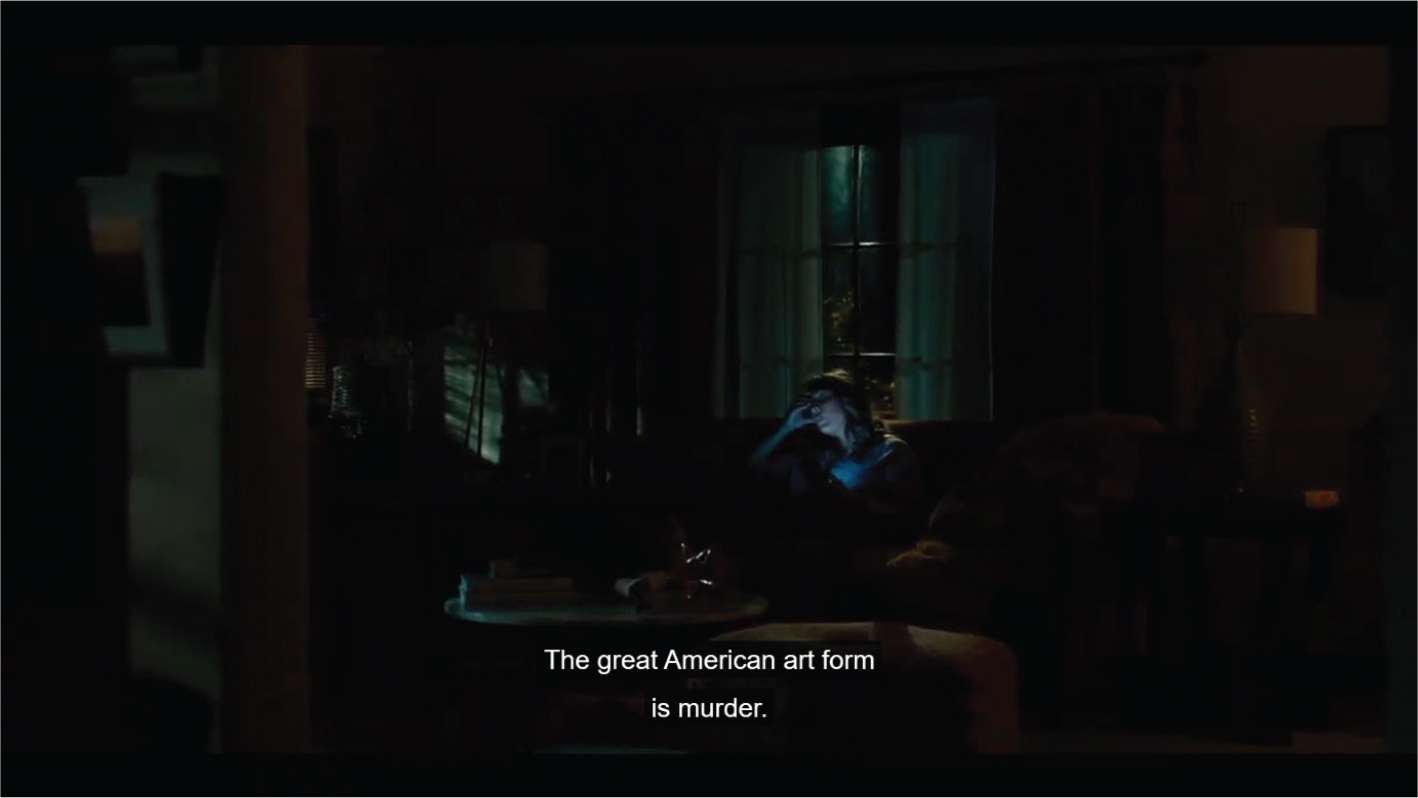
Figure 1
Screengrab from Based on a True Story, ‘The Great American Art Form’ (Peacock, 2024), 1:1, minute 11: 23.
Based on a True Story is therefore the ideal starting point for this analysis: it establishes and reinforces the characteristics of true crime podcasting as a practice that has emerged from the American context, being the first reply to Only Murders in the Building in its triangulation OF comedy, mystery and media reflexivity. However, it abandons the light-hearted and cozy atmospheres of the Hulu series in favour of a more explicit and unabashed social satire which also accounts for its limited success, ultimately leading to its cancellation after two seasons and sixteen episodes11. In the plot, a troubled Los Angeles couple, Ava (Kaley Cuoco), an avid podcast listener, and Nathan (Chris Messina), encounters Matt, a plumber who is in fact the West Side Ripper, a serial killer terrorising the local community. Instead of reporting Matt to the authorities, the couple decides to involve him in the creation of a true crime podcast about his own murders, taking advantage of his first-hand take on the events.
Through the lens of dark comedy and satiric hyperbole, the series highlights the dependence of entertainment on criminal and gruesome events, whose narrativisation and commercialisation constitute the very source of its success. Matt increasingly assumes the role of a ‘producer’ of the podcast, suggesting the title (predictably, Based on a True Story) and even the use of his personal cut of the episodes, which he deems more authentic than that of his collaborators. He also speaks of protecting his ‘brand,’ accusing the couple of treating the product ‘like every other dead white girl podcast.’ The satire of this product and its social practices goes even further when Matt suggests ending the podcast with the rhetorical question ‘who’s next?’12 He then insists on the need for ‘new fresh content,’ which can only be provided by new murders, committed of course by himself. The serialisation of the podcast, and of the Peacock series itself, therefore, mirrors the serialisation of the killings. Significantly, this narrative turning point occurs in the two episodes set during CrimeCon in Las Vegas, where true crime is celebrated and represented as fully integrated into the American entertainment industry. By evoking ComicCon and similar conventions, the series depicts a booming multimedia environment in which tragedy and pain are commodified and repackaged for entertainment purposes, where victims both are commercially exploited in their suffering and become influencers thanks to their newfound popularity, all in the service of television news and talks shows, marketing and franchising strategies, and ultimately internet fan cultures.13
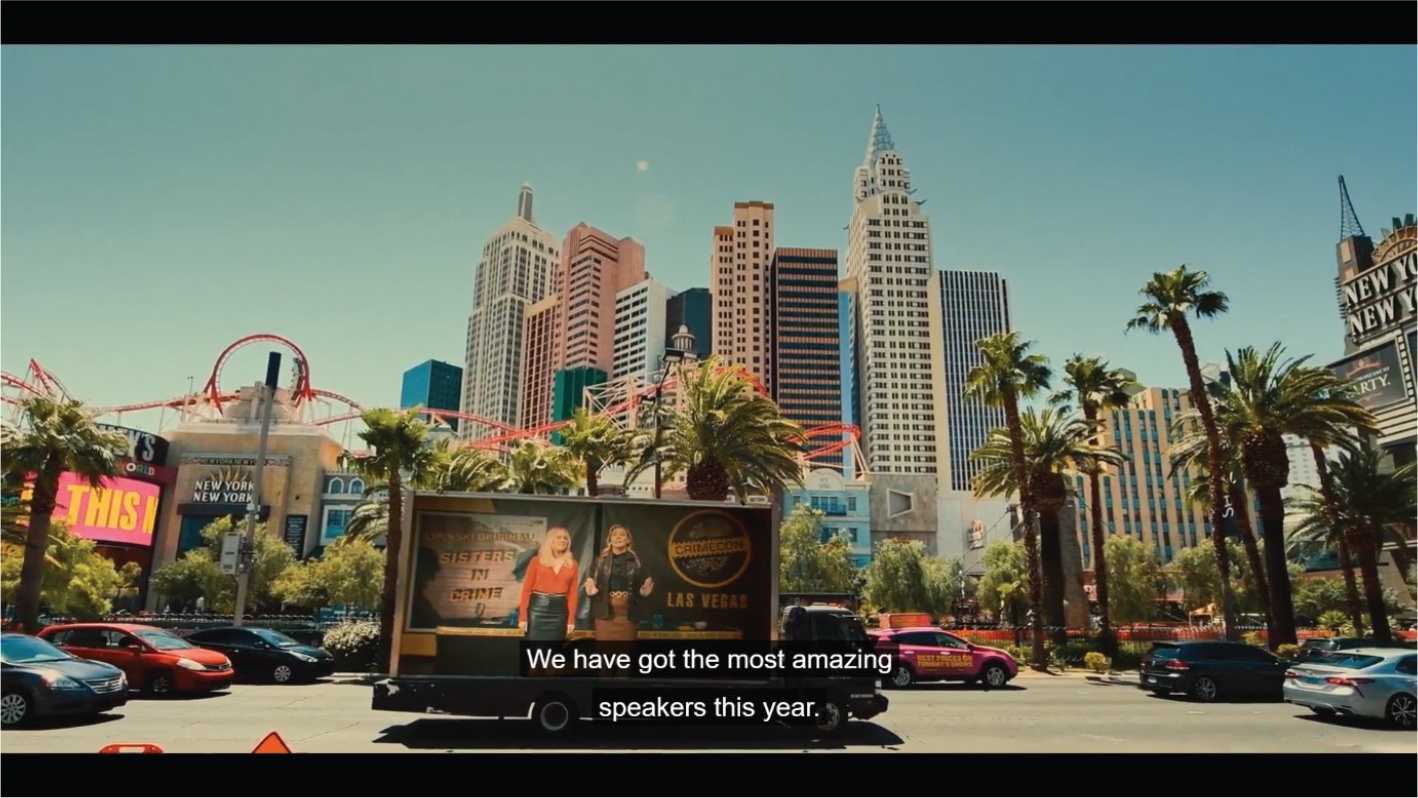
Figure 2
Screengrab from Based on a True Story, ‘The Survivor’ (Peacock 2023), 1: 4, minute 0: 19.
Therefore, while Based on a True Story inflates and celebrates the importance of true crime podcasting in the American media diet, it simultaneously denounces it. Together with the more subtle Only Murders in the Building, the series emerges as a localised reflection on a medium still perceived as distinctly American, pointing to its promotional tics, ethical dilemmas, and distortions of collective life. In doing so, it provides both the audience and the industry itself with tools not only for discussing the genre, but also for deconstructing it, a path that will be further explored by other fictional series in other parts of the world.
3 True Crime Across Cultures: Bodkin and Transnational Podcasting
An emblematic example that thematizes this transition – from the self-reflexive deconstruction of true crime podcasting in American series to its reinterpretation in other media cultures – is Bodkin, an Irish American co-production involving Higher Ground Productions (founded by Michelle and Barack Obama), wiip, and the Irish company Wild Atlantic Pictures, and distributed by Netflix – a configuration that already reflects the transnational dynamics at the core of the project. The story follows Dove Maloney, an Irish journalist working for The Guardian, who – after a professional scandal that forces her to leave London – is assigned to collaborate with the American podcaster Gilbert Power during his investigation for a true crime podcast. Their inquiry takes place in the small Irish town of Bodkin and centres on the disappearance of three people twenty-five years earlier. Through this pairing of characters and perspectives, the series articulates a deeply reflexive commentary.
The first level at which this metanarrative reflection is expressed relates to the media and industrial context itself, and to the conflictual efforts through which podcasting seeks to integrate within it. In the series, this dynamic is symbolically embodied in the uneasy relationship – and the ongoing attempt to negotiate common ground – between traditional journalism, represented by Dove Maloney, and investigative podcasting, embodied by Gilbert Power. Significantly, this negotiation unfolds within the true crime genre, a deliberately ambiguous terrain in which the boundaries between investigative reporting and sensationalist storytelling remain blurred and are repeatedly contested throughout the series.
In fact, on the one hand, in the series podcasting is framed as a crucial asset for sustaining contemporary journalism, a position explicitly articulated in the first episode by Dove’s editor (‘true crime is a big business for us’14). On the other hand, this integration proves far from smooth.15 The series entrusts a critical stance to Dove herself, who consistently draws a line between journalistic practice and podcast production.
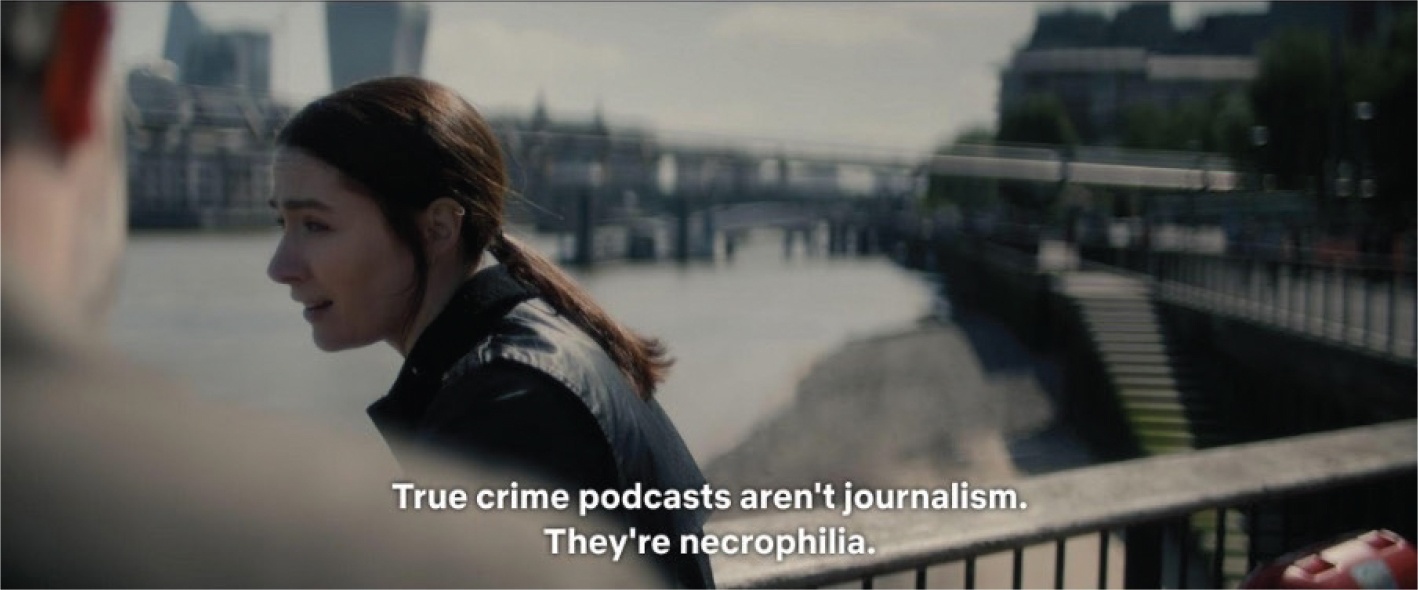
Figure 3
Screengrab from Bodkin, ‘One True Mystery’ (Netflix, 2024), 1:1, minute 3:44.
While traditional journalism is portrayed as struggling (often awkwardly) between innovation and the preservation of professional standards, the productive context of podcasting depicted in Bodkin is equally far from celebratory. Although the medium is acknowledged as economically significant, it is also shown to be marked by instability and precarity. Gilbert embodies a generation of podcasters whose early success has failed to translate into long-term sustainability. Having invested his resources in podcasting ventures that attract little to no audience, he becomes emblematic of a media system navigating a post-boom phase.16
The contrast between traditional journalism and investigative podcasting also embodies a broader cultural opposition between European and American productive cultures. Podcasting is consistently framed as a profoundly American medium, and its arrival in a European context is depicted as awkward and intrusive. The tension between American podcasting practices and European journalistic traditions is articulated through a sharp satirical portrayal of the American podcaster. Gilbert is depicted as superficial, performatively empathetic yet lacking authenticity, repeatedly proclaiming emotional engagement while ultimately pursuing little more than ‘a good story to tell’. His gaze toward Europe – and Ireland in particular – is marked by a naïve and exoticising enthusiasm that borders on caricature, making his fascination with the local landscape almost absurd.
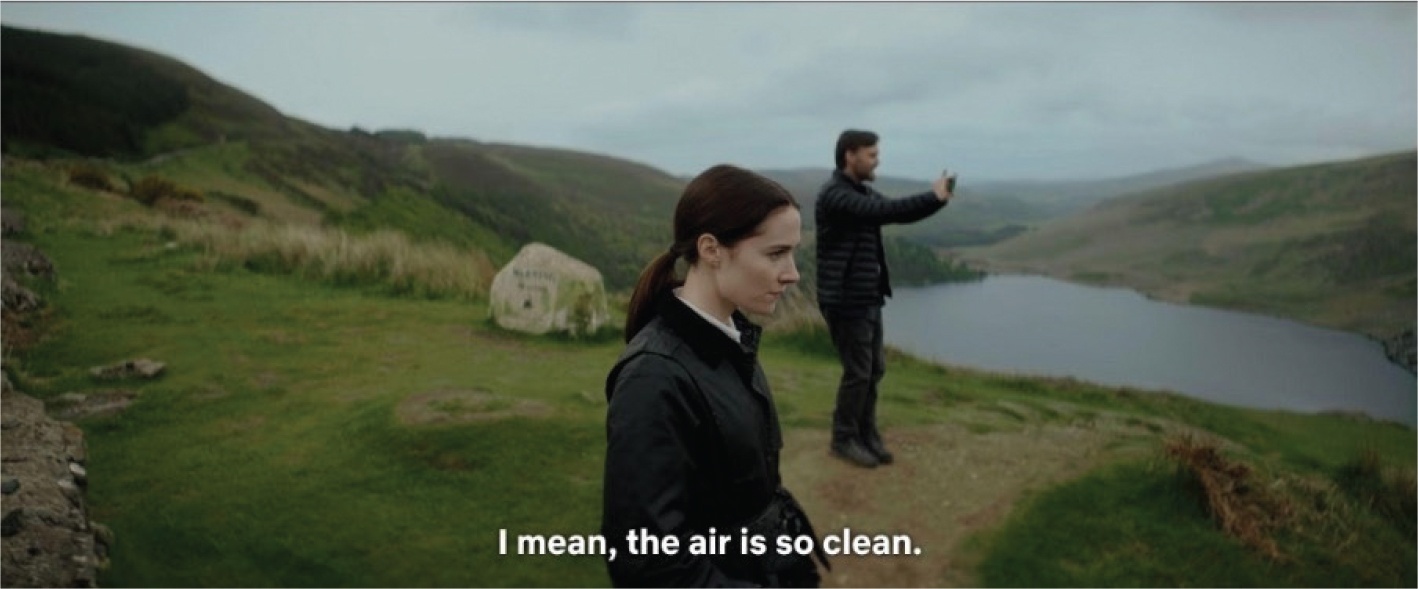
Figure 4
Screengrab from Bodkin, ‘One True Mystery’ (Netflix, 2024), 1:1, minute 8:22.
The problematic nature of Gilbert’s approach to the local context is further underscored by the response of the local community, which actively works to deflate the myth of podcasting. Contrary to Gilbert’s expectations, the inhabitants of Bodkin prove reluctant to speak and repeatedly question the relevance of the project, asking whether anyone would actually listen to the podcast. Gilbert’s investigative incursion, and the American medium he represents, is ultimately perceived as a form of violence, as proved by the question posed by one of the main characters: ‘What if we don’t want a podcast made about our town?’.17
This demystification and problematisation of podcast storytelling is completed in the closing moments of the series, when Gilbert ultimately renounces the story and throws his recorder away, opting for silence over narration. This gesture, however, does not imply that his intervention left no trace. Over the course of their collaboration, a partial exchange of perspectives has taken place, leading Dove to acknowledge that, at times, stories may matter more than factual truth. The series thus gestures toward a tentative yet unresolved reconciliation between journalism and podcasting, one that nonetheless culminates in withdrawal and silence, underscoring the limits of mediation and the unresolved tensions at the heart of transnational true crime storytelling.
Bodkin does not limit its metanarrative reflection to the role of podcasting alone but also turns reflexively toward television’s own position within this media ecology. Television is presented as the medium capable of absorbing and rearticulating the languages, formats, and assumptions of newer media forms. Formally, this is made explicit through the structure of the series itself: each episode opens and closes with the introduction and conclusion of Gilbert’s podcast episode that ultimately remains unrealized. At the same time, television persists as the horizon of institutionalisation and legitimation to which podcasters aspire.
In conclusion, Bodkin explicitly foregrounds the tension between American and European media cultures staged by the co-production, without seeking a definitive resolution or convergence of practices and values. Moreover, through its sustained metanarrative engagement with podcasting and its conventions, the series relies on a platform-literate audience capable of recognising the references to the conventions and cultural imaginaries of true crime podcasting, and accustomed to moving seamlessly across media environments, from Spotify to Netflix, thereby underscoring the central role of platforms in contemporary media consumption and circulation of narrative forms.
4 A Matter of Costanza: Historical ‘Crimes’ on Italian TV
Following a path of progressive remediation, after highlighting an example that consecrates podcasting within the U.S. media context (Based on a True Story), and a second step (Bodkin) in which the medium is critically assessed through its conflictual transition into European production cultures, it remains to be examined how podcasting is reinterpreted in fully European-produced series. The best (and virtually the only) candidate for such an assessment is the Italian series Costanza (Raiuno, RaiPlay, 2025–present). Similarly to the previous cases, it places a podcaster at the centre of the story, with podcasting acting as a fundamental narrative driver, but at the same time it is sufficiently different to illustrate how true crime is ultimately adopted and adapted within a specific national context.
Produced by Rai, the Italian PSB, and Banijay Studios Italy, it tells the story of a Sicilian paleopathologist, Costanza Macallè, who wins a research fellowship at the fictional Department of Paleopathology at the University of Verona. There, guided by her emotions and imagination, she investigates a peculiar ‘cold case’ dating back to the mid-thirteenth century: the true story of Selvaggia di Staufen, the illegitimate daughter of Frederick II, Holy Roman Emperor, and wife of the fearsome warlord Ezzelino III da Romano. Following the discovery of Selvaggia’s remains at Montorio Castle (Verona), we follow Costanza through the clinical analysis of skeletons and DNA traces, as well as through her engagement with archival sources, which allows Costanza to reconstruct both the circumstances of the noblewoman’s death and life, the fate of her only daughter, Biancofiore, and the identity of the child’s father.
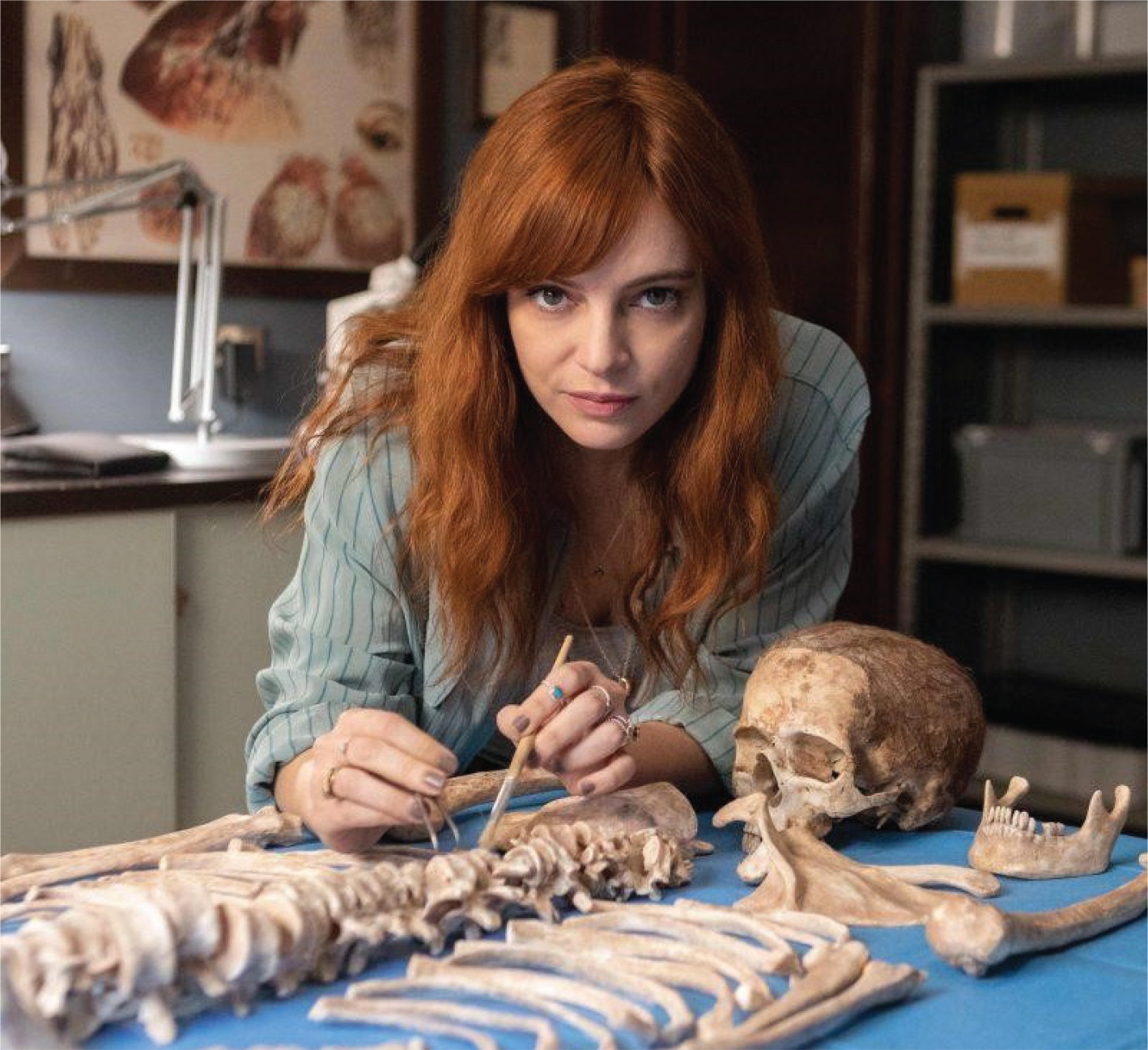
Figure 5
Costanza examining a skeleton, from Banjay’s studios promotional material for the series.
Costanza fits within the tradition of Italian television crime drama, which has increasingly featured female protagonists18 and often intertwines with romantic drama and comedy.19 Disturbing elements such as violence, escapes, and deaths are relegated to the distant medieval past, evoked through extended flashbacks that take the form of a full-fledged period drama. These sequences are narrated by Costanza’s voice-over, and in this bridge between present and past an element of novelty is introduced: namely, a podcast recorded by the scholar, which transforms historical and scientific research into a narrative genre, with its many questions becoming mysteries, and its dead ends turning into alternative versions of events.
The metatextual inclusion of podcasting is clearly inspired by American television models20 and it is an original feature of the tv series: it adapts in audiovisual form the first-person narrative of the books on which the Rai series is based, namely the novels by Alessia Gazzola where no podcast appears.21 In the series, however, Costanza’s colleague and lover, Ludovico, suggests that she turn the story of Selvaggia into a podcast, following the example of a professor from her university years, ‘a great divulgatore’22 who, ‘starting from simple bones, would tell the biography of a person and the historical context in which they had lived’, creating a story out of the broader and more complex History.23
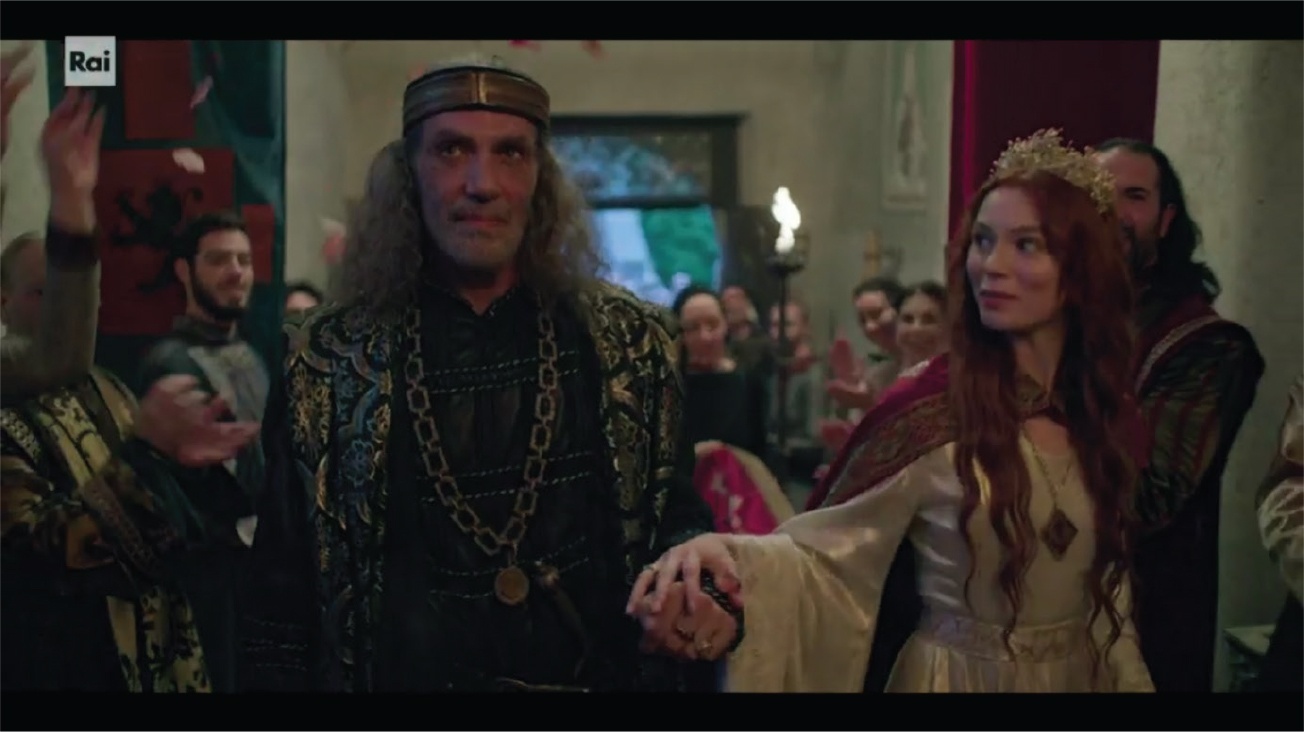
Figure 6
The marriage between Ezzelino and Selvaggia in the period segments of the series. From Costanza, ‘Episode 1’ (RaiPlay, 2025), 1:1, minute 49.33.
This dynamic is indeed an essential ingredient to understand Costanza’s remediation. Despite the consolidation of true crime podcasting in Italy, along with the development of specialized production companies and podcasts associated with individual journalists or news outlets24, the historical subplot of Costanza suggests that the inspiration came not from true crime but from the wide and cross-generational success of history podcasts in Italy25, with which the series’ broad target audience may be more familiar. Within this media and cultural context, the popularity of intermedial figures such that of university professor, medievalist and public historian Alessandro Barbero, have often catalysed media attention around podcasting, not without misunderstandings on its production routines, genres and purposes26. The idea of podcasting as something intrinsically linked to public history is therefore incorporated into the series, which takes a further step in exploring the life of subjects relegated by both academic and popular history to the margins. Indeed, from Costanza’s point of view, the true ‘crime’ does not lie in Selvaggia’s death or exile, nor in her daughter’s disappearance or her father’s fate, nor even in the role of the bloodthirsty Ezzelino. Rather, it lies in the removal of women from the historiographical canon. Costanza indeed begins her podcast by stating:
official history, as we know, has not been kind to women. It has erased their traces, removed their memory. This podcast wants to do the opposite. It wants to bring back to light what official history has cast into darkness. My name is Costanza Macallè, I am a paleopathologist. And what I begin to tell you today is the story of Selvaggia di Staufen, daughter of Frederick II of Swabia.27
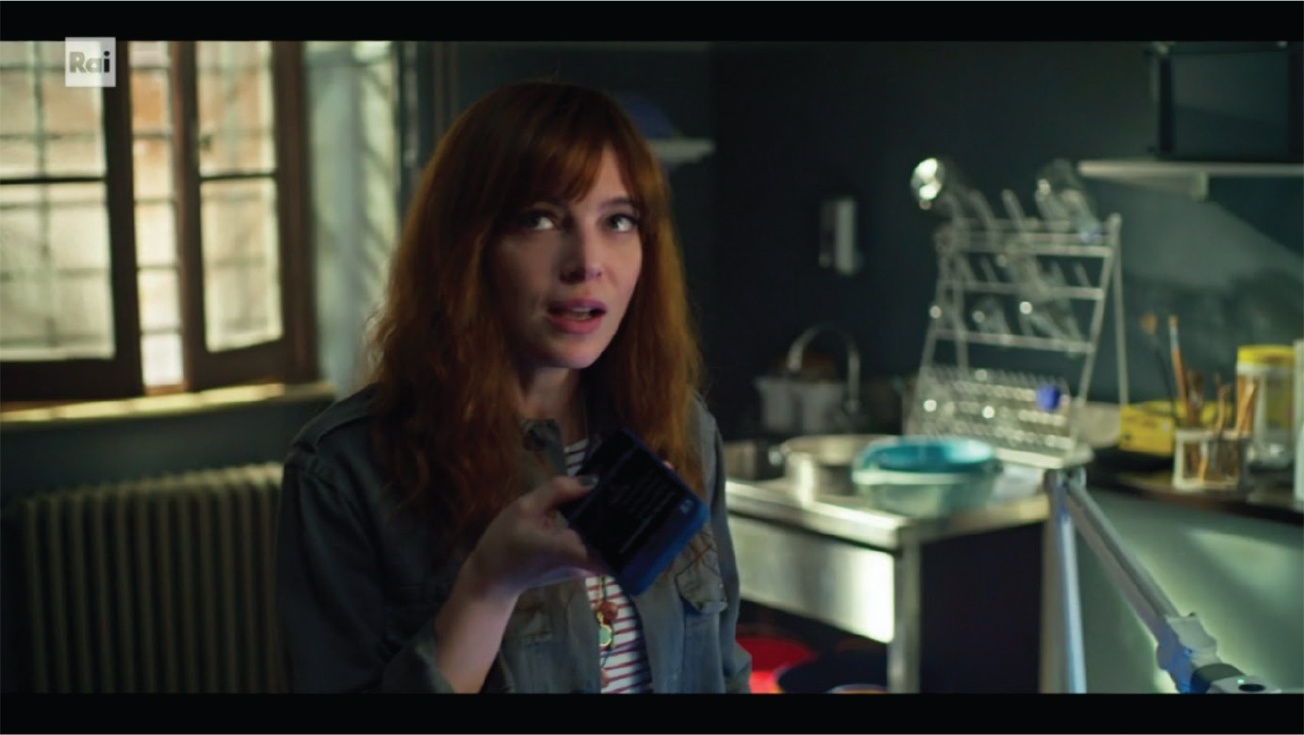
Figure 7
Costanza recording the first lines of her podcast. Screengrab from Costanza, ‘Episode 1’ (RaiPlay, 2025), 1:1, minute 52:28.
Costanza, then, begins her path as a podcaster recording voice notes on her phone, spontaneously, without a script, and uploading them without editing to a platform. This sense of ongoing amateurism, improvisation, and lack of planning is later partially mitigated by the introduction of a microphone (‘so we can move to a more professional level’) paired with a laptop.28 This stylized representation draws its inspiration from the hybrid and modular aspect of the medium, interpreted as naturally integrated into everyday work routines: an obvious and somewhat unremarkable extension of cultural work, as well as available to everyone, now pervasive, easily feasible and accessible also in Italy. The taken-for-granted nature of podcasting does not, however, make it marginal for the plot; on the contrary, it often becomes a driving force of it. When Costanza invents crucial details in her story and jumps to conclusions without empirical evidence, she is reprimanded by her scientific supervisor, since she is a university employee and any misstep on her part could jeopardize the team’s reputation and founding: thus, she must apologise to her followers.29 Conversely, when funding for the project is cut in the end, it is precisely the protest of Costanza’s fans on social media that leads to the research being financed again, permitting thus the continuation of the podcast.30
The survival of the podcast and that of the research are therefore interdependent, and the serialisation of the medium is closely tied to the unfolding of the drama across the eight episodes of the first season, and the resolution of Selvaggia and Biancofiore’s story in the last episode. Indeed, the incorporation of podcasting reflects Rai’s broader narrative and distribution choices, situated at the intersection between broadcasting and digital platforms. Firstly, the series features a prominent running plot, as opposed to other crime series such as L’Allieva (Raiuno, 2016–2020), another adaptation of Gazzola’s novels in which Alice Allevi, a postgraduate trainee in forensic medicine, investigates and solves a different crime in every episode31. Therefore, Costanza is influenced by on-demand productions such as Based of a True Story, Bodkin and others not only from a topical point of view but also from a structural one. Furthermore, while its themes and tones are adjusted to the tastes of a mainstream audience, it strongly attempts to intercept non-linear viewing practices through Rai’s streaming platform RaiPlay, where all the episodes of the series were already available before the end of their weekly broadcast on Raiuno’s prime time.32
In conclusion, the original thematic core of Only Murders in the Building is firstly reinforced in Based on a True Story in its distinctly ‘American’ traits, where the satirical degradation is the result of its consecration within the cultural mainstream. By blending dramatic and light registers, and undergoing multiple, context-specific national remediations, this trajectory firstly moves, in Bodkin, toward a dialectical deconstruction under the transnational aegis of Netflix and the confrontation with a different environment, and finally is ‘digested’ in Costanza, which playfully integrates podcasting into professional daily routines, implicitly certifying its acceptance into the local mainstream. Streaming platforms both facilitate and structure this process. They are the first to release the series here analysed and they are crucial for their international circulation: Bodkin via Netflix, while Based on a True Story via RaiPlay in Italy, for instance, and via Sky in other European countries. At the same time, the meanings of ‘podcast’ and ‘podcasting’ shift depending on local contexts: they are subject to a continuous process of adjustment and negotiation shaped by national media systems, which must account for the rooting of on-demand players, the role of commercial and public service broadcasters, the configuration of media journalism, as well as broader cultural sensibilities. In this journey from the United States to Europe, the decoding of podcasting representations depends upon an audience already familiar with podcasts and therefore capable of grasping auto- and meta-reflexive references. At the same time, as podcasts are absorbed into broader national media systems, these series attempt to introduce them to an increasingly wide and cross-sectional audience. Television, therefore, as a medium that progressively intercepts and aggregates multiple audiences through serialisation and domestication into everyday life, confirms its privileged role in negotiating the position of a new medium, in illustrating and debating its status within the cultural industries, while also functioning as a barometer of collective media consumption.
Acknowledgement
AI-assisted tools were used for language translation purposes. All analytical and argumentative content is the responsibility of the authors.
The article was conceived jointly by the authors. For attribution purposes, Diletta Cenni authored paragraphs 1 and 3, while Matteo Marinello authored paragraphs 2 and 4.
Notes
[1] Horace M. Newcomb and Paul M. Hirsch, “Television as a Cultural Forum: Implications for Research”, Quarterly Review of Film Studies 8, no. 3 (1983): 45–55; Ethan Thompson and Jason Mittell, eds., How to Watch Television. Second edition (New York: NYU Press, 2020); John Ellis, Seeing things: television in the age of uncertainty (London: I.B. Tauris, 2000).
[2] Lance Dann and Martin Spinelli, Podcasting: The Audio Media Revolution (New York: Bloomsbury, 2019); John L. Sullivan, Podcasting in a Platform Age: From an Amateur to a Professional Medium (New York: Bloomsbury, 2023); Jeremy Wade Morris, Podcasting (New York: John Wiley & Sons, 2024).
[3] Jemily Rime, Jon Francombe, Tom Collins, “How Do You Pod? A Study Revealing the Archetypal Podcast Production Workflow”, Proceedings of the ACM International Conference on Interactive Media Experiences, 22 June 2022, 11–18, https://dl.acm.org/doi/10.1145/3505284.3529977.
[4] As scholars have noted, true crime podcasts successfully rely on forms of sonic intimacy that create a strong sense of proximity between narrator and listener – one of the key reasons for the particularly strong affinity between the podcast medium and the true crime genre [Lili Paquet, “‘It’s Time to Transport Us Back to the Day of the Crime’: The Intimacy of Sound in True Crime Podcasts”, Crime Media Culture 22, no. 1 (2026).
[5] Richard Berry, “A Golden Age of Podcasting – Evaluating Serial in the Context of Podcast Histories”, Journal of Radio and Audio Media 22, no. 2 (2015): 170–178.
[6] On cultural studies of media industries: John T. Caldwell, Production Culture. Industrial Reflexivity and Critical Practice in film and Television. (Durham: Duke University Press, 2008); Vicki Mayer, Miranda J. Banks, J.T. Caldwell (eds), Production studies. Cultural Studies of Media Industries (New York: Routledge, 2009). David Hesmondhalgh, “Bourdieu, the Media and Cultural Production”, in Media, Culture & Society 28, no. 2 (2006): 211–31.
[7] Among the works that address these tensions on European tv: Jérôme Bourdon, Du service public à la télé-réalité. Une histoire culturelle des télévisions européennes 1950-2010 [From public service to reality TV. A cultural history of European television 1950–2010] (Bry-sur-Marne: INA Éditions, 2011); Luca Barra and Massimo Scaglioni, eds., A European Television Fiction Renaissance: Premium Production Models and Transnational Circulation (Oxon and New York: Routledge, 2021). On the broader socio-cultural process of Americanisation: Victoria De Grazia, Irresistible Empire: America’s Advance Through Twentieth-Century Europe (Cambridge, MA: Harvard University Press, 2009).
[9] On comedic media reflexivity: Denise Mann. Hollywood Independents: The Postwar Talent Takeover. University of Minnesota Press, 2008; Nick Marx. Sketch comedy: identity, reflexivity, and American television (Bloomington: Indiana University Press, 2019); Matteo Marinello, “Saturday Night Candidates: Comedic Brands on Saturday Night Live During the 2016 Presidential Election”, Cinergie 20 (2021): 139–151.
[11] Matthew Rudoy, “Kaley Cuoco’s Cancelled Crime Series Only Needed 1 More Season To Be Truly Great, And I’m Upset It Won’t Happen”, Screen Rant, April 18, 2025, https://screenrant.com/kaley-cuoco-based-on-a-true-story-canceled-season-3-ending-op-ed/.
[15] Existing scholarship has explored the complex and often ambivalent relationship between journalism and podcasting: Klaus Meier et al., eds., Innovation in Journalism. Comparative Research in Five European Countries (New York: Routledge, 2024); Nic Newman and Nathan Gallo, “News Podcasts and the Opportunities for Publishers”, Reuters Institute for the Study of Journalism, 2019, https://reutersinsti-tute-politics-ox-ac-uk.translate.goog/news-podcasts-and-opportunities-publishers?_x_tr_sl=en&_x_tr_tl=it&_x_tr_hl=it&_x_tr_pto=sc; Marta Perrotta, ed., Podcast in the Future of Journalism. Exploring Forms and Formats of Audio Storytelling in Digital News Media, (Rome: Roma Tre Press, 2025).
[18] Valentina Re and Arianna Vergari, Da Laura Storm a Imma Tataranni. Le investigatrici della Tv italiana [From Laura Storm to Imma Tataranni. Female detectives on Italian television] (Rome: Carocci 2026); Luana Fedele, “Female Leads in Contemporary Italian Crime Drama: Industry, Narratives and Reconfiguration of Gender in Rai Fiction (2016–21)”. Journal of Italian Cinema & Media Studies online first, 2025, https://doi.org/10.1386/jicms_00349_1.
[19] Luca Barra and Valentina Re. “Giallo! Going through the History of Italian Television Crime Drama. Intellect”, Journal of Italian Cinema & Media Studies, online first, 2025, https://doi.org/10.1386/jicms_00341_2; Milly Buonanno, Italian TV Drama and Beyond. Stories from the Soil, Stories from the Sea (Bristol: Intellect, 2012), 107–138.
[20] As noted also by tv critic and scholar Aldo Grasso, “Costanza. Giallo Sentimentale” [Costanza. Sentimental Crime], Io Donna - Corriere della sera 16 (April, 2025): 20.
[21] For the full collection of novels: Alessia Gazzola, Costanza. Questione di costanza - Costanza e buoni propositi - La costanza è un’eccezione [Costanza. A Matter of Costanza - Constancy and good intentions - Constancy is an Exception] (Milan: Longanesi 2025).
[22] From ‘divulgazione’, Italian word reserved for the public mediation and communication of scientific knowledge, literally ‘dissemination’, ‘popularisation’. All the quotations from the series are translated by the authors.
[24] As highlighted by Diletta Cenni, Voci dal buio. Podcast e true crime in Italia [Voices from the dark. Podcasts and True Crime in Italy] (Bologna: Patròn 2025); Id., Exploring the Role of the Podcast Journalist in Italy: a Production Studies Approach, in Podcast in the future of journalism. Exploring Forms and Formats of Audio Storytelling in Digital News Media, ed. Marta Perrotta (Roma: Romatre Press, 2025).
[25] Enrico Valseriati, “Clio in cuffia. Sapere storico, podcast e sfide della divulgazione. Itinerari di ricerca storica” [Clio in headphones. Historical knowledge, podcasts and the challenges of dissemination, Historical research itineraries], in Itinerari di ricerca storica 36, no. 2 (2022).
[26] Paola Brembilla, “La storia insegna. La (ri)costruzione dell’immagine pubblica di Alessandro Barbero, dal podcast ai meme” [History teaches. The (re)construction of Alessandro Barbero’s public image, from podcasts to memes] in Celebrity and Crisis. Celebrity in Crisis, eds. Roy Menarini and Sara Pesce (2026) [soon to be published]; Lucia Di Girolamo and Mariangela Palmieri, “New Frontiers for Historical Dissemination: Alessandro Barbero Between Fandom and Performativity”, Cinergie 28, 2025, 187–195.
[31] Valentina Re, “‘Quo Vadis, Baby?’: Pending Investigations into Contemporary Italian Female Detectives”, 221B, April 4, 2025, https://221bmag.com/quo-vadis-baby-pending-investigations-into-contemporary-italian-female-detectives/.