
1 Introduction. The Meta-Machine: Netflix, Nostalgia, and the Self-Aware Romcom
The opening gambit of Todas las veces que nos enamoramos (In Love All Over Again, Netflix Spain, 2023) declares generic self-awareness. As a boy and a girl walk toward each other on a university campus, a female, literary voiceover intrudes – a speech act, voicing them into being: ‘Yes, this is one of those stories where you already know what’s going to happen. Or maybe not – but you still want to watch how they get there.’ The commentary immediately self-edits, deleting the line (via an audible ‘backspace’), and continues: ‘Or maybe it’s one of those stories where you don’t know. Those are even better. Shall we begin?’ From its opening, ILAOA frames its central love story – between the source of that voice, aspiring filmmaker Irene (Georgina Amorós), and law-student-turned-actor Julio (Franco Masini) – as a consciously constructed narrative, a script in progress.
This essay’s argument is twofold. Firstly, it contends that, in playing with conceptualisations of time(s) (the titular ‘veces’) and timings – both the traditional structures of romcom storytelling and the temporal aspects of romance and dating-ILAOA performs a real-time autopsy on the romantic comedy genre. Yet, second, it maintains that while its narrative edict preaches patience and delayed gratification as a means of deepening romantic tension in a famously ‘predictable’ genre, the series’ pace quickly descends into a nostalgic lag or reset, evoking questions of nostalgia, looping, and even extinction.1 ILAOA’s cancellation in February 2024 – a quiet casualty of the platform’s ruthless metrics – ironically confirmed the series’ own thesis: that the prolonged, recursive deferral of romantic resolution, stretched across episodic form and amplified by binge consumption, can exhaust rather than sustain desire. ILAOA toys with time, yet ends up demonstrating how time, and an audience’s restlessness, can fatigue – or call time on – the romance itself.
Video 1
In Love All Over Again | Official Teaser | Netflix, Netflix, 16 January 2023. Last Access: 02/01/2026.
The romantic comedy has long been preoccupied with time: the ‘meet-cute’ that launches a timeline, the first date, the first kiss, the obstacles that delay union, the final embrace that arrests narrative flux. Yet recent years have witnessed an intensification of this temporal play, as romcoms – on streaming, especially – embrace fractured, looped, or multi-epoch structures. From the time-loop conceits of Palm Springs (Max Barbakow, 2020) and The Map of Tiny Perfect Things (Ian Samuels, 2021), both distributed by Amazon Prime Video, to the decade-spanning chronicles of One Day (Netflix, 2024) and Los años nuevos (The New Years, Movistar+, 2024), the genre increasingly asks not whether lovers will unite, but how many times they will nearly do so – and, often, at what cost to viewers’ patience. This proliferation of recursive romance coincides with a broader cultural scepticism toward heterosexual coupling, diagnosed by scholars as ‘heteropessimism’ or even ‘heteronihilism’: a stance in which traditional romantic ideals are viewed with irony, embarrassment, or exhaustion, even as they retain their gravitational pull.2 The streaming romcom, then, operates at a peculiar crossroads: tasked with resuscitating a supposedly ‘post-romantic’ genre while navigating industrial pressures that demand extended serialisation, franchise potential, and binge-ready momentum.3
ILAOA offers a privileged site for examining this crossroads. Created by Carlos Montero – architect of Élite (2018-), Netflix Spain’s flagship erotic teen romance/thriller – the series transplants the romcom into an unusually expansive temporal frame. A romantic coming-of-age story told non-linearly across eight 50-minute episodes shuttling between 2003 and 2019, it tells the story of Irene, who moves from Castellón to Madrid to study and practice film (including, specifically, romantic comedy) at the Complutense University, where she meets Julio by chance at a premiere. Their immediate connection is severed when, sharing their first kiss on an otherwise banal train journey, they are suddenly hospitalised by the traumatic 2004 Atocha train bombings (referred to as 11-M as March 11 was the date of the bombings) that killed 193 people and injured around 2,500. This tragedy haunts them thenceforth, setting a pattern of horrendous timing – break-ups, and missed opportunities – alongside interrupting past relationships (e.g. Irene’s boyfriend back in Castellón, Fer [Albert Salazar]), and friendships with Irene’s likewise film-obsessed flatmates, Jimena (Blanca Martínez) and Da (Carlos González). Across sixteen years, they re-connect (and re-part) through film shoots, festivals, and chance encounters, each reconciliation pregnant with its own undoing. From the outset, the series is steeped in this double consciousness: both a nostalgic recreation of early-2000s Madrid – complete with Nokia 3310s, a soundtrack featuring Iván Ferreiro, and the unimaginable trauma of 11-M – and a hyper-aware commentary on the very act of nostalgic recreation. ‘These two will fall in love many times, because they’ll break up many times’, the above voiceover soon continues, playing with the machinery of cinematic genre and production; however, the series purposefully tests viewer patience for romantic rapprochement and reunion.
Despite its status as a high-profile Netflix Spain production – released on Valentine’s Day 2023 and touted by film magazine Fotogramas as one of the platform’s 22 best love stories – ILAOA has received only passing scholarly attention, typically as a footnote to discussions of Madrid’s on-screen representation or Netflix’s promotional strategies.4 This article addresses that gap by offering the first sustained analysis of the series, situating it within the broader landscape of Netflix Spain’s production strategies. Building on scholarship by […] Carolina Amaral, Beatriz Oria, and John Alberti on the temporal logics […] of serialised romantic comedy, and on Alain Badiou’s account of love as a structure of necessary return, this article first analyses ILAOA’s metatextual self-awareness, before examining how its extended deferral of romantic resolution ultimately produces exhaustion rather than desire. Presenting love as something written, lived, and re-written, exploring whether people are destined to reconnect or remain unfinished chapters in one another’s lives, ILAOA stretches the romantic ‘will-they-won’t-they’ dynamic to breaking point, ironically exposing the exhaustion latent within the very fantasy it appears to sell. Despite boasting the word ‘enamoramos’ (we love/loved) in its (Spanish) title, prominently highlighted in its typed branding (Figure 1), it ultimately offers a strikingly self-aware, meta-textual post-mortem of the genre. This article heeds Celestino Deleyto’s call to examine romcoms’ middle section, a focus that illuminates humour’s structuring role and the genre’s inherent flexibility, while challenging the ideological determinism long embedded in its criticism.5
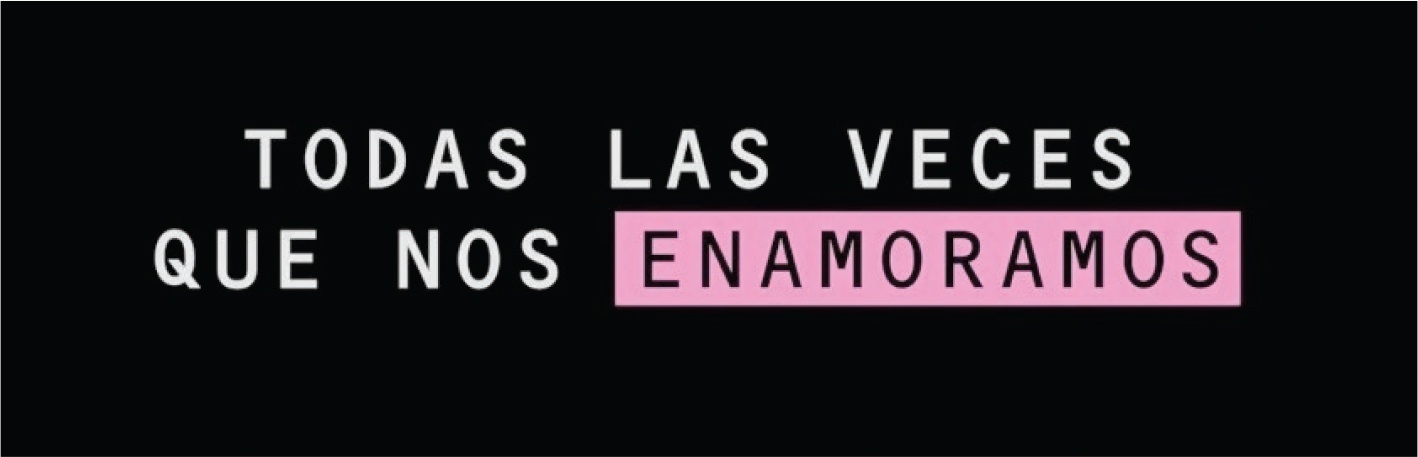
Figure 1
Netflix’s ‘scriptwriting’ branding, with its monospaced letters ‘typed out’ in real time by romcom filmmaker Irene, foregrounds the series’ dissection of the mechanics, constraints, and history of the genre. Screenshot from the library of Netflix.
To make this case, the article adopts a three-pronged qualitative approach: close textual analysis of key scenes across its eight episodes that crystallise its metatextual and temporal strategies; examination of paratextual materials (interviews, featurettes, marketing) illuminating industrial and authorial discourses; and analysis of twelve reviews from Spanish and international publications identifying recurrent tropes of ‘tedium’, ‘looping’, and ‘fatigue’. While not a systematic reception study, this sampling establishes a discernible pattern of public reception – one that culminated in cancellation and thus supports the article’s central thesis. Underpinning the analysis is a key conceptual distinction between narrative fatigue (the recursive logic internal to the text) and audience exhaustion (the extra-diegetic response registered in reception and cancellation), tracing how the former precipitates the latter. The argument unfolds in four movements: first, situating ILAOA within Netflix Spain’s meta-romcom cycle and its self-reflexive framework; second, analysing its manipulation of cyclical time to argue that endless deferral transforms optimism into pathology; third, examining the industrial context of binge-watching and platform cancellation, positioning the series within a broader wave of truncated or exhausted romcoms on streaming services; and finally, reflecting on what its fate reveals about the precarious state of streaming-era romantic comedy (e.g. Nobody Wants This [Netflix, 2024-]), caught between demands for extended serialisation and an audience increasingly impatient with being kept waiting.
2 Platform Reflexivity and the Netflix Meta-Romcom Cycle
ILAOA arrives at a moment of profound generic and industrial recalibration. As noted, contemporary romantic comedy is now routinely positioned as occupying a ‘post-epitaph’ or ‘post-romantic’ phase, its traditional promises and structures viewed with suspicion.6 Yet, paradoxically, this ‘post-’ era has coincided with the genre’s strategic resuscitation by streaming giants, epitomised by Netflix’s 2018 ‘Summer of Love’ and a wave of transnational romcoms since.7 Within Spain, Netflix’s 2015 launch and 2019 Madrid production hub transformed the country into a transnational laboratory for Netflix Originals embedded within local contexts, fuelling a production boom that significantly increased output and revolutionised industry dynamics.8 This context spawned a distinct Netflix Spain romcom ecology, including series like Smiley (2022-), Valeria (2020-2023), and Un cuento perfecto (A Perfect Story, 2023), and films such as Loco por ella (Crazy About Her, Carlos Sedes, 2021) and Eres tú (Love At First Kiss, Alberto Ruiz Rojo, 2023).
Amanda Lotz’s concept of ‘portals’ helps contextualise this shift: as streaming services displaced linear broadcasting, they renegotiated not only distribution models but also narrative expectations, privileging serialised complexity (to which we shall return) and brandable authorship.9 Carlos Montero, ILAOA’s creator, is well-known in Spanish television for spearheading the evolution of erotic Spanish teen series, a trajectory begun with Física o química (Physics or Chemistry, 2008), on terrestrial channel Antena 3, and culminating, following an exclusive partnership with Netflix, in several series including thrillers El desorden que dejas (The Mess You Leave Behind, 2020) and Feria: La luz más oscura (Feria: The Darkest Light, 2022); medical drama Respira (Breathe, 2024); and ‘sexy’ thriller Élite (2018-), a global streaming behemoth set in an exclusive independent school, Las Encinas [The Oak Groves].10 However, with ILAOA, Montero deployed the meta-romcom framework to complicate – and partially escape – the formula and Netflix brand identity he had honed with Élite: retaining what Deborah Castro, in her analysis of that series, calls its heightened adolescent drama, explicit sex, strategic casting of actors in their early-to-mid twenties as teenagers, and themes of class differences, drugs, homosexuality, and masculinity – all while introducing a lighter, more romantic tone.11 Framing ILAOA as a conscious pivot, Montero contrasted Élite’s ‘idealised world of the rich’ with the messier reality of ‘university and flatmates’, seeking, in actor González’s words, a warmer, grittier Madrid of ‘dirty streets’ and ‘stippled walls’.12 Montero even hesitated to cast Amorós due to her role as Cayetana – a working-class scholarship student who pretends to be wealthy to fit in – in Élite, emphasising that ILAOA should be ‘a much more comfortable series, one that you can watch with a smile on your face’.13
Montero’s biography, moreover, forms an essential blueprint for the series’ meta-romantic architecture. His formative years as – like the protagonist – an Audiovisual Communication student at the Complutense (in the 1990s), sharing an apartment in Malasaña with future auteurs Alejandro Amenábar and Mateo Gil (who directs the first two episodes of ILAOA), and his subsequent immersion in the cinematic machine as Pedro Almodóvar’s personal assistant during the pre-production of Hable con ella (Talk to Her, 2002) and La mala educación (Bad Education, 2004), directly engender the series’ self-reflexive core. This deeply personal, cine-literate history is transfigured into the series’ very substance, manifesting in the protagonists’ Film School milieu, their reverence for a fictional auteur ‘Romano’ (often read as a cross ‘between [fellow director, Julio] Medem and Almodóvar’), and the practical humiliations of being a meritorio [runner], which forms the title – and plot – of Episode 7.14
Moreover, the students’ cinephilia is evident through pervasive dialogue about Spanish cinema, including Adolfo Aristarain’s Martín (Hache) (1997), Medem’s Los amantes del Círculo Polar (The Lovers of the Arctic Circle, 1998), Amenábar’s Tesis (1996) (a film set and shot in the Complutense’s very Faculty of Information Sciences that plays host to this series), and Almodóvar’s ¡Átame! (Tie Me Up, Tie Me Down) (1990) and La ley del deseo (Law of Desire) (1986), whose infamous ‘¡Riégueme!’ [Hose me down!] scene, involving actor Carmen Maura in a Madrid street, Da recreates (Figure 2).15 The real-life Faculty served as the main filming location for the Netflix series, which was pre-screened there and features students as extras shot across its classrooms and hallways (Figure 3).16
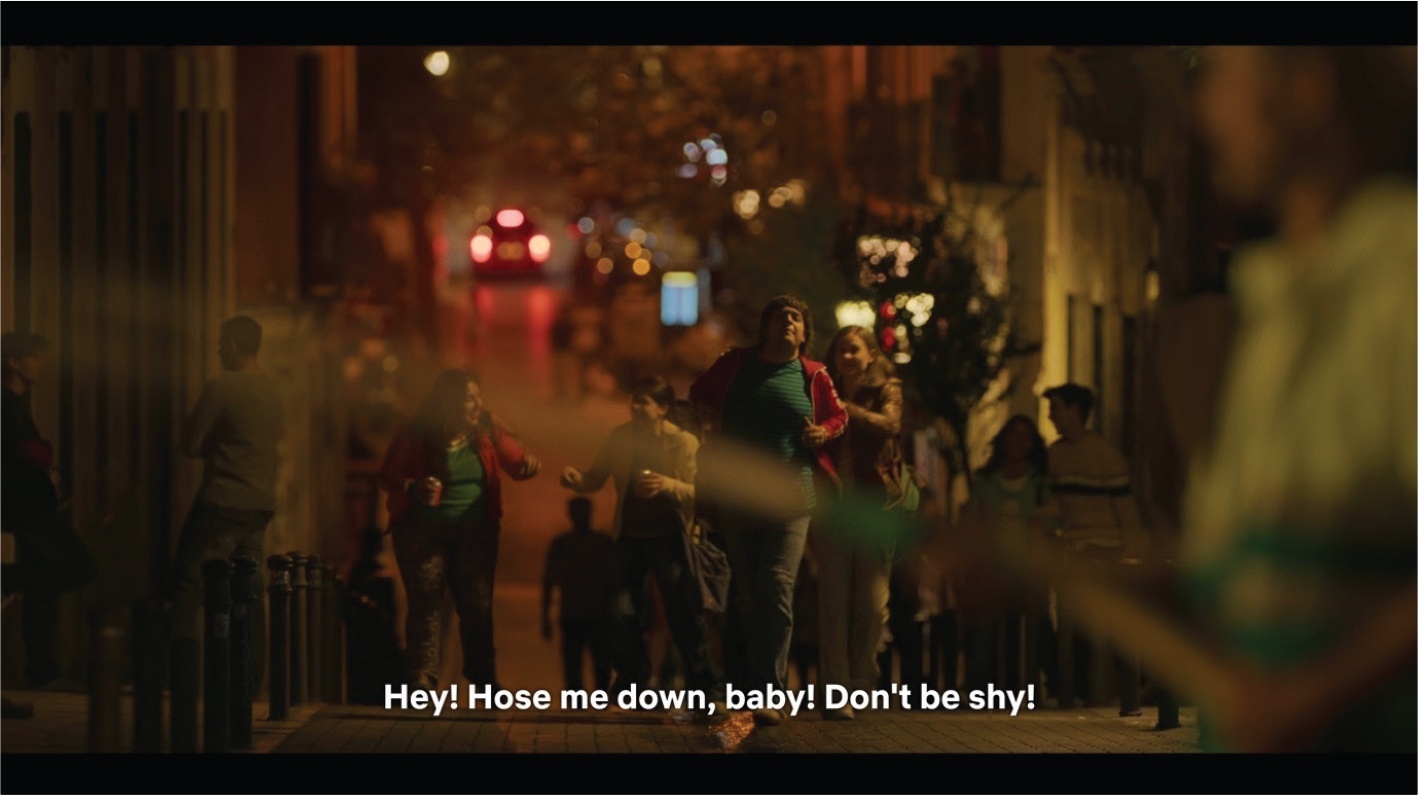
Figure 2
Da recreates the infamous ‘Hose’ scene from Almodóvar’s Law of Desire (1986) (‘I Forgot That I Had Forgotten You’, 1: 4). Screenshot from the library of Netflix.
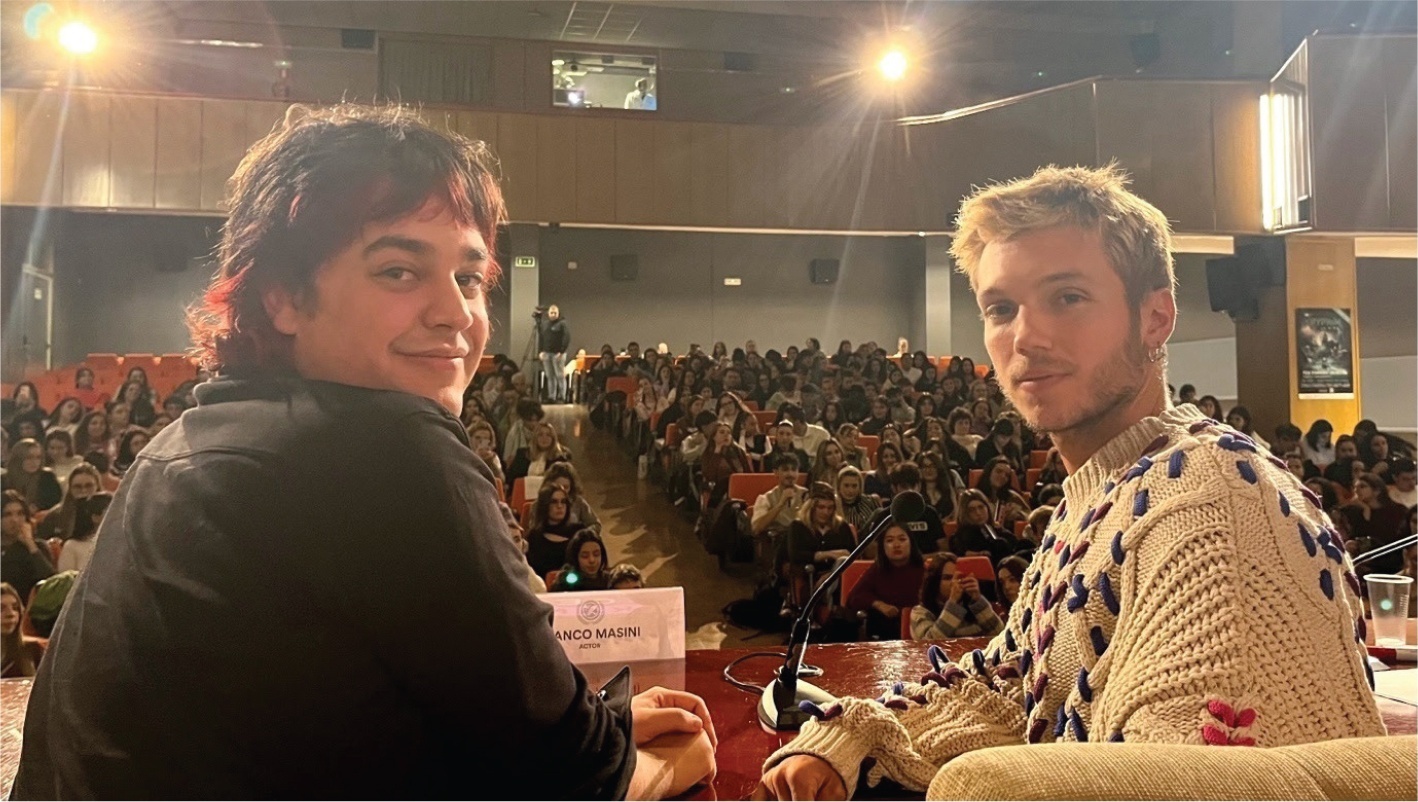
Figure 3
The series’ pre-screening at its primary filming location, the Complutense Faculty of Information Sciences.20
This self-reflexive construction exemplifies what Anna Tous-Rovirosa identifies as the broader evolution in Spanish television drama from literary influence towards metatelevision and self-referentiality, a hallmark of the ‘complex narrative’ that Jason Mittell associates with contemporary television.17 As Lauro Zavala notes, this reflects a broader turn from ‘pretextual’ toward ‘architextual’ references, characterised by mixture and pastiche.18 Accordingly, by making his stand-ins, in his own words, ‘film students […] who want to make a romantic comedy and end up getting caught up in their own romantic comedy’, Montero constructs the ultimate meta-romcom: a series that doubles as an autobiographical exorcism, and a working-through of his own romantic and professional entanglements with the Spanish film industry.19
Video 2
La ley del deseo - ¡Riégueme! [sequence from Pedro Almodóvar’s Law of Desire (1987)], El Deseo [eldeseopc], 17 December 2012. Last access: 02/01/2026.
Against this backdrop, ILAOA emerges as a pointed artefact of this recalibration: a Netflix Original that leverages the platform’s industrial logic and the creator’s autobiographical capital to stage a meta-commentary on the genre, one where the very act of producing a romantic comedy becomes the mechanism for its critical dissection. As Irene’s clacking keyboard becomes the diegetic heartbeat, ‘screenwriting’ this very romcom in real time, film shoots, sets within sets, and technical explanations inform and crystallise the romantic pairing, and casual explanations of the 180-Degree Rule (Figure 4) – a cinematic convention that ensures directional consistency and spatial orientation for the audience, learnt diegetically during the characters’ university degree – become metaphors for emotional boundaries.22 By embedding repetition, rehearsal, and revision into both its romantic and creative processes, ILAOA literalises French philosopher Alain Badiou’s notion that love itself must be continually re-started, re-declared over and over: ‘desire is immediately powerful but love also requires care and re-takes’.23
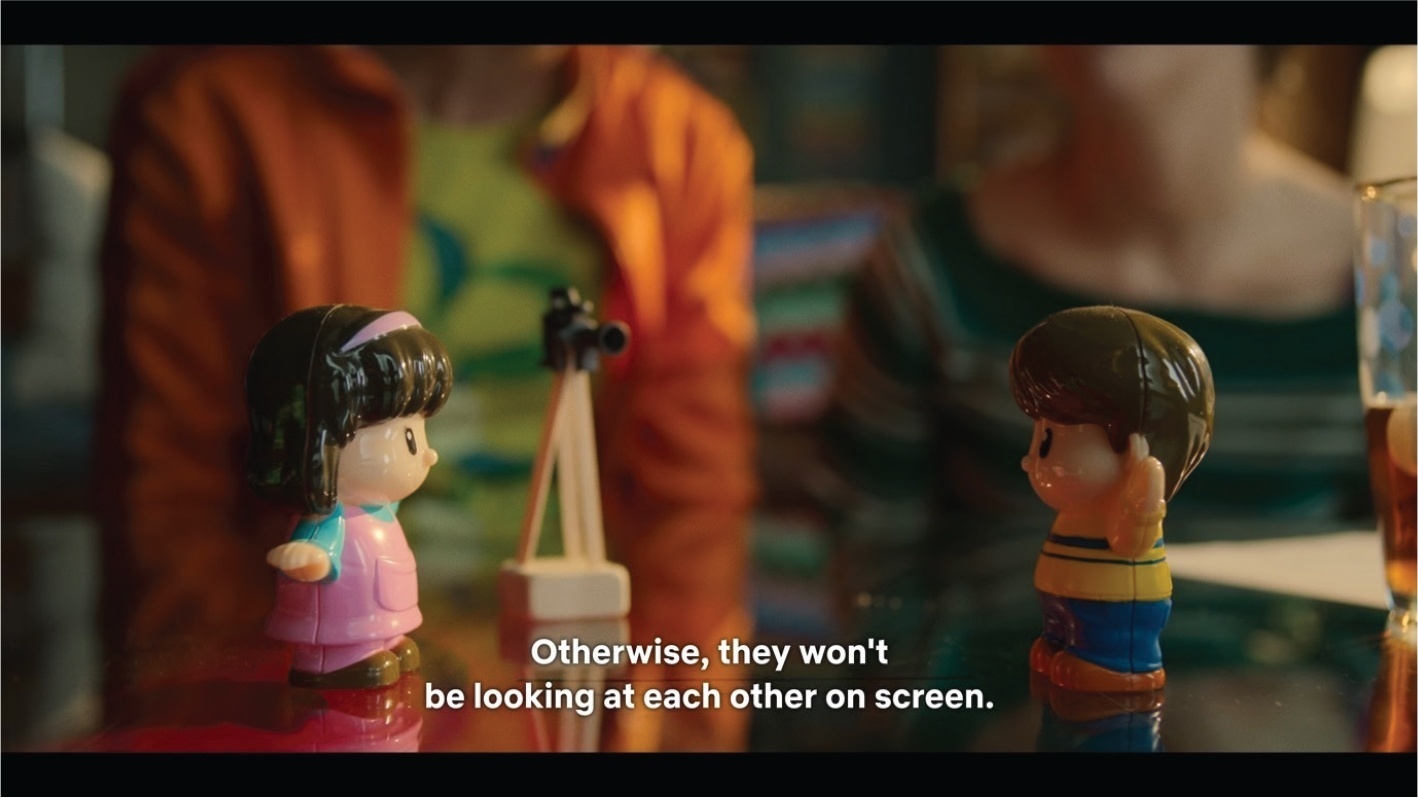
Figure 4
Adri (Roser Vilajosana) uses toy figurines to explain the 180-Degree Rule to Irene (‘I Forgot I Had Forgotten About You’). Screenshot from the library of Netflix.
In ‘Meet Cute’ (1: 1), Irene’s roommates mock her romantic comedy short, spontaneously drafting a cynical decalogue of reasons to loathe the genre in a metacinematic moment reminiscent of 10 Things I Hate About You (Gil Yunger, 1999). This performative critique, however, ultimately inverts itself (like that earlier romcom), as the very cynicism they articulate comes to define and unravel the romantic entanglements in their own lives, embedding the genre’s clichés into their reality through ironic, self-fulfilling prophecy. Indeed, Irene and Julio meet literally through cinema: at a film premiere, where she casts him, the law student with acting ‘itch’ (gusanillo). Their romance is, from its inception, a professional collaboration. Desire is mediated through the lens, script, and rehearsal – and Irene falls in love with Julio when seeing him literally through her camera screen, so enraptured she forgets to say ‘Cut’ (Figure 5). Affection unfolds on sets, editing rooms, acting classes, and festivals, inseparable from power dynamics and the erotic charge of creative collaboration. Romance is less an organic force than a genre to be produced, a script to be written – and, as the series will relentlessly explore, a take that can be endlessly reshot. Moreover, both Amorós and Vilajosana directed certain scenes, and the cast remembered saying ‘Action’ or ‘Sound’ twice each time, for they were filming ‘cinema within cinema’.24
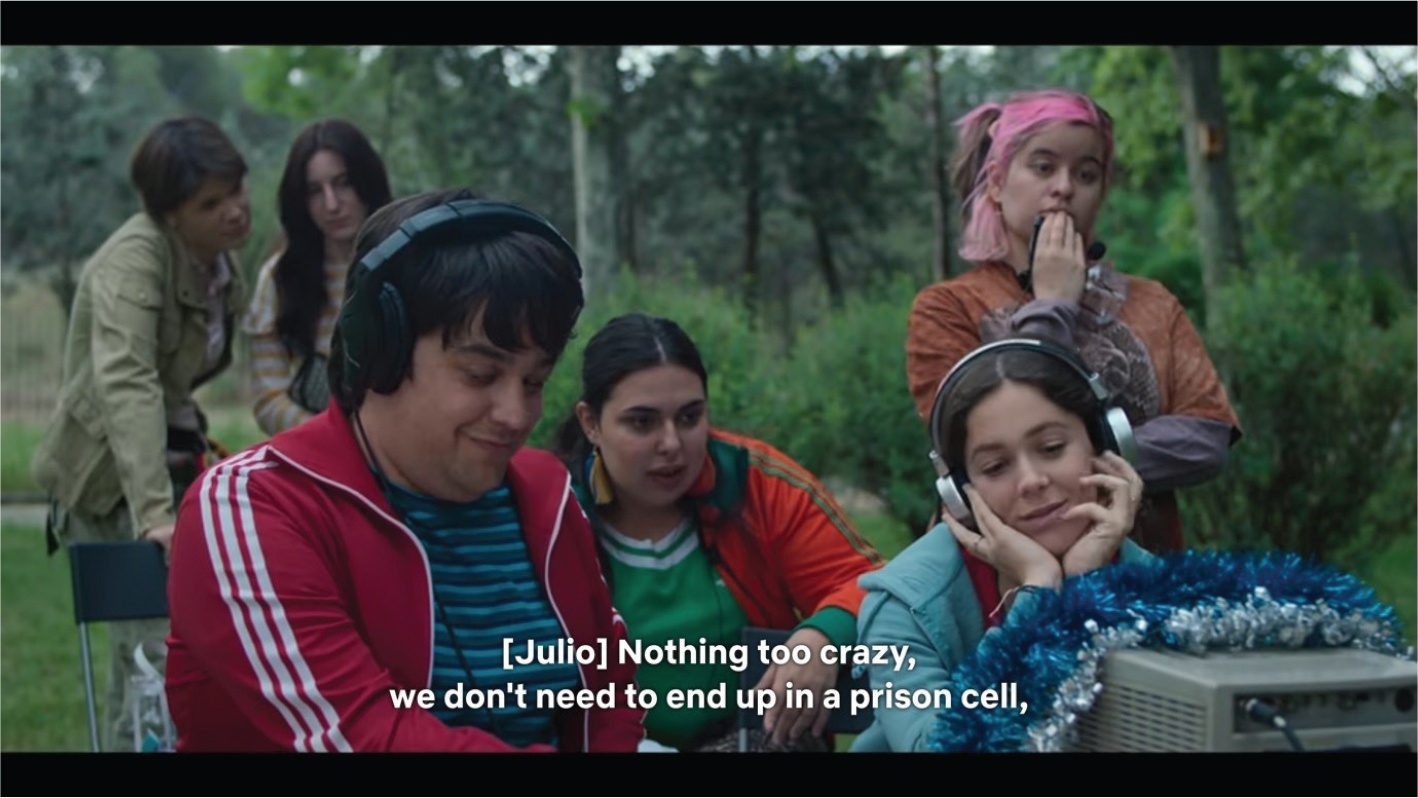
Figure 5
Irene falls in love with Julio through the camera, while he acts in her romcom short (‘I Forgot I Had Forgotten About You’). Screenshot from the library of Netflix.
Montero frames ILAOA as genre deconstruction, through Irene’s eyes: ‘I had to give the genre a twist. It’s the perspective of someone who knows the theory, but who – even if they come across as stupid as the omniscient narrator of a romantic comedy – can’t help being that stupid’.25 The series is about knowing the formula, yet being helplessly compelled to repeat it – and its internal dialogue remains keenly aware of this tension. In ‘Meet Cute’ (1: 1; the series’ working title), Irene’s roommate Jimena delivers a manifesto that serves as the series’ thesis: ‘Disney and society have programmed us to want one person for life… But advertising and third-wave feminism, man, are there to make sure no desire goes unfulfilled. So, of course, we live in that contradiction’. Yet her advice, ‘Less Disney, more Third Wave’, becomes an ironic chorus: the intellectual rejection of the monolithic romantic ideal, which clashes violently with the persistent, ‘stupid’ (Montero’s term) emotional pull toward that very fantasy. In ‘Summer Camp’ (1: 6), weary Julio’s question to Irene, ‘[Are you] With me in your short, or with me in your life?’, embodies the fatal conflation underpinning their romance: the inability to separate cinematic collaboration from the personal relationship. Julio’s acting ability on camera, he complains, is limited because ‘In every damn take I’ve got you [Irene] in my head’ (‘The Intern’, 1: 7), a line that encapsulates the exhausting, recursive cycle. The contrast between his glossy commercial blockbuster (as his acting career flourishes) and Irene’s gritty, grassroots short stages the central conflict – between commercial fantasy and authentic artistry – within their love. Moreover, the couple repeatedly prefer to watch love rather than live it, enshrining deferral through spectatorship and displacing love into representation rather than confrontation. Irene refuses to watch Julio’s mainstream features (Figure 6), and Julio avoids watching Irene’s short that re-creates their relationship, because to watch would be to believe, or remember, that there might be ‘something unfinished between us’ (1: 7). This crystallises a defining condition of the contemporary meta-romcom: hyper-literate characters, saturated with romantic narratives, become connoisseurs of curated feeling, yet are paralysed in generating authentic intimacy. Characters become fluent in the language of love stories, but struggle to speak in their own messy, unscripted voices.
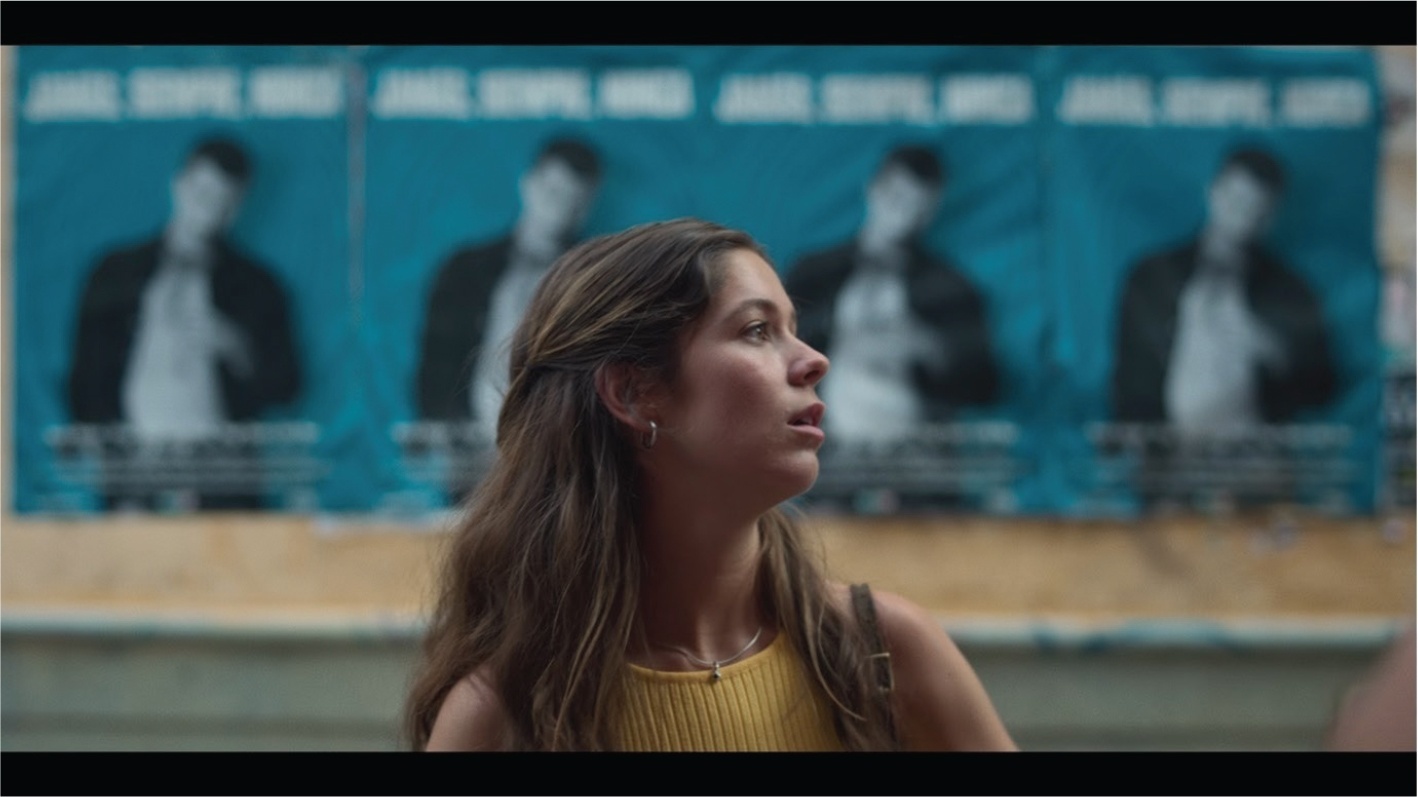
Figure 6
Irene refuses even to acknowledge – let alone watch – Julio’s latest blockbuster, Jamás, siempre, nunca [Never, Always, Not Ever], whose posters are plastered across Madrid (‘The Intern’, 1: 7). Screenshot from the library of Netflix.
3 The Pathology of Pursuit: Cyclical Time and the ‘Crisis Ordinariness’ of the Will-They-Won’t-They
Romance and courtship are fundamentally structured, of course, by a temporal vocabulary, from the inaugural ‘first date’ to the projected ‘future together’, where success or failure hinges on navigating loops of ‘déjà vu’, deferrals like ‘worth the wait’, and accelerations including ‘whirlwind romance’. This lexicon reveals romance as a negotiation with time itself, where desire is measured in ‘missed chances’, ‘second shots’, and the relentless assessment of whether it is the ‘right time’ or ‘too early/late’, making the love story inseparable from its chronology.
Building on this, ILAOA reconfigures the romantic comedy’s relationship with time, transplanting the genre from the finite, destiny-driven chronology of film into the looped and potentially endless temporality of the streaming series. First, where a two-hour film might have traced the tragicomic loop of a doomed love affair, or an efficient progression toward a conclusive ‘happily ever after’ – or even a romcom series of 22- or even 30-minute episodes might have been more traditional – ILAOA’s eight 50-minute episodes, spanning two decades, is deeply unusual for SVODs. As Deborah Castro and Concepción Cascajosa Virino note, while traditional Spanish programming used an average of thirteen 70-minute episodes per season, Netflix Spain – inaugurated in 2015 – shifted to 30 minutes in comedy and 60 minutes in drama.26 Thus ILAOA is, from the outset, a nostalgic throwback (mirroring its core themes), since its structure aligns more with long-running Spanish sitcoms such as Aquí no hay quien viva (No One Could Live Here, Antena 3, 2003-2006) or its predecessor La que se avecina (The One Next Door, Telecinco, 2007-), whose episodes run from 45-60 minutes, or an astonishing 85-95 minutes, respectively.
Therefore, ILAOA’s central dramatic question becomes not ‘Will they end up together?’ but ‘How many times will they fail to stay together?’ Focus is redirected from the what to the how, or more precisely, to the how many (the agonising, almost excruciating countdown and waiting game), establishing a contract of narrative fatalism from its outset. The classic romantic beats – meet-cute, journey, disguise, makeover, turning point, choice, crisis, breakup, epiphany, marriage, happy ending – are thus transformed from milestones of a single journey into stations of a circular transit system, a route the protagonists are doomed to ride repeatedly. Thus, despite the characters’ intense cinephilia (there are far fewer references to television), ILAOA is, of course, a televisual series explicitly about (numbingly repetitive) seriality, exploiting what Amy Holdsworth describes as television’s capacity for ‘looping, repetitive, banal, catastrophic, messy, and incomplete’ experience.27 The series’ temporal dis/mis-connections embody how television itself is
A kind of folded media with a nonlinearity that is, once again, akin to a process of spiraling, looping, or doubling – continually moving backward and forward. The process here, is like the most recent celebrations of television’s serial characteristics, cumulative, distinguished by an iterative process of repetition that is “lived” over time.28
Yet, in ILAOA, this structural choice – less a time-loop back to the exact same spot, but rather a repeated break-up-and-return cycle – transforms the televisual ‘will-they-won’t-they’ dynamic from a source of pleasurable suspense into a clinical study of romantic pathology, stretched across an indefinite timeline. In Celestino Deleyto’s words, romcoms traditionally nurture a comic ‘magic space’ in which love remains safe, optimistic, freed from everyday hindrances, and crucially inevitable.29 However, in ILAOA, this reassuring space cultivates a chronic condition of relapse and remission – an endless deferral knowingly satirised in Julio’s (fictional) blockbuster Jamás, siempre, nunca (also Episode 5’s title). Likewise, the series’ very name encodes this cyclical fate: literally ‘All The Times We Fall/Fell In Love’, a deliberate temporal disjunction since the Spanish -amos verb ending is identical in both present and preterite. The titular change internationally, then, to ILAOA, ironically implies a fatigued ‘…Again!?’, and echoes Deborah Jermyn and Stacey Abbott’s seminal edited collection on the romcom, Falling in Love Again, which analyses how ‘every time we watch a romantic comedy we fall in love again with falling in love’.30 ILAOA inverts that common genre sentiment, asking what happens when that act of falling becomes a tiresome, recursive compulsion.
The series’ temporal manipulations recall what Adrian Martin deems the contradictory elements central to romcom: holding our hand with the reassurance that all will be well, squaring love, sex, and friendship in a perfect fusion, before ‘affirming it, questioning it, wanting to believe in it… and then starting all over again’.31 Similarly, Badiou argues that since love’s intensity stems from its attempts to inscribe eternal potential into a duration, repetition is its basic structure: ‘one must start time and again’.32 ILAOA hyperbolises this conception; however, its constant return engenders accumulating fatigue, ironically enacting heteropessimism not through overt cynicism about romantic ideals, but through an abrasive surfeit of heteronormativity, akin to what Badiou calls the ‘locking in of chance’.33 Crucially, this reading provides a counterpoint to Élite, which, in Castro’s reading, omits love as a catalyst for sex at precisely the stage of life - adolescence - most associated with romantic idealisation, consolidating its appeal instead through recognisable social issues.34 Likewise, it challenges James Slattery’s analysis of post-2019 Hollywood time-loop romcoms, such as Palm Springs (2020), which, in framing heterosexual romance as a gamified ritual culminating in closure, ultimately uphold heteronormative structures.35 By contrast, ILAOA’s compulsive insistence on the couple’s inevitable reunion, I argue, does not secure romance so much as wear it down: hetero-optimism is overcranked, grinding the affective machinery until romance becomes exhausted rather than affirmed.
lLAOA’s narrative of compulsive return echoes Beatriz Oria’s argument, in her study of Netflix romcom series Master of None (2015-2021), that the formal, serialised postponement of romantic resolution underscores the story’s acknowledgement that traditional ideals – such as ‘the One’ or the ‘Happily Ever After’ – are unrealistic.36 Consequently, given widespread jadedness toward romantic archetypes, the act of continuing to pursue them can itself be read as self-evidently pathological. Oria draws on Lauren Berlant’s work in her 2011 monograph Cruel Optimism, where she argued that, from the 1990s onward, fantasies of the ‘good life’, including the promise of lively, lasting intimacy, have been eroded by a systemic condition in which ‘the ordinary becomes a landfill for overwhelming and impending crises of life-building’.37 Expanding Berlant’s notion of ‘crisis ordinariness’ – a series of ‘happenings that force people to adapt to an unfolding change’ – Oria argues that the serialised television format captures how an excess of choice induces an anxiety about settling down and a paralysing FOBO (‘fear of better options’), leaving individuals unable to commit.38 ILAOA makes this pathology its plot: every reconciliation between Irene and Julio already contains the conditions of its next collapse. Romance itself becomes, in Berlant’s terms, an ‘aesthetically mediated affective response’ to a shared sense of historical impasse.39 After their first kiss is interrupted by the fixed chronological interruption of the 11-M attacks, the couple repeatedly break up over career conflicts, infidelity, Julio’s mental health, and simple, accumulating weariness. The ‘perfect evening’ is perpetually disrupted. Yet each split is followed by a magnetic pull back together, often mediated through cinema – a film project, a script, a performance.
Carolina Amaral argues that serialised romcoms intensify the genre’s defining ‘temporality of the almost’ by stretching romantic deferral across episodes and seasons. Whereas classical romcom suspends fulfilment within a single narrative arc, serialisation multiplies moments in which the central couple almost unite, aligning erotic desire with spectators’ long-term narrative anticipation. This structure relies on suspense and retardation – obstacles that appear to keep lovers apart but in fact function as ‘desire propellers’ – and is reinforced by cliffhangers, hiatuses, and season breaks that embed delay into the viewing experience itself.40 Amaral likens this logic to Scheherazade’s nightly storytelling, where resolution is endlessly postponed to ensure continued engagement – a framework that resonates with broader scholarship on televisual serialisation, which links narrative devices such as analepsis, plot fragmentation, and soap-opera conventions to seriality’s capacity for sustained viewer investment.41 Amaral builds, moreover, on Linda Williams’ foundational concept of generic ‘temporalities’, whereby body genres – those that provoke physical reactions like terror, tears, or arousal – are governed by a distinct narrative rhythm: horror by the shocking ‘too soon’, melodrama by the tragic ‘too late’, and pornography by the perfectly synchronised ‘on time’. While Williams does not analyse comedy (despite naming it a body genre), this framework identifies the romcom as a body genre whose intended physical response – the exhilarated satisfaction of a happy ending – is meticulously engineered through structured postponement.42
This reading echoes John Alberti’s analysis of the Netflix series Love (2016–2018), which similarly frames romantic comedy as an addiction to the same script: not merely a genre to be consumed, but a pathological attachment that characters and viewers alike struggle to unlearn. In both series, then, the recursive compulsion to restart the same romance – while remaining unsure whether that “love” is even possible – becomes not a bug but the operating system of serialised streaming romcom.43
ILAOA literalises literary scholar Lynne Pearce’s argument that love, though traditionally seen as unique, is defined by a desire for ‘the same again’, making repetition its essential mode of understanding.44 Yet, in the series’ formal time-jumps between 2003 and 2019, it highlights not growth but a haunting stasis. We cut from a heated argument in Julio and Irene’s youth to a nearly identical conflict decades later. Despite additional facial hair, the latter-day Julio, just out of rehab, mirrors the insecure young actor of the past; and the Irene preparing to marry her safe fiancé (regressing, yet again, to her ex, Fer), despite sporting more fashionable designer clothing, still writes scripts about her old, destabilising flame. Indeed, critics observed a ‘clear problem of temporal credibility’, since, when we jump to the present, the characters are only superficially aged: ‘we find protagonists for whom twenty years have not passed’.45
The lovers seem untouched by 16 years, I argue, because their relational pathology exists somewhat outside of linear time. This exposes what Elizabeth Freeman, writing of the ways in which temporal and sexual dissonance are intertwined in queer art, calls chrononormativity: the organisation of bodies through time until ‘institutional forces come to seem like somatic facts’.46 ILAOA’s ellipses, then, do not register lived duration so much as what Freeman describes as time ‘turned into space, quantity and/or measure’: twenty years collapsed into a recognisably identical emotional site.47 Yet resisting chrononormativity does not mean escaping it, for the (here, intensively heteronormative, despite the abundant queered relationships around them) couple’s cyclical time produces no future, only repetition. Indeed, while these queer, alternative intimacies – Da’s homosexuality; Jimena’s decision, pregnant by Fer, to become a sole parent – might offer alternatives to heteronormative repetition, Irene and Julio remain sealed within their recursive dyad, showing something akin to hetero-compulsion: the relentless return to a script that has already proven itself exhausted.
Julio’s return from rehab and Irene’s compulsive re-enactments show this stasis to be somatic as well as narrative: the past persists through their bodies. What appears as arrested development is, in fact, temporal enclosure – a self-reproducing present that defies chrononormativity while foreclosing futurity. Later, this recursive, self-reflexive temporality is expanded when Julio gets in on the act, directing his own short film, Los años que vendrán (The Years to Come), which folds the narrative back onto itself: a sideways glance into the future that re-narrates the Julio-Irene love story from his vantage point, turning anticipation itself into another loop. The series’ promise of multiplicity, which collapses into stagnation, is brutally underscored by Episode 4’s title ‘I Forgot I Had Forgotten About You’.
Crucially, this closed circuit involves the explicit exclusion and injury of peripheral figures, most starkly Irene’s fiancé Fer. The classic ‘wrong partner’, in romcom theorist Steve Neale’s terms – the charming but ultimately unsuitable love interest who sparks attraction yet ultimately lacks the depth, compatibility, or emotional connection to be the protagonist’s true match – Fer is reduced to a narrative placeholder, a symbol of stable adulthood (who, in the 2019 timeline, cooks meals in a bourgeois kitchen [1: 7]) to be ritualistically betrayed.48 The pattern is relentless: after declaring, ‘I’m getting married, and it’s not to you [Julio]!’ (1: 6), 2019 Irene immediately engages in passionate sex with him. The series’ own meta-commentary – Irene’s wry admission, ‘I say I’m off romance but I can’t kick the habit. I’m really just the worst’ (1: 5: ‘Never, Always, Not Ever’) – serves as a damning self-indictment. This recursive betrayal erodes viewer sympathy, presenting the pursuit of ‘authentic’ romance as a self-justifying cycle, sealed off from accountability – emblematic of Oria’s critique that the serialised romcom reflects millennials’ heightened sense of self-focus and individualism.49
Likewise, Julio’s confession that he believed love would ‘cure his mental chaos’ (1: 7) specifies the pathological weight placed on their relationship. Indeed, his final grand gesture, mere minutes before Irene’s wedding fer, reinforces this. He has secured the lead role in a new film, on one condition: that Irene direct it, and it starts in just three days. Once again, intimacy and professional ambition become inseparable. The ultimate decision, with Irene abandoning Fer at the altar for a directing credit, crystallises the series’ rather bleak thesis. Their ‘happy ending’ is the professionalised consolidation of their mutually absorbing universe, achieved at a third party’s expense; small wonder critic Pere Solà Gimferrer accused the series of ‘ombliguismo’ (navel-gazing).50 The narrative solipsism is intensified as the couple insist on their connection’s significance while disregarding those around them. Indeed, in this finale (1: 8, titled ‘The Power of Words’, prioritising romantic declarations over steady yet relatively uninspiring partners), a heavily pregnant Jimena finds the couple having sex near-constantly, in every single (even communal) room of their shared apartment, joking that it is like a live ‘porno’ – a line that once again blends ‘real’ romance with cinematography. As Irene appreciates: ‘Don’t you think it’s weird that we […] have spent 6 weeks doing nothing else [than sex]?’ Amaral argues that the romcom’s purpose is to unite the ‘instant’ of attraction with the ‘eternal’ promise of an ending.51 Yet when the narrative middle designed to bridge these points is extended indefinitely – lacking the compressed tension that makes such delay satisfying – the slow burn risks exhausting its own logic, driving diminishing returns.
4 Nobody Wants This? Series Fatigue and Netflix’s Cancellation Clock
This manipulation of serial time situates ILAOA within a broader wave of Spanish romcoms that use chronological disjunction as a core mechanic. These include the body-swap time loops of Amazon Prime Original Mañana es hoy (Tomorrow Is Today, Nacho G. Velilla, 2022) and feature film Yo no soy esa (I Am Not That One, María Ripoll, 2024), both of which feature time-travel between the 1990s and the early 2020s. This formal device transcends national contexts, proliferating in French romcoms since 2018, and appearing in the aforementioned UK year-hopping miniseries One Day (2024), where a couple meet on their university graduation night and reunite on that same date each year for two decades, and in Movistar+’s (Spanish) decade-spanning Los años nuevos (The New Years, 2024), which traces a couple throughout their thirties, over the course of ten New Year’s Eves.52 Likewise, the time-loop trope characterises global streaming romcoms from When We First Met (USA, Ari Sandel, 2018) to Same Day with Someone (Thailand, Rangsima Aukkarawiwat and Yanyong Kuruangkura, 2025) to One More Time (Sweden, Jonathan Etzler, 2023), all on Netflix, to US productions including Amazon Prime Video’s Palm Springs and The Map of Tiny Perfect Things, and Hallmark romance Round and Round (Stacey N. Harding, 2023).53 A test case, therefore, for the televisual romcom in the streaming age, ILAOA employs this fractured temporality to both epitomise and critically reframe the central preoccupation of the streaming-era romcom: the erosion of linear romantic destiny into a coil of perpetual, even exhausted – and exhausting – potential.
According to Amaral, serialised romcoms bind characters’ erotic longing to the audience’s ongoing desire to keep watching, ensuring that romantic fulfilment remains perpetually imminent – ‘repeatedly postponed but […] close at hand’. The relationship between spectator and story continues even between episodes, seasons, and after the story’s nominal end.54 Yet, in the case of ILAOA, this symbiotic association became strained, as critics repeatedly criticised its excessive length, thereby showcasing how narrative fatigue breeds audience exhaustion. Diana Mangas lamented the ‘tedium of constant re-starts’, describing a couple ‘fated to start their love story time and again […] falling in love and breaking up and starting again and breaking up and fucking and stopping talking (like that, in a loop)’.55 International reviews echoed this response. Jason Flatt lamented the series became ‘tedious’, even ‘love-less’, because the central relationship is interrupted ‘again and again’, returning Irene and Julio to their ‘will-they-won’t-they once again’. Jonathan Wilson likewise called it a ‘tiring formula’ that stretches ‘eight whole episodes’ worth of contrivances […] around a couple who fall in love, get together, split up, and reunite, again and again, and for all kinds of reasons’. For Joel Keller, the central challenge lay in ‘guard[ing] against […] contriving eye-rolling ways to keep these two intensely-connected people apart’, noting we are left watching ‘two people who spend two decades getting together and breaking up’. Elsewhere, Ishita Chaterjee argued that the non-linear storytelling ‘makes the story and its incidents duller since it takes away any intrigue’, labelling ILAOA ‘An Expected Tale of Love and Breakups’. To quote Wilson again, this ‘long-term love story’, with its ‘contorted timeline’, had overstayed its welcome.56
This audience fatigue mirrors a broader cultural impatience with extended, perpetually-unresolved romantic narratives on streaming, a phenomenon manifest in the viral discourse around Nobody Wants This (2024-), a Netflix Original romcom series about an outspoken podcaster (Kristen Bell) and a newly single rabbi (Adam Brody) navigating love, and religious differences in Los Angeles, USA. The series is heavily metatextual, from its self-conscious deployment and interrogation of romcom conventions – using genre-literate dialogue to articulate scepticism about romance, destiny, and ‘happily-ever-after’ narratives – to its diegetic plot that swaps Fleabag’s ‘Hot Priest’ (BBC, 2016-2019) for Brody’s ‘Hot Rabbi’. Most concretely, its title winkingly telegraphs both an odd-couple dynamic (Kristen Bell’s character is not Jewish, and struggles to convert) and a negative critique of repetitiousness, as teased in Netflix’s own marketing [Figure 7]), which ironically captures viewer sentiment of Please, no more of this…. Despite some mixed, metatextual reviews (e.g. ‘It’s me. I don’t want this’), a largely well-received first season was renewed for a follow-up, released in October 2025 – to diminishing returns.57 Citing a lack of dramatic tension since the couple are already together, critics noted ‘the honeymoon is over’, documenting ‘repetition and exhaustion’.58 When – such reviews notwithstanding – a third season was announced in early November 2025, @ashleyray’s world-weary tweet went viral, crystallising series fatigue (Figure 8).
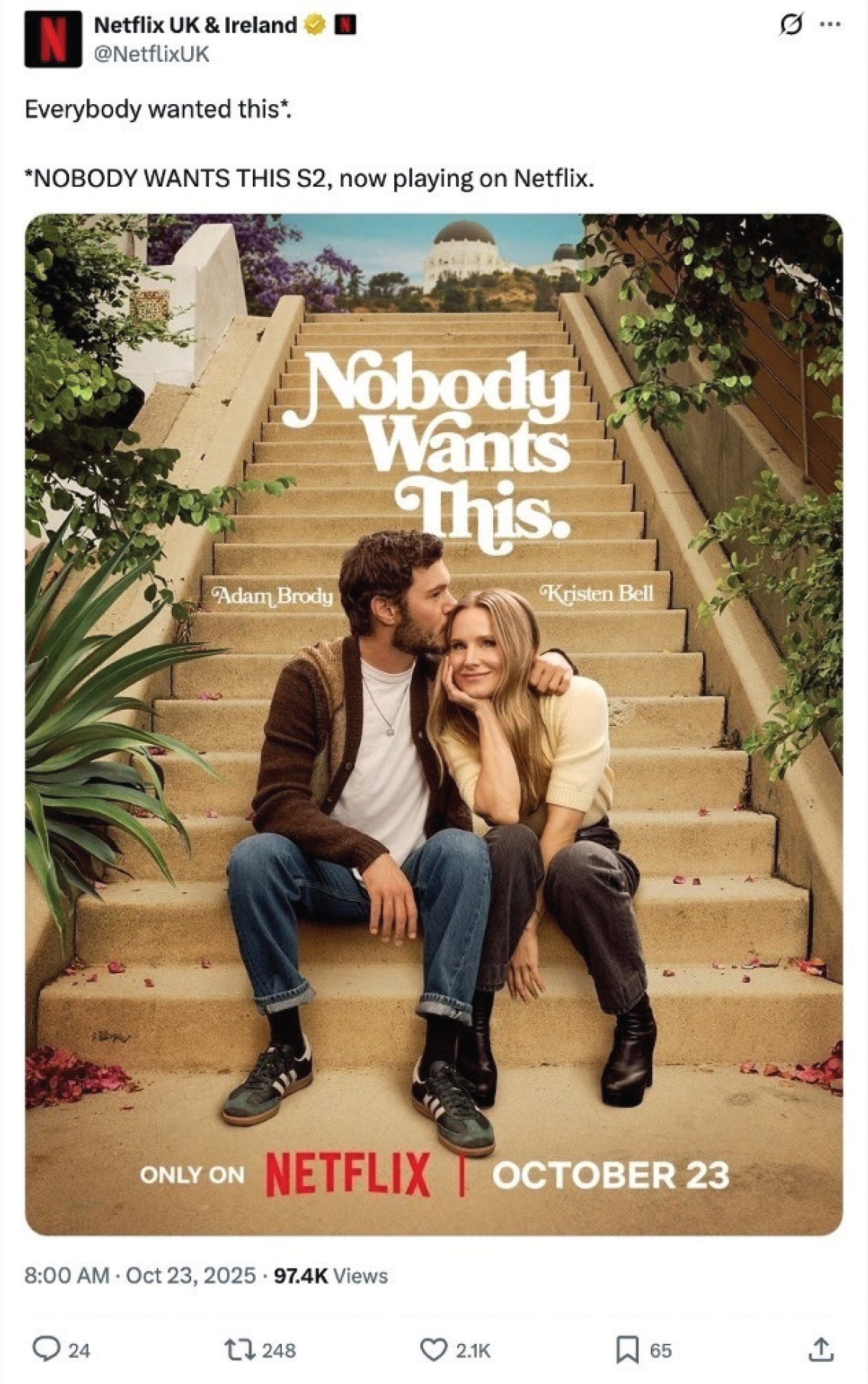
Figure 7
Netflix’s marketing for Nobody Wants This winkingly inverts its own self-negating title, engaging with its own critique of repetitive storytelling.59
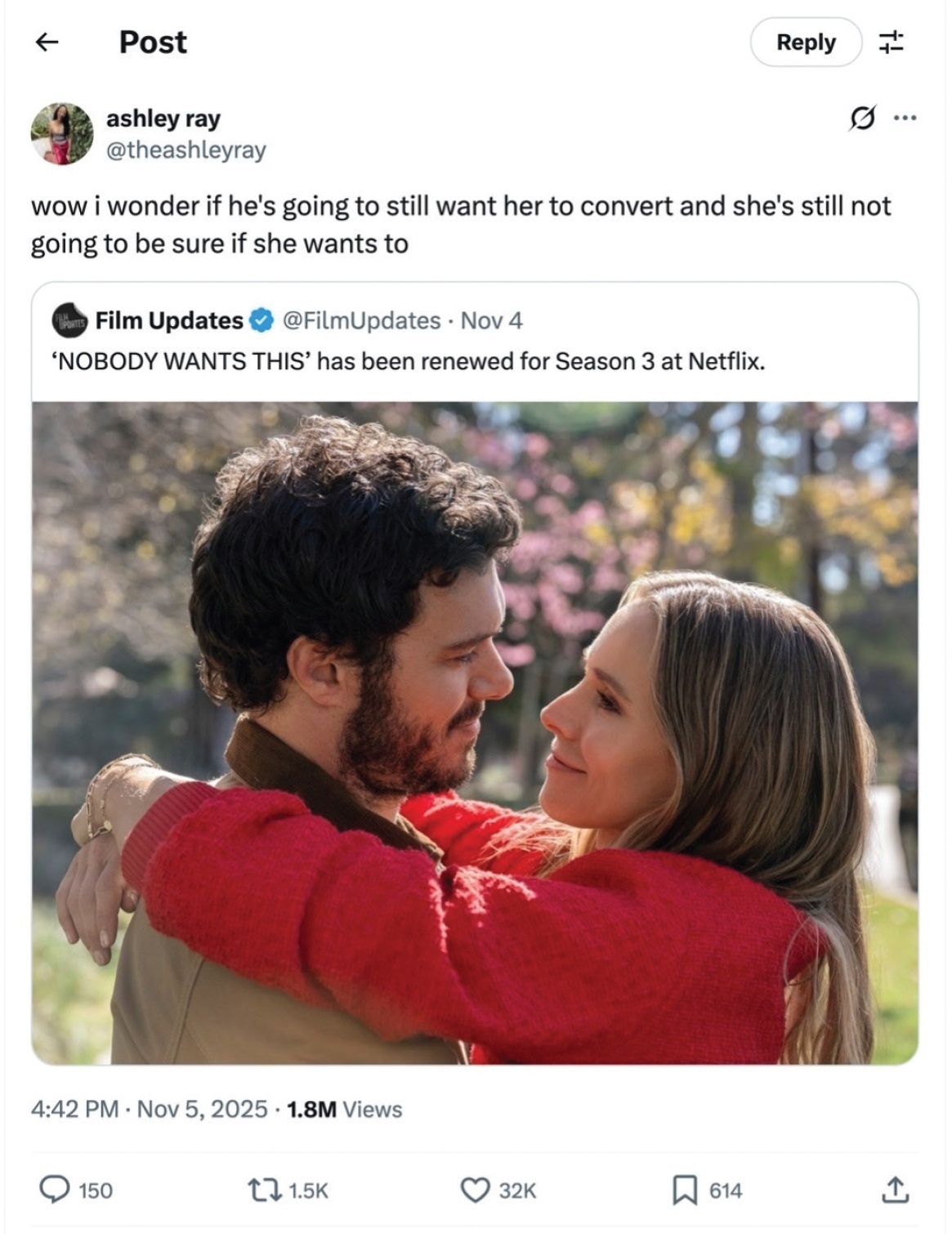
Figure 8
Ashley Ray’s Viral ‘X’ post epitomises audience fatigue with Netflix’s endlessly looping, serialised romcom conflicts.60
Mirroring such inertia, ILAOA concludes with comparable indecision and open-endedness: it is implied, but not confirmed, that Irene accepts Julio’s offer to direct his next feature. This ending – on yet another new beginning – becomes another deferral, part of the exhausting cycle that, ironically, only ‘finished’ when the series was cancelled after one season. Its fate is dryly mirrored by two aforementioned one-season meta-romcoms on Netflix Spain: Catalan-Spanish LGBTQ+ romcom Smiley (2022), which involved diegetic discussions of memorable feature-film romcom quotes and episode titles including ‘Bringing Up Baby’ (referencing the 1938 Howard Hawks film); and period romcom The Lady’s Companion (2025), which, like ILAOA, deployed a wry, fourth-wall-breaking heroine Elena (Nadia de Santiago) who began by dissecting audience expectations, claiming to embody the ‘suffering heroine’ that, she teases, viewers desire from romcoms (1: 1, ‘Lesson 1: Never Fall in Love’). However, the latter’s finale pointedly withholds this closure, substituting instead an ambiguous chase toward her lover (Álvaro Mel) that concludes with her – now disillusioned – voiceover lamenting, ‘The carriage hasn’t stopped … It’s gone. But … what kind of love story is this?’ (Figure 9). A male baritone voiceover now overrides hers, insisting her romantic climax was mere imagination, privileging instead ‘one that looks a lot like real life’ over narrative wish-fulfilment. Though this voice offers one final comment – ‘I wouldn’t give up on love so quickly…’ – the series’ sustained deferral, underscored by the ironic extradiegetic use of Celine Dion’s ‘All by Myself’ (1996), stretches the pleasurable suspense of the almost into viewer fatigue – a meta-commentary rendered starkly literal by the series’ own abrupt cancellation.
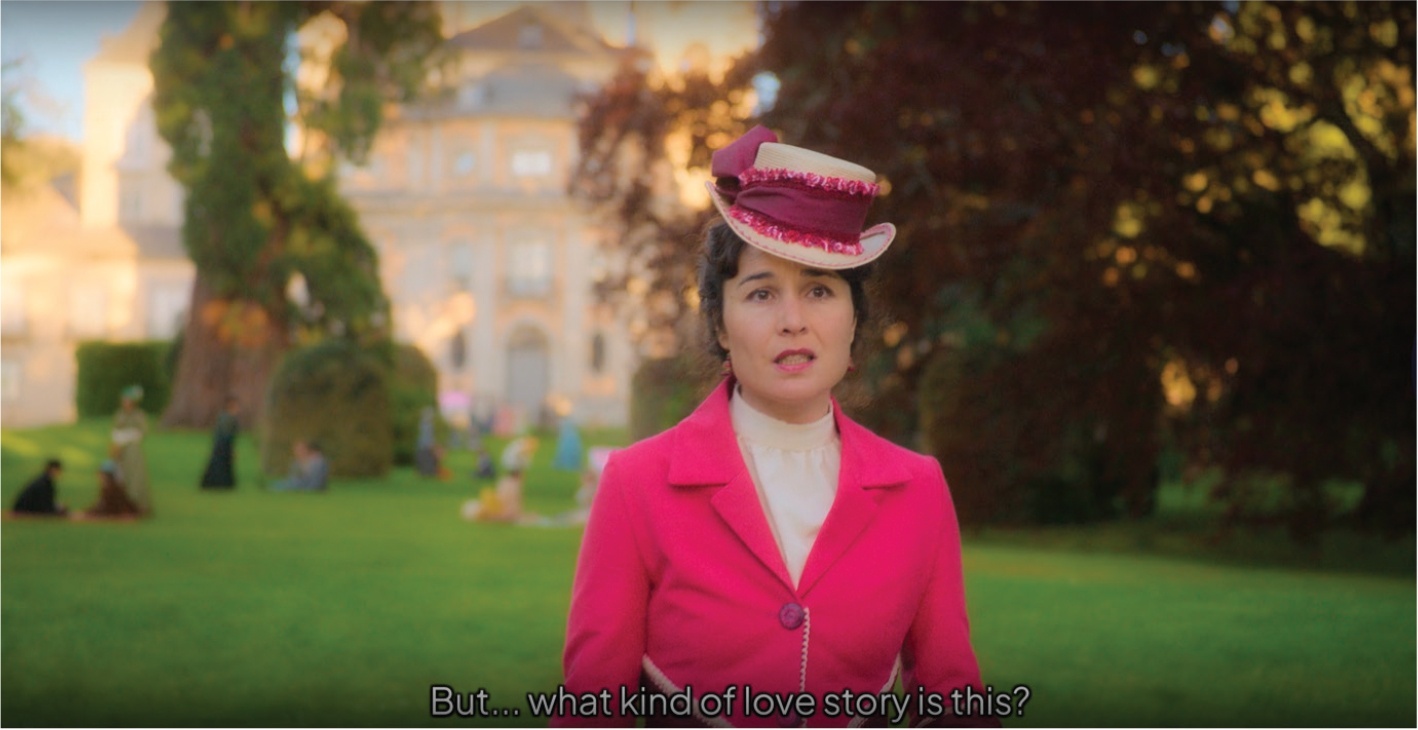
Figure 9
Elena’s disillusioned question – directed at a wily extradiegetic narrator who teases a future season – remains unanswered, as the series itself was cancelled before its ending could be told (The Lady’s Companion, 1: 8, ‘Make Your Lady Happy’). Screenshot from the library of Netflix.
This pattern of renewal and cancellation underscores the precarious lifespan of the streaming-era romcom, caught between the algorithm-driven demand for extended, franchise-able series and audience impatience with repetitious loops. While productions including the US series Emily in Paris (2020-), Love (2016-2018), Never Have I Ever (2020-2023), and the aforementioned Master of None, alongside Norway’s Hjem Til Jul (Home for Christmas, 2019-2022), France’s Plan Coeur (The Hook-Up Plan, 2018-2022), and the UK’s Lovesick (Channel 4, Netflix, 2014-2018), achieve multi-season runs, many others have been cancelled after one season, including US series Dash & Lily (2020), the Neil Patrick Harris vehicle Uncoupled (2022), and Lena Dunham’s British-American hybrid Too Much (2025). This context positions ILAOA within a precarious industrial reality for deconstructive romcom series on Netflix. Productions that dare to snatch away the expected happy ending, or that stretch the ‘will-they-won’t-they’ into a fatiguing loop, often find their own narratives abruptly deferred by the platform itself, leaving their meta-commentary on romantic dissatisfaction ironically validated by their own inconclusive fates.
Finally, this pattern of viewer fatigue must be understood within the specific mode of consumption that streaming platforms cultivate: binge-watching. As Mareike Jenner argues, Netflix’s 2013 shift to full-season drops reconfigured viewer engagement, transforming television from a weekly ritual into an ‘all-you-can-eat’ format where narrative momentum must sustain itself across consecutive hours rather than week-long hiatuses.61 The binge model places unique pressure on serialised romance: the ‘temporality of the almost’ that Amaral identifies as central to romcom pleasure depends on intervals of anticipation: gaps in which desire can simmer. When episodes are consumed back-to-back, deferral may cease to feel like suspense and begin to feel like stagnation. ILAOA’s eight 50-minute episodes, designed for binge consumption, thus confront a paradox: the very format that enables prolonged serialisation also intensifies its risks, transforming slow-burn romance into an exercise in endurance. Audience exhaustion may, therefore, be read as revealing an effect that runs counter to binge-watching, revealing that when repetition and deferral exceed a certain threshold, the binge model – premised on uninterrupted flow – amplifies rather than mitigates exhaustion.
4 Conclusion. Here We Go Again (and Again, and Again): The Fatigue of Romantic Seriality
This article has argued that ILAOA exemplifies the recursive tension at the heart of contemporary romantic seriality, negotiating between critique and enactment, (a somewhat generically intrinsic) heterooptimism and rising heteropessimism. During promotional interviews, while Montero remained ambivalent about Irene and Julio’s relationship (‘it fills you with life’, ‘…stories we all want to live and yet hope we never have to live’), Amorós labelled it ‘toxic’, stating that, in reality, she would always choose stable-if-boring Fer over Julio.62 This dissonance positions ILAOA within what scholars identify as a contemporary mode: what Jonathan Cicoski calls ‘bittersweet romances’ that negotiate ‘the affective, forward pull of hope and the unrelenting sense that such hope will inevitably transform into future losses’; or what Mary Harrod, Suzanne Leonard, and Diane Negra call narratives suspended ‘between romantic utopia and dystopia’, manifesting romance’s ‘apparent inability to thrive in modern conditions, yet [enduring] status as cultural ideal and driving force’.63 ILAOA’s repeated, ironically-unheeded mantra, ‘Less Disney, more Third Wave’, crystallises its narrative engine: oscillating between the cynicism and ‘crisis ordinariness’ of modern love, and an undeniable pull toward Berlantian ‘cruel optimism’: the attachment to traditional romantic structures that actively impedes the very flourishing they promise.
Amaral argues that time in romantic comedy functions like striptease, undressing ‘piece by piece before exposing the naked vulnerability of its characters’.64 However, this article has argued that ILAOA stretches this tantalising reveal to breaking point, weaponising the ‘temporality of the almost’ until the serialised deferral of gratification, without meaningful escalation, becomes the entire narrative substance. Ultimately, such meta-gameplay drains its own emotional currency through sheer repetition; viewers may wonder whether all the times (Todas las veces) were strictly necessary. SVODs’ binge model, paradoxically, accelerates the very exhaustion it seeks to forestall: designed to sustain narrative momentum across consecutive hours rather than week-long hiatuses, it collapses the intervals of anticipation that Amaral identifies as central to romcom pleasure. As the loop wears thin, what begins as narrative fatigue – the internal recursive logic, the endless reshooting of the same romantic scene – precipitates audience exhaustion, the extra-diegetic response registered in critical panning and premature cancellation.
ILAOA completes a melancholic circuit: a series about the exhaustion of a romantic formula that itself becomes exhausted by the serial form; a Montero Netflix rebrand that was prematurely curtailed by Netflix itself. Its critical panning and abrupt cancellation served as the final, unscripted plot point that proves its thesis. Montero acknowledged that romcoms are almost ‘destined to last no more than three or four episodes’; in challenging this ‘fate’, he extends the romcom’s temporal blueprint to rupture, exposing the pathology of pursuit in the streaming age, where narrative time dilutes rather than accelerates fantasy.65 As the loop wears thin, ILAOA thus becomes, ironically, an expression of heteropessimism through a prolonged celebration, and dissection, of heteronormative obsession. A meta-romcom becomes a eulogy for the serialised version of the very fantasy it could not stop circling, proving, in its very structure and fate, that some love stories – and some series – cannot be forever starting (all) over (again).
Acknowledgements
This publication has emanated from research conducted with the financial support of Taighde Éireann—Research Ireland under Grant Number R2750.
Notes
[1] On romcoms’ ‘predictability’, see Kyle Stevens, “Romantic Comedy and the Virtues of Predictability”, New Review of Film and Television Studies 18, no. 1 (2020): 28–48, https://doi.org/10.1080/17400309.2019.1664059.
[2] Asa Seresin, “On Heteropessimism”, The New Inquiry, October 9, 2019, n.p., https://thenewinquiry.com/on-heteropessimism/; Jacob Johanssen and Jilly Kay, “From females to ‘femcelcore’: Women’s involuntary celibacy and the rise of heteronihilism”, European Journal of Cultural Studies 0, no. 0 (2024): 1-19. https://viewjournal.eu/about/submissions#style-guidelines
[3] Maria San Filippo, ed., After ‘Happily Ever After’: Romantic Comedy in the Post-Romantic Age (Detroit: Wayne State University Press, 2021).
[4] Jorge Fernández Mencías, “Las 22 mejores series de amor en Netflix para románticos”, Fotogramas, February 14, 2023, https://www.fotogramas.es/series-tv-noticias/g40988254/mejores-series-amor-romanticas-netflix/; Jorge González del Pozo and Xosé Pereira Boán, eds., Netflix’ Spain: Critical Perspectives (Oxon: Routledge, 2024); María José Higueras Ruiz, “Identificación cultural y emocional con Madrid a través de la serie Valeria (Netflix, 2020-2023)”, Revista de Comunicación 22, no. 2 (2023): 243–260, http://dx.doi.org/10.26441/rc22.2-2023-3163; Andy Damián Tavárez Pérez and Marta Saavedra Llamas, “Propósitos sociales y preocupaciones juveniles en las campañas promocionales de las teen series: el caso de Netflix España”, IROCAMM 8, no. 1 (2025): 43–58, https://dx.doi.org/10.12795/IROCAMM.2025.v08.i01.03.
[5] Celestino Deleyto, The Secret Life of Romantic Comedy (Manchester: Manchester University Press, 2009), 24.
[6] Shelley Cobb and Diane Negra, “‘I Hate to Be the Feminist Here…’: Reading the Post-Epitaph Chick Flick”, Continuum 31, no. 6 (2017): 757–766, https://doi.org/10.1080/10304312.2017.1313389; Maria San Filippo, ed., After ‘Happily Ever After’.
[7] Mary Harrod, “Out of Time: Fantasising the French Romantic Hero in the Netflix Era”, French Screen Studies 24, no. 2 (2024): 194–217, https://doi.org/10.1080/26438941.2023.2275896.
[8] Deborah Castro and Concepción Cascajosa, “From Netflix to Movistar+: How Subscription Video-on-Demand Services Have Transformed Spanish TV Production”, JCMS: Journal of Cinema and Media Studies 59, no. 3 (2020): 154–160, https://doi.org/10.1353/cj.2020.0019.
[9] Amanda D. Lotz, Portals: A Treatise on Internet-Distributed Television (Ann Arbor: Michigan Publishing, 2017).
[10] See Deborah Castro Mariño, “Élite: la ficción Teen española que juega en la NBA”, in Revolución seriada: el gran cambio de la ficción televisiva en España, ed. Miguel Ángel Huerta Florano (Valencia: Tirant lo Blanch, 2020), 145–173, 149, 169.
[12] Francesc Puig, “‘Todas las veces que nos enamoramos’, la comedia romántica más coral”, La Vanguardia, February 13, 2023, https://www.lavanguardia.com/series/20230213/8745892/todas-veces-enamoramos-netflix-serie-comedia-romantica-elite-carlos-montero.html; González in Berto Molina, “‘Todas las veces que nos enamoramos’: 9 secretos de la serie de Netflix”, El Confidencial, February 17, 2023, https://www.elconfidencial.com/television/series-tv/2023-02-17/todas-las-veces-que-nos-enamoramos-secretos-netflix_3577838/; Marisa de Dios, “Estreno de Todas las veces que nos enamoramos, la serie romántica de Netflix para San Valentín”, El Periódico, February 13, 2023, https://www.elperiodico.com/es/tele/series/20230213/todas-las-veces-que-nos-enamoramos-serie-netflix-georgina-amoros-franco-masini-carlos-montero-82722943. González plays Irene’s friend and flatmate Da. All translations from Spanish are my own.
[13] Álvaro Onieva, “De la difícil búsqueda de Franco Masini a ‘no’ a Georgina Amorós: así fue el casting de Todas las veces que nos enamoramos”, Fotogramas, February 21, 2023, https://www.fotogramas.es/series-tv-noticias/a42987101/todas-las-veces-que-nos-enamoramos-netflix-franco-masini-georgina-amoros-casting/.
[14] See, for instance, Álvaro Onieva, “Todas las veces que nos enamoramos: la inocente juventud del jefe de la adolescencia en España”, El Mundo, February 5, 2023, https://www.elmundo.es/cultura/2023/02/05/63de83b1fc6c834c688b458a.html.
[15] Onieva, “De la difícil búsqueda”. For how Montero’s own experiences shaped ILAOA: Puig, “Todas las veces”.
[16] “La Facultad, escenario de la serie ‘Todas las veces que nos enamoramos’”, Facultad de Ciencias de la Información, Universidad Complutense de Madrid, February 7, 2023, http://ccinformacion.ucm.es/noticias/la-facultad-escenario-de-la-serie-todas-las-veces-que-nos-enamoramos.
[17] Anna Tous-Rovirosa, “Intertextuality and police television dramas in Spain (1990-2010). The literary shift to metatelevision and recurrence of the female victim as motif”, Communication & Society 33, no. 4 (2020): 89–106, https://doi.org/10.15581/003.33.4.89-106; Jason Mittell, Complex TV: The Poetics of Contemporary Television Storytelling (New York: New York University Press, 2015).
[18] Lauro Zavala, Teoría y práctica del análisis cinematográfico. La seducción luminosa (México: Trillas, 2010), 84.
[21] Matthew Hilborn, “Narrativising Netflix: Metatextuality and Brand Management in Netflix Spain’s Romantic Comedies”, in Imagining ‘We’ in the Age of ‘I’: Romance and Social Bonding in Contemporary Society, 2nd edn., eds. Diane Negra, Stephanie Leonard, and Mary Harrod (Oxford: Routledge, forthcoming), chapter 14; Hilborn, “‘It Doesn’t Make Me Feel the Way You Do’: Reading Dating Apps and Digital Intimacies in Smiley (Netflix 2022)”, International Journal of Iberian Studies 38, no. 3 (2022): 227–254, https://doi.org/10.1386/ijis_00166_1.
[22] This feature also characterises another serialised, self-reflexive romcom: Film Club (BBC, 2025), about two film-buffs who share a weekly film club.
[24] “TODAS LAS VECES QUE NOS ENAMORAMOS: Las claves de esta serie que muestra el cine dentro del cine”, YouTube video, uploaded by FormulaTV, February 15, 2023, https://www.youtube.com/watch?v=uIMEyLShl3I. Last access: 31/03/2026.
[25] Europa Press, “Carlos Montero deconstruye la comedia romántica en Todas las veces que nos enamoramos: ‘Esto no es Élite’”, Europa Press, June 29, 2022, https://www.europapress.es/tv/noticia-carlos-montero-deconstruye-comedia-romantica-todas-veces-nos-enamoramos-esto-no-elite-20220629133333.html.
[30] Sarah Jermyn and Stacey Abbott, “Introduction”, in Falling in Love Again, eds. Sarah Jermyn and Stacey Abbott (London: I. B. Tauris, 2008), 1–8.
[31] Adrian Martin, “In the Mood For (Something Like) Love: The Situation of the Rom-Com Today”, Cinéaste 39, no. 1 (Winter 2013): 16–20, 20, https://www.jstor.org/stable/43500914.
[35] James Slattery, “Breaking the Cycle: The Promise of Heterosexuality in Time Loop Narratives”, in Unspool: Critical Time Loops in Screen Media, ed. Nick Jones (Edinburgh: Edinburgh University Press, forthcoming).
[36] Beatriz Oria, “Facing the Fig Tree: Contemporary Intimacy Culture in Master of None”, in Imagining ‘We’ in the Age of ‘I’, edited by Mary Harrod, Suzanne Leonard, and Diane Negra (London: Routledge, 2021), 77–92.
[40] Carolina Amaral, “The Temporality of (Serialized) Romantic Comedy”, Networking Knowledge: Journal of the MeCCSA Postgraduate Network 13, no. 2 (2020): 78–89, 78, 82, https://doi.org/10.31165/nk.2020.132.581.
[41] Veronica Innocenti and Guglielmo Pescatore, “Information Architecture in Contemporary Television Series”, Journal of Information Architecture 1, no. 2 (2012): 61–77, https://journalofia.org/volume4/issue2/05-pescatore/; Anna Tous-Rovirosa, Tatiana Hidalgo-Marí, and Luís Fernando Morales-Morante, “Serialización de la ficción televisiva: el género policiaco español y la narrativa compleja. Cadenas generalistas (1990-2010)”, Palabra Clave 23, no. 4 (e2342) (2020): 1–34, https://doi.org/10.5294/pacla.2020.23.4.2. Klinger (2018, p. 519) similarly associates transformations in seriality with shifts in technology and consumption, positioning serialisation as a hallmark of quality television, as previously highlighted in Mittell, Complex TV: Barbara Klinger, “Gateway bodies: Serial form, genre, and white femininity in imported crime TV”, Television & New Media 19, no. 5 (2018): 515–534, https://doi.org/10.1177/1527476418768003.
[42] Linda Williams, “Film Bodies: Gender, Genre and Excess”, in Film Genre Reader III, ed. Barry Grant (Austin: University of Texas Press, 2003), 141–159.
[43] John Alberti, “Addicted to Love: The Productive Pathology of the Romantic Comedy in the Netflix Series Love”, in After ‘Happily Ever After’, ed. Maria San Filippo, 257–274.
[44] Lynne Pearce, “Romance and Repetition: Testing the Limits of Love”, Journal of Popular Romance Studies 3, no. 1 (2011): 1–14, 7, https://journals.scholarsportal.info/details/21596499/jprs.
[45] Diana Mangas, “Crítica ‘Todas las veces que nos enamoramos’ (Netflix)”, LosInterrogantes.com, February 16, 2023, https://losinterrogantes.com/cine/criticas/todas-las-veces-que-nos-enamoramos-netflix.
[46] Elizabeth Freeman, Time Binds: Queer Temporalities, Queer Histories (Durham: Duke University Press, 2010), 3.
[48] Steve Neale, “The Big Romance or Something Wild? Romantic Comedy Today”, Screen 33, no. 3 (1992): 284–299, 289. https://doi.org/10.1093/screen/33.3.284.
[50] Pere Solà Gimferrer, “‘Todas las veces que nos enamoramos’, una historia de amor que da sentido a Netflix”, La Vanguardia, February 14, 2023, https://www.lavanguardia.com/series/netflix/20230214/8755530/todas-las-veces-que-nos-enamoramos-netflix-comedia-romantica-critica.html.
[53] These SVOD productions emerge alongside feature-film time-loop romcoms including Meet Cute (Alex Lehmann, 2022).
[56] Jonathan Wilson, “In Love All Over Again Season 1 Review – A long-term love story”, Ready Steady Cut, February 15, 2023, https://readysteadycut.com/2023/02/15/in-love-all-over-again-season-1-review/; Joel Keller, “In Love All Over Again: Stream It Or Skip It? Netflix Review”, Decider, February 14, 2023, https://decider.com/2023/02/14/in-love-all-over-again-netflix-review/; Ishita Chatterjee, “‘In Love All Over Again’ Netflix Series Review – An Expected Tale of Love and Breakups”, MoviesR.net, February 14, 2023, https://moviesr.net/p-in-love-all-over-again-netflix-series-review-an-expected-tale-of-love-and-breakups.
[57] Quote is from Chloe Williams, “Sorry, I Don’t Get The ‘Nobody Want This’ Hype – 6 Reasons I Won’t Be Watching Season 2.’”, Brit + Co, December 10, 2025, https://www.brit.co/nobody-wants-this/.
[58] Vicky Jessop, “Nobody Wants This Season 2 review: the honeymoon is over”, Evening Standard, October 23, 2025, https://www.standard.co.uk/culture/tvfilm/nobody-wants-this-season-2-review-kristen-bell-adam-brody-b1254462.html; Daniel Fienberg, “‘Nobody Wants […] This’ Season 2 Review: Netflix Hit Back, but Not Better”, The Hollywood Reporter, October 23, 2025, https://www.hollywoodreporter.com/tv/tv-reviews/nobody-wants-this-season-2-review-netflix-adam-brody-1236407761/.
[59] NetflixUK [@NetflixUK], “Everybody wanted this*. *NOBODY WANTS THIS S2, now playing on Netflix”, X, October 23, 2025, https://x.com/NetflixUK/status/1981254263591358956.
[60] Ashley Ray [@theashleyray], “wow i wonder if he’s going to still want her to convert and she’s still not going to be sure if she wants to”, X, November 5, 2025, https://x.com/theashleyray/status/1986111993758294271.
[61] Marike Jenner, “Introduction”, in Mareike Jenner, ed, Binge-Watching and Contemporary Television Studies (Edinburgh: Edinburgh University Press, 2021), 1–22.
[62] Puig, “Todas las veces”; “Franco Masini y Georgina Amorós en Todas las veces que nos enamoramos: ‘A veces te enamoras y…’”, YouTube video, uploaded by eltelevisero, February 10, 2023, https://www.youtube.com/watch?v=DB_RX68BpLo. Last access: 31/03/2026.
[63] Jonathan Cicoski, “The bittersweet queer romance: Affect and temporality in Weekend and Paris 05:59: Théo & Hugo”, in Imagining “We” in the Age of “I”: Romance and Social Bonding in Contemporary Culture, eds. Mary Harrod, Suzanne Leonard, and Diane Negra, 160–174, 161; Harrod, Leonard, and Negra, “Introduction: Romance and social bonding in contemporary culture – before and after COVID-19”, in Ibid., 1–28, 1.