
And in the naked light I saw
Ten thousand people, maybe more
People talking without speaking
People hearing without listening
People writing songs that voices never share
And no one dared
Disturb the sound of silence
‘Fools’, said I, ‘You do not know
Silence like a cancer grows . . .’
‘The words of the prophets are written
on the subway walls
And tenement halls’
And whispered in the sounds of silence.1
Video 1
Simon and Garfunkel, The Sound of Silence (1966).
1 A Word to Our Readers
An association between Simon’s and Garfunkel’s The Sound of Silence and archives may strike those of you with more conventional expectations of an academic publication as a tad dramatic and performative. Some of you may even think this to be unnecessarily eccentric. We want to reassure these readers that this particular choice of framing has been deliberately crafted. For now, it suffices to tell you that in this special issue we have taken to heart to use the act of a creative dialogue as the basic unit of conversation, imagination and thinking about what it means to work with broadcast archives in the production of historical knowledge on television history and culture. An intended element of this endeavour is also our direct address to you as readers, appealing to your ‘subjective belief system’ with the intention of engendering a dialogic form of writing – about broadcast archives – where ‘various different points of view, conceptual horizons, systems for providing expressive accents, various social “languages” come to interact with one another’.2 We thought that Simon’s and Garfunkel’s The Sound of Silence is a good starting point for igniting conversation, one that lays the groundwork well for the imaginative tenets of this special issue.
There may also be readers who in their generosity choose to give the analogy above the benefit of the doubt, and who may yet still wonder how it may be that silence can ever shape up to be an inspired starting premise for talking and thinking about archives and archive-based historical knowledge production. To these readers we say that it is in fact silence where our creative dialogues with broadcast archives begin. Here we refer specifically to the silence of those narratives and voices that are neglected or missing from institutionalised archives, the silences that feed the professional chasm between archivists and historians, and equally the silences that puncture archivists’ and historians’ appraisal of archival records.
We appreciate there will be readers who will remain unconvinced, and to them we say that the analogy above is in fact a borrowed choice, and as such, it is less of a bold a move on our part, as it is an intentional writing device that invites them to give free rein to their imagination, suspend their disbelief and join us in our creative remit for this special issue. For these readers, we are keen to create stories out of flesh and bone, where discussions about broadcast archives come to life in ways that challenge them to fully embody their reading experience so as to engage with the conversations on the page - or rather on the screen – through responses of remembering, imagining, questioning, and why not, resisting or opposing the dialogues at hand. We contend that these embodied experiences are central to knowledge production - as performance studies scholar Diana Taylor argues, historical knowledge does also come in an embodied form and as such, it can be stored and circulated through performative acts. In the context of broadcast archives and television histories, we believe that embodied forms of knowledge have the potential to revisit historical narratives that customarily live in institutionalised archives.3
All this is not merely a stylistic choice for a particular narrative form, as it is a demonstrative reiteration of how we approach archives as situated sites of knowledge that are in a constant state of what Donna Haraway calls ‘becoming with’.4 What other good ways are there to observe the many ways of ‘becoming with’ an archive, than to situate these within real-life conversations?
2 At the Table of Dialogue
We have established that our readers get an honorary seat at the discussion table. But who else is sitting at this table?
When we thought up this special issue, we decided on ‘creative dialogues’ as an invitation for imaginative and experimental forms of engaging with broadcast archives in historical knowledge production. It was our way to explore what becomes possible through meaningful experiments in and with the archives. We were particularly keen on inviting creative forms of historical narration and mine these for their potential methodological use. We envisioned these to serve as a ‘knowing method’5 that could help resurface voices and narratives obscured by gaps and silences in institutional archives. Experimenting with creative forms of narration also enabled us to broaden the horizon of who gets to participate in and contribute to knowledge production, extending our invitation beyond media scholars and norm-bound conventions of academic writing. Isn’t then our very form of writing here a way of interrupting expectations of norm-bound academic writing? In itself this has been our demonstrative act of searching for the polyvocality of broadcast archives and showcasing knowledge production on television through a multiplicity of voices. This gives away our positioning in support of understanding archives as creative practices, and against the understanding of archives as monoliths.
This special issue is a spin-off that originally grew out of an event that we organised in our capacity as the Media Studies Commission of the International Federation of Television Archives FIAT/IFTA. On the 8th of December 2023, we hosted a one-day international seminar at the BFI Southbank in London. To this seminar, we invited contributors to ‘join us in a dialogue about broadcast archives, present-day archival transformations and how these inform new understandings of the archives and new ways of engaging with the past’. The thematic focus of the event was left specifically open, for which reason we entitled our seminar Rethinking Broadcast Archives: Dig, Deconstruct, Display. Our aim was to bring archivists and media historians in conversation with each other and in doing so, chart various ways of approaching broadcast archives in historical knowledge production. Scholars who have been closely working with broadcast archives and other archival materials, as well as archivists and filmmakers joined our seminar in London.
Several key themes of discussion emerged on that particular Friday in December 2023 at the BFI Southbank: the consideration of archives as sites of memory and remembering, demonstrations of feminist and decolonial approaches to media histories, discussions of alternative historiographies of television, engagement with various forms of archival records, showcasing of archival re-use and archive-based productions and last, but not least, discussions on good practices of accessing and collaborating with broadcast archives for research purposes.
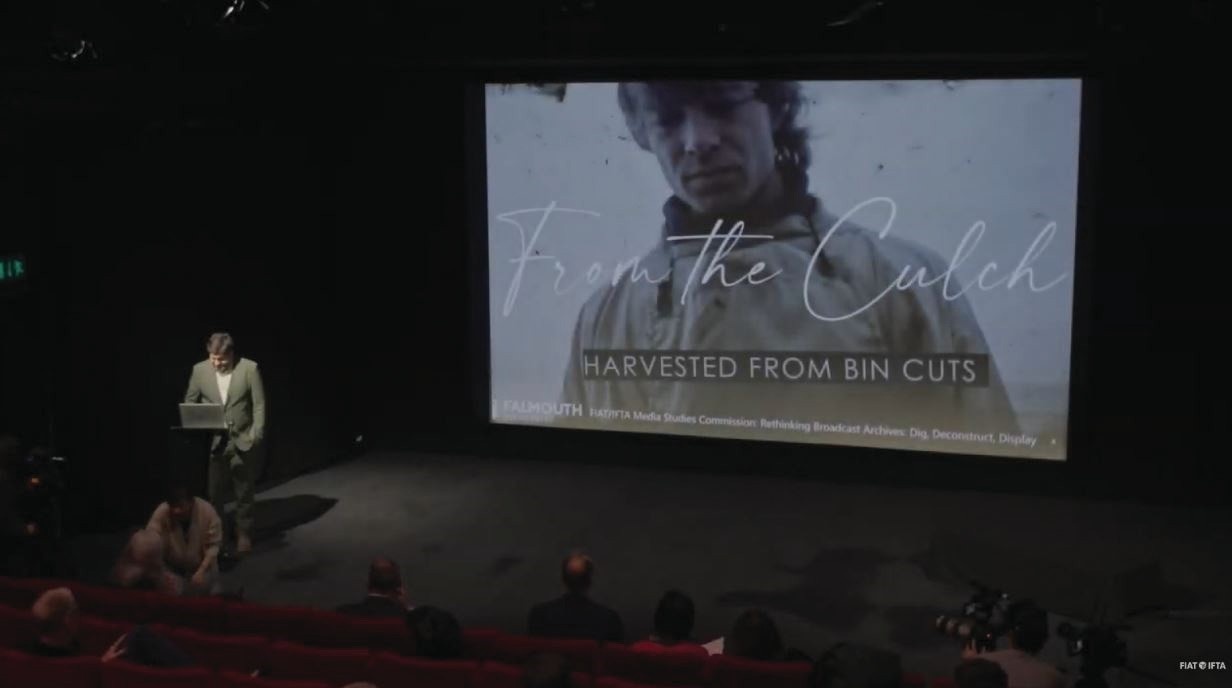
Video 2
Recordings from the 2023 FIAT/IFTA Media Studies Seminar at BFI Southbank. Watch the recordings here.
It was our wish for this special issue to include a varied range of contributing voices, from media scholars, archivists, filmmakers to other media professionals who creatively engage with broadcast archives.
This brief background on how the special issue came about should give readers the context to imagine who sits at our table of dialogue.
3 Co-Creating Broadcast Archives and Television Histories
We have said before that it’s silences where our creative dialogues begin, whether silences in the archives, silences between archivists and historians, and silences that alienate archivists and historians alike from a critical appraisal of the archival record.
Silence in its various forms serves as both an imperative condition for creative dialogues as well as a terrain rife with meaningful possibilities for archival discovery and a revisiting of historical narratives. It is in the gaps left behind by silences that creative dialogues between archivists, historians and other professionals working with broadcast archives gain urgency and become most fertile.
Going back to our previous reference to The Sound of Silence, the association between the lyrics of the song and silences in the archives does not belong to us. In a reworking of his keynote address given at the Annual Conference of The Society of Archivists (UK) in Manchester, England, on 1 September 2010, and later published in the Journal of the Society of Archivists, archivist and scholar Terry Cook cited Paul Simon’s lyrics as a dare to his peers:
Do we archivists dare to disturb those sounds of silence? Do we dare to assign value to the words of those prophets written on subway walls and tenement halls, now more likely inscribed on web sites, blogs, Twitter, Facebook, YouTube, and other digital social media? Do we admit that such cancerous silences in our archives are an indictment of our past appraisal theory and practice? Do we dare assign appraisal value to those voices, these ‘sounds,’ that heretofore no one heard? Should we not preserve these voices and sounds by indeed ‘democratizing archives’ and ‘archiving democracy,’ in through participatory partnerships, with our fellow citizens, determining collaboratively and collectively with them of what society’s enduring archival memories should consist? […] If we can grasp this vision, if we can break the ‘cancer’ of silence, if we can ‘disarm’ ourselves of exclusive power and learn to share it collaboratively, then what we keep in future will be radically different.6
In his keynote speech, Cook made it a point to remind his peers that their work is an ‘act of creation’ and archivists are in fact ‘co-creators of archives as records’.7 To Cook, that means that appraisal of the archival records ought to be ‘the first responsibility’ of the archivist, ‘from which all else flows’: the selection, description, preservation and further dissemination of the archives.8 This also means that appraisal is what ‘starkly determines which documents are destroyed, excluded from archives, their creators forgotten, effaced from memory – all this done by us, the archivists’, Cook wrote.9
Archival appraisal is not solely a technical endeavour, according to Cook. It is a political act that asks archivists to give up the pretense of ‘neutrality’ and ‘objectivity’ in selecting, documenting and preserving records. Inevitably, this makes appraisal an introspective practice by which archivists ought to consider ‘their inner life as human beings, those dimensions of the emotional and psychological forces that can shine intense light, through recorded memory traces, on what makes us human: our loves and hates, our deepest relationships, our spirits and souls’.10 Concomitently, Cook argued, appraisal implicates a moral and ethical stand by which archivists renounce claims of exclusive power over the shaping and preservation of an archive in favour of participatory partnerships with different interest groups and communities, lest the very trust with which their guardianship over an archive is invested becomes undermined. In practice, archival appraisal is essentially collaborative, argued Cook, as archivists ought to develop a holistic, ‘total archive’ perspective as a pre-requisite by which they can ascertain which records – from amidst ‘the public and private, the centre and the regions, the well-articulated voices and the missing voices’ – have potentially the greatest archival value.11
Cook’s assertions highlight the necessary interrelation between archivists’ work and the work of other stakeholders involved in archive-based knowledge production. This phenomenon manifests par excellence in collaborations and partnerships between archivists and historians, scholars, (amateur) collectors of historical records, and any other professionals using archival materials in the production of historical knowledge. Such collaborations and partnerships are in effect political: they establish the archival value - or the lack thereof - of historical documents, which in turn determines what gets preserved or erased. These partnerships are also a moral imperative in so far as they construct archives and archive-based knowledge production as spaces of co-creation. In these spaces, exclusive power over archived histories, as well as dominant voices and mainstream historical narratives are critiqued, dismantled and met with critical appraisals of the politics of preservation and erasure, and a warning of the dangers of sidestepping discussions on ideologies of inclusion and exclusion. It takes self-reflexivity for anyone involved in archival work and archive-based knowledge production to question how the histories we (re)produce - whether through archival preservation, academic writing or archive-based productions - ultimately say something about who we are. ‘We are what we keep; we keep what we are’, warned Terry Cook.12 Additionally, it takes an ethical stand to make this self-reflexivity a visible and active part of our methods and practices of preserving and (re-)using archives, researching and narrating histories.
4 Partnering Up: Arriving at Mutual Understandings
We established that broadcast archives and television histories are acts and spaces of co-creation for which partnerships are deemed imperative based on principles of ethical and moral accountability for the histories we preserve and (re-)produce, and the political implications of our work. Such partnerships may also sound attractive for funding reasons. When it comes to partnerships between archivists and academics, it would however be limiting to think of these solely in terms of access to archives or the acquisition of joint funding, as opposed to approaching these as ‘an area of mutual intellectual interest, viz. the history of archives, archivists, and archival practices’.13
This mutual understanding is not a given, nor self-explanatory as one may be tempted to believe given the preoccupation of both archivists and historians with the historical record and the archived past, and ‘that century-long historian-archivist relationship’.14 In fact, it is primarily these aspects that ‘hinder understanding the realities of archives and forging closer partnerships with each other’.15 Arriving at a mutual understanding is a process for both archivists and historians of working through their different orientations towards the past, learning a different professional language and ultimately finding the fertile grounds for collaboration in ways that can generate those acts of co-creation that are essential for the critical appraisal of broadcast archives and television histories alike.
L. P. Hartley wrote in the opening of his novel The Go-Between ‘[t]he past is a foreign country, they do things differently there’, which David Lowenthal borrowed as the title for his book The Past Is a Foreign Country.16 Paraphrasing them, Terry Cook concluded that ‘the archive(s) is a foreign country’ and between archivists and historians lies a vast foreign language:
The [historian] focuses on issues of power, memory, and identity centered upon the initial inscription of a document (or series of documents). The [archivist] concentrates on the subsequent history of documents over time, including the many interventions by archivists (and others) that transform (and change) that original archive into archives.17
Moreover, while archivists’ core aim is to achieve a condition of permanency for the archival collections under their guardianship, historians are guided by expectations that their work will be ‘superseded again and again’, as it mirrors interpretations of the past and historical narratives that change over time.18
It is here, in this foreign land with its foreign language that the chasms between archivists and academics reside and where silence can either fail to find voice or be broken open and transformed into dialogues of co-creation. For this dialogic transformation to take place, both historians and archivists need to contribute by making visible the act of co-creation and accounting for this in their respective work.
Historians ought to appraise archives as mediations, namely as sites of knowledge that are also mediated through – among others – archivists’ selection and appraisal of historical records, archivists’ practical knowledge, their curatorial practices as dictated by institutional and organisation-specific modi operandi and by the financial, political, legal and other administrative considerations defining their profession and daily work. If historians were to liken the work of archivists to a vacuum-cleaner – as W. Kaye Lamb, former president of the Canadian Historical Association, observed back in the 1960’s that a historian did as a misguided compliment to the thoroughness of archivists’ work – then historians ought to ‘[open] the bag of the vacuum cleaner, [sort] out its contents, and [make] intelligent use of the good things [they] found there’, all the while acknowledging the voice of the archivist in the co-creation of archived pasts and the co-authoring of history.19 In exchange, archivists ought to embrace their role as active co-creators of the past and render their mediations transparent and visible in processes of selection, preservation, documentation and dissemination of archival records.
5 Ethics of Care in Partnering Up
Arriving at a mutual understanding while rendering visible each other’s roles in the co-creation of broadcast archives and television histories, is not only a matter of furthering professional knowledge but also fundamentally an ethical issue. Partnerships ultimately ask of us to make space for the other, be inclusive of their voice and expertise in our knowledge production, respect the limits of their capacity to contribute, recognise that their primary professional objectives may be different from ours and remain attentive to any burdens that the partnership may impose, while striving to minimise these.
For historians and any other academic researchers needing to access broadcast archives, ethical partnerships rooted within reciprocity and principles of mutual consideration ought to be a pre-requisite. The primary objective of most broadcast archive institutions (depending on their legal status and organisational remit) is preservation, followed by the re-use of the archival material in production. More often than not, this leaves research access dependent on the benevolence, good will, personal time and resources of the archivist. Such precarious forms of partnering and collaboration make it imperative to attend to questions about who benefits from research access to archives, in what ways they benefit, and how some of these benefits can be returned to archives.
The most fortunate cases are evidently those where collaborations between archival expertise and academic scholarship help secure joint funding from which both academics and archivists benefit. EUscreen has been exemplary in that sense. Built on long-lasting partnerships between broadcast archives, researchers and technical partners, what started out as a series of funded European projects that secured financial and other forms of support for the work of each partner involved, developed into an online infrastructure which presently offers standardised and contextualised open access to more than 60,000 broadcast archival materials.20 VIEW, the very journal we are writing for today, has been a by-product of the partnerships between broadcast archives and academics that EUscreen has established, nurtured and financed over the years.
A successful acquisition of joint funds unfortunately remains more the exception than the rule. In these circumstances, the question remains how modes and modalities of academic knowledge production – including academic writing – can forge mutual dialogues with broadcast archives in ways conducive to the practices of co-creation we have previously advocated. At its core, this is equally a question about ethics of care, as it is a question about the valorisation of academic scholarship for archival practice.
As part of our own practice of an ethics of care, we have chosen to experiment with different narrative forms. In doing so, we sought to bring to life the creative dialogues we envision and to give voice to some of the silences that permeate broadcast archives and television histories. We hope that the creative approaches and narrative versatility of the contributions in this issue will speak to a wide and diverse readership, one that extends beyond academic audiences to include archivists, media professionals, visual artists, and the general public. In turn, we wish that this wider readership will help bring greater visibility to and potentiate the value of broadcast archives and archival materials featured in this special issue.
As Canadian archivist and historian W. Kaye Lamb noted back in 1963:
Historians, to my mind, seem to be in danger of forgetting that style is the greatest of all preservatives. […] Style is the quality that makes us read on and on, instead of merely looking up the page or two that deals with a detail that happens to be of interest to us at the moment. […]
I feel strongly on this point because, if our historians have important things to say, surely it is equally important that they should say them themselves, in works that will have some chance of being read by the general public as well as by their academic brethren.21
So, then, perhaps when Terry Cook wrote that ‘beyond the politics (and ethics/moral imperative) of appraisal and of archives, there is the poetry of archives, the song of archives’,22 it wouldn’t be far off to go one step further and say that talking about the politics, ethics and the moral imperative of archives is ultimately inseparable from talking about ‘the poetry of archives, the song of archives’. Affect, imagination and expressive narrative forms are integral to understanding the politics of archives and to the appraisal of the archival record. And if that is so, then why wouldn’t we start our editorial reflection here with Simon and Garfunkel’s The Sound of Silence?
It is by means of experimentation with creative forms that we have sought, throughout this special issue, to enable meaningful dialogues with broadcast archives, fully aware that ‘form and style shape substance, content and meaning’.23 We remain attentive to the potential of imaginative forms of narration to tell stories that can attend to archival silences, ‘capable of retrieving what remains dormant’.24 We also believe that such imaginative and creative approaches are suitable instruments for producing historical narratives that work ‘along the archival grain’ attuned to the granular textures of the archives and approaching these as active ‘sites of knowledge’. 25
6 Who We Are and What We Do as the FIAT/IFTA Media Studies Commission
For readers to understand why the subject matter and the conversations in this special issue are important to us, we ought to tell you a bit more about who we are and what we do.
As the Media Studies Commission of the International Federation of Television Archives FIAT/IFTA, our core mission is to foster collaboration and dialogues between archives and academics. We do so by promoting and facilitating academic research into broadcast archives, publishing academic research for a wider readership in order to valorise academic knowledge for archival practice and enhance the value of broadcast archives, and last but not least, by consulting and advising academics on issues of research access to FIAT/IFTA member archives. Our commission has a mixed constituency, consisting of archivists, curators, librarians and academics and as such, we work at the intersection between archival expertise and academic knowledge-production.
Within FIAT/IFTA, the Media Studies Commission (MSC) operates alongside four other commissions: Media Management Commission, Preservation and Migration Commission and the Value, Use and Copyright Commission. Among these, the MSC focuses specifically on collaborations between broadcast archives and academics.
The interest of FIAT/IFTA in academic research and its synergies with the academic community have an established tradition. In 1998, the federation set up its Academic Research Work Group. According to the minutes of the meeting the FIAT/IFTA Executive Council held at the ORF in Vienna on 28 November 1998: ‘[t]he Secretary General informed about a scientific seminar to be held in Stockholm, “Approaches of Television Studies” in October 1999’, which FIAT/IFTA was to co-sponsor (see figure 1). In 2000, the Academic Research Work Group was renamed the Television Studies Work Group, and in 2003 this became the Television Studies Commission. In 2016, the group took on its current name – the Media Studies Commission – as a response to the changing convergent environment of television and television archives.
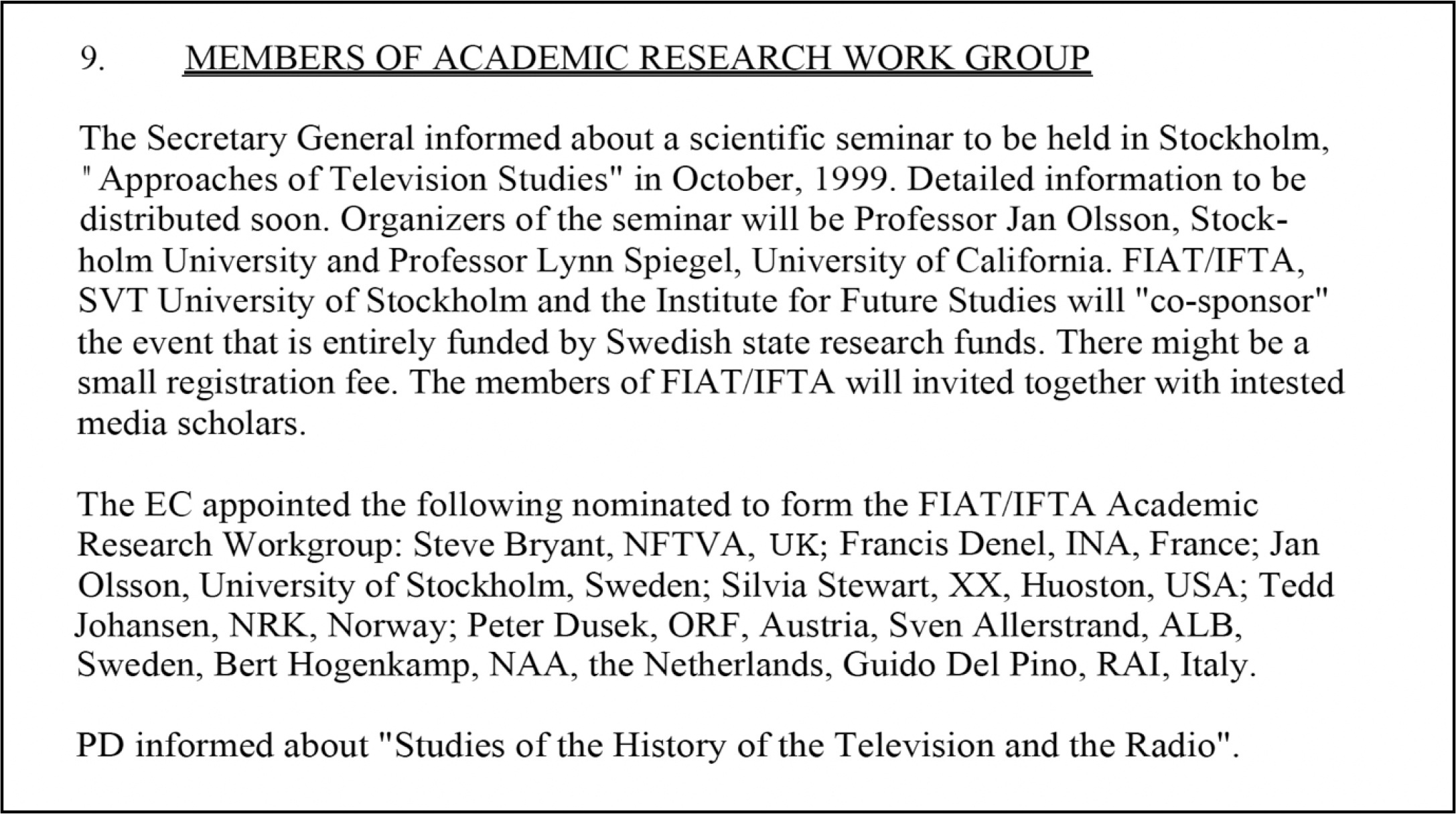
Figure 1
Screenshot from the minutes of the FIAT/IFTA Executive Council meeting that took place in Vienna, Austria, at the ORF on November 28th, 1998. In the meeting, the FIAT/IFTA Academic Research Workgroup was established. Document courtesy of Brecht Declercq and Virginia Bazán-Gil.
The synergies between FIAT/IFTA and the academic community have been mutual. At the 2004 FIAT/IFTA World Conference in Paris, the European Television History Network (ETHN) was launched with the aim to promote and make possible transnational perspectives on the history and culture of television in Europe.26 At the time, the ETHN highlighted ‘the necessity of cooperation between archives and academics on a European scale in order to bridge academic research and archival initiatives’.27 Two years later, at the 2006 FIAT/IFTA World Conference in Madrid, the ETHN initiated conversations about comparative, transnational and European approaches to television history and the role of archives in enabling these approaches. These conversations were to materialise later on in the publication of the edited collection A European Television History.28 At the same conference, Video Active – the predecessor of EUscreen – was also launched as a European project under the leadership of Utrecht University and the Netherlands Institute for Sound and Vision, where universities and FIAT/IFTA members archives across Europe partnered up to provide free online access to broadcast archives for researchers, educators and the general public.
Founded in 1977 as a non-profit organisation, FIAT/IFTA currently has over 250 members worldwide, consisting of broadcast archives, television production companies that maintain archives, and organisations authorised by broadcasters of national governments to manage television archives. Organisations with an academic interest in audiovisual archives – universities or research institutes – can also become FIAT/IFTA associate members.The establishment within FIAT/IFTA of a specialized commission whose mission is to promote and hone cooperation between broadcast archives and academic research is a testimony to the importance the federation and the archiving community place on academic research.
The most visible activities undertaken by the Media Studies Commission are the bi-annual seminars that the commission organises and the yearly Media Studies Grant that supports academics in carrying out small-scale research projects that are presented at the annual FIAT/IFTA World conference.
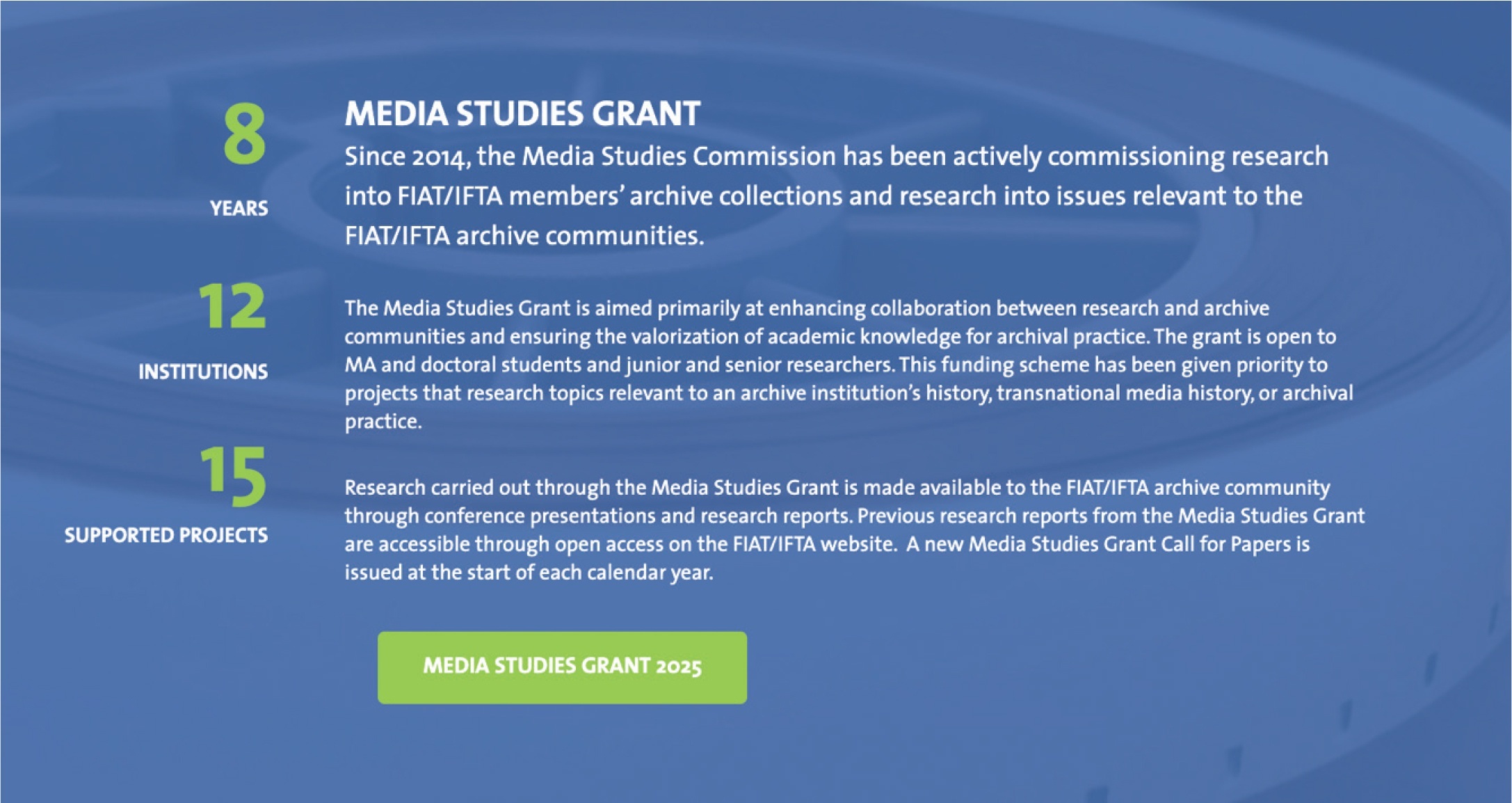
Figure 2
An overview of the FIAT/IFTA Media Studies Grant. More information available on the FIAT/IFTA webpage.
7 Contributions to the Issue
It is now time to turn to the main event of this special issue: the authors and their contributions that give voice to and bring to life creative dialogues with broadcast archives, showcasing the different forms such dialogues can take and the ramifications they have on engaging with archive-based knowledge production in the fields of television history, television cultures and archival practice.
The audiovisual essay More Than a Game: Television Archives in Two Acts by Nevena Popović from Radio Television of Serbia is an artistic act of entering into a conversation with broadcast archives. The conversation is ignited by fragments the author has found in the archives, to which she adds new narrative threads in the form of slam poetry, electronic music, personal remembering and private family footage. The result is a repurposing of archival material for use in public spaces – a music club, on a stage, or in a museum – or in private, intimate spaces of personal remembering and self-reflection. The audiovisual essay features two videos, each with its own original variation on the creative reuse and artistic repurposing of archival material. The video Eye on the Screen combines slam poetry, electronic music and archival footage in an attempt to bring archival material outside spaces of archiving and preservation and closer to the public. The creative treatment of archival material adds rhythm to the viewing experience in ways that reinforce the exhibitionist aesthetics of television, which television scholar John Caldwell once called ‘televisuality’.29 The second video Circus – Monday, Tuesday, Saturday juxtaposes original archival footage with the author’s personal narrative and childhood family footage. The boundaries between the archival material and the author’s personal narrative dissolve and the two threads of narrative become enmeshed. The affective force of narration also serves to dissipate the boundaries between the author’s personal remembering and the viewer’s own acts of remembering and self-reflection. The video is even more powerful as it serves as a paragon for how one artist’s personal engagement with archival material has the potential to branch out onto adjacent spaces of conversation. In that sense, the video could be experienced as a metaphor for historical television. The story that speaks of ‘Monday, Tuesday, Saturday’ underscores the temporality of linear television between the mundanity of everyday life (‘Monday, Tuesday’) and the extraordinary times of eventful television (‘Saturday’ as the much anticipated day when the circus would come to town). The status of television as eventful is also emphasised in the video by ‘the grand spectacle’ of the circus that the archival footage illustrates. There are ‘circuses that come and go’ – one circus in particular that ‘has come and gone’ – and this storyline carries the flavour of a moving allegory for the ephemerality of television, the sense of loss and nostalgia that television archives are imbued with. Through voice-over, the author actively ‘talks back’ to the archival footage of the Adria Circus coming to Sarajevo: ‘my first memories…’, ‘I remember…’, ‘one of my childhood fears was that I would be late, that the world would forget about me…’ This personal act of conversation with television archives echoes into understandings about linear television scheduling – the idea that one had to be on time in front of the television screen – but also about the fundamental function of television archives to preserve, preserve our memories and safeguard our own sense of self so that the world wouldn’t forget about us. The author’s invitation to ‘breathe, breathe, you are not alone’ might as well allude to the collective memory embedded within television archives and to the connective nature of television viewing able to create imagined communities where we can breathe in their familiarity, where we are no longer alone, and no longer need to fear being forgotten.
In a powerful imaginative act inspired by the scarcity of archive materials on their subject, Christopher Wolff and Jesse Blanchard have created a fabulation, crafting a ‘love letter’ to French trans actress Valérie Wilson in “They Lack Imagination... - Valérie Wilson and Trans Life in the Audiovisual Archive. Working mainly from an interview with Wilson from the 1973 programme Chutes on tourne held by Institut national de l’audiovisuel (INA), their piece offers questions and reflections towards a person whose life and career are only available to be interpreted through archival fragments. Inspired by trans-centred approaches to biography, the authors use encounters with archive material to produce their own encounter for readers of this journal, including original art beautifully realised by Jesse Blanchard.
Laura Alhach’s and Rodolfo Palomino Cassiani’s article ‘Angélica la palenquera’: Collective Memory and a Decolonial Reimagining of Archival Futures is an exemplary demonstration of what happens when historians and local communities come together to generate metadata and co-create television archival records. Working in collaboration with the Kuchá Suto Communications Collective in San Basilio de Palenque, Colombia, the authors initiated a collective viewing of a restored episode of Yurupari, a Colombian documentary television series commissioned by the state. This set up the stage for a community-driven cataloguing process. The article dissects the politics of television archiving, cataloguing and metadata. It probes and critiques the epistemic violence residing in archival representations and disrupts centralised, top-down archiving through participatory practices. We learn about Yaneth, Ignacio, Dairis, Juan, Antonia, Nicasio and others, who bring flesh and bone to the argument that archives are ‘a living, breathing space’ imbued with memories and unresolved silences. We are shown how co-creative dialogues and ethics of care operate in practice, how bringing communities together and restoring their voices to archival representations that depict their heritage is a moral imperative and an ethical stand against misrepresentations, exclusion, silences and processes of objectification in television archives. The community-driven process and framework the article models is an example for anyone seeking to confront silences in the archives, restore their polyvocality and make visible the people erased or warped by archival images.
Utilising digitised historical BBC radio news scripts for their academic project Whose Voice? Whose Story? BBC Radio News and the Language of Race in Post-WWII Britain, Eleni Liarou, Sylvie Carlos and Matt Green developed a series of active engagements with material from the scripts for different generations of Black British people from African and Caribbean backgrounds. Reflecting on this work in their article Decolonising the BBC Radio Archive: Challenges, Opportunities, Ethics of Care and Access, Liarou, Carlos and Green discuss how active creative work with archive material in a decolonial context can shift the understanding of the archive itself. In conceiving of podcasts produced with the use of the scripts as an act of ‘counter-archiving’ the authors create a literal dialogue with archival material and their work perfectly dovetails with the theme of this issue as they explain how ‘the act of ‘clapping back’ is about recovering and amplifying diverse experiences and missing voices’.
Luca Barra’s, Diego Cavallotti’s and Emiliano Rossi’s article ATLas Chronicles. Designing and Valorising an Italian Archive of Past Local TV Channels breaks new ground on how research on neglected television histories can lead to safeguarding, preserving and making accessible television heritage that otherwise would be destined to disappear or remain inaccessible. The article discusses ATLas, a project based on the partnership between four Italian universities and aiming to explore the broadcasting history of five privately-owned local television stations which operated in Italy between 1976 and 1990. Piecing together histories of local private television by sifting through different archival sites - corporate, personal and commercial archives, audiovisual archives as well as paper archives - and complementing these with oral history interviews, ATLas is a compelling illustration of what Terry Cook calls ‘a ‘total archive’ framework’.30 Modeling an exemplary conduct for an ethics of care, the project shows how television historians and media scholars can safeguard television heritage that falls under the radar of established, institutional broadcast archives, and how they can generate new archival sources on histories that risk being lost to time. An impressive contribution of the project to television history and archival practice, which the article discusses, is the ATLas database, an online platform hosted by the digital library at the University of Bologna. The database provides access to 400 historical and archival records, including fragments from original local television programmes, which are further contextualised by means of digital exhibitions. This is an important intervention into archival practice, one that shows the value of participatory approaches to safeguarding neglected television heritage.
In Coventry Cathedral: Building for a New Britain John Wyver documents the production of a feature length BBC television documentary charting the planning and construction of a modernist replacement for the medieval cathedral which was almost entirely destroyed in World War II. He reflects on the many types of archive footage included in the film which is woven into a commentary on the reconstruction of post-war Britain. In this way the filmmakers were consciously aiming to achieve William Wees’ conception of audio-visual collage ‘to invest found footage with new meanings’.
The ethics of contemporary filmmakers re-using and appropriating archive footage is a theme embedded in this special issue. As well as investigating examples of Wees’ theory of the creative impact of film collage, several authors consider the implications of Jaimie Baron’s observations31 on how the use of found footage archive material can appear to influence historical memory for the audience. They also reflect on how the work of recent practitioners can be analysed through the lens of archiveology as set out by Catherine Russell.32
Archiveology as a creative practice is used as a framework in the article Lockerbie Pan Am 103 – Tracking the Evolving Re-Use of Archive Broadcast News by Alistair Scott. He examines the ways in which broadcast news footage of the bombing of Pan Am 103 over Lockerbie in 1988 has been re-used over the past 37 years: from the moment of the event as breaking news, to the use of imagery as evidence, documentary history, creative memorials, witness testimony and scripted dramatisations. The use of the often iconic imagery is a way of activating history in the form of traces, that are motivated by the fact that there are still unanswered questions in the series of events. Scott shows how news coverage of key events of historic significance evolves and shapes collective memory and how this can be examined as a type of media archeology with a similar analytical approach.
Michael Marlatt’s article ‘Preserving Atrocity’ Mental Health and the Broadcast Media Archivist addresses the overlooked issue of the mental health and wellbeing of broadcast media archivists who are routinely dealing with graphic and violent audiovisual material. These sounds and images are often not appropriate for broadcast but must be kept and catalogued within the archive. As part of his research Marlatt made a direct call out to European broadcast media archivists to find out about their working environments and whether support was available to them in the course of their work. In the process of uncovering this, his article now gives voice to how individuals are personally affected by this work and prompts readers to consider the ethical conditions of archival work as well as asking us to consider the archivists as individuals just as Cook posited above. Marlatt’s recommendations for support and resources are a call to action and proof that this dialogue must continue.
In Expanding the Small Screen: Exhibiting Northern Irish Television Archive, Rose Baker details how she has curated two screenings and an installation of archival material from the collections of Ulster Television for the Belfast Film Festival, and how these festival events have provoked themes of hauntology. This work is related to Baker’s PhD research on the first decade of Ulster Television, 1959–1969, a poignant period to reflect on in a Northern Irish context as the conflict routinely referred to as ‘the Troubles’ began in the late 1960s. The decades of the conflict permanently altered internal and external perceptions of Northern Ireland enacting what Baker aptly describes as an ’eclipse’ on the broadcasting history of Northern Ireland prior to 1968. Consequently, the creation of a creative dialogue with this broadcast material has resonance and meaning unique to the social context of Northern Ireland, underlining the importance of curatorial knowledge and closeness to audiences in bringing this work to life.
In their article Caring for Past Media from Below: Bottom-up Practices and Networks Supporting Obsolete Broadcast Technologies that discusses two case studies of obsolete broadcast technologies, Sergio Minniti and Roberta Spada analyze grassroots practices of care through the lens of Maintenance and Repair studies and Science and Technology Studies. Interviews with Italian networks on the preservation of U-matic video technology and the reappropriation of CRT displays in retrogaming communities, reveals in a qualitative analysis the interplay between three dimensions of care: the object, network and ecosystem. Minniti and Spada argue that the group of heterogeneous actors outside formal institutions play a crucial role for preservation. The article discusses the dynamics of hands-on and improvised technical interventions, material engagement and knowledge circulation of the specific communities. It concludes that care for the past technologies is not merely preservational, but generative. It produces new social configurations, rearticulates knowledge hierarchies, and forges alternative trajectories for technological persistence.
In Broadcasting from Below: Television Archives, Microhistory, and the Many Voices of 1990s Sicily Vladimir Rosas Salazar analyses the use of archive material in the Italian documentary Un mito antropologico televisivo (2011), and the ways in which the film reveals a mosaic of micro-history of life in the community around Catania. He argues that even fragmentary local television archives can play a vital role in reconstructing a visual story of a place from the perspective of those ordinary citizens who were recorded by the journalists of this local television station. This archive captures significant moments, such as Mafia killings, the housing crisis, and public protests, highlighting the poverty and divisive civil unrest experienced by ordinary members of the public.
In some of the articles in this edition, academics who are creative practitioners reflect on how their recent productions demonstrate different ways to engage with television archives in new and innovative ways. In From the Culch: Lost in the Archives, Found in the Community Paul Mulraney writes about finding and re-using lost and missing television archive footage giving a new life to old bin-cuts to create a film that presents a poetic portrait of a working fishing community on the south-west coast of England. His commentary also considers the ethics of archival documentaries and the re-use of posthumous material in re-shaping the memory of contributors who are no longer alive and able to consent.
8 Before You Read On…
…we want to bring your attention to the fact that recently, VIEW Journal of European Television History and Culture has undertaken a reorganisation of its publication formats. Starting with this issue, the journal features Enthusiasms and Academic Research Articles.
Academic articles are theoretically-informed, have a strong empirical and methodological focus, and can be presented as a written piece or as an audiovisual essay. Enthusiasms are contributions written by academics, archivists, television and media professionals and aimed at a readership that goes beyond the academic community.
The remit of Enthusiasms is to open up knowledge-production on television history and culture to creative and artistic approaches, as well as to experiment with different forms of writing and online presentation. This format leaves room for contributions that diverge from conventional academic articles, and these contributions can be in written or audiovisual form.
This reorganisation couldn’t have been more timely for this special issue. Readers may not be surprised that the majority of the contributions in this issue are presented as Enthusiasms.
Both Academic Research Articles and Enthusiasms undergo a blind double peer-review procedure and make equally relevant contributions to television history and culture. Starting with this issue, the journal also incorporates an open-themed section that presents peer-reviewed articles that are independent from the theme of the special issue.
Signing off this editorial reflection, we invite our readers to engage creatively with the contributions presented in this special issue, and to let that engagement branch out into further spaces of dialogue. We very much welcome further conversations with our readers through the communication channels of the FIAT/IFTA Media Studies Commission.
Notes
[1] Lyrics from the song The Sounds of Silence (1966) written by Paul Simon and performed by Simon and Garfunkel, cited by Terry Cook, “‘We Are What We Keep; We Keep What We Are’: Archival Appraisal Past, Present and Future”, Journal of the Society of Archivists 32, no. 2 (October 2011): 173–189, https://doi.org/10.1080/00379816.2011.619688.
[2] Mikhail M. Bakhtin, Dialogic Imagination:Four Essays, ed. Michael Holquist (Austin:University of Texas Press, 1981), 282.
[3] Diana Taylor, The Archive and the Repertoire: Performing Cultural Memory in the Americas (Durham: Duke University Press, 2003).
[5] Kevin Morrison, Pälvi Rantala, “Introduction. Methods of Knowing”, Historical Research, Creative Writing, and the Past:Methods of Knowing, eds. Kevin Morrison, Pälvi Rantala (New York, NY: Routledge, 2023), 1–12.
[13] Ann Blair and Jennifer Milligan, “Towards a Cultural History of Archives”, Archival Science 7, no. 4 (December 2007), 289.
[14] Terry Cook, “The Archive(s) Is a Foreign Country: Historians, Archivists, and the Changing Archival Landscape”, The American Archivist 74, no. 2 (Fall/Winter 2011): 600–632, 603.
[16] Cited in David Lowenthal, The Past Is a Foreign Country (Cambridge: Cambridge University Press, 1985), xvi.
[18] Lamb, W. Kaye. 1963. “The Archivist and the Historian”, The American Historical Review 68, no. 2 (1963): 385–91, 386, https://doi.org/10.2307/1904538.
[20] See: https://euscreen.eu/about/.
[23] James Goodman, “Editorial: history as creative writing”, Rethinking History 14, no. 1, (February 2010): 1–3, 1, https://doi.org/10.1080/13642520903515587.
[24] Saidiya Hartman, “Venus in Two Acts”, Small Axe: A Caribbean Journal of Criticism 26, no. 3 (2008): 1–14, 2, https://doi.org/10.2979/SAX.2008.-.26.1.
[25] Ann Laura Stoler, Along the Archival Grain: Epistemic Anxieties and Colonial Common Sense (Princeton: Princeton University Press, 2008).
[26] Andreas Fickers, Sonja de Leeuw: “Editorial”, Journal of European Television History and Culture 1, no.1 (Spring 2012): 1–2.
[28] Jonathan Bignell, Andreas Fickers, A European television history (Malden, Mass: Wiley-Blackwell, 2008).
[29] John Thornton Caldwell, Televisuality: Style, Crisis, and Authority in American Television (New Brunswick, N.J.: Rutgers University Press, 1995).