
1 Introduction
Sport has historically been a central genre within television schedules; since the very emergence of the medium, and across all national contexts, it has represented an indispensable content for broadcasters, capable of influencing editorial strategies, reshaping programming flows, and aggregating large and heterogeneous audiences. Generally, the relationship between sport and television has been addressed by focusing on the ways in which the two fields have mutually influenced one another. As Victoria E. Johnson argues, sport and television should be understood as two ‘analogous institutions’1 that have played a crucial and shared role in the construction of national identities throughout the twentieth century. By contrast, considerably less attention has been paid to other television genres through which sport may be represented, such as documentaries and TV series.
Within television studies, academic research has predominantly privileged the dimension of the live events, variously investigating modes of production and representation, the impact of technological developments, and the legal and commercial implications connected to the transformation of sports content from universally accessible public good into premium content available through paid subscription.
Nevertheless, documentary – also in its serialized forms – has experienced remarkable growth in recent years as a means of narrating the world of sport, to the extent that it is now possible to claim that we are witnessing a golden age of the genre.2 Indeed, sports documentaries function as texts to ‘reposition sport from a site of leisurely consumption into an occasion to consider the cultural attitudes and intersecting forces that inform them’.3 The documentary approach lends media texts a sense of immediacy and an interpretive engagement with the real world4 that is clearly distinct from the imagined worlds of other representational forms, such as fictional narratives.5 More specifically, ‘the sports documentary differs from a televised game in that the former seeks to interpret a sport story, to make sense of it, and to explain its significance’;6 in this sense, following Branden Buehler’ words,7 it is an example of ‘quality sports television’, distancing itself from the traditional conventions of televised sport and characterized by explicit references to authorship and promotional strategies closely aligned with seriality, thus situating it within broader discourses on quality television.
2 A Brief History of Sports Documentary in Italian Television
The narration of heroes, events, and feats from national sporting history through the language of documentary is a relatively recent development in the evolution of Italian television. Nonetheless, from the early years of the medium, several programs attempted to narrate sport beyond the contingency of the live event, seeking to capture the profoundly dramaturgical nature of an athlete, a discipline, or a specific competition.
Between 1965 and 1968, the public broadcaster RAI aired Sprint, the first regular television news program entirely devoted to sport. In outlining its features in the weekly magazine Radiocorriere TV, Maurizio Barendson – one of the program’s contributing journalists – identified its aim as that of ‘entering, in a concrete way, into the fundamental issues of sport’,8 while also highlighting a format structured around short reports ‘dedicated to concise illustrations of technical secrets, celebrated memories (…), and the relationship between sport and poetry’,9 in line with the investigative news magazines that Italian public service broadcasters had begun producing in the early 1960s.10

Figure 1
Sprint, the first RAI’s sports weekly magazine (1965) - Rai Teche website.
In subsequent decades, the behind-the-scenes narration of sport and the evocation of memories intensified within news and current affairs programs. Examples include PSB programs such as Dribbling (Raidue, 1973–1982; 1989–) and Domenica Sprint (Raidue, 1976–2013), or La grande boxe (Italia 1/Canale 5, 1982–1990), on private channels, hosted by journalist Rino Tommasi and considered the first – and only – Italian television program dedicated to the explorations of the history and social dimensions of boxing.
These, however, remain sporadic cases in which investigative and documentary approaches are confined within formats still strongly anchored to journalistic logics, functioning as a kind of ancillary embellishment to a narrative flow primarily structured around weekly sporting events. A more substantial shift in the productive, narrative, and aesthetic forms of sport storytelling can be observed only from the late 1990s onward, with Sfide (Raitre, 1998–2016), which recounted iconic moments and achievements in Italian sport through extensive use of archival footage, images, and interviews with protagonists.
A further turning point in the documentary’s narration11 of sport coincides with the arrival of pay television, marked by the launch of Tele+ in 1991 and especially the launch of Sky Italia in 2003.12 Two key figures in this process are Giorgio Porrà and Federico Buffa, journalists who approach sports stories through storytelling techniques and what has been termed ‘TV-theatre’. Through programs such as Lo sciagurato Egidio (Tele+/Sky, 2002–2006) or L’uomo della domenica (Sky Sport, 2017–), as well as Buffa’s specials devoted to World Cups and iconic figures or events in sports history (Storie mondiali, Federico Buffa racconta), pay-tv laid the foundations for an epic and highly dramatized mode of narration, in which the figure of the storyteller – the journalist-narrator of past sporting heroes – still remained central.
3 Italian Sports Documentary in the Streaming Age
The genre of sports documentary has been further transformed by the diffusion of streaming platforms. At a global level, the most recent and significant turning point is undoubtedly represented by The Last Dance (ESPN/Netflix, 2020), the ten-episode docuseries dedicated to the life of NBA star Michael Jordan. This product has effectively rewritten the genre’s production, writing, and distribution logics;13 even though, in previous years, serialized documentaries devoted to sporting phenomena had already found success within streaming catalogues, often focusing not on historical retrospection but on real-time, behind-the-scenes accounts of sporting achievements or failures,14 The Last Dance represents a crucial milestone in the genre: it is based on around 500 hours of previously unused footage, material that was later collected and ‘worked on’ by ESPN. The U.S. cable network had initially scheduled the documentary to air in June 2020, in conjunction with the NBA Finals; however, due to the outbreak of the Covid-19 pandemic, the release was brought forward to April, with a simultaneous global launch on Netflix through a weekly release, a distribution model closer to that of a linear channel than to the typical characteristics of on-demand platforms, also favored by the unprecedented format for this type of content (ten episodes of over an hour each), with a narrative structure well suited to this kind of distribution strategy.
From The Last Dance onward, and especially in the post-pandemic period, the presence of sports documentaries – both one-off and serialized formats – also on Italian television channels and streaming platforms has grown steadily,15 establishing the genre as one capable of circulating in the new ‘streamcasting era’,16 that is both in linear schedules and through on-demand consumption. These products span a wide range of disciplines and can be grouped into different categories, also according to their intended audiences (domestic or international).
A first group includes titles dedicated to star athletes, recounting their careers, expectations, and private lives, such as Federica Pellegrini Underwater (Amazon Prime Video, 2022), Federico Chiesa – Back on Track (Amazon Prime Video, 2023), and Se la tigre avesse un altro nome – La storia di Federica Brignone (Discovery+, 2025). A second group focuses on national sporting heroes of the past and their epic achievements, including Due con – La storia dei fratelli Abbagnale (RaiPlay, 2022), Alberto Tomba, vincere in salita (Raitre, 2023), and Dino Meneghin. Storia di una leggenda (Raitre, 2023).
Another strand addresses the darker sides of sport, explored through documentaries focusing on corruption, doping, and violence (Il caso Alex Schwazer, Netflix, 2023; Heysel 1985, Raidue, 2025; I demoni dello sport, Dmax, 2025). A fourth area includes documentaries and docu-series that anticipate or celebrate major international events such as the Olympic Games or football World Cups (Mondiali 2006 – Destino Azzurro, Sky Documentaries, 2022; Stelle Paralimpiche, Raitre, 2024; Breaking – Dalla strada alle Olimpiadi, RaiPlay, 2025). Finally, a further group comprises products centered on ‘collective heroes’, narrating achievements realized by teams in which multiple individual stories intersect. Significant recent examples include Una squadra (Sky Sport, 2022), a four-part docu-series on Italy’s victory in the 1976 tennis Davis Cup; La bella stagione (Raidue, 2023), recounting Sampdoria’s Serie A title in the 1990–91 season and broadcast on 7 January 2023, the day after the death of Gianluca Vialli, one of the main players of that team. Two titles of this group will be analysed in greater detail in the following section, combining textual analysis and in-depth interviews with professionals involved in production process: Scugnizzi per sempre17 (Raidue/RaiPlay, 2023) and Generazione di fenomeni – La miglior squadra di pallavolo del XX secolo18 (Raidue/RaiPlay, 2024). The two cases are relevant as they share some key aspects: the use of memory since they both narrate sports achievements and heroes located in the early Nineties, in an era of deep economic and cultural transformations of the two disciplines represented, basketball and volleyball; besides, despite a different format (docu-series on one hand and one-shot docu on the other), they share a similar dramaturgical structure and are significant examples of the role of PSB in the recovery of histories rooted in national and local identity and promote international events and tournaments with ancillary content.
4 Scugnizzi per sempre and Generazione di fenomeni: two portraits of Nineties through the ‘team’ rhetoric.
The two case studies, Scugnizzi per sempre and Generazione di fenomeni, represent attempts by the public broadcaster to engage with key features and trends of contemporary sports documentary in terms of language, narrative structure, and distribution strategies, placing the team at the centre of the narrative as a ‘choral’ protagonist.
Scugnizzi per sempre, produced by Tramp Ltd from an idea by Attilio De Razza and director Gianni Costantini, and written by Vincenzo Cascone and Sante Roperto, consists of six fifty-minute episodes dedicated to the epic story of Juvecaserta, an Italian basketball team from the city of Caserta, in Campania region, that won its first and only championship in the 1990-91 season. The narrative is not confined to the winning season alone; rather, it reconstructs the club’s entire trajectory beginning in the preceding years, from the arrival of a new management to promotion to the main championship, and ultimately to the recruitment of some of the most prominent players and coaches of the period. Thus, Scugnizzi per sempre presents a dramaturgic approach in which a ‘fascinating narrative structure’ includes the ‘aesthetics choices, the physical and psychological characteristics of the protagonists and the other characters, the linguistic peculiarities, and the settings’19 The docu-series was aired on Raidue over three evenings in late August 2023, while all six episodes were simultaneously released on RaiPlay on the first evening.
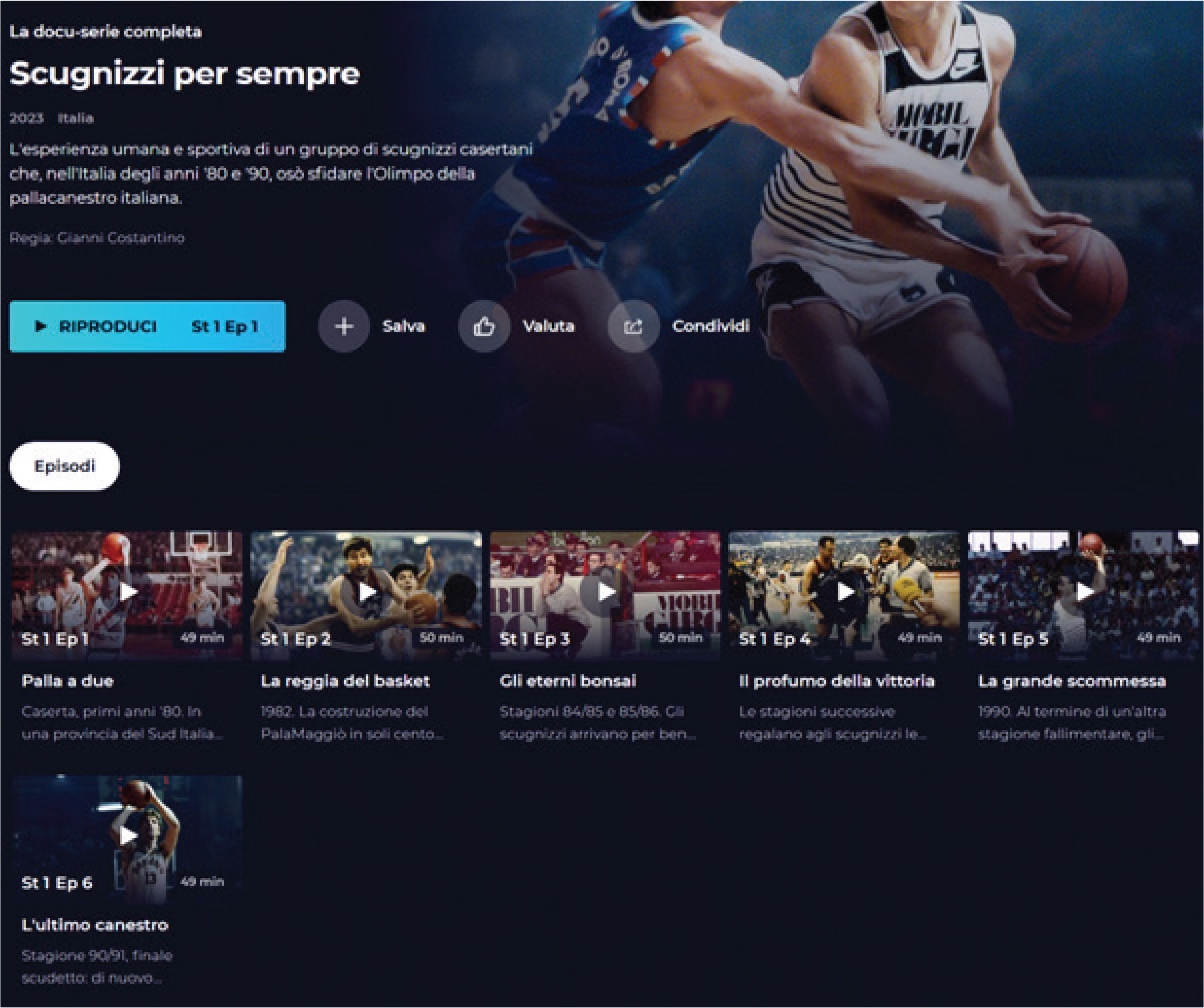
Figure 2
Scugnizzi per sempre on RaiPlay platform.
Generazione di fenomeni is a one-off documentary conceived by Andrea Zorzi, former member of the Italian national volleyball team, produced by Dinamo, and written and directed by Filippo Nicosia and Paolo Borraccetti.20 The documentary was therefore initiated by a former athlete directly implicated in the national team’s successes, who imprinted the narrative with a predominantly sporting focus by involving nearly all former teammates and coach Julio Velasco. The product chronicles the trajectory of the most successful national volleyball team of the twentieth century, as indicated in the subtitle, culminating in eighteen titles won between 1989 and 1998. It was broadcast in prime time on Raidue on Tuesday 23 July 2024 and immediately made available on RaiPlay. Despite differences in style and format, the two productions are complementary and share several elements that may be considered paradigmatic of an ‘Italian way’ to sports documentary, as well as contributing to an examination of societal and sports-industry transformations in the critical phase of the Nineties.
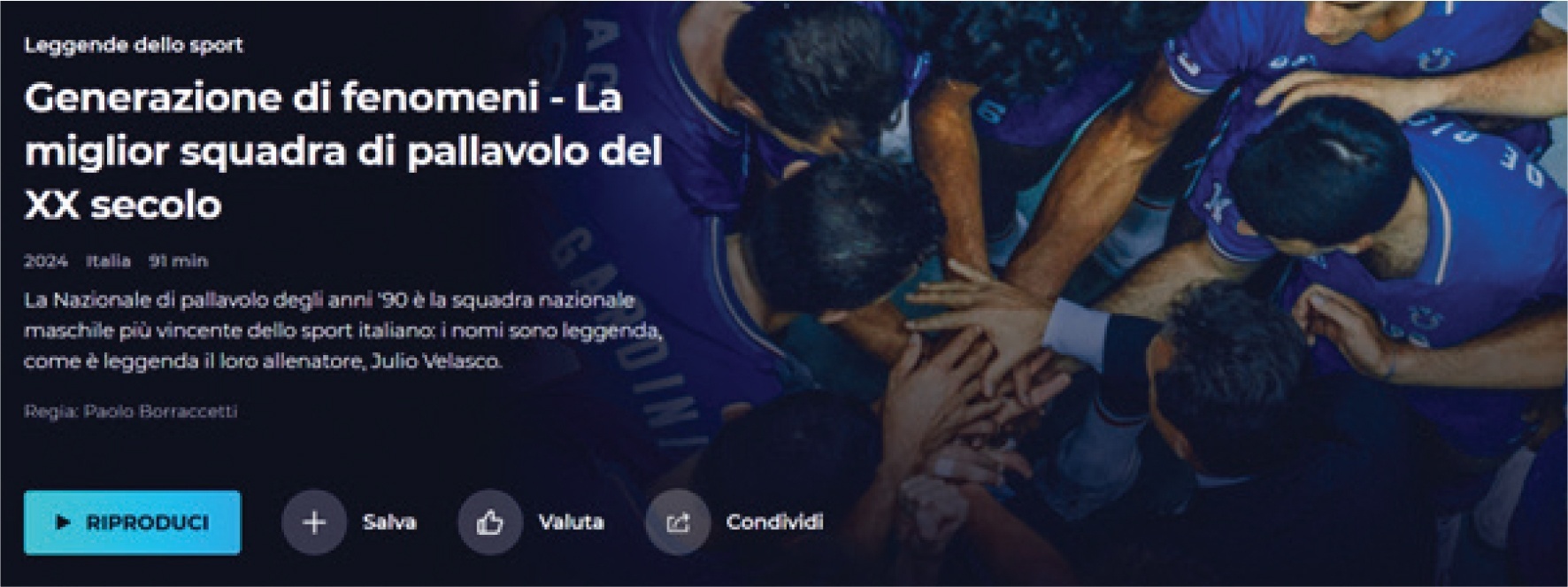
Figure 3
Generazione di fenomeni on RaiPlay platform.
4.1 The Last Dance Model
A first aspect shared by the two products concerns authorial inspiration. Both of them developed in the wake of the genre’s transformation brought about by The Last Dance, which also became a key reference point in promotional rhetoric, despite vastly different production conditions.
That was the spark that lit everything. We had a much smaller budget, we didn’t have that epic scope, those characters, or simply that archive. But probably, if The Last Dance hadn’t existed, we wouldn’t have thought of embarking on this project; what we ended up with was more of a comedy-like story.21
We had The Last Dance as a reference; the idea was to develop two or three characters per episode, but then we had to opt for a different narrative structure.22
If The Last Dance was the main reference for the creation of the two documentaries, they exhibit specific features: for instance, Scugnizzi per sempre, in addition to archival footage and testimonial interviews, also incorporates fictional segments featuring two actors portraying Nando Gentile and Enzo Esposito – two players born and raised in Caserta who embody the protagonists of that epic – thus bringing the content, in certain sections, closer to a sort of docudrama.
4.2 Programming and Releasing Strategies
Choices regarding scheduling and distribution strategies reveal deep tensions between the editorial and commercial logics governing broadcasters. In both cases, the initial intention was to link broadcast and release to major international sporting events. For Scugnizzi per sempre, for instance, RAI initially planned to air the docuseries alongside matches from the Basketball World Championships taking place during the same weeks. However, because the games were held in the Philippines and thus broadcast in the morning Italian time, RAI altered its strategy and opted for distribution across three consecutive evenings.
Generazione di fenomeni was initially conceived for the pay-TV channel Sky, following the success of the four-part docuseries Una squadra. The subsequent collaboration with Rai Documentari23 and the impending start of the Paris 2024 Olympic Games – of which RAI held free-to-air broadcasting rights for a significant number of events – led the production to rethink the format and engage in a ‘race against time’ to complete the documentary in time for its broadcast on 23 July.
4.3 The Role of Archives
Both productions follow the classical archetype of contemporary documentaries, combining interviews with protagonists, television archives, and a decisive role for editing. Archives, in particular, perform a fundamental connective function within the narrative, and their use depended on the availability of footage from national and local broadcasters, which fully reflects the era and prevailing modes of televisual sports representation.
The crucial turning point was finding the archive of a local TV station in Campania that aired Juvecaserta’s matches, materials that RAI didn’t have because it only aired highlights. We discovered the rights were free because the station had gone bankrupt.24
RAI had more institutional footage, Tele+ offered a warmer, more immersive narrative. And we shouldn’t forget the role of private broadcasters such as Mediaset, TV Koper, and TMC, which at the time was part of Brazil’s Rede Globo; for instance, all the images of the 1990 World Cup victory in Brazil come from there. More generally, it was interesting to observe how sports filming changed: between 1989, the 1996 Olympics, and the 1998 World Cup, the differences are enormous—many more cameras and much higher image quality.25
Private archives also played a key role in the conception and writing of both productions, granting access to previously unseen footage of teams and behind-the-scenes moments in the protagonists’ lives. One of the narrative hooks of Generazione di fenomeni, for example, is the private archive of setter Paolo Tofoli, who filmed many everyday moments during national team trips in the late 1980s and early 1990s. Recovering this material allowed the documentary to convey a sense of intimacy and authenticity, depicting informal situations such as dinners, walks, and leisure time in hotel rooms. Similarly, in Scugnizzi per sempre, private archives – ranging from wedding videos and family photographs to personal collections held by fans – become central narrative resources.
The way Tofoli uses the camera is one of the most interesting aspects of the documentary; he bought it and used it in Japan, which at the time was technologically advanced. Although the footage is somewhat low-quality, it really conveys the sense of the team—they look like a group of kids on a school trip.26
You have to remain open to what the archives might reveal; at the very last moment, just before closing, we happened to find a fan who had recorded Gentile’s debut match on VHS, broadcast by a local TV network.27
4.4 Ensemble Dramaturgy
Another crucial element is the dramaturgical construction of sporting achievement and the device of ‘chorality’, which broadens the focus beyond individual performance by shaping characters as distinct ‘human types’. Inspired by The Last Dance, both productions envisaged a chapter-based structure drawing on the classical ‘hero’s journey’.28 Differences in format, however, resulted in distinct dramaturgical approaches, with Scugnizzi per sempre able to expand character development and devote greater attention to places, environments, and objects that articulate a specific socio-historical context. Scugnizzi per sempre is deeply rooted in the representation of a territory, offering a narrative with strong local features, including linguistic and cultural references.
Once we realized we were making six episodes, we linked each one chronologically to a specific phase in the team’s life, despite the difficulty of managing a choral narrative with many storylines: a classic pair of heroes, Nando Gentile and Enzino Esposito, but also many other characters: the president, the coaches, the audience. Managing collective dimension was the hardest part.29
The challenge was keeping five major tournaments together within an hour and a half; we had to sacrifice a few elements, especially concerning coach Velasco’s personal history.30
The idea of ensemble dramaturgy is also evident in Generazione di fenomeni through the choice of its opening sequence. Initially, a more explicitly ‘authorial’ opening had been envisaged, drawing on footage from the players’ private archives interspersed with captions designed to reconstruct the context of the national team’s epic narrative. At a later stage, however, the production opted for a more classical opening ‘conceived as a teaser’,31 beginning with images from the 1996 Olympic final – a match the team lost in the decisive final set – and then moving backwards in time to retrace its successes. The narrative of the Italian national volleyball team’s achievements thus opens with a defeat.
Video 1
Generazione di fenomeni: alternative opening sequence.
Video 2
Generazione di fenomeni: real opening sequence.32
5 Conclusion
This article has tried to examine the transformations of Italian television sports documentary in an age of growing contamination between linear TV and streaming platforms which contributes to reshape production and writing strategies of audiovisual content. In this sense, national lens helps to focus specific approaches to the genre in terms of rhetoric adopted, themes, heroes and values, since sport is a global language, but it’s still tied to national cultures and traditions.
The narration of exploits, achievements, and everyday aspects of sporting heroes’ lives constitutes a key strength within the catalogues of these players and has also become a resource through which traditional broadcasters can update their expressive languages. The case studies of Generazione di fenomeni and Scugnizzi per sempre, analysed here, exemplify renewed approaches to the production of sports documentaries. First, at the creative and conceptual level, both projects are closely linked to initiatives driven by individuals who experienced those stories either directly or indirectly (former athlete Andrea Zorzi on the one hand, and director Gianni Costantini – who regularly attended the Caserta arena as a fan – on the other). This results in a profound sense of intimacy that permeates the narrative.
From the perspective of writing and storytelling, the use of clips, newspapers, and match footage activates a form of collective memory that extends beyond sporting events to encompass society and a historical period. This is a key point for a national public service broadcaster; in fact, both the products analysed show how in an era of competition between national traditional players and global streaming platforms, the issue of collective memory, spread out above all with the genre of documentary, ‘represents a fundamental trait of a modern project of public service’;33 we could state that the strength of public television, in this sense, lies in its past and tradition and the role and the use of archives are strategic tools for a deep comprehension of a sport national culture.
Generazione di fenomeni and Scugnizzi per sempre, and more broadly contemporary Italian sports documentaries, embody the dynamics of the ‘mediatisation of sport’,34 that is, the transformation of sport, through media narratives, into an economic, cultural, and social phenomenon capable of producing myths, characters, and universal values.
Notes
[2] Barney Ronay, “Dramatic Victory: Are We Entering a Golden Age for the Sports Documentary?”, The Guardian, November 20, 2017.
[3] Samantha N. Sheppard and Travis Vogan, “Introduction”, in Sporting Realities. Critical Readings of the Sports Documentary, eds. S. N. Sheppard and T. Vogan (Lincoln: University of Nebraska Press, 2020), 1.
[4] John Corner, “‘Documentary Studies’: Dimensions of Transition and Continuity”, in Rethinking Documentary: New Perspectives, New Practices, eds. Thomas Austin and Wilma De Jong (Maidenhead: McGraw Hill, 2008), 13–28.
[5] Scripted series on sports issues show a lack of systematic mapping. Recently, I have tried to fill this gap with the book Sport e serialità televisiva. Storie, generi, culture nazionali (Brescia: Morcelliana Scholé, 2025).
[6] Zachary Ingle, “Introduction”, in Identity and Myth in Sports Documentaries. Critical Essays, eds. Z. Ingle and D. M. Sutera (Lanham: Scarecrow Press 2013), xi (italics in the text).
[7] Branden Buehler, “The Documentary as ‘Quality’ Sports Television”, in Sporting Realities, eds. S. N. Sheppard and T. Vogan (Lincoln: University of Nebraska Press, 2020), 11–33.
[8] Maurizio Barendson, “Vicende dello sport”, Radiocorriere TV, XLII, No. 8, 21st-27th February 1965: 16.
[10] Sprint was explicitly modelled on TV7, a current affairs program produced by RAI that debuted in 1963 and is still on air today. Sprint adopted the language of the so-called inchiesta, the investigative report which was one of the main genres of early television in Italy. Interestingly, the first piece of the first episode, titled “Poveri ma campioni” (Poor, but champions) and devoted to the Sardinian boxer Fernando Atzori and the difficulties of practising sport in Sardinia region, is by Ugo Zatterin, who had previously produced several socially-oriented inchieste for Public Service Broadcasting in the precedent years.
[11] For an overview on the role of documentary in Italian cinema and television, see Marco Bertozzi, Storia del documentario Italiano. Immagini e culture dell’altro cinema (Venezia: Marsilio 2008).
[12] Tele+ was the first pay-TV broadcaster in Italy; its subsequent merger with another pay-tv channel (Stream) gave rise to Sky Italia in 2003.
[13] Aldo Grasso and Paolo Carelli, “I media e l’epica sportiva dopo The Last Dance”, Vita e Pensiero 104, no. 1 (2021): 134–140.
[14] Notable examples in this regard include All or Nothing, Sunderland ’Til I Die, and F1: Drive to Survive, to name a few.
[15] See the Television Yearbooks annually edited by Massimo Scaglioni (www.annuariodellatv.it).
[16] Massimo Scaglioni and Anna Sfardini (eds), La televisione. Dal broadcasting allo streamcasting (Roma: Carocci 2025).
[17] Scugnizzi forever; according to Italian dictionary Treccani, “scugnizzo” (in Neapolitan dialect) refers to a “cunning and intelligent boy, lively, willing to make do with any espedient”.
[18] Generation of Phenomena. The Best Volleyball Team of the XX Century. Hereafter, it will be referred to simply as Generazione di fenomeni for the sake of brevity.
[19] Mario Tirino, “Against All Common Sense. The Mediatized Legend of Juve Caserta between Basketball Epics, Aged Sports Celebrities, and Collective Memory in the Docu-Series Scugnizzi per sempre”, Funes. Journal of Narratives and Social Sciences 7, no. I/II (2024): 63.
[20] More specifically, the documentary has been written by both of them, while it has been directed by Paolo Borraccetti alone.
[28] Christopher Vogler, The Writer’s Journey. Mythic Structures for Storytellers and Screenwriters (Studio City: Michael Wiese Productions, 1992).